 ASVAB Camp
Learning Outcomes and Exam Fit
This lesson trains you to evaluate functions written in f(x) notation, find the input that produces a given output, and decide whether a relation is a function. You will read domain and range from tables and graphs, build rules for arithmetic and geometric sequences, extend patterns, and handle composite and piecewise functions. These skills belong to ASVAB Mathematics Knowledge algebra, although no single question type is guaranteed.
Function as Input–Output Rule
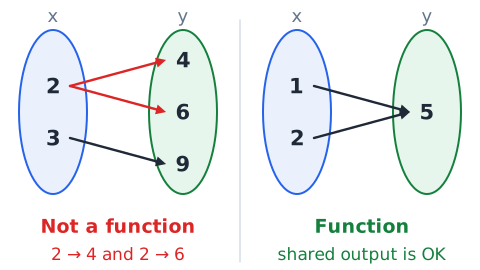
A function is a rule that assigns each input exactly one output. Think of a vending machine: pressing button B4 should always drop the same snack. If one button could give two different snacks, the machine would not behave like a function. Inputs are usually called x, outputs y or f(x). Different inputs may share an output, but one input may never have two.
Reading Function Notation
The notation is read as f of x and means the output of f at input x; it is not multiplication. For
the value means replace x by 2:
Evaluating at Fractions and Decimals
Fractions and decimals substitute the same way; just keep the arithmetic tidy. If
Put parentheses around every substituted value, especially negatives.
Finding Inputs from an Output
To find which input gives a certain output, set the rule equal to that output and solve. If
and the output is 22, then
so 5x = 25 and x = 5. Check:
Function or Not a Function?
A relation fails to be a function when one input is paired with two different outputs. The set {(2, 4), (3, 9), (2, 6)} is not a function because 2 maps to both 4 and 6. An identical pair listed twice, or several inputs sharing one output, as in {(1, 5), (2, 5)}, is still a function.
Domain and Range
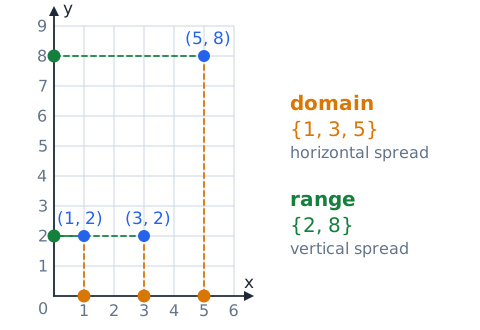
The domain is the set of all allowed inputs, and the range is the set of outputs actually produced. For the pairs (1, 2), (3, 2) and (5, 8), the domain is {1, 3, 5} and the range is {2, 8}. On a graph, the domain is the horizontal spread and the range is the vertical spread.
Domain Restrictions
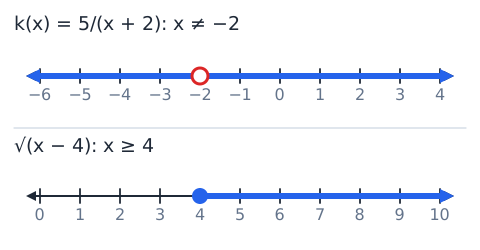
Some inputs are banned because they cause impossible arithmetic. A denominator cannot be zero, so
excludes
In real numbers, a square root needs a nonnegative inside, so requires
Tables, Ordered Pairs, and Graphs
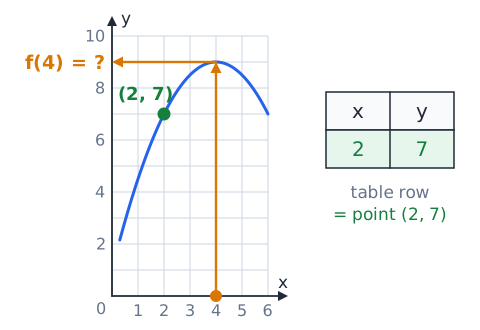
The same function can appear as a rule, a table, a list of ordered pairs, or a graph. A table row with x = 2 and y = 7 is the ordered pair (2, 7) and one plotted point. To read f(4) from a graph, find 4 on the horizontal axis, move straight up or down to the curve, and read its height.
The Vertical Line Test
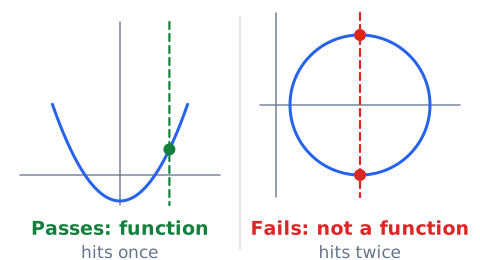
To test whether a graph shows a function, imagine sliding a vertical line across it. If any vertical line touches the graph more than once, some input has two outputs, so the graph is not a function. A parabola opening upward passes; a circle fails, since a vertical line through its middle hits it twice.
Linear Functions and Constant Change
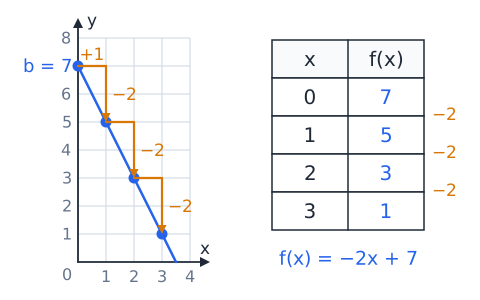
A linear function has the form f(x) = mx + b. Each time x increases by 1, the output changes by the same amount m, the slope. The constant b is the output when x = 0. For
the outputs for x = 0, 1, 2, 3 are 7, 5, 3, 1, dropping by 2 each step.
Rate of Change from a Table
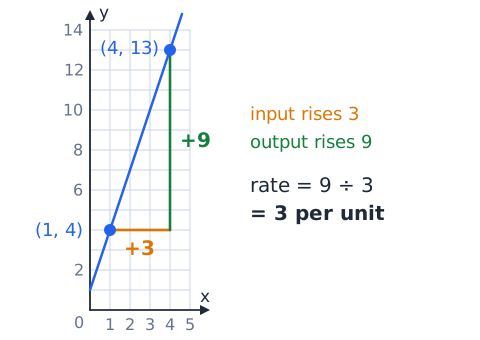
Rate of change compares the change in output with the change in input:
From (1, 4) to (4, 13), the output rises 9 while the input rises 3, so the rate is 3 per unit.
Function Rules in Word Contexts
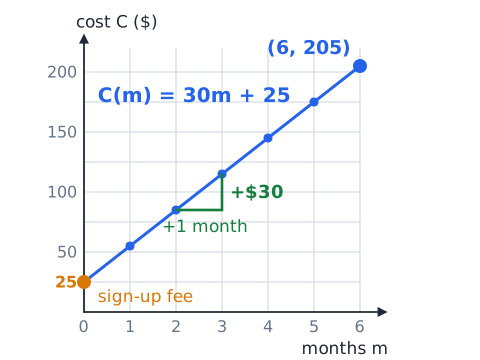
Word problems often hide a function. A gym charges a 25-dollar sign-up fee plus 30 dollars per month, so the cost is
Here 30 is the rate per month and 25 is the starting value. After 6 months,
Arithmetic Sequences
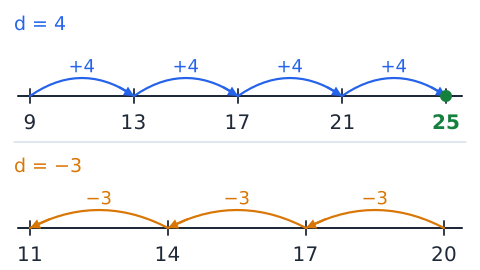
An arithmetic sequence adds the same number, the common difference d, to get each new term. In 9, 13, 17, 21, ..., d = 4, so the next term is 25. A negative d makes the terms fall, as in 20, 17, 14, 11, where
The nth-Term Formula for Arithmetic Sequences
The nth term is
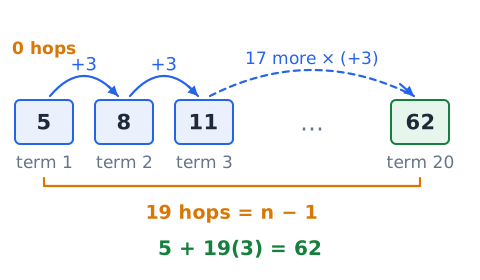
For 5, 8, 11, ..., the 20th term is
Use n - 1, not n, because reaching the first term takes no steps.
Working Backward in Arithmetic Sequences
You can run the formula backward. A sequence starts at 3 with d = 5. Which term is 48? Solve
so n = 10.
Sum of an Arithmetic Sequence
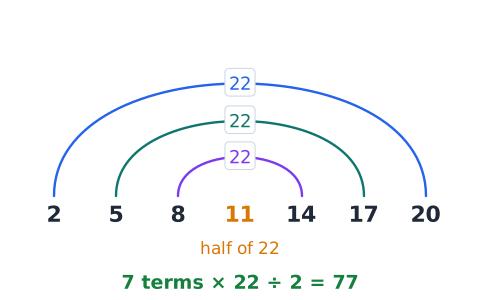
To add the first n terms, average the first and last terms and multiply by n:
For 2, 5, 8, ..., 20, which has seven terms, the sum is
Geometric Sequences
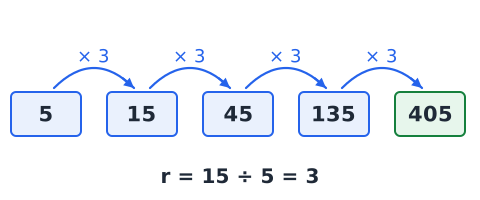
A geometric sequence multiplies by the same number, the common ratio r, each time. Find r by dividing a term by the one before it. In 5, 15, 45, 135, ...,
so the next term is 405. When r is between 0 and 1, the terms shrink.
The nth-Term Formula for Geometric Sequences
The nth term of a geometric sequence is
For 4, 8, 16, ..., r = 2, so the 7th term is
Growth and Decay Patterns
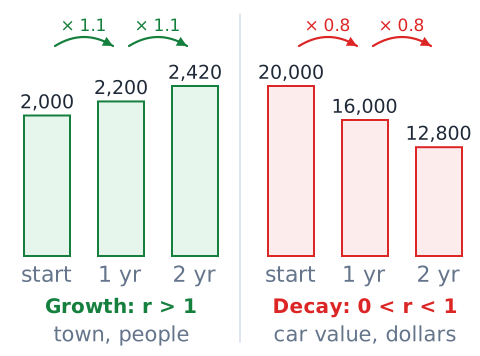
Repeated multiplication models growth and decay. A town of 2,000 people growing 10% per year multiplies by 1.1 each year: 2,200, then 2,420. A car worth 20,000 dollars that loses 20% per year keeps 80% each time: 16,000, then 12,800 dollars. Growth uses r greater than 1; decay uses r between 0 and 1.
Recognizing Quadratic-Like Patterns
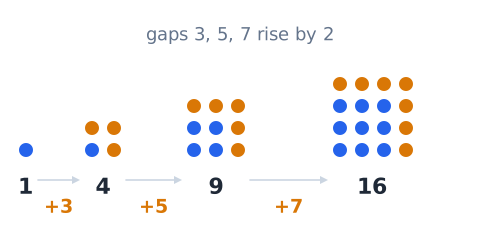
If the gaps between terms are not constant but the gaps of those gaps are, the pattern is quadratic. In 1, 4, 9, 16, ..., the gaps 3, 5, 7 rise by 2, and the terms are . A pattern such as 3, 6, 11, 18, ... follows , so the next term is 27.
Recursive Definitions
A recursive rule gives a starting term and says how to get each term from the one before. With
the terms are 3, then 7, then 19, then 55. You must build the terms one at a time, in order.
Alternating and Multi-Rule Patterns
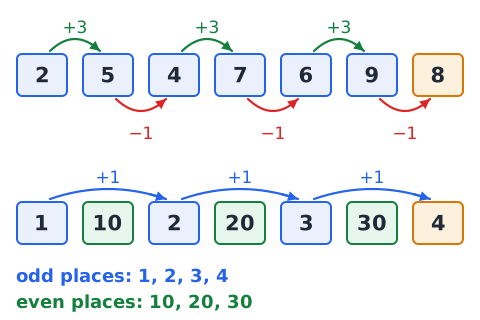
Some patterns switch between two rules or weave two sequences together. In 2, 5, 4, 7, 6, 9, ..., the steps alternate between adding 3 and subtracting 1, so the next term is 8. In 1, 10, 2, 20, 3, 30, ..., odd positions count 1, 2, 3 while even positions count by tens, so the next term is 4.
Composition of Functions
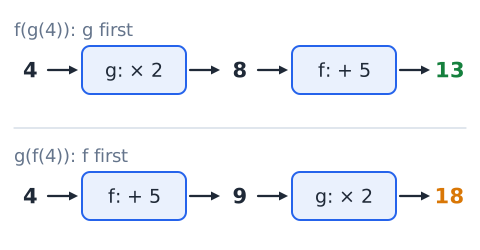
means apply g first, then feed that result into f. With
and g(x) = 2x, g(4) = 8 and f(8) = 13. Order matters:
Piecewise Rules
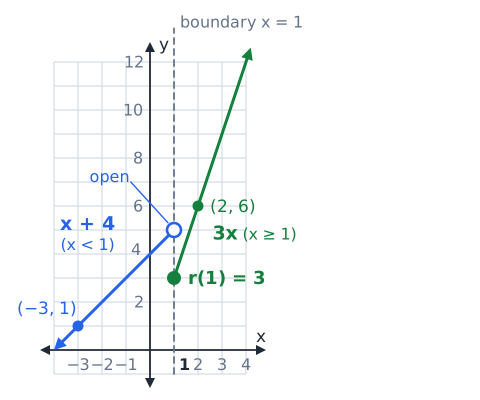
A piecewise function uses different rules on different parts of the domain. Suppose
when
when
and r(2) = 6. At the boundary x = 1, the second rule applies, so r(1) = 3.
Sequence Word Problems
Many word problems are sequences in disguise. A runner trains 2 miles the first week and adds half a mile each week, so the weekly distance is arithmetic with first term 2 and d = 0.5. Week 9 is
Doubling, halving, or a fixed percent change signals a geometric pattern instead.
Tables with Unequal Input Steps
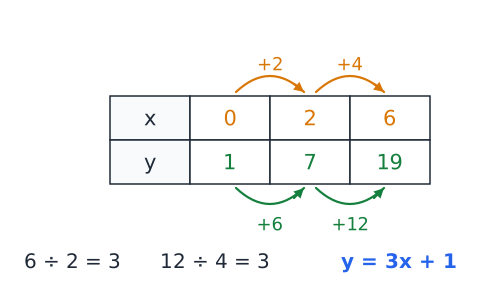
When the inputs in a table do not rise by 1, divide each output change by its input change. If x goes 0, 2, 6 and y goes 1, 7, 19, the changes are 6 over 2 and 12 over 4, both 3, so
Fast No-Calculator Checks
Check answer choices instead of recomputing from scratch. If
and a choice claims x = 6 gives an output of 19, compute 16 and reject it; x = 7 gives 19. For sequences, confirm the pattern with two consecutive gaps or ratios before extending it. Watch signs: an even power of a negative number is positive.
Worked Example 1 — Function Evaluation
Problem: Find for
Step 1: Replace every x with (−3). Always use parentheses around a negative input.
Step 2: Do the exponent first. (−3)² =
because a negative times a negative is positive.
Step 3: Multiply:
Subtracting a negative is the same as adding, so −(−3) = +3.
Step 4: Add from left to right:
Answer: 25.
Check: A common mistake is writing −3² = −9, which would give
Squaring a negative number always gives a positive result, so the term 2x² must be positive: 18. Then
is right.
Worked Example 2 — Infer a Linear Rule
Problem: A table gives the points (1, 2), (3, 8) and (5, 14). Find the linear rule y = mx + b.
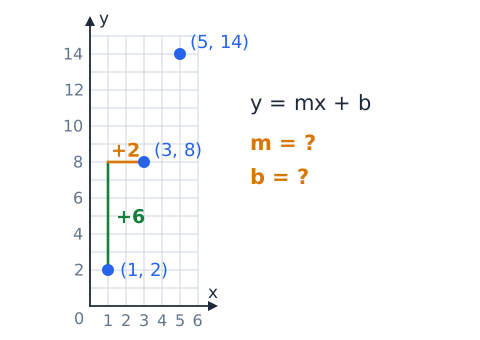
Step 1: Find the slope. From (1, 2) to (3, 8), x goes up
and y goes up
Step 2: Find b. Put the slope and the point (1, 2) into y = mx + b.
Step 3: Subtract 3 from both sides:
Answer:
Check: Test all three points. x = 1:
x = 3:
x = 5:
All three match the table.
Worked Example 3 — Arithmetic Term and Sum
Problem: For the sequence 6, 10, 14, ..., find the 15th term and the sum of the first 15 terms.
Step 1: Find the common difference:
so d = 4. The first term is 6.
Step 2: To reach the 15th term, start at the 1st term and add d fourteen times (
).
Multiply first:
Step 3: For the sum, use: number of terms × (first + last) ÷ 2. First add
Step 4: Halve 68 first to keep the numbers small:
Answer: The 15th term is 62, and the sum is 510.
Check: The average term is
and 15 terms at an average of 34 make 510.
Worked Example 4 — Geometric Growth
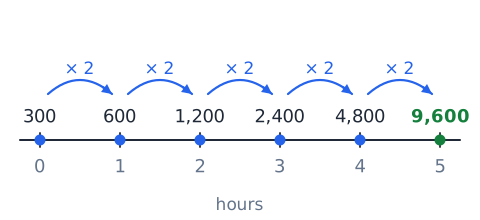
Problem: A culture of 300 bacteria doubles every hour. How many are there after 5 hours?
Step 1: Doubling means multiplying by 2 each hour. After 5 hours you multiply by 2 five times, which is .
Step 2: Work out the power:
Step 3: Multiply:
Answer: 9,600 bacteria.
Check: Track it hour by hour: 300, then 600, 1,200, 2,400, 4,800, and 9,600 after hour 5.
Worked Example 5 — Composition
Problem: With
find .
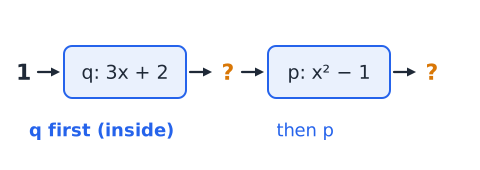
Step 1: Work from the inside out. First find q(1) by putting 1 into q.
Step 2: The output of q becomes the input of p. So p(q(1)) = p(5).
Step 3: Square 5:
Then subtract 1.
Answer: 24.
Check: Be careful not to work outside in.
and q(0) = 2, which is q(p(1)), a different question. For p(q(1)), q always goes first: q(1) = 5, p(5) = 24.
Worked Example 6 — Quadratic-Like Pattern
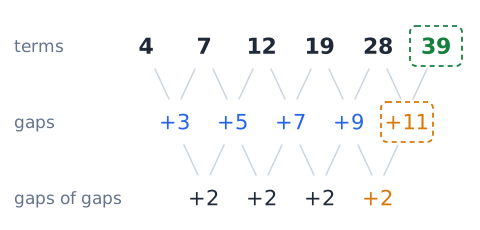
Problem: Find the next term of 4, 7, 12, 19, 28, ...
Step 1: Find the gaps between neighboring terms:
Step 2: The gaps 3, 5, 7, 9 go up by 2 each time, so the next gap is
Step 3: Add the next gap to the last term.
Step 4: Find a rule as a second method. Compare each term with the square numbers 1, 4, 9, 16, 25: every term is 3 more (
and so on). So the nth term is .
The next term is term number 6.
Answer: 39.
Check: Both methods give 39. Also check the rule on term 5: 5² +
which matches the sequence.
Worked Example 7 — Piecewise and Boundary
Problem: Let
for
for
Find .
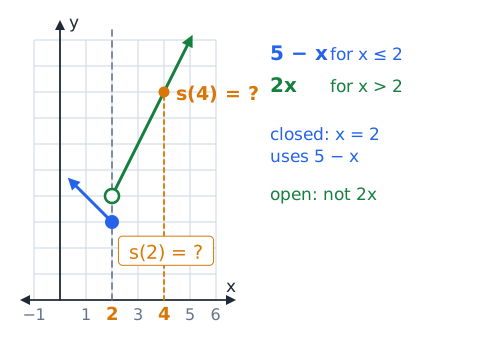
Step 1: Decide which rule to use for x = 2. The first rule covers x ≤ 2, which includes 2 itself. So use 5 − x.
Step 2: For x = 4, the number 4 is greater than 2, so use the second rule, 2x.
Step 3: Add the two results.
Answer: 11.
Check: The boundary is the tricky part. If you wrongly used 2x for x = 2, you would get 4 instead of 3 and a total of 12. Since ≤ includes 2, the first rule is correct and the total is 11.
Worked Example 8 — Domain Restriction
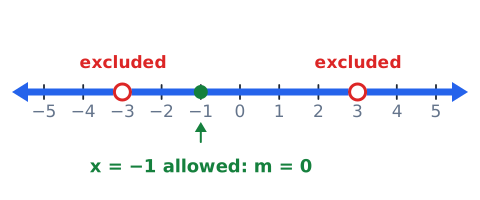
Problem: Which inputs are excluded from the domain of
Step 1: You can never divide by zero. So find the x values that make the denominator zero.
Step 2: Add 9 to both sides.
Step 3: Which numbers squared give 9? Both
Step 4: Think about the numerator. It is zero when
but a zero on top is fine: 0 divided by a nonzero number is just 0.
Answer: x = 3 and
are excluded. Every other real number is allowed.
Check: At x = 3 the bottom is
and at
it is
so both fail. At
the value is
which is fine.
Pitfalls and Distractor Patterns
Treating as f times x leads nowhere; it names an output. Dropping parentheses around negatives turns
into -9. Using n instead of n - 1 in the arithmetic formula overshoots by one step, which is why wrong choices often differ from the key by exactly d. Mixing up arithmetic and geometric patterns is avoided by checking whether gaps or ratios stay constant. Work compositions inside out, read piecewise boundary signs carefully, and remember that a repeated identical pair never breaks a function.
Final Exam-Ready Review
A function gives each input one output; use the vertical line test on graphs and look for one input with two outputs in lists. Evaluate by substituting in parentheses, and find an input by setting the rule equal to the output. Domains exclude zero denominators and negative square-root insides. Arithmetic sequences add d, with
Geometric sequences multiply by r, with
Check second differences for quadratic patterns, and work compositions inside out.
 English ▾