ASVAB Camp Get the appGoogle Play
MK · lesson 7 of 14 · 39 min

Systems and Relationships: Two-Variable Equations

When a problem gives you two unknowns and two conditions, you need a system. This lesson explains what changes when you move from one equation to two, what an ordered pair means, and how a system looks on a graph. It then teaches substitution, whether a variable is already isolated or must be rearranged, and elimination by adding, subtracting or scaling equations, along with guidance on when each method is faster.

Video lesson: Systems and Relationships

Video transcript

0:00 Welcome to this explainer. Today, we're going to absolutely master solving two variable linear systems entirely by hand. That's right, we are talking no calculator needed and absolutely no stress. Let's get right into it. So our main goal here is to easily solve pairs of linear equations. Now, if you're gearing up for exams like the ASVAB, this is incredibly high-value algebra knowledge. But you know what the best part is? You literally already possess all the basic arithmetic skills required to do this mentally. We're just going to organize the skills you already have. Basics and solving methods, demystifying equations. We're going to start with the foundational building blocks of equations and the core methods used to solve them. Think about a single equation like x plus y equals 10. It has endless solutions, right? It could be 1 and 9, 4 and 6, or even 12 and negative 2. But the moment you add a second independent equation, say x minus y equals 2, it instantly narrows the choices down. Only the ordered pair 6 and 4 satisfies both. Graphically, every equation is just a straight line.

1:03 And here's the golden rule. The solution to a system is simply the exact single point where those two lines actually cross. Okay, let's move to the substitution method and see how this builds. When one equation already has a variable isolated by itself like y equals 2x, you just substitute it directly into the other. So x plus y equals 12 simply becomes x plus 2x equals 12. Take a breath there. That means 3x equals 12, giving us x equals 4. Plug that 4 right back in and y equals 8. Simple, right? Now, if neither is isolated, just pick one with a coefficient of 1. For x plus 3y equals 11, rearrange it to x equals 11 minus 3y. Plug that chunk into the second equation so you get 2 times the quantity 11 minus 3y minus y equals 1. Solve that out carefully, step by step, and you get y equals 3 and x equals 2. Elimination. If your coefficients are exact opposites, like a positive y and a negative y, you literally just add the equations vertically. The y's cancel out completely, leaving you with 5x equals 20.

2:10 So x equals 4. Plug that 4 back in and you find y equals 2. But what if the coefficients match exactly, like a positive 2y in both equations? Well, then you subtract 1 equation entirely from the other. Just remember to subtract every single term, including the constants at the end. Here, that leaves 3x equals 12, so x equals 4, and y equals 3. Sometimes, though, no coefficients match, and they aren't opposites either. When that happens, no worries. Just multiply 1 equation to scale it up so the numbers do align. Take a look. To fix this one, we just multiply the entire second equation by 2. It becomes 2x plus 2y equals 10. Now we've got a 2x in both equations. Subtracting our new equation from the first one makes the x terms disappear completely, leaving simply y equals 3. Substitute that 3 back into x plus y equals 5, and boom, x equals 2. Solution types and models, recognizing patterns. Now let's explore how these systems apply to different mathematical scenarios. What their solutions actually tell us, and how we can model real-world word problems.

3:21 What's really fascinating here is how you can instantly classify a system based just on the algebra. Look, a linear system can never have exactly two solutions. It's either one, none, or infinite. If your elimination leaves you with a totally false statement, like 2 equals negative 5, the lines are parallel. There's no solution. If it leaves a true statement, like 0 equals 0, they are the exact same coincident line, meaning there are infinite solutions. You could also just compare the coefficients. If the variable numbers double, but the constant doesn't, you know right away they're different parallel lines. We can actually model almost any word problem into two constraints. Say a parking lot has 40 vehicles made of cars and motorcycles. Well, C plus M equals 40. If there are 130 wheels total, 4C plus 2M equals 130. Or what about a sum and difference problem. If two numbers add up to 50 and subtract to 14, it's just x plus y equals 50 and x minus y equals 14. And for a pricing problem, three bagels and two coffees for 13 bucks versus one bagel and two coffees for nine bucks, that translates directly into equations as you can see right here.

4:30 Before we move on to full examples, keep these test-taking scenarios in your back pocket. Always, always check your ordered pairs in both original equations. If you spot fractions or decimals, just multiply the whole equation to clear them out into whole numbers first. And this is absolutely crucial. Always read the actual question. If they're asking for x plus y, sometimes you can literally just add the equations together and get the final answer immediately without ever finding x and y separately. Step by step worked examples, the game tape. Let's run the game tape. We're going to walk through eight specific examples to see exactly how to execute these skills from start to finish. Let's check out example one. The crucial point here is adding directly. We've got a plus b equals 15 and a minus b equals 5. Add them up to get 2a equals 20. So a is 10. Plug it back in and b is 5. Now moving over to example two, this one requires a quick substitution step. We know y equals x plus 4, so we literally just drop that right into the second equation to get 2x plus x plus 4 equals 19. That simplifies beautifully to 3x equals 15, giving us x equals 5 and y equals 9. For example three, we need to scale to eliminate.

5:40 We have 3x plus 2y equals 16 and x minus y equals 2. We just double that second equation to get 2x minus 2y equals 4. Add that to the first one, the y's vanish entirely and 5x equals 20. So x is 4, y is 2. Now take a look at example four. Let's classify this system. 6x minus 3y equals 9. If we rearrange that by moving the 6x and dividing by negative 3, we get y equals 2x minus 3. Wait a second. That's exactly the second equation. Since they're the exact same line, there are infinite solutions. Alright, example 5 scales receipts to price some flowers. 4 roses and 3 tulips cost $26. 2 roses and 5 tulips cost $20. Just double the second receipt to get 4 roses and 10 tulips for $40. Subtract the first receipt from it, leaving 7 tulips for $14. So 1 tulip is clearly $2. Plug that back in and a rose is 5. Next up, example 6 takes a slightly different approach.

6:44 It simply sets two lines equal to find exactly where they cross. Y equals 3x minus 4 and y equals negative x plus 8. Set them equal, move the x's over to get 4x equals 12 so x is 3, making y equal to 5. Finding an unknown parameter in example 7 means scaling to match. To find when the system has no solution, we match the y terms by tripling the first equation to get 6x minus 3y equals 12. Now if a equals 6, the left side match perfectly, but 12 definitely doesn't equals 7. That means parallel lines. Example 8 shows exactly why we have to read the full question. We solve for x by subtracting equations to get 2x equals 8 so x is 4. Plug that in to get y equals 2. But wait, the question actually asks for x squared plus y. So 4 squared is 16 plus 2 equals 18. Game changer, right? Common traps and review, avoiding the potholes. We've mastered the math and we've run the game tape. Now let's quickly highlight the exact mistakes you need to actively avoid when you're taking an exam. Watch out for these traps on your test.

7:52 I honestly see this happen all the time. Always label your ordered pairs correctly. Remember x comes first. When you're subtracting equations, subtract every single term. And yes, that includes those constants at the very end. If you scale an equation, you have to multiply both sides, forgetting the other side completely breaks the equality. Don't stop calculating halfway through if the question asks for a combination like x plus y. And finally, remember that 0 equals 0 is a true statement, meaning infinite solutions, while a false result like 0 equals 5 means absolutely none. Check yourself questions claim your victory. It's time to prove you've got this. We're going to do two quick practice questions straight from the source. I'll read the question, you pause the explainer to solve it mentally or on paper, and then we'll review it together. Which ordered pair is the solution of the system x plus y equals 9 and x minus y equals 3? Go ahead and pause right now to find your answer. Alright, let's see how you did.

8:52 Adding the equations vertically eliminates y immediately, giving 2x equals 12, so x equals 6. Plugging 6 back into that first equation means 6 plus y equals 9, so y equals 3. The ordered pair is 6,3, making option A the clear winner. Great job if you got that. Let's do one more. Pause one last time for question 5. How many solutions does the system y equals 4x plus 1 and y equals 4x minus 3 have? Pause now and figure it out. Okay, let's break it down. Setting the equations equal means 4x plus 1 equals 4x minus 3. If we subtract 4x from both sides, well they cancel out, leaving us with 1 equals negative 3. Obviously this is a completely false statement, which proves the lines are parallel and will literally never cross. So the correct answer is D, no solution. Amazing job. You now hold the structured tools to conquer literally any two variable linear system, completely calculator free. Remember, it's just basic arithmetic and following the steps, you've totally got this.

9:54 So take this new confidence into your studying. What other complex math concept can we demystify together next?

Visual lesson

Lesson slides

13 slides
Systems and Relationships – slide 1 of 13

Lesson Goal and Exam Context

In this lesson you will solve pairs of linear equations in two variables by substitution, by elimination, and by reading where two lines cross. You will also decide whether a system has one solution, no solution, or infinitely many, turn word problems into two equations, and confirm answers by plugging them back in. On the ASVAB, systems fall under Mathematics Knowledge algebra; they are useful practice, but no specific question type is guaranteed.

One Equation Versus Two Equations

A single equation such as

x + y = 10

has endless solutions: (1, 9), (4, 6), (12, -2), and so on. Adding a second, independent equation, say

x - y = 2

narrows the choices. Only the pair that satisfies both equations at once survives, here (6, 4). Two unknowns usually need two separate facts.
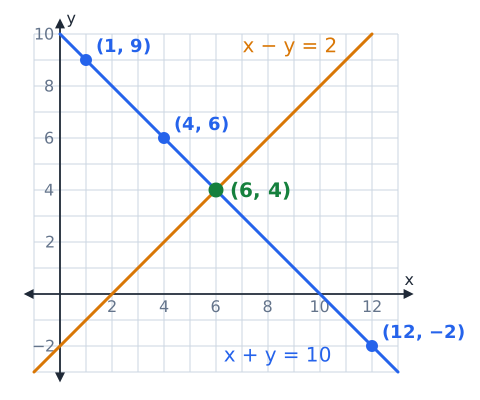
Graph of the line x + y = 10 with solution points (1, 9), (4, 6) and (12, −2) marked, and the line x − y = 2 crossing it only at (6, 4).

Ordered Pairs and Coordinate Meaning

An ordered pair (x, y) lists the x-value first and the y-value second. The point (3, -2) sits 3 units right of the origin and 2 units down. Swapping the order gives (-2, 3), a different point, so always match each number to its variable before choosing an answer.
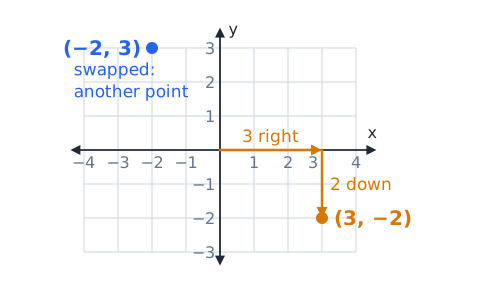
Coordinate grid with the point (3, −2) reached by moving 3 right and 2 down from the origin, and the swapped pair (−2, 3) plotted as a different point.

Graphical Interpretation of a System

Every linear equation in two variables graphs as a straight line, and every point on that line is a solution of that equation. A system's solution is therefore any point lying on both lines. If

y = x + 1
and
y = -x + 5

are drawn on one grid, they cross at (2, 3), and that crossing point is the one pair that makes both equations true.
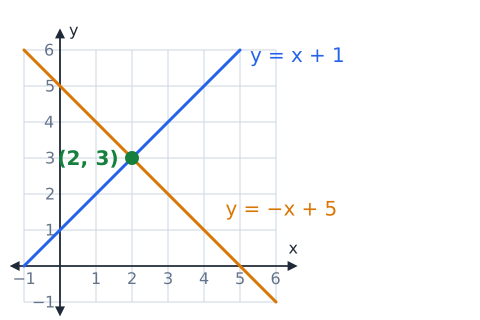
Graph of the lines y = x + 1 and y = −x + 5 crossing at the point (2, 3), the solution of the system.

Substitution When a Variable Is Isolated

When one equation already reads y = ... or x = ..., replace that variable in the other equation. For y = 2x and

x + y = 12

write

x + 2x = 12

Then 3x = 12, so x = 4 and y = 8.

Substitution by Rearranging One Equation

If neither variable is alone, isolate one that has a coefficient of 1. In

x + 3y = 11
and
2x - y = 1

rewrite the first as

x = 11 - 3y
then
2(11 - 3y) - y = 1
gives
22 - 7y = 1

so y = 3 and x = 2.

Elimination With Opposite Coefficients

If one variable has opposite coefficients, add the equations to cancel it. With

3x + y = 14
and
2x - y = 6

adding gives 5x = 20, so x = 4. Then

3(4) + y = 14

so y = 2.

Elimination by Subtracting Equations

When a variable has the same coefficient in both equations, subtract one equation from the other. From

4x + 2y = 22
and
x + 2y = 10

subtracting gives 3x = 12, so x = 4. Then

4 + 2y = 10

and y = 3. Subtract every term, including the constants.

Elimination by Scaling an Equation

If no coefficients match, multiply one or both equations first. For

2x + 3y = 13
and
x + y = 5

multiply the second by 2 to get

2x + 2y = 10

Subtracting this from the first leaves y = 3, and then x = 2. Multiply every term, not just the one you target.

When Substitution Beats Elimination

Substitution is fastest when a variable is already isolated or has a coefficient of 1 or -1. Elimination wins when coefficients already match or are easy multiples, such as 2 and 4. For

y = 5 - x

paired with

3x + 2y = 13

substitution is immediate:

3x + 10 - 2x = 13

so x = 3 and y = 2.

One Solution, None, or Infinitely Many

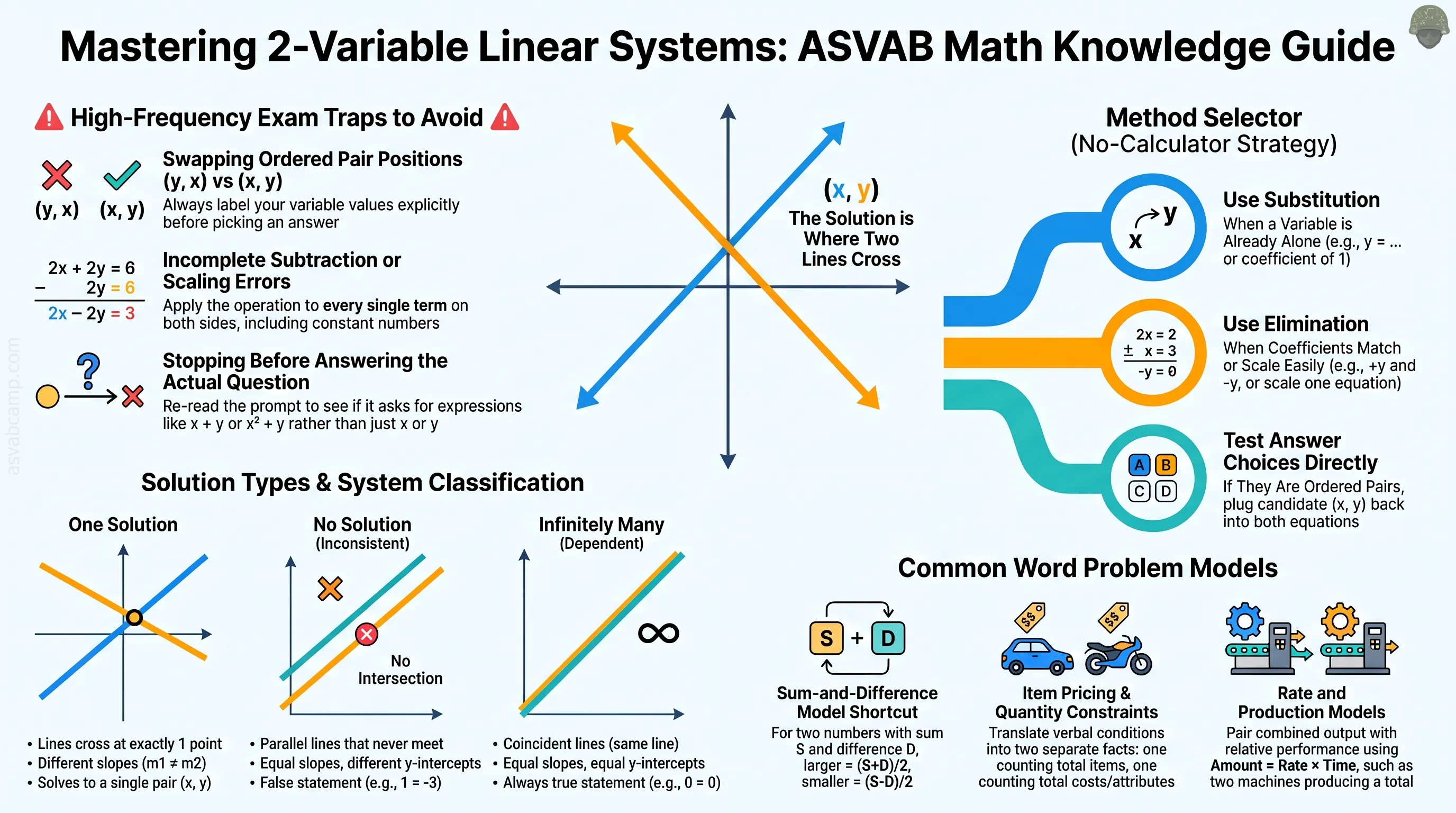
Two lines in a plane can relate in only three ways. They cross once, giving exactly one solution. They are parallel and never meet, giving no solution. Or they are the same line, so every point on it works and there are infinitely many solutions. A linear system can never have exactly two solutions.
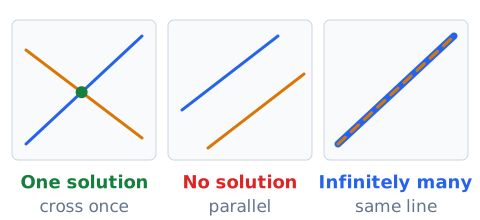
Three panels: two lines crossing once (one solution), two parallel lines (no solution), and two lines lying on top of each other (infinitely many solutions).

Parallel Lines: Inconsistent Systems

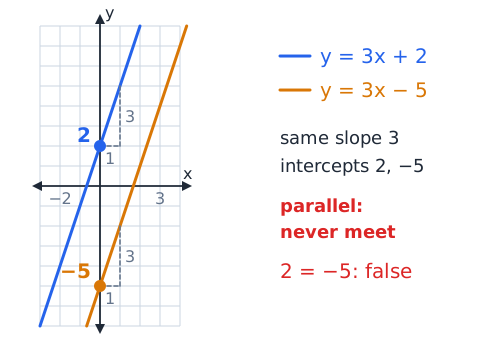
Lines with the same slope but different y-intercepts are parallel, so the system has no solution. Algebraically, elimination wipes out both variables and leaves a false statement. For

y = 3x + 2
and
y = 3x - 5

setting them equal gives

2 = -5

which is impossible.

Graph of the parallel lines y = 3x + 2 and y = 3x − 5 with y-intercepts 2 and −5 and slope 3 on both; they never meet, and setting them equal gives the false statement 2 = −5.

Coincident Lines: Dependent Systems

If one equation is just a multiple of the other, both describe the same line. For

x - 2y = 4
and
3x - 6y = 12

the second is three times the first. Elimination leaves 0 = 0, a true statement, meaning infinitely many solutions.

Slope-Intercept Form and Systems

Rewriting each equation as y = mx + b reveals slope m and intercept b. Different slopes mean one solution. Equal slopes with different intercepts mean no solution. Equal slopes and equal intercepts mean infinitely many. Example:

4x + 2y = 6

becomes

y = -2x + 3

Comparing Relationships Without Solving

You can often classify a system without solving it by comparing matching coefficients. In

2x + 5y = 7
and
4x + 10y = 9

both variable coefficients double, but the constant does not (7 doubled is 14, not 9). Same slope, different line: no solution.

A System as Two Constraints

Each equation in a word problem is one constraint, a condition the answer must meet. Suppose a parking lot holds 40 vehicles, all cars or motorcycles, with 130 wheels in total. Then

c + m = 40

counts vehicles and

4c + 2m = 130

counts wheels. Solving gives c = 25 cars and m = 15 motorcycles.
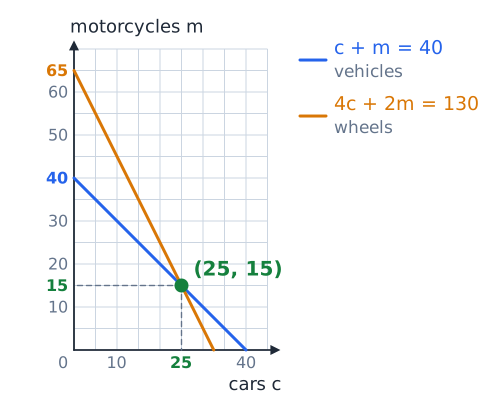
Graph of the constraints c + m = 40 (vehicles) and 4c + 2m = 130 (wheels), with cars c across and motorcycles m up; the lines cross at (25, 15): 25 cars and 15 motorcycles.

Sum-and-Difference Models

If two numbers have sum S and difference D, adding

x + y = S
and
x - y = D
gives
2x = S + D

So the larger is (S + D)/2 and the smaller is (S - D)/2. With sum 50 and difference 14, the numbers are 32 and 18.
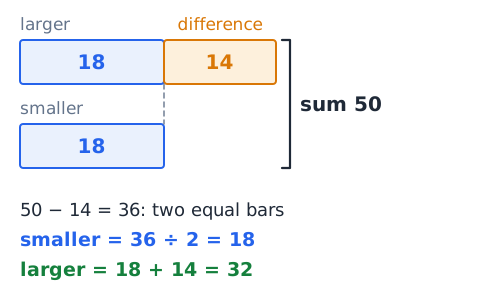
Bar model: the larger number is a bar of 18 plus an extra 14 (the difference), the smaller is a bar of 18; together they make 50, so 50 − 14 = 36, smaller = 18 and larger = 32.

Purchase and Pricing Models

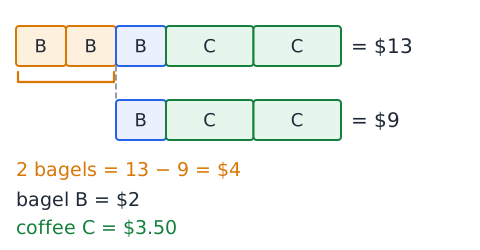
Pricing problems pair quantities with unit prices. If 3 bagels and 2 coffees cost 13 dollars, and 1 bagel and 2 coffees cost 9 dollars, subtracting gives 2 bagels = 4 dollars, so a bagel is 2 dollars. Then

2 + 2c = 9

so a coffee costs 3.50 dollars.

Bar model: 3 bagels and 2 coffees cost $13; 1 bagel and 2 coffees cost $9; the 2 extra bagels cost 13 − 9 = $4, so a bagel is $2 and a coffee is $3.50.

Production and Rate Relationships

Rate problems use amount = rate times time. Two machines together fill 600 bottles in one hour, and Machine A runs 100 bottles per hour faster than Machine B. So

a + b = 600
and
a - b = 100

giving a = 350 and b = 250 bottles per hour.

Checking by Substitution

Always test your pair in both original equations. A pair that fits only one is wrong. For

2x + y = 9
and
x - y = 3

the pair (4, 1) gives 9 and 3, so it checks. The pair (3, 3) fits the first equation but gives 0 in the second.

Fractions and Decimals in a System

Clear fractions or decimals first by multiplying each whole equation by a suitable number. For

multiply every term by 6 to get

3x + 2y = 24

For

0.2x + 0.5y = 2.7

multiply by 10 to get

2x + 5y = 27

The whole-number system then gives x = 6 and y = 3.

Parameters and Changing Relationships

Some systems contain a letter such as k whose value controls the outcome. For

x + 3y = 5

and 2x + ky = 10, the second equation is exactly the first doubled when k = 6, so there are infinitely many solutions. Any other k changes the slope and gives exactly one solution.

Two-Minute Method Selector

Spend a few seconds choosing a method before you write. If a variable is alone, substitute. If coefficients match or are opposites, eliminate directly. If one coefficient is a small multiple of its partner, scale once and eliminate. If the question asks only how many solutions exist, compare slopes instead of solving. If the answer choices are ordered pairs, plugging them in may be fastest of all.

Fast No-Calculator Elimination

Without a calculator, target the variable whose coefficients are easiest to match, and keep numbers small by scaling the equation with smaller coefficients. Line up like terms in columns and write each sign before adding or subtracting. After finding both values, plug them into the equation you did not use for back-substitution.
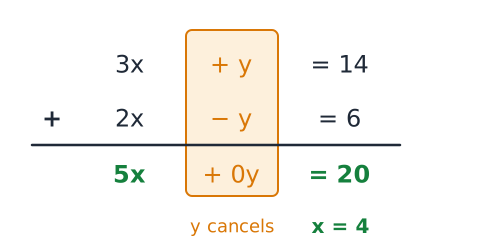
Elimination with like terms in columns: 3x + y = 14 above 2x − y = 6; adding gives 5x + 0y = 20, the y column cancels, and x = 4.

Read the Actual Question

Many items ask for something other than x and y, such as x + y, 2x - y, or the cost of a combination. Sometimes the requested expression comes straight from combining the equations: if

and

adding gives

4x + 4y = 28
so
x + y = 7

without solving.

Worked Example 1 — Direct Elimination

Problem: Solve the system

and

Step 1: Notice that b has opposite signs in the two equations (+b and −b). Add the equations so b cancels.

Step 2: Divide both sides by 2:

20 ÷ 2 = 10

Step 3: Substitute a = 10 into the first equation to find b.

Step 4: Subtract 10 from both sides:

15 − 10 = 5

Answer: a = 10 and b = 5, written as (10, 5).

Check: First equation:

10 + 5 = 15

Second equation:

10 − 5 = 5

Both are true.

Worked Example 2 — Substitution

Problem: Solve the system

and

Step 1: The first equation already tells you what y equals. Substitute x + 4 in place of y in the second equation, using parentheses.

Step 2: Combine like terms:

2x + x = 3x

Step 3: Subtract 4 from both sides:

19 − 4 = 15

Step 4: Divide both sides by 3:

15 ÷ 3 = 5

Step 5: Put x = 5 into the first equation to find y.

Answer: x = 5 and y = 9, or (5, 9).

Check: First equation:

5 + 4 = 9

Second equation:

2 × 5 + 9 = 10 + 9 = 19

Both are true.

Worked Example 3 — Scale to Eliminate

Problem: Solve the system

and

Step 1: To make y cancel, the y terms must be opposites. The first equation has +2y, so multiply every term of the second equation by 2 to get −2y.

Step 2: Add this new equation to the first one. The y terms cancel:

2y + (−2y) = 0

Step 3: Divide both sides by 5:

20 ÷ 5 = 4

Step 4: Put x = 4 into the simpler equation

x − y = 2

Subtract 4 from both sides:

−y = −2

so y = 2.

Answer: x = 4 and y = 2, or (4, 2).

Check: First equation:

3 × 4 + 2 × 2 = 12 + 4 = 16

Second equation:

4 − 2 = 2

Both are true.

Worked Example 4 — System Classification

Problem: Classify the system

and

one solution, no solution, or infinitely many?

Step 1: Rewrite the first equation in the form y = mx + b. Subtract 6x from both sides.

Step 2: Divide every term by −3:

−6 ÷ (−3) = 2
and
9 ÷ (−3) = −3

Step 3: Compare with the second equation,

y = 2x − 3

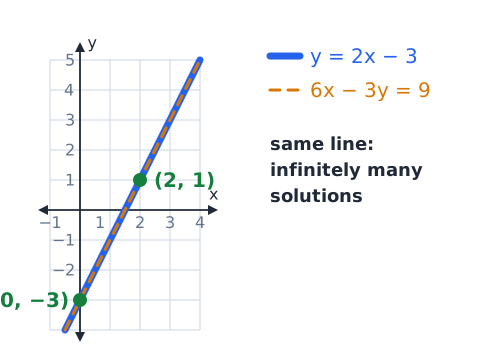
Both have slope 2 and y-intercept −3. They are the same line, so every point on that line works for both equations.

Answer: The system has infinitely many solutions.

Check: Pick two points on

y = 2x − 3

When x = 0,

y = −3

when x = 2,

y = 4 − 3 = 1

Test them in the first equation:

6(0) − 3(−3) = 0 + 9 = 9
and
6(2) − 3(1) = 12 − 3 = 9

Both work.

Graph of the single line y = 2x − 3, which is also 6x − 3y = 9, through the points (0, −3) and (2, 1): the same line, so infinitely many solutions.

Worked Example 5 — Two Goods and Two Receipts

Problem: A florist's first receipt shows 4 roses and 3 tulips for 26 dollars. The second shows 2 roses and 5 tulips for 20 dollars. Find the price of each flower.

Step 1: Let r be the price of a rose and t the price of a tulip. Write one equation per receipt.
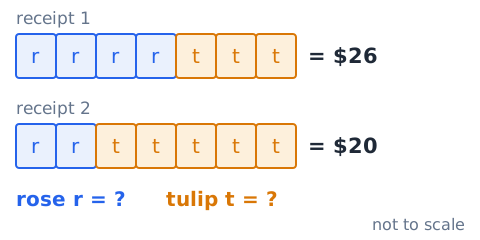
Bar model of two receipts: 4 roses r and 3 tulips t cost $26; 2 roses r and 5 tulips t cost $20; rose r = ? and tulip t = ? (not to scale).

Step 2: Make the rose terms match. Multiply every term of the second equation by 2.

Step 3: Subtract the first equation from this one. The 4r terms cancel:

10t − 3t = 7t
and
40 − 26 = 14

Step 4: Divide by 7: t = 2, so a tulip costs 2 dollars.

Step 5: Put t = 2 into the first equation:

3 × 2 = 6

Subtract 6: 4r = 20. Divide by 4: r = 5, so a rose costs 5 dollars.

Answer: A rose costs 5 dollars and a tulip costs 2 dollars.

Check: Receipt 1:

4 × 5 + 3 × 2 = 20 + 6 = 26

Receipt 2:

2 × 5 + 5 × 2 = 10 + 10 = 20

Both match.

Worked Example 6 — Crossing Lines

Problem: Where do the lines

and

cross?

Step 1: At the crossing point, both lines have the same y. So set the two right sides equal.

Step 2: Add x to both sides to collect the x terms on the left:

3x + x = 4x

Step 3: Add 4 to both sides:

8 + 4 = 12

Step 4: Divide both sides by 4:

12 ÷ 4 = 3

Step 5: Put x = 3 into either equation. Using the first:

3 × 3 = 9
and
9 − 4 = 5

Answer: The lines cross at (3, 5).

Check: Use the second line:

−3 + 8 = 5

Both lines give y = 5 when x = 3, so the point is on both.
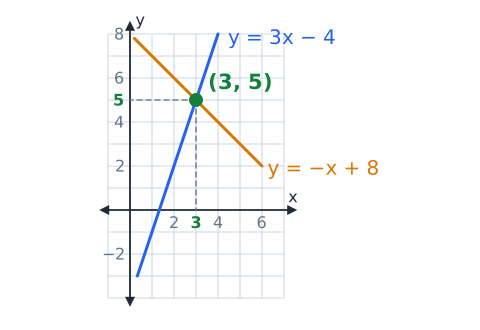
Graph of y = 3x − 4 and y = −x + 8 crossing at (3, 5), with dashed guides to x = 3 and y = 5.

Worked Example 7 — Unknown Parameter

Problem: For what value of a do

and

have no solution?

Step 1: A system has no solution when the two lines are parallel: the x and y parts match, but the constant does not. Make the y terms match by multiplying every term of the first equation by 3.

Step 2: Compare it with the second equation, ax − 3y = 7. The y terms already match (−3y). If a = 6, the left sides are identical.

Step 3: The same expression 6x − 3y cannot equal both 12 and 7 at once. So the lines are parallel and never meet.

Answer:

Check: Write both in slope form. The first is

y = 2x − 4

With a = 6, the second is

y = 2x − 7/3

Same slope 2, different intercepts, so they are parallel. Any other value of a gives a different slope, and the lines would cross once.
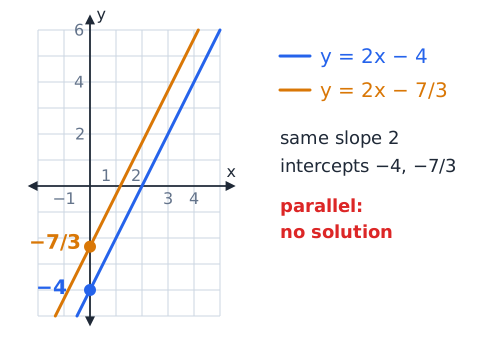
Graph of the parallel lines y = 2x − 4 and y = 2x − 7/3: same slope 2, y-intercepts −4 and −7/3, so they never meet (no solution).

Worked Example 8 — Combined Expression

Problem: If

and

find .

Step 1: Both equations contain +2y. Subtract the second equation from the first so the y terms cancel:

5x − 3x = 2x
and
24 − 16 = 8

Step 2: Divide by 2: x = 4.

Step 3: Put x = 4 into the second equation:

3 × 4 = 12

Subtract 12: 2y = 4. Divide by 2: y = 2.

Step 4: Now evaluate the expression. Square x first:

4 × 4 = 16

Answer: 18.

Check: First equation:

5 × 4 + 2 × 2 = 20 + 4 = 24

Second:

12 + 4 = 16

Both are true, so x = 4 and y = 2 are right.

Common System-Equation Traps

Writing the pair in the wrong order, as (y, x), turns a correct solution into a wrong choice, so label each value before matching. Subtracting only the first term when subtracting equations causes sign errors; subtract every term, constants included. Multiplying one side of an equation but not the other breaks the equality. Stopping after x when the question asks for y or a combination loses easy points. Finally, 0 = 0 means infinitely many solutions, while a false result such as 0 = 5 means none.

Quick Review

A system's solution is the pair that satisfies every equation, which on a graph is where the lines meet. Substitute when a variable is isolated or easy to isolate; eliminate when coefficients match, are opposites, or can be scaled to match. Different slopes mean one solution, equal slopes with different intercepts mean no solution, and identical lines mean infinitely many. Write one equation per fact in word problems, check your pair in both originals, and answer exactly what is asked.

Quick review

What is the solution of a system of two linear equations?
The ordered pair (x, y) that makes both equations true at the same time; on a graph it is the point where the two lines cross. List x first, then y.
When is substitution the best method for a system?
When one variable is already alone, or has coefficient 1 or −1 and is easy to isolate. For y = x + 2 and 3x + y = 14: 3x + x + 2 = 14, so x = 3 and y = 5.
How does the elimination method work?
Add the equations when a variable has opposite coefficients, subtract when they are equal, or scale one equation first. x + y = 9 and x − y = 3: adding gives 2x = 12, so x = 6 and y = 3.
Common errors when scaling or subtracting equations?
Multiplying only the targeted term instead of every term on both sides, and subtracting only the first term instead of every term, constants included. Both break the equality.
How many solutions can a linear system have?
Exactly one (the lines cross), none (the lines are parallel), or infinitely many (both equations describe the same line). It can never have exactly two.
How do slope and intercept classify a system?
In y = mx + b form: different slopes mean one solution; equal slopes with different intercepts mean none; equal slopes and intercepts mean infinitely many. Elimination ending in 0 = 0 means infinite; 0 = 4 means none.
Two numbers have sum S and difference D. What are they?
Larger and smaller . With sum 40 and difference 12, the numbers are 26 and 14.
The question asks for x + y. Must you find x and y separately?
Not always. Combining the equations may give it directly: 2x + y = 11 plus x + 2y = 10 gives 3x + 3y = 21, so x + y = 7. Always answer exactly what is asked.

What next?

← Previous: Inequalities

About this lesson

You will learn to classify systems as having one solution, none or infinitely many, connecting parallel and coincident lines to slope-intercept form. Modeling sections cover sum-and-difference, purchase and pricing, and production and rate relationships. Further topics include fractions and decimals in a system, unknown parameters, a two-minute method selector and reading what the question actually asks.

Eight worked examples, from direct elimination to a combined expression, close out the instruction. Mathematics Knowledge counts toward the AFQT, so this is worth the effort. Plan for about 39 minutes, then take the 18-question lesson test.

Take it with you: the free app

The same 124 lessons, 6,516 questions and 82 timed practice tests on your phone, plus flashcards with spaced review and progress tracking. Free to download, and it works offline.

  • Works offline
  • Spaced-review flashcards
  • Progress for every subtest
  • Menus in 59 languages
ASVAB Camp appGoogle Play