 ASVAB Camp
Lesson Outcomes and Exam Context
By the end of this lesson you should be able to classify angles by size and use the key totals: complementary angles make 90 degrees, supplementary angles and linear pairs make 180 degrees, and angles around a point make 360 degrees. You will apply vertical angles and angle bisectors, name the angle pairs formed when a transversal crosses parallel lines, and solve equations built from these relationships. ASVAB Mathematics Knowledge includes basic geometry like this, though no particular question is promised.
Points, Lines, Rays, and Segments
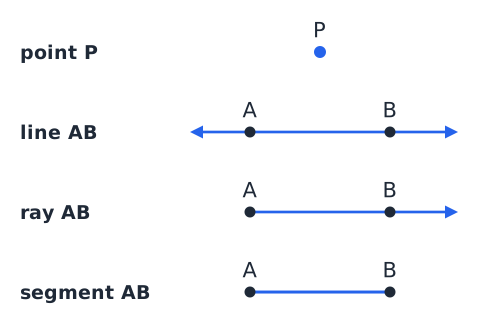
A point marks an exact location and has no size; it is named with a capital letter such as P. A line is perfectly straight, has no thickness, and extends forever in both directions; the line through points A and B is called line AB. A ray starts at an endpoint and continues forever in one direction. Ray AB begins at A and passes through B, so ray BA is a different ray. A segment is the part of a line between two endpoints, so segment AB has a measurable length, unlike a line or a ray.
What Is an Angle?
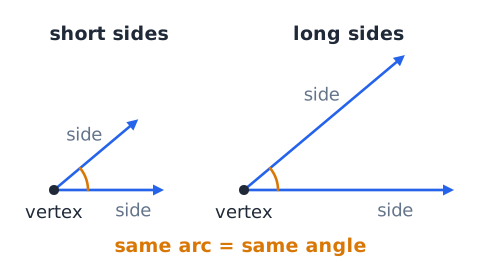
An angle is formed by two rays that share a common endpoint, called the vertex. The rays are the sides of the angle. The size of an angle measures how far one side is turned from the other, not how long the sides are drawn, so extending the sides on a diagram does not change the angle. Think of a door on its hinge: the hinge is the vertex, and how far the door has swung open is the angle, whether the door is wide or narrow.
Naming Angles Without Ambiguity
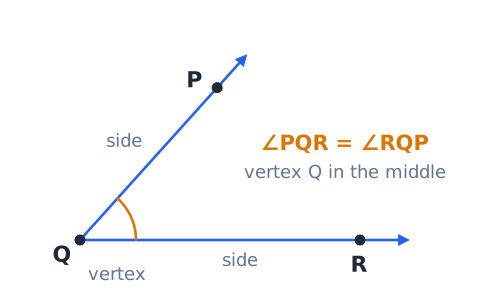
An angle can be named by its vertex alone, such as angle Q, only when exactly one angle sits at that vertex. When several rays meet at a point, use three letters with the vertex in the middle: angle PQR has its vertex at Q and sides passing through P and R. Angle RQP names the same angle. Diagrams may also label angles with numbers, such as angle 3.
Degree Measure and Full Rotation
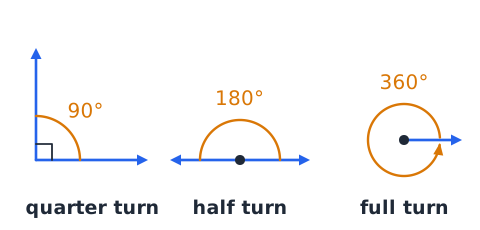
Angles are measured in degrees. One full turn around a point is 360 degrees, a half turn along a straight line is 180 degrees, and a quarter turn, like a square corner, is 90 degrees. A protractor measures an angle by placing its center on the vertex and one side along zero. A clock face shows the idea: the minute hand sweeps 360 degrees per hour, or 6 degrees per minute.
Angle Classification
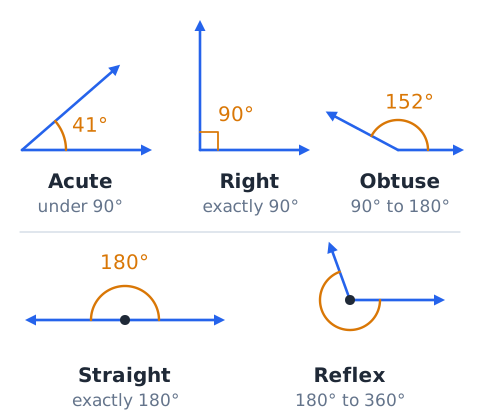
Angles are classified by measure. An acute angle is greater than 0 and less than 90 degrees. A right angle is exactly 90 degrees. An obtuse angle is greater than 90 but less than 180 degrees. A straight angle is exactly 180 degrees. Angles between 180 and 360 degrees are called reflex angles. For example, 41 degrees is acute and 152 degrees is obtuse.
Adjacent Angles
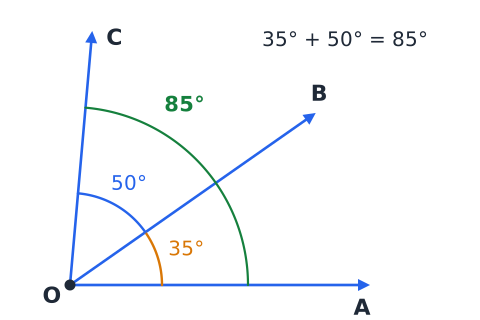
Adjacent angles share a vertex and one common side but do not overlap. If ray OB lies between rays OA and OC, then angles AOB and BOC are adjacent, and their measures add to give angle AOC. For instance, if angle AOB is 35 degrees and angle BOC is 50 degrees, then angle AOC is 85 degrees. Angles that touch only at the vertex, without a shared side, are not adjacent.
Linear Pairs and Straight Lines
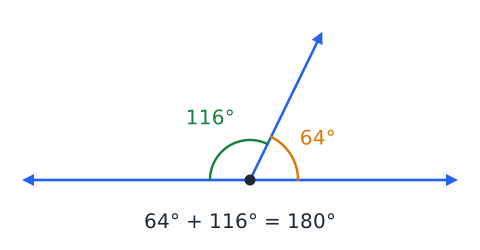
When two adjacent angles have outer sides that form a straight line, they are called a linear pair, and their measures always add to 180 degrees. If one angle of a linear pair is 64 degrees, the other must be 180 minus 64, or 116 degrees. This is one of the most useful facts in diagram problems: whenever a ray stands on a straight line, the two angles on either side of it total 180 degrees.
Vertical Angles
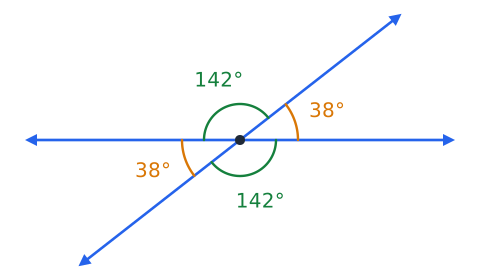
When two lines cross, they form four angles. The angles directly across from each other are vertical angles, and vertical angles are always equal. The reason is that each of them forms a linear pair with the same neighboring angle. If one angle is 38 degrees, its vertical partner is also 38 degrees, and each of the other two angles is 142 degrees.
Perpendicular Lines
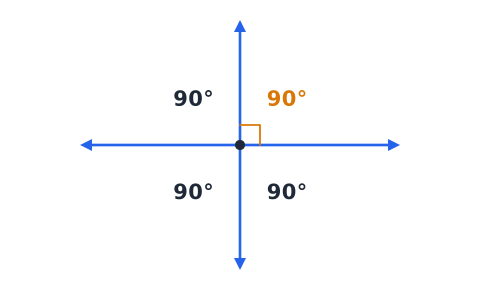
Perpendicular lines meet at a right angle, so all four angles they form are 90 degrees. Diagrams show this with a small square drawn in the corner. If you know that one angle at an intersection is 90 degrees, the other three must also be 90 degrees, because of vertical angles and linear pairs. A wall meeting a floor and the corners of a sheet of paper are everyday examples.
Complementary Angles
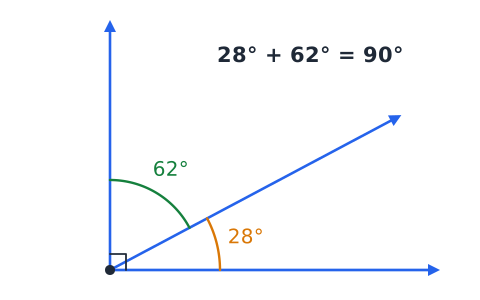
Two angles are complementary when their measures add to 90 degrees. The complement of a 28-degree angle is 90 minus 28, or 62 degrees. Complementary angles do not need to be adjacent; they only need to total 90. Only acute angles have complements.
Supplementary Angles
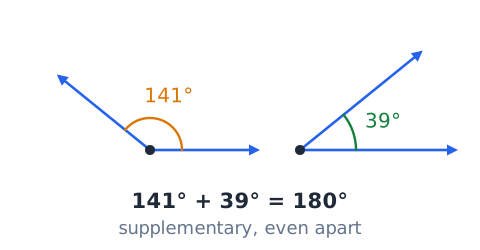
Two angles are supplementary when their measures add to 180 degrees. The supplement of a 141-degree angle is 39 degrees. Every linear pair is supplementary, but supplementary angles can also sit apart on a diagram. A memory aid: C comes before S in the alphabet, just as 90 comes before 180.
Angle Bisectors
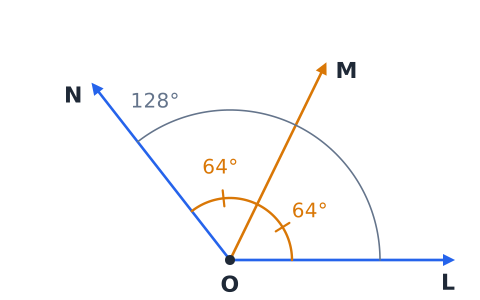
An angle bisector is a ray that splits an angle into two equal angles. If ray OM bisects angle LON, which measures 128 degrees, then angles LOM and MON are each 64 degrees. Working backward, if each half is given, double it to get the whole angle. Bisector problems often combine with linear pairs or algebra.
Parallel Lines and Transversals
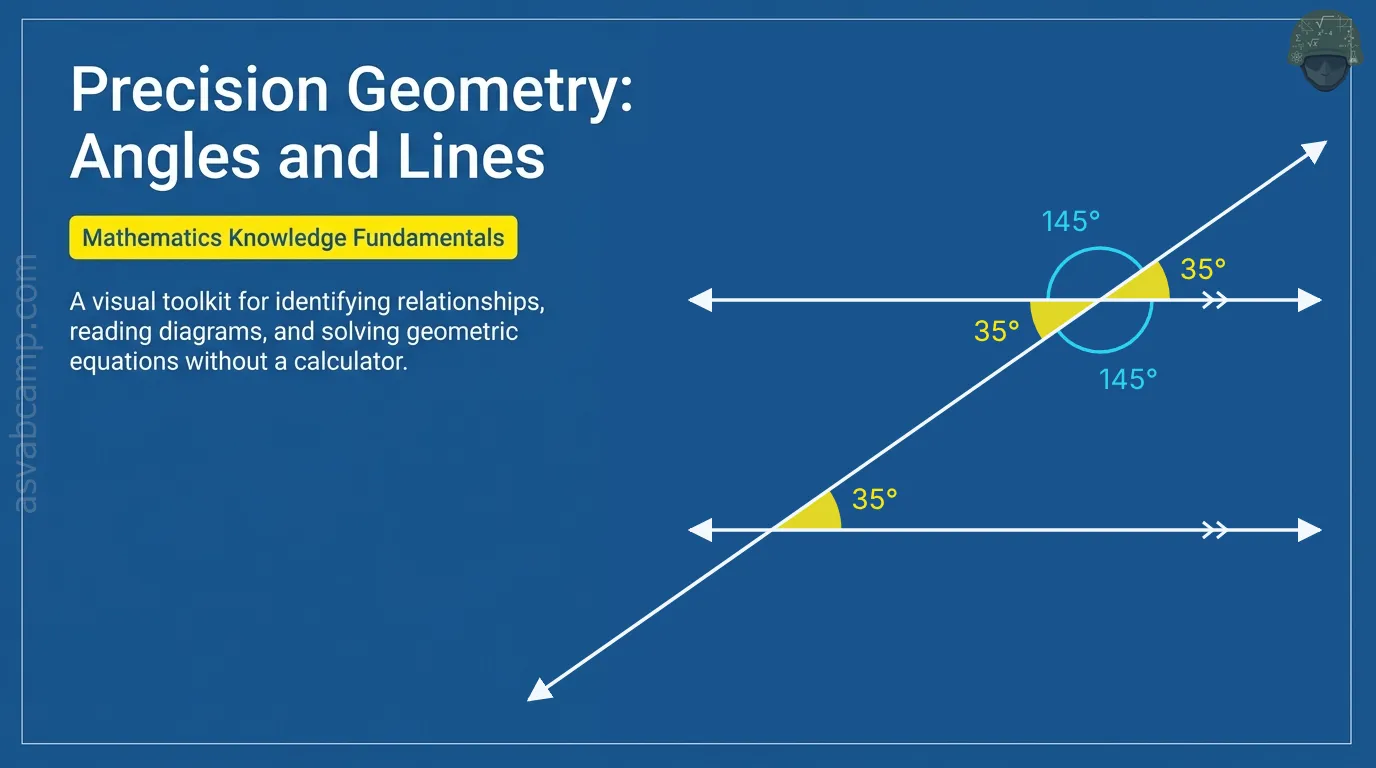
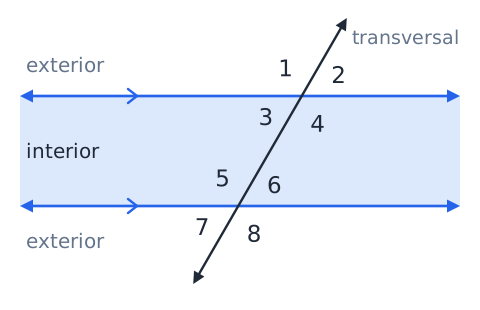
A transversal is a line that crosses two or more other lines at different points. When it crosses two lines, it forms eight angles, four at each intersection. If the two lines are parallel, meaning they lie in the same plane and never meet, those eight angles follow strict patterns described in the next sections. If the lines are not parallel, the angles at each intersection are still linked by vertical angles and linear pairs, but the two intersections are not tied to each other. Diagrams mark parallel lines with matching arrowheads.
Labeling the Eight Transversal Angles
To keep track of the eight angles, number them. At the upper intersection, call the angles 1 (top left), 2 (top right), 3 (bottom left) and 4 (bottom right). At the lower intersection, use 5, 6, 7 and 8 in the same positions. Angles 3, 4, 5 and 6 lie between the two lines and are interior angles. Angles 1, 2, 7 and 8 lie outside the lines and are exterior angles. Angles in matching positions, like 1 and 5, are corresponding angles.
Corresponding Angles
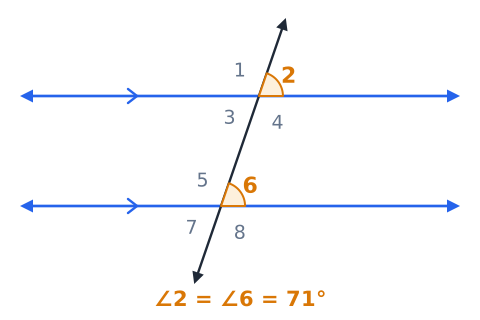
Corresponding angles occupy the same relative position at each intersection, such as angles 2 and 6 in the numbering above. When the lines are parallel, corresponding angles are equal. Picture sliding the upper intersection down the transversal until it sits on the lower one: every angle lands on its match. If angle 2 is 71 degrees, angle 6 is 71 degrees.
Alternate Interior Angles
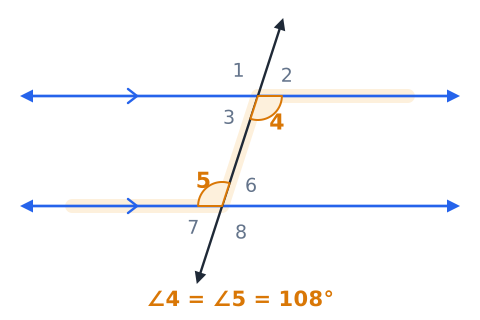
Alternate interior angles lie between the two lines and on opposite sides of the transversal, such as angles 3 and 6 or angles 4 and 5. When the lines are parallel, alternate interior angles are equal. A quick way to spot them is the Z shape, or backward Z, traced by the lines. If angle 4 measures 108 degrees, then angle 5 also measures 108 degrees.
Alternate Exterior Angles
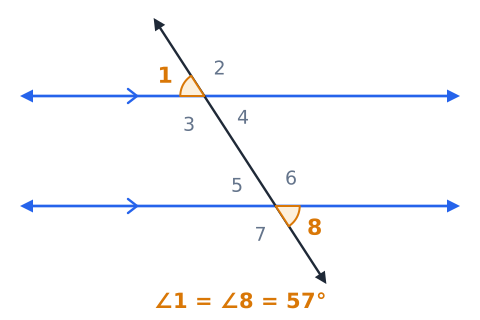
Alternate exterior angles lie outside the two lines and on opposite sides of the transversal, such as angles 1 and 8 or angles 2 and 7. When the lines are parallel, alternate exterior angles are equal. So if angle 1 measures 57 degrees, angle 8 also measures 57 degrees. The reason: each one equals a vertical angle that is corresponding to the other.
Same-Side Interior Angles
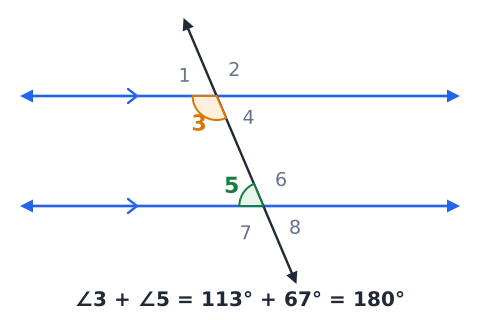
Same-side interior angles, also called consecutive interior angles, lie between the two lines and on the same side of the transversal, such as angles 3 and 5 or angles 4 and 6. When the lines are parallel, these angles are supplementary, adding to 180 degrees; they are not equal. If angle 3 is 113 degrees, angle 5 is 67 degrees. Same-side exterior angles, such as 1 and 7, are also supplementary.
Every Transversal Angle Is Either Acute or Obtuse in the Nonperpendicular Case
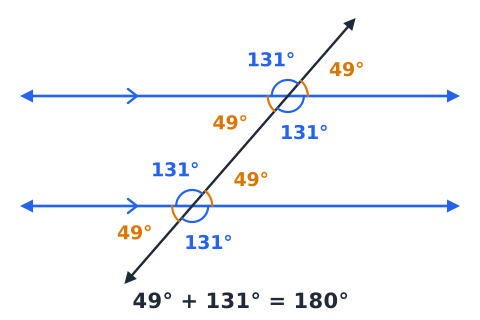
When a transversal crosses two parallel lines and is not perpendicular to them, the eight angles come in only two sizes: four equal acute angles and four equal obtuse angles. Any acute angle plus any obtuse angle equals 180 degrees, so once you know one angle, you know all eight. If one angle is 49 degrees, every other angle is either 49 or 131 degrees. If the transversal is perpendicular, all eight angles are 90 degrees.
Converse Tests for Parallel Lines
The parallel-line facts also work in reverse. Two lines cut by a transversal are parallel if any one of these is true: a pair of corresponding angles is equal, a pair of alternate interior angles is equal, a pair of alternate exterior angles is equal, or a pair of same-side interior angles is supplementary. Facts that hold for every pair of crossing lines, such as equal vertical angles or a linear pair totaling 180 degrees, prove nothing about parallel lines.
Combining Vertical and Parallel-Line Relationships
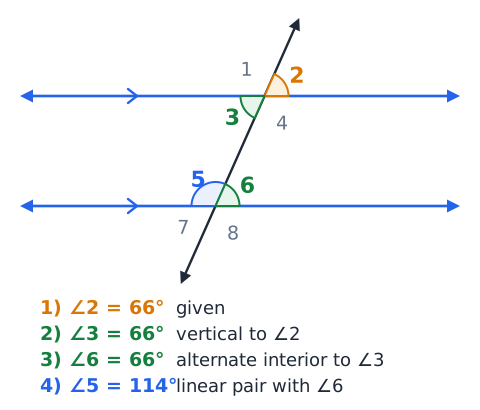
Harder problems chain relationships together. Suppose angle 2 is 66 degrees. Its vertical angle, angle 3, is also 66 degrees. Angles 3 and 6 are alternate interior, so angle 6 is 66 degrees. Angle 5 forms a linear pair with angle 6, so angle 5 is 114 degrees. Name the relationship at each step, and you can travel from any angle to any other.
Solving Algebraic Angle Equations
When angle measures are written as expressions, decide which relationship applies, then write the matching equation. Equal angles (vertical, corresponding, alternate) give one expression equal to the other. Complementary angles sum to 90; supplementary angles and linear pairs sum to 180. If vertical angles are (5x - 8) and (3x + 12) degrees, then
so x = 10 and each angle is 42 degrees. Finish by finding the quantity asked.
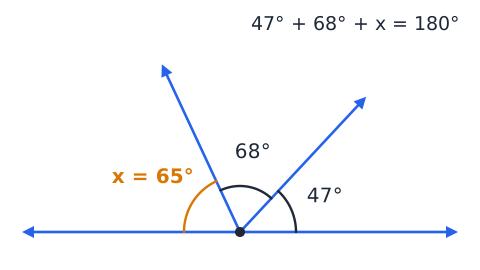
Several Adjacent Angles on a Line
When several adjacent angles fill a straight line, their measures total 180 degrees. If angles of 47, 68 and x degrees sit side by side along a line, then
The same idea works when the angles are given as algebraic expressions.
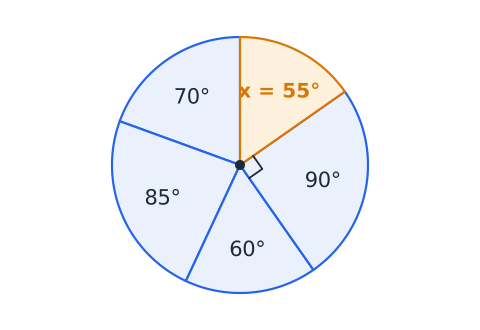
Angles Around a Point
Angles that completely surround a point without overlapping add up to 360 degrees. If five angles around a point measure 70, 85, 60, 90 and x degrees, then
Before using 360, make sure the angles neither overlap nor leave a gap.
Right-Angle and Parallel Constraints in Drawings
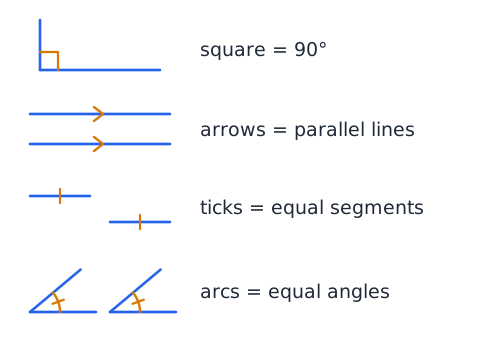
Diagram markings carry information that the drawing alone does not. A small square means 90 degrees, matching arrowheads mean parallel lines, and matching tick marks or arcs mean equal segments or angles. Do not assume two lines are parallel or perpendicular just because they look that way; test figures may not be drawn to scale. Use only the facts that are stated or marked.
Geometry Model: Identify → Pair → Equation → Check
Use a four-step routine. Identify: find the angles named in the question and mark what is known. Pair: name the relationship that connects them, such as vertical, linear pair, corresponding, or same-side interior. Equation: for equal-measure relationships, set one expression equal to the other; for sum relationships, set the total to 90, 180 or 360. Check: substitute your value back, confirm each angle is sensibly acute or obtuse, and answer the exact quantity asked.
Mental Arithmetic and Answer-Choice Checks
Subtract from 90 or 180 in friendly steps: 180 - 137 is 43 because
Estimate before solving: if an angle is clearly obtuse, discard acute answer choices. On algebra items you can plug each choice for x into both expressions and keep the one that fits the relationship. If the question asks for an angle rather than x, finish that last step.
Worked Example 1 — Intersecting Lines
Problem: Lines PQ and RS cross at point T, and angle PTR measures 57°. Find the other three angles.
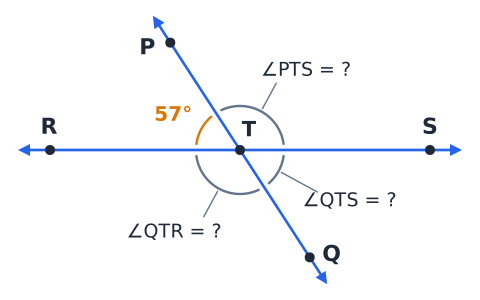
Step 1: Find angle QTS. It sits directly across from angle PTR, so the two are vertical angles. Vertical angles are always equal.
Step 2: Find angle PTS. It sits next to angle PTR along line RS, so together they make a straight line (a linear pair). A straight line measures 180°, so subtract.
Step 3: Find angle QTR. It is across from angle PTS, so it is a vertical angle and equals it.
Answer: Angle QTS = 57°, angle PTS = 123°, and angle QTR = 123°.
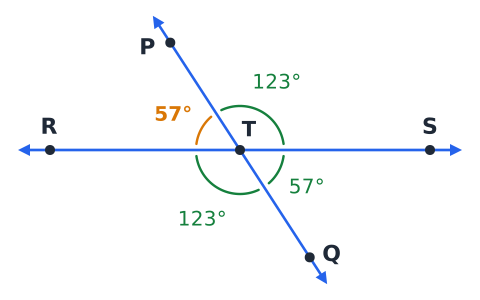
Check: All four angles around point T must add to 360°.
Worked Example 2 — Complementary Expressions
Problem: Two complementary angles measure (4x + 5)° and (x + 10)°. Find x and both angles.
Step 1: Complementary angles add up to 90°, so write an equation.
Step 2: Combine like terms. The x-terms give
and the numbers give
Step 3: Subtract 15 from both sides to get the x-term alone.
Step 4: Divide both sides by 5.
Step 5: Substitute x = 15 back into each expression.
Answer: x = 15, and the angles are 65° and 25°.
Check:
so the angles really are complementary.
Worked Example 3 — Corresponding Angles
Problem: Two parallel lines are cut by a transversal. A pair of corresponding angles measures (6x − 10)° and (4x + 18)°. Find x and the angle measure.
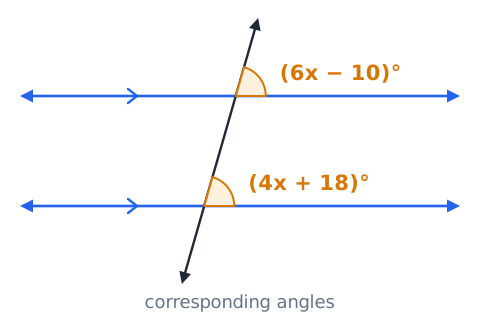
Step 1: When lines are parallel, corresponding angles are equal. Set the expressions equal.
Step 2: Subtract 4x from both sides so x appears on one side only.
Step 3: Add 10 to both sides.
Step 4: Divide both sides by 2.
Step 5: Substitute x = 14 into either expression.
Answer: x = 14, and each angle measures 74°.
Check: Use the other expression:
Both give 74°, so they match.
Worked Example 4 — Same-Side Interior Angles
Problem: Two parallel lines are cut by a transversal. Same-side interior angles measure (3x + 22)° and (2x + 8)°. Find both angles.
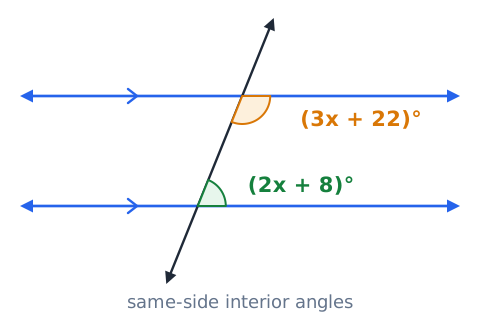
Step 1: Same-side interior angles between parallel lines are supplementary, which means they add to 180°.
Step 2: Combine like terms:
Step 3: Subtract 30 from both sides.
Step 4: Divide both sides by 5.
Step 5: Substitute x = 30 into each expression.
Answer: The angles are 112° and 68°.
Check:
so they are supplementary as required.
Worked Example 5 — Three Angles on One Line
Problem: Three angles sit side by side along a straight line. They measure 2x°, (x + 30)° and (3x − 6)°. Find each angle.
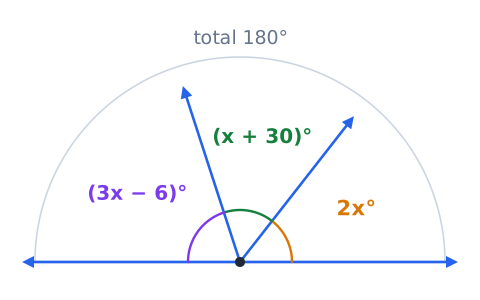
Step 1: Angles that together form a straight line add to 180°.
Step 2: Combine like terms. The x-terms:
The numbers:
Step 3: Subtract 24 from both sides.
Step 4: Divide both sides by 6.
Step 5: Substitute x = 26 into each expression.
Answer: The angles are 52°, 56° and 72°.
Check:
They fill the straight line exactly.
Worked Example 6 — Bisector and Supplement
Problem: Ray OK bisects angle JOL, and each half measures (x + 9)°. Angle JOL forms a linear pair with an angle of (2x + 42)°. Find angle JOL.
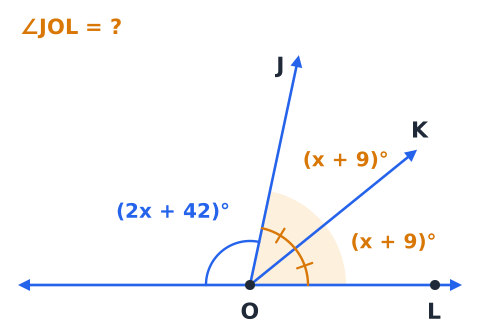
Step 1: Bisect means cut into two equal halves. So the whole angle JOL is two halves.
Step 2: A linear pair forms a straight line, so the two angles add to 180°.
Step 3: Combine like terms:
Step 4: Subtract 60 from both sides, then divide by 4.
Step 5: Substitute x = 30 into the expression for angle JOL.
Answer: Angle JOL measures 78°.
Check: The partner angle is
°, and
Each half is
°, and
Worked Example 7 — Vertical Angles Algebra
Problem: Two lines intersect. A pair of vertical angles measures (7x − 15)° and (4x + 18)°. Find all four angles.
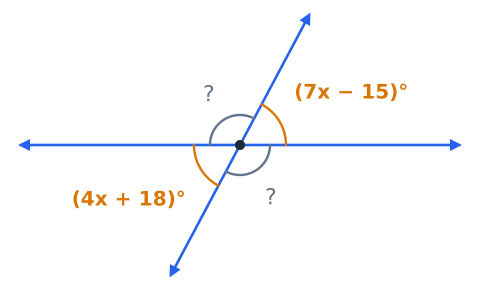
Step 1: Vertical angles are equal, so set the expressions equal.
Step 2: Subtract 4x from both sides.
Step 3: Add 15 to both sides, then divide by 3.
Step 4: Substitute x = 11 to find the vertical angles.
Step 5: Each neighboring angle forms a straight line with a 62° angle, so subtract from 180°.
Answer: The vertical angles are 62° each, and the other two angles are 118° each.
Check:
which matches. Also
Worked Example 8 — Point Rotation with Four Regions
Problem: Four angles surround a point without overlapping. They measure 2x°, 3x°, 95° and 115°. Find the two unknown angles.
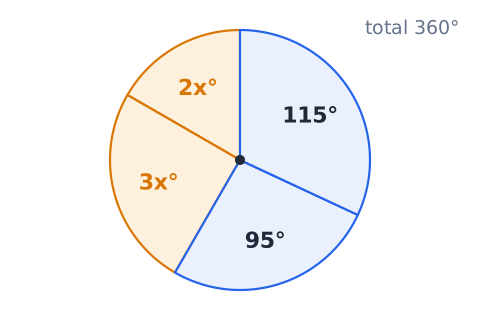
Step 1: Angles all the way around a point add to 360°.
Step 2: Combine like terms:
Step 3: Subtract 210 from both sides, then divide by 5.
Step 4: Substitute x = 30.
Answer: The unknown angles are 60° and 90°.
Check:
Frequent ASVAB-Style Angle Mistakes
Mixing up complement and supplement: subtracting from 180 when the question says complementary gives an answer 90 degrees too large, so tie complementary to 90 and supplementary to 180. Assuming same-side interior angles are equal: between parallel lines they add to 180 instead. Stopping at x: many items ask for an angle, and the value of x is often planted among the choices. Trusting appearance: lines are parallel only when stated or marked. Citing a fact that is always true, such as equal vertical angles, as proof of parallel lines. Forgetting to double a bisected half when the whole angle is asked.
Rapid Review and Final Checklist
Acute angles are under 90 degrees, right angles are 90, obtuse angles fall between 90 and 180, and straight angles are 180. Complementary angles total 90; supplementary angles, linear pairs and angles along a line total 180; angles around a point total 360. Vertical angles are equal, and a bisector creates two equal halves. With parallel lines and a transversal, corresponding, alternate interior and alternate exterior angles are equal, while same-side interior angles are supplementary. Identify the relationship, write one equation, solve, and answer the exact quantity asked.
 English ▾