 ASVAB Camp
Lesson Goal
In this lesson you will learn to evaluate powers, apply the rules for multiplying, dividing and raising powers, and interpret zero and negative exponents. You will also find square and cube roots, recognize perfect squares, simplify radicals, and read, write and calculate with scientific notation, all without a calculator, the way the ASVAB expects.
What an Exponent Means
An exponent tells how many times a base is used as a factor. In , the base 2 appears five times:
It is repeated multiplication, not base times exponent, so is not 10.
Squares and Cubes
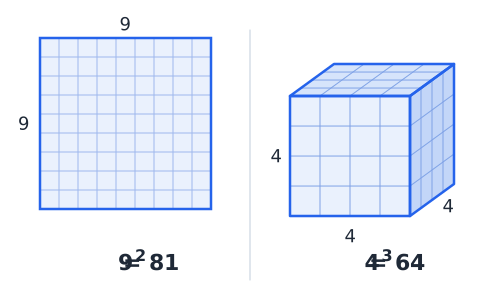
An exponent of 2 is called squared and an exponent of 3 is called cubed. For example,
Memorizing squares through and cubes through saves time on the test.
Product Rule for Exponents
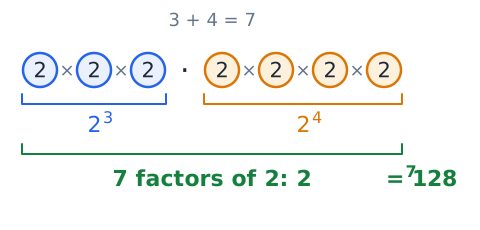
When multiplying powers with the same base, keep the base and add the exponents:
For example,
Quotient Rule for Exponents
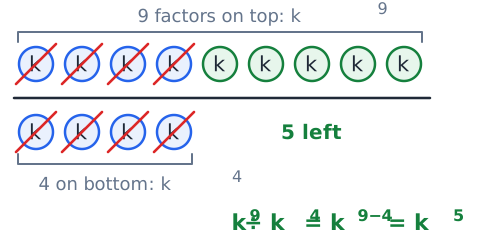
When dividing powers with the same base, keep the base and subtract the bottom exponent from the top one:
with a not zero. For example,
Power of a Power
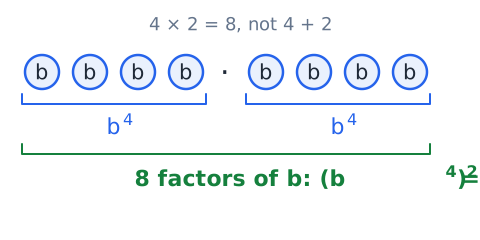
When a power is raised to another power, multiply the exponents:
For example,
not .
Power of a Product
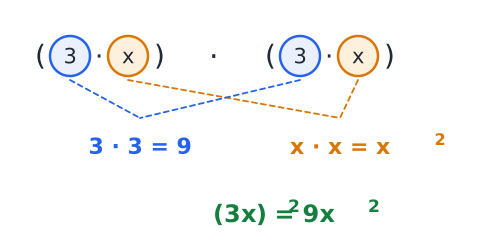
An exponent outside parentheses applies to every factor inside:
For example,
Zero Exponents
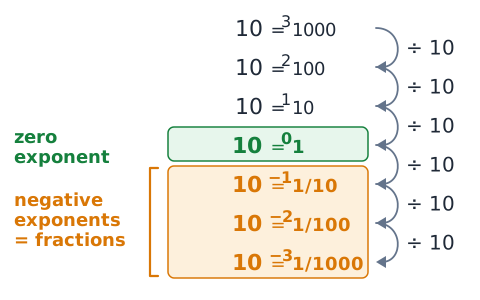
Any nonzero number raised to the zero power equals 1:
This follows from the quotient rule, since
and also equals 1. So
Negative Exponents
A negative exponent means take the reciprocal of the base with a positive exponent:
For example,
A negative exponent makes a fraction, never a negative number.
Negative Bases and Parentheses
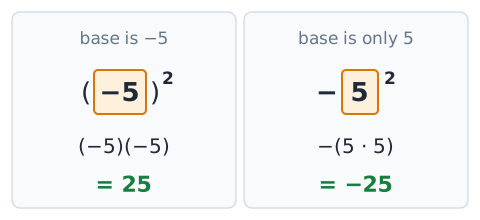
Parentheses show whether the minus sign belongs to the base.
because −5 is squared, but
because only 5 is squared. Also,
Square Roots
A square root of a number is a value that, multiplied by itself, gives that number. The radical sign means the principal, nonnegative root, so
even though is also 49. Square roots of negative numbers are not real numbers, so expect only nonnegative inputs on the test.
Perfect Squares
A perfect square is the square of a whole number: 1, 4, 9, 16, 25, 36, 49, 64, 81, 100, 121, 144, 169, 196, 225. Their roots are whole numbers. Roots of other numbers fall between neighbors, such as the root of 30, which lies between 5 and 6.
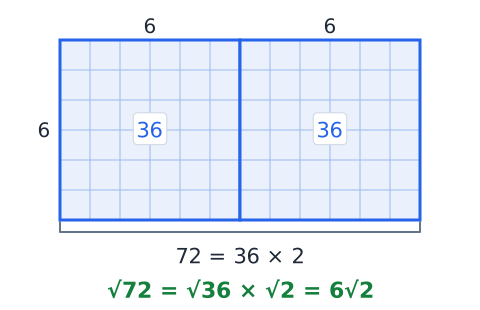
Simplifying Square Roots
Split the number into a perfect-square factor times what remains, then take the root of the perfect square:
For example,
Cube Roots
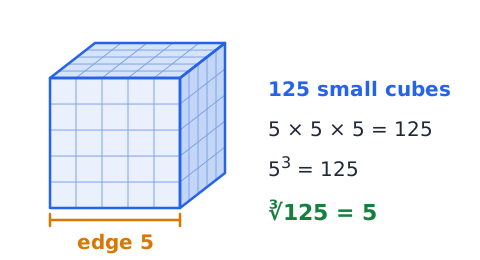
A cube root is a number that, used as a factor three times, gives the original number. So
Unlike square roots, cube roots of negative numbers are real:
because
Scientific Notation
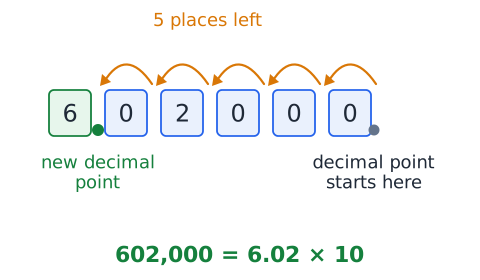
Scientific notation writes a number as a factor from 1 up to but not including 10, times a power of ten. Large numbers get positive exponents and small numbers get negative ones. For example, 602,000 is .
Scientific Notation to Standard Form
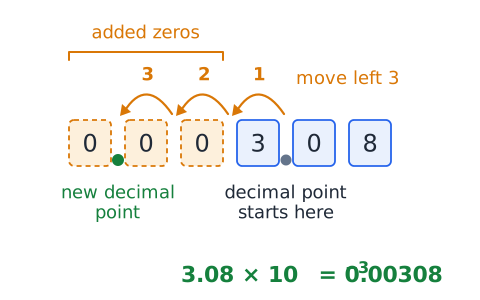
To convert back, move the decimal point by the exponent: right for positive, left for negative. So becomes 0.00308.
Multiplying Scientific Notation
Multiply the front numbers and add the exponents, then adjust if the front is 10 or more. For example,
Dividing Scientific Notation
Divide the front numbers and subtract the exponents:
Estimate Powers and Roots
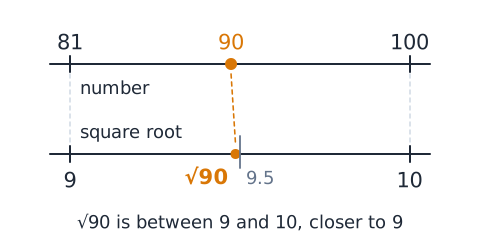
Bracket a root between perfect squares to check answer choices. Since 81 is less than 90 and 90 is less than 100, is between 9 and 10, and closer to 9. Any choice outside that range can be eliminated at once.
Worked Example 1 — Exponent Laws
Problem: Simplify .
Step 1: Power of a power: multiply the exponents.
Step 2: Multiplying same bases: add the exponents.
Step 3: Dividing same bases: subtract the exponents.
Answer: .
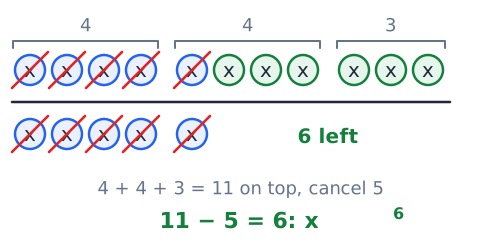
Check: Count the x's. The top has
x's multiplied together. Canceling 5 of them with the bottom leaves 6.
Worked Example 2 — Negative Exponent
Problem: Evaluate .
Step 1: A negative exponent means "take the reciprocal." Flip it into a fraction with a positive exponent.
Step 2: Work out the square.
Step 3: Change to a decimal. Multiply top and bottom by 4 to get hundredths.
Answer: , or 0.04. It is positive: a negative exponent does not make the number negative.
Check:
so 0.04 really is 1 divided by 25.
Worked Example 3 — Radical Simplification
Problem: Simplify .
Step 1: Find the largest perfect square that divides 48. Try 4, 9, 16, 25... 16 divides 48, since
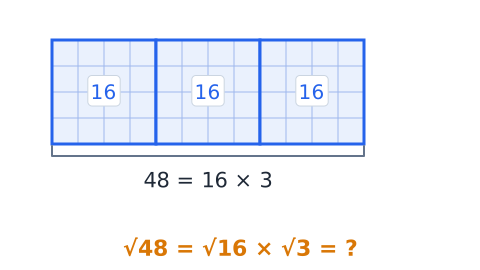
Step 2: Split the root into two roots.
Step 3: Take the root of the perfect square.
Answer: .
Check: Square the answer.
Using 4 instead of 16 (
) gives , which is not fully simplified.
Worked Example 4 — Scientific Notation Product
Problem: Find .
Step 1: Multiply the front numbers.
Step 2: Multiply the powers of 10 by adding the exponents.
Step 3: Put them together.
Step 4: Scientific notation needs a front number from 1 to just under 10. Write 35 as 3.5 × 10, which adds 1 to the exponent.
Answer: , which is 3,500.
Check: In ordinary numbers, is 10,000 and is 0.01. So the problem is
Worked Example 5 — Scientific Notation Quotient
Problem: Find .
Step 1: Divide the front numbers. Since
the answer is 4.
Step 2: Divide the powers of 10 by subtracting the exponents.
Step 3: Put them together. The front number 4 is between 1 and 10, so no adjustment is needed.
Answer: , which is 400,000.
Check: Multiply back.
giving the original top number.
Common Exponent and Root Traps
Multiplying the base by the exponent: is 81, not 12. Adding exponents when you should multiply them:
not . Multiplying exponents when you should add:
Thinking
it equals 1. Reading a negative exponent as a negative number:
Leaving a front number of 10 or more in scientific notation: rewrite 12 as 1.2 and raise the exponent by one.
Quick Review
An exponent counts repeated factors. With the same base, add exponents when multiplying, subtract them when dividing, and multiply them for a power of a power. An outside exponent applies to every factor in a product. Any nonzero base to the zero power is 1, and means . Parentheses decide whether a negative sign is part of the base. The radical sign gives the nonnegative square root; simplify by pulling out perfect-square factors. Cube roots of negatives are negative. In scientific notation, keep the front number from 1 up to 10, multiply fronts and add exponents for products, and divide fronts and subtract exponents for quotients.
 English ▾