ASVAB Camp Get the appGoogle Play
MK · lesson 4 of 14 · 37 min

Algebraic Expressions

Before you can solve equations, you need to read and reshape expressions fluently. This lesson opens with the vocabulary of terms, variables, coefficients and constants, then shows how to identify and combine like terms, apply the distributive property, and manage negative signs in front of parentheses and nested grouping.

Video lesson: Algebraic Expressions

Video transcript

0:00 Welcome to this explainer. Look, if you're gearing up for the ASVAB and feeling that familiar pang of math anxiety, especially since you literally are not allowed to use a calculator on this part of the test, you are in exactly the right place. Today, we're going to translate algebra into a simple, really reliable toolkit, so you can confidently solve these questions entirely by hand, or even in your head. Okay, let's dive right into this. Here is our roadmap for today. We've got six simple sections, the basics of expressions, combining and distributing, substituting and multiplying, factoring and dividing polynomials, worked examples and traps, and finally, a check yourself section to prove you've got this. All right, section one, the basics of expressions. This is basically the alphabet of math. So before we do any actual math, let's look at how this language works. Take the expression 5x squared minus 3y plus 8. An expression is really just built from terms joined by plus or minus signs. Here, x and y are our variables, you know, the letters that stand in for unknown numbers. The numbers multiplying those variables, we call those coefficients.

1:08 In this case, that's 5 and negative 3, and that 8, just sitting there by itself at the end, is the constant. Now, here's a super crucial thing to remember. The sign in front of a term always belongs to it. That's exactly why the coefficient for y is negative 3, not just 3. Combining and distributing. This is where we use our first tools to clean up messy expressions. When we talk about combining like terms, the rule is strict, okay. They absolutely must have the exact same variables raised to the exact same powers. If they do, you just add or subtract the coefficients and keep the variable exactly as it is. So let's look at 9y plus 4 minus 2y minus 7. We group our y's together. 9y minus 2y is 7y. Then we group our constants. 4 minus 7 is negative 3. Stick it all together and our cleaned up final expression is 7y minus 3. Pretty simple, right? Okay, section 3, substituting and multiplying. Let's level up that toolkit. So to multiply two binomials, those are the expressions sitting inside the parentheses.

2:13 We use a handy memory trick called FOIL. It's a lifesaver because it ensures every single term in the first parentheses multiplies every term in the second. First, outer, inner, last. Let's try it with x plus 3 times x plus 5. We multiply the first terms to get x squared. The outer terms give us 5x. The inner terms give us 3x. And the last terms give us 15. Finally, we just combine those middle like terms, the 5x and 3x. And boom, we have our final expression, x squared plus 8x plus 15. Factoring and dividing polynomials. Sometimes we have to reverse the process. Factoring is kind of like un-distributing what we just did. And there's one specific math identity you absolutely need to memorize for the ASVAB. The difference of two squares. Whenever one perfect square is subtracted from another, it splits beautifully into a sum times the difference. Meaning, a squared minus b squared is equal to a minus b times a plus b. So take 9x squared minus 16. Both of those are perfect squares. So it factors out cleanly to 3x minus 4 times 3x plus 4.

3:19 But a quick heads up. A sum of two squares, like x squared plus 16, does not factor this way. All right, section 5 worked examples and traps. It's time to test out this toolkit. Since you're doing this without a calculator, you really want to memorize this 5-step simplification sequence. It's basically a checklist that keeps you from getting overwhelmed. First, clear any grouping symbols by distributing. Second, collect your like terms. Third, write the result in standard form, meaning the highest power goes first. Fourth, factor it if the question asks for it. And fifth, check your work. You can actually substitute a simple number like x equals 1 into your answer and the original question just to make sure they match. Actually, before we hit the examples, here's a really crucial distinction. You have to know the difference between expressions, which you just simplify, and equations, which you can actually solve. See, an expression like 3x plus 2 has no equal sign. You just tidy it up. But an equation, like 3x plus 2 equals 11 has that equal sign. That means you can actually isolate the variable and solve for x.

4:24 Always, always read the question carefully, so you know which one you're dealing with. Now, test writers absolutely love setting traps for you. Here are the biggest ones to watch out for. First, do not combine unlike terms. 3x and 2x squared do not miraculously become 5x cubed. No way. Second, when distributing, do not stop at the first term. Also, if there's a minus sign in front of parentheses, you have to flip every single sign inside, not just the first one. Oh, and always use parentheses when squaring negative numbers. Also, remember that a plus b squared has a middle term, 2ab, do not drop it. And finally, if you're dealing with fractions, you can only cancel entire factors. Never individual terms separated by a plus or minus. Let's see this in action. In example 1, we have negative 3 times the group 2w minus 5 plus 4w. Watch how we distribute carefully here. Negative 3 times 2w is negative 6w, and negative 3 times negative 5 flips to a positive 15. We combine our w's and we get negative 2w plus 15.

5:31 In example 2, we've got nested groups. The golden rule here, always start with the innermost groups first. So, distribute that negative 3 inside, simplify the bracket to negative 2x minus 3, and then distribute the outside negative 2. It cleans up beautifully to 4x plus 11. Examples 3 and 4 are all about fractions and negative substitution. In example 3, fractional coefficients just need a common denominator. So, we convert everything to tenths. 4 minus 1 plus 5 gives us 8 tenths, which simplifies down to 4 fifths t. In example 4, we plug in x equals negative 2. The massive takeaway here is that negative values must be protected with parentheses before squaring. Negative 2 squared is positive 4. Multiply by 3 to get 12, subtracting negative 8 becomes plus 8. So, 12 plus 8 plus 1 equals 21. Look at examples 5 and 6. Our toolkit is doing all the heavy lifting. In 5, we use FOIL to get 2x squared plus 12x minus 3x minus 18. Combine the middle terms, and we've got 2x squared plus 9x minus 18.

6:38 Example 6 is that perfect execution of factoring a difference of 2 squares we talked about earlier. 25y squared is just the square of 5y, and 49 is the square of 7. So, it cleanly factors to 5y minus 7 times 5y plus 7. See? We've got this. Now, example 7 proves you must factor completely before canceling. We have x squared minus 16 all over 2x plus 8. So, we factor the top as a difference of squares and factor a 2 out of the bottom. Suddenly, we have identical x plus 4 factors on both the top and the bottom. Only now can we cancel them out, leaving us with x minus 4 over 2. Oh, and we have to note any values that would make that original bottom 0, which means x cannot equal negative 4. And finally, section 6, check yourself. You have built up this toolkit step-by-step. You know the traps. So, let's finish off with two practice questions directly from the study guide. Here's question one. Which expression is equivalent to negative 4 times the quantity 3 minus 2y?

7:43 Take a quick second to mentally work through those steps. Did you get it? The answer is negative 12 plus 8y, because you absolutely must faithfully distribute that negative sign to both of the inside terms. Negative 4 times 3 is negative 12, and negative 4 times negative 2y flips the sign to positive 8y. Awesome. Let's look at question 2. What is the exact value of 5n minus 8 when n equals negative 3? Take a beat to do the mental math. Just remember the most important rule of substitution. The answer is negative 23. Placing that substituted value strictly in parentheses is the ultimate toolkit secret that will save you every single time. 5 times negative 3 gives you negative 15. Subtract 8 more, and you land right at negative 23. You just navigated the rules of algebra, dodged the common traps, and solved these completely without a calculator. So, I'll leave you with this. What other math topics are you ready to absolutely conquer? Now that algebra isn't so scary. Keep practicing, trust your toolkit, and you're going to do great.

Visual lesson

Lesson slides

14 slides
Algebraic Expressions – slide 1 of 14

Goal and ASVAB Relevance

This lesson teaches you to read algebraic notation and work with expressions confidently. You will identify terms and coefficients, combine like terms, distribute across parentheses, substitute values, multiply monomials and binomials, factor out common factors and differences of squares, and simplify rational expressions while noting which values are not allowed.

Mathematics Knowledge questions often ask which expression is equivalent to another. These skills, built on signed numbers and exponents, are what you need to answer them quickly and to solve equations in later lessons.

Terms, Variables, Coefficients and Constants

An expression is built from terms joined by plus or minus signs. In there are three terms. A variable is a letter that stands for a number, such as x or y. A coefficient is the number multiplying a variable: 5 and −3 here. A constant is a term with no variable, such as 8. The sign in front of a term belongs to it.
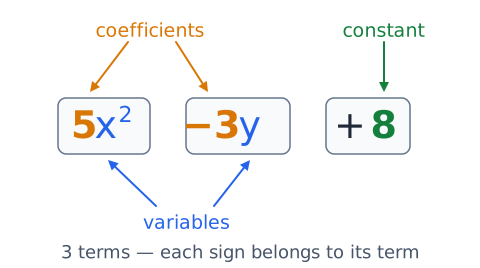
The expression 5x² − 3y + 8 with its three terms boxed: coefficients 5 and −3, variables x and y, and the constant 8; each sign belongs to its term.

Like Terms: Same Variable Parts, Same Powers

Like terms have exactly the same variables raised to exactly the same powers; only the coefficients may differ. So and are like terms. But and are not, because the exponents sit on different letters. Constants are like terms with each other.

Combining Like Terms Correctly

To combine like terms, add or subtract their coefficients and keep the variable part unchanged. In , group

and

giving . The exponents never change when you combine terms.
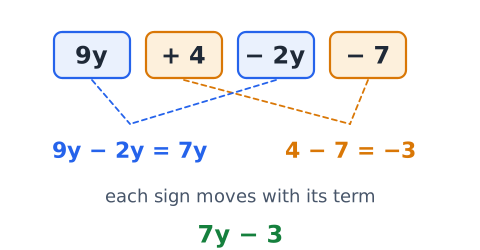
The terms 9y, +4, −2y and −7 sorted by colour: 9y − 2y = 7y and 4 − 7 = −3, each sign moving with its term, giving 7y − 3.

The Distributive Property

The distributive property says

Multiply the outside factor by every term inside the parentheses. For example,

and

Missing even one term changes the answer.
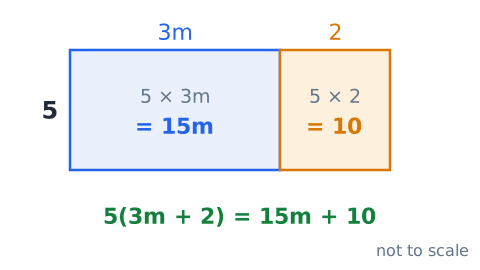
Area model for 5(3m + 2): a rectangle of height 5 split into parts 3m and 2 wide, with areas 15m and 10, so 5(3m + 2) = 15m + 10.

Negative Signs Before Parentheses

A minus sign in front of parentheses acts like multiplying by −1, so every sign inside flips. For example,

Change every term, not just the first.
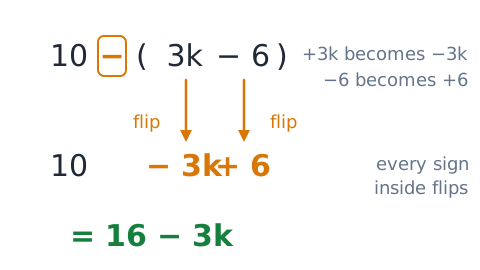
10 − (3k − 6) rewritten as 10 − 3k + 6: the minus in front flips both signs inside, giving 16 − 3k.

Multiple Distributions and Nested Grouping

Distribute each factor to its own group, then combine:

With nested symbols, simplify the innermost group first and work outward.

Substitution: Evaluate an Expression

To evaluate an expression, replace each variable with its given value and then follow the order of operations. Put each substituted value in parentheses so signs stay attached. For example, at n = 3 is

At

n = −2

it is

Substitution With Powers and Signed Values

When a negative value is squared, the parentheses matter. If

x = −3
then

not −9. So

Square first, then multiply.

Fractions as Algebraic Coefficients

Fractional coefficients combine like any fractions. Rewrite them over a common denominator, then add or subtract the numerators:

Exponents in Products of Monomials

To multiply monomials, multiply the coefficients, then multiply each variable by adding its exponents. For example:

Here 4 times 5 is 20, a has exponents 3 + 1, and b has exponents 1 + 2. A letter without a written exponent has exponent 1.

Multiplying Two Binomials

To multiply two binomials, every term in the first must multiply every term in the second. A common memory aid is FOIL: first, outer, inner, last. For : first , outer , inner , last 15. Combine the middle terms:
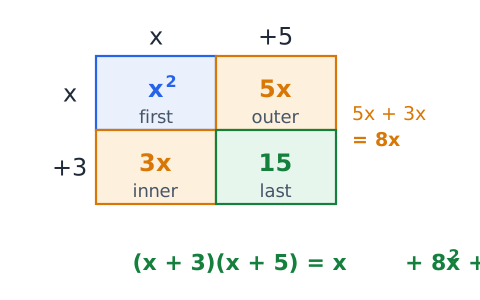
Box method for (x + 3)(x + 5): cells x² (first), 5x (outer), 3x (inner) and 15 (last); 5x + 3x = 8x, so the product is x² + 8x + 15.

Factoring Out the Greatest Common Factor

Factoring reverses distribution. Find the largest number and the highest power of each variable that divide every term, write that outside, and put what remains inside. For the GCF is , so the result is . Check by distributing back.
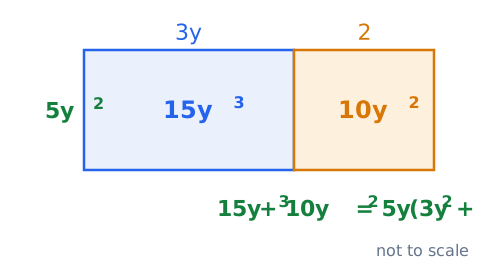
Factoring as a reverse area model: a rectangle of height 5y² split into widths 3y and 2 with areas 15y³ and 10y², so 15y³ + 10y² = 5y²(3y + 2).

Difference of Two Squares

When one perfect square is subtracted from another, it factors as a sum times a difference:

For example,

A sum of two squares does not factor this way.
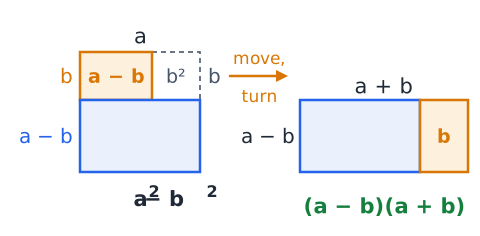
A square of side a with a b-by-b corner removed leaves area a² − b²: a strip a − b by b and a rectangle a by a − b; moving and turning the strip makes a rectangle a + b by a − b, so a² − b² = (a − b)(a + b).

Simplifying Rational Expressions Safely

A rational expression is a fraction with polynomials on top and bottom. Factor both parts completely, then cancel only identical factors. For example:

The original expression is undefined when the denominator is zero, so the simplified form is valid only for

Never cancel single terms across a plus or minus sign: is not 6.
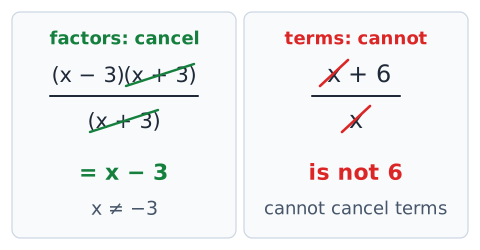
Two panels: (x − 3)(x + 3) over (x + 3) cancels the matching (x + 3) factors to give x − 3 for x ≠ −3; (x + 6) over x cannot cancel the x's, so it is not 6.

Dividing a Polynomial by a Monomial

Divide each term of the polynomial by the monomial separately:

The last term becomes 1, not 0, because 4x divided by 4x is 1.

Equivalent Forms and Algebraic Identities

Two expressions are equivalent when they give the same value for every allowed input. A few identities appear often enough to memorize:
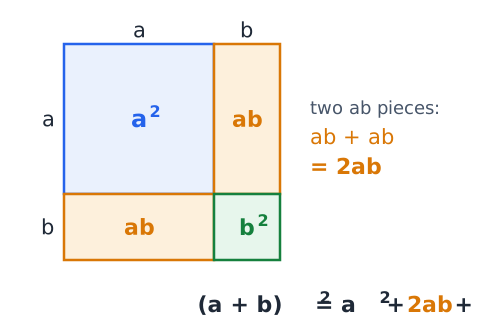
Area model of (a + b)²: a square of side a + b split into a² (a by a), two ab rectangles and b² (b by b); the two ab pieces make 2ab, so (a + b)² = a² + 2ab + b².

Note that is not ; the middle term 2ab is easy to forget. To test whether a choice is equivalent, plug in a simple number such as 2 and compare values.

No-Calculator Simplification Sequence

Follow the same order each time. First clear grouping symbols by distributing, flipping signs after any minus in front of parentheses. Second, collect like terms, constants included. Third, write the result in standard form with the highest power first. Fourth, factor if the question asks for a factored form. Finally, check by substituting a small value such as x = 1 into the original and your answer; matching values strongly suggest you are right.

Distinguish Expressions From Equations

An expression, such as , has no equals sign; you simplify, evaluate or factor it, but you cannot solve it. An equation, such as

states that two expressions are equal and can be solved for x. Read the question stem carefully: simplify asks for an equivalent expression, while solve asks for a value.

Example 1 — Signed Terms and Distribution

Problem: Simplify .

Step 1: Distribute −3 to each term inside the parentheses. Watch the signs.

So the expression becomes:

Step 2: Combine like terms. The w-terms go together.

Answer: .

Check: Try w = 1. Original:

−3(2 − 5) + 4 = −3(−3) + 4 = 9 + 4 = 13

Answer:

−2 + 15 = 13

They match.

Example 2 — Nested Distribution

Problem: Simplify .

Step 1: Start with the innermost parentheses. Distribute −3 to x and to 1.

Step 2: Simplify inside the brackets by combining the x-terms.

Step 3: Distribute −2 to everything in the brackets. A negative times a negative is positive.

Step 4: Add the 5 in front and combine the numbers.

Answer: .

Check: Try x = 0. Original: 5 − 2[0 − 3(1)] =

5 − 2(−3) = 5 + 6 = 11

Answer:

0 + 11 = 11

They match.

Example 3 — Fractional Coefficients

Problem: Simplify .

Step 1: All three terms have t, so we only need to combine the fractions. Find a common denominator: 10 works for 5, 10 and 2.

Step 2: Rewrite each fraction in tenths.

Step 3: Combine the tops.

Step 4: Reduce by dividing top and bottom by 2.

Answer: .

Check: Try t = 10. Original:

4 − 1 + 5 = 8

Answer:

They match.

Example 4 — Evaluate With a Negative Input

Problem: Evaluate at

x = −2

Step 1: Substitute −2 for every x. Use parentheses so the signs stay correct.

Step 2: Square first. A negative times a negative is positive.

Step 3: Multiply the middle term. Negative times negative is positive.

Step 4: Add everything up.

Answer: 21.

Check: Every term ended up positive (12, 8 and 1), so a positive answer makes sense. A common mistake is writing (−2)² as −4, which would give

−12 + 8 + 1 = −3

Example 5 — Binomial Expansion

Problem: Expand .

Step 1: Multiply each term in the first parentheses by each term in the second (First, Outer, Inner, Last).
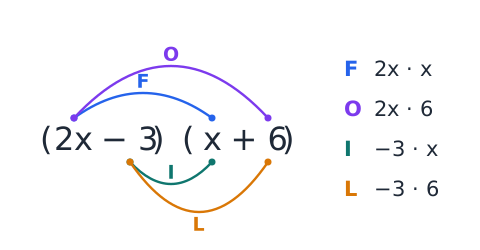
FOIL arcs for (2x − 3)(x + 6): First 2x · x, Outer 2x · 6, Inner −3 · x, Last −3 · 6.

Step 2: Write all four products together.

Step 3: Combine the like terms in the middle.

Answer: .

Check: Try x = 1. Original: (2 − 3)

(1 + 6) = (−1)
(7) = −7

Answer:

2 + 9 − 18 = −7

They match.

Example 6 — Factoring a Difference of Squares

Problem: Factor .

Step 1: Notice the form. It is one perfect square minus another, called a difference of squares.

Step 2: Write each part as something squared.

Step 3: Use the pattern: a² − b² = (a − b)(a + b), with a = 5y and b = 7.

Answer: .

Check: Multiply back with FOIL.

The middle terms cancel, giving the original.

Example 7 — Rational Expression With a Restriction

Problem: Simplify .

Step 1: Factor the top. It is a difference of squares, since 16 = 4².

Step 2: Factor the bottom. Both terms share a factor of 2.

Step 3: Cancel the common factor x + 4 from top and bottom.

Step 4: State the restriction. The original bottom is 0 when

x = −4

so x cannot be −4, even though the factor was canceled.

Answer: , with

Check: Try x = 0. Original:

−16 ÷ 8 = −2

Answer:

(0 − 4) ÷ 2 = −2

They match.

Common Algebraic Expression Traps

Combining unlike terms, such as treating as ; these terms cannot be combined. Distributing to only the first term: is , not . Flipping only the first sign after a minus:

Squaring a negative input without parentheses. Writing as . Canceling terms instead of factors in a fraction, and forgetting the excluded values.

Quick Review

Terms are separated by plus and minus signs; each has a coefficient and a variable part, or is a constant. Combine only like terms, which share identical variables and powers. Distribute a factor to every term in parentheses, and flip every sign after a leading minus. When evaluating, put substituted values in parentheses and follow the order of operations. Multiply monomials by multiplying coefficients and adding exponents. Multiply binomials so that each term meets each term, then combine. Factor by pulling out the GCF, and recognize

Simplify rational expressions by factoring and canceling common factors, and state values that make the original denominator zero. Check equivalence by substituting a number.

Quick review

Name the terms, coefficients and constant in .
Terms are the parts joined by + or −: , and 9. Coefficients multiply the variables: 7 and −4 (the sign belongs to the term). The constant is the term with no variable: 9.
What are like terms, and how are they combined?
Like terms have identical variables raised to identical powers, such as and . Add the coefficients and keep the variable part: . Terms like and x cannot be combined.
Distributive property: what about a minus before parentheses?
: multiply the outside factor by every term inside. A leading minus flips every sign inside: .
Evaluating at x = −4: why use parentheses?
Write . Without parentheses you might get −16 for the square. Put every substituted value in parentheses, then follow the order of operations.
How do you multiply two binomials (FOIL)?
Multiply each term of one binomial by each term of the other (first, outer, inner, last), then combine like terms: .
How does a difference of two squares factor?
. Example: . A sum of two squares, such as , does not factor this way.
Is equal to ?
No. and ; the middle term 2ab is easy to drop. Test a = 1, b = 2: 9 versus 5.
How do you simplify a rational expression safely?
Factor top and bottom, then cancel only common factors, never single terms across + or −: , valid only for x ≠ 2, since the original denominator cannot be zero.

What next?

← Previous: Exponents, Roots and Scientific Notation

About this lesson

You will evaluate expressions by substitution, including powers and signed inputs, work with fractional coefficients, multiply monomials and two binomials, factor out a greatest common factor, and recognize the difference of two squares. Later sections cover simplifying rational expressions safely, dividing a polynomial by a monomial, equivalent forms, and the difference between an expression and an equation. A no-calculator simplification sequence gives you a repeatable order of steps.

Seven examples range from nested distribution to a rational expression with a domain restriction. Algebra is a steady part of Mathematics Knowledge, one of the AFQT subtests, so this material pays off. Allow around 37 minutes, then take the lesson test.

Take it with you: the free app

The same 124 lessons, 6,516 questions and 82 timed practice tests on your phone, plus flashcards with spaced review and progress tracking. Free to download, and it works offline.

  • Works offline
  • Spaced-review flashcards
  • Progress for every subtest
  • Menus in 59 languages
ASVAB Camp appGoogle Play