ASVAB Camp Get the appGoogle Play
MK · lesson 2 of 14 · 31 min

Signed Numbers: Positive and Negative Values

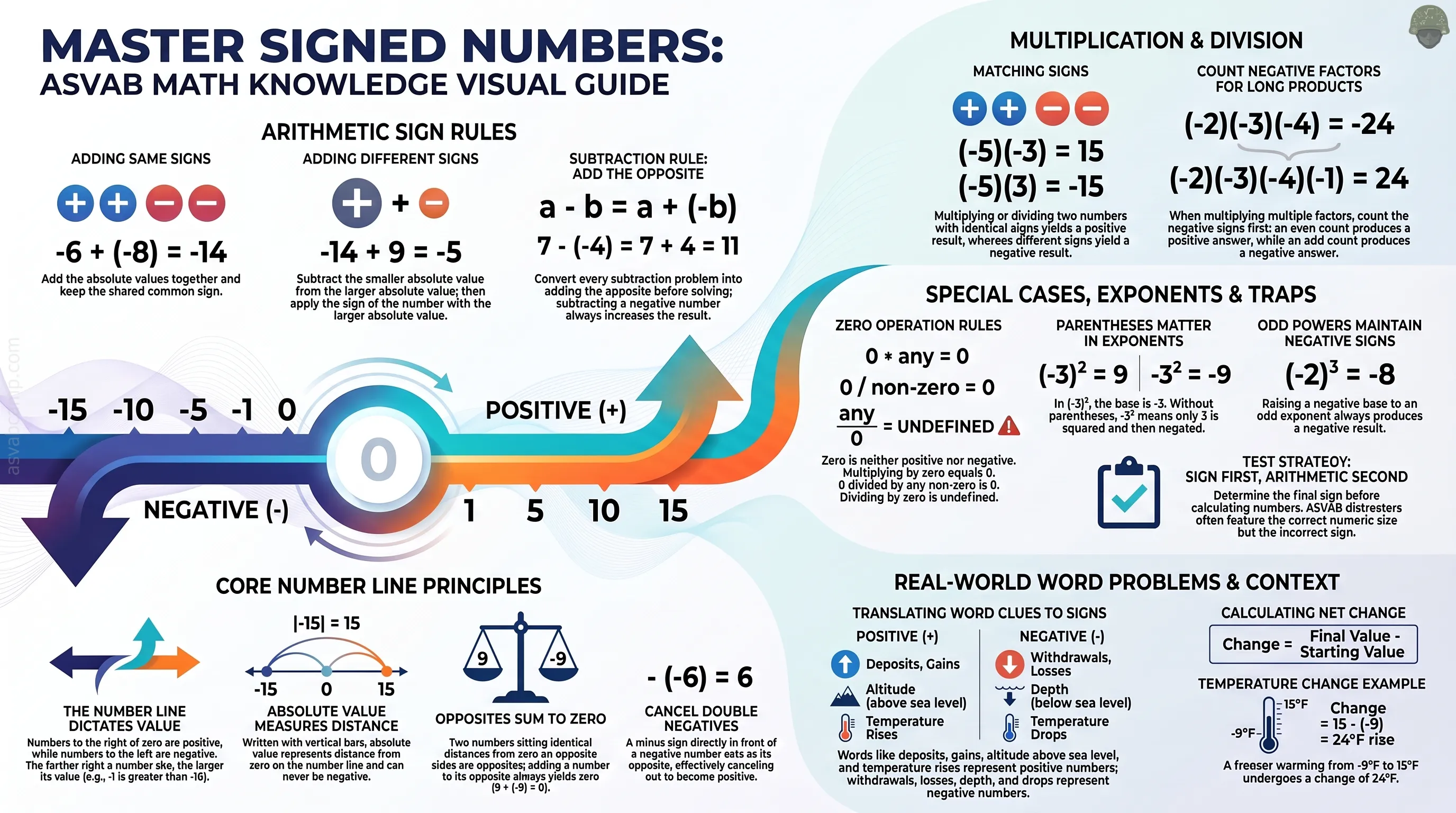
Sign errors are among the most common reasons test takers miss math questions they actually understand. This lesson tackles that problem head-on, starting with signed numbers on the number line, opposites and absolute value, then working through the rules for adding numbers with the same and different signs, subtracting, multiplying and dividing.

Video lesson: Signed Numbers

Video transcript

0:00 Welcome to this explainer. Okay, today we're tackling something absolutely crucial for the ASVAB mathematics knowledge subtest. And that is signed numbers. Look, if you've ever felt a little, you know, uneasy when a bunch of negative signs suddenly show up in an equation, trust me, you are in the exact right place. We all know the ASVAB doesn't allow calculators. That means every single operation has to be done by hand or right in your head. But seriously, don't worry, by the time we wrap up here, we're going to build your confidence so you can handle these questions smoothly, completely on your own. All right, let's take a really quick look at our roadmap. We've got six bite-size steps. The basics of signed numbers, adding and subtracting rules, multiplying, dividing, and zero, advanced operations and context, worked examples and traps, and then we'll finish up with some check yourself practice questions. So let's jump right into section one, the basics of signed numbers. To really master signed numbers, it helps to just picture a horizontal number line. Zero sits right there in the middle. Positive numbers go off to the right and negative numbers go off to the left.

1:00 The farther right a number is, the larger it is. Pretty straightforward, right? Now let's talk about absolute value. That's the one written with those two vertical bars. Absolute value is honestly just a measurement of distance from zero. And think about it, because it's a distance, it can literally never be a negative number. You can't walk negative miles. So the absolute value of negative 15 is 15. And the absolute value of positive 15 is also 15, because both of those numbers are exactly 15 units away from zero. Now this right here brilliantly illustrates a common trap that trips up a lot of test takers. When you're looking at negative numbers, a bigger absolute value actually means a smaller overall number. I know, that sounds weird, but why is that? It's because it sits further to the left on the number line. So negative 10 is actually less than negative one. Even though 10 feels bigger than one, negative 10 is way farther left, which makes its true value smaller. Adding and subtracting rules, let's see how we actually use these numbers.

2:03 Okay, here is your golden rule for addition. When you're adding numbers, always check their signs first. For same signs, when both numbers share a sign, like negative six plus negative eight, you literally just add their sizes together. Six plus eight is 14, and keep that common negative sign. Two losses just make a bigger loss, right? So the answer is negative 14. But check out different signs. For negative 14 plus nine, the signs differ. Here, you subtract the smaller size from the larger one. 14 minus nine is five. Then you just keep the sign of the number with the larger absolute value. Since 14 is larger than nine and it was negative, our final answer is negative five. Now, for subtraction, the crucial point is this. Subtracting a signed number is basically just adding the opposite. Let's take seven minus negative four. You just turn that subtraction into addition and flip that negative four to a positive four. So it becomes seven plus four, which equals 11. Subtracting a negative always, always increases your result. It's just a simple mental trick that instantly turns a kind of confusing subtraction problem into an easy addition one.

3:11 All right, section three, multiplying, dividing, and zero. Let's add these to our toolkit. The absolutely great news here is that multiplication and division follow the exact same sign rules. If the signs are the same, your result is positive. For example, negative six times negative four equals a positive 24. If the signs are different, your result is negative. But hey, what if you're multiplying a really long string of numbers? Don't panic. Just count the negative factors. An even count of negative numbers gives you a positive answer. And an odd count gives you a negative answer. Figure out the sign first. Then just multiply the actual numbers. Now, let's take a second to look at the unique behavior of zero, because zero is a special case on the ASVAB. It's neither positive nor negative. If you multiply anything by zero, you get zero. But division, that's where they're going to try to trick you. Zero divided by any non-zero number, like negative five, is just zero. But if zero is in the denominator, meaning you're trying to divide a number by zero, like negative five divided by zero, the answer is undefined.

4:12 You simply cannot divide by zero. There's no answer. Let's step it up a notch with section four, advanced operations, and context. Okay, pay close attention, because this is one of the most classic traps on the entire math subtest. Parentheses are what decide what gets raised to the power. If we have negative two enclosed in parentheses raised to the fourth power, the base is that whole negative two. Since it's an even power, the negative cancels itself out, giving us a positive 16. But look at negative two to the fourth power without parentheses. Here, the base is only the two. You calculate two to the fourth power to get 16, and then that negative sign just gets attached to the very end, leaving you with negative 16. Always, always check for parentheses. When you run into word problems, the signs are often hiding in plain English. Words like deposits, gains, or a temperature rise, those mean positive numbers. Withdrawals, losses, or temperature drops, those are your negative numbers. And if a question asks for a change, remember it's always the final value minus the starting value. But most importantly, I really want you to adopt this strategy.

5:18 Sign first, arithmetic second. Figure out if your answer should be positive or negative before doing the heavy mental math. A lot of the wrong multiple choice options have the right number, but the wrong sign. This one defensive habit will literally help you cross out wrong answers instantly. Worked examples and traps. Let's see this in action. Let's take this one careful mental step at a time, just like you would on the test. Step one, we need to evaluate negative eight plus negative six minus negative three. For step two, let's tackle that tricky subtraction at the end. We know subtracting a negative is the exact same as adding a positive, so let's rewrite the equation as negative eight plus negative six plus three. Much better. Step three, let's combine the negative numbers first. Negative eight plus negative six gives us a bigger negative, negative 14. Finally, negative 14 plus three. The signs are different, so we subtract three from 14 to get 11, and we keep the sign of the larger absolute value, which was the negative 14. So the final answer is negative 11.

6:22 All right, let's look at another one. And this one features that exponent trap we talked about. Step one, evaluate eight minus three times negative two squared. Order of operations absolutely protects us here. We have to do the exponent before we multiply or subtract. So in step two, negative two inside parentheses squared is a positive four. Mentally rewriting, we have eight minus three times four. Step three, multiply first, three times four is 12. And finally, in step four, we do the subtraction. Eight minus 12 gives us our answer, which is negative four. So let's quickly summarize these common pitfalls. Think of this as your mental checklist. First, don't confuse negative three squared without parentheses with negative three squared inside parentheses. Huge difference. Second, don't forget to change minus a negative into a plus. Third, remember that on a number line, negative 10 is further left. So it's actually smaller than negative two. And finally, absolute value is distance. It can never ever be a negative answer. Keep these tucked in your brain and you're going to spot the test's tricks way before you fall for them.

7:24 And now, section six, check yourself practice questions. It's time to prove to yourself just how much you've mastered. What is negative nine plus four? Are the options a negative five, b negative 13, c 13, or d five? Go ahead and pause this explainer right now. Solve it in your head using the rules we just went over and then hit play when you're ready for the answer. Okay, if you picked a negative five, excellent job. Let's break down exactly why. We are adding numbers with different signs. The rule says we subtract their absolute values. Nine minus four is five. Then we look at the original numbers to see which had the larger absolute value. Nine is bigger than four and that nine was negative. So we keep the negative sign. The answer is indeed negative five. Let's try one more. Question two, which of the following has the least value? A negative six, b negative one, c the absolute value of negative 14, or d negative 11. Take a moment, pause the explainer, find the smallest value out of the group, and lock in your answer.

8:33 And the correct answer is d negative 11. Did you happen to spot the traps in that one? Option c is an absolute value, which means it actually evaluates to a positive 14. So that is definitely not the smallest. Out of the remaining negative numbers, negative 11 is the farthest to the left on the number line. Remember, among negatives, the one with the bigger absolute value is actually the smaller number. See? With just these few foundational rules, you really can conquer any signed number question without a calculator. But you know, signed numbers are really just the beginning. So what other hidden math tricks are waiting to be unlocked in your ASVAB prep? Keep practicing, keep building that confidence, and thanks so much for joining me for this explainer.

Visual lesson

Lesson slides

16 slides
Signed Numbers – slide 1 of 16

Lesson Goal

By the end of this lesson you should be able to place positive and negative numbers on a number line, compare them, and find absolute values. You will also add, subtract, multiply and divide signed integers, fractions and decimals, handle powers of negative numbers, and keep the signs straight inside multi-step expressions.

Signed Numbers on the Number Line

Picture a horizontal line with 0 in the middle. Positive numbers sit to the right of zero and negative numbers sit to the left. The farther right a number is, the larger it is. So 4 lies four units right of zero, while −4 lies four units left of zero, the same distance on the other side.
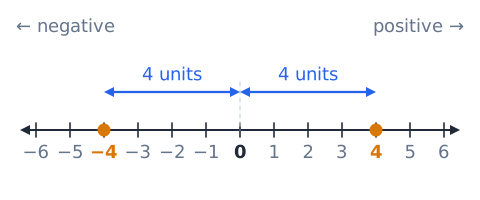
Number line from −6 to 6 with 4 and −4 marked; each is 4 units from zero, negatives to the left and positives to the right.

Opposites

Two numbers are opposites when they sit the same distance from zero on opposite sides, such as 9 and −9. The opposite of a number is written with a leading minus sign. A number plus its opposite always equals zero:

Absolute Value

Absolute value measures distance from zero, so it can never be negative. It is written with vertical bars. For example,

and

because both numbers are 15 units from zero. Also,
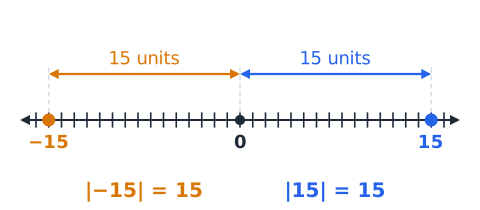
Number line from −16 to 16: −15 and 15 are each 15 units from zero, so |−15| = 15 and |15| = 15.

Adding Numbers With the Same Sign

When both numbers share a sign, add their absolute values and keep that common sign. Two gains make a bigger gain; two losses make a bigger loss. For example,

6 + 8 = 14
and

The answer is never closer to zero than either number.
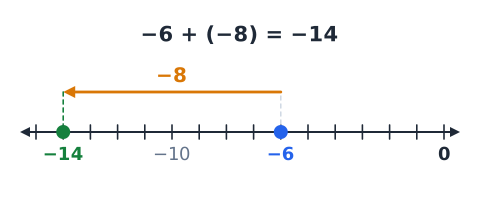
Number line from −15 to 0: start at −6 and move 8 left to −14, showing −6 + (−8) = −14.

Adding Numbers With Different Signs

When the signs differ, subtract the smaller absolute value from the larger one. The answer takes the sign of the number with the larger absolute value. For : 14 minus 9 is 5, and 14 belongs to the negative number, so the sum is −5.
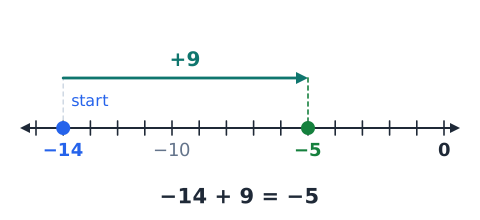
Number line from −15 to 0: start at −14, move 9 right to −5, showing −14 + 9 = −5.

Subtracting Signed Numbers

Turn every subtraction into addition of the opposite, then use the addition rules. For example,

and

Subtracting a negative always increases the result.
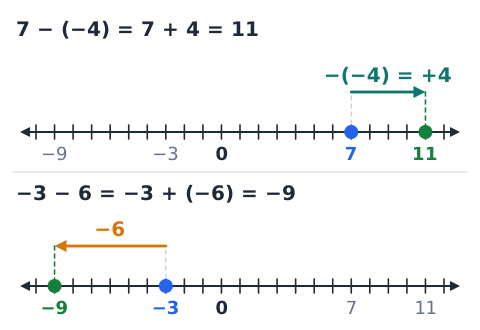
Two number lines from −10 to 12: 7 − (−4) = 7 + 4 starts at 7 and moves 4 right to 11; −3 − 6 = −3 + (−6) starts at −3 and moves 6 left to −9.

Multiplying Signed Numbers

Multiply the absolute values, then decide the sign. Same signs give a positive product; different signs give a negative product. So

but

With several factors, count the negatives: an even count gives a positive answer, an odd count gives a negative one.
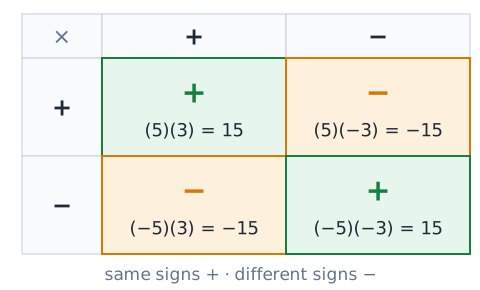
Sign table for multiplying: same signs give a positive product, (5)(3) = 15 and (−5)(−3) = 15; different signs give a negative product, (5)(−3) = −15 and (−5)(3) = −15.

Dividing Signed Numbers

Division follows the same sign rules as multiplication. Divide the absolute values, then use like signs for a positive answer and unlike signs for a negative answer. For example,

and

Zero and Signed Operations

Zero is neither positive nor negative. Adding zero changes nothing, and any number times zero is zero:

Zero divided by a nonzero number is zero, as in

Dividing by zero, however, is undefined, so has no answer.

Ordering Signed Numbers

On a number line, a number to the left is always smaller. That means every negative number is less than zero and less than every positive number. Among negatives, a bigger absolute value means a smaller number: −10 is less than −1.
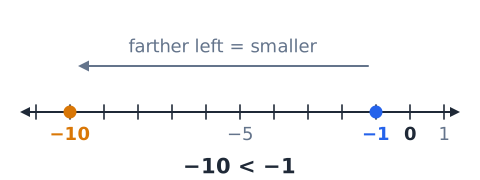
Number line from −11 to 1 with −10 and −1 marked; −10 is farther left, so −10 < −1.

Double Negatives

A minus sign in front of a negative number means the opposite of that negative, which is positive. So

Two negative signs side by side cancel each other.

Order of Operations With Signed Numbers

Signs do not change the order of operations. Work powers first, then multiply and divide, then add and subtract:

Powers of Negative Numbers

Parentheses decide what gets raised to the power. In the base is −2, so the result is 16. In the base is only 2, and the minus is applied afterward, giving −16. A negative base with an odd exponent stays negative:
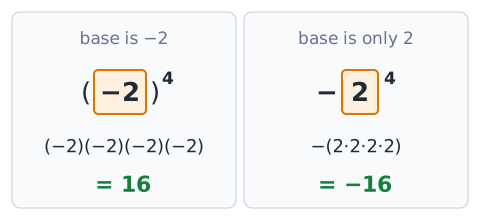
Two panels: in (−2)^4 the base −2 is boxed, (−2)(−2)(−2)(−2) = 16; in −2^4 only the 2 is boxed, −(2·2·2·2) = −16.

Signed Fractions and Decimals

Fractions and decimals follow the same sign rules as integers. Find a common denominator, then combine:

For decimals,

Signed Quantities in Context

Word problems often hide signs in words. Deposits, gains, altitude above sea level and temperature rises are positive; withdrawals, losses, depth below sea level and drops are negative. A change is always found by computing final value minus starting value.
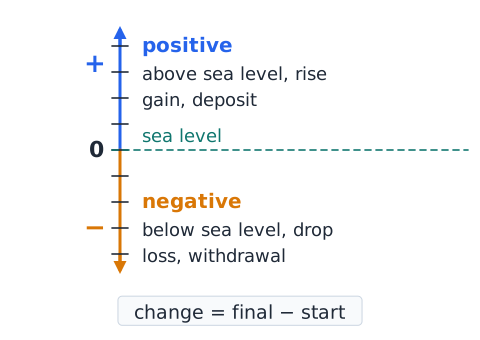
Vertical number line with 0 at sea level: up is positive (above sea level, rise, gain, deposit), down is negative (below sea level, drop, loss, withdrawal); change = final − start.

Sign First, Arithmetic Second

On the test, settle the sign before you calculate. Count negative factors or compare absolute values first, then do the arithmetic. Many wrong choices have the right size but the wrong sign, so this habit removes them quickly.

Worked Example 1 — Mixed Addition and Subtraction

Problem: Evaluate .

Step 1: Change subtracting a negative into adding a positive. Minus a negative 3 is plus 3.

Step 2: Add the two negatives. Same signs: add the sizes and keep the negative sign.

Step 3: Add 3. Different signs: subtract the sizes (

14 − 3 = 11

) and keep the sign of the larger size, which is negative.

Answer: −11.

Check: On a number line, start at −8, move 6 left to −14, then 3 right to −11.
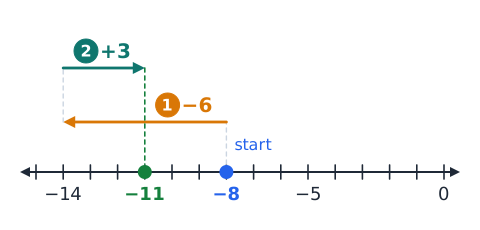
Number line: start at −8, step 1 moves 6 left to −14, step 2 moves 3 right to −11.

Worked Example 2 — Product of Several Signed Factors

Problem: Find .

Step 1: Count the negative factors: −2, −1 and −4. That is 3 negatives, an odd number, so the answer is negative.

Step 2: Multiply the sizes, ignoring signs.

Step 3: Attach the sign from Step 1.

Answer: −24.

Check: Multiply left to right, one pair at a time.

Worked Example 3 — Subtracting Negatives in a Chain

Problem: Evaluate .

Step 1: Rewrite each subtraction as adding the opposite. Minus 3 becomes plus −3, and minus −10 becomes plus 10.

Step 2: Work left to right. Add the two negatives first.

Step 3: Add 10. Different signs:

10 − 8 = 2

and the larger size (10) is positive.

Answer: 2.

Check: Start at −5, move 3 left to −8, then 10 right to 2.
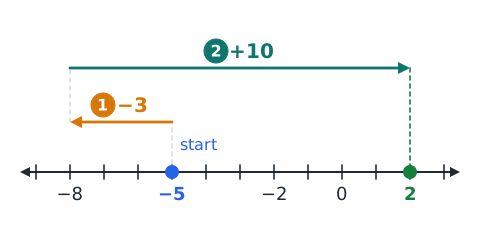
Number line: start at −5, step 1 moves 3 left to −8, step 2 moves 10 right to 2.

Worked Example 4 — Exponent Trap

Problem: Evaluate .

Step 1: Do the exponent first (order of operations). The base is −2, because it is inside the parentheses. A negative times a negative is positive.

Step 2: Multiply next.

Step 3: Subtract last.

Answer: −4.

Check: Common traps give other numbers. Doing 8 − 3 first gives

5 × 4 = 20

which is wrong. Squaring as −4 gives

8 + 12 = 20

also wrong. Only the exponent-first order gives −4.

Worked Example 5 — Temperature Change

Problem: A freezer reads −9°F and warms to 15°F. How much did the temperature change?

Step 1: Change is always final minus start.

Step 2: Subtracting a negative is the same as adding a positive.

Answer: The temperature rose 24°F.

Check: Count on a thermometer. From −9 up to 0 is 9 degrees. From 0 up to 15 is 15 degrees.
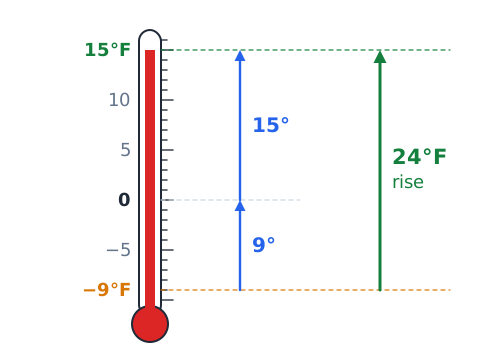
9 + 15 = 24
Thermometer from −9°F to 15°F: 9 degrees up to 0 plus 15 degrees up to 15 makes a 24°F rise.

Common Signed-Number Traps

Trap one: treating as . Without parentheses, only 3 is squared, so

while

Always check whether the minus sign is inside the parentheses.

Trap two: forgetting to change the sign when subtracting a negative. Rewrite as before computing.

Trap three: thinking −10 is greater than −2 because 10 is greater than 2. On the number line, −10 is farther left, so it is smaller.

Trap four: giving an absolute value a negative answer. Distance cannot be negative, so

Trap five: losing track of the sign in a long product. Count the negative factors and decide the sign before multiplying.

Quick Review

Numbers to the right on the number line are larger, so negatives are always less than zero and less than positives. Absolute value is distance from zero and is never negative. Add like signs by adding sizes and keeping the sign; add unlike signs by subtracting sizes and keeping the sign of the larger size. Subtract by adding the opposite. Multiply or divide sizes, then use the rule: same signs positive, different signs negative. Zero times anything is zero, and division by zero is undefined. A negative base raised to an even power is positive, but is always negative for nonzero a. Find a change as final minus start.

Quick review

Adding two signed numbers: what are the rules?
Same signs: add the absolute values and keep the common sign (−7 + (−5) = −12). Different signs: subtract the smaller absolute value from the larger and keep the sign of the larger (−12 + 5 = −7).
How do you subtract a signed number?
Add its opposite: a − b = a + (−b). So 5 − (−8) = 5 + 8 = 13 and −4 − 7 = −4 + (−7) = −11. Subtracting a negative always makes the result larger.
Sign rules for multiplying and dividing signed numbers?
Work with the absolute values, then attach the sign: like signs give a positive result, unlike signs a negative one. Examples: (−6)(−4) = 24 and −42 ÷ 7 = −6.
Product of many signed factors: how do you find the sign fast?
Count the negative factors first. An even count gives a positive product; an odd count gives a negative one. (−1)(−2)(−3)(5) has three negatives, so it equals −30.
Is the same as ?
No. In only 3 is squared and then negated, giving −9. In the base is −3, giving 9. An odd power of a negative base is negative: .
Which is greater, −12 or −3?
−3, because it lies to the right of −12 on the number line. Among negative numbers, the one with the larger absolute value is the smaller number.
What happens with zero in signed operations?
Zero is neither positive nor negative. Any number times 0 is 0, and 0 divided by a nonzero number is 0, but division by 0 is undefined, so 7 ÷ 0 has no answer.
How do you compute a change, such as a temperature change?
Change = final value − starting value. From −6°F to 11°F: 11 − (−6) = 17, a rise of 17°F. A negative result means the quantity decreased.

What next?

← Previous: Number Properties and Divisibility

About this lesson

You will also practice ordering signed values, untangling double negatives, applying the order of operations, and handling powers of negative numbers, where parentheses change everything. Sections on signed fractions and decimals and on signed quantities in context, such as temperature change, connect the rules to word problems. A habit called Sign First, Arithmetic Second ties it together, and five worked examples, from a product of several factors to an exponent trap, show the method in action.

The Mathematics Knowledge subtest counts toward the AFQT, and almost every algebra item later in this course assumes you handle signs without hesitation. Set aside roughly 31 minutes, then try the lesson test to measure your accuracy.

Take it with you: the free app

The same 124 lessons, 6,516 questions and 82 timed practice tests on your phone, plus flashcards with spaced review and progress tracking. Free to download, and it works offline.

  • Works offline
  • Spaced-review flashcards
  • Progress for every subtest
  • Menus in 59 languages
ASVAB Camp appGoogle Play