 ASVAB Camp
Learning outcomes and General Science boundaries
By the end of this lesson you should be able to state the main ideas of cell theory, tell prokaryotic cells from eukaryotic cells, and match common organelles to their jobs. You should also be able to compare typical plant and animal cells, predict which way water moves across a membrane, and explain how ATP, photosynthesis and aerobic respiration fit together.
Finally, you will separate mitosis, meiosis and binary fission and arrange the levels of organization from cell to organ system. The lesson stays at the depth a General Science item expects, not a college biology course.
Why cell biology matters for ASVAB General Science
The General Science subtest samples both physical and life science, and cells are the starting point for most life science ideas. Questions about disease, nutrition, genetics, plant growth and even body systems all lean on knowing what a cell is and what its parts do.
Cell items also reward careful reading. A single word such as nucleus, membrane or ribosome often decides the answer, so a clear mental map of the cell turns many questions into quick points.
Cell theory: three durable principles
Cell theory rests on three statements. First, every living organism is made of one or more cells; a bacterium is one cell, while a person is trillions. Second, the cell is the smallest unit that carries out all the activities of life. Third, new cells come only from cells that already exist, by division.
Notice what the theory does not say. It does not claim that all cells look alike, that every cell has chloroplasts, or that cells form spontaneously from nonliving chemicals inside a body.
What a cell actually does
A living cell is busy. It takes in nutrients and water, releases energy from food molecules, and uses that energy to build proteins, membranes and other parts. It removes wastes, responds to signals such as hormones or light, and keeps its internal conditions within a workable range.
Many cells also grow and divide. Consider a cell lining your small intestine: it absorbs sugars, burns some for energy, makes digestive enzymes, and is replaced every few days by division of neighboring cells. All of those are cellular activities.
Universal features of cellular life
Despite huge variety, cells share four basic features (a few specialized cells, such as mature human red blood cells, later lose their DNA). Each cell is surrounded by a plasma membrane, it is filled with cytoplasm, it stores its genetic instructions in DNA, and it has ribosomes for making proteins.
These shared features are a good test-day anchor. If an answer choice claims some true cell has no DNA, no membrane or no ribosomes, that choice is almost certainly wrong.
Prokaryotes: no membrane-bound nucleus
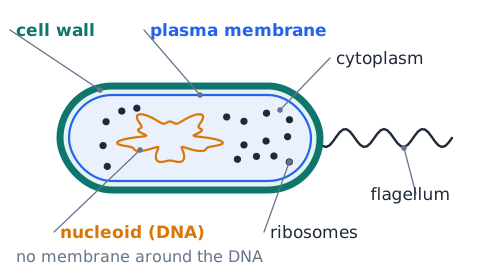
Prokaryotes, the bacteria and archaea, are usually small and simple. Their DNA sits in a region called the nucleoid with no membrane around it. They lack membrane-bound organelles such as mitochondria and Golgi, yet they still have a plasma membrane, cytoplasm, ribosomes and DNA. Most also have a cell wall outside the membrane, and some have a flagellum for swimming.
Eukaryotes: compartmentalized cells
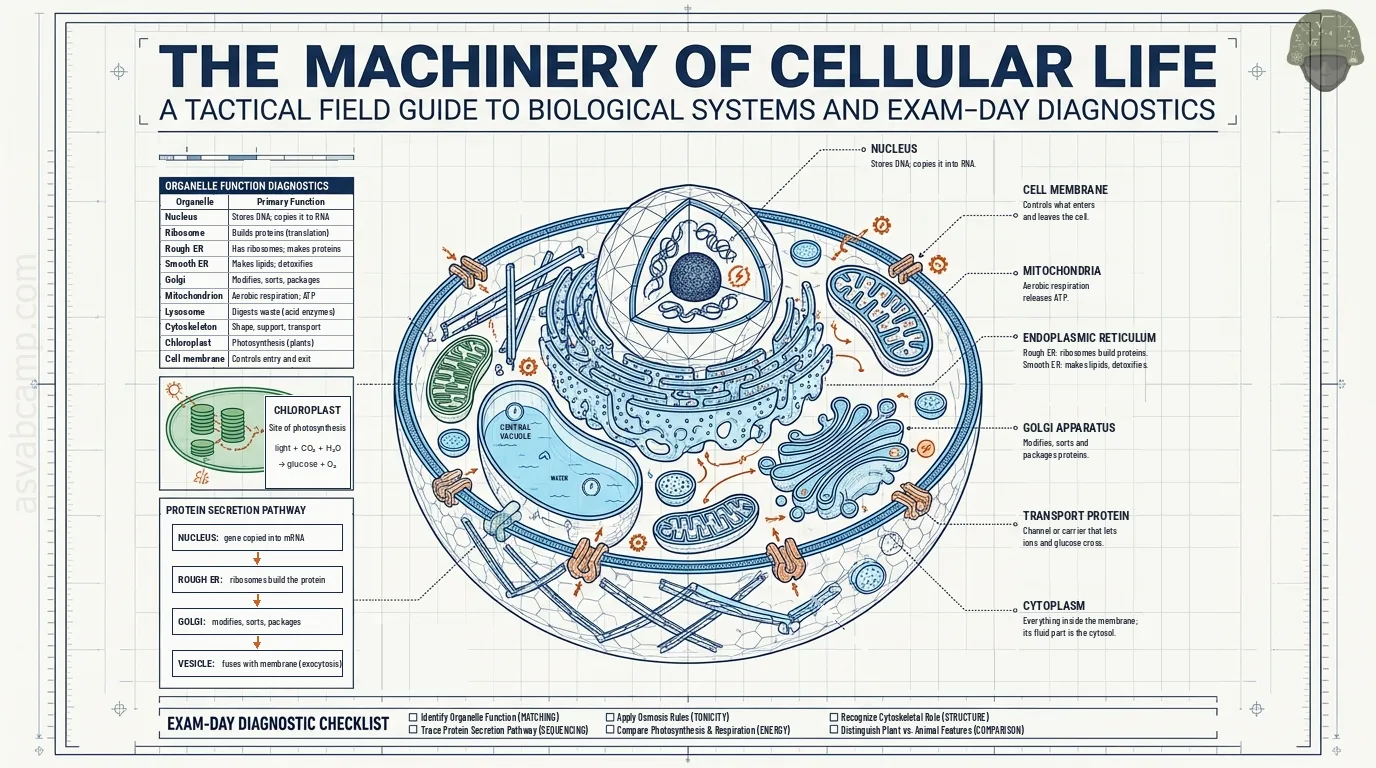
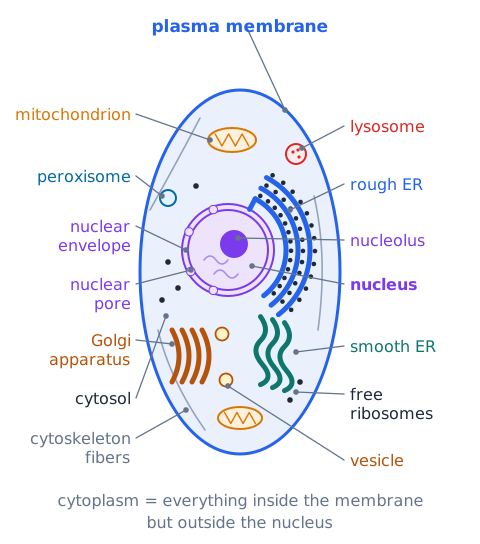
Eukaryotic cells keep their DNA inside a true nucleus wrapped in a membrane. They also contain other membrane-bound compartments, such as mitochondria, endoplasmic reticulum, Golgi apparatus and, in plants and algae, chloroplasts. Each compartment can hold its own chemical conditions, so different jobs run side by side without interfering.
Animals, plants, fungi and protists are all eukaryotes. Their cells are usually much larger than a typical bacterium.
Example 1 — classify an unknown cell
Scenario: a lab report describes a tiny cell with a cell wall, ribosomes, a circular DNA molecule loose in the cytoplasm, and no internal membranes. Is it prokaryotic or eukaryotic?
Step 1: look for a membrane-bound nucleus. None is present. Step 2: look for other membrane-bound organelles. None are present. Step 3: the cell wall and ribosomes do not settle the question, since both cell types can have them.
Answer: the cell is prokaryotic, most likely a bacterium.
Cell membrane: selectively permeable boundary
The plasma membrane is a thin double layer of phospholipids with proteins embedded in it. Its main job is to control what enters and leaves the cell. Small uncharged molecules such as oxygen and carbon dioxide slip through easily, while ions and larger molecules like glucose need protein channels or carriers.
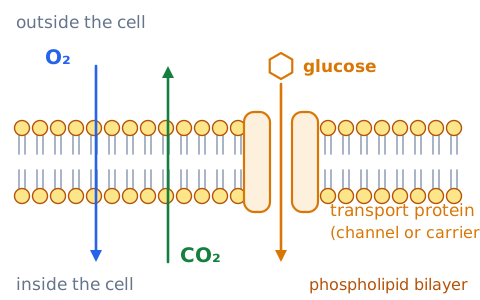
Because it lets some substances pass and blocks others, the membrane is called selectively permeable. Every cell, from bacterium to neuron, has one.
Cytoplasm and cytosol
In a eukaryotic cell, the cytoplasm is everything inside the plasma membrane but outside the nucleus. That includes the organelles and the fluid that surrounds them. The fluid part alone is called the cytosol, a watery gel packed with dissolved salts, sugars, amino acids and enzymes.
The cytoplasm is far from empty space. Many reactions happen there, including the first stage of glucose breakdown and the assembly of proteins by free ribosomes.
Nucleus and nuclear envelope
The nucleus is the control center of a eukaryotic cell because it stores most of the cell's DNA. A double membrane called the nuclear envelope surrounds it, and nuclear pores in that envelope let RNA and proteins move in and out.
Inside sits the nucleolus, a dense region where ribosome parts are assembled. The nucleus holds instructions and copies them into RNA, but it does not itself link amino acids into proteins.
DNA, chromosomes and genes: a preview
DNA is the long molecule that stores hereditary information. In eukaryotes it is wrapped around proteins and packaged into chromosomes; human body cells carry 46 of them. A gene is a stretch of DNA that holds the instructions for one product, often a protein.
Think of a chromosome as a volume in a reference set and a gene as one entry within it. The genetics lesson will build on this picture.
Ribosomes: the protein-assembly machinery
Ribosomes are small particles made of RNA and protein. They read a messenger RNA copy of a gene and join amino acids, one at a time, into a chain that folds into a protein. This step is called translation.
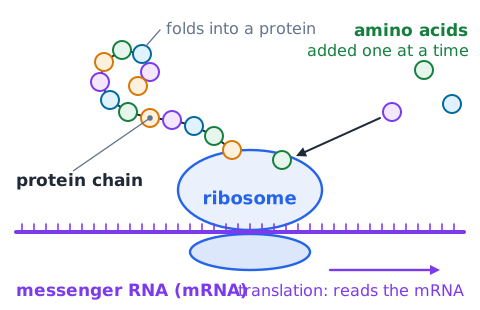
Ribosomes are not surrounded by a membrane, which is why even bacteria have them. In eukaryotes some float free in the cytosol, making proteins used inside the cell, while others attach to the rough endoplasmic reticulum.
Rough endoplasmic reticulum (RER)
The rough endoplasmic reticulum is a network of flattened membrane sacs connected to the nuclear envelope. It looks bumpy under the electron microscope because ribosomes stud its outer surface.
Those ribosomes make proteins destined for export, for the plasma membrane, or for organelles such as lysosomes. As each new chain is built, it is threaded into the RER interior, where it begins folding and may receive sugar groups.
Smooth endoplasmic reticulum (SER)
The smooth endoplasmic reticulum is continuous with the rough ER but has no ribosomes on its surface. Its main jobs are making lipids, including membrane phospholipids and steroid hormones, and detoxifying drugs and poisons. Liver cells, which process alcohol and medicines, have a large amount of SER. In muscle cells it also stores calcium ions that trigger contraction.
Golgi apparatus: modify, sort and package
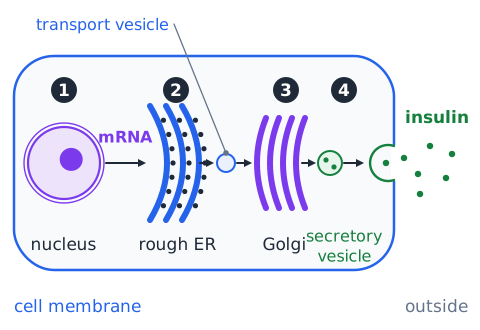
The Golgi apparatus is a stack of flattened membrane sacs that acts like a shipping department. It receives proteins and lipids from the ER in small vesicles, trims or adds chemical groups, and sorts the finished products by destination.
Products leave the Golgi in new vesicles. Some travel to the plasma membrane for release outside the cell, some become part of the membrane, and some carry enzymes to lysosomes.
Example 2 — trace a secreted protein
Scenario: a cell in the pancreas releases the hormone insulin, which is a protein. What route does the insulin take?
Step 1: the gene is copied into messenger RNA in the nucleus. Step 2: a ribosome on the rough ER builds the protein chain into the ER interior. Step 3: a vesicle carries it to the Golgi, which processes and packages it. Step 4: a secretory vesicle fuses with the cell membrane and releases insulin outside.
Answer: rough ER ribosome, Golgi, secretory vesicle, cell membrane.
Mitochondria and usable energy
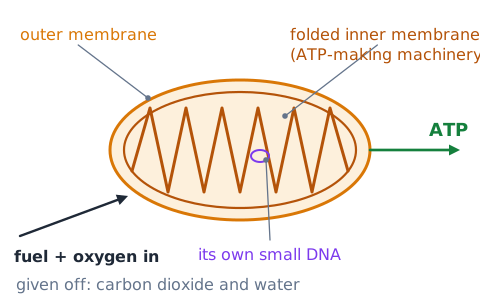
Mitochondria are the organelles where aerobic respiration finishes. They take fuel molecules derived from glucose and fats, combine them with oxygen, and capture the released energy in ATP. Carbon dioxide and water are given off as by-products.
A mitochondrion has two membranes, and the folded inner one provides room for the ATP-making machinery. Hard-working cells such as heart muscle contain many of them. Mitochondria also carry a small DNA molecule of their own.
Lysosomes and peroxisomes
Lysosomes are membrane sacs filled with digestive enzymes that work best in acidic conditions. They break down worn-out organelles, food particles and bacteria that a cell has engulfed, so the pieces can be reused. They are most prominent in animal cells.
Peroxisomes are small sacs that break down fatty acids and neutralize certain toxins. Their reactions produce hydrogen peroxide, which an enzyme inside them quickly converts to water and oxygen.
Vacuoles: storage and water balance
Vacuoles are membrane-bound storage sacs. A mature plant cell usually has one large central vacuole that can fill most of its volume. It stores water, ions, pigments and wastes, and when full it presses outward against the cell wall to keep the cell firm. Animal cells have smaller, temporary vacuoles, and some freshwater protists use contractile vacuoles to pump out extra water.
Cytoskeleton: support and movement
The cytoskeleton is a network of protein fibers running through the cytoplasm. It gives the cell its shape, anchors organelles, and provides tracks along which vesicles are carried.
It also powers movement. Fibers pull chromosomes apart during division, help a white blood cell crawl toward an infection, and form the core of cilia and flagella, such as the tail of a sperm cell or the beating hairs that line your airways.
Cell wall versus cell membrane
These two structures are easy to confuse but do different jobs. The cell membrane is a thin, flexible lipid layer present in every cell; it controls what enters and leaves. The cell wall is a thicker, rigid layer outside the membrane that gives support and protection and keeps the cell from bursting when it takes in water.
Plant cell walls are made mainly of cellulose, fungal walls of chitin, and most bacterial walls of a different material. Animal cells have no wall at all. A wall lets most dissolved substances through freely; the membrane is the real gatekeeper.
Chloroplasts and chlorophyll
Chloroplasts are the organelles of photosynthesis in plants and algae. Like mitochondria, they have a double outer membrane and their own small DNA. Inside are stacks of membrane discs that hold chlorophyll, the green pigment that absorbs red and blue light and reflects green.
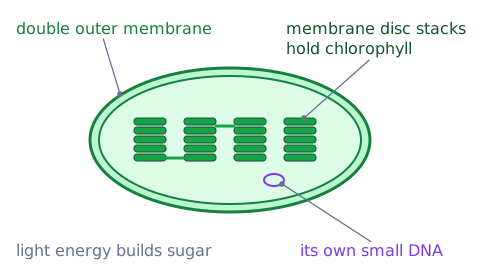
The absorbed light energy is used to build sugar from carbon dioxide and water. Chloroplasts are plentiful in leaf cells but absent from many other plant cells, such as those deep in roots.
Typical plant and animal cells: compare carefully
Both typical plant and animal cells have a plasma membrane, nucleus, cytoplasm, ribosomes, ER, Golgi and mitochondria. A typical plant cell adds a cellulose cell wall, a large central vacuole, and in green tissue, chloroplasts. A typical animal cell lacks a wall and chloroplasts, often has a rounder, more flexible shape, and contains lysosomes more prominently.
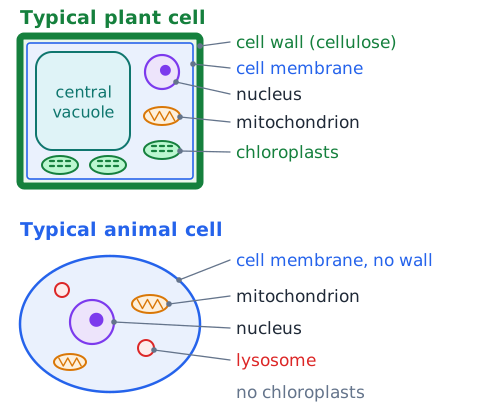
Remember the word typical: a plant root cell may have no chloroplasts, yet it is still a plant cell.
Example 3 — identify a diagram from organelles
Scenario: a labeled drawing shows a boxy cell with a thick outer layer, a nucleus, mitochondria, many green oval bodies, and a large clear sac filling the center. Which kind of cell is it?
Step 1: the nucleus and mitochondria mark it as eukaryotic. Step 2: the thick outer layer suggests a cell wall. Step 3: green ovals are chloroplasts, and the big central sac is a central vacuole. Together these point away from animal cells.
Answer: a plant cell, most likely from a leaf.
Diffusion: movement down a concentration gradient
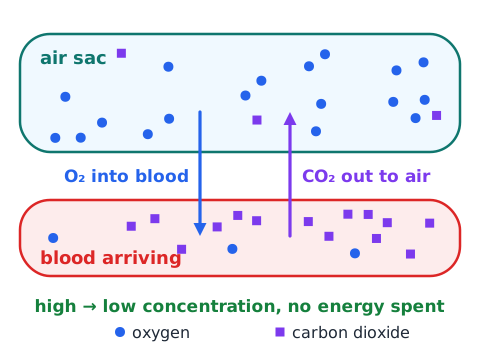
Diffusion is the net movement of particles from a region of higher concentration to a region of lower concentration, driven by their random motion. The difference in concentration is called a gradient. No cell energy is spent, so diffusion is a form of passive transport.
Example: in the lungs, oxygen is more concentrated in the air sacs than in the blood arriving there, so oxygen diffuses into the blood, while carbon dioxide diffuses the other way. Diffusion continues until concentrations even out.
Facilitated diffusion uses a membrane protein
Some substances cannot cross the lipid layer on their own because they are charged or too large. In facilitated diffusion they pass through a channel or carrier protein instead. The movement is still from higher to lower concentration, and the cell spends no ATP on it.
Glucose entering red blood cells through carrier proteins and potassium ions passing through open channels are common examples. The protein only provides a doorway; the gradient supplies the push.
Osmosis: diffusion of water across a selective barrier
Osmosis is the diffusion of water across a selectively permeable membrane. Water moves from the side with fewer dissolved solute particles, where water is relatively more concentrated, toward the side with more solute particles. In short, water follows solute.
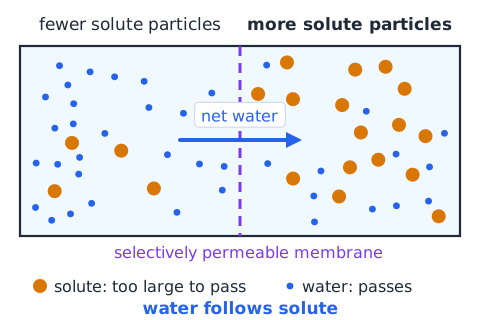
Picture a raisin soaked overnight in plain water: water moves into its sugar-rich cells and it plumps up. Much of the water crosses through special channel proteins called aquaporins.
Tonicity: hypotonic, hypertonic and isotonic
Tonicity compares the outside solution with the cell interior, counting solutes that cannot cross the membrane. In a hypotonic solution the outside has less solute, so water moves in and an animal cell swells and may burst. In a hypertonic solution the outside has more solute, so water moves out and the cell shrinks. In an isotonic solution the solute levels match and there is no net change in volume.
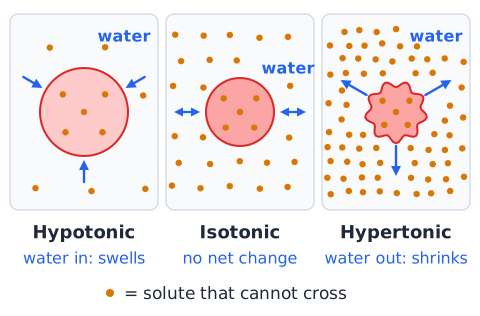
Memory tip: hypo means under, hyper means over, and iso means equal, all describing the outside.
Example 4 — saltwater and a cell
Scenario: a red blood cell is dropped into a salt solution that is much saltier than blood plasma. Predict what happens.
Step 1: compare solute. The outside has more nonpenetrating solute, so it is hypertonic. Step 2: water moves toward higher solute, which means out of the cell. Step 3: the cell loses volume.
Answer: the red blood cell shrinks and wrinkles. Note that it is water, not salt, doing the main moving.
Plant turgor and plasmolysis
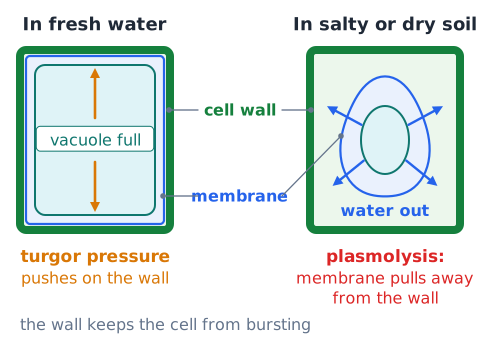
When a plant cell sits in fresh water, water enters the central vacuole and the cell pushes against its wall. That outward pressure, called turgor pressure, keeps stems upright and leaves firm. The wall stops the cell from bursting.
In a salty or dry environment water leaves the vacuole, turgor drops, and the plant wilts. If water loss continues, the membrane pulls away from the wall, a condition called plasmolysis. Watering a wilted houseplant often restores turgor within hours.
Active transport moves substances against a gradient
Active transport moves a substance from lower to higher concentration, against its gradient. Because this is uphill, the cell must spend energy, usually ATP, and use a carrier protein called a pump.
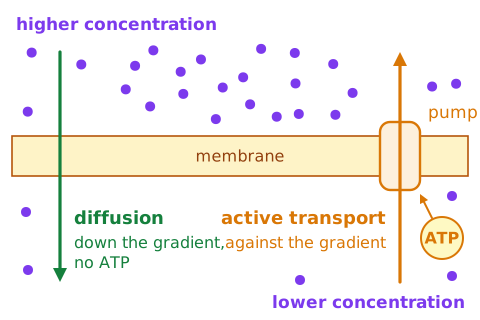
The best-known example is the sodium-potassium pump, which pushes sodium out of the cell and potassium in, keeping each concentrated on one side. Nerve cells rely on this imbalance to send signals. Root cells use pumps to collect minerals from soil water that is more dilute than the cell. If ATP runs out, the pumps stop.
Endocytosis and exocytosis handle bulk material
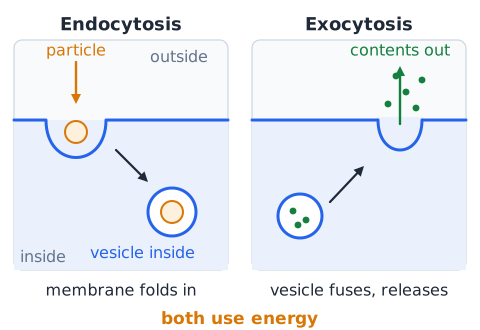
Some cargo is too large for channels or pumps. In endocytosis the membrane folds inward around material outside and pinches off as a vesicle inside the cell. When the cargo is a large particle, such as a bacterium swallowed by a white blood cell, it is called phagocytosis.
Exocytosis runs the other way: a vesicle inside fuses with the membrane and releases its contents outside. Nerve cells release chemical messengers this way. Both processes use energy.
Example 5 — choose the transport process
Scenario A: carbon dioxide leaves a muscle cell, where it is concentrated, into the blood. Scenario B: an intestinal cell pulls in a nutrient that is already more concentrated inside, using ATP. Scenario C: an amoeba wraps its membrane around a food particle.
Step 1: ask the direction relative to the gradient. Step 2: ask whether energy or a vesicle is involved.
Answers: A is simple diffusion, because it is down the gradient with no protein needed. B is active transport, because it is against the gradient with ATP. C is endocytosis, specifically phagocytosis.
Photosynthesis: converting light into chemical energy
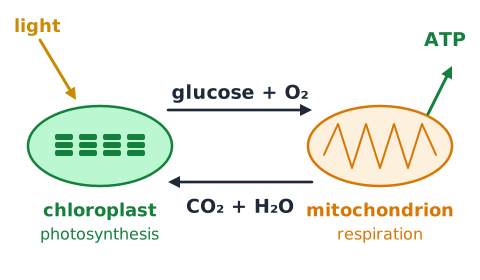
Photosynthesis is the process by which plants, algae and some bacteria capture light energy and store it in sugar. The raw materials are carbon dioxide from the air and water from the soil. The products are glucose and oxygen gas.
Light is the energy input, and in plants the reactions take place in chloroplasts. The oxygen you breathe comes from water split during this process.
Cellular respiration: releasing usable energy
Aerobic cellular respiration breaks glucose down with oxygen and stores much of the released energy in ATP. Carbon dioxide and water are given off. It begins in the cytosol and is completed in the mitochondria.
Compare this with photosynthesis: the inputs of one are the outputs of the other. Nearly all eukaryotic organisms, including plants, carry out respiration all day and night.
ATP: short-term energy carrier, not an organelle
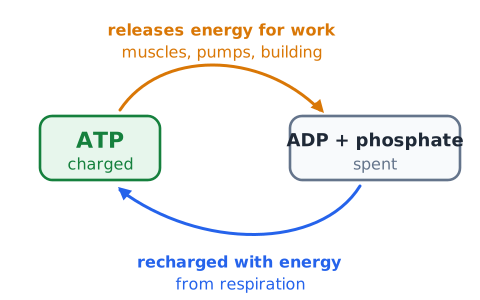
ATP, adenosine triphosphate, is a small molecule that cells use as a ready energy supply. Removing its last phosphate group releases energy that powers muscle contraction, active transport pumps and building reactions. The leftover ADP is then recharged into ATP using energy from respiration.
ATP works like a rechargeable battery: it is spent and restored constantly rather than stored long term. It is a molecule, not a cell structure, so do not confuse it with the mitochondrion that makes it.
Example 6 — plants use mitochondria too
Scenario: a student claims that a bean plant kept in a dark closet overnight cannot make any ATP because photosynthesis has stopped. Evaluate the claim.
Step 1: list the bean cell's energy organelles. It has chloroplasts and mitochondria. Step 2: in the dark, chloroplasts stop capturing light. Step 3: mitochondria keep running aerobic respiration, using sugar stored during the day plus oxygen.
Answer: the claim is wrong. The plant keeps making ATP by aerobic respiration in its mitochondria.
Enzymes and metabolism
Metabolism is the full set of chemical reactions in a cell, both those that break molecules down and those that build them up. Most of these reactions would run far too slowly without enzymes.
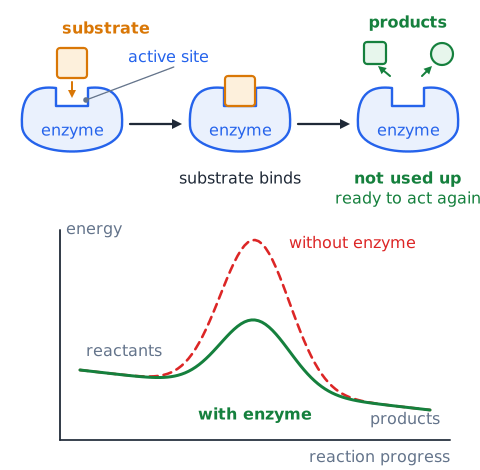
An enzyme is a biological catalyst, usually a protein. It binds its specific reactant, the substrate, at a region called the active site, and lowers the activation energy needed for the reaction to start. That speeds the reaction greatly. The enzyme is not used up, so one molecule can act again and again. Heat or extreme pH can change an enzyme's shape and stop it working.
Building blocks: carbohydrates, lipids, proteins, nucleic acids
Cells are built from four main classes of large molecules. Carbohydrates, such as glucose, starch and cellulose, provide fuel and structure. Lipids, including fats and phospholipids, store energy and form membranes. Proteins, chains of amino acids, act as enzymes, pumps, signals and structural fibers. Nucleic acids, DNA and RNA, store and carry genetic information.
Carbohydrates, proteins and nucleic acids are made from smaller repeating units joined together; lipids are not true polymers.
Homeostasis happens at the cell level
Homeostasis is the maintenance of stable internal conditions while the outside world changes. Single cells do this constantly. They pump ions to keep the right balance of salts, adjust how much glucose they take in, and remove wastes before they build up.
Example: a freshwater protist gains water by osmosis all the time, so a contractile vacuole repeatedly collects and expels the excess. Without that, the cell would swell and burst.
Surface area, volume and cell size
A cell exchanges materials through its surface, but its needs depend on its volume. As a cell grows, volume increases faster than surface area, so the surface-area-to-volume ratio falls. For a cube with side s:
A cube with side 3 units has ratio 54 to 27, which is 2 to 1. Large cells struggle to feed themselves, which is one reason most cells stay small.
Example 7 — predict surface-area changes
Scenario: a model cube cell has side 2 micrometers and grows to side 4 micrometers. What happens to its surface-area-to-volume ratio?
Step 1: at side 2, the area is
and the volume is
giving 3 to 1. Step 2: at side 4, the area is
and the volume is
giving 1.5 to 1.
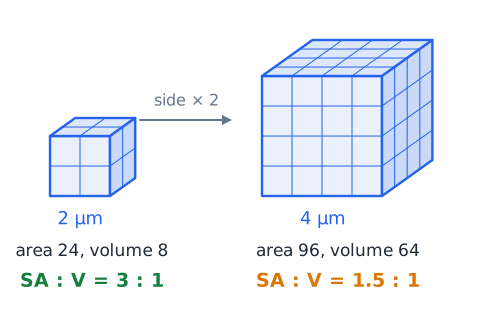
Answer: doubling the side cuts the ratio in half. Area rose by 4 times while volume rose by 8 times.
Unicellular versus multicellular organisms
A unicellular organism is a single cell that does everything needed to stay alive: feeding, removing waste, responding and reproducing. Bacteria, amoebas and yeast are examples.
A multicellular organism, such as a mushroom, an oak tree or a human, is built from many cells that divide the work. Its cells specialize and depend on one another, so most cannot survive for long on their own.
Levels of biological organization
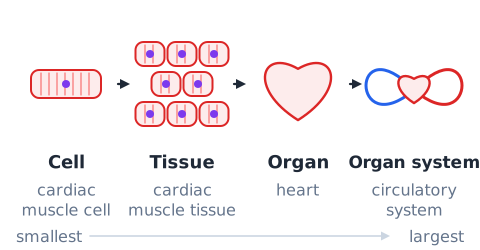
In a multicellular animal, life is organized in levels from small to large. Similar cells working together form a tissue. Different tissues combine into an organ that has a specific job. Organs that cooperate form an organ system, and all the systems together make the organism.
Example: stomach lining cells form epithelial tissue; that tissue plus muscle, nerve and connective tissue make up the stomach; the stomach, intestines and liver belong to the digestive system. Below the cell are organelles and molecules.
Example 8 — from heart cell to organ system
Scenario: put these in order from smallest to largest: heart, cardiac muscle tissue, circulatory system, cardiac muscle cell.
Step 1: the cell is the smallest living unit listed. Step 2: many of those cells form cardiac muscle tissue. Step 3: the heart is an organ, since it combines muscle, nerve, connective and lining tissues. Step 4: the heart, blood vessels and blood make up the circulatory system.
Answer: cell, tissue, organ, organ system.
Tissues are cooperating cells, not organelles
A tissue is a group of similar cells, along with material around them, that performs a shared job. Animals have four main tissue types: epithelial tissue covers and lines, connective tissue supports and binds, muscle tissue contracts, and nervous tissue carries signals.
Do not confuse tissues with organelles. A mitochondrion is part of one cell; bone or skin tissue is made of many cells. On a level-of-organization question, organelles sit below the cell, and tissues sit above it.
Cell specialization and cell differentiation
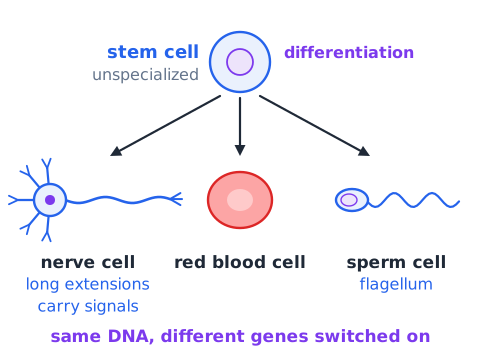
Almost every cell in your body carries the same DNA, yet a nerve cell looks and acts nothing like a red blood cell. The difference arises through differentiation, the process by which a cell switches certain genes on and others off and takes on a specialized form.
A specialized cell's shape fits its job: nerve cells have long extensions to carry signals, and sperm cells have a flagellum. Stem cells are unspecialized cells that can still divide and give rise to specialized types.
Cell cycle: preparation and division
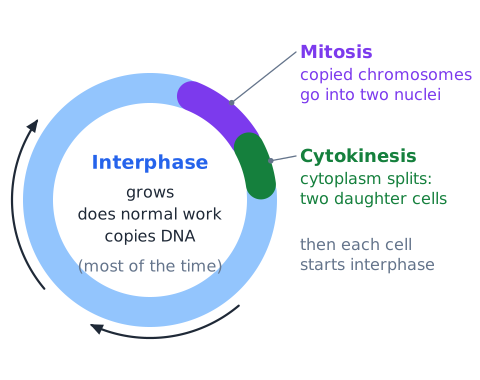
The cell cycle is the repeating sequence a eukaryotic cell follows from one division to the next. Most of the time is spent in interphase, when the cell grows, does its normal work, and copies its DNA. Next comes mitosis, which separates the copied chromosomes into two new nuclei. Finally cytokinesis splits the cytoplasm, producing two daughter cells.
Mitosis versus meiosis versus binary fission
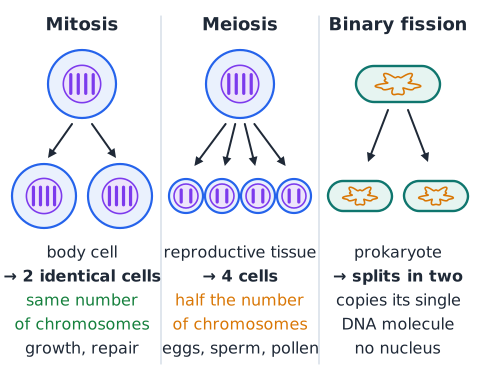
These three ways of dividing serve different purposes. Mitosis divides the nucleus of a eukaryotic body cell to make two identical daughter cells; it is used for growth and repair, such as healing a cut. Meiosis occurs only in reproductive tissues, such as those that make eggs, sperm or pollen; it produces four cells, each with half the chromosome number. Binary fission is how prokaryotes reproduce: the cell copies its single DNA molecule and splits in two, with no nucleus involved.
Example 9 — which division process?
Scenario: name the process in each case. Case A: an E. coli cell splits into two. Case B: cells in a sprained ankle's ligament divide during healing. Case C: cells in a flower's anther produce pollen-forming cells with half the usual chromosomes.
Step 1: check whether the cell has a nucleus. Step 2: check whether the chromosome number is halved.
Answers: A is binary fission, because it is a prokaryote. B is mitosis, since it is ordinary repair. C is meiosis, because the chromosome number is halved.
Microscopy: identification from visible structures
A light microscope can show cells, nuclei, cell walls, chloroplasts and large vacuoles, especially with stains. Smaller structures, such as ribosomes and the details inside mitochondria, need an electron microscope.
When you identify a cell from an image, reason only from what you can actually see. A visible nucleus shows a eukaryote. A cell wall with chloroplasts strongly suggests a plant or alga. Absence of a feature in one image may only mean it is too small or out of focus.
Example 10 — a microscope inference with limits
Scenario: a pond-water slide shows a single oval cell with a clear membrane-bound nucleus and a whip-like tail. A student declares it is a specific species of photosynthetic alga. Is that justified?
Step 1: the nucleus shows the cell is eukaryotic. Step 2: the tail shows it can swim. Step 3: no chloroplasts are mentioned, and one image cannot name a species.
Answer: the safe inference is a single-celled eukaryote, such as a protist. Naming the species or claiming photosynthesis needs more evidence, such as pigment checks or genetic testing.
Viruses are not prokaryotic cells
Viruses are much smaller than bacteria and are not cells at all. A virus is a piece of genetic material, DNA or RNA, inside a protein coat, sometimes with an outer envelope. It has no ribosomes, no cytoplasm and no metabolism of its own.
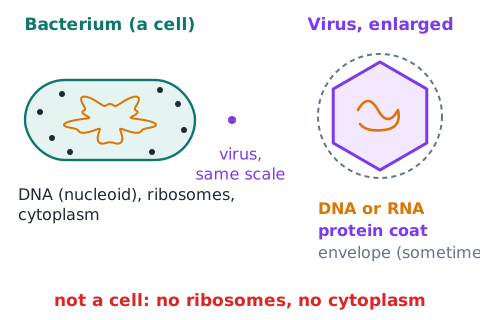
A virus can copy itself only by entering a host cell and using that cell's machinery. That is why antibiotics, which target bacterial structures, do not cure viral infections like the flu. Never label a virus prokaryotic.
Exceptions and exam-safe wording
Biology has many exceptions. Mature human red blood cells lose their nucleus and mitochondria. Some plant cells lack chloroplasts. Some fungi are single-celled, and some bacteria have no cell wall.
For this reason, answer choices that say always, never, every or only deserve suspicion. Correct choices often use words such as typical, usually, likely or can. When the question says typical, answer about the typical case; when it gives a specific situation, consider the exception.
Example 11 — avoid an absolute trap
Question: which statement is best? Choice A: every plant cell contains chloroplasts. Choice B: plant cells can contain chloroplasts, especially in green tissue.
Step 1: test the absolute word every. Step 2: think of a counterexample. Cells in a potato tuber or carrot root are plant cells, yet they lack working chloroplasts and store food instead.
Answer: B. A single counterexample is enough to defeat an always-type claim, while the qualified statement stays true.
Two-pass organelle identification
For organelle questions, make two passes. In the first pass, find the action word in the stem: builds proteins, stores DNA, makes ATP, captures light, packages, digests or controls entry. Each verb points to one main structure: ribosome, nucleus, mitochondrion, chloroplast, Golgi, lysosome or membrane.
In the second pass, check the context. Is the cell a plant, animal or bacterium? Is the product leaving the cell? Context can rule out a choice, such as a chloroplast in an animal cell.
Solve transport scenarios in three questions
When a stem describes something crossing a membrane, ask three quick questions. First, is the substance water? If yes, it is osmosis, and water moves toward the side with more nonpenetrating solute. Second, is the substance moving down or against its gradient? Down is passive; against requires energy and a pump, which is active transport. Third, is a protein or a vesicle involved? A channel or carrier going downhill means facilitated diffusion, and a vesicle means endocytosis or exocytosis.
Keep photosynthesis and respiration separate
Build a two-column picture. Photosynthesis takes in carbon dioxide, water and light and gives out glucose and oxygen; in plants it happens in chloroplasts and only in light. Respiration takes in glucose and oxygen and gives out carbon dioxide, water and ATP; it happens in the cytosol and mitochondria, day and night, in plants and animals alike.
If an answer swaps inputs for outputs, or puts respiration in chloroplasts, eliminate it.
General Science question habits and practice timing
General Science items are usually short and fact-based, so most should take well under a minute. Read the final question first, then underline key words like typical, against the gradient, or smallest to largest. Eliminate choices that contradict a firm rule, such as a bacterium without DNA. If two choices remain, prefer the more carefully qualified one.
Practice in short timed sets, then review every miss and name the specific concept you confused, such as wall versus membrane, rather than just noting the right letter.
Trap 1 — mixing nucleus, ribosome and mitochondrion
The mistake: saying the nucleus makes proteins or the mitochondrion stores genes. Why it is wrong: the nucleus stores DNA and copies it into RNA, but ribosomes actually link amino acids into proteins, and mitochondria make most of the ATP. The fix: tie each to one verb. Nucleus stores instructions, ribosome builds proteins, mitochondrion releases energy as ATP.
Trap 2 — assuming plants do not respire
The mistake: thinking plants only photosynthesize, while animals respire. Why it is wrong: plant cells have mitochondria and carry out aerobic respiration continuously, using sugar they made earlier. At night, when photosynthesis stops, respiration is their only source of ATP. The fix: plants do both processes; animals do only respiration.
Trap 3 — confusing solute movement with water movement
The mistake: predicting that salt rushes into a cell placed in salty water. Why it is wrong: in tonicity questions the solute usually cannot cross the membrane, so the water moves instead, toward the side with more solute. The fix: ask where the higher solute is, then send the water there. Water follows solute.
Trap 4 — equating cell wall with cell membrane
The mistake: treating the wall and membrane as the same layer. Why it is wrong: the membrane is a flexible lipid layer in every cell that controls exchange, while the wall is a rigid outer layer, cellulose in plants, that gives support and is absent in animal cells. The fix: wall supports, membrane regulates.
Trap 5 — saying all cells have identical organelles
The mistake: assuming every cell contains the same set of parts. Why it is wrong: bacteria lack membrane-bound organelles, animal cells lack walls and chloroplasts, and specialized cells vary widely. The fix: learn the universal core of membrane, cytoplasm, DNA and ribosomes, and treat everything else as dependent on cell type.
Guided drill 1 — organelle map
Prompt: which structure packages proteins into vesicles for export? Answer: the Golgi apparatus.
Prompt: which organelle digests worn-out cell parts in an animal cell? Answer: the lysosome.
Prompt: which structure is studded with ribosomes? Answer: the rough endoplasmic reticulum.
Prompt: where is most of a eukaryotic cell's DNA stored? Answer: in the nucleus.
Prompt: which network of protein fibers gives a cell its shape? Answer: the cytoskeleton.
Guided drill 2 — classify and transport
Prompt: a cell has DNA in a nucleoid and no mitochondria. What type is it? Answer: prokaryotic.
Prompt: a slug shrivels when sprinkled with salt. Which way did water move? Answer: out of its cells, toward the salt.
Prompt: a gland releases mucus in vesicles that fuse with the membrane. Name the process. Answer: exocytosis.
Prompt: iodide ions are pumped into thyroid cells against their gradient. Name the process. Answer: active transport.
Guided drill 3 — energy and organization
Prompt: what are the products of photosynthesis? Answer: glucose and oxygen.
Prompt: which organelle completes aerobic respiration? Answer: the mitochondrion.
Prompt: is ATP an organelle? Answer: no, it is an energy-carrying molecule.
Prompt: is the lung a tissue or an organ? Answer: an organ, because it contains several tissue types.
Prompt: which comes first in the cell cycle, DNA copying or mitosis? Answer: DNA copying, during interphase.
Core facts for fast recall
All living things are made of cells, and new cells come from existing cells. Every cell has a membrane, cytoplasm, DNA and ribosomes. Prokaryotes lack a nucleus and membrane-bound organelles; eukaryotes have both.
The nucleus stores DNA, ribosomes build proteins, rough ER and Golgi process and ship proteins, smooth ER makes lipids, mitochondria make ATP, lysosomes digest, and chloroplasts carry out photosynthesis. Typical plant cells add a cellulose wall, a central vacuole and chloroplasts.
Transport, energy and scale checklist
Diffusion and facilitated diffusion move substances down a gradient without ATP. Osmosis moves water toward higher solute: hypotonic outside makes an animal cell swell, hypertonic outside makes it shrink, and isotonic means no net change. Active transport moves against a gradient using ATP, and vesicles handle bulk cargo.
Photosynthesis turns carbon dioxide and water into glucose and oxygen; respiration reverses that and yields ATP. Enzymes speed reactions by lowering activation energy. As cells grow, surface area to volume falls. Order of organization: cell, tissue, organ, organ system.
Mastery checkpoint — explain instead of chant
Memorized lists fade under pressure, but explanations stick. Before the lesson quiz, try explaining aloud why a bacterium can make proteins without a nucleus, why a wilting plant recovers when watered, and why doubling a cell's width makes feeding it harder.
Then explain why a plant needs mitochondria and why a heart counts as an organ. If you can give the reason behind each answer in one or two sentences, you are ready. If not, return to that section and rebuild the explanation before moving on.
 English ▾