 ASVAB Camp
Learning outcomes and exam boundaries
After this lesson you should be able to describe DNA, genes, alleles and chromosomes; pair DNA bases; and trace the path from DNA to RNA to protein. You will use Punnett squares and simple probability, such as a chance, for one- and two-gene crosses. You will also contrast mitosis with meiosis, explain mutation and variation, and describe natural selection, genetic drift and the evidence for evolution, at the level a General Science item expects.
General Science reasoning map: genetics to evolution
This lesson follows one chain of ideas. DNA holds information in its base sequence. Genes are stretches of that DNA, and alleles are different versions of a gene. Meiosis shuffles alleles into eggs and sperm, and fertilization combines them, so offspring vary. Mutation adds brand-new variants.
Across many generations, some variants become more or less common in a population, through natural selection, chance or migration. That change in a population's inherited makeup is evolution. Each test item usually targets one link of this chain.
Heredity, genetics and variation are different ideas
Heredity is the passing of traits from parents to offspring. Genetics is the science that studies how that passing works, from DNA molecules to family patterns. Variation is the set of differences among individuals, such as differences in coat color among puppies in one litter.
Variation can come from genes, from the environment, or from both. A question that asks why siblings differ is asking about variation, not just about heredity.
DNA: molecular information in sequence
DNA, deoxyribonucleic acid, is the molecule that carries hereditary information in nearly all living things. It is built from units called nucleotides, each containing a sugar, a phosphate and one of four bases: adenine, thymine, guanine or cytosine, abbreviated A, T, G and C.
Two strands twist around each other in a double helix. The information lies in the order of bases, much as meaning in a sentence lies in the order of letters.
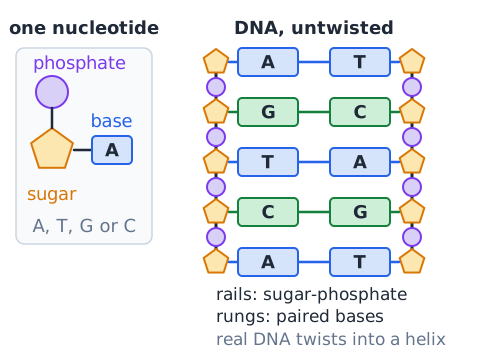
Complementary DNA base pairing
The two strands of DNA are held together by pairs of bases that fit each other. Adenine always pairs with thymine, and guanine always pairs with cytosine. Because of this rule, knowing one strand tells you the other, which is how cells copy DNA accurately. A quick memory aid: A with T, G with C.
Example 1 — find a complementary DNA strand
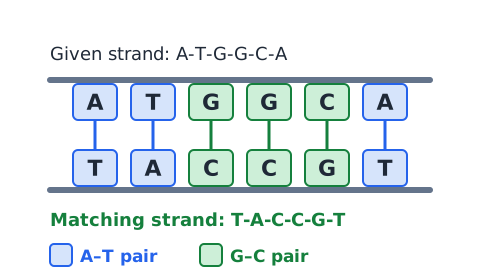
Problem: one DNA strand reads A-T-G-G-C-A. What is the matching strand?
Step 1: replace each A with T and each T with A. Step 2: replace each G with C and each C with G. Step 3: work base by base: A gives T, T gives A, G gives C, G gives C, C gives G, A gives T.
Answer: T-A-C-C-G-T.
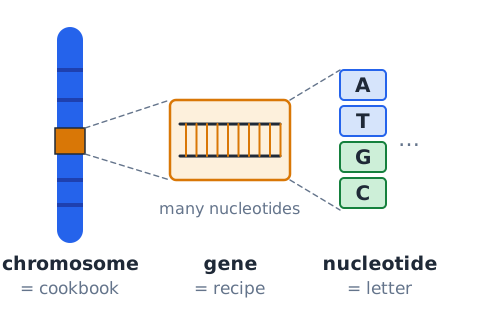
Nucleotides versus genes versus chromosomes
These terms describe different scales. A nucleotide is a single building block of DNA, one letter in the code. A gene is a stretch of many nucleotides that carries instructions for one product, often a protein. A chromosome is one very long DNA molecule, wrapped with proteins, that carries hundreds to thousands of genes.
Picture a library: nucleotides are letters, genes are recipes, and a chromosome is a whole cookbook.
Chromosome counts: what 46 and 23 mean
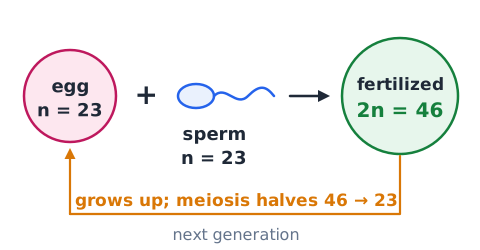
Human body cells normally contain 46 chromosomes arranged as 23 pairs. One member of each pair came from the mother and one from the father. A cell with paired sets is called diploid, written 2n, so for humans 2n equals 46.
Eggs and sperm carry just one chromosome from each pair, 23 in all. They are haploid, written n. Other species have other numbers; a dog has 78 chromosomes in body cells and 39 in its gametes.
Example 2 — why fertilization restores chromosome number
Problem: a human egg and sperm fuse. How many chromosomes does the fertilized egg have, and why?
Step 1: each gamete is haploid with 23 chromosomes. Step 2: fertilization combines them. Step 3: 23 plus 23 equals 46.
Answer: 46. Meiosis halved the number, and fertilization restores it, so it stays constant across generations.
DNA replication happens before division
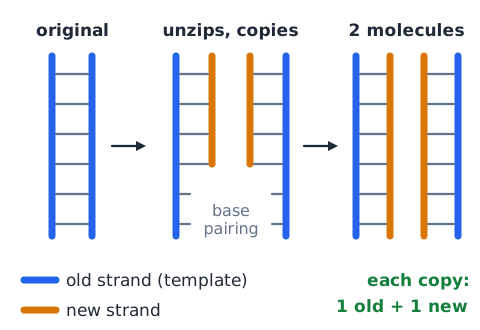
Before a cell divides, it copies its DNA in a process called replication, during interphase. The double helix unzips, and each old strand serves as a template for a new partner strand built by base pairing.
Each new DNA molecule ends up with one old strand and one new strand. After replication, each chromosome consists of two identical sister chromatids joined together, ready to be separated into the daughter cells.
Gene expression: DNA → RNA → protein
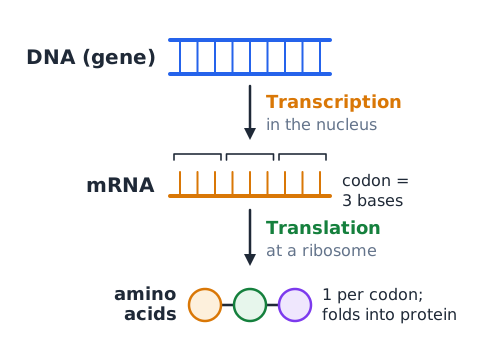
Using a gene's instructions takes two main steps. In transcription, which happens in the nucleus of eukaryotes, the gene's DNA is copied into messenger RNA. In translation, a ribosome reads the RNA three bases at a time, and each three-base codon specifies an amino acid. The chain of amino acids folds into a protein. Some genes stop at RNA products that do other jobs.
Example 3 — DNA versus RNA base
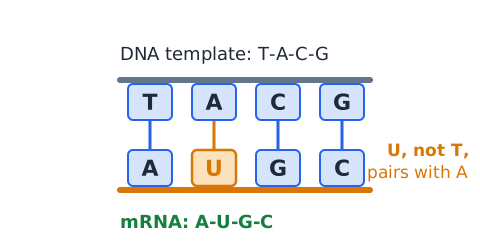
Problem: a DNA template strand reads T-A-C-G. What messenger RNA is made from it?
Step 1: pair as usual, except that RNA uses uracil, U, in place of thymine. Step 2: T gives A, A gives U, C gives G, and G gives C.
Answer: A-U-G-C. Any choice that shows T in an RNA strand is wrong.
Alleles are versions of a gene
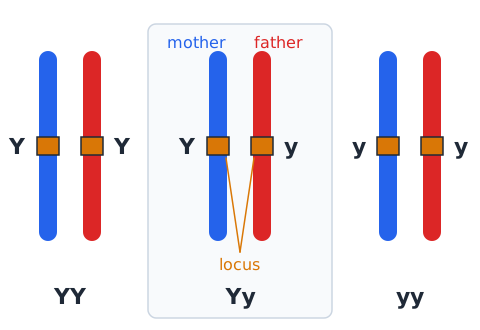
A gene sits at a specific location on a chromosome, called its locus. Different versions of that gene are called alleles. For example, a pea plant gene for seed color has a yellow allele and a green allele.
Because body cells carry two copies of each chromosome, they carry two alleles for each gene. We write them with letters: a capital letter, such as , for the dominant allele and lowercase, such as , for the recessive one, giving combinations like , or .
Genotype and phenotype are not synonyms
Genotype is the pair of alleles an organism carries for a trait, such as . Phenotype is what you can observe or measure, such as freckles or a blood type.
Genotype influences phenotype, but they are not the same thing. Two different genotypes, and , can produce the same phenotype when one allele is dominant. Environment can also shape phenotype; a well-fed plant grows taller than its genetic twin grown in poor soil.
Example 4 — same phenotype, different genotype
Problem: in pea plants, tall (T) is dominant to short (t). Two plants are both tall. Must they have the same genotype?
Step 1: list tall genotypes: TT and Tt. Step 2: both show the dominant phenotype.
Answer: no. One could be TT and the other Tt. Phenotype alone does not reveal the genotype.
Homozygous versus heterozygous
An organism that carries two identical alleles for a gene is homozygous for that gene. It may be homozygous dominant, such as RR, or homozygous recessive, such as rr. An organism with two different alleles, such as Rr, is heterozygous.
Homo means same and hetero means different. A heterozygous individual can pass on either allele to its offspring.
Complete dominance and recessiveness
Under complete dominance, one allele, called dominant, fully masks the other, called recessive, in a heterozygote. A guinea pig with genotype Bb has black fur, just like a BB animal, because black B is dominant over brown b.
The recessive trait shows only when no dominant allele is present, that is, in the homozygous recessive genotype bb. A heterozygote that carries a hidden recessive allele is called a carrier. Dominant does not mean stronger, healthier or more common; it only describes what shows in the heterozygote.
Punnett squares represent possible combinations
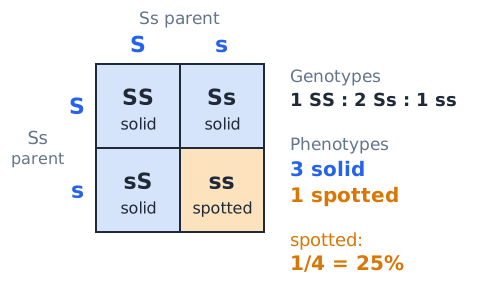
A Punnett square is a grid used to predict the possible offspring of a cross. Write one parent's possible gametes along the top and the other's down the side. Each box combines one allele from each parent, giving a possible offspring genotype.
For one gene, the grid has four boxes, each equally likely if gametes form and combine at random. Count the boxes to get ratios or probabilities. Each box represents a one-in-four chance.
Example 5 — heterozygous × heterozygous
Problem: two Ss rabbits mate, where S, solid coat, is dominant to s, spotted coat. Predict the offspring.
Step 1: each parent makes S and s gametes. Step 2: the four boxes are SS, Ss, sS and ss. Step 3: genotypes are 1 SS to 2 Ss to 1 ss.
Answer: phenotypes are 3 solid to 1 spotted, so each kit has a 25 percent chance of being spotted.
Crossing homozygous parents
When both parents are homozygous, every gamete from each parent carries the same allele, so the outcome is certain. Two homozygous dominant parents produce only homozygous dominant offspring. Two homozygous recessive parents produce only homozygous recessive offspring. A homozygous dominant parent crossed with a homozygous recessive parent produces offspring that are all heterozygous.
Example 6 — purebred cross
Problem: a purebred round-seeded pea plant, RR, is crossed with a purebred wrinkled-seeded plant, rr. What are the offspring?
Step 1: the RR parent can give only R; the rr parent can give only r. Step 2: every box is Rr.
Answer: 100 percent Rr, and all have round seeds.
Test cross: infer hidden genotype
An individual showing the dominant phenotype could be homozygous or heterozygous. A test cross reveals which. Cross it with a homozygous recessive partner, whose gametes all carry the recessive allele.
If any offspring show the recessive trait, the unknown parent must have contributed a recessive allele, so it is heterozygous. If many offspring are all dominant, the unknown parent is very likely homozygous dominant.
Example 7 — test-cross logic
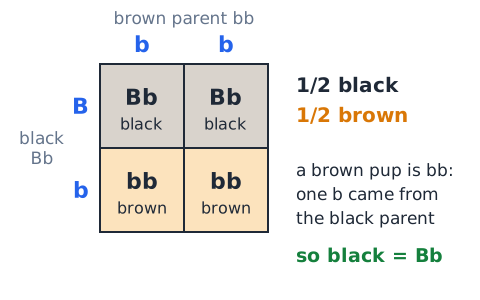
Problem: a black Labrador, B dominant to brown b, is mated with a brown Labrador, bb. Two of seven puppies are brown. What is the black parent's genotype?
Step 1: a brown puppy is bb. Step 2: it got one b from each parent. Step 3: so the black parent carries b.
Answer: the black parent is Bb.
Probability applies separately to each child
Each fertilization is an independent event. A one-in-four chance applies to every child, no matter how earlier children turned out; a couple with three unaffected children still faces the same chance with the fourth.
To find the chance that several independent events all happen, multiply their probabilities:
Example 8 — independent birth probabilities
Problem: two Bb parents, b recessive, have two children. What is the chance the first is bb and the second is not?
Step 1:
Answer: 3/16, about 19 percent.
Autosomal dominant and autosomal recessive patterns
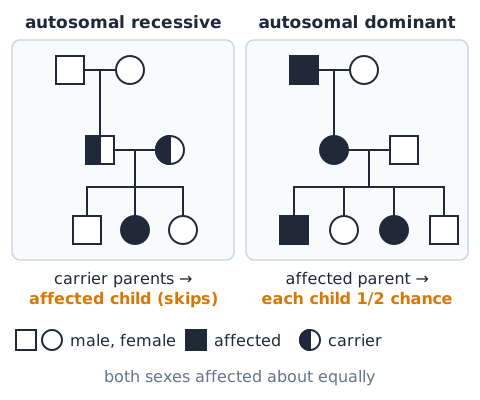
Autosomes are the non-sex chromosomes. In an autosomal recessive condition, such as cystic fibrosis, a person must inherit two copies of the variant to be affected. Unaffected carrier parents can have an affected child, so the trait can skip generations.
In an autosomal dominant condition, such as Huntington disease, one copy is enough. An affected person usually has an affected parent, and each child of a heterozygous affected parent has a one-in-two chance of inheriting it. Both sexes are affected about equally in either pattern.
X-linked inheritance requires attention to sex chromosomes
Typical females are XX and typical males are XY. Genes on the X chromosome are called X-linked. A male has only one X, so a single recessive X-linked allele will show in him; that is why conditions such as red-green color blindness and hemophilia are more common in males.
A father gives his X to every daughter and his Y to every son. A mother gives one of her two X chromosomes to each child.
Example 9 — father-to-son X-linked transmission
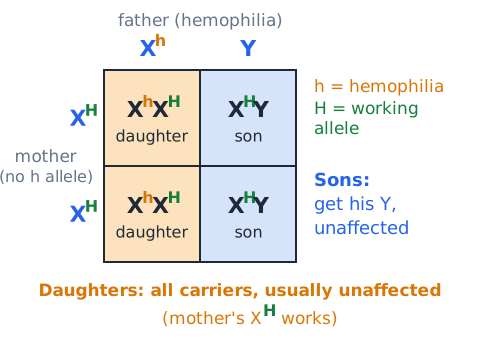
Problem: a man with hemophilia, an X-linked recessive condition, has children with a woman who carries no hemophilia allele. Which children could inherit his allele?
Step 1: his allele sits on his X chromosome. Step 2: sons receive his Y, not his X. Step 3: daughters receive his X.
Answer: none of his sons inherit it from him. Every daughter inherits it and is a carrier, usually unaffected because her mother's X supplies a working allele.
Beyond dominance: codominance and incomplete dominance
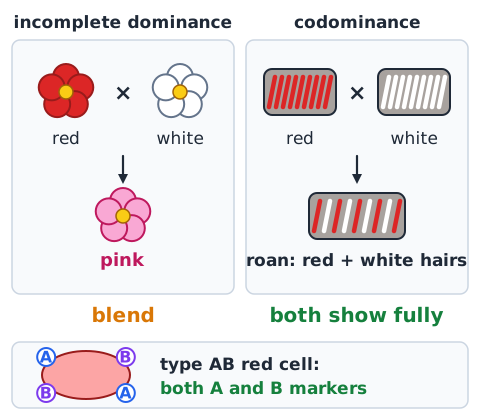
Not every gene follows complete dominance. In incomplete dominance, the heterozygote shows an intermediate phenotype; crossing red and white snapdragons gives pink flowers. In codominance, both alleles show fully and side by side in the heterozygote.
Human ABO blood type is the classic codominance case: a person with one A allele and one B allele has type AB blood, with both A and B markers on the red cells. Roan cattle, with both red and white hairs, are another example.
Example 10 — incomplete-dominance 1:2:1 phenotypes
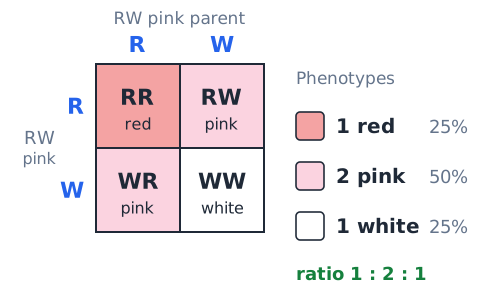
Problem: in snapdragons, RR is red, RW is pink and WW is white. Two pink plants are crossed. What phenotypes appear?
Step 1: each pink parent makes R and W gametes. Step 2: the boxes are RR, RW, WR and WW.
Answer: 1 red to 2 pink to 1 white, or 25, 50 and 25 percent.
Polygenic and multifactorial traits
Many traits are controlled by several genes at once; these are polygenic traits. Human height, skin color and eye color are examples. Because many genes each add a small effect, these traits show a smooth range of values rather than a few distinct classes.
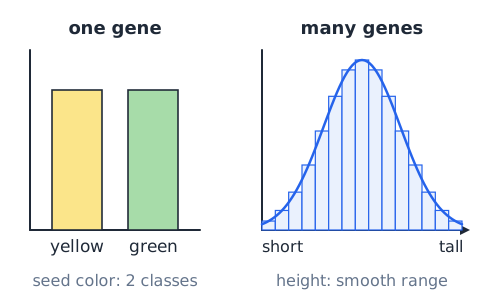
Most such traits are also multifactorial, meaning the environment matters. Height depends on nutrition and health in childhood as well as on genes, so siblings can differ considerably.
Meiosis: making haploid gametes
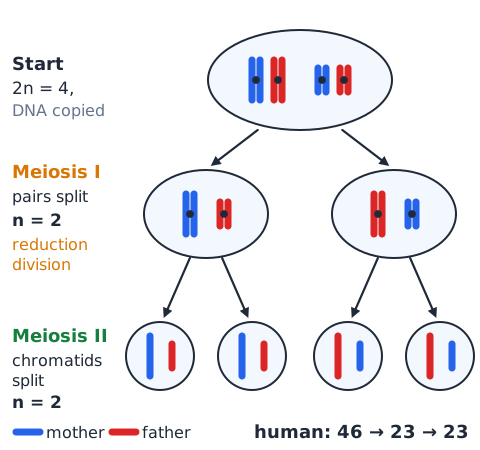
Meiosis is a special type of cell division that produces sex cells: sperm and eggs in animals; in plants, meiosis produces spores. It starts with one diploid cell whose DNA has already been copied, and it involves two rounds of division, meiosis I and meiosis II.
The result is four haploid cells, each with one chromosome from every pair. Because of shuffling during meiosis, the four cells are genetically different from one another and from the parent cell.
Meiosis I separates homologous chromosomes
Homologous chromosomes are the matching pair, one from each parent, carrying the same genes. Early in meiosis I they line up together, and crossing over can occur between them. Then the pairs separate, with one homolog going to each new cell.
This step is the reduction division: it cuts the chromosome number in half. In a human cell, the 23 pairs split so each new cell gets 23 chromosomes, although each one still has two sister chromatids.
Meiosis II separates sister chromatids
Meiosis II looks much like mitosis. No DNA copying happens between the two divisions. In each of the two cells from meiosis I, the sister chromatids of every chromosome are pulled apart into separate cells.
The chromosome number stays haploid during this step; for humans it is still 23. The overall result is four haploid cells, each with single-chromatid chromosomes, ready to mature into gametes.
Example 11 — separate mitosis from meiosis
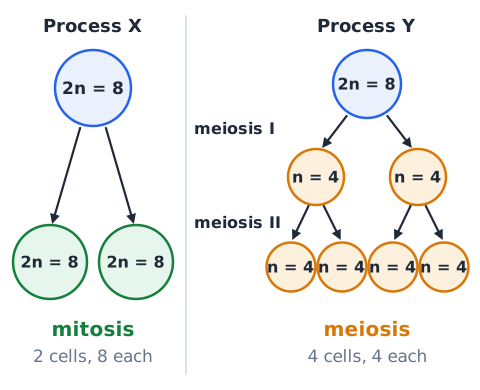
Problem: a cell with 2n equal to 8 divides. Process X makes two cells with 8 chromosomes each. Process Y makes four cells with 4 each. Name them.
Step 1: X keeps the number and yields two identical cells, which is mitosis. Step 2: Y halves the number and yields four cells, which is meiosis.
Answer: X is mitosis; Y is meiosis.
Crossing over creates new allele combinations
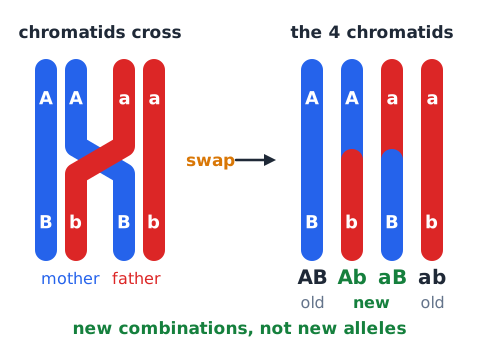
During meiosis I, homologous chromosomes pair tightly, and their chromatids can break and swap matching segments. This exchange is called crossing over. A chromosome that started with alleles from only the mother can end up carrying some alleles from the father.
Crossing over does not create new alleles; it creates new combinations of alleles that already exist on the same chromosome. It is a major reason that siblings, apart from identical twins, differ genetically.
Independent assortment adds diversity
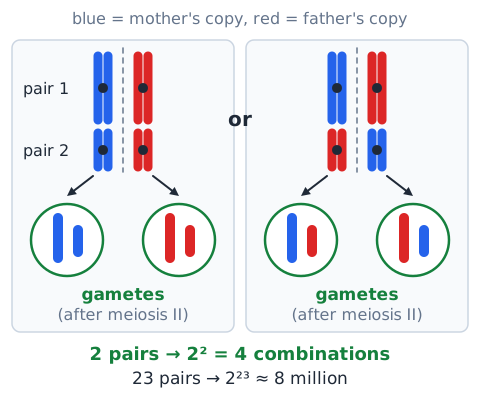
In meiosis I, each pair of homologous chromosomes lines up and separates independently of the other pairs. Whether a gamete gets the maternal or paternal copy of chromosome 1 has no effect on which copy of chromosome 2 it receives.
With 23 pairs in humans, this alone allows about 8 million different chromosome combinations in a gamete, before crossing over adds more. Genes on different chromosomes, or far apart on one chromosome, therefore tend to be inherited independently.
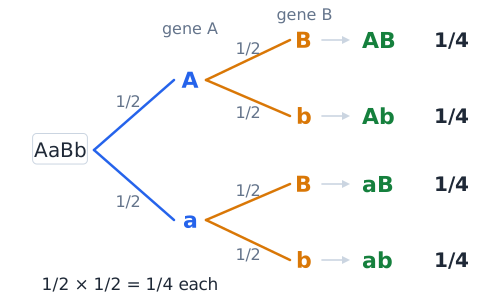
Example 12 — possible gametes from AaBb
Problem: list the gametes an AaBb individual can make if the genes assort independently.
Step 1: each gamete gets one allele of each gene. Step 2: pair A with B or b, and a with B or b.
Answer: four types, AB, Ab, aB and ab, each with probability .
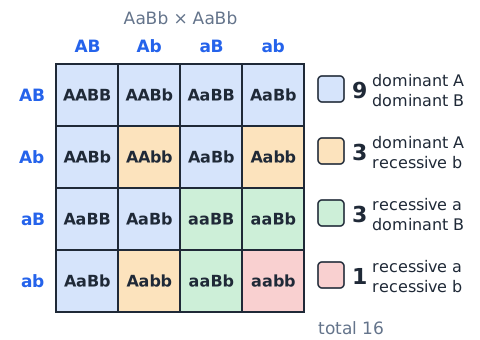
Dihybrid inheritance: why a classic 9:3:3:1 arises
In a cross of two AaBb parents with independent assortment and complete dominance, each gene alone gives a 3 to 1 ratio. Combining two independent 3 to 1 results gives:
Out of 16, 9 show both dominant traits, 3 show dominant A with recessive b, 3 show recessive a with dominant B, and 1 shows both recessive traits.
Example 13 — two recessive traits at once
Problem: AaBb is crossed with Aabb. What is the chance of an aabb offspring?
Step 1:
Mutation versus variation versus disease
A mutation is any change in a DNA sequence; it may be one base or a large segment. Variation is the overall set of differences among individuals, and mutations are its ultimate source.
A mutation is not automatically a disease. Many have no noticeable effect, some are harmful, and a few are helpful. A single change can be harmful in one setting and useful in another.
Germline versus somatic variants
Where a mutation occurs decides whether it can be inherited. A germline variant is present in eggs or sperm, or the cells that make them, so it can be passed to children and will be in every cell of a child who inherits it.
A somatic variant arises in an ordinary body cell, such as a skin or lung cell, after conception. It affects only that cell and its descendants and is not passed to offspring. Many cancers begin with somatic mutations.
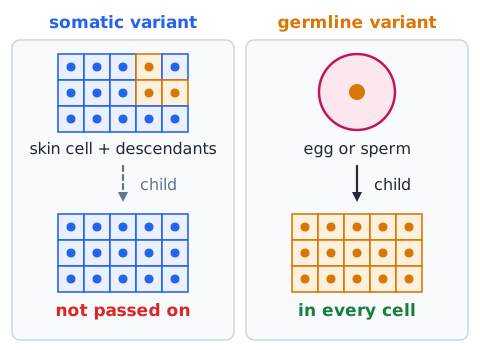
Example 14 — can a skin-cell mutation be inherited?
Problem: years of sun exposure cause a mutation in skin cells on a farmer's arm. Can the farmer's future children inherit it?
Step 1: skin cells are body cells, so the change is somatic. Step 2: it is not in eggs or sperm.
Answer: no. The variant may affect the farmer's skin, but it is not passed on.
Mutations do not appear because organisms need them
Mutations arise from random copying errors and from damage by radiation or chemicals. They happen whether or not they would help. A bacterium does not create a resistance mutation because an antibiotic arrives; a few cells may already carry one by chance.
The environment then affects which existing variants survive and reproduce. It sorts variation; it does not order it up.
Evolution means inherited population change
In biology, evolution is change in the inherited characteristics of a population over generations. It is measured as shifts in how common certain alleles or heritable traits are.
Individuals do not evolve. A rabbit's genes stay the same through its life, and muscles built by a weightlifter are not inherited. Only when the genetic makeup of a population shifts from one generation to the next has evolution occurred. That shift can be driven by natural selection, genetic drift, gene flow or mutation.
Natural selection: required ingredients
Natural selection needs three conditions. First, individuals in a population vary in some trait. Second, that variation is at least partly heritable. Third, the variation affects survival or reproduction, so some individuals leave more offspring than others.
When all three hold, alleles linked to more offspring become more common over generations. Charles Darwin and Alfred Russel Wallace described this process in the 1850s. Remove any one ingredient and selection cannot produce lasting change.
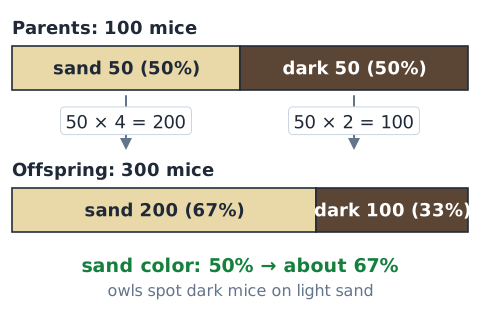
Example 15 — natural selection using counted offspring
Problem: a population has 50 sand-colored mice and 50 dark mice on light sand, and color is inherited. Owls spot dark mice easily, so each sand mouse leaves 4 surviving offspring on average and each dark mouse leaves 2. What fraction of the next generation is sand-colored?
Step 1: sand offspring are 50 times 4, which is 200. Step 2: dark offspring are 50 times 2, which is 100. Step 3: 200 out of 300 is about 67 percent.
Answer: sand color rose from 50 to about 67 percent in one generation, a result of natural selection.
Fitness is reproductive success in context
In evolution, fitness means how well an individual survives and reproduces in its environment compared with others, measured by surviving offspring. It is not physical strength or size.
Fitness depends on context. Thick fur raises fitness in the Arctic but may lower it in a desert. A small, plain bird that raises many chicks has higher fitness than a large, showy one that raises none.
Adaptation occurs in populations over generations
An adaptation is an inherited trait that helps organisms survive and reproduce in their environment, such as a cactus's water-storing stem or a polar bear's thick fur. Adaptations build up in populations over many generations as natural selection favors helpful variants.
An individual's short-term adjustment, such as tanning in summer, is not an adaptation in this sense.
Genetic drift differs from natural selection
Genetic drift is a change in allele frequencies caused by chance rather than by how well a trait works. Random events, such as which individuals happen to mate or which seeds land in good soil, can make an allele more or less common regardless of its effect.
Drift is strongest in small populations, where a few chance events matter a great deal; it can even eliminate a helpful allele. Selection, by contrast, consistently favors traits that raise survival or reproduction.
Gene flow changes population gene pools
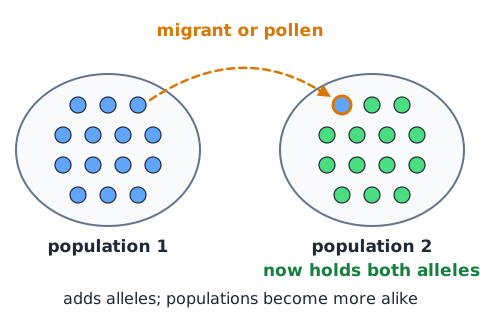
Gene flow is the movement of alleles from one population into another when individuals or their gametes migrate and breed. Pollen blown to a distant field and a wolf that joins a new pack are examples.
Gene flow can add new alleles to a population and tends to make neighboring populations more alike genetically. Reduced gene flow lets populations drift apart.
Founder and bottleneck effects
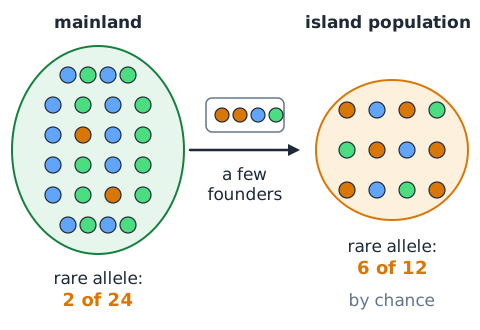
Two special cases of genetic drift often appear on exams. The founder effect occurs when a few individuals start a new, isolated population; their alleles, including rare ones, may be overrepresented by chance.
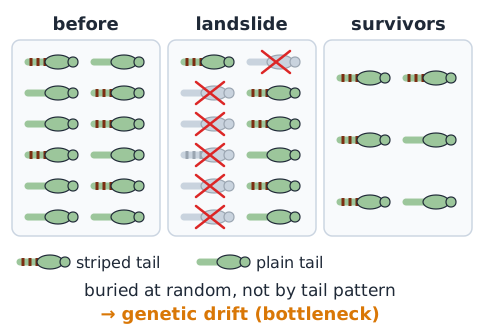
The bottleneck effect occurs when a disaster sharply reduces a population, and the random survivors carry only part of the original variation. Northern elephant seals, hunted down to a small number, show very low genetic diversity today.
Example 16 — selection or chance?
Problem: a landslide buries half of a lizard population at random. Afterward, an allele for striped tails is more common. Selection or drift?
Step 1: ask whether the trait affected survival. Step 2: the landslide killed lizards regardless of tail pattern.
Answer: genetic drift, specifically a bottleneck. If striped lizards had survived because stripes helped them hide, it would be selection.
Antibiotic resistance: selection, not intention
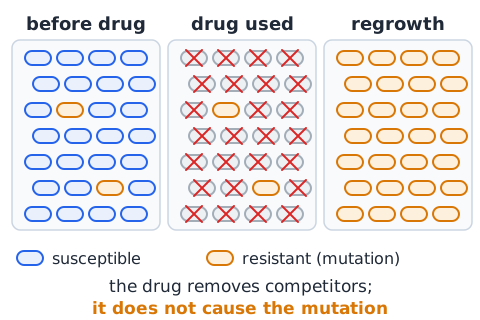
Antibiotic resistance shows natural selection happening fast. In a large bacterial population, a few cells may already carry a mutation that lets them survive a certain drug. When the antibiotic is used, susceptible bacteria die and resistant ones survive and multiply.
After many rounds, most of the population is resistant. The drug did not cause the helpful mutations; it removed competitors. This is why health agencies urge people to take antibiotics only when prescribed and to finish the full course, and why antibiotics do nothing against viruses.
Evidence for evolution has multiple independent forms
Several separate lines of evidence point to the same conclusion. Fossils show organisms changing through rock layers of different ages, including transitional forms. Comparative anatomy reveals shared body plans. DNA and protein comparisons show closely related species have more similar sequences.
Embryos of related animals show similar early stages, and biogeography shows related species clustered on connected landmasses. Evolution has also been observed directly in bacteria, insects and fish.
Homologous versus analogous features
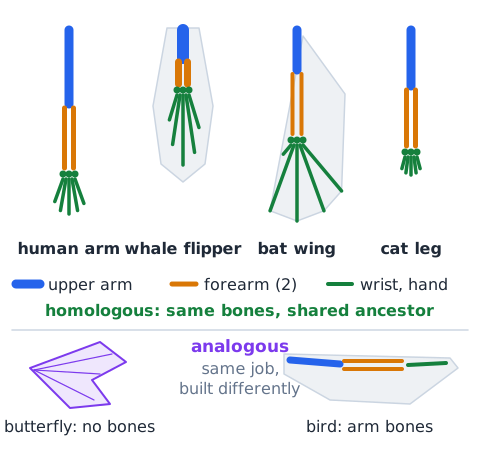
Homologous structures share an underlying design inherited from a common ancestor, even if they now do different jobs. A human arm, a whale flipper, a bat wing and a cat's leg all contain the same set of bones in a similar arrangement.
Analogous structures do similar jobs but evolved separately, without shared ancestry for that feature. The wings of a butterfly and a bird both allow flight, but they are built very differently. Homologous features support common ancestry; analogous ones show that similar environments can shape similar solutions.
Common ancestry and branching evolution
Evolution is often pictured as a branching tree. A single ancestral population can split into separate populations that change independently and become different species. Over long periods, repeated splitting produces the great variety of life.
Species alive today are not ancestors of one another; they are relatives on different branches. Humans did not descend from modern chimpanzees. Instead, humans and chimpanzees share a common ancestor that lived millions of years ago, and each line has changed since.
Speciation and reproductive isolation basics
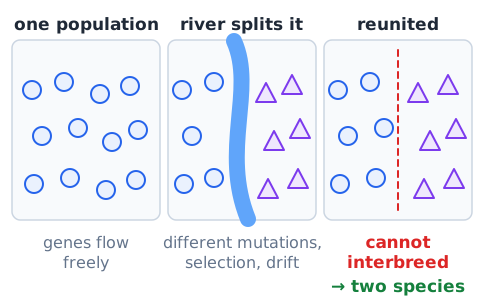
A species is commonly defined as a group of organisms that can interbreed in nature and produce fertile offspring. New species form when populations become reproductively isolated, so genes no longer flow between them.
Isolation often starts with a physical barrier, such as a river or a mountain range. Separate populations then experience different mutations, selection and drift. Eventually they may differ in mating season, courtship or anatomy so much that they cannot interbreed even if reunited.
Example 17 — read a simple evolutionary tree
Problem: a tree shows one ancestor splitting into the lizard line and a second branch. That second branch later splits into crocodiles and birds. Which pair is most closely related?
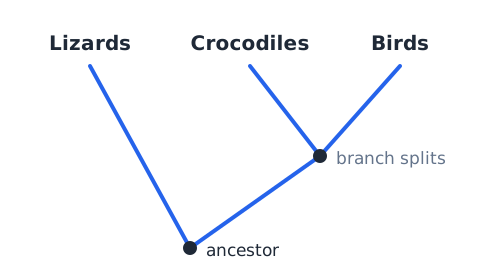
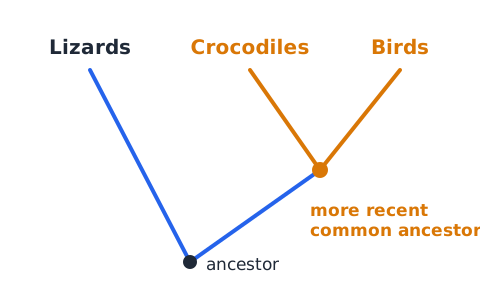
Step 1: find where branches join. Step 2: crocodiles and birds share a more recent common ancestor than either shares with lizards.
Answer: crocodiles and birds, even though crocodiles look more like lizards.
Probability language: model conditions matter
A Punnett square result is a prediction from a simple model, and it rests on assumptions. The model assumes each parent makes each gamete type equally often, gametes combine at random, every offspring type survives equally well, and genes assort independently.
When those conditions hold, a result means each offspring has a 25 percent chance, and in a large number of offspring about a quarter show that outcome. When the stem changes the conditions, such as linked genes, the expected ratios change too.
Reading genetic percentages and ratios carefully
A ratio such as 3 to 1 means 4 equal parts in total, so the fractions are and , or 75 and 25 percent. A 1 to 2 to 1 ratio also has 4 parts: 25, 50 and 25 percent.
Read whether the question asks for genotype or phenotype, and whether it asks out of all offspring or only out of a subgroup.
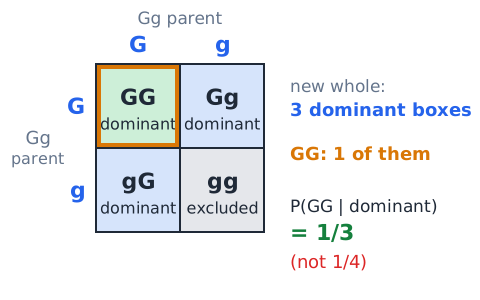
Example 18 — conditional chance among dominant offspring
Problem: from Gg × Gg with complete dominance, a pup shows the dominant phenotype. What is the chance it is GG?
Step 1: of the four boxes, three are dominant: GG, Gg and gG. Step 2: only one of those three is GG.
Answer: 1/3, not 1/4.
Genotype frequency is not allele frequency
A genotype frequency is the fraction of individuals with a given genotype, such as the fraction that are Bb. An allele frequency is the fraction of all gene copies in the population that are a given allele. Since each diploid individual carries two copies, you must count alleles, not individuals.
Example 19 — calculate allele frequency from counts
Problem: 36 BB, 48 Bb and 16 bb. Find the frequency of B.
Step 1: there are 100 individuals, so 200 alleles. Step 2: count B alleles.
Answer: 60 percent.
Two-gene multiplication needs independent assortment
Multiplying single-gene probabilities, such as , works only when the two genes are inherited independently, which is usual for genes on different chromosomes. Genes very close together on the same chromosome are linked and tend to travel together, so their combined outcomes can depart from the multiplication rule and from a 9 to 3 to 3 to 1 pattern.
Trap 1 — dominant does not mean widespread
The mistake: assuming a dominant allele must be the most common or the most beneficial. Why it is wrong: dominance only describes which phenotype appears in a heterozygote. Extra fingers, polydactyly, is often caused by a dominant allele yet is rare. The fix: judge commonness by frequency data and benefit by fitness, never by dominance.
Trap 2 — mitosis versus meiosis
The mistake: thinking mitosis makes gametes or that meiosis repairs tissue. Why it is wrong: mitosis makes two identical diploid cells for growth and repair; meiosis makes four genetically different haploid cells for reproduction. The fix: ask whether the chromosome number is halved. If so, it is meiosis; if not, it is mitosis.
Trap 3 — the Punnett square does not schedule births
The mistake: thinking that a 1 in 4 chance means exactly one of four children will be affected, or that after three unaffected children the fourth must be affected. Why it is wrong: each birth is independent, and probabilities describe chances, not a fixed schedule. The fix: apply the same probability to every child.
Trap 4 — selection acts on existing heritable differences
The mistake: saying giraffes grew long necks because they stretched for leaves, or that a species develops a trait because it needs it. Why it is wrong: traits acquired during life are not inherited, and mutations are not made to order. The fix: describe selection as already-existing heritable variation plus differences in survival and reproduction, which change frequencies over generations.
Trap 5 — mutation is not always a disease
The mistake: treating every mutation as harmful. Why it is wrong: many mutations have no effect, and some help, such as a variant that lets adults digest milk. Whether a mutation helps or harms can depend on the environment. The fix: classify a mutation by its effect in context: neutral, harmful or beneficial.
Trap 6 — correlation is not a genetic explanation
The mistake: concluding a trait is genetic because it runs in families, or that a rise in a trait's frequency proves natural selection. Why it is wrong: families share diets, homes and habits too, and frequency can change by drift or migration. The fix: name the conclusion the data support, such as a population change, and say what extra evidence, like survival or twin data, would establish a cause.
Exam strategy: translate the stem into a tiny model
Turn each genetics stem into a small model before looking at the choices. Write the parent genotypes using letters, note which allele is dominant, and list the gametes. Draw a quick Punnett square or multiply probabilities.
For evolution stems, name the ingredients present: is there heritable variation, a difference in survival or reproduction, a chance event, or migration? Once you know which mechanism fits, choose the answer that matches it and ignore choices that add information the stem never gave.
Fast elimination: four recurring distractor patterns
Watch for four common wrong-answer patterns. First, intention: organisms deciding or needing to change. Second, individual change: one organism evolving during its life. Third, absolute words: always, every, never, as in every mutation causes disease. Fourth, swapped terms: genotype for phenotype, mitosis for meiosis, or T for U in RNA. Striking these out often leaves only one choice.
Calculator-free probability checks
Use fractions, not decimals. Multiply for and: from AaBb × AaBb, the chance of aa and bb is
Add for either-or when outcomes cannot both happen: from Aa × Aa, AA or Aa is
Check that all outcomes add to 1. Multiplying two fractions less than one always gives a smaller answer.
Question timing and non-adaptive practice
Vocabulary items, such as defining an allele, should take only seconds. Save time for probability and multi-step items. On paper practice tests, which do not adapt to your answers, every question counts the same, so skip and return to slow ones. Review missed items by naming the specific concept, such as conditional probability.
Guided drill A — vocabulary foundation
Prompt: what is a different version of the same gene called? Answer: an allele.
Prompt: what term describes a cell with two sets of chromosomes? Answer: diploid.
Prompt: is having freckles a genotype or a phenotype? Answer: a phenotype.
Prompt: what is the genotype Tt called? Answer: heterozygous.
Prompt: which molecule carries a copy of a gene to the ribosome? Answer: messenger RNA.
Guided drill B — base pairing and gametes
Prompt: give the DNA partner of G-G-A-T. Answer: C-C-T-A.
Prompt: which base replaces thymine in RNA? Answer: uracil.
Prompt: a corn plant has 2n equal to 20. How many chromosomes are in its gametes? Answer: 10.
Prompt: how many gamete types can Rr make? Answer: two, R and r.
Guided drill C — Punnett square outcomes
Prompt: Tt × tt gives what fraction tt? Answer: one-half.
Prompt: TT × Tt gives what fraction showing the recessive trait? Answer: zero.
Prompt: Tt × Tt gives what genotype ratio? Answer: 1 TT to 2 Tt to 1 tt.
Prompt: tt × tt gives what? Answer: all tt.
Guided drill D — conditional probability
Prompt: from Hh × Hh, a dominant offspring is chosen. Chance it is Hh? Answer: .
Prompt: from Hh × hh, a dominant offspring is chosen. Chance it is Hh? Answer: 1, since hh parents cannot give H.
Prompt: from Hh × Hh, what is the chance two children are both dominant? Answer: .
Guided drill E — choose the evolutionary process
Prompt: a few birds blown to a remote island start a new population with unusual allele frequencies. Answer: founder effect.
Prompt: moths matching tree bark survive predators better and leave more offspring. Answer: natural selection.
Prompt: pollen from one meadow fertilizes flowers in another. Answer: gene flow.
Prompt: a random flood leaves a few survivors. Answer: bottleneck effect, a form of genetic drift.
Guided drill F — distinguish inheritance and environment
Prompt: identical twins raised apart differ in weight. Is the difference genetic? Answer: largely environmental, since their genes are the same.
Prompt: a hydrangea's flower color changes with soil acidity. Answer: environment affecting phenotype.
Prompt: a bodybuilder's muscles are inherited by his children. True? Answer: no, acquired traits are not inherited.
Prompt: is adult height purely genetic? Answer: no, it is polygenic and affected by nutrition.
Quick review — core inheritance facts
DNA stores information in base sequence; A pairs with T, G with C, and RNA uses U instead of T. Genes are DNA segments on chromosomes, and alleles are gene versions. Humans have 46 chromosomes in body cells and 23 in gametes. Genotype is the allele pair; phenotype is the observed trait. For Aa × Aa, expect 1 AA to 2 Aa to 1 aa and a 3 to 1 phenotype ratio. Each birth is independent; multiply chances for combined events, such as
Quick review — evolution facts
Evolution is change in a population's inherited traits over generations. Mutation is the source of new variants and is random with respect to need. Natural selection requires heritable variation that affects survival or reproduction. Genetic drift changes allele frequencies by chance and is strongest in small populations; founder and bottleneck effects are kinds of drift. Gene flow moves alleles between populations.
Evidence for evolution includes fossils, homologous structures, DNA comparisons, embryos and direct observation. Species form when populations become reproductively isolated.
Self-check before the lesson test
Before the quiz, answer these without notes. Can you write the partner strand for any DNA sequence and convert it to RNA? Can you predict the offspring of a heterozygous cross and of a test cross? Can you explain why a son cannot inherit his father's X-linked allele?
Can you tell meiosis I from meiosis II, and drift from selection? Can you calculate an allele frequency from genotype counts? If any answer is shaky, revisit that section first.
 English ▾