 ASVAB Camp
Lesson outcomes and test focus
After this lesson you should be able to use Ohm's law,
to find any one of voltage, current, or resistance from the other two. You will convert between milli, kilo, mega, and micro units, read V–I graphs, apply the law to simple series and parallel circuits, and calculate power. You will also recognize when the constant-resistance assumption fails and how to measure safely.
Where Ohm’s law fits in Electronics Information
Ohm's law is the single most used relationship in basic electronics. It connects the three quantities that describe what is happening in almost any resistive part of a circuit: the voltage across it, the current through it, and its resistance.
On the Electronics Information subtest, it appears directly in calculation questions and indirectly in questions about fuses, lamps, heaters, meters, and wiring. Questions about series and parallel circuits, power, and troubleshooting also lean on it. If you can apply Ohm's law quickly and check units, many other EI topics become easier, because they reuse the same reasoning about how a push, a flow, and an opposition relate to one another.
Define potential difference before calculating
Voltage is properly called potential difference. It is the energy given to or taken from each unit of charge as it moves between two points, measured in volts, where one volt is one joule per coulomb.
The key word is difference. A voltage always refers to two points, such as the two terminals of a battery or the two ends of a resistor. In Ohm's law, V is the voltage across the specific component whose resistance is R. Using the full supply voltage for a part that receives only a share of it is a frequent source of wrong answers.
Electric current measures a flow rate
Current is the rate at which electric charge passes a point in a circuit. One ampere means one coulomb of charge passing each second.
Because current is a flow, it is measured through a component, not across it. In a single loop with no branches, the same current passes every point, much as the same number of cars passes each spot on a one-lane loop road. In Ohm's law, I is the current flowing through the component of resistance R.
What resistance measures
Resistance tells how much voltage is needed to drive each ampere of current through a component. A 10 ohm resistor needs 10 volts for each ampere; a 1,000 ohm resistor needs 1,000 volts for each ampere.
Resistance depends on the part's material, length, cross-sectional area, and temperature. In most Ohm's law questions it is treated as a fixed property of the component, which means it does not change just because the applied voltage changes. The resistor sets how the current responds to the voltage; it does not produce voltage or current by itself.
Read the central equation precisely
Ohm's law is written
voltage equals current multiplied by resistance. It is a product, not a sum. Writing
is a classic error.
Every symbol refers to the same component at the same moment. V is the voltage across that part in volts, I is the current through that part in amperes, and R is its resistance in ohms. When these three belong together, the equation can be rearranged to solve for whichever one is unknown.
Find current from voltage and resistance
To find current, divide voltage by resistance:
Example: 36 V is applied across a 9 heating coil.
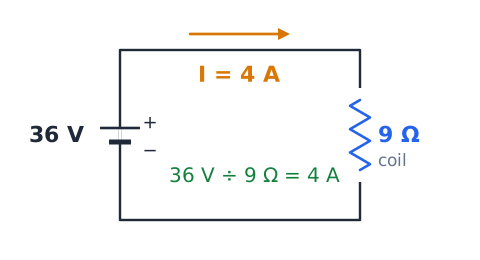
More voltage means more current; more resistance means less current. This is the form you need when a question gives a supply voltage and a part's resistance and asks how much current flows, for example to check whether a fuse will hold.
Find resistance from voltage and current
To find resistance, divide voltage by current:
Example: a toaster element draws 2.5 A from a 120 V outlet.
Volts divided by amperes gives ohms. Use this form when meters give you the voltage across a part and the current through it. The result describes the element at its operating condition; if the element heats up, its resistance can differ from a cold ohmmeter reading.
Find voltage from current and resistance
To find voltage, multiply current by resistance. Suppose 1.5 A flows through an 8 ohm speaker coil. The voltage across the coil is 1.5 times 8, which is 12 V.
This is the form you use to find a voltage drop across one part of a circuit when you know the current through that part and its resistance.
Use the cover-up triangle carefully
A memory aid places V on top of a triangle with I and R side by side underneath. Cover the quantity you want: covering V leaves I next to R, meaning multiply; covering I leaves V over R, meaning divide; covering R leaves V over I.
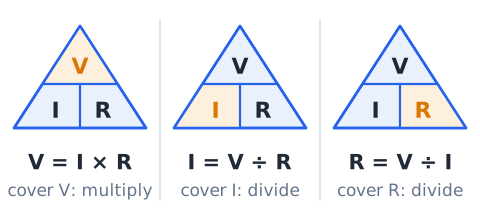
The triangle only helps if V is on top. If you are unsure, rebuild the formula from V = IR with simple algebra.
SI units and their relationships
Ohm's law ties three SI units together. Voltage is in volts (V), current in amperes (A), and resistance in ohms (). From V = IR,
Power links in too: one watt equals one volt times one ampere. If your units do not combine this way, the setup is wrong.
Milliampere and ampere conversion
Milli means one thousandth, so
To change mA to A, divide by 1,000: 350 mA is 0.35 A, and 8 mA is 0.008 A. To change A to mA, multiply by 1,000: 0.06 A is 60 mA. Convert to base units before using V = IR, unless you deliberately pair kilohms with milliamperes.
Kilohms and ohms
Kilo means one thousand: 3.3 k is 3,300 . A handy shortcut is that volts divided by kilohms gives milliamperes:
That matches
Megohms and microamperes
Mega means one million, so 1 megohm is 1,000,000 ohms. Micro means one millionth, so 1 microampere is 0.000001 ampere. Very large resistances produce very small currents.
These prefixes pair neatly: volts divided by megohms gives microamperes. For example, 5 V across a 1 megohm resistor drives 5 microamperes. A digital voltmeter often has an input resistance of about 10 megohms, so it draws only a tiny current from the circuit it measures.
Make mental division efficient
Without a calculator, simplify before dividing. Move decimals together: multiplying top and bottom by 10 does not change a fraction.
Cancel common factors:
Dividing by 0.5 is the same as doubling, and dividing by 0.25 is the same as multiplying by 4.
Understand proportional change in voltage
If resistance stays constant, current is directly proportional to voltage. Whatever factor multiplies the voltage also multiplies the current. Triple the voltage and the current triples; cut the voltage in half and the current is halved.
So if a fixed resistor carries 0.4 A at 6 V, it carries 1.2 A at 18 V, because 18 V is three times 6 V. You do not need to find the resistance first; the ratio carries you directly to the answer.
Understand proportional change in resistance
If the voltage stays constant, current is inversely proportional to resistance. Doubling the resistance halves the current; cutting the resistance to one fourth makes the current four times larger.
Example: a fixed 24 V supply drives 3 A through a load. If that load is replaced by one with three times the resistance, the current drops to one third, or 1 A.
When both voltage and resistance change
If both change, combine their factors:
Example: voltage triples and resistance increases by 1.5 times. The current changes by
so it doubles. If both change by the same factor, the current is unchanged. If voltage is halved while resistance doubles, the current falls to one fourth, since
Work out each factor separately, then combine them, rather than recalculating from scratch.
Two observations can reveal resistance
If a device is ohmic, any one reading gives R. Two readings let you also check the result using the changes:
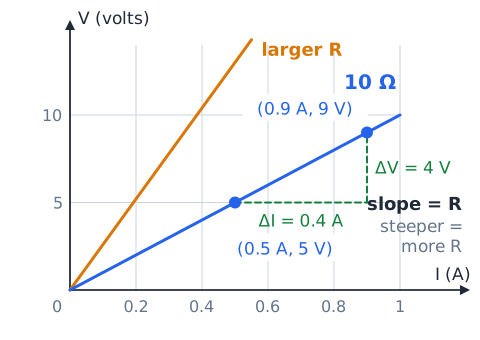
Example: 5 V gives 0.5 A and 9 V gives 0.9 A. Then
Each single reading also gives 10 , confirming the device is ohmic.
Read a voltage-versus-current graph
When voltage is plotted on the vertical axis and current on the horizontal axis, an ohmic resistor gives a straight line through the origin. The slope, rise over run, is volts per ampere, which is resistance in ohms.
A steeper line means more resistance, because more voltage is needed for each ampere. To read R, pick any point on the line and divide its voltage value by its current value, being careful to convert any milliamperes on the axis to amperes.
Read a current-versus-voltage graph
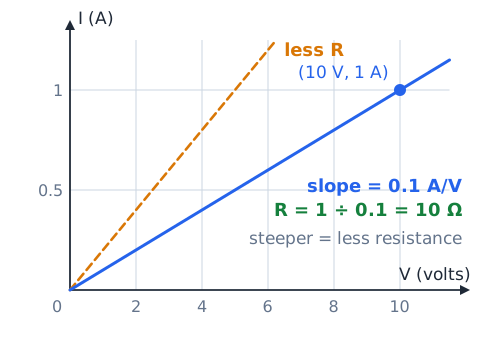
Many textbooks and data sheets plot current vertically and voltage horizontally. Then the slope of an ohmic line is
in amperes per volt, or siemens. Here a steeper line means less resistance. A slope of 0.1 A/V means R = 10 .
Identify an ohmic device
A component is ohmic if its resistance stays the same over the range of voltages used. Its V/I ratio is constant, and its V–I graph is a straight line through the origin.
Test a table by dividing each voltage by its current. Readings of (2 V, 0.1 A), (4 V, 0.2 A), and (6 V, 0.3 A) all give
so the part is ohmic. If the ratio rises or falls as voltage increases, as in a lamp filament or a diode, the device is nonohmic, and a single R value only applies at one operating point.
Voltage drop means a difference across a component
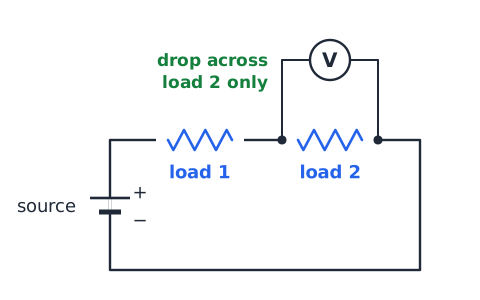
A voltage drop is the potential difference that appears between the two ends of a component while current flows through it. It represents the energy each coulomb gives up in that part.
Measure it by placing a voltmeter's probes on either side of the component. In a simple circuit with ideal wires, the drops across the loads add up to the source voltage. A drop belongs to one component, so when you use V = IR for that part, use its own drop, not the supply voltage.
Current is equal through ideal series resistors
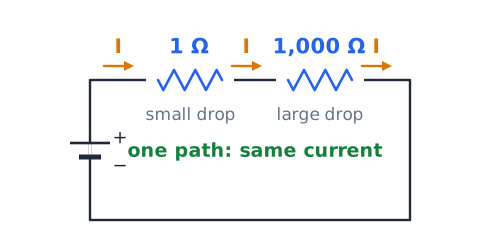
Components are in series when they are connected end to end so that there is only one path for current. Charge cannot pile up or leak out between them, so the same current flows through every series part.
That is true even when the resistors have very different values. A 1 ohm and a 1,000 ohm resistor in series carry exactly the same current. What differs is the voltage drop across each, which is larger for the larger resistor.
Voltage is equal across ideal parallel branches
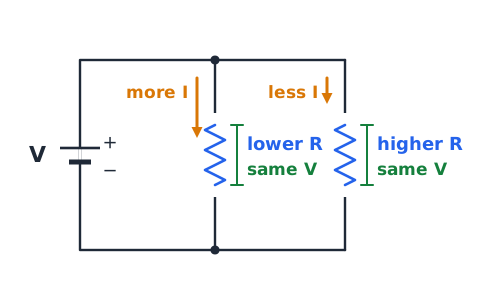
Components are in parallel when each one is connected across the same two points. Every parallel branch therefore has the same voltage across it, equal to the voltage between those two points.
The branch currents are generally not equal. Each branch draws its own current according to
so a branch with lower resistance draws more current. Household outlets are wired in parallel, which is why each appliance gets the full line voltage regardless of what else is plugged in.
Equivalent resistance for two series resistors
In series, resistances simply add:
A 220 and a 330 resistor in series act like 550 . Across 11 V, the loop current is
or 20 mA. The total is always larger than either resistor alone.
Equivalent resistance for two equal parallel resistors
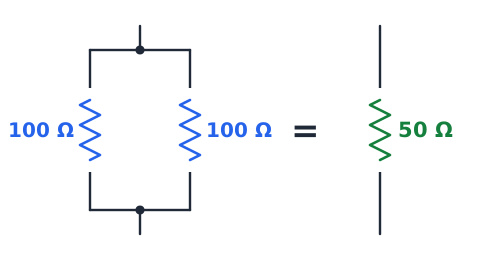
Two equal resistors R in parallel give
so two 100 resistors in parallel act like 50 . More generally, n equal resistors in parallel give R/n. The result is smaller than either branch.
Three ways to find resistor power
Combining P = VI with Ohm's law gives three forms:
For a 12 resistor with 6 V across it and 0.5 A through it, all three give 3 W: , , and . Use P = VI when you know voltage and current, when you know current and resistance, and when you know voltage and resistance. Power is in watts.
Voltage doubling and resistor heating
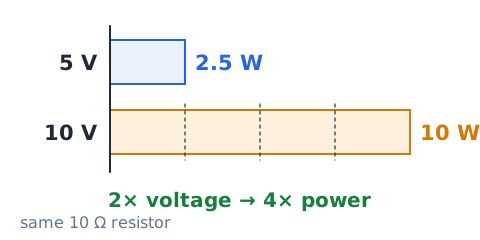
With R fixed, power depends on the square of voltage:
Doubling the voltage doubles the current too, so power becomes
times as large. A 10 resistor dissipates 2.5 W at 5 V but 10 W at 10 V. That is why a resistor that runs warm at one voltage can overheat if the voltage is raised.
Current doubling and power
With R fixed, power depends on the square of current:
A 6 resistor carrying 1 A dissipates 6 W. At 2 A it dissipates
four times as much. Tripling the current would make power nine times as large. Doubling current is not doubling power. The square appears because a larger current both carries more charge each second and needs a proportionally larger voltage across the same resistance, so the two effects multiply.
Different quantities share similar numbers
In a test question, a 4 might be volts, amperes, ohms, or watts. The number alone tells you nothing; the unit tells you what it is.
Before calculating, label each given value with its quantity and unit. Watch for answer choices that show the right digits with the wrong unit, or a value of 2 when the problem asks for volts but 2 is actually the current. Reading the units carefully prevents mixing up quantities that happen to share a number.
Estimate before you calculate
A rough estimate tells you what size of answer to expect and catches slips. If 115 V is across a resistor of about 24 ohms, the current should be roughly 120 divided by 24, or about 5 A. An answer of 0.2 A or 2,760 A is clearly wrong.
Also check direction. If a question raises the resistance at a fixed voltage, the current must go down. Discard any choices that move the wrong way before doing exact arithmetic.
Track significant details in circuit language
Small words change the problem. "Across" refers to voltage between two points; "through" refers to current in a path. "In series" means a single path with shared current; "in parallel" means shared voltage across separate branches.
"Ideal" means ignore wire resistance or source internal resistance. "Fixed" or "constant" resistance means R does not change when voltage or current changes. "Directly across the source" means the component gets the full source voltage. Reading these details first tells you which equation to use and which values belong together.
Handle an ideal open circuit
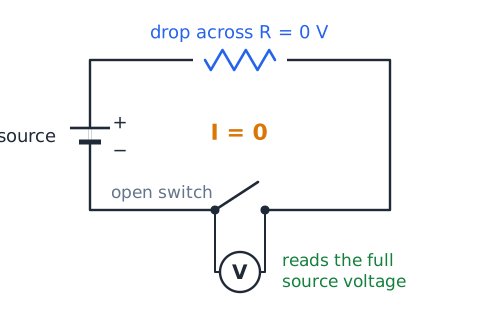
An open circuit is a break in the only path, as from an open switch, a blown fuse, or a broken wire. The resistance of the gap is effectively infinite, so the current is zero.
With no current, no voltage drops appear across the other resistors in that loop, because V = IR gives zero when I is zero. As a result, the full source voltage appears across the gap itself. That is why a voltmeter placed across an open switch in a working circuit reads the supply voltage.
Handle an ideal short circuit carefully
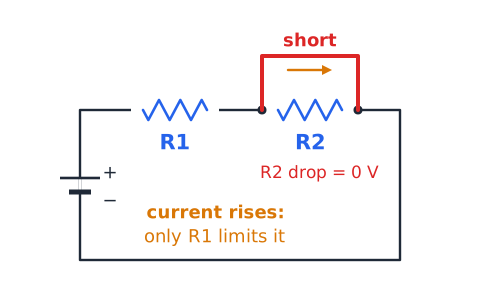
A short circuit is a path of nearly zero resistance connected across a source or a component. In the ideal math,
with R near zero predicts an enormous current, which is why shorts are dangerous.
A short across one resistor in a series string bypasses that resistor: its voltage drops to zero and the rest of the circuit carries more current. In real circuits, wire and source resistance limit the current, and fuses or breakers are designed to open before wiring overheats. Never create a short on purpose to test a battery or supply.
Internal resistance and ideal source limits
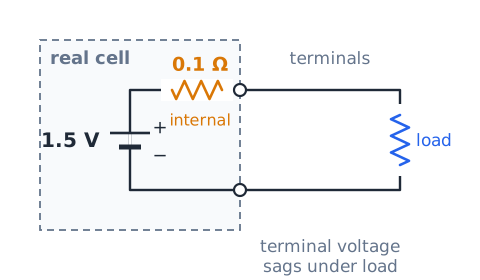
An ideal source keeps its voltage the same no matter how much current is drawn. Real batteries and power supplies have internal resistance, so some voltage is lost inside the source when current flows, and the terminal voltage sags under heavy load.
For example, a car battery's voltage dips while the starter motor cranks because the large current produces a drop across the battery's internal resistance. If a 1.5 V cell with about 0.1 ohm of internal resistance were shorted, its current would be limited to roughly 15 A, still enough to heat it dangerously. Test questions usually assume an ideal source unless they state otherwise.
Voltage divider intuition
When resistors are in series across a source, the source voltage is shared among them in proportion to their resistances. Two equal resistors each get half. If one resistor is three times larger than the other, it gets three quarters of the total and the smaller gets one quarter.
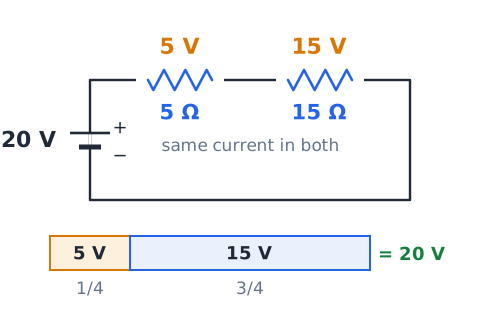
This works because both resistors carry the same current, and V = IR makes each drop proportional to R. A volume control is a variable version of this idea, tapping off part of a signal voltage.
Current divider intuition
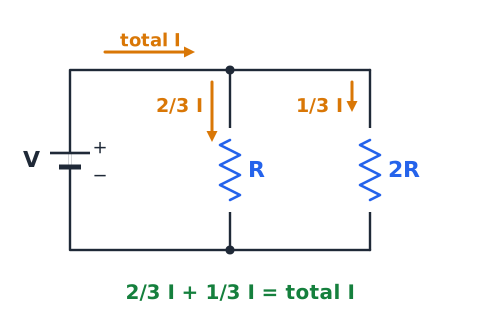
When resistors are in parallel, each branch has the same voltage, so each branch current is V/R. The total current divides among the branches in inverse proportion to their resistances: the smaller resistance takes the larger current.
For two branches where one is twice the resistance of the other, the lower-resistance branch carries two thirds of the total current and the higher-resistance branch carries one third. All branch currents add up to the source current.
Combine unit conversions with ratios
Ratios work in any consistent units. A 2 k resistor carries 2 mA at 4 V, since
If the voltage rises to 10 V, that is 2.5 times as much, so the current becomes
mA. No conversion to amperes is needed, as long as the units stay consistent.
Solve for a target resistance
Sometimes you know the voltage and the current you want, and you need to choose R. Example: a 9 V circuit should draw 20 mA. Convert first: 20 mA = 0.02 A.
A slightly larger standard value would keep the current just under the target.
Find an unknown current from two resistive cases
Suppose a fixed resistor carries 0.3 A when 6 V is applied, and you need the current at 15 V. Because the resistance does not change, current scales with voltage.
The voltage ratio is 15 divided by 6, which is 2.5. Multiply the original current by 2.5 to get 0.75 A. You could also find R first (6 divided by 0.3 is 20 ohms) and then compute 15 divided by 20, which gives the same 0.75 A.
Use a table of measurements
Given a table of readings, divide V by I in every row. Example:
Since all rows agree, the device behaves as a 20 resistor. Use that value to predict new readings, such as 0.6 A at 12 V.
Apply Ohm’s law to an ideal indicator
Many test questions model a small indicator lamp as a simple resistor. Suppose a pilot lamp is treated as 480 ohms and placed directly across a 24 V supply. Its current is 24 divided by 480, which is 0.05 A, or 50 mA.
This model is fine when the question says to treat the lamp as a fixed resistance. A light-emitting diode, however, is not a resistor; it needs a separate series resistor to limit its current, and its voltage-current behavior is not described by a single fixed R.
Why a tungsten lamp can be nonohmic
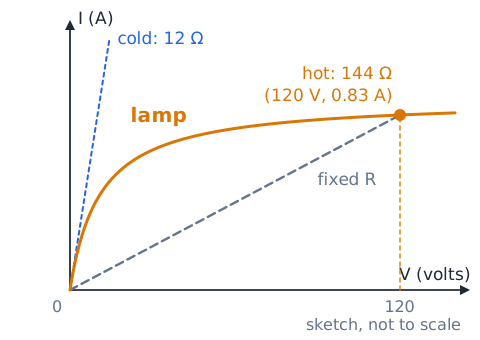
A tungsten filament's resistance grows a lot as it heats. Consider a 120 V lamp whose hot resistance is 144 :
Cold, the same filament might measure only 12 , so at the instant of switch-on the current could be
A instead of about 0.83 A. Because R changes with temperature, the V–I curve bends instead of staying straight.
Why a diode is different
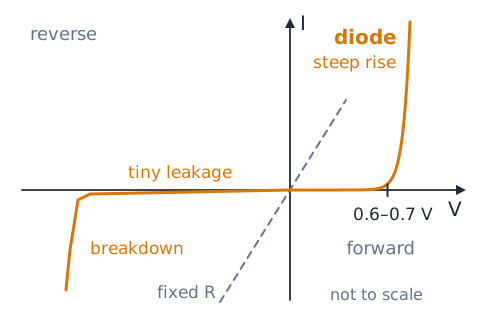
A diode is designed to conduct easily in one direction and block current in the other. In the forward direction, almost no current flows until the voltage reaches a threshold, around 0.6 to 0.7 V for a silicon diode. Above that, current rises very steeply for small increases in voltage.
In the reverse direction, only a tiny leakage current flows until breakdown. Its V/I ratio changes dramatically with voltage and direction, so the graph is curved and one-sided. Ohm's law with a single fixed R does not describe a diode; you need its characteristic curve or a simplified diode model instead.
Never infer current from voltage alone
Knowing only the voltage tells you the push, not the flow. A 12 V battery might drive milliamperes through a small indicator or hundreds of amperes through a starter motor. The current depends on the resistance of whatever is connected.
If a question gives a voltage and asks for current without giving or implying a resistance, the honest answer is that it cannot be calculated. Be wary of choices that assume the number of amperes equals the number of volts.
Measurement: the voltmeter connection
A voltmeter measures the difference in potential between two points, so it is connected in parallel, with one probe on each side of the component. It does not require breaking the circuit.
A good voltmeter has a very high internal resistance so it draws almost no current and barely disturbs what it measures. On a multimeter, select the correct AC or DC voltage function and a range above the expected value. Connecting a voltmeter in series instead would block most of the circuit current and give a misleading reading.
Measurement: the ammeter connection
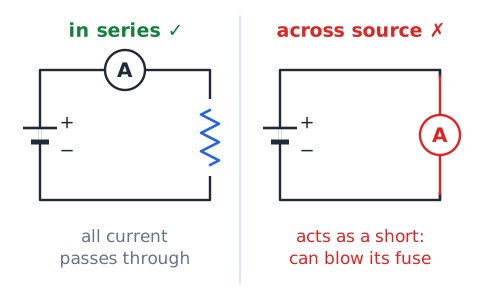
An ammeter measures the current flowing through a path, so it must be connected in series. The circuit is opened at one point and the meter is inserted so that all of the current passes through it.
An ideal ammeter has nearly zero resistance so it does not change the current. Because of that low resistance, an ammeter connected directly across a voltage source acts like a short circuit, which can blow the meter's fuse or damage the meter. Clamp-on meters avoid breaking the circuit by sensing the magnetic field around a conductor.
Measurement: the ohmmeter connection
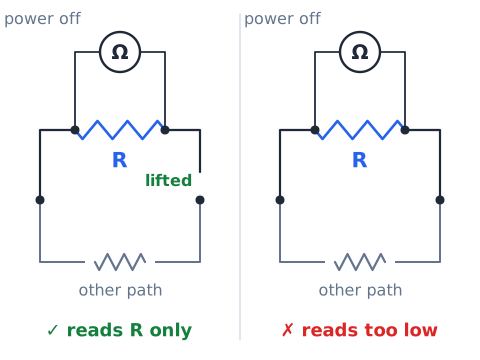
An ohmmeter supplies its own small test current from an internal battery and measures the resulting voltage, then reports
For that reason the circuit must be off and de-energized, with capacitors discharged. Isolate the part by lifting one lead so parallel paths do not lower the reading. Do not touch both probe tips, since your body adds a parallel path.
Common mistake: dividing in the wrong direction
Resistance is voltage divided by current, not current divided by voltage. For 12 V and 3 A,
while
is the conductance in siemens, not the resistance. Check that the units come out as volts per ampere.
Common mistake: adding unrelated numbers
Adding a voltage to a current or a resistance gives a meaningless result. If a problem gives 6 V and 2 ohms, the answer 8 is a trap, since volts and ohms cannot be added.
Add only like quantities: resistances in series add, voltage drops around a series loop add, and branch currents in parallel add. Multiply or divide when combining different quantities, as Ohm's law requires.
Common mistake: unit blindness
Ignoring prefixes produces answers off by a factor of 1,000. For 5 V and 250 mA, dividing 5 by 250 gives 0.02, which is wrong. Convert first:
Always attach units and convert milli, kilo, and mega before calculating.
Common mistake: assuming series components have equal voltage
Series components share the same current, not necessarily the same voltage. Each drop equals that shared current times the part's own resistance, so a larger resistor has a larger drop.
The drops are equal only when the resistances are equal. In a 5 ohm and 15 ohm series pair across 20 V, the drops are 5 V and 15 V, not 10 V each. Equal voltage is the rule for parallel branches.
Common mistake: treating resistance as consumed
Resistance is not a supply that gets used up, and current is not consumed as it passes through a resistor. The current entering a resistor equals the current leaving it.
What a resistor does is convert electrical energy into heat. The charges arrive with more potential energy and leave with less, which is the voltage drop. Saying a lamp "uses up current" or that a resistor "runs out of resistance" mixes up energy with charge flow. In circuit questions, follow energy through voltage drops and power, and follow charge through current, which stays the same around a single loop.
Common mistake: overlooking stated assumptions
Test questions often contain words like ideal, constant resistance, ohmic, or negligible wire resistance. These tell you which simplifications are allowed.
If a problem says the resistance is constant, scale current with voltage. If it describes a lamp without saying its resistance is fixed, be cautious about assuming proportionality. Ignoring a stated assumption, or adding one that was not given, can lead to an answer that is mathematically neat but physically wrong for that question.
Circuit safety and appropriate learning materials
Practice Ohm's law with low-voltage sources such as small batteries or a bench supply with current limiting, along with resistors rated for the power involved. Household outlets and car battery terminals can deliver dangerous current and are not appropriate for experiments.
Never deliberately short a battery, since even small cells can overheat or leak. Turn off and disconnect power before changing connections, and keep hands and work area dry. Resistors can become hot enough to burn skin, so let them cool. Leave work on building wiring to qualified, licensed electricians who follow lockout procedures.
A compact method for exam-style questions
For each question: identify which component the numbers belong to, convert all prefixes to base units, then write the form you need:
If the question involves a change, use ratios rather than recalculating everything. For power, choose the form that uses the given values. Finally, compare the result with an estimate and confirm the unit matches what was asked.
Example 1: current with exact division
Problem: A 48 V battery bank is connected directly across a 12 heater element. Find the current.
The full 48 V appears across the element.
Check: 4 A times 12 gives back 48 V. Answer: 4 A.
Example 2: resistance from a meter pair
Problem: A voltmeter reads 9 V across a resistor, and an ammeter in series with it reads 0.15 A. Find R.
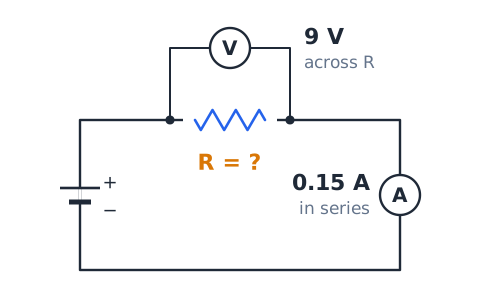
Mental check: 0.15 A times 60 is 9. Answer: 60 .
Example 3: find voltage from current
Problem: A current of 0.25 A flows through a 36 ohm resistor. What is the voltage across it?
Multiply current by resistance: 0.25 times 36 equals 9. A quarter of 36 is 9, so the voltage drop is 9 V.
Example 4: convert milliamperes before division
Problem: A sensor draws 25 mA from a 5 V supply. What is its resistance?
First convert: 25 mA is 0.025 A. Then 5 divided by 0.025 is 200, so R is 200 ohms. Dividing 5 by 25 without converting would wrongly give 0.2 ohm.
Example 5: kilo-ohm arithmetic
Problem: 12 V is applied across a 4 k resistor. Find I.
That is 3 mA, matching the shortcut V over k equals mA.
Example 6: voltage doubles while R stays constant
Problem: A fixed 50 resistor has 5 V across it. The voltage is raised to 10 V. Find both currents.
The voltage doubled, so the current doubled, as expected for constant R.
Example 7: resistance triples at fixed voltage
Problem: A 12 V supply drives a 4 load. The load is replaced with 12 .
Tripling R cut the current to one third.
Example 8: proportional changes cancel
Problem: A load draws current from 10 V across 5 . Later the voltage is 20 V and the resistance is 10 . Compare currents.
Both doubled, so the current is unchanged.
Example 9: series-drop reasoning
Problem: 4 and 8 are in series across 24 V. Find each drop.
Total R is 12 , so
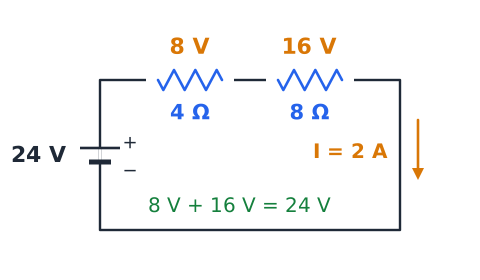
The drops add to 24 V.
Example 10: parallel branches
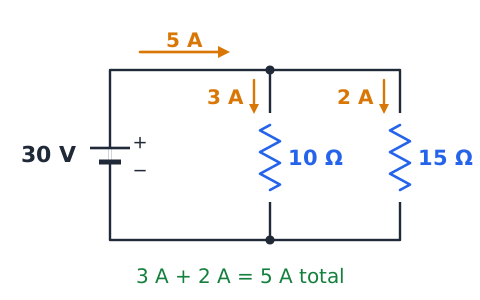
Problem: 10 and 15 are in parallel across 30 V. Find the total current.
Total: 5 A.
Example 11: recover R from a V-on-I graph
Problem: On a graph of V (vertical) versus I (horizontal), a straight line from the origin passes through (0.5 A, 11 V). Find R.
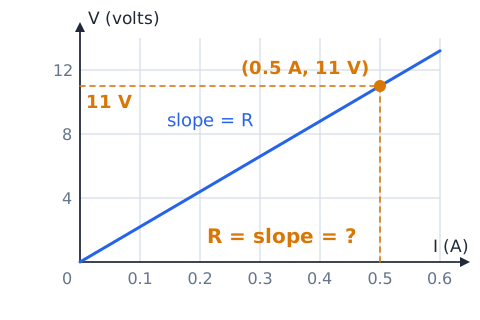
On this graph the slope is R:
Answer: 22 .
Example 12: compare constant-R table measurements
Problem: A part gives (2 V, 0.1 A), (5 V, 0.25 A), and (8 V, 0.4 A). Is it ohmic, and what is I at 10 V?
Each ratio gives
so it is ohmic. At 10 V,
Example 13: calculate resistor power
Problem: 0.5 A flows through a 40 resistor. Find its power.
Square the current first:
Check: V = 20 V, and 20 times 0.5 is also 10 W.
Example 14: current and power after a voltage change
Problem: A fixed 25 resistor goes from 10 V to 20 V. Find current and power each time.
Current doubles; power quadruples.
Drill 1: identify units
What is the unit of potential difference? The volt, V.
Of current? The ampere, A.
Of resistance? The ohm, written with the omega symbol.
Of power? The watt, W.
What does one volt divided by one ampere equal? One ohm.
Drill 2: fill in the missing current
20 V across 5 ohms? 4 A.
3 V across 150 ohms? 0.02 A, which is 20 mA.
100 V across 2 kilohms? 0.05 A, which is 50 mA.
1.5 V across 0.5 ohm? 3 A.
9 V across 45 ohms? 0.2 A, which is 200 mA.
In each case divide volts by ohms, and convert kilohms to ohms first.
Drill 3: convert before calculating
6 V across 3 k: convert to 3,000 , so I = 2 mA.
5 V with 250 mA: convert to 0.25 A, so R = 20 .
0.4 A through 1.5 k: convert to 1,500 , so V = 600 V.
Drill 4: interpret series conditions
In a series loop, is the current the same through each resistor? Yes.
Is the voltage the same across each? Only if the resistances are equal.
Which resistor has the larger drop? The larger resistance.
Drill 5: interpret graph orientation
A V-versus-I line has slope 50 V/A. What is R? 50 .
An I-versus-V line has slope 0.02 A/V. What is R?
Same resistor, different axes.
Drill 6: mixed three-step challenge
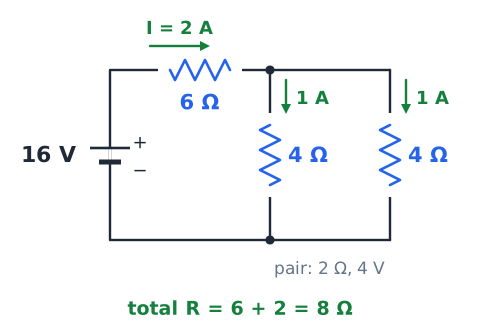
A 6 ohm resistor is in series with two 4 ohm resistors in parallel, across 16 V. Total resistance? The parallel pair is 2 ohms, so 8 ohms.
Source current? 2 A.
Current in each 4 ohm branch? The pair drops 4 V, so 1 A each.
Six-step calculator-free solving routine
Step one: read the question and identify which component and which quantity are asked for.
Step two: list the given values with units, and note any stated conditions such as constant resistance, series, or parallel.
Step three: convert every prefix to base units, or use a consistent pairing such as volts, kilohms, and milliamperes.
Step four: choose the right form of V = IR or the power equation, or set up a ratio for a change.
Step five: simplify fractions before dividing.
Step six: check direction, size, and unit, and eliminate choices that fail.
Seven test traps to recognize
Watch for these traps. Writing
instead of a product. Dividing current by voltage to get resistance. Forgetting to convert milliamperes or kilohms. Using the supply voltage for one resistor in a series string. Assuming equal current in parallel branches or equal voltage in series parts. Treating a lamp or diode as having fixed resistance when it does not. Assuming power changes in proportion to voltage or current, when at fixed resistance it changes with the square.
High-yield review and final checklist
Ohm's law links voltage, current, and resistance for one component:
Convert prefixes first. With R constant, current tracks voltage and power goes with the square. Series parts share current and their resistances add; parallel branches share voltage. On a V-versus-I graph the slope is R; on I-versus-V it is 1/R. An open path carries zero current. Voltage alone cannot determine current.
 English ▾