 ASVAB Camp
Learning outcomes and exam relevance
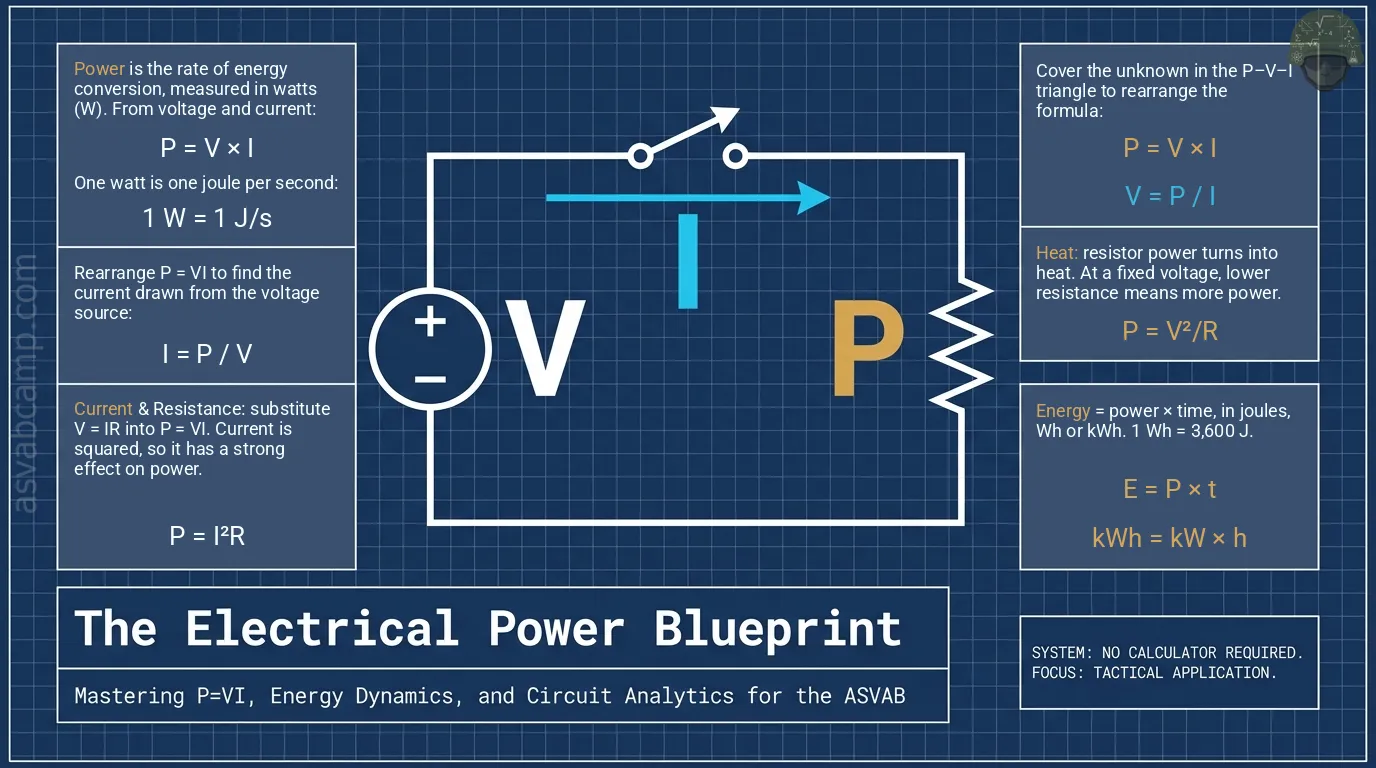
After this lesson you should be able to compute electrical power from any two of voltage, current and resistance, rearrange the power formula to find a missing quantity, and turn power and time into energy in joules, watt-hours or kilowatt-hours. You will also estimate electricity cost, efficiency and battery runtime. These skills appear regularly in ASVAB Electronics Information questions.
Why electrical power is tested
Power ties together the quantities that every Electronics Information question is built from. A label on a soldering iron, a space heater or a phone charger states its power, and from that number you can work out how much current it pulls, whether a circuit or fuse can handle it, and how much it costs to run. The ASVAB rewards people who can move quickly between volts, amps, ohms, watts and watt-hours without mixing them up. Most power questions need only one formula and one or two steps of arithmetic, so they are good places to collect points if you know the relationships well.
Power is a rate, not a quantity of stored energy
Power tells you how fast energy is being transferred or converted, not how much energy exists. Think of a garden hose: the flow rate in gallons per minute is like power, while the total gallons that land in a bucket is like energy. A 100 W bulb converts energy at a steady 100 joules every second. Leave it on longer and it uses more energy, yet its power stays 100 W the whole time.
The watt and the joule
The joule (J) is the SI unit of energy. The watt (W) is the SI unit of power, and one watt means one joule transferred per second. So a device rated at 25 W moves 25 J of energy each second it runs. If a question asks for power, the answer belongs in watts; if it asks for energy, look for joules or watt-hours.
Fundamental electrical power equation
Voltage is the energy each coulomb of charge gives up as it passes through a component, measured in joules per coulomb. Current is how many coulombs pass each second. Multiply the two and the coulombs cancel, leaving joules per second, which is watts. That is why electrical power equals voltage times current. The relationship holds for any component at a given instant, whether it is a resistor, a motor or a charging battery. It is the starting point from which every other power formula in this lesson is built.
Formula: electrical power from voltage and current
Here P is power in watts (W), V is the voltage across the component in volts (V), and I is the current through it in amperes (A). Example: a car dome light on 12 V that draws 0.5 A uses
Rearrange to find voltage
When you know the power and the current, divide power by current:
Example: a heating pad uses 60 W and draws 0.5 A. Its voltage is
Check by multiplying back:
Rearrange to find current
When you know the power and the voltage, divide power by voltage:
Example: a 1,200 W microwave on a 120 V outlet draws
This is the kind of figure you compare with a circuit breaker rating.
The P–V–I relationship diagram
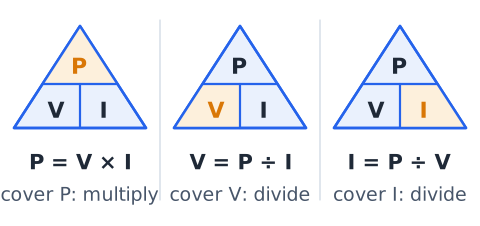
A quick memory aid is a triangle with P on top and V and I side by side underneath. Cover the quantity you want. Covering P leaves V beside I, so multiply. Covering V leaves P over I, so divide. Covering I leaves P over V, so divide.
Voltage, current and power are distinct quantities
Each of these quantities answers a different question. Voltage, in volts, is the push or energy per unit of charge. Current, in amperes, is the rate at which charge flows. Power, in watts, is the rate at which energy is converted. A 9 V battery can supply a tiny current to a smoke alarm or a much larger one to a toy motor; the voltage is the same, but the power is very different. Never treat a number in one unit as if it were another.
What happens to power if voltage doubles at fixed current
Because
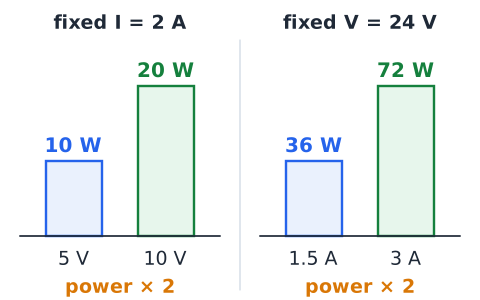
power is directly proportional to voltage when current is held constant. If the current stays at 2 A and the voltage rises from 5 V to 10 V, power goes from 10 W to 20 W: double. Note the condition. In a plain resistor, raising the voltage also raises the current, so the result there is different, as later sections show.
What happens if current doubles at fixed voltage
With voltage held steady, power is directly proportional to current. A 24 V supply delivering 1.5 A provides 36 W; if the load draws 3 A instead, the supply delivers 72 W. Doubling current doubled power. This is a common exam item: at constant voltage, double the current and you double the power, not quadruple it and not leave it unchanged.
Power formula derived using Ohm’s law
Ohm's law,
links voltage, current and resistance for an ohmic resistor. Substituting it into
produces two more forms of the power equation. Replacing V gives a formula using current and resistance. Replacing I with gives a formula using voltage and resistance. All three forms describe the same physics.
Resistor power from current and resistance
Substitute
into
P is in watts, I in amperes, R in ohms. Because current is squared, it has a strong effect. Example: 3 A through a 4 Ω resistor gives
Resistor power from voltage and resistance
Substitute
into
Example: 6 V across a 3 Ω resistor gives
Since voltage is squared, doubling the voltage on a fixed resistor makes the power four times larger.
Deriving power is a consistency check
The three formulas must agree, so you can use one to check another. Take 10 V across a 5 Ω resistor. Ohm's law gives 2 A. Then
If your answers disagree, an arithmetic step went wrong.
Choosing the right power equation
Pick the formula that uses the two values you were given, so you avoid an extra step. Given voltage and current, use
Given current and resistance, use
Given voltage and resistance, use
Finding Ohm's law values first also works, but each extra step is one more chance for an arithmetic slip under time pressure.
Resistor heating and safety ratings
Electrical power dissipated in a resistor becomes heat. Every resistor has a power rating, such as 1/4 W, 1/2 W or 5 W, which is the most it can safely dissipate. A resistor forced to handle more than its rating can overheat, change value, discolor the circuit board or burn open. A good habit is to choose a part rated at roughly twice the expected dissipation. For example, a resistor expected to dissipate 0.3 W should get about 0.6 W of rating, so a 1/2 W part is marginal and a 1 W part is the sensible choice.
Fixed voltage: lower resistance increases power
When the voltage is fixed, use
Resistance sits in the denominator, so smaller resistance means more power. On a 12 V supply, a 24 Ω load uses 6 W, while an 8 Ω load uses 18 W. This is why household heaters have low-resistance elements: on a fixed outlet voltage, low resistance draws more current and makes more heat.
Fixed current: greater resistance increases power
When the current is fixed, as in resistors connected in series, use
Now resistance is in the numerator, so larger resistance means more power. With 0.5 A flowing, a 10 Ω resistor dissipates 2.5 W while a 40 Ω resistor dissipates 10 W. Whether more resistance means more or less power depends entirely on what is held constant, which is why exam questions state that condition.
What electrical energy means in these problems
In these problems, electrical energy is the total amount delivered to or used by a device over some time. It becomes heat, light, motion or sound, or it is stored chemically in a battery being charged. The power company bills you for energy, not power. A large motor running briefly can use less energy than a small fan running all day, because energy depends on both power and time.
Energy from power and time
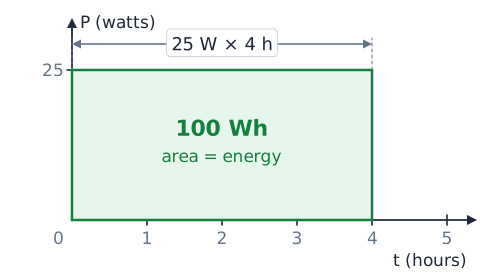
E is energy, P is power and t is time. Watts times seconds gives joules; watts times hours gives watt-hours (Wh); kilowatts times hours gives kilowatt-hours (kWh). Example: a 25 W fan running 4 hours uses
Wh. The same rule, rearranged as
finds power from energy.
Watts and watt-hours are different units
The watt measures a rate. The watt-hour measures an amount: the energy used by a 1 W load running for one hour. A 40 Wh label on a battery describes stored energy, while a 40 W label on a lamp describes how fast the lamp uses energy. The names look alike, but swapping them is like confusing miles per hour with miles. Check the units of the question before choosing an answer.
Kilowatts and megawatts
The metric prefixes work the same for power as for any unit. One kilowatt (kW) equals 1,000 W, and one megawatt (MW) equals 1,000,000 W. To convert kW to W, multiply by 1,000, so 3.5 kW is 3,500 W. To go from W to kW, divide by 1,000, so 750 W is 0.75 kW. Megawatts describe power plants and large industrial loads.
The kilowatt-hour as an energy unit
One kilowatt-hour is the energy used by a 1 kW load in one hour. A 1.5 kW space heater on for 2 hours uses
kWh. Utility meters and bills use this unit.
Convert between watt-hours and joules
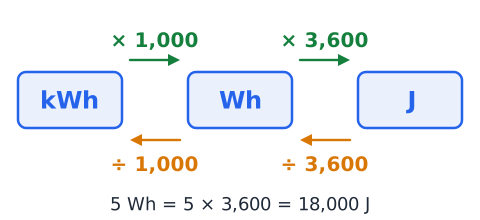
One hour contains 3,600 seconds, and one watt is one joule per second, so 1 Wh equals 3,600 J. Multiply watt-hours by 3,600 to get joules, or divide joules by 3,600 to get watt-hours. A 5 Wh battery stores 18,000 J. One kilowatt-hour is 3,600,000 J, or 3.6 MJ.
Hours, minutes and seconds
Time units must match the energy unit you want. For joules, put time in seconds. For watt-hours or kilowatt-hours, put time in hours. Turn minutes into hours by dividing by 60: 15 minutes is 0.25 h, 45 minutes is 0.75 h, and 90 minutes is 1.5 h. Turn minutes into seconds by multiplying by 60: 3 minutes is 180 s.
Calculating energy in kWh
Convert watts to kilowatts first, then multiply by hours:
A 150 W television watched for 6 hours uses
kWh.
Electricity cost as a simple arithmetic model
Energy cost equals energy in kilowatt-hours multiplied by the price per kilowatt-hour. A 2 kW electric oven used for 1.5 hours consumes 3 kWh; at a made-up rate of 16 cents per kWh, the energy charge is 48 cents. Real bills add fixed fees, taxes and changing rates, but exam questions usually include only the energy charge. Keep the units straight: kWh times cents per kWh gives cents.
Efficiency: input power versus useful output
Efficiency compares the useful output of a device with what you put in:
The Greek letter (eta) is efficiency, is useful output power and is input power, both in watts. Energies over the same time period work too. Example: a pump motor takes in 250 W and delivers 225 W of mechanical power, so
or 90 percent. To find required input instead, divide output by efficiency.
Efficiency is not another name for power rating
A power rating says how much power a device draws or delivers. Efficiency is a ratio with no units that says what fraction of the input ends up as useful output. A 1,000 W motor and a 50 W motor could both be 85 percent efficient. Efficiency of a real device is always below 100 percent, so an answer choice over 100 percent signals that the output and input were swapped.
Input power, useful power and lost power
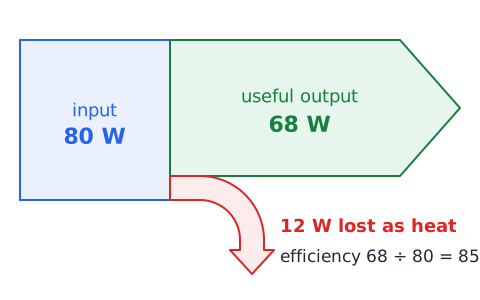
Energy is conserved, so input power equals useful output power plus lost power. The losses are usually heat from wire resistance and friction, plus some sound or vibration. If a power supply draws 80 W from the wall and delivers 68 W to a computer, 12 W is lost as heat, which is why the supply feels warm. Its efficiency is
or 85 percent.
Battery capacity in ampere-hours
Battery capacity is often stated in ampere-hours (Ah) or milliampere-hours (mAh). An ampere-hour is a quantity of charge: one ampere flowing for one hour. A 2 Ah battery could, in an ideal case, supply 1 A for 2 hours or 0.5 A for 4 hours. A 3,000 mAh phone battery holds 3 Ah. Ampere-hours alone are not energy, because they leave out the voltage at which that charge is delivered.
Estimate battery energy from voltage and ampere-hours
Multiply nominal voltage by capacity in ampere-hours to estimate stored energy in watt-hours:
The units work because volts times amperes is watts, and watts times hours is watt-hours. A 3.7 V, 2.5 Ah lithium cell holds about
Wh. A 12 V, 7 Ah backup battery holds about 84 Wh. Real usable energy is a bit lower.
Estimating battery runtime
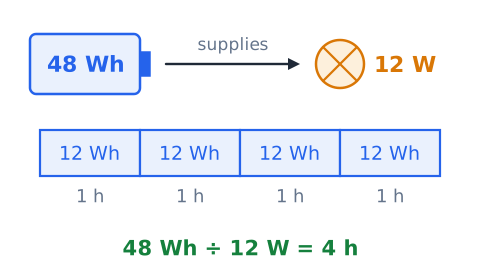
Ideal runtime equals stored energy divided by load power: hours equals Wh divided by W. A 48 Wh pack running a 12 W light lasts about 4 hours. If a converter sits between the battery and the load, the battery must supply more than the load uses, so divide the load power by the converter efficiency first. Treat the result as an upper estimate, since batteries are rarely drained completely.
Why power ratings have conditions
A label such as 60 W assumes a stated operating condition, usually the rated voltage. Run a heater rated 1,500 W at 120 V on a lower voltage and its power drops, because its resistance stays about the same while falls. Motors draw different power at light and heavy loads. Battery capacity depends on how fast it is discharged and on temperature. When an exam says "operates at its rated power," it is telling you to use the label value directly.
Appliance example: a heater and a lamp
Compare a 1,500 W heater with a 10 W LED lamp, both on 120 V. The heater draws
the lamp draws about 0.083 A. In one hour the heater uses 1.5 kWh while the lamp uses only 0.01 kWh. The heater uses as much energy in one hour as the lamp would use in 150 hours.
Two devices operating simultaneously
When several loads run at the same time, their powers add. Total power equals the sum of the individual powers, regardless of how they are wired. A 900 W coffee maker and a 600 W toaster on together demand 1,500 W, which on 120 V is 12.5 A total. Their combined energy over 0.2 hours is
kWh. Adding powers like this is how electricians check whether a circuit will be overloaded.
Power in series resistors
In a series string, every resistor carries the same current, so
is the natural choice, and the largest resistor dissipates the most power. With 2 A flowing through 3 Ω and 7 Ω, the 3 Ω part dissipates 12 W and the 7 Ω part dissipates 28 W, for 40 W total. That total equals times the 10 Ω combined resistance.
Power in parallel resistors
In parallel, every branch has the same voltage, so use
The smallest resistor dissipates the most power because it carries the most current. Across 10 V, a 5 Ω branch dissipates 20 W and a 20 Ω branch dissipates 5 W, for 25 W total. Total parallel power is the sum of the branch powers.
Source power equals load power in an ideal circuit
In an ideal circuit with lossless wires, the power the source delivers equals the total power the loads absorb. This is conservation of energy. A 9 V source supplying 0.4 A delivers 3.6 W, so the loads together must dissipate 3.6 W. If a problem gives you all the load powers, add them to get source power; if it gives source power and all but one load power, subtract to find the missing one.
Loads connected to the same voltage
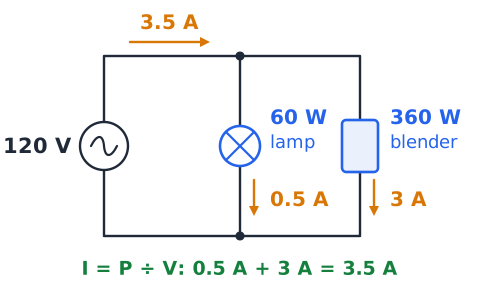
Household outlets put each appliance across the same voltage, which is a parallel arrangement. Each load then draws current according to its own power:
On 120 V, a 60 W lamp draws 0.5 A and a 360 W blender draws 3 A, and the circuit supplies the total of 3.5 A. A higher-power device on the same voltage always draws more current.
What a power meter measures
A wattmeter reads power, the rate of energy use at that moment, in watts or kilowatts. An energy meter, like the utility meter on a house, reads accumulated energy in kilowatt-hours; it keeps counting upward as long as anything is drawing power. A plug-in monitor often shows both: present watts on one screen and total kWh since reset on another. Watts tell you how hard something is working now; kWh tell you how much it has used so far.
Why a kWh meter can increase with low power
An energy meter counts power multiplied by time, so a small load that never turns off still adds up. A 5 W standby device runs 24 hours a day:
Wh each day, or about 3.6 kWh in a 30-day month. Low power over a long time can match high power over a short time.
Instantaneous versus average power
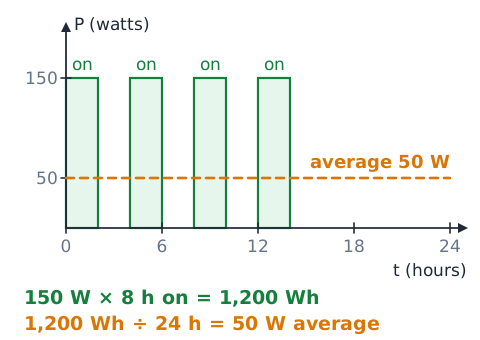
Instantaneous power is the value at one moment. Average power is total energy divided by total time. A refrigerator compressor may draw 150 W while running and nearly zero while off. If it runs 8 hours of a 24-hour day, it uses 1,200 Wh, and its average power over the day is
Use average power when finding energy over long periods for loads that cycle on and off.
Two-stage energy calculations
When a device runs at different power levels, find the energy for each stage separately, then add. A blender at 300 W for 10 minutes and 600 W for 5 minutes uses
Wh. Do not average the two powers unless the stages last equal times.
Reading power and energy labels
Device labels show several kinds of numbers, and the unit tells you which is which. A power adapter might read "Input 100–240 V, 1.5 A" and "Output 19 V, 3.42 A, 65 W." The output power checks:
A battery label might show "11.1 V, 4,400 mAh, 48.84 Wh." The Wh value is energy; the mAh value is charge. Volts are never power.
Think through unit cancellation
Writing units alongside numbers catches many errors. Watts times hours gives watt-hours. Joules divided by seconds gives watts. Watt-hours divided by watts gives hours. Volts times ampere-hours gives watt-hours. If your setup ends in a strange unit, such as watts per hour or watt-squared, the setup is wrong even if the arithmetic is right.
Distinguish power delivered and power dissipated
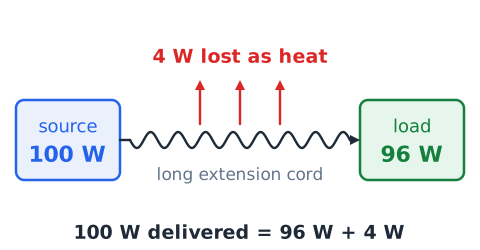
Power delivered is what a source supplies to the circuit. Power dissipated is what a component converts, usually into heat. In a simple resistor circuit with ideal wiring, they are equal. In a real circuit, the source delivers slightly more than the main load receives, because the wires and connections dissipate a little. For example, a source delivering 100 W through long extension cords might put 96 W into the load and lose 4 W heating the cords. ASVAB questions usually assume ideal wiring unless they say otherwise.
Resistive power is not all useful light
An incandescent bulb is a resistor, and all the power it dissipates becomes heat and light, but most of it is heat. A traditional 60 W bulb turns only a few percent of its power into visible light. An LED produces similar brightness at around 8 to 10 W because more of its input becomes light. The dissipated power is still computed with the usual formulas; efficiency describes how much of it is useful.
AC systems require a qualification
For DC circuits and purely resistive AC loads,
works directly when the AC voltage and current are effective (RMS) values. Household 120 V is an RMS value. Motors and other loads with coils or capacitors can draw current that is out of step with the voltage, so their true power in watts is less than volts times amps. That product is then called apparent power, measured in volt-amperes (VA). Unless a question mentions this, treat loads as resistive.
A safe approach to electrical questions
Real circuits can injure or kill, so all hands-on work must follow proper procedures and training. The habits that matter for this lesson are general: high power means high current or high voltage, both of which create heat and shock hazards. Overloaded outlets and extension cords overheat. Devices should be de-energized and unplugged before anyone touches internal parts. On the test, treat the calculations as models of ideal circuits, never as instructions for trying things on live equipment.
Build a short plan before calculating
Before any arithmetic, write down three things: what is given, with units; what is asked for, with units; and which formula connects them. Then check whether a conversion is needed, such as minutes to hours or watts to kilowatts. This ten-second plan prevents most mistakes on multi-step power questions.
Use estimation to reject impossible choices
Rough estimates eliminate wrong choices quickly. If a 1,000 W heater runs for a bit less than an hour, the energy must be a bit less than 1 kWh; a choice of 50 kWh is impossible. If a device on 120 V uses about 600 W, its current must be about 5 A. Round first, then pick the choice near your estimate.
Find watts from volts and amps
A portable air compressor runs from a 12 V vehicle outlet and draws 8 A. What power does it use?
Given V = 12 V and I = 8 A. Use the basic power formula:
The compressor uses 96 W.
Find voltage from power and current
A laptop draws 45 W at a current of 2.25 A. What voltage does it run on?
The answer is 20 V.
Find current from watts and volts
A 36 W fluorescent fixture runs on a 120 V circuit. What current does it draw?
It draws 0.3 A, or 300 mA.
Resistor dissipation with current
A current of 0.2 A passes through a 150 Ω resistor. How much power does it dissipate?
The resistor dissipates 6 W, so a 1/2 W part would overheat.
Resistor dissipation with voltage
A 50 Ω resistor has 15 V across it. Find its power.
It dissipates 4.5 W.
Convert a small device to kWh
An 8 W aquarium pump runs nonstop for 30 days. How much energy does it use?
Hours:
h. Energy:
Wh.
Divide by 1,000: the pump uses 5.76 kWh.
Watt-hours to joules
A small flashlight battery stores 3.5 Wh. Express this in joules.
The battery stores 12,600 J, since each watt-hour is 3,600 J.
Electricity cost from kWh
A 1,800 W hair dryer runs 20 minutes a day for 30 days. At an assumed 15 cents per kWh, what is the energy cost?
Daily energy:
kWh. Monthly:
kWh.
Cost:
Estimate an efficient motor output
A drill motor takes 600 W from the outlet and is 70 percent efficient. How much useful mechanical power does it deliver, and how much is lost?
Lost power:
mostly as heat in the windings and bearings.
The motor delivers 420 W of useful power.
Find efficiency
A battery charger draws 50 W from the wall while delivering 40 W into the battery. What is its efficiency?
The charger is 80 percent efficient; the other 10 W heats the charger. A quick check: efficiency must be below 100 percent, and it is.
Estimate battery runtime
A 12 V, 10 Ah battery powers a 30 W camping fridge directly. About how long will it run?
Energy:
Wh.
About 4 hours, ignoring losses and the usual advice not to drain the battery fully.
Series resistors and their heating
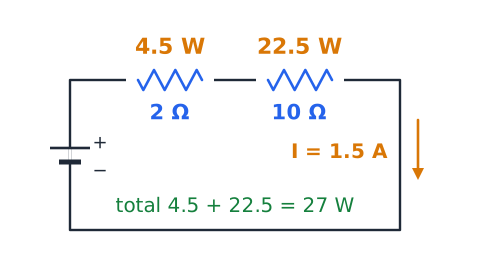
A 1.5 A current flows through 2 Ω and 10 Ω resistors in series. Find each power.
Total: 27 W. The larger resistor heats more.
Parallel branch powers
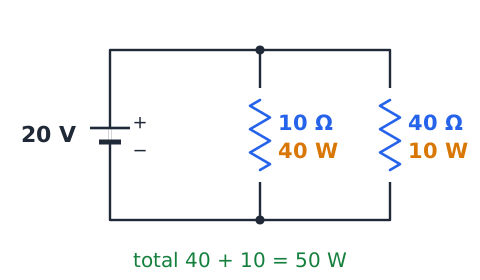
A 20 V supply feeds 10 Ω and 40 Ω resistors in parallel. Find each power.
Total: 50 W. The smaller resistor heats more.
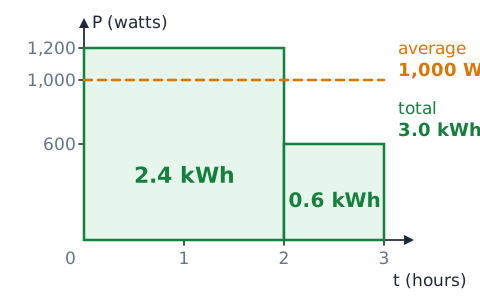
Two-stage energy, then average power
A space heater runs at 1,200 W for 2 hours, then at 600 W for 1 hour. Find total energy and average power.
Stage energies:
kWh and
kWh. Total: 3.0 kWh.
Average power:
which is 1,000 W.
Drill — identify the physical quantity
Name the quantity each value describes.
250 W? Answer: power.
7.2 kWh? Answer: energy.
5 Ah? Answer: electric charge (battery capacity).
3,600 J? Answer: energy.
120 V? Answer: voltage, or energy per unit of charge.
15 A? Answer: current.
Drill — choose a formula
Pick the most direct formula.
Given 24 V and 2 A, find power. Answer:
Given 0.5 A and 100 Ω, find power. Answer:
Given 9 V and 18 Ω, find power. Answer:
Given 600 J over 20 s, find power. Answer:
Drill — convert units without a calculator
Convert each value.
4.2 kW to W? Answer: 4,200 W.
850 W to kW? Answer: 0.85 kW.
2 Wh to J? Answer: 7,200 J.
40 minutes to hours? Answer: 2/3 h, about 0.67 h.
1,500 mAh to Ah? Answer: 1.5 Ah.
Drill — current and resistance tradeoffs
Decide how power changes.
Fixed voltage, resistance halved? Answer: power doubles.
Fixed current, resistance tripled? Answer: power triples.
Fixed resistance, current doubled? Answer: power becomes four times larger.
Fixed resistance, voltage halved? Answer: power drops to one-fourth.
Drill — estimate an energy bill
Assume 20 cents per kWh.
A 100 W lamp on 10 hours? Answer: 1 kWh, 20 cents.
A 2.5 kW heater on 4 hours? Answer: 10 kWh, 2 dollars.
A 50 W router on for 24 hours? Answer: 1.2 kWh, 24 cents.
A 3 kW dryer for 45 minutes? Answer: 2.25 kWh, 45 cents.
Drill — power balance
Apply the idea that input equals output plus losses.
A source delivers 60 W to three loads using 15 W and 20 W and an unknown amount. The third? Answer: 25 W.
A motor takes 500 W and delivers 400 W. Losses? Answer: 100 W, so it is 80 percent efficient.
A 90 percent efficient converter must output 45 W. Input? Answer: 50 W.
Trap — treating watts as watt-hours
The mistake: answering an energy question in watts, or a power question in watt-hours. Watts are a rate; watt-hours are an amount. The fix: if time is involved and the question asks how much was used, the answer must be in Wh, kWh or J.
Trap — squaring the wrong variable
The mistake: writing
Only current or voltage is squared, never resistance. The fix: recall the derivation. Substituting
into
gives , so the current appears twice and the resistance once.
Trap — skipping resistor conditions
The mistake: saying more resistance always means more power, or always less. Both claims fail without knowing what is held fixed. The fix: at fixed voltage, use , so more resistance gives less power. At fixed current, use , so more resistance gives more power. Read the question to see which quantity is fixed before choosing.
Trap — confusing charge capacity and energy
The mistake: comparing batteries by ampere-hours alone, as if Ah were energy. A 3.7 V, 4 Ah cell and a 12 V, 4 Ah battery hold very different energy. The fix: multiply by voltage. The first holds about 14.8 Wh; the second about 48 Wh.
ASVAB approach to electrical power problems
Start by reading the last line to see what is asked and in which unit: watts, watt-hours, kilowatt-hours, joules, volts, amps or ohms. Next, list the given values and convert anything that needs it, such as kilowatts to watts, milliamps to amps, or minutes to hours or seconds. Choose the single formula that links the given values to the unknown. Calculate, then check the answer by size and units. Is the current reasonable for the voltage? Is the efficiency below 100 percent? Does energy grow with time? Watch for choices that come from multiplying instead of dividing, from adding the given numbers, or from forgetting to square. If a ratio question asks "by what factor," set up the formula as a proportion rather than plugging in made-up numbers.
Review checklist and next lesson bridge
Power is the rate of energy transfer, in watts, and
applies to any component. For resistors,
give the same answer. Energy is power times time, measured in joules, watt-hours or kilowatt-hours, with 1 Wh equal to 3,600 J. Cost is kWh times the rate. Efficiency is useful output divided by input. Battery energy is about volts times ampere-hours. Next you will apply these ideas to series circuits, where the same current flows through every part and the resistances and voltage drops add up.
 English ▾