 ASVAB Camp
What fast visual scanning actually means
Visual scanning is the controlled process of inspecting a figure for a few decisive properties instead of repeatedly viewing every detail. In a spatial-assembly problem, start by naming the source parts, connector or marked corner, and allowed transformations. A fast answer is one that survives these checks without wasted comparison. Speed never excuses accepting a mirrored piece when reflection is forbidden. This lesson teaches a repeatable scan, not a universal stopwatch trick or a claim about secret ASVAB items.
What the AO subtest measures
The official ASVAB describes Assembling Objects as the ability to determine what an object will look like when its parts are put together. A visible contour, a labeled attachment point, and an internal notch can each help distinguish candidates. Visual scanning is an instructional support skill: it makes assembly comparisons more systematic. These examples are newly drawn for practice, not examples retrieved from a secure test. The exact layout and directions of actual questions can differ from the practice questions in this course.
The five-question scan
On the first look, answer five questions in order. What transformations does the prompt permit? Where is the anchor or marked point? What is the unusual contour, notch, or protrusion? Which edges must touch? Which candidate violates an invariant? An invariant is a property that must not change, such as the number of occupied cells or the location of a dot relative to its own shape. Do not calculate every possible rotation when one invariant eliminates three answers.
Read the rule before viewing options
A candidate can look plausible and still violate the rule written over the diagram. A direction such as 'rotate clockwise 90 degrees' forbids a counterclockwise quarter turn, while 'slide only' preserves orientation. Read the operator first, then scan the four choices. When the correct operation is known, look for the transformed feature that will be hardest for an incorrect option to fake. This prevents attractive but illegal transformations from stealing attention.
Translate without changing handedness
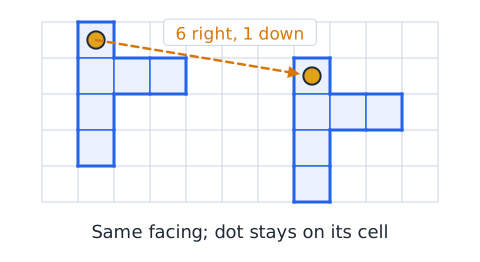
Translation shifts every point by the same horizontal and vertical amount. A right-facing hook remains right-facing, and a marked square maintains its relative position. For grid diagrams, all coordinates change by the same pair of offsets. Translation neither stretches nor mirrors a figure. You can ignore the absolute placement of an object on the candidate page when the question allows sliding, but cannot ignore which arm lies above the notch.
Clockwise versus counterclockwise
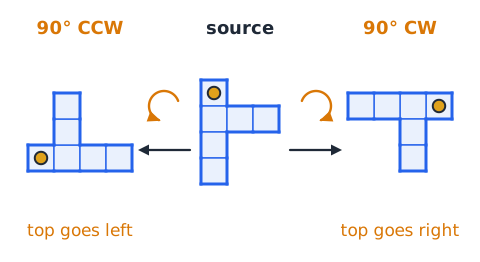
A clockwise quarter turn moves the top of an upright object toward the right; counterclockwise moves the top toward the left. Track an asymmetric marker: if the source has a dot on its upper-left arm, that dot must travel with its cell through the rotation. A shape may have an almost identical outline in two orientations, so the marker often decides the answer. Use a brief mental rotation anchored to one distinctive feature, then verify the entire contour.
Half turns and quarter turns
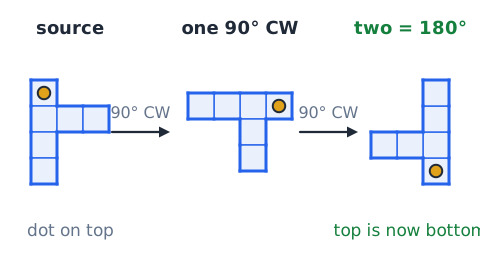
A half turn is a 180-degree rotation: top becomes bottom and left becomes right. Two clockwise quarter turns equal one half turn, but one quarter turn does not. A fast scanner compares the longest projecting arm first, then checks the opposite notch and finally the marker. This order limits needless attention to common square cells. Always use the angle named by the current question; do not carry an angle from the preceding item.
Why a mirror is not a rotation
Reflection flips handedness. It reverses which side of an asymmetric hook has its shorter branch, even if the overall silhouette seems close. Pure rotations preserve handedness. When the prompt says 'no reflection,' reject a mirror regardless of whether a candidate fits inside the same rectangular dimensions. A simple L may be too symmetric to expose a mirror trap, so inspect any notch, internal dot, or uneven third branch before selecting an answer.
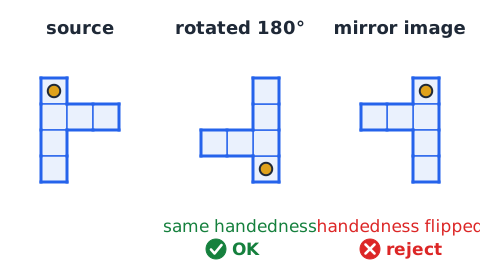
Count occupied cells when needed
Grid-based figures are composed of filled square cells. Rotation and translation preserve the number of filled cells. If the source has seven squares, an option with six or eight cannot be its rigidly moved copy. Cell counting is particularly useful when distractors differ by an added or missing corner. However, counting every cell first is wasteful if a single marked notch already rules out the answer. Use count as a secondary check or when outlines nearly match.
Track markers as part of the object
A circle, triangle, or letter printed within a square is attached to that specific square. It is not a decoration that stays in the upper-left corner of the drawing after rotation. Before rotating mentally, choose the marker as your anchor. Ask which arm it touches and whether it lies next to a notch. An option showing the correct rotated outline with its dot moved to another square must be rejected. In these exercises, the gold dot is integral to the figure.
Outer boundary before interior details
The outer boundary is the easiest feature to examine at a glance. Compare extremities: topmost block, bottommost extension, left-facing tooth, and long right edge. If the boundary differs, there is usually no reason to inspect interior shading. If multiple choices share the same outline, shift to the position of a dot, hole, tab, or joint. This two-pass scan balances speed and accuracy without assuming that a matching silhouette always means a correct assembly.
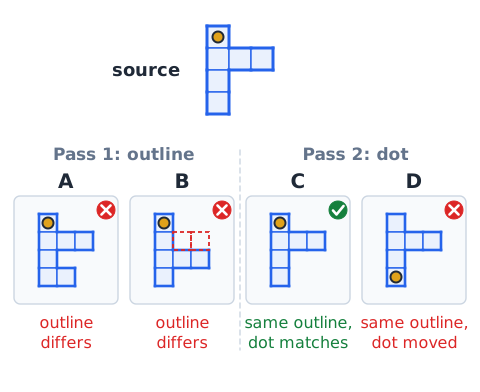
Distinctive features are efficient anchors
A distinctive feature is rare among the options, for example a two-cell notch followed by a one-cell finger. Identify such a feature before analyzing generic rectangular areas. In a crowded four-option layout, locate its expected transformed direction and eliminate shapes that point elsewhere. Then confirm one second feature. An efficient scan uses a small amount of reliable evidence and stops when the remaining answer satisfies every rule rather than continuing to compare irrelevant shading.
Top-left scanning is a habit, not a law
A predictable left-to-right and top-to-bottom scan prevents skipped options, especially when several panels look similar. You may start at a marked connector if that is a more diagnostic anchor. What matters is following one path consistently, not scanning randomly back and forth. On a phone or small screen, ensure every option is displayed at equal scale. Our practice illustrations avoid intentional cropping because cropped information can create accidental ambiguity.
Batch reject, then verify
First make a fast rejection pass using one invariant, such as a forbidden mirror. Second, verify the survivors using a different invariant, such as marker position or cell count. Do not treat a 'looks close' impression as proof. When the first pass leaves two possibilities, examine exactly the property that differs between them. When only one candidate remains, still ensure it obeys the direction and attachment rules rather than merely being the least incorrect.
A two-feature stopping rule
For many original training diagrams, two independent checks are sufficient to distinguish a valid rigid transformation: (1) the correct silhouette and orientation; (2) the correct marker or notch location. This is a practice heuristic, not a guarantee that every official question can be solved with two glances. Complex assemblies may require connector alignment, additional edges, and collision checks. Use the rule to structure your attention, then slow down where a full consistency check is needed.
Avoid repeated full rotations
Mentally rotating the entire source four separate times to test four options is slow. Instead, rotate one distinctive arm or marker once to predict the target orientation. Scan each option for that prediction. A candidate failing the predicted arm direction is out immediately. Only rotate the complete source after you have narrowed the field. This approach lowers working-memory demands because you keep one diagnostic relationship active rather than four complete imagined pictures.
Manage clutter with a scan order
An assembly may contain labels, colors, four answer boxes, and a grid. Establish a visual order: read operation, inspect source, set a predicted anchor, sweep choices, verify the remaining whole. Do not compare background decorations, border thickness, or font shapes unless the question explicitly makes them meaningful. In these practice items, colored squares are shape components and the gold dot is a meaningful marker; light grid lines and card borders are only viewing aids.
Use negative evidence precisely
A clear mismatch is stronger than a vague similarity. For example, 'candidate B has the marked square on the wrong branch' is a defensible rejection. 'B looks odd' is not. Practice naming the exact reason an option fails, such as mirrored handedness, wrong rotation, missing cell, relocated marker, or incompatible contact. This produces useful feedback from missed questions: you can improve the check that failed instead of simply trying to look faster next time.
Question-level time checks
Time management means monitoring the remaining time without making hasty random clicks. Read the instructions and notice which questions require full geometry rather than a quick feature match. A personal practice time target can be used during review, but it should not be represented as a guaranteed official allocation. The official ASVAB publishes AO subtest limits that depend on administration and tryout questions; always rely on your current test screen and administrator directions.
CAT questions cannot be revisited
In CAT-ASVAB, the official instructions say you cannot return to a previous question once it has been answered. Therefore, use a scan–compare–verify decision cycle before submitting; do not assume you can flag and return later as on many practice apps. The paper-and-pencil format allows different review habits. Practicing with a strict one-way mode can simulate this decision discipline, but it is not a replacement for the actual official interface or directions.
Why blind last-second guessing can fail
Official CAT-ASVAB guidance cautions that racing through remaining questions with random answers can result in penalties when a series of responses is incorrect near the end. This lesson does not recommend an invented fixed seconds-per-question rule. Work each problem legitimately, eliminate visible errors, and select the best-supported candidate. If uncertain, use the highest-value remaining check rather than clicking immediately on a familiar-looking shape.
Practice with and without a clock
First solve a new diagram without a timer and write the elimination reasons. Once accuracy is stable, repeat different original problems under moderate time pressure. Compare errors, not just completion time. If speed rises while the wrong-mirror rate doubles, your method needs correction. Timed practice is an instructional routine. You can review your own answers locally during a session without creating an ongoing profile.
Worked example: exact copy
Suppose a source polyomino consists of six cells, a tall arm on the left, and one short arm extending right. The prompt permits translation only. First reject any option that is upside down, with the short arm sitting low and pointing left, because it was rotated. Reject a mirror in which the short arm extends left. Then inspect the source's marked cell and reject an option with the marker moved. The survivor has the original orientation and marker relation, even if it appears in a different location on the page.
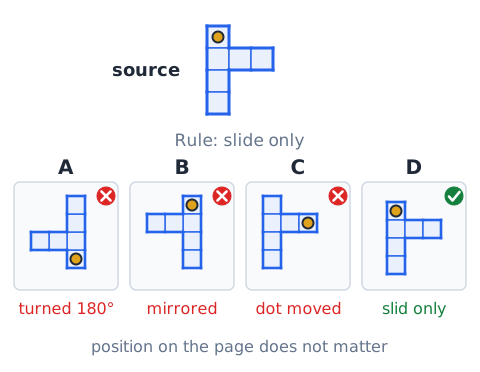
Worked example: clockwise quarter turn
Imagine an asymmetric source with a dot on its topmost cell. A clockwise quarter turn moves that top arm toward the right. Predict the location of the dot after the turn, then scan the candidate boxes for the same outline and dot placement. A counterclockwise turn points that arm left; a half turn points it down. Use the angle and marker before counting every cell. The final verification is that the dot remains attached to the corresponding cell.
Worked example: a one-cell defect
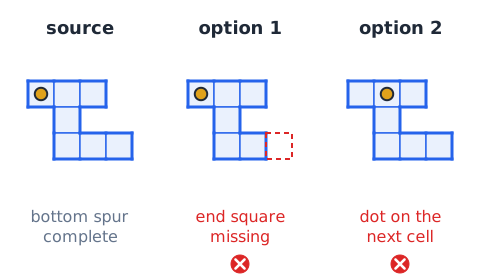
You see four options that all have nearly the same outer outline. One option omits a tiny square at the end of a bottom spur. If the source includes that square, no rigid rotation can remove it. Counting or checking that spur rules it out immediately. A different option may retain all the squares yet place the gold dot in an adjacent cell; that candidate is also invalid. The correct option must preserve both geometry and marker identity.
Worked example: a mirrored decoy
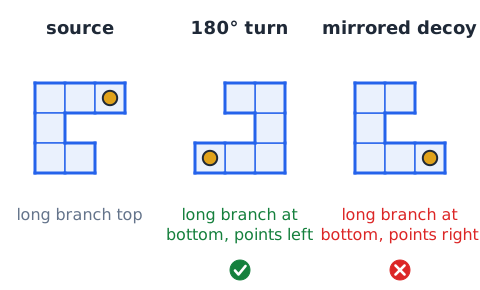
Consider a source figure whose top branch extends two squares right, while its lower branch extends one square right. Under a 180-degree turn, the long and short branches exchange top-bottom position and left-right direction in a specific way. A mirrored drawing may place the long branch on the correct side while reversing the notch. Trace the sequence from dot to elbow to spur, not merely the long branch, to tell a legal turn from a reflection.
Worked example: looking at contacts
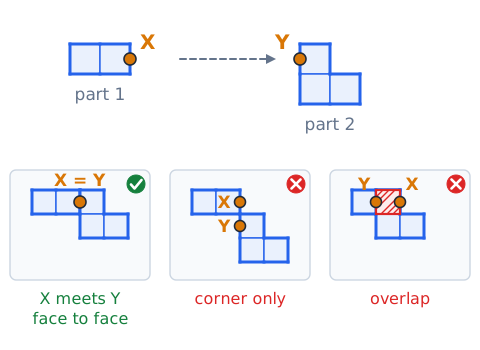
When the picture shows two individual parts that must join at labeled X and Y, identify their specified faces first. An option where X and Y are diagonally close but not edge-to-edge is invalid. If an option overlaps pieces, it may also be invalid even if the total outline looks compact. A fast scan can reject wrong contact geometry before doing an exact silhouette comparison. This connection method builds on the earlier Matching Connection Points lesson.
Worked example: an occluded edge
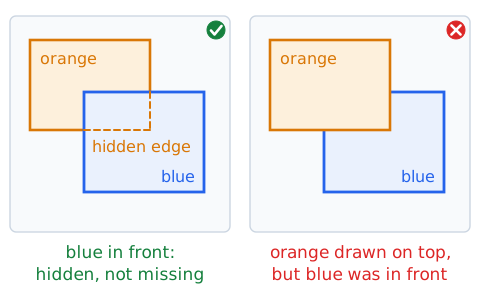
One opaque blue plate overlaps part of an orange plate. The orange plate's hidden line is not proof that its material ends there; the line is simply behind another part. Scan first for which plate is in front, then for the visible parts that continue beyond its boundary. A candidate with an orange segment appearing on top when the blue plate was specified as frontmost is wrong. This connects timed scanning to Hidden Edges and Occlusion.
Worked example: reduce four choices to two
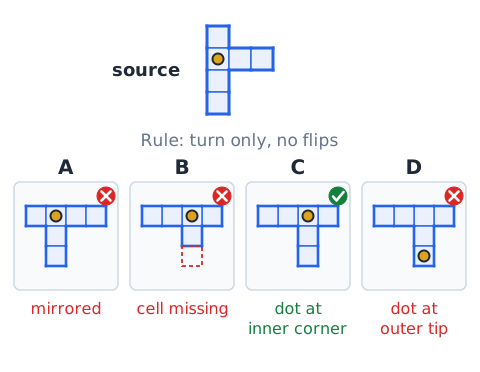
Option A is reflected; option B has a missing cell; options C and D appear to preserve the shape. Instead of repeating the entire drawing mentally, find the single feature that differs between C and D. If the marker lies at the inner corner in C but at the outer tip in D, trace where the source marker must travel. The source dot sits at the inner corner, and a turn keeps it there, so C is correct and D is rejected. This final focused comparison is faster and more reliable than reconsidering A and B after they were clearly eliminated.
Three stages of a disciplined response
Stage one, decode the instruction and form a predicted feature. Stage two, scan candidates in a consistent order and eliminate any with an objective mismatch. Stage three, verify the strongest candidate, including the marker if one exists, and submit once. The scan itself may be rapid, but the verification stage should not be skipped when alternatives are deceptive. The strategy is for training decision quality, not claiming that any single fixed routine fits every question.
Write a one-line reason during practice
After each untimed drill, write 'I chose C because its top spur faces right and its dot is on the same cell.' If your reason mentions only one weak property, find a second independent check. If you missed a question, describe exactly what transformed incorrectly. This short verbal step makes the skill explicit and can be discarded when you are more fluent. It is especially valuable before adding the pressure of a stopwatch.
When to count and when not to
Count occupied cells when a distractor is suspected of adding or dropping material. Do not count as your primary method when three choices can be rejected from arm directions alone. The cost of a check matters: direction takes one glance; verifying seven tiny cells takes several. Choose the cheapest decisive check first, then add a slower one only if needed. A faster sequence comes from ordering checks intelligently rather than skipping them.
Marker-first versus silhouette-first
If the candidates share similar outlines but differ in gold-dot position, begin with the dot. If the outlines differ strongly, begin with the silhouette. The key is to match your attention to the feature that most clearly separates the choices. There is no single scan direction that always wins. In the visual quiz, some wrong options have a perfect shape with a wrong marker; this is intentional and tests whether you verify both properties.
Reading angle labels carefully
The words clockwise, counterclockwise, and 180 degrees are not interchangeable. A common speed error is reusing the previous question's angle when the next one has changed. Look back at the instruction immediately before choosing. If a source is asymmetric, use its long arm to predict a quarter turn. If a source is nearly symmetric, lean more heavily on the marker. This extra half-second of instruction checking may prevent an otherwise avoidable error.
No silent reflection
When a prompt allows rotations and translations but not reflection, every reflected choice is invalid even if it connects neatly. Real-world objects with printed labels, asymmetric holes, or one-sided tabs reveal why handedness matters. In our examples, the source's handedness is an invariant under a rigid rotation. Make 'Did I mirror anything?' one of your final checks in difficult items. Do not mentally flip a candidate simply because flipping would make it fit.
Near-identical candidates
A difficult answer set can contain two options with identical occupied cells yet different dot positions. Compare the exact source cell that owns the marker, not the dot's screen coordinates. Another pair may differ by only one square, even though both have equal width and height. Isolate the distinguishing cell as soon as you notice it; then inspect the target transformation. This is a targeted verification, not a complete restart of the problem.
Practice without claimed score forecasts
Finishing a set of visual questions faster does not imply a specific ASVAB percentile, AFQT score, or military qualification. AO is one component of a larger assessment, and official scoring depends on administration and broader performance. Use these drills to build reliable comparison and elimination habits. Review error categories such as wrong rotation, reflection, omitted cell, and misplaced marker. Do not infer a guaranteed real-exam time improvement from a short practice session.
Pitfall: answer by color alone
Blue and orange can make a complex figure easier to read, but color itself does not prove a transformation. The same colored shape can be reflected or have a dot shifted. These polyomino figures use one consistent blue fill so that outline and marker carry the answer. If the figure were printed in grayscale, the reasoning would be unchanged. Train yourself to check contour, adjacency, and the marker rather than selecting the panel that merely has familiar colors.
Pitfall: forgetting the smallest spur
Long edges draw attention, while a one-square spur near a corner can be overlooked. A choice that omits a spur may look like a perfect match at thumbnail size. When two options are nearly identical, inspect the most irregular boundary segment. In our harder problems, a distractor may differ from the source by only a single added or removed cell. One added or removed cell is not an acceptable byproduct of rotation.
Pitfall: treating 90° CW as 90° CCW
Clockwise and counterclockwise rotations are different operations for an asymmetric figure. If you imagine the top moving left when the question says clockwise, you will choose a plausible but wrong candidate. Name the turn before scanning: clockwise means the original top goes toward the right. The source's marker should move according to the same rotation. Check this predicted direction once, then apply it consistently to all answer options.
Pitfall: resetting the gold dot
An option can show exactly the correct rotated silhouette with the gold dot on an incorrect square. Moving a dot independently is not part of any rigid-body operation in this lesson. Imagine the dot glued to its original cell. Rotate or slide the entire marked figure in your mind, never the outline alone. This single check explains many near-miss distractors and prevents an answer based only on the overall appearance.
Pitfall: inconsistent reading order
Jumping between B, D, A, and C multiple times can cause a previously eliminated option to feel new. Select a repeatable scan order and mentally record one concise reason for rejecting each panel. If C and D remain, compare their distinguishing feature directly. A deliberate scan does not mean slow scanning; it removes redundant passes. Ensure all four options actually appear before selecting, especially on a narrow mobile screen.
Pitfall: inventing an extra rule
Some training diagrams say that translation is permitted, meaning the object may move within its card; others specify a rotation. Do not reject a correct shape merely because it is drawn at a slightly different panel position when location is irrelevant. Conversely, do not apply a mirror or rotation without permission. Read what the question explicitly asks. Efficient scanning depends as much on respecting the task rules as on detecting geometric differences.
Practice drill 1: find the invariant
Without using a timer, draw an asymmetric five-cell figure with a dot. Make one translated copy, one clockwise-rotated copy, and one mirrored copy. Say which properties stay constant in all rigid movements: square count and marker ownership do. Then say which property changes under mirror reflection: handedness. The goal is to name the evidence, not merely recognize a drawing. Compare the original and each copy in the same fixed order.
Practice drill 2: predict before scanning
Pick a six-cell source with an elbow on the lower-right. Before looking at any options, imagine what a clockwise quarter turn does to that elbow. Now inspect four different answer shapes and immediately reject the ones whose elbow points in another direction. Finally verify a dot or short branch. Repeat with a counterclockwise turn on a new source. This drill reduces the common habit of trying to mentally rotate every candidate from scratch.
Practice drill 3: the marker trap
Keep the exact occupied cells of a rotated figure in all four answer choices, but place the dot at four different cells. Trace its original cell through the named rotation. Select the correct option and write one sentence identifying the matching cell. This isolates marker tracking from silhouette recognition. Once you can solve it accurately without time pressure, repeat with an additional one-cell-shape defect to make the distinction less obvious.
Practice drill 4: short timed round
Set a modest personal training interval for a small group of original figures, then record the number of correct explanations. Stop if accuracy falls sharply. On the next round, choose a slower pace and apply the five-question scan. The purpose is to find a reliable rhythm, not to simulate an official AO timing guarantee. Use fresh shapes so that the improvement reflects transferable comparison skill rather than memorization of particular answers.
Practice drill 5: error-label review
After a practice round, classify each error: failed instruction reading, wrong rotation direction, mirror confusion, missing square, or marker mismatch. Identify which first check would have prevented it. If you made two wrong-direction errors, practice predicting the top arm before analyzing all four options. If you made marker errors, point to its original square before rotating. This short audit is more informative than merely seeing a percentage correct.
A compact final scan checklist
Read the operation. Identify one distinctive arm, notch, or dot. Predict how it should move. Eliminate options that violate angle, orientation, handedness, or cell count. Verify the surviving option's marker. Commit your answer only after these checks. For CAT-ASVAB, remember that you cannot revisit a submitted item. For other administrations, follow the official directions for that version. Practice choices are newly authored training examples and do not promise exact exam replication.
A 20-second explanation is better than a lucky click
Try to explain why the selected candidate is right in one short sentence. 'The long arm points down after a half turn and the gold dot remains at the same source square' is an evidence-based reason. 'It looked close' is not. When explanations are reliable, you can shorten the routine because the important checks become familiar. Correctness still has priority over an arbitrary target time; a fast wrong answer does not build the intended spatial skill.
Transfer to larger assemblies
The scan routine extends beyond one polyomino. In two-part and three-part AO assembly tasks, predict one contact, rule out impossible part orientations, and then check the joined outline. Occlusion problems add a front-back check; hidden edges are not necessarily absent material. The concepts from earlier C11 lessons work together here. Use the fastest discriminating evidence, but verify the full assembly whenever the figure includes multiple interacting constraints.
Final reminders and source limits
Official resources define the AO content domain and provide general test strategies; they do not validate the correctness of this course's invented questions or certify its timing. The 40 practice questions that follow are original instructional items with answer-by-answer explanations. Graphics are vector-based so that their edges remain sharp on mobile screens.
 English ▾