 ASVAB Camp
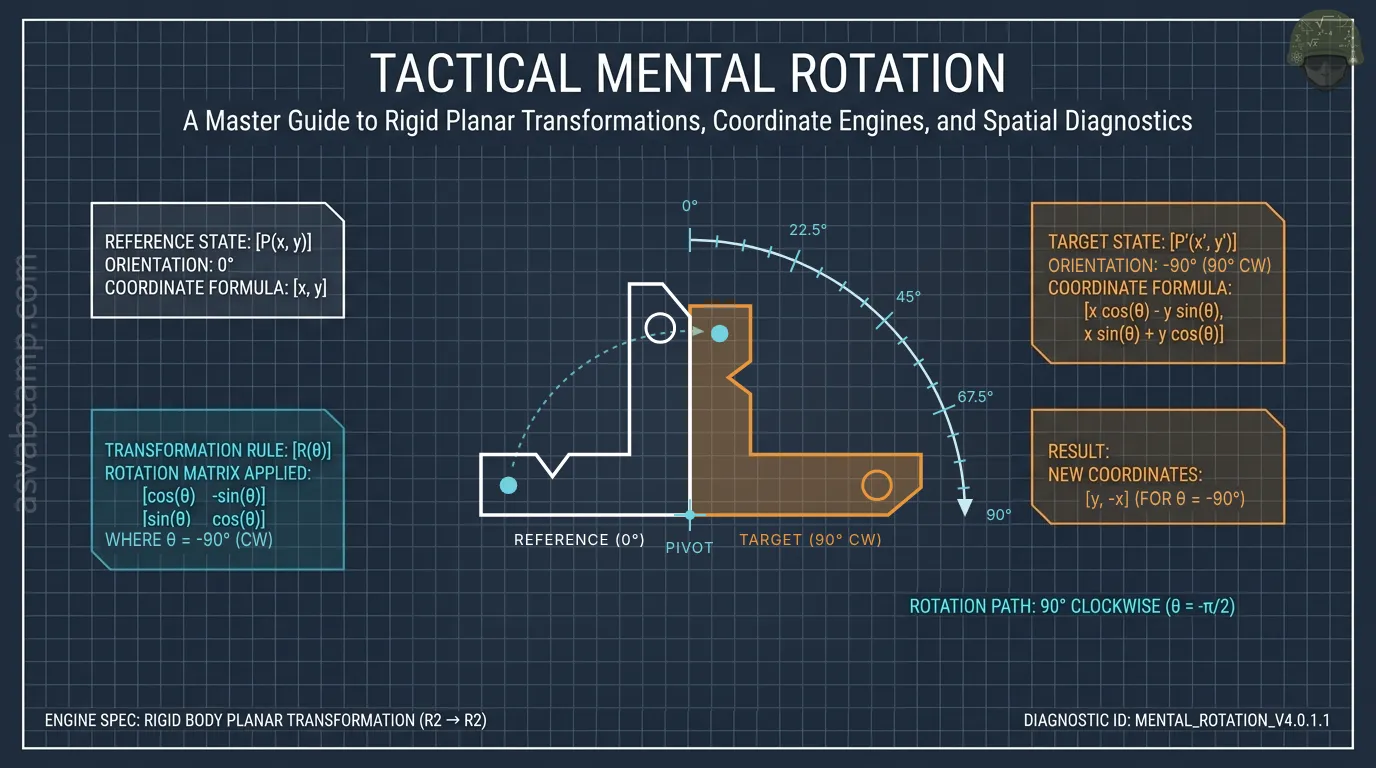
The goal: rotate, do not reshape
In this lesson you learn to turn a flat shape in your mind and predict exactly how it will look afterward. You will practice quarter-turns of 90 degrees in both directions, half-turns of 180 degrees, and three-quarter turns of 270 degrees.
By the end you should be able to keep a marked dot attached to the correct cell while the shape turns, spot an answer that was turned the wrong way, and reject any choice that is really a mirror image. The shape may change its facing, but never its size, its pieces, or its handedness.
Where mental rotation fits in ASVAB preparation
The ASVAB includes an Assembling Objects subtest. Its items show loose pieces or labeled parts and ask which picture shows them correctly put together. Very often a piece in the correct answer is drawn turned compared with how it appeared in the question.
That means you must recognize a piece after a turn of 90, 180 or 270 degrees, and you must notice when a choice shows a flipped copy instead. This lesson builds that single skill on simple square grids so it becomes fast and reliable. Later lessons add connection points and full assembly items. The practice shapes here are original training material, not real test questions.
A rigid transformation keeps shape and size
A rigid transformation moves a figure without stretching, shrinking, bending or tearing it. Every side keeps its length, every angle keeps its size, and every part stays connected to the same neighbors.
Picture a cardboard cutout of a capital T lying on a desk. You can slide it or spin it, and it is still the same T with the same bar length and stem length. Rotations are rigid. So are slides. If a candidate picture shows a longer arm, an extra square, or a missing corner, it cannot be a rotation of the original.
Rotation and translation answer different questions
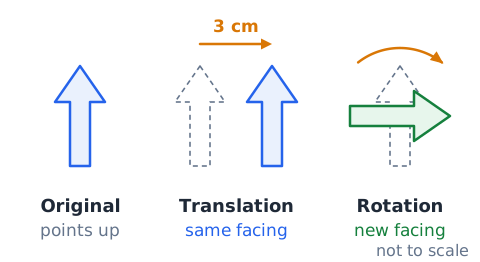
A translation, or slide, answers the question "where is the shape now?" Every point moves the same distance in the same direction, so the shape keeps facing the same way.
A rotation answers "which way is the shape facing now?" Points swing around a center, and the facing changes by the turn angle.
Suppose a cutout arrow points up. Sliding it 3 cm to the right leaves it pointing up. Turning it 90 degrees clockwise makes it point right, even if it stays in the same spot. Many answer choices combine both, so judge facing and position separately.
Clockwise means the direction of clock hands
Clockwise is the direction the hands of a wall clock move: from 12 toward 3, then 6, then 9. On a compass that is north to east to south to west.
So a quarter-turn clockwise sends anything pointing up to point right, right to down, down to left, and left back to up. A quick way to check: imagine the minute hand moving from the 12 to the 3. Whatever was at the top of the shape is now on its right side.
Counterclockwise reverses that cycle
Counterclockwise, sometimes called anticlockwise, is the opposite direction: 12 toward 9, then 6, then 3. On a compass it runs north to west to south to east.
A quarter-turn counterclockwise therefore sends up to left, left to down, down to right, and right to up. The top of a shape ends up on its left side.
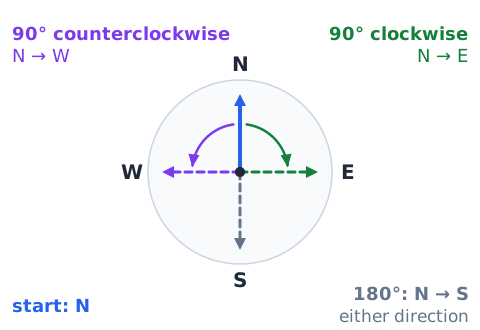
Notice that one quarter-turn counterclockwise lands in exactly the same place as three quarter-turns clockwise, because both reach the 9 on the clock face. In symbols, a turn of 90 degrees counterclockwise equals a turn of 270 degrees clockwise.
A half-turn has no direction ambiguity
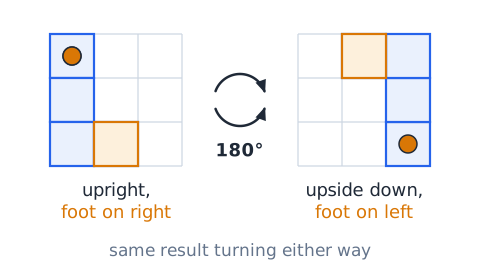
A rotation of 180 degrees is a half-turn. Turning halfway clockwise and turning halfway counterclockwise end at the same place, so you never need to ask which way a half-turn goes.
After a half-turn, top and bottom trade places and left and right trade places at the same time. A shape that was upright now appears upside down, and something on its right side is now on its left. A shortcut: is the same as two quarter-turns in either direction.
Full turns return to the starting orientation
Four quarter-turns in the same direction add up to 360 degrees, a full turn, and the shape looks exactly as it did at the start.
This lets you simplify any total. Add up the clockwise turns, subtract the counterclockwise ones, then remove whole multiples of 360. For example, 450 degrees clockwise leaves 90 degrees clockwise, because
A total of 360 or 720 degrees means no change in facing at all.
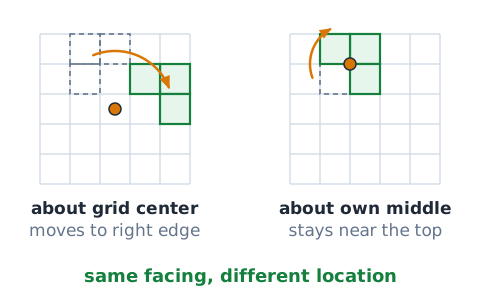
The center matters during a turn
Every rotation turns around a fixed point called the center of rotation. The center itself does not move; every other point travels along a circle around it.
On a square grid the usual center is the middle of the grid, so a shape near the top edge swings over to the right edge after a clockwise quarter-turn. If instead the shape spins about its own middle, it changes facing but stays roughly where it was. The facing comes out the same either way; only the final location differs.
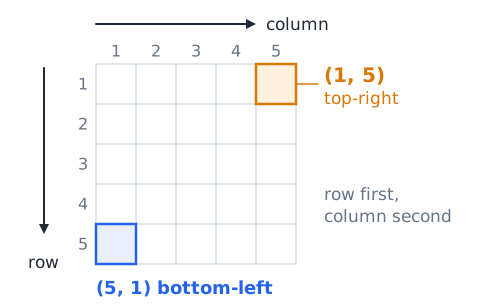
Read the screen grid correctly
Practice grids in this course name each cell by row first and column second. Rows are counted from the top, starting at 1, and columns are counted from the left, starting at 1.
So cell (1, 5) is the top-right corner of a five-by-five grid, and cell (5, 1) is the bottom-left corner. Moving down the screen raises the row number. This differs from a math graph, where the vertical value grows as you go up, so always check which system a problem uses before applying any rule.
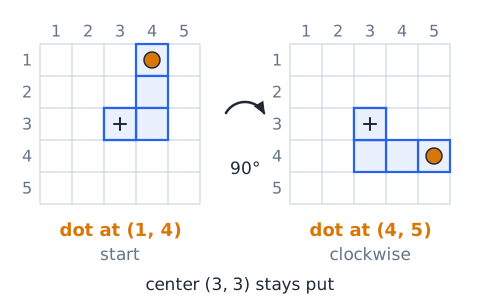
Quarter-turn rule for five-by-five cells
On a five-by-five grid turned about its center cell (3, 3), each cell (r, c) moves by a simple rule.
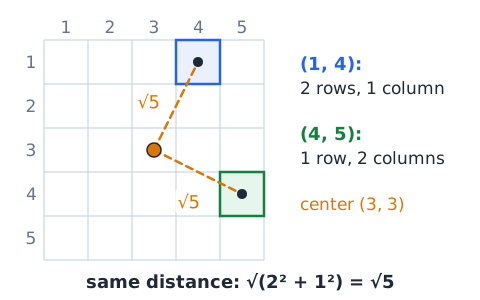
Here r is the row from the top and c is the column from the left. Check with cell (1, 4), near the top-right corner. Clockwise it goes to (4, 5), near the bottom-right corner, just as the clock picture predicts. The center (3, 3) stays put.
Half-turn and return transformations
For a half-turn on the same five-by-five grid, both numbers are replaced by their partners across the center.
Cell (1, 4) goes to (5, 2). Doing the half-turn twice brings every cell home, since 6 minus (6 minus r) is just r.
Every turn has an undo. A clockwise quarter-turn is undone by a counterclockwise quarter-turn, and a half-turn undoes itself. Applying a turn and then its undo is a quick way to check your work.
Rotation must preserve handedness
Handedness, also called chirality, describes whether a shape has a left-handed or right-handed arrangement. Your two hands are the classic example: they match in every measurement, yet no turn on a flat table makes a left-hand outline lie exactly on a right-hand outline.
A rotation never changes handedness. If a piece has a hook that curls clockwise as you trace its outline, it still curls clockwise after any turn. A choice in which the hook curls the other way has been flipped, so it is not a valid rotation.
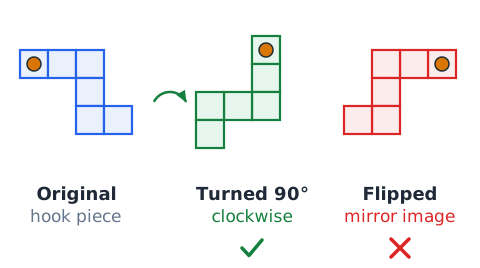
Why reflections fool the eye
A mirror image matches the original in every length, angle and square count. Because those easy checks all pass, a quick glance says "same shape," and that is exactly why test writers use mirror copies as wrong answers.
Think of a pair of shoes seen from above. Both have the same length and the same curves, and a fast look might call them identical. Only when you check which side the big toe is on do you see they are opposites. Finding one such side-specific feature is the only reliable way to catch a reflection.
No flipping unless the task allows it
In mental rotation practice, a piece lies flat and may only spin in its own plane. Lifting it and turning it face down produces a mirror image, and that is not allowed unless the instructions say so.
When a problem says "rotate," treat the piece as glued face up to the page. If a choice can only be reached by turning the piece over, eliminate it. In Assembling Objects items, assume the same rule: pieces are turned, not flipped, unless an item clearly states otherwise.
Choose landmarks that do not move independently
A landmark is a feature you use to track the turn, such as a dot, a notch, a corner square, or the end of the longest arm. A good landmark is part of the rigid shape, so it moves only when the whole shape moves.
Pick two landmarks that are far apart, for example the tip of the long arm and the marked dot. If both land where the rule predicts, the rest of the shape almost always follows. A single landmark can be misleading, because several different turns can put one point in a plausible spot.
Count squares and preserve connectivity
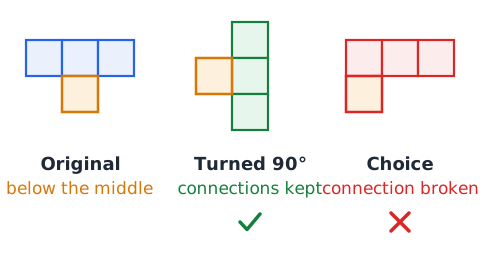
Before thinking about direction, run two cheap checks. First, count the squares. A shape made of five squares must still have five after any rotation. Second, check connectivity: squares that shared an edge before must still share an edge afterward, and squares that only touched at a corner must still touch only at a corner.
For example, if the original is a row of three squares with one more square attached below the middle, any choice that shows that extra square attached below an end square has broken the connection pattern and can be eliminated at once.
An asymmetric outline is useful, not an obstacle
A perfectly symmetric shape, such as a plain square, looks the same after many turns, so you cannot tell which turn was used. An irregular, lopsided shape is easier, because each turn gives it a different look.
Use the lopsidedness. Find the feature that appears only once, such as the single longest arm or the one corner that sticks out, and track it. Since that feature has no twin, its new position tells you the turn directly and also exposes mirror images, which put it on the wrong side.
Marker tracking tests the whole transform
Many items place a dot, letter or small symbol inside one cell of a shape. The marker is welded to that cell. When the shape turns, the marker turns with it and stays in the same relative position within the shape.
Checking the marker therefore tests the direction and the size of the turn together. If the outline looks right but the dot sits in a different cell of the shape, the choice is wrong. A common wrong answer turns the outline correctly but leaves the marker where it was on the page.
Work from local to global
Start with one small, distinctive detail and turn just that in your mind. Then attach the next part, and the next, until the whole shape is rebuilt.
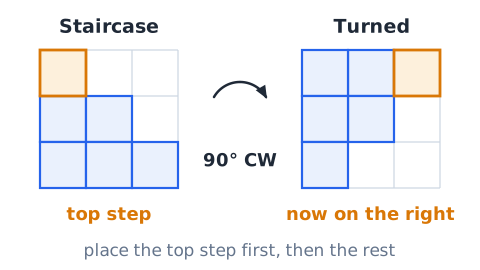
For instance, with a shape like a staircase, first ask where the top step goes. If the turn is a quarter-turn clockwise, the top step moves to the right side. Then place the step next to it, keeping the same edge connection. Building up piece by piece is slower at first but more accurate than trying to spin the whole picture at once, and it gets faster with practice.
Use a small imaginary arrow
An arrow is the easiest object to rotate in your head, because it has only one direction. Imagine an arrow drawn along a key feature, for example from the base of a shape to its longest tip.
Turn only the arrow. If it pointed up and the turn is 90 degrees counterclockwise, it now points left. Then look for the answer choice whose matching feature points left. The arrow handles direction; a second check, such as which side a notch is on, handles handedness.
Compare clockwise and counterclockwise outcomes
For any shape, the clockwise and counterclockwise quarter-turn results always differ from each other by a half-turn. An arrow pointing up ends pointing right under one and left under the other: opposite directions.
This explains why test makers like to include both. If a choice shows the shape turned exactly the opposite way from your prediction, you probably turned in the wrong direction. Re-read the instruction, then redo the arrow check, saying the direction aloud in your head: "top goes to the right" for clockwise, "top goes to the left" for counterclockwise.
Rotation on coordinate axes
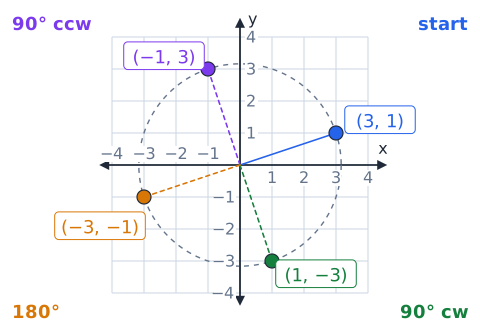
On a math graph, with x to the right and y upward, turns about the origin follow these rules.
Try the point (3, 1). Counterclockwise it goes to (-1, 3); clockwise to (1, -3); a half-turn sends it to (-3, -1). Each image is the same distance from the origin as the original.
Preserved measurements provide an audit
Since rotation is rigid, distances from the center of rotation stay the same. You can use that as an audit of any cell you moved.
On the five-by-five grid, cell (1, 4) is 2 rows and 1 column from the center (3, 3), so its distance is
Its clockwise image (4, 5) is 1 row and 2 columns from the center, again . If your computed image ends up nearer to or farther from the center, you made an error.
What if a shape appears in a different location?
Answer choices often draw a piece in a new spot on the page. Do not let location distract you. A rotation about some other center equals a rotation about the shape's own middle plus a slide, and the slide does not change facing or handedness.
So compare the shape with itself: which arm is longest, which side the notch is on, which cell holds the dot. If those internal relationships match a legal turn, the piece is a correct rotation no matter where on the page it is drawn. If the parts are rearranged, location cannot rescue it.
Example: north to east
Problem: A weather vane cutout has its arrowhead pointing north, with the tail feather on the south end. It is turned 90 degrees clockwise. Which way does the arrowhead point, and where is the tail?
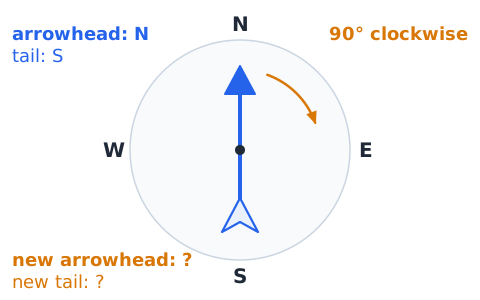
Step 1: Clockwise order is north, east, south, west. Step 2: A quarter-turn moves one step along that list, so north becomes east. Step 3: The tail is always opposite the head, so it moves from south to west.
Answer: The arrowhead points east and the tail is on the west end.
Example: turn the L, then test its chirality
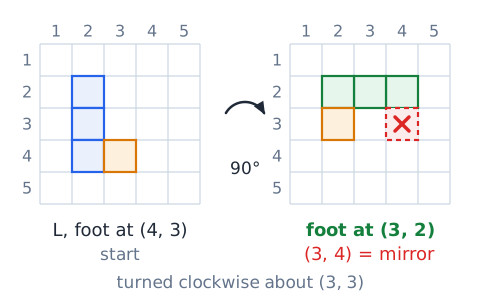
Problem: An L occupies cells (2, 2), (3, 2), (4, 2) and (4, 3) of a five-by-five grid. Turn it 90 degrees clockwise about (3, 3).
Use
The cells become (2, 4), (2, 3), (2, 2) and (3, 2).
Answer: a bar along row 2, columns 2 to 4, with a foot below its left end at (3, 2). Chirality check: a choice with the foot below the right end, at (3, 4), is a mirror image and must be rejected.
Example: successive turns
Problem: A key-shaped piece points west. It is turned 90 degrees clockwise, then 180 degrees. Which way does it point, and what single turn gives the same result?
Step 1: Clockwise from west is north. Step 2: A half-turn from north gives south. Step 3: The total is
clockwise.
Answer: The key points south. A single 90-degree counterclockwise turn does the same job, since 270 clockwise equals 90 counterclockwise; check: counterclockwise from west is south.
Example: a dot in the corner
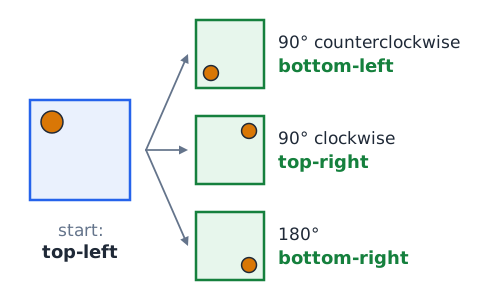
Problem: A square tile has a dot in its top-left corner. Where is the dot after 90 degrees counterclockwise, after 90 degrees clockwise, and after 180 degrees?
Counterclockwise, the top edge swings to the left side, so the top-left corner slides down to the bottom-left. Clockwise, the left edge swings up to the top, so top-left becomes top-right. A half-turn swaps both top and bottom and left and right, giving bottom-right.
Answer: bottom-left, top-right and bottom-right, respectively.
Example: distinguish rotation from reflection
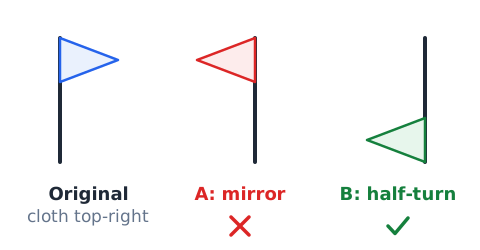
Problem: A flag cutout has an upright pole with the cloth attached at the top, pointing right. Choice A shows the pole upright with the cloth at the top pointing left. Choice B shows the cloth at the bottom pointing left. Which is a rotation?
The four rotations are: cloth top-right (0), cloth at the right end pointing down (90 clockwise), cloth bottom-left (180), cloth at the left end pointing up (270 clockwise).
Answer: B is the half-turn. A matches none of the four; it is a mirror image.
Example: half-turn of a cell set
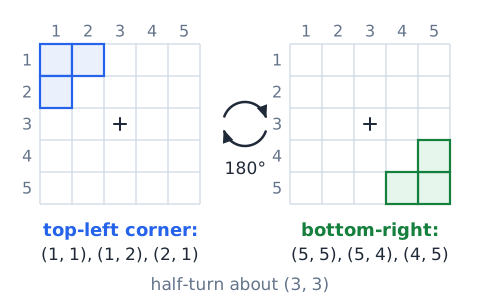
Problem: A small corner piece covers cells (1, 1), (1, 2) and (2, 1) of a five-by-five grid. Find its position after a half-turn about (3, 3).
Use
Cell (1, 1) goes to (5, 5), cell (1, 2) to (5, 4), and cell (2, 1) to (4, 5).
Answer: the piece now sits in the bottom-right corner, covering (5, 5), (5, 4) and (4, 5). It still has three squares in a corner pattern.
The three-pass choice strategy
Sort the answer choices in three quick passes.
Pass one, the count: drop any choice with the wrong number of squares, a changed arm length, or a broken connection. Pass two, the direction: turn an imaginary arrow and drop choices facing the wrong way. Pass three, the handedness: check one side-specific feature, such as which side a notch or dot is on, and drop the mirror copy.
Each pass is cheap, and together they usually leave exactly one choice. If two survive, re-run pass three with a second landmark.
When you feel stuck
Getting stuck usually means you are trying to spin the whole picture at once. Break it down instead.
Pick the single most distinctive feature and turn just that. Name its new direction in words, such as "the long arm now points down." If you still cannot decide, try turning the answer choice back toward the original instead of turning the original forward; sometimes the reverse direction is easier to see. And if a choice cannot be matched by any of the three turn sizes, it is likely a mirror image.
A timed mental approach
Speed comes from doing the same short routine every time, not from rushing. A useful routine has three steps that take a few seconds each.
First, glance at the original and choose one landmark, preferably a unique feature with a clear direction. Second, state the turn in plain words, for example "top goes to the right." Third, scan the choices for that landmark only, then confirm the best match with a quick handedness check.
Practice this on untimed items until it feels automatic, then add a time limit. You will notice the routine holds up under pressure because it does not depend on seeing the whole image at once.
CAT-style decision hygiene
On the computer-adaptive version of the ASVAB, you answer one item at a time and cannot return to change earlier answers. That makes clean decisions important.
Commit to your routine on each item: count, direction, handedness. When one choice passes all three checks, select it and move on rather than second-guessing. If you are torn between two, use a second landmark, choose, and continue. Spending too long on one hard picture can cost several easier items later. Keep an eye on the clock and avoid leaving items unanswered at the end of the section.
Translate shape language into movement
Test items and teachers describe turns in several ways. Translate each into one clear motion.
"A quarter-turn to the right" means 90 degrees clockwise. "A quarter-turn to the left" means 90 degrees counterclockwise. "Turned upside down," when the piece stays face up, means a half-turn of 180 degrees. "Three-quarter turn clockwise" equals one quarter-turn counterclockwise. "Flipped" or "turned over" means a reflection, which is a different operation from any rotation, so treat it as a warning word.
Trap: moving the mark but not the shape
The mistake: you move the marked dot correctly, but you accept a choice whose outline has not turned, or you turn the outline and leave the dot in its old spot on the page.
Why it is wrong: the dot is welded to one cell. A real rotation moves the outline and the dot together, so the dot stays in the same cell of the shape.
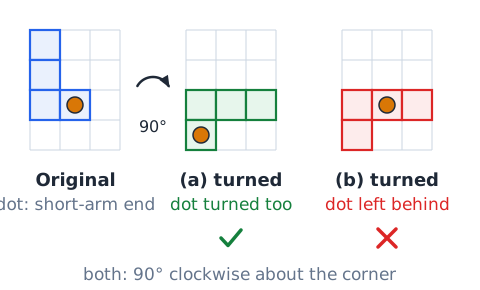
The fix: after predicting where the dot goes, also check that the cell holding it is the same part of the shape, such as the end of the short arm, in both pictures.
Trap: accepting a mirror twin
The mistake: choosing an answer because the squares, lengths and angles all match.
Why it is wrong: a mirror image matches every one of those measurements too. Only a rotation keeps handedness, and a mirror copy reverses it.
The fix: after the count and direction checks, always do one handedness check. Pick a feature that sits on one side, such as a notch on the right of the long arm, and confirm it is still on the right of that arm in the choice.
Trap: mixing drawing and math coordinates
The mistake: using the math rule
for a counterclockwise turn on a grid whose rows are counted from the top.
Why it is wrong: on a math graph y grows upward, but row numbers grow downward. Flipping the vertical direction reverses the sense of the turn, so the math rule applied to rows and columns gives a clockwise picture.
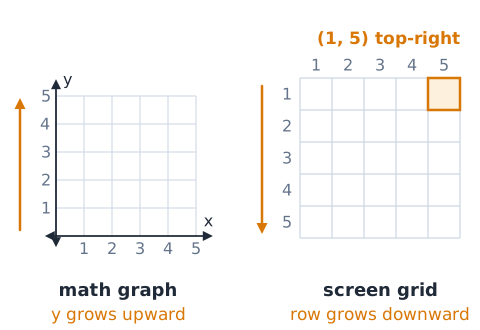
The fix: decide which system the problem uses. For screen grids, use the row and column rules from this lesson, and test one corner cell before trusting the result.
Trap: confusing two 90-degree directions
The mistake: the instructions ask for 90 degrees counterclockwise, and you pick the choice turned 90 degrees clockwise.
Why it is wrong: these two results face opposite ways; they differ by a full half-turn. Test makers often include both, so a choice that looks almost right is likely the wrong-direction trap.
The fix: before scanning the choices, say the direction in words. Counterclockwise means "top goes left." Then check the top feature of the original in each choice.
Trap: rotating just one branch
The mistake: with a branching shape, such as a plus sign missing one arm or a T with a long stem, you rotate the most noticeable arm and leave the others where they were.
Why it is wrong: in a rigid turn every arm turns by the same angle. Turning one arm alone changes the angles between arms, which a rotation can never do.
The fix: after turning the main arm, check at least one other arm. If the angle between the two arms changed, the picture is not a rotation.
Trap: relying on the blank space
The mistake: judging a choice by the empty gap or open side of a shape, for example "the opening faces down, so it matches."
Why it is wrong: blank space is not a reliable landmark. A shape and its mirror image can have openings facing exactly the same direction, and two different turns can leave a gap in similar spots, especially in symmetric outlines.
The fix: track solid features instead, such as a marked cell, the end of the longest arm, or a single protruding square. Confirm the result with a handedness check.
Drill 1: cardinal directions
Find the new direction of an arrow after each turn.
North, turned 90 degrees clockwise. Answer: east.
East, turned 90 degrees counterclockwise. Answer: north.
South, turned 180 degrees. Answer: north.
West, turned 90 degrees clockwise. Answer: north.
North, turned 270 degrees clockwise. Answer: west, the same as 90 degrees counterclockwise.
East, turned 360 degrees. Answer: east, no change.
Drill 2: turn a short arm
A shape has a long upright bar with a short arm sticking out to the right from its middle. Describe the result of each turn.
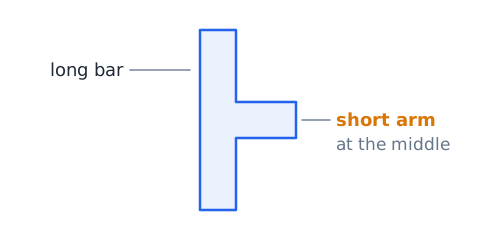
Turned 90 degrees clockwise. Answer: the bar lies flat and the short arm points down.
Turned 90 degrees counterclockwise. Answer: the bar lies flat and the short arm points up.
Turned 180 degrees. Answer: the bar is upright and the short arm points left.
Turned 270 degrees counterclockwise. Answer: the arm points down, the same as 90 clockwise.
Drill 3: protect a landmark
A dot sits in cell (2, 4) of a five-by-five grid, and the whole grid turns about the center cell (3, 3). Where is the dot?
After 90 degrees clockwise. Answer: (4, 4), using (r, c) to (c, 6 minus r).
After 90 degrees counterclockwise. Answer: (2, 2), using (r, c) to (6 minus c, r).
After 180 degrees. Answer: (4, 2).
After 360 degrees. Answer: (2, 4), back where it started.
Audit: every answer is one row and one column from the center, just like the original.
Drill 4: opposite candidates
Each prompt gives a turn and two candidate results. Pick the correct one.
An arrow points up; turn it 90 degrees counterclockwise. Candidates: pointing right, pointing left. Answer: left.
An arrow points left; turn it 90 degrees clockwise. Candidates: up, down. Answer: up.
A notch is on the bottom edge; turn the shape 90 degrees clockwise. Candidates: left edge, right edge. Answer: left edge.
A notch is on the right edge; turn it 90 degrees counterclockwise. Candidates: top, bottom. Answer: top.
Drill 5: cell coordinates
Use the five-by-five rules: clockwise sends (r, c) to (c, 6 minus r), counterclockwise sends it to (6 minus c, r), and a half-turn sends it to (6 minus r, 6 minus c).
Cell (1, 2), clockwise. Answer: (2, 5).
Cell (4, 1), counterclockwise. Answer: (5, 4).
Cell (2, 5), half-turn. Answer: (4, 1).
Cell (5, 3), clockwise. Answer: (3, 1).
Cell (3, 3), any turn. Answer: (3, 3), since the center does not move.
Drill 6: two turns combined
Give the single turn equal to each pair.
90 degrees clockwise, then 90 degrees clockwise. Answer: 180 degrees.
90 degrees clockwise, then 90 degrees counterclockwise. Answer: no turn at all; the second undoes the first.
180 degrees, then 90 degrees counterclockwise. Answer: 270 degrees counterclockwise, which equals 90 degrees clockwise.
Three quarter-turns counterclockwise in a row. Answer: 90 degrees clockwise.
90 degrees clockwise, then 270 degrees clockwise. Answer: 360 degrees, the original position.
Drill 7: eliminate mirror shortcuts
Treat these lowercase letters as flat cutouts that may only spin, never flip.
Which of d, p and q is a rotation of b? Answer: q, a half-turn of b. The letters d and p are mirror images of b.
Which of b, d and q is a rotation of p? Answer: d, a half-turn of p.
Is a backward capital N a rotation of a normal N? Answer: no, it is a mirror image; a half-turn of N gives N again.
Is a capital Z turned a quarter-turn the same as a mirror image of Z? Answer: no; turning keeps handedness, flipping reverses it.
Drill 8: prepare for assembly
Assembling Objects pieces often carry a connection dot on one edge. Say where the dot ends up.
The dot is on the left edge; the piece turns 180 degrees. Answer: right edge.
The dot is on the top edge; the piece turns 90 degrees counterclockwise. Answer: left edge.
The dot is on the bottom edge; the piece turns 90 degrees clockwise. Answer: left edge.
The dot is at the top-right corner; the piece turns 90 degrees clockwise. Answer: bottom-right corner.
Matching each dot to its partner is the first step in solving an assembly item.
Five facts you should remember
First, a rotation is rigid: square count, lengths, angles and connections never change.
Second, clockwise sends top to right, and counterclockwise sends top to left. Their results always face opposite ways.
Third, a half-turn swaps top with bottom and left with right, and it is the same in either direction.
Fourth, a marked dot stays welded to its cell and turns with the shape.
Fifth, a rotation keeps handedness. A choice that only matches after flipping is a mirror image and is wrong.
A concise final checklist
Before you choose an answer, run through these questions.
Does the choice have the same number of squares, the same arm lengths and the same edge connections? If not, eliminate it.
Does my imaginary arrow, turned by the stated amount in the stated direction, point the same way as the matching feature in the choice? If not, eliminate it.
Is the marker in the same cell of the shape? Is a side-specific feature, such as a notch, still on the correct side? If either fails, the choice is wrong or a mirror image.
The choice that passes all checks is your answer.
What to practice next
Keep building speed with short daily sessions. Draw a lopsided shape of four or five squares on graph paper, write a turn such as "90 counterclockwise," and sketch your prediction before checking with a cutout you can actually spin.
Next, practice with two pieces at once, tracking a connection dot on each so they meet correctly after turning. That bridges directly to Assembling Objects items, where several parts must be turned and joined.
Finally, mix in mirror distractors on purpose. Making your own trick answers is one of the fastest ways to learn to spot them under time pressure.
 English ▾