 ASVAB Camp
Lesson Goal
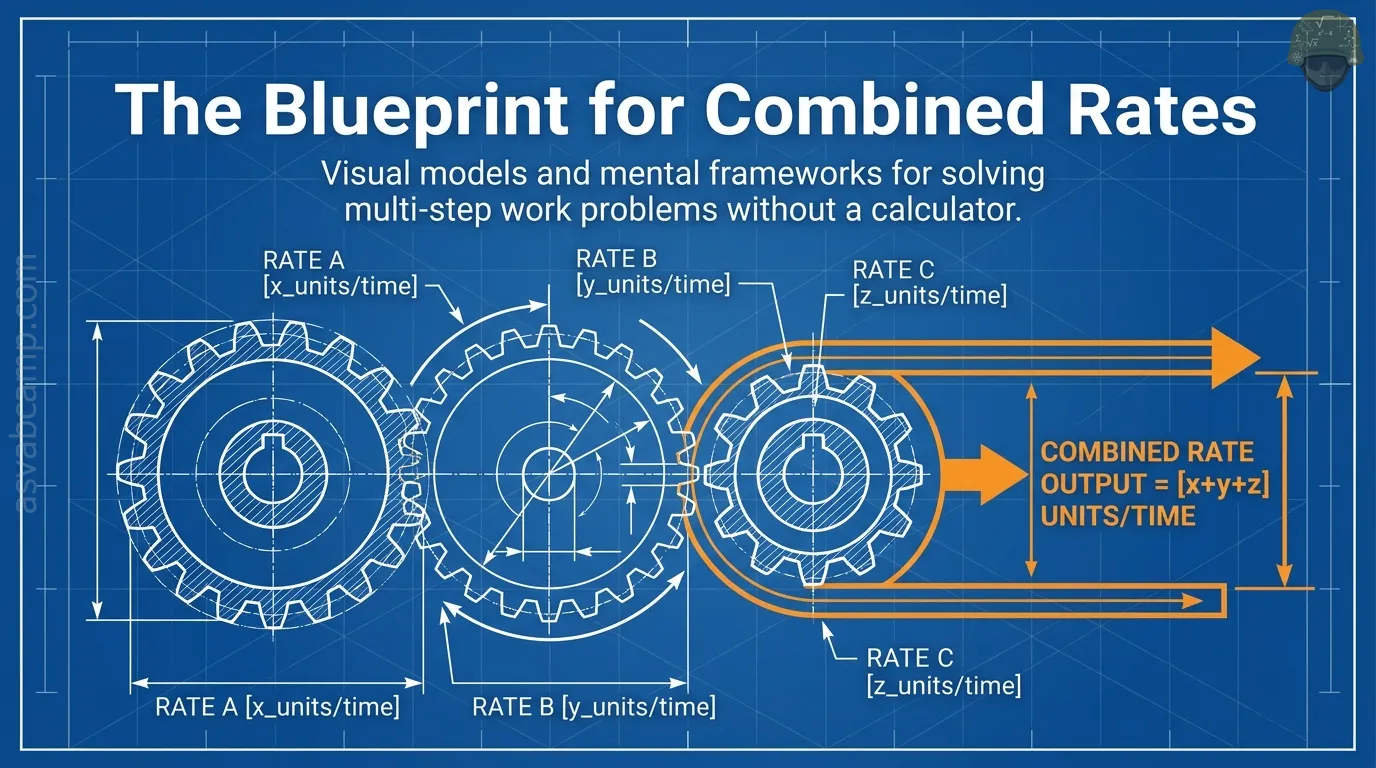
This lesson shows how to treat a job as one whole unit and each worker or machine as finishing a fraction of it per hour. You will combine rates for teams, find a missing worker's rate, handle work done before help arrives, deal with pipes that fill while drains empty, and work with output counted in parts or pages.
Work Rate as Fraction of a Job
If a task takes a worker h hours alone, the worker completes of the task each hour. A mechanic who rebuilds an engine in 5 hours does of the rebuild per hour. Thinking in fractions of a job lets you add, subtract and compare workers easily.
Work = Rate × Time
The amount of a job completed equals the rate times the time worked.
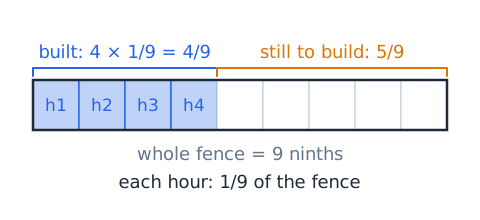
A crew that does of a fence per hour finishes of it in 4 hours, leaving of the fence still to build.
Two Workers Together
When two people work at the same time, add their rates and then invert the sum to get the time. Workers needing 5 hours and 20 hours alone have a combined rate of
so the job takes 4 hours together.
Common Denominators for Work Rates
To add rates, rewrite the fractions over a common denominator. For 6 hours and 10 hours:
The time is hours, or 3 hours 45 minutes.
Three Workers or Machines
The same idea works for any number of machines. Copiers that take 4, 6 and 12 hours alone combine to
of the job per hour, so all three together need 2 hours.
Partial Work Before Help Arrives
Worker A needs 12 hours alone and works 4 hours, finishing
so remains. Worker B, who needs 6 hours alone, then joins. Together they do
per hour. Time for the rest:
or 2 hours 40 minutes.
Changing Teams Mid-Job
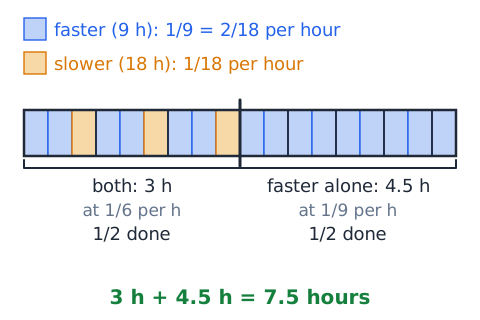
Split the job into stages and track how much is done in each. Two cleaners who take 9 and 18 hours alone work together for 3 hours at one-sixth of the job per hour, finishing half. Then the slower one leaves. The faster cleaner needs 4.5 more hours for the remaining half, so the whole job takes 7.5 hours.
Fill and Drain Problems
A fill pipe adds a positive rate and a drain adds a negative rate. A pipe that fills a tank in 3 hours and a drain that empties it in 6 hours give
tank per hour, so the tank fills in 6 hours with both open.
Opposing Production Rates
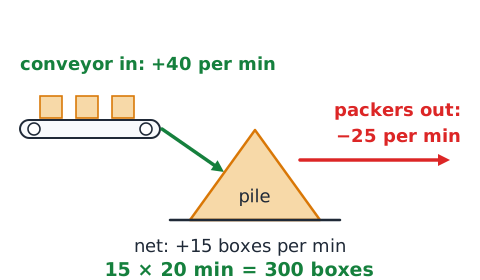
Quantities work the same way as fractions of a job. A conveyor delivers 40 boxes per minute while packers remove 25 boxes per minute. The pile grows by 15 boxes per minute, so a backlog of 300 boxes builds up in 20 minutes.
Finding an Unknown Worker Rate
Subtract the known rate from the team rate. A team needs 6 hours; A alone needs 10:
So B alone needs 15 hours.
Work Rate From Quantity Output
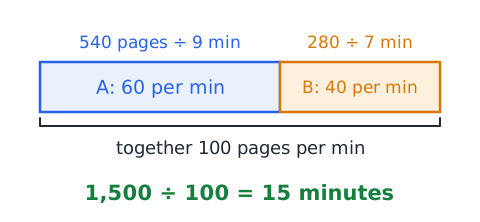
When output is counted in items, find each machine's items per unit time and add. Printer A makes 540 pages in 9 minutes (60 per minute); printer B makes 280 in 7 minutes (40 per minute). Together they make 100 pages per minute, so 1,500 pages take 15 minutes.
Different Job Sizes
A rate measured on one job size can be scaled to another. A crew that paints 3 rooms in 4 hours works at 0.75 room per hour, so 9 rooms take 12 hours. If one job is twice as large as another at the same rate, it takes twice as long. Always state what one job means before combining rates.
Use the Whole Job as 1
Call the full task 1, whatever it is: a wall, a tank, an order. Each worker's rate is 1 divided by solo time, and the remaining work is 1 minus what is finished. This keeps every problem in one form, so you never need the actual size of the wall or tank.
Choose a Convenient Common Job Size
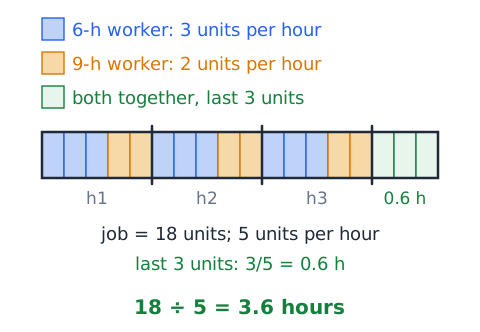
If fractions feel slow, invent a job size that both times divide evenly, usually their least common multiple. For workers needing 6 and 9 hours, call the job 18 units. They do 3 and 2 units per hour, so 5 together, and the job takes
Estimate Combined Time
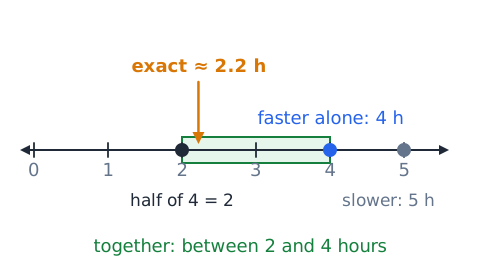
Two workers together are always faster than the faster worker alone. If both were as fast as the faster one, the time would be half of that worker's time. So the answer lies between those two values. For 4 and 5 hours, it must be between 2 and 4 hours; the exact value is about 2.2 hours.
Worked Example 1 — Two Workers
Problem: A plumber needs 8 hours to do a job and an apprentice needs 24 hours. How long does it take them working together?
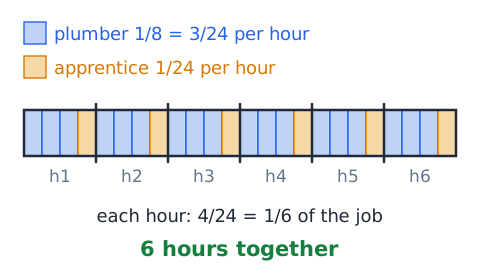
Step 1: Write each rate as the part of the job done in one hour: the plumber does and the apprentice does .
Step 2: Use the common denominator 24. Since
multiply the top and bottom of 1/8 by 3.
Step 3: Add the rates.
Step 4: Simplify by dividing top and bottom by 4.
Together they do one-sixth of the job per hour, so the whole job takes 6 hours.
Answer: They finish in 6 hours.
Check: In 6 hours the plumber does
of the job and the apprentice does
whole job. And 6 hours is less than the plumber's 8 hours alone, as it should be.
Worked Example 2 — Three Machines
Problem: Three pumps empty a pond in 10, 15 and 30 hours when working alone. How long do all three take together?
Step 1: Each pump's hourly rate is 1 divided by its time: , and .
Step 2: Rewrite each with the common denominator 30.
Step 3: Add the three rates.
Step 4: Simplify by dividing top and bottom by 6.
All three together empty one-fifth of the pond per hour, so the whole pond takes 5 hours.
Answer: All three pumps take 5 hours.
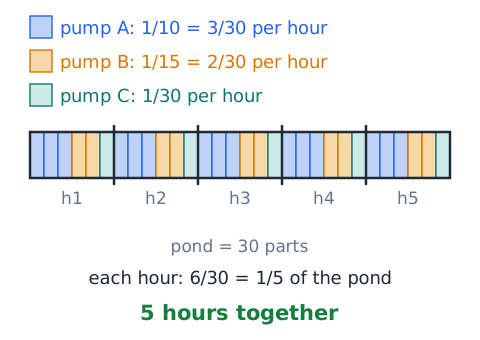
Check: In 5 hours the pumps do
one whole pond. And 5 hours beats the fastest pump alone (10 hours).
Worked Example 3 — Unknown Worker
Problem: Together two typists finish a job in 4 hours. One alone takes 5 hours. How long does the other take alone?
Step 1: The team does of the job per hour, and the first typist does . The other typist's rate is what is left when you subtract.
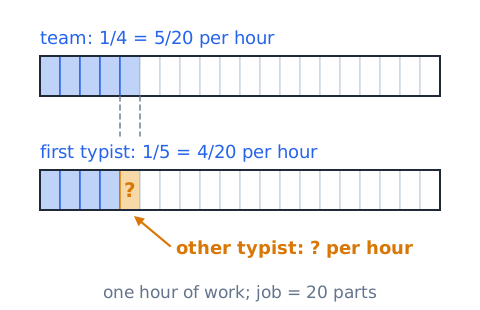
Step 2: Use the common denominator 20.
Step 3: Subtract.
Step 4: The other typist does one-twentieth of the job per hour, so alone the job takes 20 hours.
Answer: The other typist alone takes 20 hours.
Check: Add the rates back:
That is the team rate, so together they finish in 4 hours.
Worked Example 4 — Partial Work
Problem: A welder can finish a frame alone in 15 hours and works by himself for 5 hours. A partner who could do the whole frame in 10 hours then joins. How long is the job in total?
Step 1: Find how much the welder finished alone. He does per hour for 5 hours.
Step 2: Find what remains.
Step 3: Find the team rate. Use the common denominator 30.
Step 4: Time = work ÷ rate. To divide by a fraction, multiply by its flip.
Step 5: Add the time alone and the time together.
Answer: The job takes 9 hours in total.
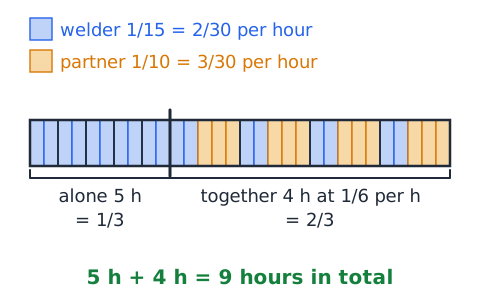
Check: The welder works all 9 hours:
The partner works 4 hours:
whole frame.
Worked Example 5 — Fill and Drain
Problem: An inlet fills a tank in 6 hours and an open drain empties it in 15 hours. With both open, how long does the tank take to fill?
Step 1: The inlet adds of a tank per hour and the drain removes . The drain works against the inlet, so subtract.
Step 2: Use the common denominator 30.
Step 3: Simplify by dividing top and bottom by 3.
The tank gains one-tenth of its volume each hour, so it fills in 10 hours.
Answer: With both open, the tank fills in 10 hours.
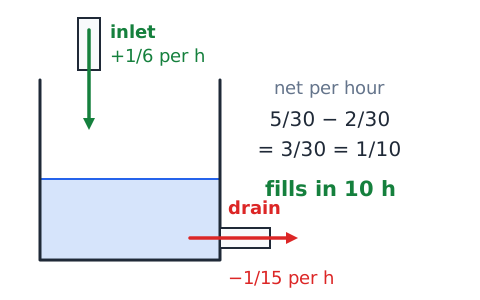
Check: In 10 hours the inlet adds 10/6 tanks and the drain removes 10/15 tanks.
full tank. And 10 hours is slower than the inlet alone (6 hours), as it should be.
Worked Example 6 — Quantity Production
Problem: Machine A makes 210 bolts in 3 hours; Machine B makes 150 bolts in 5 hours. Working together, how long do they take to make an order of 850 bolts?
Step 1: Find each machine's hourly rate. Machine A:
Machine B:
Step 2: Add the rates to get the combined rate.
Step 3: Divide the order size by the combined rate.
Answer: The order takes 8.5 hours (8 hours 30 minutes).
Check: In 8.5 hours, A makes
bolts and B makes
bolts.
Common Combined-Work Traps
Adding times instead of rates: two workers taking 3 and 6 hours do not need 9 hours together. Add and invert.
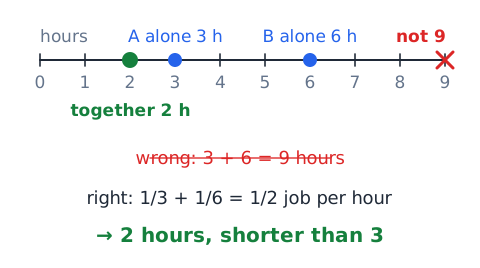
Averaging times: the team time is shorter than either worker's time, never the average.
Forgetting to invert: a combined rate of job per hour means 4 hours, not one-quarter hour.
Adding a drain: a drain's rate is subtracted.
Giving the wrong time: when help arrives partway, check whether the question asks for time after help joins or total elapsed time.
Quick Review
Treat a job as 1. A worker who needs h hours has a rate of 1/h per hour, and work done equals rate times time. Add rates for people or machines working together, then invert the total to get the time. Subtract the rate of a drain or opposing process. Find an unknown worker by subtracting the known rate from the team rate. For staged jobs, find what is left after each stage. With item counts, add items per hour directly. A convenient job size such as the LCM of the times avoids fractions, and the team must always beat the fastest single worker.
 English ▾