ASVAB Camp Get the appGoogle Play
AR · lesson 9 of 12 · 34 min

Distance, Rate and Time Problems

Motion problems follow one relationship, distance equals rate times time, but the ASVAB dresses it up in many ways. This 34-minute core lesson starts with the motion relationship and unit consistency, then drills one-vehicle problems for distance, time and rate before adding a second object.

Video lesson: Distance, Rate and Time

Video transcript

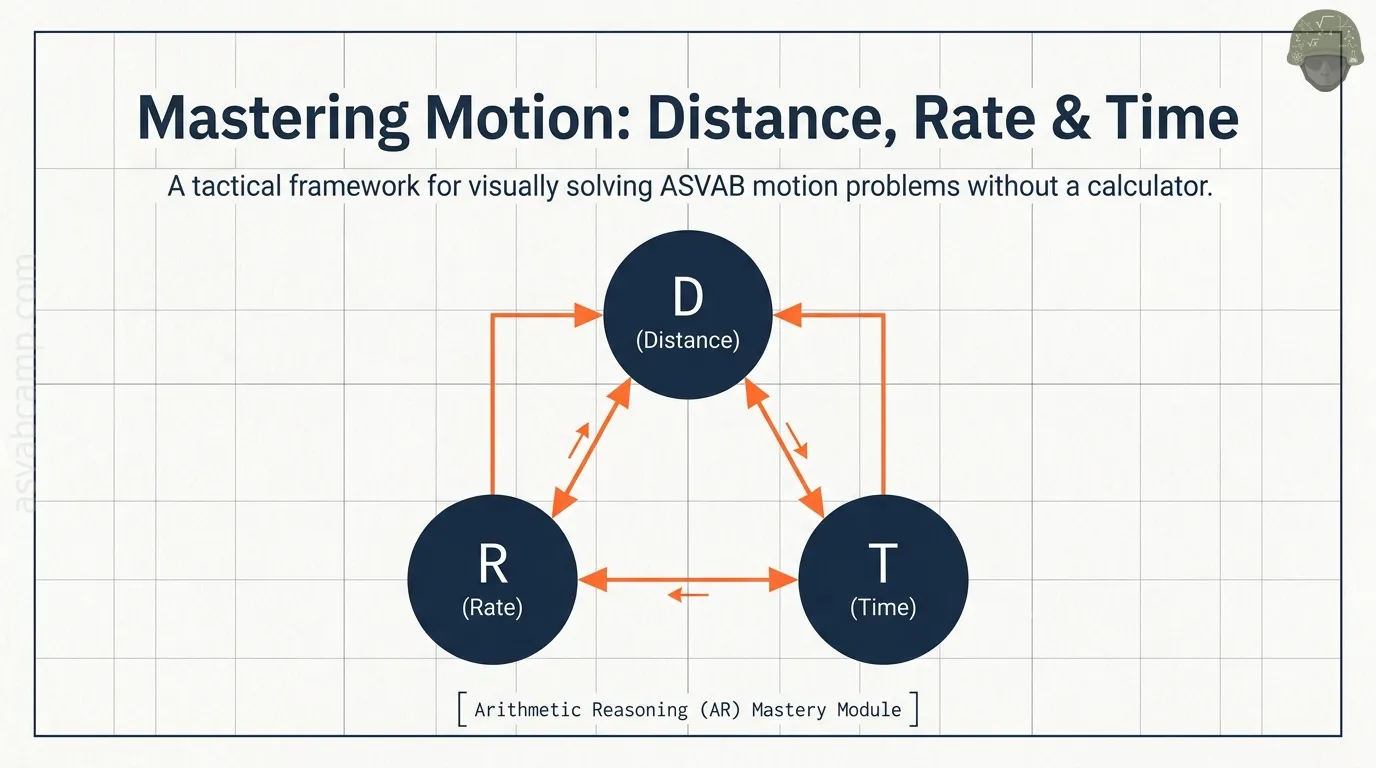
0:00 Welcome to this explainer. Look, if you're getting ready for the ASVAB and feeling, well, maybe just a little uneasy about the math sections, I want you to take a deep breath right now, because today we're going completely calculator free. I'm going to show you exactly how you can confidently solve literally every single motion problem on the ASVAB entirely by hand, just by using a few straightforward logical steps. Here's our quick roadmap for today. We've got the core motion formula, two vehicle motion rules, round trips and stops. Short cuts and worked examples, common motion traps, and finally a chance to check yourself. All right, let's dive right into section one, the core motion formula. Okay, so here is our absolute core relationship, D equals R times T, distance equals rate times time, and honestly, that's it. Assuming a steady or average speed over a trip, this one simple equation is the only key you need. It's like a three-piece puzzle. If a question gives you any two of these pieces, you can always unlock the missing third piece. You just divide distance by time to get the rate, or you can divide distance by rate to get the time.

1:05 Now, the biggest pitfall you're going to encounter here is unit consistency. The units of your rate completely decide the units for your time and distance. Take a look at this example. Say a train runs at 72 kilometers per hour for 25 minutes. If you just grab those numbers and multiply 72 by 25 directly, you get 1,800 kilometers. Think about that for a second. That is an impossibly fast 25-minute train ride. No way. Instead, you have to convert those 25 minutes into hours first by dividing by 60. Then you multiply 72 by the fraction 25 over 60, and boom, you get the correct answer, 30 kilometers. And you can do all of this math without a calculator for sure. Let's say you need to find the time by dividing distance by speed. You've got a 275 mile drive at 50 miles per hour. Well, 275 divided by 50 is 5.5 hours. To make sense of that decimal in the real world, simply multiply the 0.5 hours by 60. That gives you exactly 30 minutes. So your total trip lasts 5 hours and 30 minutes. Pretty easy, right? Two vehicle motion rules.

2:11 So what happens when two objects are approaching each other, or maybe separating in opposite directions? Well, they're actually working together to shrink or grow the gap between them. So you simply add their speeds. If two buses are 380 kilometers apart, and driving toward each other at 90 kilometers per hour and 100 kilometers per hour, they are actively closing that gap at a combined 190 kilometers each hour. Now, contrast this with a chase scenario. If a faster object is chasing a slower one on the exact same route, the gap only shrinks by the difference in their speeds. In this case, you subtract. A car going 57 miles per hour, closing in on a bus, doing 48 miles per hour, shrinks the gap by exactly 9 miles per hour. But what if they don't start at the same time? Stay calm, we just take it step by step. Imagine two towns, 260 miles apart. Car A leaves at 40 miles per hour, and exactly one hour later, Car B leaves the other town at 70 miles per hour. Deal with Car A's solo hour first. In that first hour, it travels 40 miles, shrinking our total gap down to 220 miles.

3:18 Now they're both driving toward each other. Add their speeds. 40 plus 70 is 110 miles per hour. 220 divided by 110 equals two hours. So they meet two hours after Car B actually starts driving. Let's jump into section three. Round trips and stops. You've got to be aware of the equal distance average speed trap. It's a classic. If you go 30 miles per hour one way and 60 miles per hour on the way back, your first instinct is probably to average those speeds to 45, right? Actually, that is completely wrong. Average speed is always total distance divided by total time. Because you travel slower on one leg of the trip, you naturally spend more time at that slower speed, which completely pulls the true average down. For those specific speeds, the true average is actually 40 miles per hour, leaning heavily toward that slower pace. And how do we handle a built in rest stop by mentally isolating your distance from your time? Let's break it down. Say a driver goes 104 miles in two hours. Then they rest for 30 minutes. Now remember, this adds time to the clock but absolutely zero distance.

4:23 After the rest, they go 90 miles in 1.5 hours. Just add your total miles. 104 plus 90 is 194. Then add your total hours. 2 plus 0.5 for the rest plus 1.5 is 4 hours. 194 divided by 4 gives you a simple, clean, 48.5 miles per hour overall average. Alright, section 4, shortcuts and worked examples. When chaos hits on a two object problem, just draw a simple motion table on your scratch paper. Literally just make a grid. Traveler A and Traveler B as your rows and rate time distance as your columns. Doing this instantly organizes the chaos. You'll clearly see how the rows relate to each other. Either they cover equal distances for a catch-up scenario or their distances add up to the total gap for a meeting scenario. Even better, you can use the relative speed shortcut we discussed. Let's look at worked example 2, exactly as it's written in the lesson. A jogger running 6 miles per hour is 0.6 miles ahead of a friend running 8 miles per hour. Instead of making two complicated equations, treat the gap itself as one object. The friend gains 2 miles per hour on the slower jogger.

5:30 The catch-up time is simply the gap of 0.6 divided by that relative speed of 2, which equals 0.3 hours. Multiply that by 60 and you get 18 minutes. Look at that. A two jogger problem turned into a single calculator-free division step. So what if the head start is in time not distance? Check out worked example 3. A truck leaves at 45 miles per hour. 40 minutes later, a car follows at 60 miles per hour. First things first, turn that 40 minute head start into a physical lead. 45 miles per hour multiplied by the fraction 40 over 60 hours gives the truck a 30 mile lead. From there, it's just a standard chase. The car gains 15 miles per hour. 30 miles divided by 15 miles per hour equals exactly 2 hours to catch-up. Let's move to section 5. Common motion traps. Here are the 5 big traps test writers love to use. Hand it to you on a silver platter. Number 1, averaging the speeds directly instead of using total distance over total time. 2, forgetting that a rest stop adds time but no distance. 3, using the wrong relative speed, like accidentally adding speeds in a chase instead of subtracting them.

6:38 4, mixed units, like simply forgetting to change minutes to hours. And 5, ignoring a time head start and dividing before converting it to a physical distance lead. Honestly, just being aware of these 5 specific traps is literally half the battle won. Finally, section 6. Check yourself. Let's see what you've learned. Let's start with question 1. A bus travels at 64 kilometers per hour for 2.5 hours. How far does it travel? Is it A, 160 kilometers, B, 25.6 kilometers, C, 128 kilometers, or D, 66.5 kilometers? I want you to pause this explainer right now. Grab a pencil and solve this by hand using our core formula before we reveal the answer. Go ahead. I'll wait. Okay, are you ready? Using distance equals rate times time, we just do direct multiplication here. 64 multiplied by 2.5. Well, we know half of 64 is 32, so 64 times 2 is 128, plus that extra 32 gives us 160. The answer is A, 160 kilometers.

7:39 If you nail that, you've absolutely mastered the core formula. Let's step it up to a two vehicle problem for question 5. Two trains are 495 kilometers apart on parallel tracks and head toward each other. One at 75 kilometers per hour and the other at 90 kilometers per hour. How long until they meet? Is it A, 6.6 hours, B, 5.5 hours, C, 3 hours, or D, 33 hours? Once again, hit pause right now, check your relative speed rules, do the mental math, and let's see what you get. Let's break it down together. Because they are approaching each other, they are working together to close that gap. So we add the speeds. 75 plus 90 equals a relative speed of 165 kilometers per hour. To find the time, we take the distance of 495 and divide it by 165. Well, 165 times 3 is exactly 495, so the answer is 3 hours, which is option C. When you master these predictable, logical rules, you really transform a scary math test into a simple puzzle.

8:46 You are now officially unstoppable on these motion problems. So my final question for you is, now that you don't need a calculator to track moving trains, what other ASVAB math fears are you ready to conquer next? Keep practicing, trust your structure, and I'll see you in the next explainer.

Visual lesson

Lesson slides

14 slides
Distance, Rate and Time – slide 1 of 14

Lesson Goal

In this lesson you will solve motion problems with one vehicle and with two. You will use distance equals rate times time, keep units consistent, combine speeds for objects moving apart, toward each other or in a chase, account for head starts, and compute true average speed for round trips and trips that include stops.

The Motion Relationship

Every motion problem uses the same link between distance, rate and time.

If you know any two of the three, you can find the third: divide distance by time for rate, or divide distance by rate for time. The formula assumes a steady speed, or an average speed over the trip.

Unit Consistency

The units of rate decide the units of time and distance. A speed in kilometers per hour needs time in hours. If a train runs at 72 km/h for 25 minutes, convert first:

Multiplying 72 by 25 directly would give 1,800, an impossible answer.

One-Vehicle Distance Problems

To find distance, multiply speed by time. A pickup driving 46 mph for 4.5 hours travels

miles

Write the time as a decimal number of hours before multiplying.

One-Vehicle Time Problems

To find time, divide distance by speed. A 275-mile drive at 50 mph takes

275 ÷ 50 = 5.5 hours

Convert the decimal part to minutes by multiplying by 60: 0.5 hour is 30 minutes, so the trip lasts 5 hours 30 minutes.

One-Vehicle Rate Problems

To find speed, divide distance by time. A courier covers 228 miles in 4 hours 45 minutes. Write the time as 4.75 hours, then divide:

228 ÷ 4.75 = 48 mph

Opposite-Direction Motion

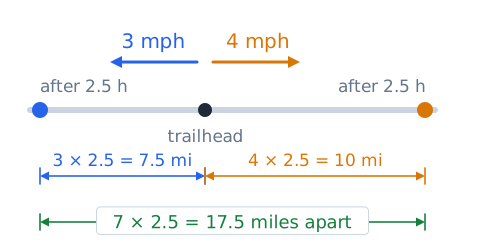
When two objects leave the same point in opposite directions, the distance between them grows by the sum of their speeds. Two hikers walking away from a trailhead at 3 mph and 4 mph separate at 7 mph. After 2.5 hours they are

7 × 2.5 = 17.5 miles

apart.

Hikers at 3 mph and 4 mph walk apart from a trailhead and are 17.5 miles apart after 2.5 hours.

Moving Toward Each Other

When two objects approach each other, the gap closes at the sum of their speeds. Two buses 380 km apart drive toward each other at 90 km/h and 100 km/h. The gap shrinks by 190 km each hour, so they meet after
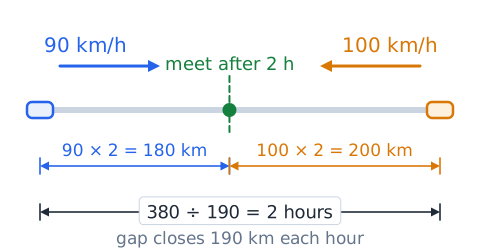
380 ÷ 190 = 2 hours
Buses 380 km apart at 90 km/h and 100 km/h meet after 2 hours, 180 km and 200 km from their starts.

Same-Direction Catch-Up

When a faster object chases a slower one on the same route, the gap shrinks by the difference of their speeds. A bus is 18 miles ahead at 48 mph, and a car follows at 57 mph. The car gains 9 miles each hour, so it catches the bus in
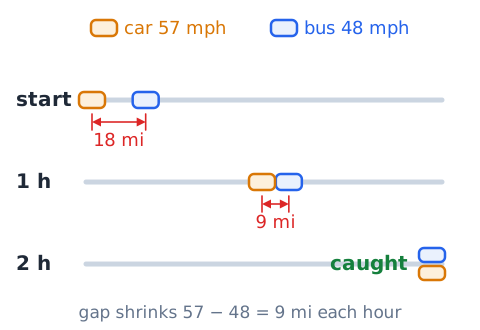
18 ÷ 9 = 2 hours
Car at 57 mph closes an 18-mile gap on a bus at 48 mph: 18, then 9, then 0 miles after 2 hours.

Head Starts in Time

Sometimes the lead is given as time rather than distance. Turn it into distance first. A boat leaves at 16 mph; a second boat follows 1 hour 15 minutes later at 24 mph. The lead is

16 × 1.25 = 20 miles

Closing at 8 mph, the second boat catches up 2.5 hours after it leaves.
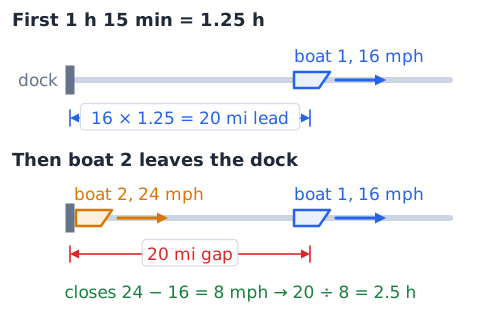
Boat 1 at 16 mph builds a 20-mile lead in 1.25 h; boat 2 at 24 mph closes it at 8 mph in 2.5 h.

Meeting Problems With Unequal Start Times

Two towns are 260 miles apart. Car A leaves one town at 40 mph; one hour later Car B leaves the other at 70 mph. In that first hour A covers 40 miles, leaving a 220-mile gap. Together they close 110 miles per hour, so they meet 2 hours after B starts, 3 hours after A starts.
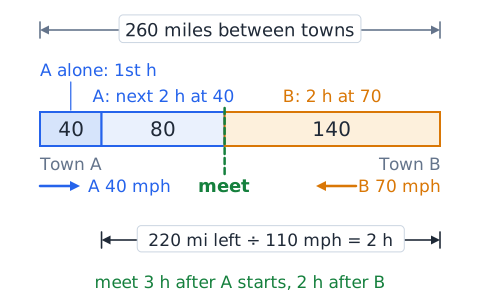
260-mile bar: A goes 40 miles alone, then A goes 80 and B goes 140 miles in 2 hours until they meet.

Round Trips

A round trip covers the same distance twice, often at different speeds. Treat each leg separately. A technician drives 84 miles to a site at 42 mph, taking 2 hours, and returns at 56 mph, taking 1.5 hours. The whole trip is 168 miles in 3.5 hours. Add distances and times before finding any average.
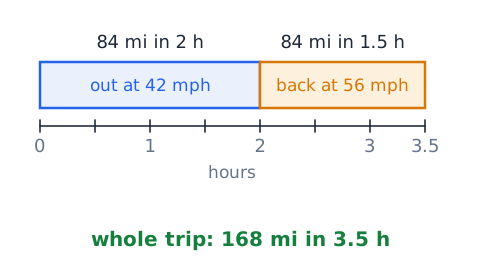
Round trip: 84 mi at 42 mph in 2 h, 84 mi back at 56 mph in 1.5 h; 168 mi in 3.5 h.

Average Speed

Average speed is total distance divided by total time, not the average of the speeds. For the technician's round trip,

mph

Averaging 42 and 56 would give 49 mph, which is wrong because more time was spent at the slower speed.

Equal-Distance Average-Speed Trap

When two legs have equal distance, the average speed is pulled toward the slower speed. Going 30 mph one way and 60 mph back gives

mph

not 45. The slow leg lasts longer, so it counts more.
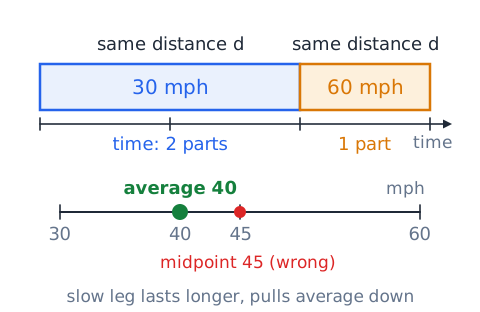
Equal distances: the 30 mph leg takes twice as long as the 60 mph leg, so the average is 40 mph, not the midpoint 45.

Rest Stops and Total Trip Time

If a question asks for overall average speed including a stop, add the stop to total time, but add no distance for it. A driver goes 104 miles at 52 mph (2 hours), rests 30 minutes, then goes 90 miles at 60 mph (1.5 hours). Total: 194 miles in 4 hours, or 48.5 mph overall.

Build a Motion Table

For two-object problems, set up a small table with one row per traveler and columns for rate, time and distance. Fill in what is given, use a variable for the unknown, and write how the rows relate: equal distances for a catch-up, distances that add to the gap for a meeting. Then form one equation and solve.
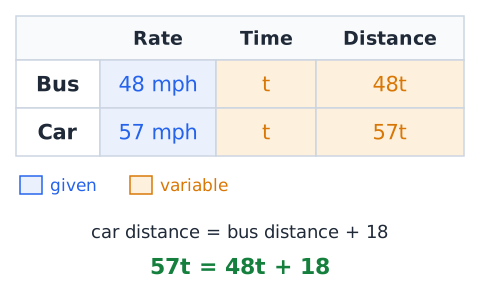
Motion table: bus 48 mph, t, 48t; car 57 mph, t, 57t; relation 57t = 48t + 18.

Relative-Speed Shortcut

Instead of tracking two travelers, treat the gap as one object. Its speed is the sum of the two speeds if they move toward or away from each other, and the difference if one chases the other. Then time equals the gap divided by that relative speed. This turns most two-vehicle questions into a single division.
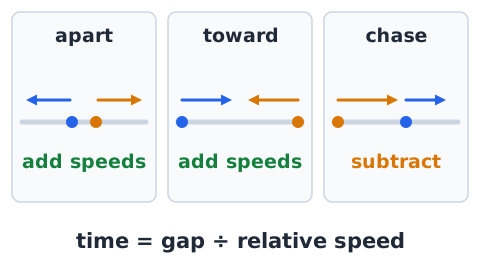
Apart: add speeds; toward: add speeds; chase: subtract; time = gap ÷ relative speed.

Worked Example 1 — Meeting Time

Problem: Two trains 420 km apart run toward each other at 110 km/h and 100 km/h. When do they meet?
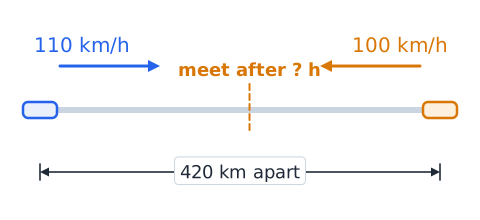
Trains 420 km apart at 110 km/h and 100 km/h head toward each other; meet after ? hours.

Step 1: The trains move toward each other, so the gap closes at the sum of their speeds (the relative speed).

Step 2: Divide the distance by the relative speed.

Answer: The trains meet after 2 hours.

Check: In 2 hours, one train goes

110 × 2 = 220 km

and the other goes

100 × 2 = 200 km
220 + 200 = 420 km

the full gap.

Worked Example 2 — Catch-Up

Problem: A jogger running 6 mph is 0.6 mile ahead of a friend running 8 mph. How long until the friend catches up?
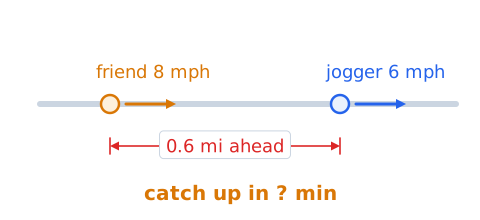
Friend at 8 mph is 0.6 mile behind a jogger at 6 mph; catch up in ? minutes.

Step 1: Both move the same direction, so the gap shrinks by the difference in speeds.

Step 2: Divide the head start by the gain per hour.

Step 3: Change hours to minutes by multiplying by 60.

Answer: The friend catches up in 18 minutes (0.3 hour).

Check: In 0.3 hour the friend runs

8 × 0.3 = 2.4 miles

and the jogger runs

6 × 0.3 = 1.8 miles
2.4 − 1.8 = 0.6

mile, exactly the head start.

Worked Example 3 — Time-Based Head Start

Problem: A truck leaves a depot at 45 mph. Forty minutes later a car leaves the same depot on the same road at 60 mph. When does the car catch the truck?
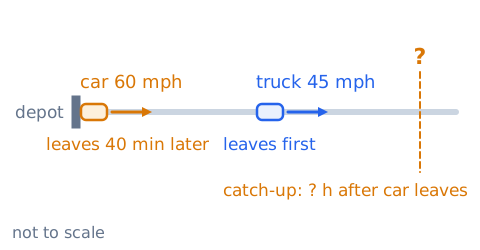
Truck at 45 mph leaves the depot first; car at 60 mph leaves 40 minutes later; catch-up time unknown.

Step 1: Find the truck's head start. Change 40 minutes to hours:

hour

(

45 ÷ 3 = 15
and
15 × 2 = 30

)

Step 2: Find how fast the car gains on the truck.

Step 3: Divide the head start by the gain per hour.

Answer: The car catches the truck 2 hours after the car leaves.

Check: In 2 hours the car goes

60 × 2 = 120 miles

The truck has driven 2 hours 40 minutes, which is

45 × 2 = 90 miles

plus 30 miles, also 120 miles. They are at the same spot.

Worked Example 4 — Round-Trip Average Speed

Problem: A pilot flies 150 miles out at 50 mph and back at 75 mph. What is the average speed for the round trip?

Step 1: Average speed = total distance ÷ total time. Find the time out.

Step 2: Find the time back.

Step 3: Total distance and total time.

Step 4: Divide.

Answer: The average speed is 60 mph, not the 62.5 mph you get by averaging the two speeds. The pilot spends more time at the slower speed, so the average is pulled toward 50.
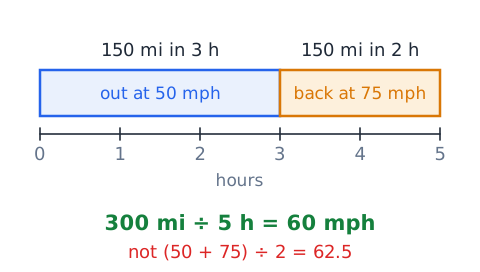
Round trip of 3 hours at 50 mph and 2 hours at 75 mph: 300 miles in 5 hours is 60 mph.

Check: 60 mph × 5 hours = 300 miles, the full round trip.

Worked Example 5 — Stop Included

Problem: A driver goes 63 mph for 2 hours, stops 30 minutes, then goes 56 mph for 1.5 hours. Find the overall average speed.

Step 1: Find the distance of each driving part. First part:

Step 2: Second part (

56 × 1 = 56

plus half of 56 = 28):

Step 3: Add the distances.

Step 4: Add all the time, including the 30-minute stop (0.5 hour), because the clock keeps running.

Step 5: Divide total distance by total time.

Answer: The overall average speed is 52.5 mph.
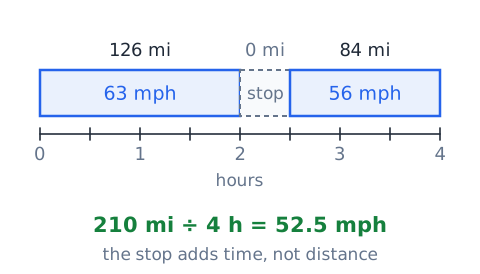
2 hours at 63 mph, a 30-minute stop, 1.5 hours at 56 mph: 210 miles in 4 hours is 52.5 mph.

Check:

52.5 × 4 = 210 miles

The answer is below both driving speeds, which makes sense because the stop adds time with no distance.

Common Motion Traps

Averaging the speeds: for a round trip at two speeds, the simple mean is too high because more time is spent at the slower speed. Divide total distance by total time.

Forgetting the stop: if the question says "including the stop," the break adds time but no distance.

Wrong relative speed: add speeds for approaching or separating objects, subtract for a chase.

Ignoring a time head start: convert the early start into a lead distance before dividing.

Mixed units: change minutes to hours before using a speed in miles per hour.

Quick Review

Use

and its rearrangements, with time in the same unit as the speed. For two travelers, find the relative speed: the sum when they approach or separate, the difference in a chase. Turn a time head start into a distance lead, then divide the gap by the relative speed. For unequal start times, subtract the early traveler's distance from the gap first. Average speed is total distance over total time; for equal legs it falls closer to the slower speed. Include rest stops in total time when the question asks for the overall average.

Quick review

What is the motion formula, and what does it assume?
: distance equals rate times time. Know any two to find the third. It assumes a steady speed, or uses the average speed over the trip.
A train runs 72 km/h for 25 minutes. How far does it go?
Convert time to hours first: km. Multiplying 72 by 25 directly gives an impossible 1,800.
How do you express 5.5 hours in hours and minutes?
Multiply the decimal part of the hour by 60: , so 5 hours 30 minutes.
What is the relative speed of two travelers, and how is it used?
The sum of their speeds when approaching or moving apart, the difference in a same-direction chase. Time = gap divided by relative speed: a 57 mph car closes an 18-mile gap on a 48 mph bus in hours.
How do you handle a head start given as time instead of distance?
Turn it into a lead distance. A 45 mph truck leaving 40 minutes early leads by miles; a 60 mph car gains 15 mph, so it catches up in 2 hours.
Average speed for two equal-distance legs at speeds a and b?
. At 30 mph and 60 mph: mph, not 45. The slower leg takes longer, so the average leans toward the slower speed.
How does a rest stop affect the overall average speed?
Add the stop to total time but add no distance. 104 miles in 2 hours, a 30-minute stop, then 90 miles in 1.5 hours gives mph.
Towns 260 mi apart: A leaves at 40 mph, B an hour later at 70 mph. Meeting time?
First remove A's early distance: miles. They close at 110 mph, so they meet 2 hours after B starts, which is 3 hours after A starts.

What next?

← Previous: Rates and Unit Rates

About this lesson

Two-object sections cover opposite-direction motion, moving toward each other, same-direction catch-up, head starts in time, and meeting problems with unequal start times. You also work through round trips, average speed, the equal-distance average-speed trap, and rest stops and total trip time. Building a motion table and using the relative-speed shortcut give you a reliable structure for Arithmetic Reasoning, which counts toward the AFQT.

Five worked examples cover a meeting time, a catch-up, a time-based head start, round-trip average speed and a trip with a stop included. After the common motion traps and Quick Review, take the Distance, Rate and Time lesson test.

Take it with you: the free app

The same 124 lessons, 6,516 questions and 82 timed practice tests on your phone, plus flashcards with spaced review and progress tracking. Free to download, and it works offline.

  • Works offline
  • Spaced-review flashcards
  • Progress for every subtest
  • Menus in 59 languages
ASVAB Camp appGoogle Play