ASVAB Camp Get the appGoogle Play
AR · lesson 11 of 12 · 36 min

Money, Interest and Everyday Quantities

Many Arithmetic Reasoning questions are set in everyday financial situations. This 36-minute core lesson treats money as ordinary decimal arithmetic and then systematically covers unit price, discounts, sales tax, tips, hourly wages, overtime pay, commission, markup, and budgets and remaining balance.

Video lesson: Money, Interest and Everyday Quantities

Video transcript

0:00 Hey there, so if you're getting ready for the ASVAB and the arithmetic reasoning section has you feeling, you know, a little stressed, take a deep breath, you're in exactly the right place. Today, we're going to build your confidence in solving everyday money problems entirely by hand. That means no calculators, no panic, just a clear logical toolkit you can rely on when test day actually arrives. By the time we wrap up this explainer, you're going to see that this math is absolutely manageable. Okay, let's dive right into this. We're looking at a pretty straightforward agenda today to build up your skills step by step. We'll start off with money basics, then scale up to wages and interest, unlock some really helpful mental math shortcuts with real worked examples, and finally we'll finish with a check yourself section to test your new skills. Alright, section one, money basics. The foundation of everything we're about to do here is beautifully simple. All money math starts with treating dollars and cents as simple decimals. When you're calculating by hand, the absolute golden rule is to line up your decimal points. It's kind of like stacking blocks.

1:03 If you buy items for $12.75, $8.40, and $3.09, you just line those decimals right up vertically, add them together, and boom, you get $24.24. Now, if you hand the cashier a $30 bill, you set up $30 minus $24.24. Again, keep those decimals perfectly aligned. That gives you $5.76 in change. Now, what about finding the absolute best deal at the store? That's where unit price comes in, which is literally just the total cost divided by the number of units. So if a six-pack of soda is $5.34, you take $5.34 divided by 6, and that equals a unit price of 89 cents per can. Now, let's talk about percentages when you're shopping. A discount is simply a percentage taken off the original price. For 30% off a $64 item, you take 0.30 times $64, which is $19.20. Subtract that from $64, and your sale price is $44.80. Sales tax, on the other hand, works the exact opposite way. It's added on. For a 6% tax on an $85 purchase, you find 6% of $85, which is $5.10, add that tax to the $85, and your final total comes to $90.10.

2:13 Wages and interest. We're shifting from the store to the workplace, and larger financial concepts here. But I want to reassure you right now, the exact same math rules apply. We're just using them for paychecks and loans. Let's see how this builds into calculating your hourly wages. Gross pay is literally just your hourly rate times the hours you work. So at 21.40 an hour for 35 hours, that's 21.40 times 35, giving you $749. But what about overtime? Overtime is usually paid at time and a half, meaning 1.5 times the regular rate. But here's the kicker. It only applies to hours over 40 in a single week. So say you make 24 an hour and work 48 hours. You've got to split it up. Regular pay is 40 times 24, which equals 960. Your overtime pay is those 8 extra hours multiplied by your new $36 overtime rate, which equals 288. Add those together, and your total is 1,248. This exact same percentage logic applies everywhere else too. Commission is just a percent of sales.

3:15 A 7% commission on 18,500 is 0.07 times 18,500, which gives you $1295. A retail markup? That's just an amount added to a seller's cost to set a price. A 40% markup on a $45 item is 0.40 times 45, which equals 18. Add that 18 to the 45 and the new price is $63. And restaurant tips? Just break them down in your head. An 18% tip on $55? Think about it. 10% is 5.50. 5% is 2.75, and 3% is 1.65. Add them up. 5.50 plus 2.75 plus 1.65 equals exactly $9.90. When you see budget questions, please don't let a wall of numbers intimidate you. A budget is really just careful addition, followed by one big subtraction to find what's left. Imagine an income of $2,400. We simply add up the expenses first. 950 for rent, 420 for food, 185 for transport, and 160 for utilities. That totals $1,715.

4:19 Subtract that total from the $2,400 income, and you have a remaining balance of exactly $685. Now what's really interesting here is the simple interest formula. i equals p times r times t. If you deposit $3,000 at 4% for 5 years, it's 3,000 times .04 times 5, which equals $600 in interest. Listen, the absolute most crucial thing to remember here is that t must always be in years. Always. If a test gives you 18 months, you have to divide by 12 to make it 1.5 years. You can also reverse this whole thing. If you know a $2,500 deposit earns $250 over two years, you divide the interest by the principal times the time. So $250 divided by the result of $2,500 times 2 equals .05, or a 5% rate. Let's wrap up this section with profit and multi-step math. Profit is literally just revenue minus cost. Spend $240 on shirts and sell them for $360. Profit is $360 minus $240, which is $120. Now, for multi-step transactions, you absolutely must do the math in the exact order the events happen.

5:28 If you buy $78 worth of clothes with a 10% coupon, apply that discount first to get $70.20. Then the 5% tax is applied to that new amount. $70.20 times 1.05 equals a final price of $73.71. Just remember this rule. Tax always, always applies after the discount. Alright, section three, shortcuts and examples. It's time to unlock those mental math cheat codes and prove that this toolkit works with actual test-style examples. When you don't have a calculator, these shortcuts are going to save you so much time. To find 10% of anything, just slide the decimal point one place to the left. Need 5%, take that 10%, and just cut it in half. For 25%, simply divide the number by 4. For 50%, divide by 2. But, guys, the real game changer for passing is understanding shifting bases. A 20% drop, followed by a 20% increase, does not return you to where you started. Think about it. If 100 drops 20%, it becomes 80. Increasing that new 80 base by 20%, only brings you up to 96.

6:33 So, always, always ask yourself, which amount does this percent apply to right now? Let's put this into practice. Worked example one, unit price. Say, a 5-pound bag is $7.45, and an 8-pound bag is $11.60. $7.45 divided by 5 equals $1.49 per pound. $11.60 divided by 8 equals $1.45 per pound. By breaking it down, it's super clear the 8-pound bag is the better deal. And this brilliantly illustrates our rule about the shifting base. Worked example two, a $90 jacket is 30% off with 5% tax. If it's 30% off, you're paying 70%, right? 0.70 times 90 equals a $63 sale price. That 5% tax applies to the 63, not the original 90. So, 63 times 1.05 equals a final price of $66.15. Next up, worked example three, overtime. A tech earns $22 an hour, gets time and a half after 40 hours, and works a 46 hour week. Let's slowly trace this math.

7:36 The first 40 hours are regular pay. 40 times 22 equals 880. The overtime rate is 1.5 times 22, which is 33. We have six extra hours, so 6 times 33 equals 198. Add them together. 880 plus 198 equals a total gross pay of $1,078. Worked example four is a straight plug-and-play for simple interest. $4,000 at 3% for two years. We just multiply the principal, the rate as a decimal, and the years. Interest equals 4,000 times 0.03 times two, which gives us a final interest of $240. For worked example five, a household earns 3,200 a month. They spend 960 on rent, 480 on savings, and 1,150 on bills. To find what's left, we subtract those directly from the income. 3,200 minus 960 minus 480 minus 1,150 equals 610 dollars remaining. Finishing up our examples with worked example six, an agent earns a $600 base plus a 3% commission on $20,000 of sales.

8:46 First, let's find the commission. 0.03 times 20,000 equals 600. Then add that calculated commission back to the base pay. 600 plus 600 equals a total check of $1,200. Okay, real quick, before we practice, I want to spotlight some common traps so you know exactly what to avoid on test day. 1, stopping early. This means finding a discount amount but forgetting to actually subtract it from the total. Always reread the question. Next, do not add percent across steps. 25% off then 8% tax is not a flat 17% off. Another huge one. Paying all hours at the overtime rate instead of just the hours over 40. Watch out for using months instead of years. Always convert to years. And finally, using the wrong base. Remember, a second discount applies to the newly reduced price, not the original tag. All right, section 4, check yourself. It's time to put your brand new calculator free toolkit to the test with two real practice questions. Let's see what you've got.

9:51 Here's question 1. A package of 8 AA batteries costs $9.92. What is the price per battery? A, $79.36. B, 81 cents. C, $1.24. Or D, $1.92. Take a quick second to mentally calculate that unit price. Got it? And the answer is C, $1.24. If you got that, nicely done. As we covered, finding a unit price is simply dividing the total cost by the number of units. So $9.92 divided by 8 equals exactly $1.24 per battery. Let's look at our final question. Question 2. A family's restaurant bill is $46. They want to leave a 15% tip. How much is the tip? A, $6.90. B, $4.60. C, $2.30. Or D, $52.90. Take a second and remember to use that 10 and 5% mental shortcut we just talked about. Okay. So the crucial point here is breaking this down without a calculator. The answer is A, $6.90.

10:57 You find 10% by shifting the decimal one place left, giving you $4.60. Then 5% is just half of that, which is $2.30. Add $4.60 and $2.30 together, and your total 15% tip is $6.90. See? You now have the toolkit to handle decimals, unit prices, wages, and interest completely by hand. So my question to you is, now that you have these mental math cheat codes, what else can you calculate in your daily life? You might be surprised at how much easier the world looks when you can do the math right in your head. Thanks for joining me on this explainer and happy studying.

Visual lesson

Lesson slides

14 slides
Money, Interest and Everyday Quantities – slide 1 of 14

Lesson Goal

You will solve everyday money questions: unit prices, discounts, sales tax, tips, hourly and overtime pay, commission, markup, budgets and simple interest. The key skill is turning each situation into a clear percent or rate calculation and keeping track of which amount the percent applies to.

Money as Decimal Arithmetic

Dollars and cents are decimals with two places, so line up the decimal points when adding or subtracting. Items costing 12.75, 8.40 and 3.09 dollars total 24.24 dollars. Paying with 30 dollars leaves

30.00 − 24.24 = 5.76 dollars

in change. Round final money answers to the nearest cent.

Unit Price

Unit price is the total cost divided by the number of units. A pack of 6 cans priced at 5.34 dollars has a unit price of

5.34 ÷ 6 = 0.89

dollar per can. Use unit prices to compare packages of different sizes or to price a different quantity.

Discounts

A discount is a percent of the original price taken off. For 30% off a 64-dollar item, the savings are

0.30 × 64 = 19.20 dollars

so the sale price is 44.80 dollars. Faster: pay 70% of the price,
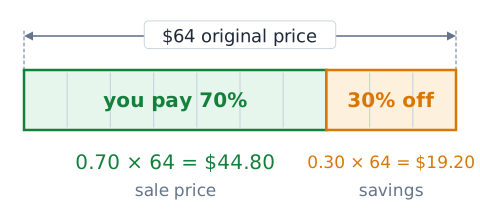
0.70 × 64 = 44.80 dollars
Percent bar for a $64 item: 70% you pay, $44.80, and 30% off, 0.30 × 64 = $19.20 savings.

Sales Tax

Sales tax is a percent of the price added on. At 6% tax, an 85-dollar purchase has

0.06 × 85 = 5.10 dollars

of tax, for a total of 90.10 dollars. In one step, multiply by 1.06. Tax is normally figured on the price after any discount.

Tips

A tip is a percent of the bill. For an 18% tip on 55 dollars, compute

0.18 × 55 = 9.90 dollars

Mentally: 10% is 5.50, 5% is 2.75, and 3% is 1.65, which add to 9.90 dollars.

Hourly Wages

Gross pay for hourly work is the hourly rate times the hours worked. Someone earning 21.40 dollars per hour for 35 hours earns

21.40 × 35 = 749 dollars

before deductions. "Gross" means before taxes or other withholdings are taken out.

Overtime Pay

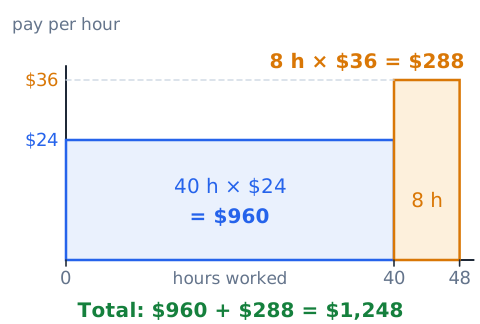
Overtime is often paid at time-and-a-half, 1.5 times the regular rate, for hours beyond 40 in a week. At 24 dollars per hour, the overtime rate is 36 dollars. For 48 hours:

40 × 24 = 960

plus

8 × 36 = 288

a total of 1,248 dollars.

40 hours × $24 = $960 plus 8 hours × $36 = $288 overtime, total $1,248.

Commission

Commission is pay equal to a percent of sales. A rep earning 7% on 18,500 dollars of sales receives

0.07 × 18,500 = 1,295 dollars

When a job pays a base salary plus commission, add the base to the commission amount.

Markup

Markup is an amount a seller adds to its cost to set a selling price. It is usually a percent of the cost. A store that pays 45 dollars for a lamp and marks it up 40% adds

0.40 × 45 = 18 dollars

so it sells for 63 dollars, or 1.40 × 45 in one step.
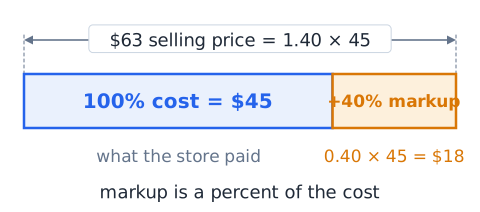
$45 cost plus 40% markup ($18) gives a $63 selling price, 1.40 × 45.

Budgets and Remaining Balance

For a budget, add all the expenses and subtract the total from the income. With 2,400 dollars a month and expenses of 950 for rent, 420 for food, 185 for transport and 160 for utilities, spending totals 1,715 dollars and 685 dollars remain. Add carefully before subtracting.

Simple Interest

Simple interest is figured only on the original principal: interest equals principal times annual rate times time in years,

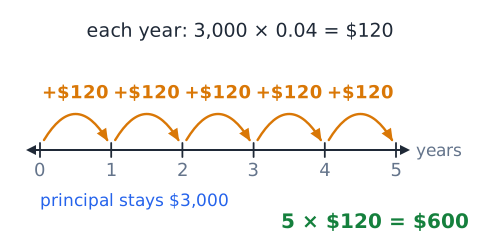
A deposit of 3,000 dollars at 4% for 5 years earns

3,000 × 0.04 × 5 = 600 dollars

in interest.

5-year timeline with +$120 interest each year on $3,000, total $600.

Time in Simple Interest

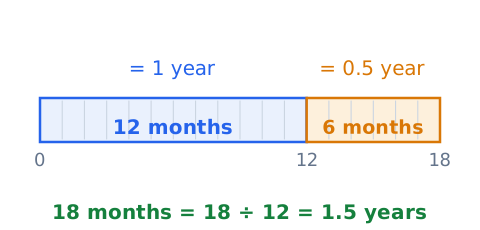
The rate is per year, so time must be in years. Divide months by 12: 18 months is 1.5 years. A 2,400-dollar loan at 5% for 18 months costs

2,400 × 0.05 × 1.5 = 180 dollars

in interest.

18 months = 12 months (1 year) + 6 months (0.5 year) = 1.5 years.

Reverse Simple-Interest Problems

If interest is known, solve for the missing value. A 2,500-dollar deposit earns 250 dollars in 2 years. The rate is

250 ÷ (2,500 × 2) = 0.05

or 5% per year.

Profit and Loss

Profit is revenue minus cost; a negative result is a loss.

A vendor buys 40 shirts at 6 dollars each (240 dollars) and sells them all at 9 dollars (360 dollars). Profit is 120 dollars, which is 50% of the cost.
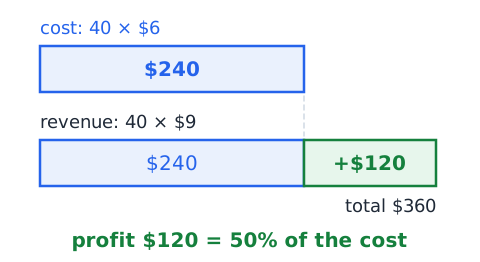
Cost $240 vs revenue $360; the extra $120 profit is 50% of the cost.

Multi-Step Transactions

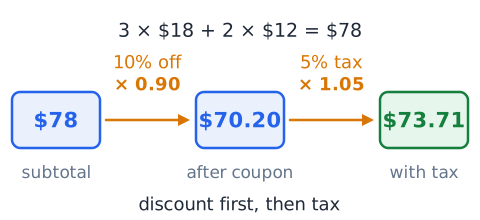
Do the steps in the order they happen. A shopper buys 3 shirts at 18 dollars and 2 hats at 12 dollars, totaling 78 dollars. A 10% coupon brings it to 70.20 dollars. Then 5% tax gives

70.20 × 1.05 = 73.71 dollars

Tax applies after the discount.

$78, times 0.90 gives $70.20, times 1.05 gives $73.71.

No-Calculator Money Shortcuts

To find 10%, move the decimal point one place left; 5% is half of that, and 15% is their sum. 25% is one-quarter and 50% is one-half. For a discount, multiply by what you pay: 20% off means multiply by 0.80. For tax or markup, multiply by 1 plus the rate. Estimate first to catch slips.

Track the Base Amount

Every percent is a percent of something, and that base can change. A second discount applies to the already reduced price, not the original. Tax usually applies to the discounted price. Markup is based on cost. Because the base shifts, a 20% decrease followed by a 20% increase does not return to the start: 100 dollars becomes 80, then 96. Before each step, ask which amount the percent multiplies.
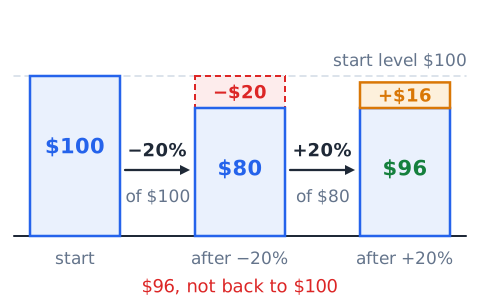
$100 falls 20% to $80, then rises 20% to $96, not back to $100.

Worked Example 1 — Unit Price

Problem: Coffee comes in a 5-pound bag for 7.45 dollars or an 8-pound bag for 11.60 dollars. Which bag is cheaper per pound?
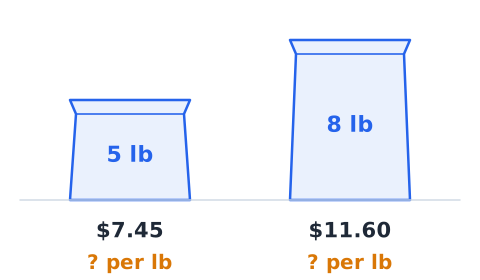
5 lb bag for $7.45 and 8 lb bag for $11.60, each ? per lb.

Step 1: Unit price = price ÷ pounds. The 5-pound bag:

(

5 × 1.40 = 7.00

and the 0.45 left over is 5 × 0.09, so

1.40 + 0.09 = 1.49

)

Step 2: The 8-pound bag:

(

8 × 1.40 = 11.20

and the 0.40 left over is 8 × 0.05, so

1.40 + 0.05 = 1.45

)

Step 3: Compare: 1.45 dollars is less than 1.49 dollars.

Answer: The 8-pound bag is cheaper per pound, at 1.45 dollars versus 1.49 dollars.

Check:

5 × 1.49 = 7.45
and
8 × 1.45 = 11.60

matching both prices.

Worked Example 2 — Discount and Tax

Problem: A 90-dollar jacket is 30% off, and sales tax is 5%. What is the final price?
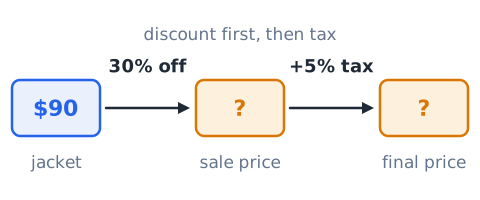
$90 jacket, 30% off to ?, then +5% tax to ?.

Step 1: 30% off means you pay

100% − 30% = 70%

of the price. Write 70% as 0.70.

The sale price is 63 dollars.

Step 2: Tax is added to the sale price. Find 5% of 63.

(10% of 63 is 6.30, and half of that is 3.15.)

Step 3: Add the tax to the sale price.

This is the same as

63 × 1.05 = 66.15

Answer: The jacket costs 66.15 dollars with tax.

Check: The discount took off 27 dollars and the tax added back only about 3 dollars, so the total should be a little over 63. 66.15 fits.

Worked Example 3 — Overtime

Problem: A technician earns 22 dollars per hour, with time-and-a-half after 40 hours, and works 46 hours. What is the total gross pay?
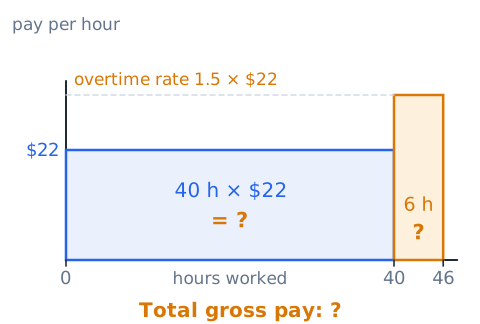
40 h at $22 and 6 h at 1.5 × $22; regular, overtime and total pay are ?.

Step 1: Regular pay covers the first 40 hours.

Regular pay is 880 dollars.

Step 2: Find the overtime rate. Time-and-a-half means 1.5 times the normal rate (22 plus half of 22, which is 11).

Step 3: Overtime hours are

46 − 40 = 6

Multiply by the overtime rate.

Overtime pay is 198 dollars.

Step 4: Add regular and overtime pay.

Answer: Total gross pay is 1,078 dollars.

Check: 46 hours at the normal 22 dollars would be 1,012 dollars. Overtime adds an extra 11 dollars for each of 6 hours, which is 66 dollars.

1,012 + 66 = 1,078

Worked Example 4 — Simple Interest

Problem: Find the simple interest on 4,000 dollars at 3% per year for 2 years.

Step 1: Use the simple interest formula: interest = principal × rate × time. Write 3% as 0.03.

Step 2: Find one year of interest.

(1% of 4,000 is 40, so 3% is

3 × 40 = 120

)

Step 3: Multiply by the 2 years.

Answer: The simple interest is 240 dollars.

Check:

4,000 × 0.03 × 2 = 4,000 × 0.06

and 6% of 4,000 is

6 × 40 = 240

Same answer.

Worked Example 5 — Budget

Problem: A household earns 3,200 dollars a month. It spends 30% on rent, saves 15%, and has 1,150 dollars of other bills. How much is left?

Step 1: Find the rent. 10% of 3,200 is 320, so 30% is 3 × 320.

Step 2: Find the savings. 15% is 10% plus 5%: 320 + 160.

Step 3: Add everything that goes out.

Step 4: Subtract from income.

Answer: 610 dollars remains each month.
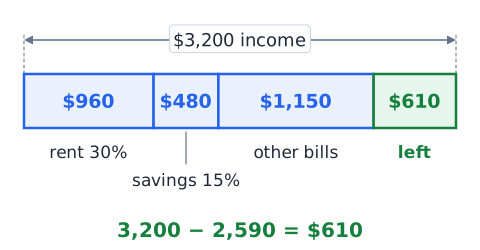
$3,200 income split into rent $960, savings $480, other bills $1,150 and $610 left.

Check: Add back:

2,590 + 610 = 3,200

the full monthly income.

Worked Example 6 — Commission Plus Base Pay

Problem: An agent earns 600 dollars base pay plus 3% commission on 20,000 dollars of sales. What is the total pay?

Step 1: Find the commission. Write 3% as 0.03. Since 1% of 20,000 is 200, 3% is 3 × 200.

The commission is 600 dollars.

Step 2: Add the base pay and the commission.

Answer: The total pay is 1,200 dollars.

Check: Commission is 600 dollars, the same as the base pay, so the total is exactly double the base:

2 × 600 = 1,200

Common Money-Problem Traps

Stopping early: finding the discount amount but not subtracting it, or the tax amount but not adding it. Reread what the question asks for.

Adding percents across steps: 25% off then 8% tax is not 17% off. Apply each step to the current amount.

Paying all hours at overtime: only hours beyond 40 earn the higher rate.

Using months as years: convert months to years in simple interest.

Wrong base: markup uses cost, and a second discount uses the reduced price.

Quick Review

Unit price is total cost divided by units. For a discount, multiply by 1 minus the rate; for tax or markup, multiply by 1 plus the rate, and apply tax after discounts. Tips and commission are percents of the bill or sales. Gross pay is rate times hours, with overtime at 1.5 times the rate only for extra hours. A budget's remainder is income minus total expenses. Simple interest is principal times rate times years, with months divided by 12. Profit is revenue minus cost. In every step, identify the base the percent applies to.

Quick review

What is the simple interest formula?
: I is interest in dollars, P the principal in dollars, r the yearly rate as a decimal, t the time in years. 3,000 dollars at 4 percent for 5 years earns 600 dollars.
How is a loan period given in months handled in simple interest?
Divide months by 12 to get years: 18 months is 1.5 years. 2,400 dollars at 5 percent for 18 months: dollars.
How do you find the rate when the simple interest is known?
. A 2,500 dollar deposit earning 250 dollars in 2 years: , or 5 percent per year.
How is time-and-a-half overtime pay computed?
Only hours beyond 40 earn 1.5 times the regular rate. At 24 dollars per hour for 48 hours: dollars.
What is a markup, and what is it a percent of?
An amount added to the seller's cost to set the price; it is a percent of the cost. A 40 percent markup on a 45 dollar cost adds 18 dollars, so the price is dollars.
How are profit and loss defined?
Profit = revenue minus cost; a negative result is a loss. 40 shirts bought at 6 dollars and sold at 9 dollars: dollars, which is 50 percent of cost.
Does a 20 percent decrease followed by a 20 percent increase return to the start?
No, the base changes: 100 dollars drops to 80, then . Likewise 25 percent off followed by 8 percent tax is not simply 17 percent off.
What is commission, and how do you find base-plus-commission pay?
Commission is pay equal to a percent of sales. Total pay = base + rate times sales: a 600 dollar base plus 3 percent of 20,000 dollars is dollars.

What next?

← Previous: Work and Combined-Rate Problems

About this lesson

The interest portion explains simple interest, how time is expressed in simple interest problems and how to work reverse simple-interest problems. Sections on profit and loss and multi-step transactions tie the pieces together, while no-calculator money shortcuts and the habit of tracking the base amount reduce errors on this AFQT subtest.

Six worked examples cover a unit price, discount and tax, overtime, simple interest, a budget, and commission plus base pay. Review the common money-problem traps and the Quick Review, then take the Money, Interest and Everyday Quantities lesson test.

Take it with you: the free app

The same 124 lessons, 6,516 questions and 82 timed practice tests on your phone, plus flashcards with spaced review and progress tracking. Free to download, and it works offline.

  • Works offline
  • Spaced-review flashcards
  • Progress for every subtest
  • Menus in 59 languages
ASVAB Camp appGoogle Play