 ASVAB Camp
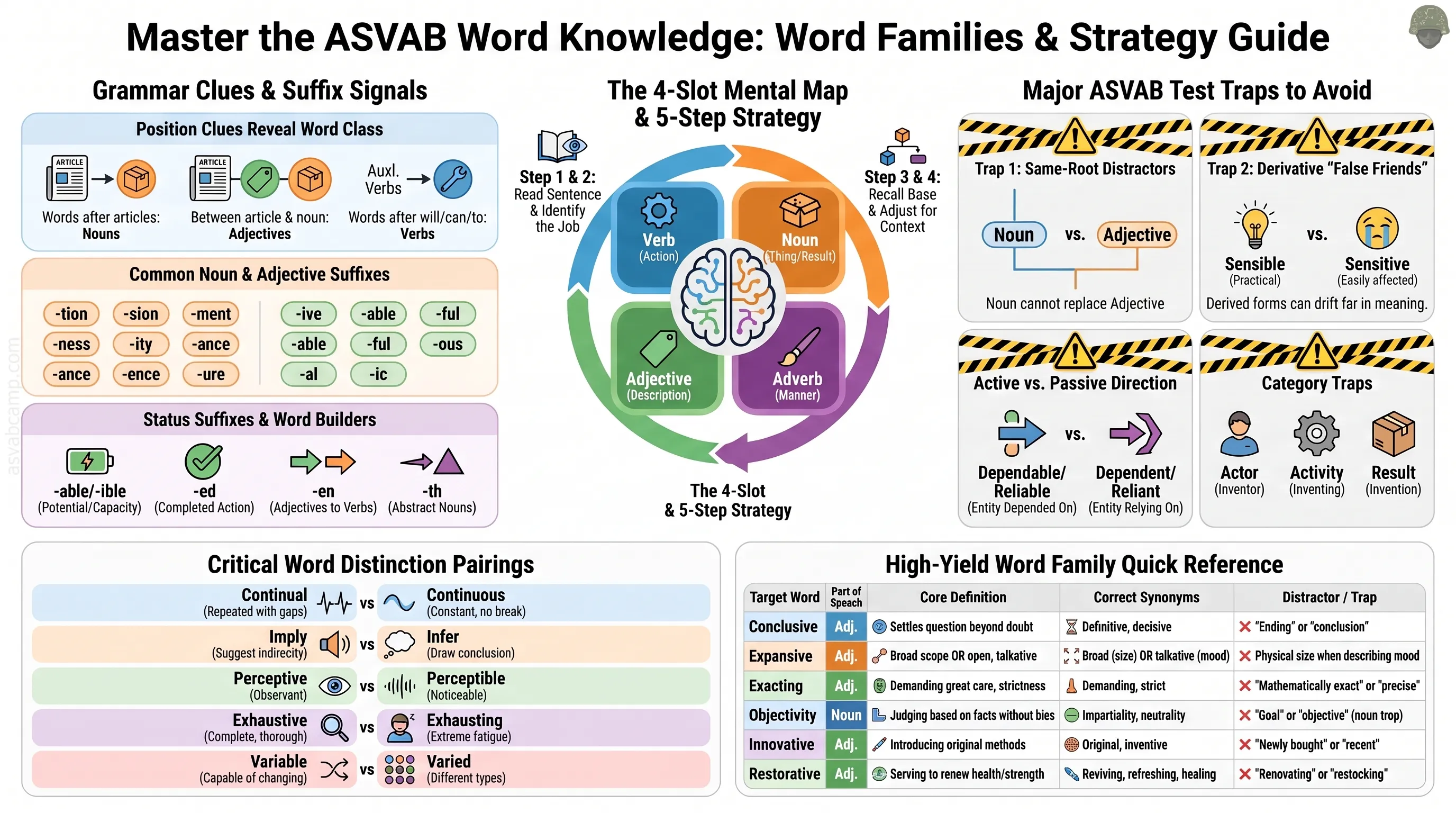
Outcome: recognize a word family without assuming every form is a synonym
In this lesson you will learn to spot the noun, verb, adjective, and adverb forms that grow from one base word, read the sentence to see which form is being used, and pick the Word Knowledge choice that matches its meaning. You will also learn why a related form from the same family is often a trap rather than a synonym.
What belongs to a word family?
A word family is a group of words built on one base, such as act, action, active, and actively. Each member adds a prefix or suffix that changes its grammar job and often shifts its meaning a little. Family members share a core idea, but they are not interchangeable. Knowing the family helps you guess a meaning; the sentence tells you which shade is meant.
A productive mental map: noun, verb, adjective, adverb
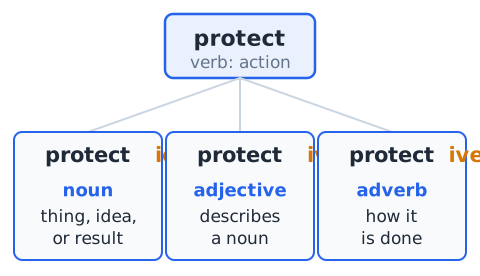
Picture each family as four slots. The verb names an action (protect). The noun names a thing, idea, or result (protection). The adjective describes a noun (protective). The adverb tells how something is done (protectively). When you meet a new word, place it in a slot, then ask what the other slots would hold. Empty slots are normal; not every family fills all four.
The five-step family approach for WK
First, read the whole sentence before looking at the choices. Second, identify the job of the capitalized word: action, thing, description, or manner. Third, recall the base word and its core idea. Fourth, adjust that core idea to fit the form and the context. Fifth, choose the answer that could replace the word in the sentence without changing its meaning, and reject choices that are merely related forms.
Inflection versus derivation: two different kinds of change
Inflection changes a word's grammar without creating a new word: walk, walks, walked, walking; box, boxes. The basic meaning stays the same. Derivation builds a new word, often in a new class: walk becomes walker, kind becomes kindness, rely becomes reliable. Derived words can drift in meaning, so each needs its own attention, while inflected forms almost never do.
Core concept is not the final meaning
The base gives you a starting idea, not a finished definition. Sense sits inside sensible, sensitive, and sensation, yet a sensible person is practical, a sensitive person reacts strongly, and a sensation is a feeling or an exciting event. Treat the base as a clue that narrows the field, then let the suffix and the sentence finish the job.
How a sentence reveals word class
Position gives word class away. A word after a, an, the, or a possessive is usually a noun: the inspection, her persistence. A word between an article and a noun, or after is, seems, or became, is usually an adjective: a thorough inspection, the crew seemed tired. A word after will, can, or to is usually a verb. A word telling how an action happened is usually an adverb: she worked carefully.
Why the official question still asks for meaning
On the Word Knowledge test, the correct choice is a synonym of the meaning, not a grammar label or a cousin from the same family. Grammar helps you check fit, because a good synonym normally matches the part of speech. Still, two adjectives can mean very different things, so the final question is always: which choice says the same thing the sentence says?
Family 1: decide, decision, decisive, decisively
Decide is the verb: to make up one's mind. A decision is the choice that results. Decisive has two common senses: showing firm judgment (a decisive leader) or settling a question (a decisive victory). Decisively is the adverb (she acted decisively). In a sentence about a quick, firm leader, decisive is close to resolute; in a sentence about an outcome, it is closer to conclusive.
Family 2: respond, response, responsive, responsiveness
To respond is to answer or react. A response is the answer or reaction itself. Responsive describes someone or something that reacts quickly and helpfully, such as a responsive help desk or responsive steering. Responsiveness is the noun for that quality. Do not confuse responsive with responsible, a look-alike that means accountable or trustworthy.
Family 3: create, creation, creative, creativity
Create means to bring something into existence. A creation is the thing made, or the act of making it. Creative describes a person or idea that shows imagination, so its synonyms include inventive and imaginative. Creativity is the noun for that ability. If a question tests creative, the answer should describe a quality of mind, not an object that was made.
Family 4: explain, explanation, explanatory
To explain is to make something clear or give reasons for it. An explanation is what you offer when you explain. Explanatory is an adjective for anything meant to clarify, as in the explanatory notes under a chart. A synonym for explanatory is clarifying, while a synonym for explanation is account or clarification. Keep the noun and the adjective in their own slots.
Family 5: conclude, conclusion, conclusive, conclusively
Conclude can mean to finish (the meeting concluded at noon) or to reach a judgment from evidence (we concluded the pump had failed). A conclusion is either the ending or the judgment. Conclusive describes evidence that settles a question beyond reasonable doubt; synonyms are decisive and definitive. Conclusively is the adverb. Conclusive never means final paragraph or simply stopped.
Family 6: depend, dependence, dependable, dependably
To depend on something is to rely on it or be determined by it. Dependence is the state of relying, often with a sense of need. Dependable describes someone others can count on, so it means reliable or trustworthy. Dependably is the adverb. Direction matters: a dependable person is relied on by others, while a dependent or reliant person relies on others.
Family 7: compare, comparison, comparable, comparably
To compare is to look at things side by side to note likeness and difference. A comparison is that act or its result. Comparable means similar enough to be weighed against each other, roughly equal in size, quality, or amount. Comparably is the adverb, as in comparably priced. Comparable suggests close, not identical, and it has nothing to do with competing.
Family 8: vary, variation, variable, varied
To vary is to change or to differ. A variation is a change or a slightly different version. Variable describes something likely to change, such as variable weather or a variable cost, so a close synonym is changeable or fluctuating. Varied describes a group with many different kinds in it, such as a varied menu, so its synonym is diverse. Variable and varied are not the same idea.
Family 9: persist, persistence, persistent, persistently
To persist is to keep going or keep happening despite resistance. Persistence is the noun for that staying power. Persistent can describe a person who refuses to quit (a persistent recruiter) or a condition that keeps coming back or will not go away (a persistent cough). Synonyms depend on context: determined or tenacious for people, lasting or recurring for problems.
Family 10: expand, expansion, expansive, expansively
To expand is to grow larger or extend. Expansion is the act or result of growing. Expansive has two senses: broad in extent (an expansive view of the valley) and, for a person, open, friendly, and talkative (he grew expansive after dinner). Expansively is the adverb. When the sentence describes a person's mood, choose the social sense rather than physical size.
Family 11: enforce, enforcement, enforceable
To enforce is to make sure a rule or law is obeyed. Enforcement is the act of doing so, as in traffic enforcement. Enforceable describes a rule, contract, or order that can legally be applied and upheld. The suffix -able points to possibility: an enforceable agreement could be upheld in court even if no one has yet tried to enforce it.
Family 12: restrict, restriction, restrictive, restricted
To restrict is to keep something within limits. A restriction is the limit itself, such as a weight restriction on a bridge. Restrictive describes something that imposes limits, so its synonyms are limiting or confining (a restrictive policy). Restricted describes what has been limited (a restricted area, restricted access). One form does the limiting; the other is on the receiving end.
Family 13: restore, restoration, restorative
To restore is to bring something back to a former, healthy, or working condition. Restoration is that process or its result, such as the restoration of an old courthouse. Restorative describes something that renews strength or health: a restorative meal or a restorative walk. Good synonyms are refreshing, reviving, or healing, not restocking or renovating.
Family 14: sustain, sustained, sustainable, sustainability
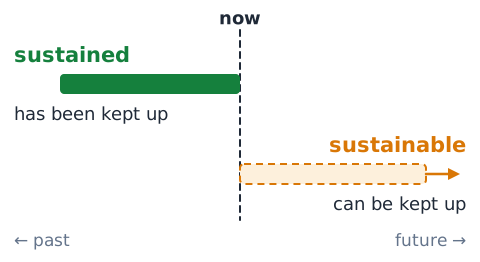
To sustain is to keep something going, to support it, or to undergo it (sustain an injury). Sustained describes something kept up over a period, such as sustained effort. Sustainable describes something that can be kept up over time without running out or collapsing, such as a sustainable pace. Sustainability is the noun. Sustained looks back; sustainable looks ahead.
Family 15: adapt, adaptation, adaptable, adaptability
To adapt is to change to suit new conditions. An adaptation is one specific change, such as a desert plant's thick leaves, or a new version of a work, like a film adaptation. Adaptable describes a person or thing able to adjust easily. Adaptability is that quality, so its synonyms are flexibility and versatility. An adaptation is one change; adaptability is the capacity.
Family 16: perceive, perception, perceptive, perceptively
To perceive is to notice or become aware of something through the senses or the mind. Perception is the act of noticing, or a way of seeing a situation. Perceptive describes a person who notices fine details or understands quickly, so it means observant or insightful. Perceptively is the adverb. Perceptible is different: it describes something that can be noticed, such as a perceptible delay.
Family 17: maintain, maintenance, maintainable
To maintain is to keep something in good condition or keep it going; it can also mean to state firmly (he maintained he was innocent). Maintenance is the upkeep work itself, such as engine maintenance. Maintainable describes equipment or software that can be kept in working order without great difficulty. Note the spelling change: maintenance, not maintainance.
Family 18: correct, correction, corrective, correctly
As a verb, correct means to fix an error; as an adjective, it means accurate. A correction is a change that fixes something. Corrective describes something intended to fix a problem, such as corrective lenses or corrective training. Correctly is the adverb, meaning accurately. Corrective points to purpose: it aims at fixing, not at punishing, and it does not say the thing is already right.
Family 19: analyze, analysis, analytical, analytically
To analyze is to examine something by breaking it into parts and studying how they relate. Analysis is that examination or its written result. Analytical describes a person or method that works in a logical, step-by-step way, so it is close to methodical, logical, or systematic. Analytically is the adverb. Analytical describes the approach; it does not promise the result is correct.
Family 20: organize, organization, organized, organizational
To organize is to arrange parts into an orderly system. Organization can mean the act of arranging, the orderly state that results, or a group of people such as a company. Organized describes something arranged neatly or a person who keeps things in order. Organizational means relating to an organization, as in an organizational chart, rather than tidy.
Family 21: justify, justification, justifiable, justifiably
To justify is to show that an action is right or reasonable. A justification is the reason given. Justifiable describes an action that can be defended with good reasons, so it means defensible or warranted. Justifiably is the adverb, as in justifiably proud. The -able ending signals that a defense is possible, not that anyone has already accepted it.
Family 22: innovate, innovation, innovative, innovatively
To innovate is to introduce new methods or ideas. An innovation is the new method, device, or idea. Innovative describes something original and inventive, not simply recently bought or produced. A brand-new copy of an old design is new but not innovative. Innovatively is the adverb. Synonyms for innovative include original, groundbreaking, and inventive.
Family 23: distinguish, distinction, distinctive, distinctly
To distinguish is to tell things apart or to set something apart from others. A distinction is a difference, or an honor that sets someone apart. Distinctive describes a feature that makes something easy to recognize, so it means characteristic, like a distinctive accent. Distinctly means clearly. Do not mix distinctive with distinguished, which means respected or eminent.
Family 24: objective, objectivity, objectively
As a noun, an objective is a goal. As an adjective, objective means based on facts rather than feelings. Objectivity is the noun for that fairness, so its synonyms are impartiality and neutrality. Objectively is the adverb, as in judged objectively. Because the noun objective means goal, a choice like goal is a classic trap when the question asks about objectivity.
Family 25: continue, continuation, continual, continuous, continuity
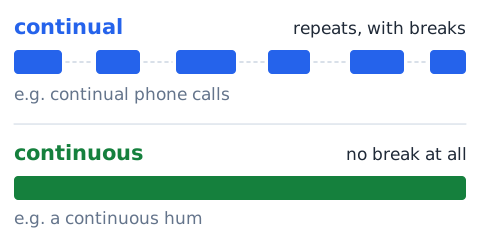
To continue is to keep going. A continuation is an extension of something. Continual describes something that repeats often, with breaks between, such as continual phone calls. Continuous describes something with no break at all, such as a continuous hum. Continuity is the smooth, consistent connection of parts over time, as in continuity of care or story continuity in a series.
Family 26: compete, competition, competitive, competence
To compete is to try to win against others. A competition is a contest. Competitive describes someone eager to win, or a price that holds up against rivals. Competence looks similar but means skill or ability, and competent means capable or qualified. A competent worker does the job well whether or not she wants to beat anyone.
Family 27: reason, reasonable, reasoning, rational
A reason is a cause or explanation, and to reason is to think logically. Reasoning is the thinking process. Reasonable means fair, sensible, or moderate. Rational means based on logic. Watch rationalize: it usually means to invent believable excuses for something, not to reason carefully. A worker who rationalizes a mistake is making excuses for it.
Family 28: effective, effect, affect, effectiveness
Effect is usually a noun meaning a result (the effect of the noise). Affect is usually a verb meaning to influence (the noise affected her hearing). Effective means producing the intended result, and effectiveness is that quality. As a verb, effect means to bring about (effect a change), which differs from affect. So affected most often means influenced.
Family 29: exact, exactness, exacting, exactly
Exact means precisely correct, with no error. Exactness is the quality of being precise. Exactly is the adverb:
exactly, but
only roughly. Exacting, however, describes a person or task that demands great care and high standards, so it means demanding or strict, not mathematical.
Family 30: strong, strength, strengthen, strongly
Strong is the adjective: having power or force. Strength is the noun for that power. Strengthen is the verb meaning to make stronger, so its synonyms are reinforce or fortify. Strongly is the adverb, as in strongly disagree. The -en suffix turns adjectives into verbs (weaken, widen, sharpen), and -th forms nouns (length, depth).
Recognize common noun-family signals without reducing WK to grammar
Common noun endings include -tion, -sion, -ment, -ness, -ity, -ance, -ence, and -ure: decision, enforcement, objectivity, persistence, closure. Spotting one tells you the answer should name a thing or quality. But an ending only checks fit. You still need the meaning, because several noun choices can share endings and only one matches.
Recognize adjective and adverb family signals carefully
Adjective endings include -ive, -able, -ible, -ful, -ous, -al, and -ic: corrective, sustainable, perceptible, analytical. Most adverbs end in -ly, but some -ly words are adjectives (friendly, costly, timely). Use endings as hints, then confirm by asking what the word describes in the sentence.
Use family members as memory anchors, not as guaranteed equivalents
Family members make good memory hooks. If you know that restore means bring back, you can guess that restorative relates to bringing back strength. Treat that guess as a starting point only. Check it against the sentence, because a family member can carry a narrower, broader, or shifted meaning than the base word you remembered.
Choose by job: action, quality, process, or result
Many families split their meaning by job. The verb is the action (organize). One noun names the process (the organization of the files took an hour). An adjective can name a result (an organized file), and another a relation (organizational skills). Decide which job the tested word does in its sentence, then pick the choice that does that same job.
Choose by time: capacity versus accomplished change
Suffixes can signal time or status. The -able and -ible endings usually express capacity: something could happen. The -ed ending often marks something already done. Sustainable means can be kept up, while sustained means has been kept up. Enforceable means can be enforced; enforced means is being or has been enforced.
Choose by strength: related is not equivalent
A related word can be weaker or stronger than the target. Exhausted is far stronger than tired, and conclusive is stronger than suggestive. Choose the option that matches the intensity in the sentence. If the sentence says every bolt was checked, partial and quick are too weak; thorough fits. Related in topic does not mean equal in force.
Choose by register: ordinary and technical senses
Some words have an everyday sense and a specialized one. Variable in a budget means changeable; in algebra it is a letter standing for an unknown. Elastic in physics means returning to shape; in economics it describes demand that changes sharply when price changes. Economic relates to the economy, while economical means thrifty or not wasteful. Read the setting to choose the right sense.
Trap: automatically choosing another member of the same family
The mistake: picking an answer because it shares a root with the tested word, such as restriction for restrictive. Why it is wrong: a noun cannot replace an adjective, and its meaning is different. The fix: set aside choices built on the same base unless they truly fit, then look for a real synonym such as limiting.
Trap: false friends inside a family
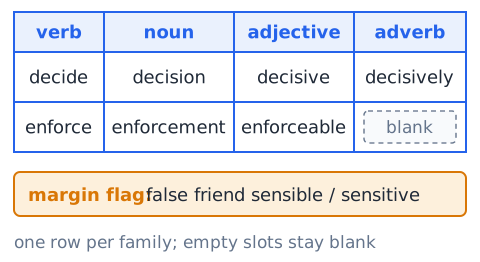
Some relatives drift far apart. Sensible means practical, but sensitive means easily affected. Economical means thrifty, but economic means related to money and trade. Responsible means accountable, while responsive means quick to react. The mistake is treating each pair as one meaning; the fix is to learn them as separate words with separate definitions.
Trap: the adjective -ive is not always a simple effect
The mistake is assuming every -ive adjective means causing the base action. Sometimes it does (a destructive storm destroys), but exhaustive means complete and thorough, not tiring. Expansive can mean friendly and talkative, not just large. The fix: check whether the -ive word describes a cause, thoroughness, or a mood.
Trap: confusing agent, process, and result
Inventor, inventing, and invention look alike but name different things: the person who acts, the activity, and the product. A test-taker who treats them as one may choose a person when the sentence needs a product. The fix: ask who did it, what was being done, and what came out of it, then match the answer to that role.
Trap: continual versus continuous and imply versus infer
Continual means repeated often with gaps; continuous means without any break. Imply means to suggest something without saying it outright; infer means to draw a conclusion from evidence. The speaker implies; the listener infers. A mechanic who sees a falling gauge and decides there is a leak has inferred, or concluded, that fact.
How to handle an unfamiliar derivative under time pressure
If you cannot place a word quickly, strip off the suffix to find the base, recall what the base means, and rebuild the meaning with the suffix in mind. Reread the sentence for clues such as contrast words (although, despite) or examples. Eliminate same-root choices and opposites, pick the best remaining option, and move on rather than spending extra time on one item.
Mini grid for efficient study and retention
Draw a small grid with four columns: verb, noun, adjective, adverb. Give each family one row and leave empty slots blank. Under each word, write a short definition in your own words and one sentence you made up. Flag any false friend in the margin. Review a few rows each day by covering the definitions and testing yourself, then mix rows so you are not just memorizing order.
Guided practice: derive and check, not just transform
Prompt: What adjective from analyze describes a logical, step-by-step method? Answer: analytical, close to methodical.
Prompt: Do sustained and sustainable mean the same thing? Answer: No. Sustained has been kept up; sustainable can be kept up.
Prompt: Which noun names the quality of being dependable? Answer: dependability, meaning reliability.
Guided practice: detect overconfident assumptions
Prompt: For DISTINCTIVE, is distinction a safe pick? Answer: No. It is a noun meaning a difference or an honor; the synonym is characteristic.
Prompt: Since exhaust can mean tire out, must exhaustive mean tiring? Answer: No. It means thorough.
Prompt: Does competent mean competitive? Answer: No. It means capable.
Family 31: invent, invention, inventive, inventor
To invent is to create something that did not exist before. An invention is the new device or process, and an inventor is the person who created it. Inventive describes a mind or approach that produces original ideas, close to creative or resourceful. Invent can also mean to make up something false, as in inventing an excuse, so check the tone of the sentence.
Family 32: deliver, delivery, deliverable
To deliver is to carry something to a destination, or to provide what was promised (deliver results). Delivery is the act of delivering, or the way a speech is presented. In business and contract language, deliverables are the specific work products a team has agreed to hand over, such as a report, a set of drawings, or a finished part. They are not trucks, addresses, or payments.
Family 33: elastic, elasticity, elastically
Elastic describes a material that stretches or compresses and then returns to its original shape, like a rubber band or a spring that has not been overstretched. Elasticity is the noun for that property. Elastically is the adverb: a beam that bends elastically springs back when the load is removed. In everyday use, elastic can also mean flexible or adaptable, as in an elastic schedule.
Family 34: resilient, resilience, resiliently
Resilient describes a person, material, or system that recovers quickly after stress, damage, or hardship. Resilience is that ability to bounce back. Resiliently is the adverb. Resilient does not mean untouched; it means hit or bent but able to recover. A resilient town may be flooded and still reopen its businesses within days.
Family 35: deteriorate, deterioration, deteriorating
To deteriorate is to become worse in condition or quality. Deterioration is the process of declining, such as the deterioration of a roof. Deteriorating is the present participle, often used as an adjective, as in deteriorating roads. Synonyms are worsen, decline, and decay. Growing older is not the same; an old tool can stay in good shape with care.
Family 36: deliberate, deliberately, deliberation
As an adjective, deliberate means intentional or done on purpose (a deliberate error), and it can also mean slow and careful (deliberate steps). As a verb, pronounced with a different last syllable, deliberate means to think over or discuss carefully before deciding, as a jury does. Deliberately is the adverb: on purpose. Deliberation is the noun for careful discussion or slow, thoughtful consideration.
Family 37: exhaust, exhaustion, exhaustive
To exhaust is to use up completely or to tire out. Exhaustion is extreme tiredness or the state of being used up. Exhaustive, though, describes something that covers every part or possibility, so its synonyms are thorough, complete, and comprehensive. An exhaustive search checks everywhere. Exhaust is also a noun for the waste gases from an engine.
Adaptability versus an adaptation
Sentence: The ship's crew showed real ADAPTABILITY when a storm forced a new route. Choices: modification, flexibility, stubbornness.
The word is a noun naming a quality the crew showed. An adaptation, or modification, is one specific change, not an ability. Stubbornness is the opposite. Adaptability is the capacity to adjust, so the answer is flexibility.
Conclusive evidence is not a conclusion
Sentence: The fingerprint match gave CONCLUSIVE proof of who opened the safe. Choices: ending, likely, definitive.
Conclusive is an adjective describing proof. A conclusion can be an ending, but that sense does not describe evidence. Likely is too weak, because the proof settles the question. The answer is definitive.
Reliable versus reliant
Sentence: The old generator is RELIABLE in every storm. Choices: reliant, dependable, fragile.
Reliant means depending on something else, but the generator is not doing the depending; people depend on it. Fragile is the opposite idea. Reliable means able to be counted on, so the answer is dependable.
Perceptive versus perceptible
Sentence: A PERCEPTIBLE change in engine noise warned the pilot. Choices: observant, noticeable, imagined.
The word describes the change, not the pilot. Perceptive describes a person who notices things, while perceptible describes a thing that can be noticed. A change cannot be observant, and nothing suggests it was imagined. The answer is noticeable.
Restorative effects in a sentence
Sentence: A week at the lake had a RESTORATIVE effect on the worn-out crew. Choices: renovating, reviving, restocking.
Restore can mean repair a building, but here the thing being renewed is people's energy. Restorative describes what brings back strength. The answer is reviving.
Enforceable versus enforced
Sentence: The new parking rule is ENFORCEABLE, but no tickets have been written yet. Choices: already applied, able to be applied, unpopular.
The -able ending marks capacity, and the clause about no tickets shows enforcement has not started. The answer is able to be applied.
Continuity versus constant recurrence
Sentence: The night crew kept CONTINUITY by finishing every log the day crew had begun. Choices: frequent repetition, unbroken connection, quick ending.
Continuity is about a smooth link between parts. Frequent repetition fits continual instead. The answer is unbroken connection.
Comparable does not mean identical
Sentence: The two used trucks had COMPARABLE mileage, about 80,000 and 84,000 miles. Choices: identical, similar, competing.
The figures differ by 4,000 miles, so identical is wrong, and competing belongs to another family. The answer is similar.
Restrictive rules versus restricted access
Sentence: Visitors found the RESTRICTIVE badge policy frustrating. Choices: limiting, limited, restriction.
The policy is doing the limiting, so the active sense fits. Restricted would describe what is being limited, such as an area, and restriction is a noun that cannot describe a policy here. The answer is limiting.
Innovative versus simply new
Sentence: The clinic adopted an INNOVATIVE scheduling system that no other clinic in the state had used. Choices: newly bought, original, costly.
The clue that no one else had used it points to originality, not purchase date or price. A newly bought copy of an old system is new but not innovative. The answer is original.
Justifiable versus justified in fact
Sentence: The sergeant's choice to delay the march was JUSTIFIABLE, given the lightning nearby. Choices: already approved, defensible, careless.
The -able ending means the choice can be defended, and the sentence supplies the reason. Nothing says a superior has signed off, so already approved goes too far. Careless contradicts the reason. The answer is defensible.
Objectivity versus a project objective
Sentence: The review board showed OBJECTIVITY, deciding each case by the written record alone. Choices: goal, fairness, opinion.
Objective as a noun means goal, but objectivity names the quality of judging by facts. Deciding by the record alone shows fairness without bias. Goal is the family trap, and opinion is the opposite. The answer is fairness.
Rapid-review checklist for family-based synonym questions
Read the full sentence before the choices. Name the word's job: action, thing, quality, or manner. Find the base and its core idea, then adjust for the suffix: -able for capacity, -ed for something done, -ive for a describing quality, -ity or -ness for a quality as a noun. Watch false friends such as sensible and sensitive, continual and continuous, imply and infer. Reject same-root choices that do not fit, and pick the true synonym.
 English ▾