 ASVAB Camp
Outcome: choose the closest meaning, not merely a related word
By the end of this lesson you should be able to separate what a word literally names (its denotation) from the feeling or judgment it adds (its connotation).
You will practice picking the most exact synonym by checking four things: tone, degree, register, and the context of the sentence. You will also be able to say, in a few words, why a near-synonym fails, for example because it is too strong, too negative, or simply about a different idea. On Word Knowledge items, related is not enough; the answer must match.
Denotation: the essential meaning shared by a word family
Denotation is the plain, literal meaning of a word, the part you could point to without any opinion attached. Thrifty, frugal, cheap, and stingy all denote the same core idea: spending little money.
Think of denotation as the shared root of a word family. It tells you which group of words is in play. It does not yet tell you which member of that group fits a particular sentence best.
Connotation: the attitude a word can carry
Connotation is the extra coloring a word brings: approval, disapproval, warmth, coldness, or a hint of some setting. Slender and scrawny both describe a thin person, yet slender sounds like a compliment while scrawny suggests weakness or poor health.
When two choices share a denotation, connotation is often the deciding factor. Ask whether the writer seems to admire, criticize, or simply report.
Precision: how tightly a word fits the evidence
A precise word says exactly what the sentence supports and nothing more. If a report says a pipe has a few drops leaking at one joint, damaged is accurate, but destroyed claims far more than the evidence shows.
Precision means matching the size, frequency, and certainty of the situation. A word that overstates or understates the facts is imprecise, even if it belongs to the right general topic.
The four dimensions of an exact synonym
To judge whether a choice is a true match, test it on four dimensions. Tone: is it positive, negative, or neutral like the original? Degree: is it equally strong? Register: does it belong to the same level of formality? Context: does it make sense in this particular sentence?
A choice that passes all four is your answer. A choice that fails even one is only a near-synonym.
Positive, negative, and neutral associations
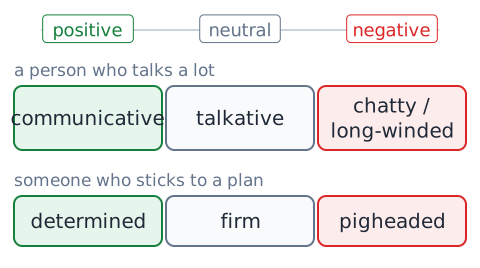
Many word families contain a positive member, a neutral member, and a negative member. Consider a person who talks a lot: communicative leans positive, talkative is roughly neutral, and chatty or long-winded lean negative.
Another set: someone who sticks to a plan may be called determined (positive), firm (neutral), or pigheaded (negative). Spotting where each word sits on this scale helps you match the writer's attitude instead of just the topic.
A useful word pair: thrifty and stingy
Thrifty and stingy both mean spending little, but they judge that behavior differently. Thrifty is approving: it describes careful, economical use of money that avoids waste. Stingy is disapproving: it suggests an unwillingness to spend or share even when it would be reasonable.
A parent who reuses jars and buys in bulk is thrifty. A roommate who will not chip in for shared groceries is stingy.
Self-belief: confident versus arrogant
Confident and arrogant both describe someone who believes in their own ability. Confident is positive: the belief is steady and generally justified, and it does not require putting others down.
Arrogant is negative: the person overrates themselves and treats others as inferior. A recruit who calmly volunteers to lead a drill is confident. A recruit who mocks squadmates and ignores the instructor's corrections because he thinks he knows better is arrogant.
Determination: resolute, tenacious, obstinate, dogmatic
All four words describe holding firm, but they differ in judgment. Resolute means firmly decided and is usually praised. Tenacious means hanging on persistently despite difficulty, also generally positive.
Obstinate means stubborn in a way that refuses reasonable persuasion. Dogmatic is narrower: it describes someone who insists their beliefs are certainly true and dismisses any evidence against them. A dogmatic person is rigidly opinionated, not simply persistent.
Directness: candid, blunt, tactless, evasive
Candid means frank and honest, especially about something uncomfortable, and it is usually approving. Blunt means plainly direct, without softening; it can be neutral or even useful in an emergency.
Tactless adds a criticism: the speaker is direct in a way that needlessly hurts feelings. Evasive is the opposite of all three, describing someone who dodges a question instead of answering it.
Attention to detail: careful, meticulous, fastidious
Careful is the general, neutral word for paying attention to avoid mistakes. Meticulous is stronger and approving: extremely thorough, checking every small detail.
Fastidious goes a step further and often carries a mild criticism: the person is hard to please and fussy about details that may not matter much. A technician who logs every torque value is meticulous; a manager who rejects a report over the shade of a font is fastidious.
Ability and insight: intelligent, astute, calculating
Intelligent is the broad word for mental ability. Astute is more specific: quick to notice what matters and judge situations shrewdly; an astute person is perceptive.
Calculating also involves careful thinking, but it adds a negative edge, suggesting someone who schemes for personal advantage. Praise for spotting a problem early calls for astute, not calculating.
Modesty: unassuming, reserved, meek, aloof
Unassuming describes a modest person who does not seek attention or brag about achievements. Reserved means slow to show feelings or share personal details, which is neutral.
Meek suggests being overly quiet and submissive, too willing to give in. Aloof means distant and cool toward others, which often reads as unfriendly. Only unassuming centers on modesty about one's own success.
Enthusiasm spectrum: pleased, delighted, exuberant, ecstatic
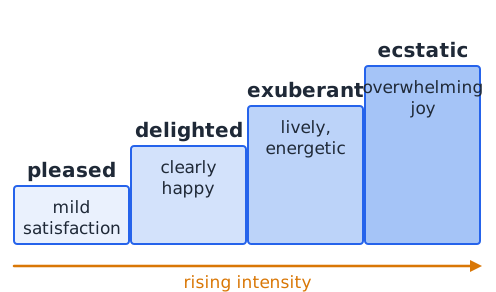
These words rise in intensity. Pleased is mild satisfaction. Delighted is clearly happy. Exuberant adds energy that shows on the outside: lively, joyfully energetic behavior such as cheering or bouncing around.
Ecstatic is the top of the scale, an overwhelming feeling of joy. If a sentence describes a team leaping and shouting after a win, exuberant fits better than pleased, which is too weak, and ecstatic may claim more inner intensity than the text shows.
Negative intensity: irritated, petulant, furious
Irritated means mildly annoyed. Furious means extremely angry, the high end of the scale.
Petulant is not simply a middle step in strength; it names a type of reaction. It describes childish, sulky bad temper over something minor: pouting, sighing loudly, complaining that it is not fair. Choose petulant when the behavior looks immature, not when it looks dangerous.
Criticism spectrum: skeptical, disdainful, derisive
Skeptical means doubtful; the person wants proof before believing a claim, and this can be perfectly reasonable. Disdainful means scornful, looking down on something as unworthy.
Derisive goes further and adds open mockery, such as laughing at or ridiculing someone. A buyer who asks for test results is skeptical. One who sneers at the product is disdainful. One who jokes about it to the crowd is derisive.
Approval versus implied approval: explicit and tacit
Explicit means stated clearly and directly, out loud or in writing. Tacit means understood or implied without being spoken.
If a supervisor signs a form authorizing overtime, the approval is explicit. If she sees the crew staying late every night and says nothing to stop it, her approval is tacit. Tacit agreement is real but unspoken. It is not the same as enthusiastic or written, two traps you may see in answer choices.
Order and speed: methodical, deliberate, hasty, impetuous
Methodical means following a systematic, orderly procedure, step by step. Deliberate means done slowly and on purpose after thought.
Hasty means done too quickly, often carelessly. Impetuous means acting on sudden impulse without thinking, driven by emotion. Note that methodical does not mean slow; a methodical worker can be fast as long as she follows the same order each time.
Frequency: intermittent, sporadic, constant, periodic
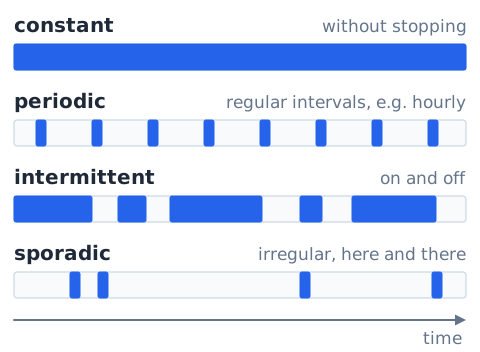
Constant means without stopping. Periodic means recurring at regular intervals, like a reminder that sounds every hour.
Intermittent means starting and stopping, on and off, with breaks in between; it does not require a regular pattern. Sporadic means occurring irregularly and scattered, here and there, often rarely. A leaky faucet dripping every few seconds is periodic; reports of a power flicker across a whole month are sporadic.
Difficulty: cumbersome, unwieldy, onerous, impossible
Cumbersome means bulky, slow, or clumsy to deal with, whether a heavy coat or a complicated process. Unwieldy means awkward to handle or control because of size, shape, or weight.
Onerous means burdensome, involving heavy effort or responsibility. None of these means impossible: an onerous duty is hard, but it can be done.
Appearance and show: austere, plain, ostentatious
Plain is neutral: simple and without decoration. Austere is stronger and can sound stern; it means severely plain, stripped of comforts, sometimes by strict choice, like a bare barracks room with only a cot and locker.
Ostentatious is the opposite: showy and designed to attract attention or display wealth. Note that ostentatious is about display, not price; an expensive watch can be quietly elegant rather than showy.
Action under risk: brave, intrepid, reckless
Brave is the general, positive word for facing danger despite fear. Intrepid means fearless and bold, often used for explorers and rescuers who go into the unknown.
Reckless is negative: it means taking risks without regard for consequences or safety. Preparation is the key test. A firefighter who checks her gear before entering a burning building can be intrepid; someone who rushes in without a mask is reckless.
Realism in decisions: pragmatic, idealistic, cynical
Pragmatic means practical, focused on what actually works in real conditions rather than on theory. Idealistic means guided by high principles or a vision of how things should be, sometimes at the cost of practicality.
Cynical means distrustful of other people's motives, expecting the worst. A pragmatic planner chooses a workable repair now; an idealist waits for the perfect design.
Clarity and logic: cogent, eloquent, lengthy, plausible
Cogent describes reasoning that is clear, logical, and convincing. Eloquent describes speech or writing that is fluent and moving; it is about style, and an eloquent speech can still be weak in logic.
Lengthy only means long. Plausible means it seems believable or reasonable, but it may not be proven. An argument that links each claim directly to supporting data is cogent, whether or not it sounds beautiful.
Requests and force: suggest, urge, demand, insist
These verbs rise in pressure. Suggest offers an idea gently, leaving the choice open. Urge means strongly encourage, pressing someone to act, often because the speaker thinks it matters.
Demand means ask forcefully, as a right or requirement. Insist means keep demanding firmly, refusing to accept no. A coach who urges a player to rest is giving strong advice, not an order.
Statements and certainty: hint, imply, assert, demonstrate
Hint means suggest something indirectly, with a small clue. Imply means communicate an idea without saying it outright. Assert means declare something confidently and directly, whether or not proof is offered.
Demonstrate means show that something is true with evidence or a clear example. The difference between assert and demonstrate matters: a speaker can assert that a bridge is safe, but only data or a load test demonstrates it.
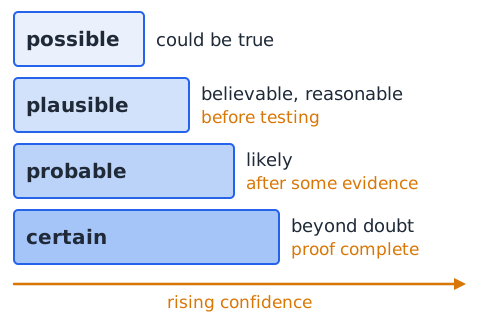
Evidence spectrum: possible, plausible, probable, certain
These rise in confidence. Possible means it could happen or be true, nothing more. Plausible means believable and reasonable on its face, though not yet confirmed.
Probable means likely, more likely than not. Certain means beyond doubt. A detective may call a theory plausible before testing it, probable after some evidence, and certain only when the proof is complete.
Quantity precision: scarce, limited, negligible, absent
Scarce means in short supply compared with need. Limited means restricted in amount, but not necessarily too little.
Negligible means so small or unimportant that it can be ignored, such as a weight change of a few grams on a truck. Absent means not there at all. A negligible amount still exists; it simply does not matter.
Degree of damage: worn, damaged, dilapidated, ruined
Worn shows light wear from use, like faded jeans. Damaged means harmed in some specific way, such as a dented fender.
Dilapidated describes a building or object that is run-down and falling apart from age and neglect: broken windows, peeling paint, a sagging porch. Ruined means destroyed beyond use or repair. Choose the word that matches the actual extent of the harm.
Physical properties: flexible, malleable, brittle, resilient
Flexible means able to bend without breaking, like a rubber hose. Malleable means able to be hammered or pressed into a new shape, as gold or copper can be.
Brittle means hard but easily cracked or shattered, like thin glass. Resilient means able to spring back after being stretched or squeezed; applied to people, it means quick to recover from setbacks.
Professional attitude: indifferent, impartial, detached
Impartial means unbiased: treating all sides fairly and equally. Indifferent means not caring at all, which is usually negative in a professional setting.
Detached means emotionally uninvolved; it can be neutral, but it can also suggest coldness. A fair judge is impartial, not indifferent.
Tone is not always an intrinsic property of the word
Some words shift tone depending on how they are used. Ambitious can praise a goal-driven student or hint at ruthless self-interest in a power-hungry official. Simple can mean easy to use or, in another sentence, lacking depth.
Because of this, read the whole sentence before deciding a word's tone. The surrounding clues, not just the dictionary sense, tell you which shade the writer intends.
Social and cultural context changes connotation
The same word can sound different in different communities or settings. Aggressive may be praise in a sales meeting or on a football field, where it means energetic and pushing ahead, but a criticism in a classroom.
Older words can drift too. Awful once meant inspiring awe and now usually means bad. On the ASVAB, focus on standard modern American usage and the clues in the sentence rather than slang or regional meanings.
Register: formal, informal, technical, literary
Register is the level of formality a word belongs to. Commence is formal, begin is neutral, and kick off is informal. Technical words belong to a field: a mechanic says torque, while a casual speaker says twisting force.
Literary words, such as steed for horse, feel poetic or old-fashioned. A good synonym usually sits in a similar register, but on WK items meaning comes first; register helps break ties between close choices.
Collocation: what words naturally go together
Collocation is the habit of certain words appearing together. We say heavy rain, not thick rain, and make a decision, not do a decision. Two near-synonyms may share a meaning but differ in which words they pair with.
For example, strong and powerful overlap, yet we say strong coffee and a powerful engine. If an answer choice sounds odd in the sentence, it may be a poor collocation, which is a sign it is not the intended match.
Part of speech is a precision filter
A correct synonym usually matches the part of speech of the tested word. If the stem word is an adjective, such as frugal, the best choice is likely an adjective too, such as economical, not the noun economy.
Verbs match verbs, and nouns match nouns. Endings give quick clues: -ous, -ful, and -ive often mark adjectives, -ly often marks adverbs, and -tion or -ment often marks nouns. Plug the choice into the sentence; if the grammar breaks, the choice is almost always wrong, even when the meanings are related.
Use a neutral paraphrase before viewing answer choices
Before you look at the choices, put the tested word into your own plain words, based on the sentence. For example, in a sentence about a worker who never skips a step, you might think: follows an orderly system.
This paraphrase acts as a target. Then scan the choices for the one that matches it. Starting with your own words keeps flashy distractors from steering your thinking.
The five-filter comparison routine
When two or more choices seem close, run them through five quick filters in order. Denotation: same core meaning? Tone: same positive, negative, or neutral attitude? Degree: same strength? Register and part of speech: same level of formality and same grammatical role? Context: does it fit the clues in this sentence?
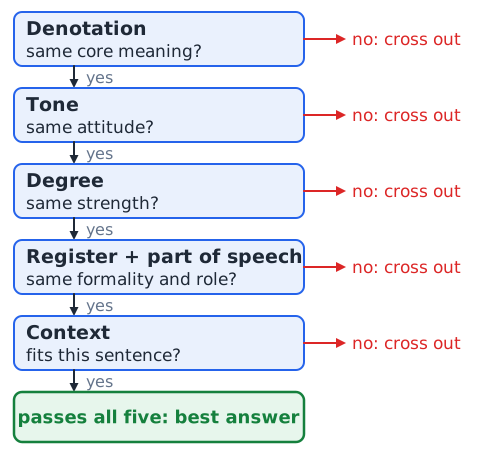
The choice that survives every filter is the best answer.
Check an answer for extra unsupported claims
A tempting wrong answer often adds a feature the sentence never mentions. If a speaker states a view without proof, declared fits; demonstrated adds the claim that proof was shown.
Ask yourself what each choice assumes. If it slips in a motive, an emotion, a cause, or a level of certainty that the sentence does not support, cross it out.
Eliminate by mismatch category, not intuition
Instead of crossing out choices because they just feel wrong, name the reason. Is it a tone mismatch (too negative)? A degree mismatch (too strong or weak)? A meaning mismatch (a different idea)? A context mismatch?
Naming the category makes your elimination reliable and helps you avoid second-guessing on test day.
Handling two tempting near-synonyms
Sometimes two choices both look right. Compare them directly: write or think of one phrase that describes how they differ. For example, intermittent means on and off, while periodic means at regular intervals.
Then go back to the sentence and find the clue that decides between them. A phrase like no clear pattern rules out periodic. The sentence always contains the tiebreaker if you look for it.
Contrast signal words reveal stance
Words like but, although, despite, yet, and rather than signal a turn in meaning. They often tell you which side of a contrast the tested word falls on.
In the sentence Although the job paid well, the hours were grueling, the word although tells you grueling is negative and stands against paid well. Use these signals to determine whether the missing meaning is positive or negative.
Degree clues: adverbs, numbers, outcomes, and behavior
Context often shows how strong a word should be. Adverbs like slightly, very, or completely set the level. Numbers matter: a two percent drop is smaller than a fifty percent drop.
Outcomes and behavior help too. If a person shouts and throws things, mild annoyance is too weak. Match the strength of your answer to the strength of the evidence.
Beware of the most dramatic answer
Test writers often include an extreme choice, such as impossible, ruined, or furious, next to a more measured one. The dramatic word may catch your eye, but it is often too strong for the sentence.
Unless the context clearly shows an extreme situation, prefer the choice that matches the evidence rather than exaggerating it.
Do not import emotions absent from the sentence
Do not assume feelings the sentence does not show. If a sentence says a clerk gave a short answer, the clerk may simply be busy, not angry or rude.
Choosing an emotional word like hostile when the text only shows brevity adds a feeling the writer never described. Stick to what the sentence tells you.
Trap: treating synonyms as perfectly interchangeable
The mistake is assuming that any word listed under the same meaning can replace another in every sentence. That is wrong because near-synonyms differ in tone, strength, or setting; slim and skinny are not equally polite.
The fix: after finding choices that share a meaning, test each one in the actual sentence and keep the one that preserves the writer's attitude and degree.
Trap: assuming longer words are better answers
Some test takers pick the most complex or impressive-sounding choice, assuming it must be right. Length and difficulty have nothing to do with accuracy.
The fix: judge every choice by meaning and fit. A short, plain word like frank can be the precise answer while a long one adds the wrong idea.
Trap: confusing intensity with evaluation
Intensity is how strong a word is; evaluation is whether it praises or criticizes. These are separate. Ecstatic is intense and positive, while petulant is mild in strength yet clearly negative.
The fix: check strength and attitude as two separate questions instead of treating them as one.
Trap: swapping state, cause, and effect
Some wrong choices describe what caused a condition or what resulted from it instead of the condition itself. For example, exhausted is a state, while grueling describes the task that causes exhaustion, and rested describes the result of recovering.
This matters because the right answer must describe the same thing the tested word describes. The fix: ask whether the word names a feeling, a cause, or an outcome, and choose the one that matches.
Trap: assuming every negative word is the same insult
Not all negative words mean the same thing. Stingy criticizes spending, arrogant criticizes self-image, and reckless criticizes risk-taking.
Picking any negative word because the tested word is negative is a mistake. The fix: match the specific type of flaw, not just the negative tone.
Timing without sacrificing precision
Word Knowledge items move quickly, so build a fast routine. Read the sentence, form a brief paraphrase, scan the choices, and eliminate obvious mismatches first.
Spend extra seconds only when two choices remain close; then use a single deciding filter such as tone or degree. If you still are unsure, pick the best remaining choice and move on rather than stalling.
Connotation compared with earlier WK lessons
Earlier Word Knowledge lessons focused on finding a word's basic meaning through roots, prefixes, suffixes, and context clues. Those skills get you to the right word family.
This lesson adds the final step: choosing the right member of that family. Roots might tell you that a word is related to belief or to speed, but connotation and precision decide whether it is confident or arrogant, deliberate or hasty. Use both skills together: decode first, then refine.
Judicious rather than stingy spending
Sentence: The team leader was frugal, buying only the equipment the squad truly needed and saving the rest of the budget for repairs.
Choices: stingy, judicious, wasteful, greedy.
Step one: the sentence praises the leader for sensible spending. Step two: stingy is negative and implies refusing reasonable spending, which the sentence does not show. Wasteful and greedy are opposite or unrelated.
Answer: judicious, meaning showing wise, sensible judgment.
Painstaking rather than hesitant review
Sentence: The auditor's review was meticulous; she checked every receipt line by line.
Choices: hesitant, painstaking, lengthy, careless.
Reasoning: line-by-line checking shows great care. Hesitant suggests uncertainty, which is not mentioned. Lengthy notes only time, not care. Careless is the opposite.
Answer: painstaking, meaning done with great care and thoroughness.
Terse rather than insulting response
Sentence: When the reporter asked for details, the officer's reply was curt: No comment.
Choices: rude, terse, evasive, furious.
Reasoning: the reply is very short. Rude and furious add hostility the sentence does not show. Evasive is close but focuses on dodging, not brevity.
Answer: terse, meaning brief and to the point.
Steadfast without rigidity
Sentence: The volunteer remained steadfast, showing up every weekend for a year even when the weather turned harsh.
Choices: dogmatic, loyal and steady, obstinate, reckless.
Reasoning: the sentence praises reliable commitment. Dogmatic and obstinate add rigid refusal to listen, and reckless adds danger.
Answer: loyal and steady.
Implicit versus formally announced consent
Sentence: The landlord never put it in the lease, but by accepting the tenant's dog for two years, he gave implicit permission.
Choices: written, official, unstated, eager.
Reasoning: permission was understood through behavior, never stated. Written and official contradict that. Eager adds emotion.
Answer: unstated, meaning implied rather than expressed.
Intermittent versus continuous lighting
Sentence: The streetlight was intermittent, flickering off and then back on at random moments all night.
Choices: constant, periodic, on and off, dim.
Reasoning: constant means never stopping. Periodic requires a regular schedule, but the sentence says random. Dim describes brightness, not timing.
Answer: on and off.
Valiant with reasonable precautions
Sentence: The lifeguard was valiant, swimming into rough water to reach the swimmer after clipping on a rescue tube and signaling her partner.
Choices: reckless, timid, courageous, careless.
Reasoning: she faced danger but prepared, which rules out reckless and careless. Timid is the opposite.
Answer: courageous, meaning brave in the face of danger.
Coherent argument versus polished speech
Sentence: Her proposal was coherent, with each step following logically from the previous one.
Choices: eloquent, lengthy, logically connected, emotional.
Reasoning: the clue is logic, not style. Eloquent is about fluent expression. Lengthy and emotional do not fit.
Answer: logically connected.
Exacting demands, not impossible demands
Sentence: The new safety standards were exacting, requiring each weld to be inspected and documented twice.
Choices: impossible, demanding, unclear, optional.
Reasoning: the rules require a lot of effort, but nothing suggests they cannot be met, so impossible is too extreme. Unclear and optional do not fit.
Answer: demanding.
Spartan rooms rather than ruined rooms
Sentence: The training base had spartan rooms with metal bunks, a single lamp, and no decorations.
Choices: ruined, luxurious, simple and bare, dirty.
Reasoning: the rooms lack comfort, not condition. Ruined and dirty describe damage or neglect.
Answer: simple and bare.
Guided drill: choose the exact shade, then justify
Prompt: The firefighter checked her oxygen tank, then calmly entered the smoke-filled hallway. Choose: reckless or intrepid?
Answer: intrepid. She showed courage with preparation, so reckless is wrong.
Prompt: Rainfall reports were scattered and unpredictable across the month. Choose: periodic or sporadic?
Answer: sporadic. Nothing suggests a regular schedule.
Prompt: The new rule placed a heavy paperwork load on every clerk. Choose: onerous or impossible?
Answer: onerous. The work is burdensome but doable.
Prompt: The mayor's showy gold-trimmed limousine drew stares. Choose: ostentatious or expensive?
Answer: ostentatious. The point is display, not cost.
Contrast drill: the added-feature test
For each pair, name the feature the second word adds.
Prompt: careful versus fastidious. Answer: fastidious adds being hard to please about small details.
Prompt: skeptical versus derisive. Answer: derisive adds open mockery.
Prompt: urge versus demand. Answer: demand adds the force of a requirement.
Prompt: plausible versus proven. Answer: proven adds confirmation by evidence.
Prompt: blunt versus tactless. Answer: tactless adds needless hurt to others.
Rapid review: four filters and five traps
Denotation is a word's literal meaning; connotation is the attitude it carries. A precise synonym matches the tested word on four filters: tone, degree, register, and context. When choices are close, add part of speech and look for the clue in the sentence that decides between them.
Watch for five traps: treating synonyms as interchangeable, choosing the longest or most impressive word, confusing intensity with approval or disapproval, swapping a state with its cause or effect, and treating all negative words as the same insult. Paraphrase first, eliminate by naming the mismatch, and avoid the most dramatic choice unless the evidence supports it.
 English ▾