 ASVAB Camp
Lesson outcome: efficient but accurate word-meaning decisions
Use a repeatable sequence to identify the sense of an unfamiliar word, eliminate unsupported choices, and commit to one defensible answer under a time limit. Speed means fewer unproductive rereads, not skipping the sentence or guessing without analysis. The task remains choosing the best synonym or meaning in context.
What WK assesses, and what this lesson adds
Official ASVAB Word Knowledge (WK) focuses on selecting the closest synonym and the meaning of a word within context. Timed elimination is a preparation technique, not a separately tested topic. Apply the techniques only to meanings actually supported by the target word and, when supplied, its sentence.
Two actual question presentations: stand-alone and contextual
In a stand-alone item, such as “VIGOROUS most nearly means,” the word itself must guide the first sense estimate. In a sentence item, consider the target word plus the clause around it. Both ask for the nearest meaning, not an antonym, an essay explanation, or the term with the most similar spelling.
The official CAT and paper timing differs substantially
Official applicant information lists the proctored CAT WK as 15 scored items with 9 minutes without tryout questions, while the paper-and-pencil WK lists 35 questions in 11 minutes. CAT timing can differ when tryout items are administered. A local practice timer is only a training setting; it is not an official exam limit.
CAT answer finality and a safe commitment habit
On CAT-ASVAB you cannot return to a question after submitting its answer. Read the entire item and check the selected option before moving on. A brief confirmation should catch a misclick or a mistaken not/least; it should not turn into repeated reconsideration of the same plausible answer.
Paper-and-pencil return strategy is different
For paper-and-pencil WK, the official preparation guidance permits skipping a difficult item and coming back within the same subtest. Mark the question or follow the test administrator’s instructions, answer straightforward items, then use remaining time on difficult ones. This skip-and-return strategy does not transfer to CAT.
Official guidance on uncertain answers
The official ASVAB program explains that on the computer version, any items you have not finished when time expires are scored as though they had been answered at random. In other words, leaving items blank gains you nothing.
On the paper version, your score is based on correct answers, so a reasoned guess on a hard item is better than an empty bubble. On CAT, keep making reasoned attempts rather than rapid random fills at the end (see Trap 7); on paper, never leave a WK item unanswered: narrow the choices, then pick.
A personal timer target is not an ASVAB promise
Many students practice with a personal pace goal, such as about 15 to 20 seconds per WK item (the paper version allows only about 19 seconds per item). That number is a training tool you set for yourself, not an official rule, and the real test will not warn you when you pass it.
Use the target to notice when you are stuck, then finish the loop and commit. Check the official time limit for your test format before test day.
The 5-move decision loop: read, paraphrase, reject, compare, commit
Run the same five moves on every item. Read the word and any sentence around it. Paraphrase: say a meaning in your own words. Reject choices that clearly do not fit. Compare the survivors against your paraphrase. Commit to the best one and move on.
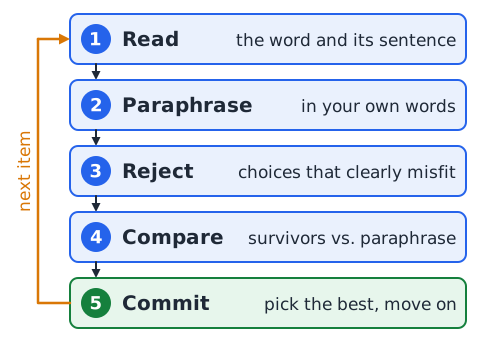
The loop keeps you from wandering, so easy items take seconds and hard items still end with a decision.
Begin by predicting a meaning before viewing choices
Before you look at the options, cover them and form your own meaning. For "The mechanic gave a BRIEF explanation," you might predict "short."
Now scan the choices for that idea. A prediction protects you from attractive distractors, because you are matching against your own target instead of letting each option suggest a new meaning. If no prediction comes, go straight to elimination.
Read the whole clause before selecting from synonyms
A capitalized word can change meaning depending on what follows it. In "The guard was ALERT to every sound in the hallway," the rest of the clause shows the word means watchful, not an alarm signal.
Read to the end of the clause, or the whole sentence, before choosing. Stopping early often makes you pick a sense that the sentence never uses.
Substitution: test one option in the original sentence
Once you have a likely answer, put it back into the sentence in place of the capitalized word and read it silently. Example: "The clerk was RELUCTANT to open the safe." Try "unwilling": the clerk was unwilling to open the safe. The meaning holds.
Now try "eager": the sentence flips its meaning, so that option is out. Test one option at a time and keep the one that preserves the original sense.
The precise-sense filter beats loosely related answers
Distractors are often connected to the topic without meaning the same thing. For "ARID desert soil," the choices "sandy," "hot," and "dry" all relate to deserts, but only "dry" means arid.
Ask: does this option mean the word, or does it just show up near it? Keep the exact match and discard the merely related ones.
Eliminate by opposite meaning first—but do not stop there
Test writers often include an antonym. If the word is GENEROUS, an option like "selfish" is an opposite and can go immediately.
That first cut is fast, but it usually leaves two or three choices. Continue the loop: compare what remains against your predicted meaning. Removing the opposite is a start, not the finish.
Eliminate mismatched word classes cautiously
A correct synonym normally matches the part of speech of the tested word. If the word is an adjective, such as HUMBLE, a noun like "humility" is unlikely to be the answer.
Be careful, though: some words work as more than one part of speech, like "lead" or "rank." Confirm the word's role in the sentence before you cut an option for grammar alone.
Use contrast and concession markers as directional evidence
Words such as "although," "but," "despite," and "however" signal that two ideas pull in opposite directions. In "Although the bridge looked old, it was STURDY," the contrast with "old" points toward strong and solid.
Treat a marker as a direction, not a definition. It tells you which side the meaning falls on; the choices still decide how far.
Use cause, result and example clues without overreading
Cause words like "because" and "so" connect the tested word to a reason or effect. In "Because the cable was FRAYED, it was replaced," the result tells you it was worn or damaged.
Example clues such as "like" or "for instance" also help. Do not overread: the clue shows a general direction, not every detail of the meaning. "Replaced" does not mean the cable was destroyed.
Negation and scope can reverse an otherwise good guess
Watch for "not," "never," "hardly," "barely," and "far from." In "The map was hardly ACCURATE, so we got lost," the word still means correct; the sentence just says the map lacked that quality.
Define the capitalized word itself first, then let negation apply to the sentence. Do not flip the word's meaning because the sentence is negative.
Intensity is often the tie-breaker
Sometimes two options share a meaning but differ in strength. If the sentence says "a slight DISLIKE of crowds," both "distaste" and "hatred" are unfavorable, but "hatred" is far stronger than the context supports.
Match the strength the sentence shows. Mild clues call for a mild answer, and extreme words need extreme evidence before you choose them.
Connotation is useful only after denotation matches
Denotation is a word's basic meaning; connotation is its emotional flavor. "Thrifty" and "cheap" both describe spending little, but one sounds approving and one critical.
First confirm that an option has the right basic meaning. Only after two options pass that test should you use positive or negative tone to choose between them.
Root and affix clues are back-up evidence, not proof
Word parts can help when you do not know a word. "Bene-" often means good, and "-less" means without.
But parts can mislead: "pertinent" has nothing to do with "tin," and "inflammable" actually means able to burn. Use roots to shrink the field when you are stuck, then check the remaining choice against the sentence before committing.
False friend options: sounds similar, means something else
Some distractors look or sound like the tested word. For AFFLUENT, an option like "fluent" shares letters but means skilled in speaking; the real meaning is wealthy.
When an option seems right mainly because it resembles the capitalized word, slow down. Ask whether you chose it for meaning or for sound, and only keep it if the meaning holds.
Partly true is not the same as best
An option can capture part of a meaning and still lose. VIGILANT means watchful and alert for danger. "Awake" is partly true, since a vigilant guard is awake, but it misses the sense of watching carefully.
The question asks for the closest meaning, so prefer the option that covers the whole idea over one that touches only a piece of it.
Do not invent a missing story for an unfamiliar term
When a word is new to you, it is tempting to build a story around it. Do not add facts the sentence does not give.
If the sentence says "The supplies were DEPLETED by noon," stay with what is stated: the supplies changed by noon. "Used up" fits that evidence; a guess like "stolen" adds a story nobody mentioned.
The final-two comparison: identify a difference that matters
When two options survive, state in a few words how they differ. For CONCEAL, "hide" and "store" both involve putting something away, but only "hide" includes keeping it out of sight.
Then check which difference the word or sentence actually requires. If you cannot name a meaningful difference, choose the one closer to your prediction and move on.
Recognize a legitimate paraphrase rather than demand a single word
Answer choices are sometimes short phrases instead of single words. For OBSOLETE, the right option might read "no longer in use."
Do not reject a choice just because it is a phrase or because it does not match the exact word you predicted. Judge whether the phrase states the same meaning, and accept it if it does.
When a familiar word has several senses, choose the sentence sense
Common words often carry several meanings. "Sound" can be a noise, healthy, or reasonable. In "The engineer gave SOUND advice," the sentence calls for reasonable or sensible.
Choose the meaning the sentence uses, even if a different meaning is the one you think of first.
A quick internal decision ladder for confidence
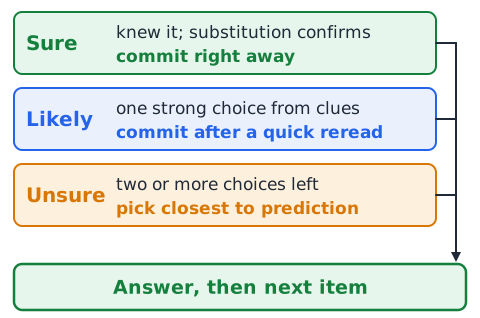
Rate yourself silently in three levels. Sure: you knew the word and substitution confirms it; commit right away. Likely: you narrowed to one strong choice using clues; commit after a quick reread. Unsure: you are down to two or more; pick the one closest to your prediction and keep moving.
All three levels end with an answer. The ladder only controls how long you spend.
Train recognition time separately from deliberation time
Two skills build speed. Recognition is knowing words on sight, which grows through flashcards and steady reading. Deliberation is working out unknown words with clues and elimination.
Practice them apart: quick word lists for recognition, and slower sentence items for deliberation. When recognition improves, more test items become one-pass decisions.
Keep a Simple Error Log
After each practice set, record every miss in a few words: the word, what you chose, and why. Tag the cause, such as unknown word, rushed, sound-alike, or wrong sense.
After a few sets, the tags show your most common error, and you know what to practice next.
Distinguish speed practice from calibrated official scoring
A practice set that you time on your phone shows your pace and accuracy, but it is not an ASVAB score. Official scores come from carefully standardized items and comparisons with a reference group.
Use practice results to track your own progress, not to predict an exact official score. For realistic score estimates, use official practice materials.
Trap 1: eliminate an answer solely because it sounds negative
Some students skip any option with an unpleasant tone. That is a mistake when the tested word is itself negative. HOSTILE means unfriendly or aggressive, so the right answer will sound negative too.
The fix: match the meaning first. Let the word and sentence decide whether the answer is positive or negative.
Trap 2: treat a clue as an absolute definition
A context clue points in a direction; it does not define the word. In "The pilot stayed CALM during the storm," the storm suggests something steady, but not "brave" or "silent."
The mistake is treating the clue as the answer itself. The fix: use the clue to choose a general direction, then select the option that means the word, not the clue.
Trap 3: choose the word with the familiar letters
Under time pressure, an option that shares letters with the tested word can feel right. For EMINENT, "imminent" looks similar but means about to happen, while eminent means famous or respected.
The fix: when the strongest reason for your choice is spelling, stop and run substitution. If the meaning breaks, cross it out.
Trap 4: spend most of the time proving every distractor wrong
Some test takers try to explain why each wrong option fails before committing. That burns time with little gain.
You do not need a full case against every distractor. Once one option clearly matches your prediction and passes substitution, select it. Save detailed comparison for the final two only.
Trap 5: chase a perfect explanation when only one best answer is needed
WK asks for the best choice of those given, not a perfect definition. Sometimes no option matches your mental definition exactly.
The mistake is stalling while you search for a perfect fit. The fix: pick the option closest to the meaning, accept a small gap, and keep moving. Close and best is enough to score.
Trap 6: assume you can return to a CAT WK question
Paper-style advice to skip and return becomes unsafe on computer-adaptive ASVAB because the answer is final once submitted. During CAT, check the target, meaning, and selected letter before confirmation. During P&P, use the permitted within-subtest return strategy, following the test administrator’s directions.
Trap 7: interpret time trouble as a signal to random-fill CAT items
The official ASVAB preparation guidance specifically cautions against filling in random guesses for several unanswered CAT items at the end because of the scoring penalty. Continue making legitimate, reasoned attempts; on paper, guidance differs. Never apply the P&P “fill all remaining circles” advice blindly to CAT.
Trap 8: confuse one-word and sentence question goals
Some items show a word alone; others place it in a sentence. Both still ask what the word means.
The trap is answering the sentence item by choosing what fits the story rather than what means the word. Use the sentence to pick the right sense, but your answer must still be a synonym of the tested word.
Guided speed drill A: eight common words
Give a one-word meaning for each, then check.
ABUNDANT: plentiful. FEEBLE: weak. RIGID: stiff. HAZARD: danger. PROMPT: quick or on time. VACANT: empty. CONCISE: brief. ROUTINE: usual practice.
Goal: answer each in about three seconds. Any word that took longer belongs in your error log for review.
Guided speed drill B: contrast-marker evidence
Predict the meaning, then check.
"The trail was steep, yet the climb felt EFFORTLESS." Answer: easy, opposite of what steep suggests.
"Despite his RESERVED manner, he spoke up at the meeting." Answer: quiet or shy.
"Unlike her CLUTTERED desk, his was bare." Answer: messy or crowded.
Guided speed drill C: reject two different traps
Name the trap in each wrong option.
LENIENT: harsh, lean, tolerant, lengthy. Harsh is the opposite; lean and lengthy share sounds. Answer: tolerant.
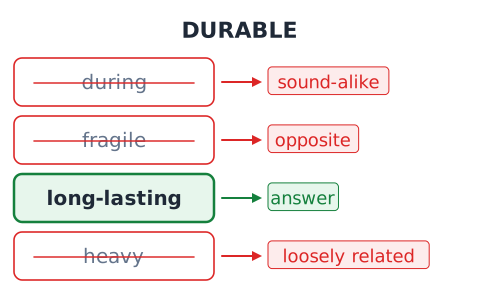
DURABLE: during, fragile, long-lasting, heavy. During is a sound-alike, fragile is an opposite, and heavy is loosely related. Answer: long-lasting.
Guided speed drill D: score confidence with a rationale
Rate each answer sure, likely, or unsure, and give a reason.
"The crowd's mood was JOVIAL." Answer: cheerful. Sure, if you know the word.
"The pilot's checklist was EXHAUSTIVE." Answer: complete. Likely, from the clue that checklists are thorough.
"The data were SPURIOUS." Answer: false. Unsure without context; choose and move on.
Two-format rehearsal: CAT-safe versus paper-safe
CAT-safe round: answer each practice question in sequence and do not revisit it; before finalizing, perform one short check of target and letter. Paper-safe round: skip only after a clear time-based decision, answer straightforward questions, and return within the same set. Compare errors, not just raw speed, across the two rehearsals.
One-minute mental checklist for WK decisions
Before test day, rehearse this checklist until it runs automatically. Read the whole item. Predict a meaning before looking at choices. Reject opposites, sound-alikes, and loosely related options. Compare the final two by a real difference, such as precise sense, intensity, or tone. Confirm with substitution. Commit.
On CAT, every answer is final, so commit carefully once. On paper, mark uncertain items and return if time allows, but fill in every bubble.
Known-word decision in one pass
Item: FRAGILE most nearly means: sturdy, easily broken, fragrant, heavy.
Read: you know the word from shipping labels. Predict: breakable. Scan: "easily broken" matches. Quick check: sturdy is the opposite, fragrant is a sound-alike, heavy is unrelated. Commit to "easily broken." Total time: a few seconds, because recognition did the work.
Contrast clue without overinterpreting
Item: "Although the lecture was long, the students stayed ATTENTIVE." Choices: bored, focused, thrilled, absent.
"Although" contrasts with a long lecture, so the word is positive about paying attention. Bored and absent are opposites. "Thrilled" overreads the clue. Answer: focused.
Cause clue plus precise intensity
Item: "Because the river rose quickly after the storm, the town was INUNDATED." Choices: damp, flooded, frightened, emptied.
The cause clue, a rising river, points to water covering the town. "Damp" is too mild for a rising river. "Frightened" and "emptied" describe possible effects, not the word. Answer: flooded, matching both meaning and strength.
Part of speech and substitution
Item: "The team will CONVENE at noon." Choices: convenience, gather, comfortable, travel.
CONVENE is a verb here: the team will do something. "Convenience" is a noun and "comfortable" is an adjective, so neither can fill the verb slot. Substitute: the team will gather at noon, which keeps the meaning. "Travel" changes it. Answer: gather.
Tonal nuance in close options
Item: "The coach PRAISED the rookie's hustle." Choices: flattered, commended, mentioned, noticed.
Mentioned and noticed are too neutral. Flattered and commended both involve compliments, but flattered implies excessive or insincere praise. The tone is sincere. Answer: commended.
Resolve a multiple-meaning word
Item: "The guard's job is to SCREEN each visitor." Choices: show a movie, inspect, hide, cover a window.
SCREEN has several senses. The sentence describes checking visitors, so the sense is examining people. Movie and window senses are real but do not fit. Answer: inspect.
Scope and negation: define target before the clause
Item: "The repair was far from ADEQUATE, so the pipe leaked again." Choices: sufficient, poor, expensive, quick.
Define ADEQUATE alone: good enough. "Far from" negates it in the sentence, which is why it leaked. "Poor" describes the repair, not the word. Answer: sufficient.
Compare final two by real semantic difference
Item: ANXIOUS most nearly means: worried, angry, lazy, frightened.
Angry and lazy fail the meaning test. Worried and frightened remain. The real difference: frightened means sudden fear of a threat, while anxious means uneasy about something uncertain. Answer: worried.
CAT-safe confirmation and paper-safe marking
On CAT practice, identify the answer, then confirm you selected the intended option before advancing; do not plan to come back. On paper practice, a difficult item may be left for later within the same WK subtest while easier ones are completed. Apply different behaviors because the official interfaces and rules differ.
Retest the reasoning without memorizing letter positions
When you repeat a practice set, shuffle the choices or cover the letters. Otherwise you may remember that the answer was C without remembering why.
For each item, say the meaning and one reason before choosing. Example: DORMANT means inactive, because the volcano had not erupted in centuries. If you can state the reason, the learning is real.
 English ▾