 ASVAB Camp
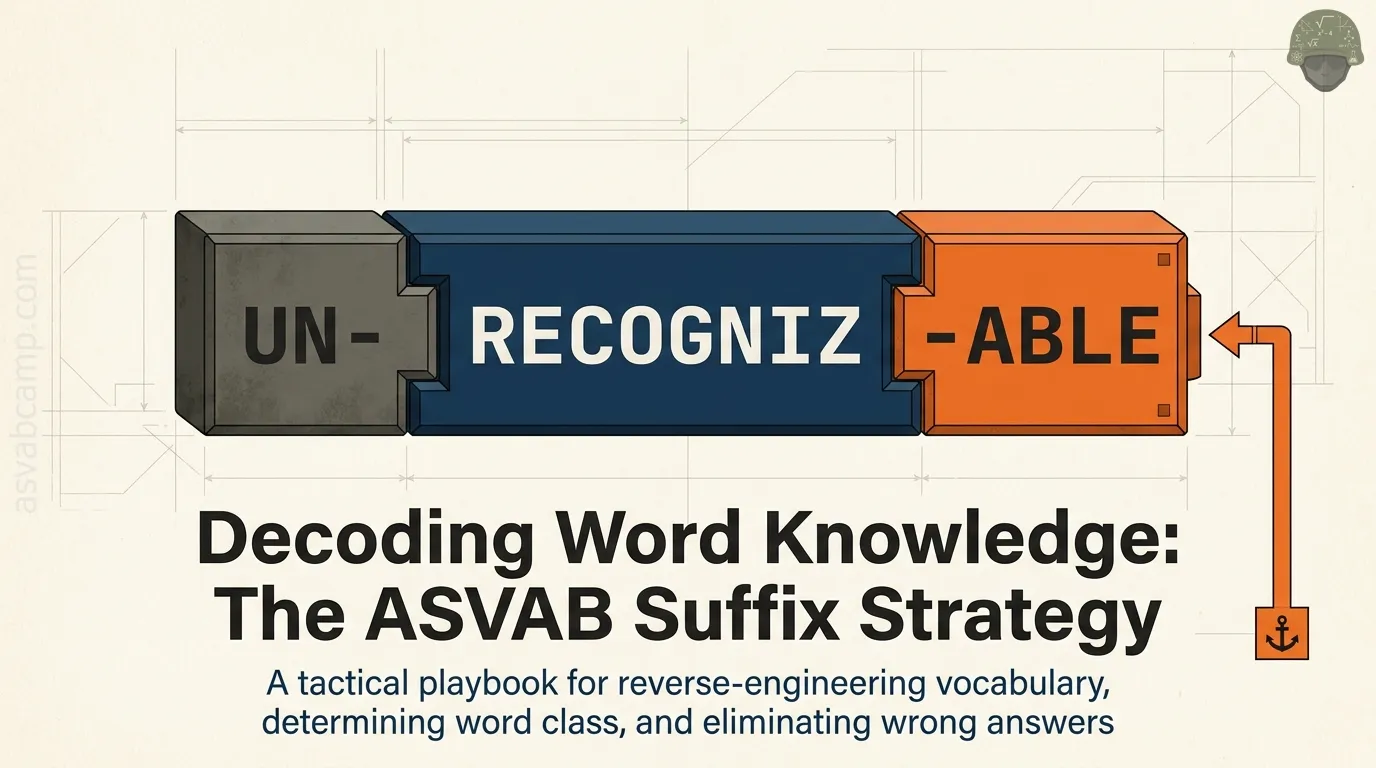
Lesson outcomes: use endings as evidence
Recognize common suffixes; separate a base from a genuine ending; decide whether a word is a noun, adjective, verb or adverb; predict the likely meaning; and select the closest equivalent in an ASVAB-style WK question. Differentiate word-formation suffixes from grammatical endings. A suffix is an inference clue, not a guarantee of an exact definition.
Why suffixes help on Word Knowledge
Word Knowledge items ask you to match a word to its closest meaning, often inside a sentence. An ending tells you what job the word does. If the target ends in -ment, it names a thing or result, so a correct synonym should also be a noun.
Example: in "The pilot showed great alertness," -ness marks a noun of quality, so "watchfulness" fits, while "watchful" does not.
A reliable five-step suffix method
First, cover the ending and find the base you already know. Second, name the ending and the word class it usually forms. Third, join the two into a rough meaning, such as hope plus -less giving "without hope." Fourth, test that meaning in the sentence. Fifth, pick the choice that matches both the meaning and the word class, and drop any choice of the wrong class.
Base, root, prefix and suffix: different roles
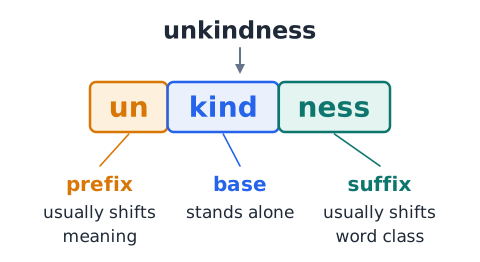
A base is a word that can stand alone, like kind in unkindness. A root carries core meaning but may not stand alone, like dict in predict. A prefix attaches at the front and usually shifts meaning (un-, re-). A suffix attaches at the end and usually shifts word class or grammar (-ness, -ed). Spot each part before you guess.
Derivational vs. inflectional endings
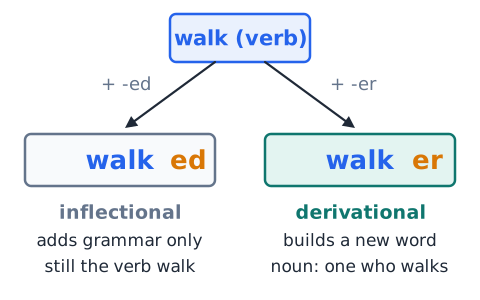
A derivational suffix builds a new word, often in a new class: teach becomes teacher, calm becomes calmly. An inflectional ending only adds grammar to the same word: plural -s, past -ed, -ing, and comparison -er or -est. So walked is still the verb walk, but walker is a new noun naming a person who walks.
Why a suffix cannot give the whole definition
An ending reveals the type of word and a broad sense, but the base and the sentence supply the rest. Both payment and judgment end in -ment, yet one is money handed over and the other is a decision. The suffix narrows the choices; it never replaces knowing the base. Always confirm your guess against the context.
-ness: condition or quality as a noun
Adding -ness to an adjective makes a noun naming that quality or state. Dark becomes darkness, fair becomes fairness, and happy becomes happiness (y changes to i). In "Her fairness won the crew's trust," fairness is a noun, so a synonym like "justice" fits better than the adjective "just."
-ity and -ty: condition or abstract quality
The endings -ity and -ty turn adjectives into abstract nouns. Rapid becomes rapidity, secure becomes security, and loyal becomes loyalty. Scarce becomes scarcity, the state of being in short supply. When you see these endings, look for a noun answer that names a quality or condition, not an action.
-tion, -sion and -ation: action or result nouns
These endings turn verbs into nouns naming an act, a process or its result. Inform becomes information, decide becomes decision, and expand becomes expansion, the act of growing larger. In "The repair crew finished the installation," installation can mean the act of installing or the finished setup; context tells which.
-ment: process, product or condition
Attached mostly to verbs, -ment forms nouns. It can name the process (the development of a plan), the product (a written agreement), or a resulting condition (amazement). Settle becomes settlement, which can mean an agreement that ends a dispute or a small community; the sentence decides which sense fits.
-ance and -ence: state, act or quality nouns
These endings form nouns from verbs or adjectives. Perform becomes performance, depend becomes dependence, and persist becomes persistence, the quality of continuing despite difficulty. Spelling choice between -ance and -ence rarely affects meaning; both point to a noun naming a state or action.
-er and -or: doer, occupation or instrument
On a verb, -er or -or names the one who does the action or a tool that does it. A driver drives, a sailor sails, an editor edits, and a can opener opens cans. So an inspector is someone who inspects or examines. Check that the base really is a verb; in water or letter, the -er is not a suffix at all.
-ist and -ism: practitioner versus system
The ending -ist names a person who practices, studies or believes in something: a pianist plays piano, a biologist studies living things. The ending -ism names the belief, system or attitude itself: realism, heroism, pessimism. Keep them apart. A test choice ending in -ist is a person; one ending in -ism is an idea.
-ship, -hood and -dom: relations or states
These noun endings name a status, relationship, period or domain. Friendship is the bond between friends, leadership is the role or skill of leading, and an internship is a period of supervised work. Neighborhood and adulthood name a group or stage of life. Freedom and kingdom name a state or a realm.
-age, -ure and -al as noun-forming endings
Some endings build nouns from verbs. With -age you get a result or amount: break gives breakage, store gives storage. With -ure you get an act or state: fail gives failure, close gives closure. With -al you get an act: arrive gives arrival, deny gives denial. Note that -al can also form adjectives, covered later.
-able and -ible: capable, fit or suitable
These adjective endings mean able to be acted on or fit for. Washable means able to be washed; readable means clear enough to read; visible means able to be seen. Break plus -able means easily broken, so it suggests fragile. Some words carry a softer sense: a comfortable chair, an acceptable result, a respectable score.
-ful: having or characterized by
Added to a noun, -ful forms an adjective meaning full of or marked by that thing. Joyful means full of joy, skillful means having skill, and fearful means feeling fear. As a noun ending, it can also mean an amount that fills something, as in a spoonful or a handful. Watch the base: a doubtful claim is one that raises doubt.
-less: lacking or without
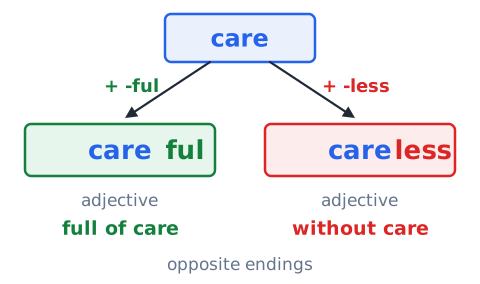
The ending -less forms adjectives meaning without the base. Fearless means without fear, endless means without end, and tireless means never getting tired. It is the opposite of -ful in many pairs: careful and careless, useful and useless. Do not confuse it with -ness, which makes a noun, not an adjective of absence.
-ous and -ious: having a quality
These adjective endings mean full of or having the base quality. Danger becomes dangerous, fame becomes famous, and grace becomes gracious. Courage plus -ous gives a word meaning showing courage, that is, brave. The answer should be an adjective describing a person or thing, not the noun base.
-ive and -ative: tendency, action or property
These endings form adjectives meaning tending to or having the power to. Protective means tending to protect, creative means able to create, and talkative means inclined to talk a lot. Inform plus -ative describes something that gives useful information. Note that some -ive words also act as nouns, such as a detective.
-al, -ial, -ic and -ical: related to
These endings make adjectives meaning relating to the base. Nation gives national, face gives facial, and hero gives heroic. Some pairs split in meaning: historic means important in history, while historical means about the past. Likewise, economic relates to the economy, but economical means thrifty or not wasteful. Read the sentence to choose.
-ary and -ory: pertaining to or serving a purpose
These endings usually form adjectives meaning connected with or serving to. Planetary relates to planets, and a cautionary tale serves to warn. Advise plus -ory gives a role that gives advice but holds no authority. Watch for nouns with the same endings: a library, a dictionary, a factory and a laboratory are places or things.
-y and -ish: qualities and approximation
The ending -y makes adjectives meaning full of or like: rainy, dusty, sandy. The ending -ish can mean somewhat (greenish, tallish), like or typical of (foolish, boyish), or roughly near a time or number (sevenish). When -ish follows a stage of life, it often signals disapproval, so a babyish remark is immature.
-ly: commonly an adverb but not always
Added to an adjective, -ly usually forms an adverb of manner: quick becomes quickly. But added to a noun, -ly often forms an adjective. Friendly, costly, lovely, orderly and elderly describe nouns, as in a costly repair or an orderly room. Test the word: if it describes a noun, it is an adjective no matter how it ends.
-ize and -ise: cause to become or perform
These endings form verbs meaning to make, to become or to act in a certain way. Standard becomes standardize, to make uniform; legal becomes legalize, to make lawful; apology becomes apologize. American spelling prefers -ize, British often -ise, with the same meaning. An answer should be a verb, not the adjective base.
-ify and -fy: make or become
These verb endings mean to make or cause to be. Simple gives simplify, solid gives solidify, and clear gives clarify, to make clear. Pure plus -ify means to make pure, so it is close to cleanse. The base often changes spelling. Because the result is a verb, eliminate any choice that is only an adjective.
-en: become or make, with limits
On many adjectives, -en forms verbs meaning to make or become: dark gives darken, short gives shorten, wide gives widen. But -en has other jobs. It forms adjectives of material (wooden, golden) and past participles (taken, broken). Some words just end in en with no suffix, like garden or seven, so check the base first.
-ate: sometimes verb-forming, often deceptive
The ending -ate can form verbs meaning to act on or cause, as in activate or motivate. It can also form adjectives (fortunate, passionate) or nouns (a graduate, a candidate). Some words merely end in those letters, like plate or debate. Use the sentence: if the word follows "to" or takes an object, it is acting as a verb.
Inflectional -s, -ed and -ing: grammar clues
These endings do not create new words; they add grammar. Final -s marks a plural noun (crates) or a present verb (she lifts). Final -ed marks past tense or a participle (painted). Final -ing marks continuing action or a verb used as a noun (Swimming builds strength). A synonym for a past-tense verb should also fit in the past tense.
Comparatives -er and -est versus agent -er
On adjectives, -er compares two things and -est compares three or more: colder, coldest. On verbs, -er names a doer: a runner, a baker. Ask what the base is. Faster comes from the adjective fast, so it means more fast. Builder comes from the verb build, so it means a person who builds.
Spelling changes when adding suffixes
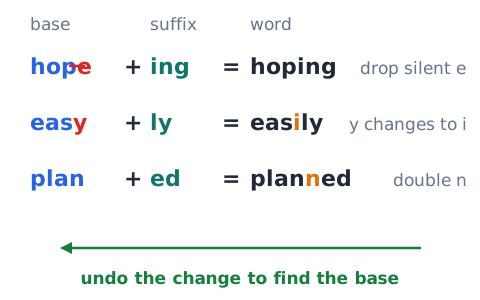
Spelling often shifts when an ending is added. A final silent e usually drops before a vowel suffix: hope becomes hoping, use becomes usable. A final y after a consonant changes to i: easy becomes easily. A short vowel plus one consonant may double it: plan becomes planned, swim becomes swimmer. Undo these changes to find the base.
Use word class to eliminate options
On most Word Knowledge items, the correct choice can replace the target word in the sentence. If the target ends in -ous, it is an adjective, so cross out nouns and verbs among the choices. If it ends in -ment, keep nouns. Answer sets often include the base itself in another form, such as "courage" for courageous; that is a trap, since it cannot replace the word.
A small change in suffix can change the answer
Related words can mean different things. Sensible means showing good sense, while sensitive means easily affected. Credible means believable, while creditable means deserving praise. Respectful means showing respect, while respectable means worthy of respect or fairly good. Read the full ending before choosing.
Literal meanings vs. specialized meanings
Adding parts gives a literal meaning, but usage can drift. Literally, a household is a group holding a house, yet it means the people living together. Awful once meant full of awe and now usually means very bad. Use the literal meaning as a starting point, then check the sentence and your own sense of how the word is used today.
Beware of false suffix boundaries
Many words only look as if they end in a suffix. Corner is not one who corns, hammer is not one who hams, and early is not an adverb from ear. Business is not just the state of being busy, and series is not a plural. Before splitting a word, make sure the leftover base is a real word with a related meaning. If not, treat the word as a whole.
Choose the closest meaning, not the broadest one
Several choices may be loosely related; pick the most precise. For brownish, "colored" is true but too wide, and "dark brown" is too strong; "somewhat brown" captures the -ish. For gratitude, "emotion" is broad, but "thankfulness" is exact. Match the intensity and the specific sense that the ending gives.
Use prefixes and suffixes together carefully
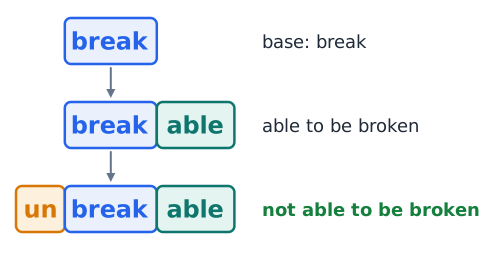
Read a long word from the inside out. Start with the base, add the suffix, then apply the prefix. Unbreakable is break plus -able (able to be broken), then un- (not), so it means not able to be broken. For impassable, pass plus -able is able to be crossed, and im- makes it unable to be crossed. Skipping a part flips the meaning.
Short timed decision procedure
With limited time, try this. Read the sentence and the target word. In two seconds, name its class from its ending. Cross out choices in other classes. Then test each remaining choice in the sentence and keep the one that preserves the meaning. If two still fit, choose the more exact one. If you are stuck, guess from the survivors and move on.
Common errors to catch before answering
One error is picking the base word instead of a synonym, such as choosing "width" for widen; fix it by matching class. Another is treating every -ly word as an adverb; check whether it describes a noun. A third is reading -er as a doer in words like silver or winter; confirm the base is a verb. A fourth is ignoring the prefix, which can reverse the meaning.
Guided self-check: word-class switches
Name the class and meaning of each word, then check.
Thoughtless? Adjective: without thought, careless.
Soften? Verb: to make soft.
Boldness? Noun: the quality of being bold.
Motherhood? Noun: the state of being a mother.
Kindly, in "a kindly nurse"? Adjective: gentle and caring.
Terrify? Verb: to fill with terror.
Quick-reference: suffix function families
Noun endings: -ness, -ity, -ty, -tion, -sion, -ment, -ance, -ence, -ship, -hood, -dom, -age, -ure, and person endings -er, -or, -ist, with -ism for ideas. Adjective endings: -able, -ible, -ful, -less, -ous, -ive, -al, -ic, -ary, -ory, -y, -ish. Verb endings: -ize, -ify, -en, sometimes -ate. Adverb ending: -ly, usually. Grammar only: -s, -ed, -ing, -er, -est.
Mastery checkpoint before the lesson test
Before the quiz, confirm that you can do these things. Split a word into base and suffix and say whether the split is real. Name the word class an ending usually produces. Tell an agent -er from a comparative -er and from no suffix at all. Explain why elderly and costly are adjectives. Separate pairs like economic and economical. Use the sentence to pick the exact sense, and reject choices that are the base in another form.
Worked example 1 — -ness identifies a noun
Sentence: "The sergeant praised the private's alertness on night watch." Step 1: base alert, meaning watchful. Step 2: -ness forms a noun of quality. Step 3: alertness is the quality of being watchful. Choices: watchful, vigilance, sleepy, warning. Watchful is an adjective, so it fails. Answer: vigilance.
Worked example 2 — -ible and a spelling shift
Target: comprehensible. Step 1: remove -ible to find comprehend, meaning understand; the d changed to s when the ending was added. Step 2: -ible means able to be. Step 3: the word means able to be understood. Choices: understandable, complicated, complete, understanding. Answer: understandable, an adjective with the same sense.
Worked example 3 — -ment as a noun of result
Sentence: "The engineer's assessment found no damage to the bridge." Base assess means evaluate. The ending -ment makes a noun naming the process or result. So assessment is an evaluation. Choices: evaluation, assess, payment, delay. Assess is a verb; payment shares only the ending. Answer: evaluation.
Worked example 4 — -ful and -less differ
Sentence: "The mechanic was careful with the fuel line, but his helper was careless with the jack." Careful means full of care, so cautious. Careless means without care, so negligent. Choices for careless: cautious, negligent, worried, caring. Cautious and caring match careful instead. Answer: negligent. One letter group reverses the meaning.
Worked example 5 — -tion expresses an action or result
Sentence: "The evacuation of the base took two hours." Base evacuate means to empty or leave a place. Adding -ion forms a noun for that act. Choices: removal of people, emergency, evacuate, inspection. Evacuate is a verb, and emergency is only the reason. Answer: removal of people.
Worked example 6 — suffix shift changes connotation
Sentence: "The recruit's childlike curiosity made every lesson fun." Compare childlike and childish. Childlike usually praises qualities such as wonder or innocence; childish usually criticizes immature behavior. Here the tone is positive. Choices: immature, innocent, babyish, spoiled. Answer: innocent. In a scolding sentence, childish would point to immature.
Worked example 7 — -ly cannot always mean adverb
Sentence: "The squad leader gave a friendly greeting." Friendly ends in -ly but modifies the noun greeting, so it is an adjective. Base friend plus -ly means like a friend. Choices: warm, quickly, friend, rudely. Quickly and rudely are adverbs, and friend is a noun. Answer: warm.
Worked example 8 — -ify signals a change
Sentence: "Rapid cooling will solidify the melted wax." Base solid; -ify means make or become. So solidify means to make solid. Choices: harden, solid, soften, liquid. Solid and liquid are not verbs, and soften is the opposite. Answer: harden, a verb with the same direction of change.
Worked example 9 — do not force a suffix on every word
Target: hamper, in "Snow hampered the convoy." Splitting it as ham plus -er gives one who hams, which makes no sense. There is no related base, so treat hamper as a whole verb meaning to slow or block. Choices: hindered, helped, cooked, covered. Answer: hindered.
Worked example 10 — combine affixes and context
Sentence: "Without a map, the trail seemed unrecognizable." Base recognize; -able gives able to be recognized; un- gives not able to be recognized. Choices: familiar, unidentifiable, forgotten, visible. Familiar and visible lean the wrong way, and forgotten adds an idea. Answer: unidentifiable.
 English ▾