 ASVAB Camp
Lesson goals and the ASVAB connection
By the end of this lesson you should be able to spot a Greek or Latin root inside an unfamiliar word, recognize its common spelling forms, and combine it with prefixes, suffixes and the surrounding sentence to choose the best meaning. You should also be able to reject answers built on a word-for-word translation or on splitting a word in the wrong place.
On the ASVAB, Word Knowledge items ask for a synonym or for the meaning a word has in a sentence. Roots are a tool for reaching that answer, not a separate test topic.
Root versus prefix versus suffix: a functional distinction
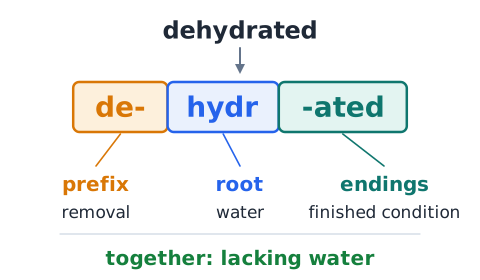
A root carries the core meaning of a word. A prefix sits in front of the root and adjusts that meaning, often by adding direction, number or negation. A suffix comes at the end and usually decides the part of speech. In dehydrated, de- signals removal, hydr means water, and the endings make the word describe a finished condition. Put together, a dehydrated person is someone lacking water.
The six-step root-decoding method
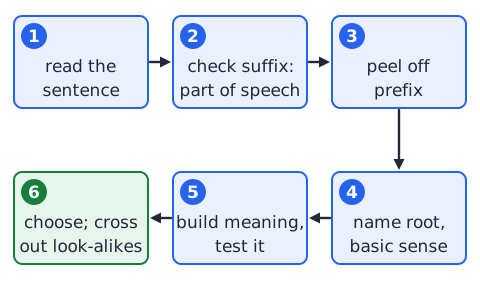
Use the same six moves on any unfamiliar word. First, read the whole sentence so you know the job the word is doing. Second, check the suffix to tell noun, verb, adjective or adverb. Third, peel off any prefix and note its meaning. Fourth, name the root and its basic sense. Fifth, build a rough meaning and test it in the sentence. Sixth, choose the answer that fits both the parts and the context, and cross out choices that only look or sound similar.
Root clues are probabilistic, not exact translations
A root tells you the likely neighborhood of a meaning, not the exact address. Words drift over centuries, so the modern sense may be figurative, narrower or broader than the parts suggest. Conduct contains duc, lead, yet copper wire that conducts electricity is not guiding anyone; it transmits current. Treat the root as a strong hint, then let the sentence and the answer choices confirm or correct your guess.
Recognize spelling variants without forcing a match
Latin roots often appear in several spellings because a Latin verb had more than one stem. Spect, spec and spic all point to looking; fac, fact, fect and fic point to making; mit and miss point to sending. Greek roots shift too, as with graph and gram. Learn the common variants, but do not force a match. Portrait, for example, does not come from port, carry; it traces back to a Latin verb meaning to draw forth.
Identify grammatical class before decoding the root
Before you decode a root, decide what part of speech the word is. Endings such as -tion and -ment usually mark nouns, -ize and -ate often mark verbs, and -ous, -ible and -ive mark adjectives. In the phrase "an audible warning," audible describes the warning, so the correct answer must also be a describing phrase, such as able to be heard, rather than a noun such as hearing.
bio (Greek): life
The Greek root bio means life or living things. Biology is the study of life, a biography is the written story of a person's life, and biodegradable material can be broken down by living organisms such as bacteria. Antibiotics are drugs that act against living germs. In a sentence like "The lab held a biohazard drill," the bio clue tells you the danger comes from living or biological material, not from chemicals or fire.
geo (Greek): earth, land
Geo comes from the Greek word for earth or land. Geography describes the earth's surface and its regions, geology studies rocks and the forces that shape the planet, and geometry began as a way of measuring land. Geothermal joins geo with therm, heat, so geothermal energy is heat that comes from inside the earth. Do not confuse it with solar energy, which comes from sunlight.
graph / gram (Greek): writing and recording
Graph and gram both go back to a Greek idea of writing, drawing or recording. A seismograph records the shaking of the ground, a paragraph is a written block of text, and a telegram was a written message sent over a long distance. You can read telegram as a simple sum, : far plus written.
That sum is only a starting point. A diagram is a drawing that explains something, not just any written page.
phon (Greek): sound or voice
Phon means sound or voice. A telephone carries a voice over distance, a microphone picks up sound so it can be amplified, and phonics teaches the sounds that letters stand for. A symphony is many sounds played together. Watch out for look-alikes: phony, meaning fake, has no reliable link to this root, so do not decode it as sound-related.
phot / photo (Greek): light
Phot or photo means light. A photograph is an image recorded by light, photosynthesis is the process plants use to build sugars with the energy of light, and a photon is a tiny packet of light energy. If a sentence says a medicine causes photosensitivity, the safe inference is that sunlight or bright light may irritate the patient's skin or eyes.
tele (Greek): far or distant
Tele means far off or at a distance. A telescope lets you see distant objects, television sends pictures over a distance, and telecommuting means working from home while linked to a distant office. When you see tele, ask what is happening across a gap in space. Telepathy, for example, is the claimed ability to sense another person's thoughts from far away.
micro / macro (Greek): small versus large
Micro means small and macro means large. A microscope reveals tiny objects, a microchip is a very small electronic circuit, and microeconomics looks at single buyers and businesses. Macroeconomics studies a whole nation's economy, and a macro view sees the big picture. Because these two are opposites, test writers like to use one as a trap for the other.
chron (Greek): time and temporal ordering
Chron refers to time. A chronometer is a precise timekeeping instrument, a chronicle records events in the order they happened, and a chronological list arranges items in time order from earliest to latest. Synchronize means to make things happen at the same time. The root points to time itself, so it does not mean old by itself.
therm (Greek): heat and temperature
Therm means heat. A thermometer measures temperature, a thermostat holds heat at a chosen level, and a thermos bottle slows heat transfer so drinks stay hot or cold. Hypothermia is a dangerously low body temperature, while hyperthermia is a dangerously high one. Thermal clothing is made to hold in body heat, which is why it is worn in cold weather.
hydr / hydro and aqu / aqua: water from two languages
Greek hydr or hydro and Latin aqu or aqua both point to water. A fire hydrant supplies water, and a dehydrated hiker has lost water the body needs. An aquarium is a tank of water for fish, and an aquifer is an underground layer of rock or sand that holds groundwater.
Two languages, one idea. When you see either root, check whether a water meaning fits the sentence before you choose.
psych / path / -pathy: mind, feeling and suffering
Psych refers to the mind, and path refers to feeling or suffering. Psychology studies the mind and behavior. Sympathy is feeling sorrow together with someone, while empathy is understanding and sharing another person's feelings as if from the inside. Apathy is a lack of feeling or interest. A pathologist studies disease, which reflects the suffering side of the root.
-logy / log: study, discourse and reason
The ending -logy means the study of a subject, and log can also mean word, speech or reason. Zoology studies animals, meteorology studies weather, and hydrology studies water, so a hydrological survey examines the water in an area. A dialogue is speech between people, and logic is careful reasoning. An adjective ending in -logical usually means connected with a field of study.
-scope / scop: looking or examining
Scope and scop come from a Greek word for looking at or examining. A periscope lets a submarine crew look above the surface, a stethoscope lets a medic examine the heart and lungs by sound, and an endoscope examines the inside of the body. Used alone, scope often means the range something covers, as in the scope of a project. That sense grows from the idea of how far you can see.
-meter / metr: measuring
Meter and metr mean measure. A speedometer measures speed, a barometer measures air pressure, and an odometer measures the distance a vehicle has traveled. Symmetry means equal measure on both sides, and the diameter of a circle is the measurement straight across its center. In a word ending in -meter, expect a device or a unit used for measuring.
anthrop / dem / -cracy: people and government
Anthrop means human being, dem means the people, and -cracy means rule or government. Anthropology studies human cultures and origins. A democracy is government by the people, often through elected representatives, while an autocracy is rule by a single person. A bureaucracy is government carried out through offices and officials. Philanthropy, literally love of humankind, means giving to help others.
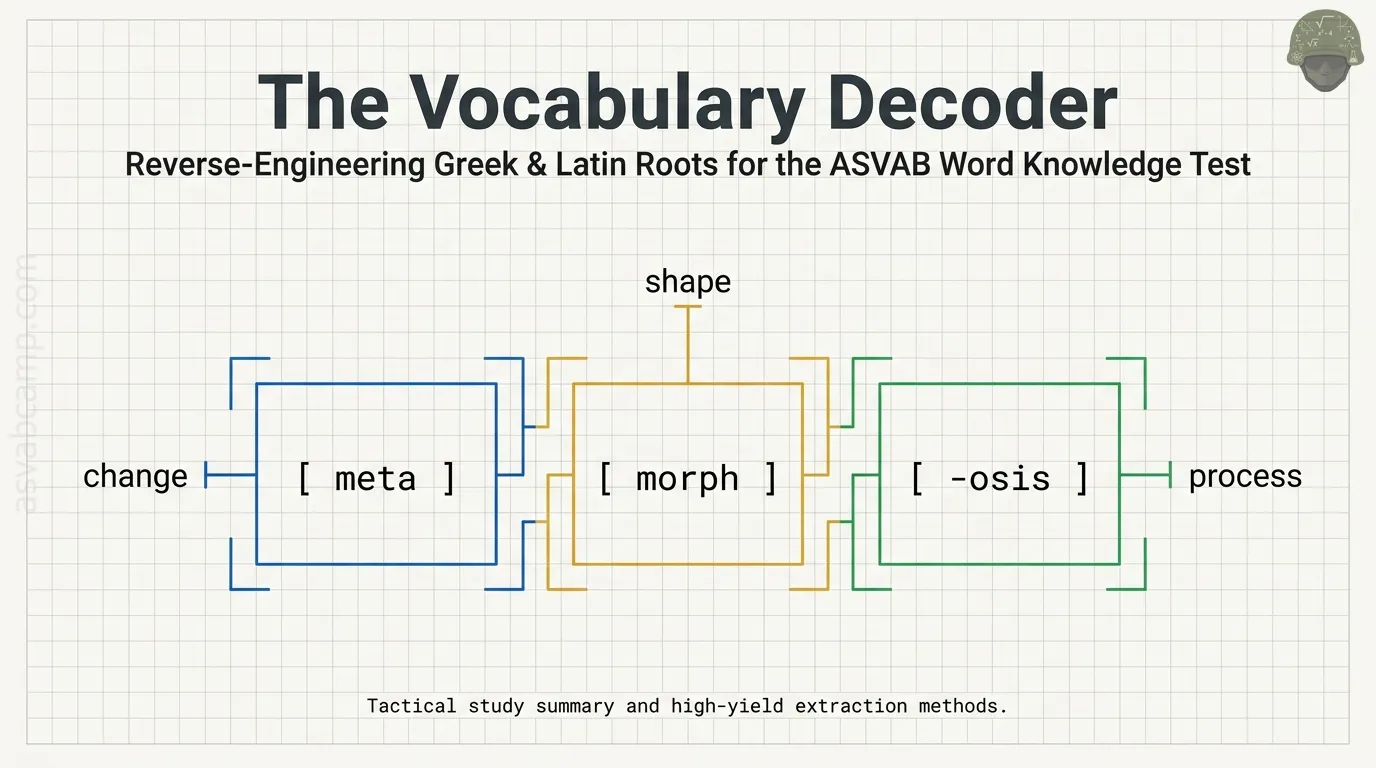
morph / form: shape or structure
Morph means shape in Greek, and form carries the same idea in Latin. Metamorphosis is a change of shape, as when a caterpillar becomes a butterfly. Amorphous means having no clear shape. To reform is to shape again or improve, a uniform has one standard shape, and to conform is to fit the shape others expect. To deform is to spoil the shape of something.
mono / poly / hetero / homo: number and sameness
Mono means one and poly means many. A monologue is a speech by one person, and a polygon is a figure with many sides. Hetero means different and homo means same. A homogeneous mixture looks the same throughout, while a heterogeneous group contains members of different kinds. Test items often swap same and different, so check which prefix is actually present.
auto, pseudo and syn: self, false and together
Auto means self, pseudo means false, and syn or sym means together. An automatic device works by itself, and autonomy is self-government. A pseudonym is a false name, such as a pen name used by an author, and pseudoscience only pretends to be science. Synthesis puts parts together into a whole, and a synopsis gives a brief view of a whole story at once.
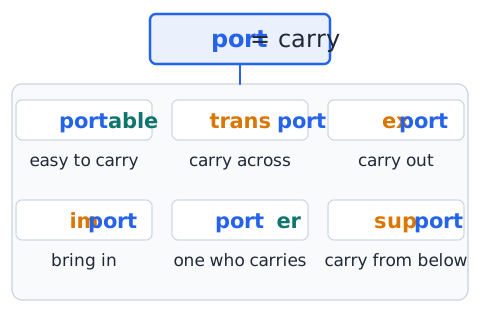
port (Latin): carry or convey
Port means carry. Something portable is easy to carry, such as a portable radio. To transport is to carry across a distance, to export is to carry goods out of a country, and to import is to bring them in. A porter carries luggage for travelers. To support is literally to carry from below, which is why we say a column supports a roof.
scrib / script (Latin): write
Scrib and script mean write. To describe is to write or tell about something, a manuscript is a text written by hand, and a prescription is a written order from a doctor. To inscribe is to write or carve into a surface, as on a monument. To subscribe first meant to sign your name at the bottom of a document, which is why it now means to sign up.
dict / dic (Latin): say or declare
Dict and dic mean say or declare. A dictator gives orders that others must obey, and to predict is to say what will happen before it does. To contradict is to speak against a statement. A verdict is the declared decision of a jury, literally a true saying. Dictation is speech that someone else writes down word for word.
spect / spec / spic (Latin): look, see
Spect, spec and spic mean look or see. A spectacle is something striking to look at, a perspective is a way of viewing a scene, and conspicuous means easy to notice. To inspect is to look into something closely. A circumspect person looks around carefully before acting, so the word means cautious rather than literally glancing about.
vid / vis (Latin): see
Vid and vis also mean see. Vision is the ability to see, a visible object can be seen, and evidence is what makes the facts clear to see. To revise is to look at work again in order to improve it, and a supervisor oversees other workers. Invisible adds the negative prefix in-, so it means unable to be seen. Video is simply Latin for I see.
aud (Latin): hear
Aud means hear. An audience is a group that listens, an auditorium is a hall built for listening, and an audit was originally a hearing of the accounts. Audible means able to be heard, and inaudible means too faint to hear. Keep the senses straight: audible concerns hearing, while visible concerns sight.
tract / trah (Latin): pull, draw
Tract means pull or draw. A tractor pulls heavy loads, to extract is to pull something out, and to subtract is to draw a number away. To retract is to pull back, so a person who retracts a claim withdraws it, and an aircraft retracts its landing gear after takeoff. To distract is to pull attention away from where it belongs.
ject (Latin): throw, cast
Ject means throw. To eject is to throw out, as a pilot ejects from a damaged jet. To reject is to throw back or refuse, a projectile is an object thrown or fired forward, and to inject is to force a fluid into something. An objection is a point thrown in the way of an argument.
rupt (Latin): break, burst
Rupt means break or burst. To erupt is to burst out, as a volcano does. A rupture is a break or tear, and a bankrupt business is financially broken. To interrupt is to break in between, so a phone call that interrupts dinner breaks in on it. To disrupt is to break apart the normal order of events.
struct (Latin): build, arrange
Struct means build or arrange. A structure is anything built or organized, to construct is to build up, and destruction is the tearing down of what was built. Instructions arrange knowledge for a learner, and an obstruction is something placed in the way that blocks passage. Infrastructure is the basic built network of roads, pipes and power lines.
cred (Latin): believe, trust
Cred means believe or trust. Credible means believable, credentials are documents that lead others to trust your qualifications, and credit is trust that you will pay later. Credulous describes someone who believes too easily. Incredulous means unable or unwilling to believe, as when news is so surprising that a person demands proof. Incredible means hard to believe.
duc / duct (Latin): lead
Duc and duct mean lead. To induce is to lead into, so a medicine that induces sleep brings it about. To deduce is to lead your reasoning to a conclusion, and to reduce is to bring something down to a smaller size. A duct leads air or fluid along a path, and a conductor carries current through a circuit.
fer (Latin): carry, bear
Fer means carry or bear. To transfer is to carry from one place to another, and fertile land bears crops. To refer is to carry someone back to a source, and to confer is to bring ideas together in a discussion. To differ is to carry apart, so two plans that differ point in separate directions. Conifers are trees that bear cones.
fac / fact / fect (Latin): make, do
Fac, fact and fect mean make or do. A factory is a place where goods are made, a manufacturer makes products, and a fact was originally something done. Effective means able to produce a result, and a defect is a flaw left when something is made badly. To facilitate is to make a task easier. A benefactor is a person who does good for others.
mit / miss (Latin): send, release
Mit and miss mean send or let go. To transmit is to send across, as a radio transmits a signal. A missile is a weapon sent through the air, and a mission is a task a team is sent to complete. To dismiss is to send away, to emit is to send out, and to omit is to let something go by leaving it out. Admission lets someone in.
pend / pens (Latin): hang, weigh, pay
Pend and pens mean hang, weigh or pay. A pendulum hangs and swings, and a pending decision is still hanging, not yet made. To suspend is to hang from above or to stop something for a time, as when a referee suspends a game during a storm. Expenses are amounts paid out, and to compensate is to pay back for a loss.
bene / mal: well or badly
Bene means well or good, and mal means badly or bad. A benefit is something that does you good, and a beneficial habit helps you. Benevolent joins bene with vol, wish, so it describes a kindly person who wishes others well. Malevolent is the opposite: wishing harm to others. A malfunction is a failure to work properly, and malnutrition is poor nourishment. Watch the strength: malevolent means active ill will, not mild grumpiness.
ver, jur, voc, mort and temp: five useful Latin roots
Ver means true: veracity is truthfulness, and to verify is to confirm. Jur means law or swear: a jury takes an oath, and perjury is lying under oath. Voc means voice or call: vocal means spoken aloud, and a vocation is a calling. Mort means death: mortal beings will die. Temp means time: a temporary job lasts a short while, and tempo is the speed of music.
noct and equi: night and equality
Noct means night. Nocturnal animals such as bats and raccoons are active at night and rest during the day, and a nocturne is a quiet piece of music that suggests night. Equi means equal. An equinox is one of the two days each year when day and night are about the same length; it joins equi with nox, night. Equidistant means equally far from two points, an equation shows two expressions with the same value, and equitable means fair to all.
sci, omni, nom and locut: knowledge, all, name and speech
Sci means know: science is organized knowledge, and conscious means aware. Omni means all, so omniscient means all-knowing and an omnivore eats all kinds of food. Do not confuse omniscient with omnipotent, which means all-powerful. Nom means name: a nominee is named for a position, and a misnomer is a wrong or inaccurate name. Locut, with its variant loqu, means speak: an eloquent person speaks well, and an interlocutor is the person you are talking with.
magn, anim, and circum: great, spirit and around
Magn means great. To magnify is to make something look larger, and magnitude is size or importance. Anim means life, mind or spirit, so animated means lively. Put the two together and magnanimous means great-spirited, describing someone generous and forgiving, especially toward a rival. Circum means around: circumference is the distance around a circle, and circumspect means looking around carefully, or cautious.
Mini-drill D: precise roots from advanced questions
Decode each word, then check the answer.
Omnipotent, from omni plus potent. Answer: all-powerful, not all-knowing.
Perjury, from per plus jur. Answer: lying under oath.
Equanimity, from equi plus anim. Answer: a calm, even state of mind.
Benediction, from bene plus dict. Answer: a blessing, literally a speaking well.
Magnitude, from magn. Answer: great size or importance.
Different roots, similar modern meanings
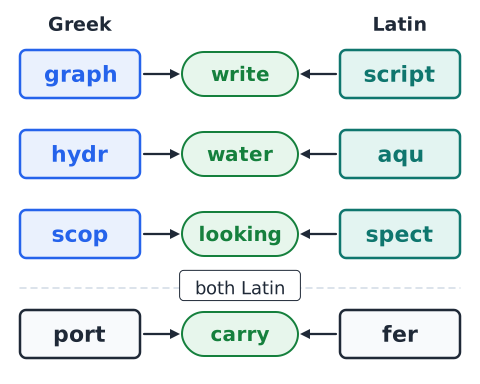
Unrelated roots can lead to the same modern idea. Greek graph and Latin script both mean write, Greek hydr and Latin aqu both mean water, and Greek scop and Latin spect both involve looking. Port and fer both mean carry. So when an answer choice uses a different root from the test word, do not reject it for that reason alone. Judge the meaning of the whole word, not the shared letters.
False splitting: the strongest root trap
The most damaging root mistake is cutting a word at letters that only look like a root. Pantry has nothing to do with pan, all; it comes from a word for bread. Biscuit is not related to bio; it comes from words meaning twice cooked. Mandate contains the letters man but means an official order. Before you split a word, ask whether the pieces make sense together and fit the sentence. If they do not, rely on context instead.
A strict match beats a related concept
Answer choices are often built to sit close to the right idea without matching it. If the sentence speaks of the scope of an inspection, "optical instrument" is related to scope, but only "range covered" fits the sentence. For omniscient, "all-powerful" shares the omni root, yet only "all-knowing" matches sci, know. Pick the choice that could replace the word in the sentence with no change in meaning.
Avoid antonym and intensity traps
Test writers often include the exact opposite of the right answer, since a reader who spots the root but misses a prefix will grab it. Credible and credulous both involve belief, but incredulous adds a negative prefix and means unable to believe. Intensity traps work differently: a choice may point in the right direction with the wrong strength, such as "mildly unfriendly" for malevolent or "canceled for good" for suspended.
Timed decisions: root then context then choice
With limited time, use a fixed order of attack. Spend a few seconds looking for a root you know. Next, read the sentence, if there is one, and decide what kind of word fits. Then scan the choices and cross out any that clash with either clue. If two choices remain, pick the one that matches the root's meaning more precisely. If no root is familiar, rely on context and move on rather than stalling.
Mini-drill A: recognize roots without choices
Name the root and its meaning before you think about any choices.
Biopsy. Answer: bio, life; a sample of living tissue taken for testing.
Thermal. Answer: therm, heat; relating to or holding heat.
Phonetic. Answer: phon, sound; relating to speech sounds.
Microbe. Answer: micro, small; a tiny living organism.
Geologist. Answer: geo, earth; a scientist who studies rocks and the earth.
Mini-drill B: use roots to avoid a near miss
Pick the stricter meaning in each pair.
Dictate: say aloud for someone to record, or write a letter? Answer: say aloud.
Eject: throw out, or open up? Answer: throw out.
Rupture: a break or tear, or a bend? Answer: a break or tear.
Retract: pull back, or drag along? Answer: pull back.
Mini-drill C: reject a false decomposition
Decide whether each split is real.
Pantomime as pan, all, plus mime. Answer: real; it grew from a word for one who imitates everything.
Notice as no plus tice. Answer: false; it comes from a Latin root meaning know.
Polite as poly, many, plus lite. Answer: false; it comes from a word meaning polished.
Transport as trans plus port. Answer: real; to carry across.
Review: eleven root families worth recognizing first
Eleven families give the best return for study time: bio, life; geo, earth; graph, write; phon, sound; photo, light; tele, far; chron, time; therm, heat; port, carry; spect, look; and cred, believe. For each one, remember one everyday word and one harder word, such as credit and incredulous, or photograph and photosensitive. Linking a familiar word to a harder one makes meanings easier to recall under time pressure.
Pre-quiz checkpoint and study boundaries
Before the quiz, check that you can do four things: give the meaning of each root in this lesson, recognize its common spelling variants, use suffixes to identify the part of speech, and test a guessed meaning in the sentence. Keep the limits in mind as well. Roots suggest a likely meaning but never replace context, not every matching string of letters is a root, and the ASVAB measures word meaning, not knowledge of Greek or Latin.
Worked 01 — autograph: an everyday Greek combination
Question: A fan asks a pilot for an autograph. What does autograph mean?
Auto means self, and graph means write. Something written by oneself suggests a person's own handwriting, and in modern use, a personal signature. Test it in the sentence: a fan asking for the pilot's own signature makes sense.
Answer: a signature written by the person themselves.
Worked 02 — hydroelectric: split only what helps
Sentence: The town gets most of its power from a hydroelectric dam. Choices: water-powered, wind-driven, coal-fired, solar.
Split off hydro, meaning water, and keep electric whole, since you already know it. Together the word means electricity produced by moving water. Breaking electric into smaller pieces adds nothing. Answer: water-powered.
Worked 03 — chronic is persistent, not a clock
Question: The medic said the soldier's knee pain was chronic. What does chronic mean?
Chron means time, but "related to time" is too vague to be an answer. In medicine, a chronic condition lasts a long time or keeps coming back, unlike an acute one, which is sudden and short. The sentence is about pain, not a schedule.
Answer: long-lasting or persistent.
Worked 04 — teleconference versus telephoto: same first clue
Question: How do teleconference and telephoto lens differ?
Both start with tele, far. A conference is a meeting, so a teleconference is a meeting among people in distant places, held by phone or video. A telephoto lens is a camera lens that makes far-off subjects look closer.
Answer: the shared clue is distance; the first is a meeting, the second is a lens.
Worked 05 — attract attention: a figurative draw
Question: The bright signal flare attracted the search team's attention. What does attracted mean?
The prefix at- is a form of ad-, toward, and tract means pull or draw, so attract literally means to draw toward. No one physically pulls the team, so the sense is figurative: the flare drew their attention.
Answer: drew or caught. A choice like "dragged" is too literal.
Worked 06 — inspect versus spectator: same root, different job
Question: Why are inspect and spectator not synonyms?
Both contain spect, look. The prefix in- adds into, so to inspect is to look into something closely, often to find problems. The ending -ator means one who does, so a spectator is a person watching an event.
Answer: inspect is a careful action; a spectator is a person who watches.
Worked 07 — transcription: spoken words become text
Question: The clerk made a transcription of the radio log. What is it?
Trans means across, and script means write. A transcription carries spoken words across into written form. The language stays the same, which rules out translation.
Answer: a written record of exactly what was said, set down word for word.
Worked 08 — credible and credulous must not be confused
Question: Which word describes a trustworthy witness, credible or credulous?
Both share cred, believe. The ending -ible means able to be, so credible means able to be believed. The ending -ulous suggests a tendency, so credulous means inclined to believe too easily.
Answer: credible. A credulous person believes others; a credible person is believed.
Worked 09 — an auditory signal is sound-based
Question: The fire panel gives an auditory signal when smoke is detected. What kind of signal is it?
Aud means hear, and -ory means relating to. An auditory signal is one you hear, such as a horn or a beep. A flashing light would be a visual signal instead.
Answer: a sound-based signal. Do not choose "loud"; the word names the sense used, not the volume.
Worked 10 — important is not literally portable
Question: The sergeant said the schedule change was important. Does important mean easy to carry?
Important does contain im-, in, and port, carry, and long ago the idea was something that carries weight into a matter. Modern English uses the word only for significance. Reading it as portable or imported is a literal-translation trap.
Answer: significant, meaning it matters to the outcome.
 English ▾