 ASVAB Camp

Lesson goal and test relevance
Decode an unfamiliar word by recognizing a genuine prefix, combining it with the base and surrounding context, then selecting the closest meaning or synonym. You will distinguish reversal from negation, time from location, degree from direction and one meaning from a misleading literal guess. On the real ASVAB, Word Knowledge (WK) measures best synonyms and meanings in context; this lesson supplies original practice, not secure or recalled test items.
What a prefix does—and what it does not do
A prefix is a word part attached to the front of a base. It adjusts the base's meaning in a predictable direction: un- turns lock into unlock, and pre- turns heat into preheat. The base still carries the core idea.
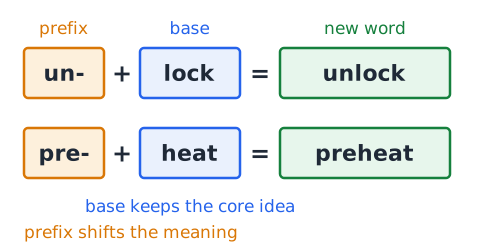
A prefix usually leaves the word's part of speech alone, and it is not hiding in every word that starts with the same letters. Uncle contains no un-, and reason contains no re-. Treat a prefix as a clue to test, not a rule to obey.
The five-step decoding sequence
Step one: read the whole sentence and form a rough guess about the blank's meaning. Step two: look for a possible prefix and check that what remains is a real base you recognize. Step three: state the prefix's meaning and join it to the base, as in re- plus build, meaning build again. Step four: compare the choices, dropping any whose direction or part of speech does not fit. Step five: put your pick back into the sentence and confirm that it reads naturally.
un-: not, or reversal
Before an adjective, un- means not: unsteady means not steady, and unaware means not aware. Before a verb, un- usually reverses an action that was done earlier: untie, unpack, unload. To unfasten clips is to undo their fastening, which means to release them. Reversal is not refusal. Unpack means to take things out, not to decline to pack.
in-, im-, il-, ir-: negative-prefix family
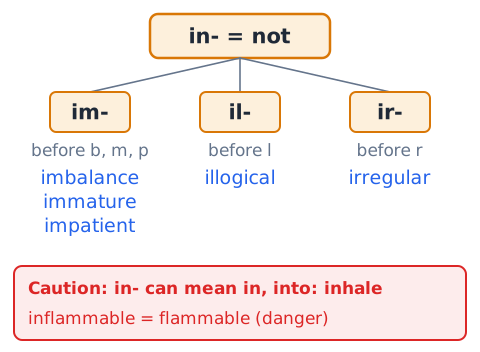
The negative prefix in- means not, and its spelling shifts to match the next letter. It becomes im- before b, m or p (imbalance, immature, impatient), il- before l (illogical) and ir- before r (irregular). Imperceptible means not able to be perceived. Caution: in- can also mean in or into, as in inhale. Inflammable means easily set on fire, the same as flammable, so it is a danger warning.
non-: without or not belonging to a category
Non- places something outside a category, usually in a neutral, matter-of-fact way: nonstop, nontoxic, nonprofit. Nonessential staff are simply not required at that moment; the word is not an insult. Noncompliance means failing to meet a requirement and does not by itself suggest open defiance. Compare un-, which often judges: unprofessional is a criticism.
dis-: not, apart or reverse
Dis- has three common senses. It can mean not, as in dishonest or dissimilar. It can mean reversing an action, as in disarm, disassemble and disconnect; to disconnect a cable is to detach it. It can also mean apart or away, as in disperse. Words such as distrust and disconnect share dis- but have different bases, so decode the base too.
mis- and mal-: error versus faulty quality
Mis- means wrongly or mistakenly and attaches to an action someone performs: misread, misspell, misplace. To misjudge a distance is to estimate it wrongly. Mal- means bad, poor or faulty and describes a condition or quality: malnourished, malodorous. A machine that malfunctions works improperly. A handy test: mis- points to a mistake in doing something, while mal- points to something being done or working badly.
re-: again or back, with caution
Re- most often means again (reheat, reread, rebuild, meaning to construct again) or back (repay, recall, return). Use it with caution. Many words that begin with r-e contain no prefix at all, such as ready, reason and realm. Others have drifted from their parts: resign means to quit, not to sign again. Confirm any re- reading against the sentence before you commit.
de-: remove, reduce or reverse
De- can mean remove (defrost, dehumidify, deice), reduce or move down (devalue, demote), or reverse (decode, deactivate). To deescalate an argument is to bring it down from a higher level, which means to calm it. The word is often written de-escalate. De- lowers or undoes; it does not mean end forever.
pre- and fore-: before, ahead of time
Pre- means before: preheat, preview, pretest. To prepay is to pay in advance. Fore- also means before or in front: forecast, foresee, forehead. To forewarn people is to warn them ahead of time. Preemptive goes further than early; it describes acting first to block a threat you expect. Watch for false starts: press and pretty contain no pre-, and forest contains no fore-.
post- and retro-: after versus back in time
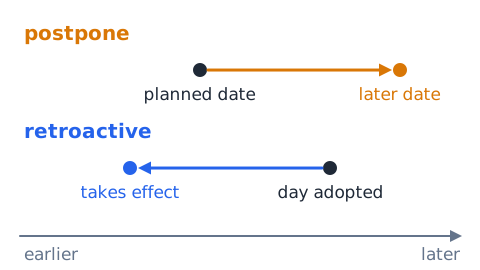
Post- means after: postwar, postgame, postoperative, meaning after surgery. To postpone is to move an event to a later time. Retro- means backward or back in time: a retrospective looks back at past work. A retroactive rule takes effect from an earlier date than the day it was adopted. Notice the direction: postponing pushes forward, while retroactive reaches back.
anti- and counter-: against or opposing
Anti- means against or preventing: antifreeze, antibacterial, antitheft. Counter- means against, opposite in direction, or in response: counterattack, counterweight, counterclockwise. A counterproductive step works against the very goal it was meant to serve. Do not mix up anti- with ante-, which means before, as in anteroom, a small room in front of a larger one.
pro-: for or forward—not always “before”
Pro- usually means forward, as in proceed, propel and project, or in favor of, as in a pro-safety policy. Only a handful of pro- words carry a sense of before, such as prologue. A proactive manager acts ahead of trouble instead of reacting to it. Many words merely start with p-r-o and have no prefix, like problem and proper, so test the base first.
inter- versus intra-: between versus within
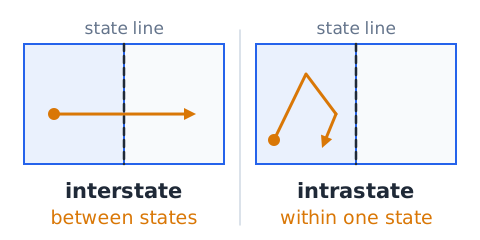
Inter- means between or among separate groups: an interstate highway links states, and international trade crosses national borders. Intra- means within a single unit: intrastate travel stays inside one state, and an intravenous line goes into a vein. Intramural games are played within one school. One letter separates the two prefixes, so read slowly.
sub-, super- and sur-: lower versus above
Sub- means under, below or less than: submarine, subzero, subtotal. Substandard work falls below the required level. Super- means above, over or beyond: superstructure, supervise, superhuman. Sur- is a French form of super- that means over or on top of: a surcharge is an extra fee added on top, and a surplus is an amount above what is needed. Do not read sur- as sure.
trans- and circum-: across versus around
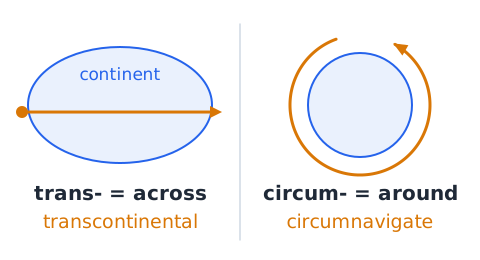
Trans- means across, through or beyond: transatlantic, transport, transfer. A transcontinental route crosses a continent from one side to the other. Circum- means around: the circumference is the distance around a circle, and to circumnavigate is to sail completely around something. Crossing goes through the middle; circling follows the outside.
over- and under-: excess or insufficiency
Over- often means too much: overcook, overcharge, overload. To overestimate is to guess too high. Under- often means too little: underpay, undercooked, understaffed. To underestimate is to guess too low. Both can also show position, as in overpass and underground. A few have idiomatic meanings: overlook means to miss seeing, and undergo means to experience.
co-, com- and con-: together, with or jointly
This family means together, with or jointly. Co- appears in words such as coworker, cooperate and coauthor, which means to write jointly. Com- appears before b, m and p: combine, commingle, compress. Con- appears before most other consonants: connect, converge, confer. The same prefix also shows up as col- and cor-, as in collaborate and correspond. Each form signals two or more parties joining.
bi-, tri- and multi-: quantity relations
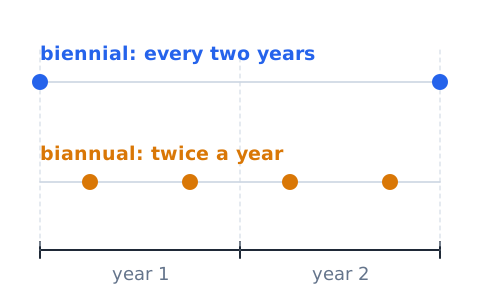
Bi- means two: bicycle, bipartisan, bilingual, meaning using two languages. Tri- means three: tripod, triangle, trilingual. Multi- means many: multilingual, multistory, multitool. Time words need care. Biennial means every two years, while biannual means twice a year. Biweekly can mean either every two weeks or twice a week, so let the sentence decide.
semi-: half, partially or not fully
Semi- means half, as in semicircle, or partly and not completely, as in semiskilled, semiprivate and semiconscious. A semiannual report comes out every half year. Semi- lowers the degree of the base but does not reverse it. A semiconscious patient is partly aware, not unconscious. On the test, a choice meaning fully or not at all is the wrong degree for a semi- word.
ex- and en-/em-: outward action and making a state
Ex- means out or outward: export, extract, expel. To exhale is to breathe out. En- and em- mean to put into or to cause to be: enlarge means to make larger, endanger means to put in danger, and empower means to give power to. Em- is the form used before b and p. Both en- and em- often turn a noun or adjective into a verb.
Prefix spelling changes and false boundaries
Prefixes often change their last letter to blend with the base. In- becomes im-, il- or ir-; con- becomes com-, col- or cor-; sub- can become sup-, as in suppress. Learn the family, not just one spelling. The opposite problem is a false boundary, where letters only look like a prefix. Uncle, reason, missile and pretty cannot be split. If the leftover piece is not a real base, there is no prefix to decode.
Do not confuse negation with opposing action
Un-, in- and non- state that something is not the case: unready means not ready. Anti- and counter- describe acting against something: an antismoking campaign actively opposes smoking, and a counteroffer answers another offer. Dis- and un- can also mean reversing an action already taken. A nonviolent protest simply lacks violence, while an antiviolence group campaigns against it. Match the relation the prefix shows, not just a negative mood.
Part of speech is an extra filter
A correct synonym belongs to the same word class as the test word. Endings help: -tion and -ance usually mark nouns, -ible and -ive mark adjectives, and -ed marks a past-tense verb or a participle that often works as an adjective. Imperceptible is an adjective, so the noun perception cannot replace it. Noncompliance is a noun, so it pairs with a noun phrase such as failure to meet requirements. Prefixes rarely change word class, though en- often builds verbs.
Meaning and register after decoding
Decoding gives you a rough meaning; the sentence then sets the exact strength and tone. Check degree: irrevocable means impossible to cancel, which is stronger than hard to reverse. Check tone: nonprofessional is neutral, while unprofessional criticizes. Check field: postoperative belongs to medicine. When two choices both fit the prefix, pick the one whose degree, tone and setting match the sentence.
A practical elimination grid
Test each choice against three checks. Direction: does it carry the prefix's relation, such as not, again, before, against or between? Base: does it keep the root idea? Fit: does it match the part of speech and the sentence? Try PRETEST, as in a pretest given on the first day of class. Test again fails direction, since that is re-. Prepare fails the base. Test given afterward fails direction. A test given before instruction passes all three.
When the word is unfamiliar, use context first
Read the sentence before dissecting the word. It tells you the topic, whether the word is positive or negative, and often restates the meaning. Example: the ferry was DECOMMISSIONED last spring and now sits at the dock, no longer in service. The phrase no longer in service and the prefix de-, meaning remove, agree: it was taken out of service. When context and prefix clash, trust context and recheck your split.
Twenty-second WK routine
Use a short, repeatable routine. In the first few seconds, read the sentence and predict a plain meaning. Next, split the word, name the prefix and confirm that the base is real. Then cross out choices that fail on direction, degree or part of speech. Finally, plug the survivor into the sentence and commit. If you are still unsure after about twenty seconds, choose the strongest remaining option and move on rather than freezing on one item.
Worked example 1 — negative prefix family
Sentence: The handwritten order was ILLEGIBLE, so the pharmacist phoned the clinic to confirm the dose. Choices: unlawful, impossible to read, written in pencil, very long.
Il- is the form of in- used before l, so it means not. Legible means readable. The phone call fits a note no one could read. Unlawful is a sound-alike trap from illegal. Answer: impossible to read.
Worked example 2 — inter- versus intra-
Sentence: The small carrier holds only an INTRASTATE permit, so its trucks may not haul loads past the state line. Choices: between states, within one state, statewide speed limit, on interstate highways.
Intra- means within, and the base is state. The ban on crossing the state line confirms that the trucks stay inside one state. Between states describes inter-, the one-letter trap. Answer: within one state.
Worked example 3 — degree prefix
Sentence: The front tire was UNDERINFLATED, so the driver stopped to add air. Choices: flat and ruined, holding too little air, overfilled, brand new.
Under- here means too little, and inflated means filled with air. Adding air fits a tire that is low. Flat and ruined overstates the degree, and overfilled is the opposite. Answer: holding too little air.
Worked example 4 — wrong action versus bad operation
Sentence: The clerk MISADDRESSED the package, so it was delivered to the wrong building. Choices: labeled incorrectly, damaged in transit, poorly built, refused.
Mis- marks a mistake in an action, and the action is addressing. The wrong building follows from a wrong label. Poorly built describes a faulty condition, which would call for mal-. Answer: labeled incorrectly.
Worked example 5 — temporal prefix
Sentence: The museum restored a PREWAR locomotive built in 1936, five years before the United States entered World War II. Choices: after the war, before the war, during the war, opposed to war.
Pre- means before, and the dates agree: 1936 plus five years is 1941. Opposed to war would need anti-. Answer: before the war.
Worked example 6 — absolute negation and intensity
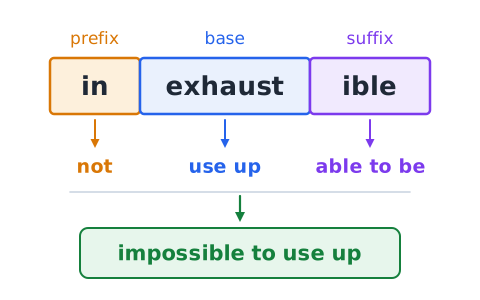
Sentence: The spring seemed INEXHAUSTIBLE; after years of steady pumping, it never ran dry. Choices: slightly tiring, hard to use up, impossible to use up, drained.
In- means not, exhaust means use up, and -ible means able to be. Together: not able to be used up at all. Hard to use up is too weak. Answer: impossible to use up.
Worked example 7 — boundary and position
Sentence: Ultrasound sensors found SUBSURFACE cracks that no one could see on the bridge deck. Choices: on the top layer, beneath the surface, across the surface, around the edge.
Sub- means below, and the base is surface. Cracks hidden from view sit below the surface, so on the top layer is the reverse position. Across fits trans-, and around fits circum-. Answer: beneath the surface.
Worked example 8 — looking backward
Sentence: When the project ended, the team held a RETROSPECTIVE meeting to review what had worked and what had not. Choices: planning ahead, looking back on the past, held after hours, delayed.
Retro- means backward, and spect means look, as in inspect. Reviewing what happened is looking back. Held after hours and delayed are post- ideas that confuse after with back. Planning ahead points the wrong way. Answer: looking back on the past.
Worked example 9 — misleading similarity
Sentence: During the blackout, the volunteer's radio skills proved INVALUABLE to the rescue crews. Choices: worthless, extremely useful, untested, unpaid.
In- seems to mean not valuable, but this word means too valuable to measure. The sentence is clearly positive, so worthless cannot fit. Trust context over a quick split. Answer: extremely useful.
Worked example 10 — partial degree
Sentence: Now SEMIRETIRED, the electrician works three days a week instead of five. Choices: fully retired, partly retired, retired twice, never retired.
Semi- means partly. Working three days instead of five shows reduced work, not none, so fully retired is too strong and never retired ignores the change. Retired twice confuses semi- with re-. Answer: partly retired.
High-value WK traps
Look-alike trap: illegible is not illegal, and intra- is not inter-; read every letter. Hidden-sense trap: in- can mean in, so inflammable warns of fire. Degree trap: impossible to cancel is stronger than hard to reverse, and semi- is never fully. Wrong-relation trap: not is different from against, and mis- (wrong action) differs from mal- (bad condition). False-split trap: uncle and reason have no prefix. Fix: confirm the base and test your choice in the sentence.
Quick review and readiness check
Prefixes push a base in a direction: not (un-, in-, non-), reverse (un-, dis-, de-), wrong or bad (mis-, mal-), again or back (re-), before or after (pre-, fore-, post-, retro-), against (anti-, counter-), between or within (inter-, intra-), below or above (sub-, super-), and amounts (bi-, tri-, semi-). You are ready if you can split a word, check the base, use context, and reject choices with the wrong direction, degree or word class.
 English ▾