 ASVAB Camp
Lesson Outcomes and WK Relevance
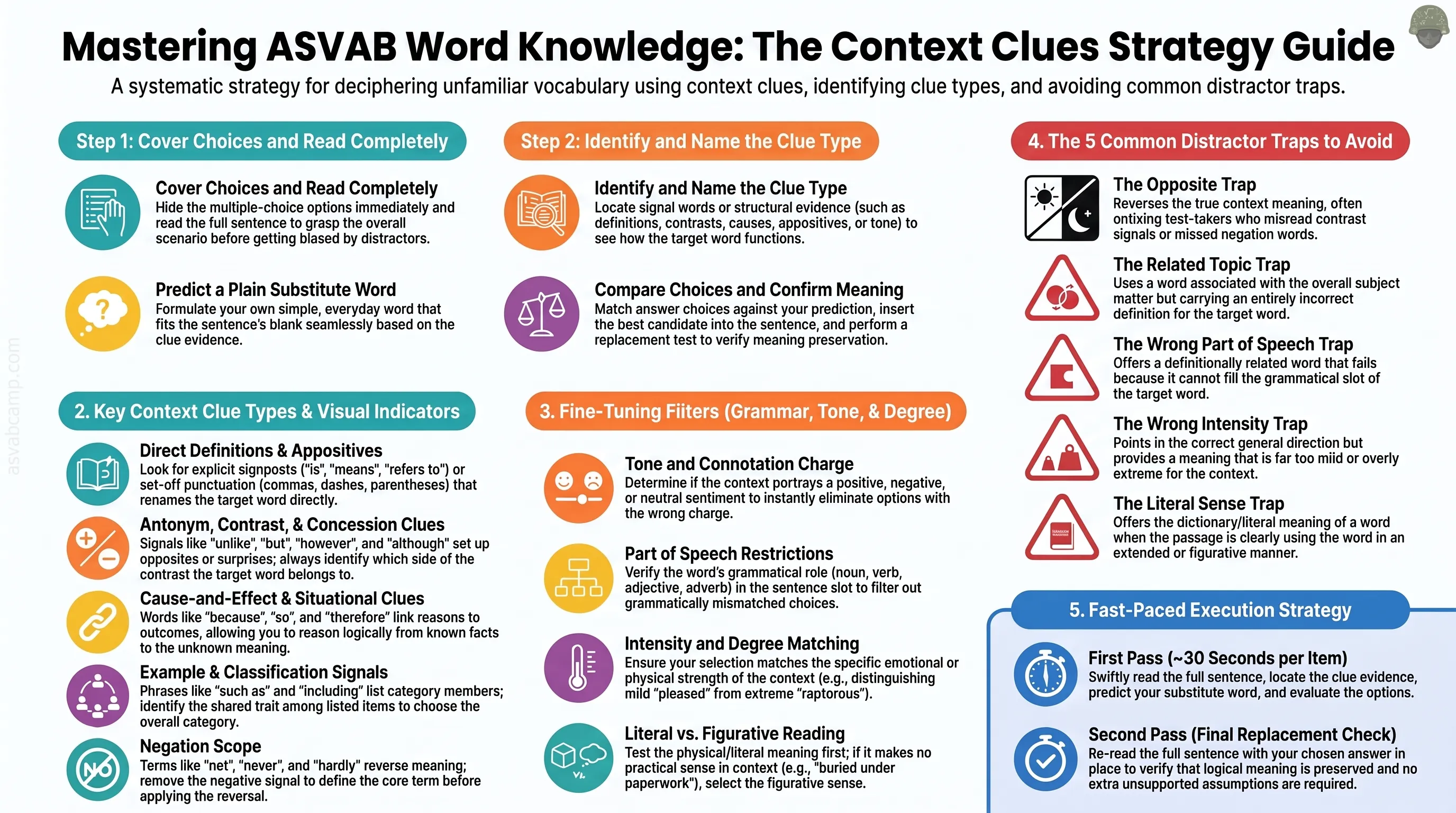
Infer the closest meaning of an unfamiliar or partly familiar word from a sentence or short surrounding passage. Identify definition, restatement, contrast, cause-and-effect, example, and tone clues; verify part of speech and connotation; reject tempting but unsupported answers; and decide when context supports only an approximate meaning. All examples and practice questions here are original training material, not operational ASVAB items.
What the Official Word Knowledge Task Measures
The ASVAB Word Knowledge subtest asks learners to identify the best synonym for a word or determine its meaning as presented in context. A contextual question usually asks what a highlighted word MOST NEARLY means. The goal is the meaning the writer conveys HERE, not every dictionary definition or a personal association.
Clues Are Evidence, Not Magic Keywords
Signal words such as "or," "but" and "because" tell you where to look, but they do not hand you the answer. The word "or" can introduce a restatement ("a lariat, or rope loop") or a real choice ("tea or coffee"). Treat every clue as evidence: read the whole sentence, ask what it actually says about the unknown word, and pick the meaning the sentence supports best.
The Four-Move Inference Routine
Move one: cover the answer choices and read the full sentence. Move two: find the clue and name its type, such as definition, contrast, cause, example or tone. Move three: predict a plain word of your own that would fit the blank. Move four: compare the choices with your prediction, then place the best one into the sentence and confirm the meaning holds.
Try it: "The trail was so circuitous that a two-mile hike took three hours." The long time suggests a path that winds back and forth, so predict "winding" and look for that idea.
Direct Definition Clues
Sometimes the writer simply defines the word. Look for phrases like "is," "means," "refers to," "is called" or "that is." In "A cistern is a tank that collects rainwater for later use," the definition follows "is." When a definition is present, your job is just to find the choice that matches it, not to guess.
Appositives and Renaming Phrases
An appositive is a phrase set off by commas, dashes or parentheses that renames the noun right next to it. In "The farrier, a craftsman who trims and shoes horses' hooves, arrived at dawn," the words between the commas tell you exactly what a farrier is. Treat the set-off phrase as a built-in definition.
Synonym and Restatement Clues
A writer may repeat an idea in easier words nearby, often after "in other words," a colon, or in the next sentence. In "The barracks were austere. The walls were bare and nothing decorated the room," the second sentence restates the first, so austere means plain and undecorated.
Antonym and Contrast Clues
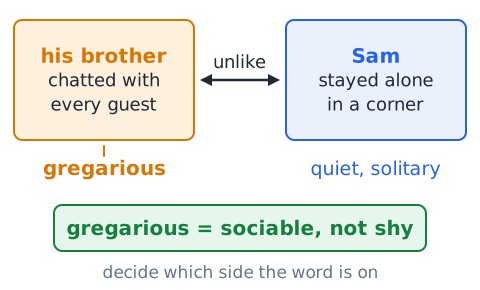
Words like "but," "however," "unlike," "instead," "whereas" and "rather than" signal that two ideas are opposed. Decide which side of the contrast the unknown word sits on. In "Unlike his gregarious brother, who chatted with every guest, Sam stayed alone in a corner," Sam is quiet and solitary, and the brother is the opposite of Sam. So gregarious means sociable, not shy. Missing which side the word belongs to is the most common contrast error.
Cause-and-Effect Clues
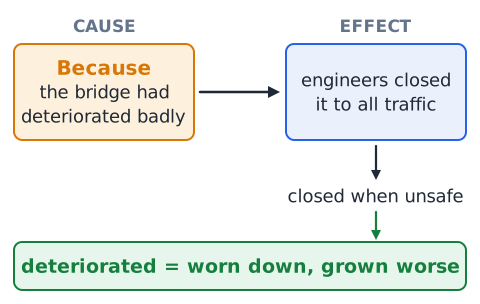
Signals such as "because," "since," "so," "therefore" and "as a result" link a cause to its effect. If you know one half, reason toward the other. In "Because the bridge had deteriorated badly, engineers closed it to all traffic," closing the bridge is the effect. A bridge gets closed when it is unsafe, so deteriorated means worn down or grown worse over time.
Example and Classification Clues
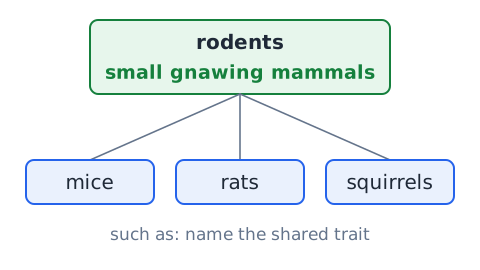
Phrases like "such as," "including," "for example" and "and other" list members of a group. Ask what the examples have in common. In "Rodents such as mice, rats and squirrels gnaw constantly," the shared trait is small gnawing mammals. Choose the answer that names the whole category, not one example from the list.
Situation and Practical-Action Clues
Some sentences give no signal word; the situation itself shows the meaning. In "Water was dripping through the ceiling, so the crew climbed up to patch the breach in the roof," you patch a hole, and water gets in through an opening. A breach is a break or gap.
Concession: The Surprise After Although
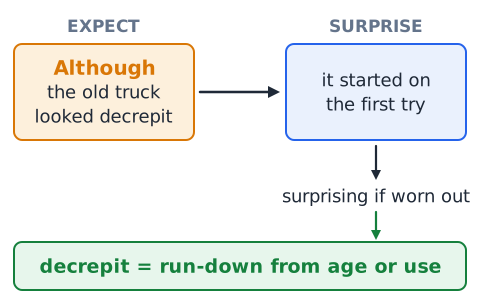
Words like "although," "even though," "though" and "despite" set up a surprise: the second part goes against what the first part would lead you to expect. In "Although the old truck looked decrepit, it started on the first try," a quick start is surprising only if the truck looked worn out. So decrepit means run-down from age or use.
Comparison and Degree Clues
Words like "like," "as...as," "more than" and "even" compare things. In "The second storm was even more ferocious than the first, which had already flattened fences," the first storm was already violent, and the second was worse. Ferocious means fierce or violent.
Positive, Negative and Neutral Tone
Even a vague sentence often shows whether a word is positive, negative or neutral. In "Critics lauded the film, calling it the finest of the year," the praise makes lauded strongly positive. Sort the choices by tone first and cut those with the wrong charge.
Part of Speech Restricts Options
The word's job in the sentence tells you whether it is a noun, verb, adjective or adverb, and the correct choice must do the same job. In "The crew will fortify the wall before the flood," fortify follows "will," so it is a verb. "Strong" (adjective) and "strength" (noun) cannot fill that slot, but "strengthen" can.
Meaning, Intensity and Degree
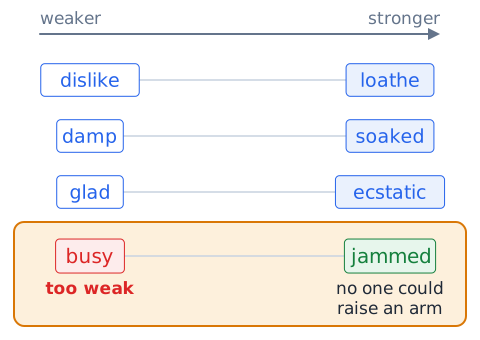
Related words can differ in strength: dislike and loathe, damp and soaked, glad and ecstatic. The context tells you how strong the meaning is. In "The hall was so jammed that no one could raise an arm," the word jammed signals extreme crowding, so a mild choice like "busy" is too weak. Pick the choice whose strength matches the sentence, not just its general direction.
Literal and Figurative Uses
A word may be used in its physical sense or in an extended, figurative sense. In "The clerk was buried under paperwork," nobody is literally underground; the clerk is overwhelmed. Test the literal reading first. If it makes no sense in the situation, look for the figurative meaning. Test makers often offer the literal meaning as a distractor when the sentence uses the word figuratively.
Negation and Scope
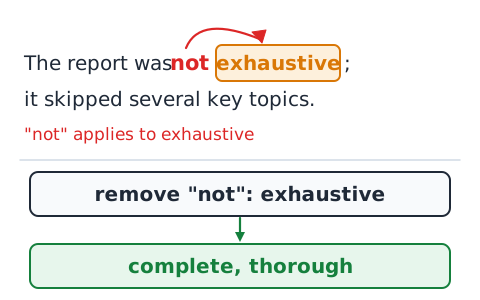
Words like "not," "never," "hardly," "far from" and "without" reverse part of a sentence. Find what the negative applies to. In "The report was not exhaustive; it skipped several key topics," the clue describes what the report actually was. Remove the "not" and exhaustive means complete or thorough.
Conclusions the Text Does NOT Support
Choose only what the sentence supports. In "The parcel was cumbersome, so two workers carried it together," you know it was bulky or awkward to handle. Choices like "expensive" or "fragile" add facts the sentence never states. If a choice needs extra assumptions to work, it is probably a trap.
Word Familiarity Is a Hypothesis, Not Proof
Recognizing a word does not mean you know the sense used in this sentence. Sanction can mean either "approve" or "penalize." In "The council sanctioned the parade and issued a permit," the permit shows approval. Treat the meaning you remember as a guess, and let the sentence confirm or reject it.
Technical and Everyday Contexts
Some words have a special meaning in a trade or science. In everyday speech, "bleed" means to lose blood, but in "The mechanic had to bleed the brake lines to remove trapped air," it means to let air or fluid out of a system. Look at the setting, such as a shop, lab, ship or field, to decide which sense the writer means.
Unfamiliar Words With Weak Clues
Sometimes the sentence gives only a faint hint. Use whatever it does show: the part of speech, whether the tone is positive or negative, and any hint of size or degree. Cross out choices that conflict with those facts. Then rely on word parts or partial familiarity, and make your best choice instead of leaving the item blank.
Two-Pass Reading Under a Timer
Word Knowledge moves fast; on the computer version you have roughly half a minute per item. Read each sentence twice. On the first pass, get the general idea and find the clue. On the second pass, read it with your chosen answer in place of the target word. This second read takes only a few seconds and catches most careless mistakes.
Five Distractor Types
Wrong choices tend to follow patterns. An opposite reverses the meaning. A related word is about the same topic but means something else. A wrong part of speech cannot fit the slot. A wrong intensity is in the right direction but too mild or too strong. A wrong sense matches a different meaning of the word, often the literal one. Naming the trap helps you reject it quickly.
Replacement Test and Meaning Preservation
Put each remaining choice in place of the target word and reread the sentence. The correct answer must keep the meaning the same, not just sound grammatical. In "The scout's report was succinct and fit on a single index card," both "brief" and "accurate" fit the grammar. Only "brief" explains why the report fit on one card, so it keeps the sentence's meaning.
A Compact Evidence Table
Keep this matching table in your head. Definition (is, means): match the definition. Renaming (commas, dashes): read the set-off phrase. Contrast (but, unlike): take the opposite side. Cause (because, so): follow the logic. Example (such as): name the shared trait. Concession (although): expect a surprise. Negation (not): remove the negative.
Worked Example 1 — Explicit Definition
Sentence: "A tributary is a stream that flows into a larger river." Choices: dam, branch stream, riverbank, flood.
Step 1: "is" signals a definition. Step 2: the definition says a smaller stream that feeds a river. Step 3: "branch stream" matches; the others are only river-related words. Answer: branch stream.
Worked Example 2 — Contrast
Sentence: "Rather than being frugal with the budget, the new clerk spent freely on supplies." Choices: generous, thrifty, careless, honest.
"Rather than" signals a contrast. The clerk spent freely, so frugal means the opposite: careful with money. Answer: thrifty.
Worked Example 3 — Consequence
Sentence: "The instructions were so ambiguous that half the team bandaged the wrong arm." Choices: unclear, rude, lengthy, printed.
"So...that" shows a result. People did the wrong thing because the instructions could be read two ways. Answer: unclear.
Worked Example 4 — Punctuation and Apposition
Sentence: "The quartermaster, the officer in charge of supplies, signed the order." Choices: medic, supply officer, pilot, cook.
The commas set off a phrase that renames quartermaster. That phrase says the person runs supplies. Answer: supply officer.
Worked Example 5 — Negation Scope
Sentence: "The repairs were hardly superficial; the crew rebuilt the entire frame." Choices: deep, surface-level, costly, quick.
"Hardly" negates superficial. The repairs went deep, so superficial means the opposite. "Deep" is a trap because it describes the real repairs. Answer: surface-level.
Worked Example 6 — Context and Degree
Sentence: "The crowd's response was not just warm but rapturous; people stood, cheered and wept with joy." Choices: polite, pleased, ecstatic, noisy.
"Not just warm but" signals a stronger level. Weeping with joy is extreme delight. "Pleased" is too weak. Answer: ecstatic.
Worked Example 7 — Figurative Meaning
Sentence: "News of the layoffs cast a pall over the holiday party." Choices: gloomy mood, burial cloth, loud argument, bright glow.
A pall can literally be a cloth laid over a coffin, but nothing is physically covered here. Bad news darkens a party's mood. Answer: gloomy mood.
Worked Example 8 — Two-Step Inference
Sentence: "Since the sergeant was known to be fastidious, the recruits polished their boots twice and refolded every towel." Choices: fussy about details, quick-tempered, forgetful, generous.
Step 1: "Since" shows that the sergeant's trait caused the extra effort. Step 2: extra effort on small details suggests a person who notices tiny flaws. Answer: fussy about details.
Worked Example 9 — Strong but Limited Clues
Sentence: "The old bridge was condemned after inspectors found rust through its main beams." Choices: declared unfit for use, sentenced to death, repainted, rebuilt.
The rust strongly suggests a safety ruling. The sentence does not say it was rebuilt, and "sentenced" is a different sense. Answer: declared unfit for use.
Editorial Error Audit: Ten Failure Modes
One: choosing the first familiar-looking word. Fix: predict before reading the choices. Two: landing on the wrong side of a contrast. Fix: label who or what each side describes. Three: choosing what a negated word is not. Fix: remove the negative, then define. Four: picking a topic-related word. Fix: require the same meaning, not the same subject. Five: ignoring part of speech. Fix: match the slot. Six: matching direction but not strength. Fix: check intensity. Seven: taking a figurative use literally. Fix: ask whether the literal reading makes sense. Eight: adding facts the sentence never gives. Fix: stay inside the evidence. Nine: trusting a remembered meaning over the sentence. Fix: confirm the sense in context. Ten: skipping the final check. Fix: always do the replacement test.
End-of-Lesson Quick Reference
Context clues are evidence, so read the whole sentence before judging. Cover the choices, find and label the clue, predict a plain word, then compare and test by replacement. Definitions and renaming phrases give the meaning directly. Contrast and concession point to an opposite or a surprise. Causes, examples and situations let you reason to the meaning. Check part of speech, tone, intensity, literal versus figurative sense and negation scope. Reject choices that add unsupported facts, and confirm any familiar meaning against the sentence.
 English ▾