 ASVAB Camp
Lesson outcome and exam alignment
By the end of this lesson you will be able to look at a familiar word inside a sentence and name the exact meaning the writer intends, even when that word has four or five common meanings.
You will tell apart meanings that grew from one root idea and meanings that only share a spelling, and you will use grammar, neighboring words, typical word partners, and tone as evidence. These skills feed directly into the Word Knowledge subtest, which counts toward the AFQT score and often tests a common word in an uncommon sense.
One spelling, several senses: why this is difficult
Most short, everyday English words carry several meanings. Your brain usually picks the right one so quickly that you never notice the choice. On a test, that speed works against you: the first meaning that pops into mind feels correct, and the answer list often includes it as a trap.
Take the word "run." A runner, a business, a stocking, and a river can all run, and each use means something different. Word Knowledge items exploit exactly this gap between the familiar sense and the intended one.
The five-step sense-selection method
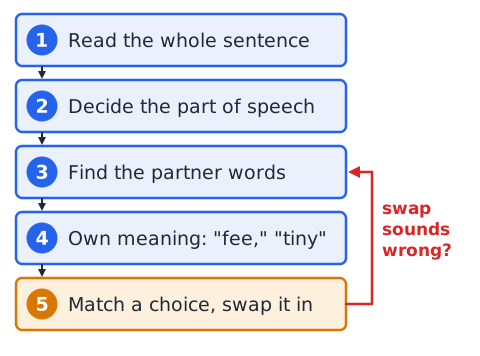
Use the same five steps on every multiple-meaning item. First, read the whole sentence before looking at the choices. Second, decide the word's part of speech from where it sits. Third, find the nearby words that work with it, such as its object or the noun it describes. Fourth, put a short meaning in your own words, like "fee" or "tiny." Fifth, pick the choice that matches your phrase and confirm it by swapping it into the sentence. If the swap sounds wrong, return to step three.
Polysemy versus homographs
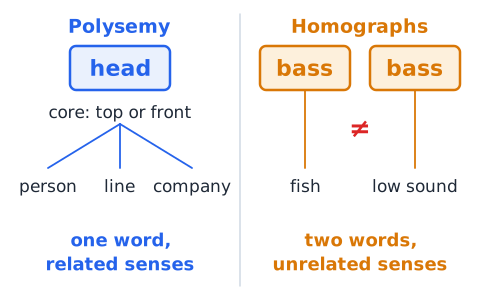
Polysemy means one word has several related meanings that grew from a shared core idea. The "head" of a person, of a line, and of a company all suggest the top or front position.
Homographs are separate words that happen to share a spelling, often with different histories and sometimes different pronunciations. "Bass" the fish and "bass" the low sound are unrelated. Related senses can lure you with a near match, while unrelated homographs are easier to rule out once you read the context.
Do not confuse the topic with context clues
A sentence's general subject is not the same as the clue that fixes a word's meaning. In "The electrician sent a bill listing the charge for the new outlet," the topic is electricity, yet "charge" means a price. The true clue is "bill listing."
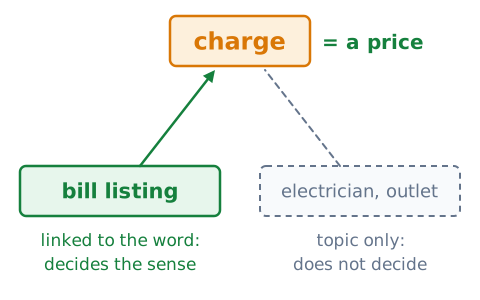
Always ask which words connect grammatically to the tested word. The overall setting can suggest a field, but the verb, object, or modifier attached to the word decides the sense.
Grammar is evidence: noun, verb, or adjective
A word's job in the sentence limits its meaning. After "a" or "the," it usually acts as a noun; after a subject and before an object, it acts as a verb; before a noun, it often acts as an adjective.
"The ship will dock at noon" uses "dock" as a verb meaning to pull into a pier. "The dock was crowded" uses it as a noun naming the pier itself. Rule out any answer that does not fit the part of speech.
Collocations can select a sense
Collocations are words that habitually travel together. Certain partners almost always call up one sense of a multiple-meaning word. "Pay a fine" points to a penalty, while "fine sand" points to small grains. "Run a business" means manage, but "run a fever" means have.
When you spot a familiar pairing next to the tested word, treat it as strong evidence. Then confirm that the rest of the sentence agrees with that sense.
Meaning precision: related is not equivalent
Two meanings can be connected without being interchangeable. "Guard" and "fasten" both relate to keeping something safe, yet "secure the cargo with straps" means fasten, not watch over.
The best answer must fit the specific action, object, and result in the sentence. A choice that is merely in the same family is often the planted distractor. Ask what the word actually does in this sentence, not what it loosely suggests.
CHARGE: fee, accusation, electrical quantity, or rush
CHARGE has many senses. A price for service: "There is no charge for parking." A formal accusation: "She faced a charge of reckless driving." Stored electricity: "The battery holds a full charge." A sudden forward rush: "The cavalry made a charge up the hill."
It can also mean a duty or responsibility. "The new clerk was charged with ordering supplies" means she was given that task. Clues such as "bill," "court," "battery," or "with" plus a task tell you which sense applies.
DRAFT: preliminary writing, moving air, or selection
DRAFT as preliminary writing means a rough version that will be revised: "My second draft cut two pages." As moving air, it is a cool current through a room: "Close the window; there is a draft." As a selection, it is a process for choosing people, such as military service or a sports league pick.
Words like "revise," "edit," or "corrections" signal the rough version; "window" or "chilly" signal air.
CURRENT: present time versus flow
As an adjective, CURRENT means happening now or most recent: "Bring a current photo ID," meaning one that is still valid. As a noun, it means a flow, either of water or air, or of electricity through a wire.
Placement helps. Before a noun, "current" usually means present. After "the" or "a" with words like "strong," "river," or "amps," it names a flow. "The current pulled the raft downstream" is clearly water.
ISSUE: problem, publication, or distribution
ISSUE can name a problem or topic under debate: "Parking is a big issue for commuters." It can mean one edition of a magazine or newspaper: "the March issue." As a verb, it means to give out officially: "The office will issue new badges."
Look for clues like "printed," "edition," or a month to signal the publication sense, and words such as "supply" or "hand out" to signal distribution.
YIELD: produce, surrender, or allow to go first
YIELD as produce means to give a result or crop: "Each orchard tree yields about two bushels of apples." As surrender, it means to give up under pressure: "The defenders refused to yield the fort." As allowing others first, it appears on traffic signs: "Yield to oncoming cars."
Ask what follows the verb. A harvest or result suggests produce; an opponent suggests surrender; "to" plus traffic or pedestrians suggests giving the right of way.
SCALE: measuring device, proportion, coating, or extent
SCALE can be a device for weighing: "Step on the scale." It can be a ratio on a map or model: "one inch to ten miles." It can be the hard plates on fish or a mineral crust inside a kettle. It can also mean size or extent: "the scale of the wildfire." Words like "huge," "sheer," or "full" before it usually point to extent.
FINE: penalty, good, or very small
FINE as a noun means money paid as a penalty: "a fine for an overdue book." As an adjective, it can mean good or acceptable: "The repair looks fine." It can also mean very thin or made of tiny particles, as in "fine powder" or "a fine wire."
Substances such as dust, flour, or sand plus the adjective almost always signal the "very small" sense, especially when a safety warning follows.
STRIKE: hit, halt work, discover, or remove
STRIKE can mean to hit: "Lightning struck the tower." It can mean a group stopping work to protest: "The nurses went on strike." It can mean to find suddenly, as in "strike oil." In legal or editing contexts, it means to delete: "Strike that sentence from the minutes." Words like "record," "list," or "from" point to removal.
CONDUCT: lead an activity, carry, or behavior
As a verb, CONDUCT means to carry out or perform: "conduct a survey." It also means to direct an orchestra, or to let heat or electricity pass through: "Copper conducts current well." As a noun, stressed on the first syllable, conduct means behavior: "His conduct in class improved." The object after the verb usually decides the sense.
SECURE: obtain, attach, or safe
SECURE as a verb can mean to obtain: "She secured a loan." It can mean to fasten firmly: "Secure the ladder with a rope." As an adjective, it means safe or protected: "a secure password." Physical items plus words like "strap," "bolt," or "tie down" point to fastening, not guarding or buying.
CAPITAL: main city, money assets, or uppercase
CAPITAL can name a seat of government: "Austin is the capital of Texas." In business, it means money or assets used to start or expand a company: "The startup raised capital from investors." It also means an uppercase letter. Clues like "borrow," "invest," or "equipment" point to the money sense.
SPRING: coil, season, jump, or water source
SPRING can be a coiled metal part that stores energy and snaps back, as in a mattress or a door closer. It can be the season after winter, a quick leap ("spring to your feet"), or a place where groundwater flows out. Mechanical words like "hinge," "latch," or "broken" signal the coil.
PLAIN: simple or an extensive flat area
As an adjective, PLAIN means simple, clear, or without decoration: "a plain white shirt" or "plain language." As a noun, it names a wide, mostly flat stretch of land, often grassland. Look for geography clues such as "herds," "across," "prairie," or "the open" to spot the land sense.
MINUTE: a unit of time, or extremely small
MINUTE (stressed on the first syllable) is sixty seconds. MINUTE (pronounced my-NOOT) is an adjective meaning extremely small: "minute traces of rust." When the word sits before a noun and describes size or detail, choose "tiny." The plural noun "minutes" can also mean a meeting record.
PERMIT: authorize or an authorization document
As a verb, stressed on the second syllable, PERMIT means to allow: "Rules do not permit food here." As a noun, stressed on the first syllable, it is an official document granting permission: "a building permit." Check whether a subject is acting on something.
VOLUME: loudness, space, quantity, or book
VOLUME can mean loudness: "Turn the volume down." In science, it is the space an object takes up, measured in units like liters. It can mean an amount or total handled: "a high volume of calls." It can also be one book in a set. Counts of items, sales, or traffic usually point to amount.
COMPOUND: chemical, enclosed area, or worsen
As a noun, COMPOUND can mean a chemical made of two or more elements, or an enclosed group of buildings. As a verb, it means to add to or make something worse: "Late payments compounded his debt." It also describes interest that grows on itself. When it acts on a problem, choose "worsened."
REFUSE: reject or waste material
REFUSE as a verb (stressed on the second syllable) means to decline or say no: "They refused the offer." REFUSE as a noun (stressed on the first syllable, REF-yoos) means trash or garbage. Words like "bins," "collection," or "dump" signal the waste sense.
CONTENT: satisfied, or material contained
CONTENT stressed on the second syllable is an adjective meaning satisfied or at ease: "She was content with a quiet weekend." Stressed on the first syllable, it is a noun for what something contains, such as the content of a box or the fat content of milk. "Content to" plus an activity signals the satisfied sense.
LEAD: guide or metallic element
LEAD rhymes with "need" when it means to guide or be in front: "She will lead the patrol." It also names first position or a clue. LEAD rhymes with "bed" when it names a soft, heavy, toxic metal used in old pipes and paint. Words like "pipes," "paint," "poisoning," or "made of" signal the metal.
ROW: line, paddle, or dispute
ROW, rhyming with "go," can mean a straight line of seats or plants: "the third row." It can also mean to move a boat with oars: "We rowed to shore." ROW rhyming with "cow" is a mostly British word for a loud quarrel: "The neighbors had a row over the fence."
The verb and the sound of the word are clues: oars and boats signal paddling, while shouting signals a dispute.
WIND and TEAR: homograph pronunciation cues
WIND with a short "i" is moving air; WIND rhyming with "find" means to turn or coil: "wind the hose." TEAR rhyming with "ear" is a drop from the eye; TEAR rhyming with "air" means to rip.
On a written test you cannot hear the word, so read the sentence aloud in your head both ways. The version that makes grammatical sense tells you the meaning and quickly eliminates the other choices.
OBJECT and PRESENT: switching parts of speech
OBJECT stressed on the second syllable is a verb meaning to oppose: "Residents object to the noise." Stressed on the first, it is a noun for a thing. PRESENT works the same way: as a verb, it means to hand over or show; as an adjective, it means in attendance or current; as a noun, it is a gift. Check the part of speech first.
BEAR: carry, endure, or animal
BEAR can mean to carry or support: "The beam bears the roof's weight." It can mean to endure or tolerate: "I can't bear the heat." It also names a large furry animal. Phrases like "can't bear" or "barely bear" with an unpleasant thing almost always mean tolerate.
FIGURE: number, person, shape, or determine
FIGURE can be a number or amount: "The sales figure rose." It can mean a person, often a well-known one, or a body shape or drawing, as in "see Figure 2." As a verb, "figure out" means to solve. Columns, totals, or budgets signal the number sense.
PASSAGE and CHANNEL: everyday and technical senses
PASSAGE can be a hallway, a section of text, the passing of time, or the approval of a law: "passage of the bill." CHANNEL can be a TV station, a water route, or a groove. It also means an official route for information or requests: "go through proper channels." Words like "approval," "request," or "director" signal the official-route sense.
PLANT and STOCK: factory, living thing, supply, or ownership
PLANT can be a living green organism, a factory ("a power plant"), or, as a verb, to place something firmly or secretly. STOCK can be a store's supply of goods ("in stock"), shares of ownership in a company, farm animals (livestock), or broth.
Words like "workers," "shift," or "bottling" signal a factory; "shares" and "market" signal ownership; "shelves" signal supply.
TONE and REGISTER: sound, attitude, or record
TONE can be a musical sound, a color shade, muscle firmness, or a writer's or speaker's attitude: "an angry tone." REGISTER as a verb means to formally record or sign up. As a noun, it can be an official list, a cash machine at a store, or the level of formality in language. Store and checkout clues signal the cash machine.
Contrastive reading: compare two sentences directly
Some items show two sentences that use the same word differently. Do not settle on one meaning and assume it carries over. Treat each sentence as a separate puzzle: find its part of speech and its partner words, then write a short meaning for each.
Compare the order of your two meanings with the order in the answer choices. Many wrong choices contain both correct meanings in reverse order, so check the sequence carefully.
The substitution and entailment checks
The substitution check: replace the tested word with your chosen answer and reread the sentence. If it keeps the same meaning and sounds natural, keep the choice.
The entailment check asks whether the sentence still says the same thing after the swap. "The judge will strike the comment" becomes "delete the comment," which matches. "Hit the comment" is grammatical but changes the meaning, so it fails the entailment check even though it passes grammar.
Distinguish literal from idiomatic meanings
An idiom is a phrase whose meaning differs from its separate words. "Hold your ground" usually means refuse to back down, not stand on one spot. "Strike a balance" means find a fair compromise. "Under fire" or "drew fire" often means facing criticism.
If the literal reading produces an odd image, such as a person grabbing dirt, switch to the figurative meaning that fits the situation.
Pronouns, prepositions, and objects resolve ambiguity
Small words carry big clues. A preposition after the word often decides the sense: "object to" means oppose, "charged with" means accused or assigned a duty, "yield to" means give way. The object after a verb matters too: "conduct a test" means perform, "conduct heat" means transmit.
Pronouns tell you who or what is acting, which helps you confirm a sense is logical.
Avoid the primary-definition trap
The first meaning you learned is not always the one being tested. Test writers often choose a less common sense and place the familiar meaning among the choices.
For example, "The meeting was adjourned until Monday" does not mean canceled; it means suspended to resume later. Read every choice, and stay suspicious of any answer that matches only the meaning you would use in ordinary speech.
Pitfall — a valid definition in the wrong context
The mistake: choosing a true dictionary meaning that simply does not fit this sentence. "Bank" really can mean a river edge, but in "she deposited cash at the bank" it means a financial company.
Why it is wrong: correct meanings for the word can still be wrong for the item. The fix is to ask whether the choice works with this subject, verb, and object, then use the substitution check before you commit.
Pitfall — nearly right is still a mismatch
The mistake: picking a choice that is close in spirit but changes the meaning. In "The office will issue new keycards," "print" and "distribute" both feel connected, but only "distribute" matches handing them out.
Why it is wrong: near synonyms differ in action, scope, or result. The fix is to restate the sentence with each close choice and ask whether a careful reader would describe the same event. Keep only the exact match.
Pitfall — false etymology and surface resemblance
The mistake: guessing meaning from how a word looks. A test taker might think "inflammable" means "not flammable" because of the in- at the front, or assume that "bear" meaning to carry has something to do with the animal.
Why it is wrong: spelling similarity does not prove a shared meaning, and homographs often have unrelated histories. The fix is to ignore look-alike parts and let the grammar and neighboring words in the sentence decide.
Pitfall — too much subject-matter inference
The mistake: letting the sentence's topic dictate the meaning. In a sentence about a power company, "plant" might be a factory, but in "the power company planted trees," it is about living things.
Why it is wrong: a setting suggests possibilities but does not decide them. The fix is to find the words grammatically linked to the tested word and base your choice on them, not on the general scene.
Guided micro-drill: select the right sense
Prompt: "The carpenter will secure the shelf to the wall." Answer: fasten, because a physical item is attached to a surface.
Prompt: "Store the minute screws in a labeled cup." Answer: tiny, because it describes the size of the screws.
Prompt: "The court reporter struck the comment from the transcript." Answer: deleted, because "from the transcript" signals removal.
Prompt: "The program's volume of applications doubled." Answer: amount, because it counts how many were received.
Prompt: "Workers walked off the line in a strike." Answer: work stoppage.
Timed WK method: no more than one extra reread
Word Knowledge gives you limited time per item, so use a fixed routine. Read the sentence once, predict a short meaning, and scan the choices for it. If a choice matches, do a quick substitution check and move on.
If nothing matches or two choices look close, reread the sentence one more time, focusing only on the words attached to the tested word. Then choose the best fit and move on. A further reread rarely helps and costs time you need for later items, where an unanswered question earns nothing.
How to study families of meanings efficiently
Study multiple-meaning words in groups instead of one definition at a time. For each word, write every sense you know, then add a short sentence of your own for each, and underline the clue word that selects it.
Review by covering the meanings and reading only your sentences. Mix up the order so you practice choosing from context, not memorizing positions. Revisit the words that fooled you on practice tests every few days until the correct sense appears automatically.
Final checklist and transfer to WK practice
Before choosing an answer, run through this checklist. Did you read the full sentence first? Did you identify the word's part of speech? Did you find its partner words, such as its object, modifier, or preposition? Did you predict a short meaning before reading the choices? Does your choice pass both the substitution and entailment checks? Did you consider idioms and less common senses?
Carry this routine into every Word Knowledge practice set. The more often you apply it, the faster it becomes, and the less likely familiar meanings are to trick you.
Worked — CHARGE: payment versus accusation
Sentence: "The hotel added a charge for late checkout to our bill."
Step one: "charge" follows "a," so it is a noun. Step two: the partner words are "for late checkout" and "to our bill," both money terms. Step three: predicted meaning is fee. Step four: compare choices "accusation," "fee," "electrical energy," and "attack." Only "fee" survives the swap: "added a fee for late checkout." Answer: fee. "Accusation" would need a court or police clue.
Worked — CURRENT: now versus flowing water
Sentence: "Swimmers were warned that the current near the jetty was dangerous."
Step one: "the current" is a noun phrase, so "current" is a noun, not the adjective meaning present. Step two: the setting is swimmers and a jetty, both water-related. Step three: predict "flow of water." Step four: compare "present time," "latest version," "flow of water," and "electricity." Swapping in "the flow of water near the jetty" keeps the warning logical. Answer: flow of water.
Worked — DRAFT: working copy versus moving air
Sentence: "Before sending the proposal, Marcus asked his manager to review the draft."
Part of speech: noun after "the." Partners: "proposal," "review," and "before sending" show the document is unfinished. Prediction: rough version. Choices: "cold air," "final copy," "rough version," "selection." "Final copy" contradicts "before sending." Answer: rough version.
Worked — ISSUE: publish versus problem
Sentence: "The agency will issue updated safety guidelines next month."
Part of speech: "will issue" makes it a verb, which rules out the noun senses "problem" and "edition." Partner words: the object is "guidelines," and the time is "next month." Prediction: release officially. Choices: "dispute," "release," "edition," "worry." Substituting "release updated safety guidelines" fits. Answer: release. "Problem" fails because a problem is not something an agency does to guidelines.
Worked — YIELD: produce versus allow precedence
Sentence: "Drivers entering the roundabout must yield to vehicles already inside."
Part of speech: verb after "must." Partner: the phrase "to vehicles already inside" names who goes first. Prediction: give way. Choices: "produce," "give way," "surrender," "grow." "Produce" needs a crop or result, and "surrender" implies a fight. Answer: give way.
Worked — SCALE: measuring size versus proportion
Sentence: "On this map, the scale shows one inch equals twenty miles."
Part of speech: noun after "the." Partner words: "map," "inch," and "equals twenty miles" describe a ratio between the drawing and real distance. Prediction: proportion. Choices: "weighing device," "proportion," "fish covering," "climb." A weighing device would not show inches equal to miles. Answer: proportion. A sentence about "the scale of the disaster" would instead mean extent.
Worked — FINE: penalty versus small grain
Sentence: "The gardener mixed fine gravel into the potting soil."
Part of speech: adjective before "gravel." Partner: "gravel" is a material made of particles. Prediction: small-grained. Choices: "penalty," "excellent," "small-grained," "thin and delicate." "Penalty" is a noun and does not fit before another noun. Answer: small-grained.
Worked — STRIKE: collective work stoppage versus hit
Sentence: "The bus drivers voted to strike until their contract was renewed."
Part of speech: verb after "voted to." Partners: "bus drivers" (a group of workers) and "until their contract was renewed" (a labor goal). Prediction: stop working. Choices: "hit," "delete," "stop working," "discover." Answer: stop working.
Worked — CONDUCT: carry out versus transmit
Sentence: "Aluminum pans conduct heat quickly to the food."
Part of speech: verb. Partners: the object is "heat," and "to the food" shows heat moving. Prediction: transmit. Choices: "perform," "transmit," "behave," "lead music." A pan cannot perform heat. Answer: transmit. In "the lab will conduct a test," the sense would be perform.
Worked — SPRING: elastic component versus water outlet
Sentence: "Hikers refilled their bottles at a cold spring near the trail."
Part of speech: noun after "a cold." Partners: "refilled their bottles" and "near the trail" point to natural water. Prediction: water source. Choices: "coiled metal part," "leap," "water source," "season." A metal coil cannot fill bottles. Answer: water source.
Worked — CONTENT: satisfied versus material
Sentence: "Nutrition labels list the sugar content of each serving."
Part of speech: noun after "sugar" and before "of each serving." Partners: "nutrition labels" and "sugar" show an amount inside the food. Prediction: amount contained. Choices: "satisfied," "amount contained," "topic," "pleased." "Satisfied" is an adjective about feelings and does not fit. Answer: amount contained.
Worked — LEAD: guide versus element
Sentence: "Older paint containing lead must be removed carefully to avoid dust."
Part of speech: noun object of "containing." Partners: "paint," "removed carefully," and "avoid dust" point to a harmful substance. Prediction: the heavy metal. Choices: "guide," "clue," "heavy metal," "first place." A paint cannot contain a guide. Answer: heavy metal.
 English ▾