 ASVAB Camp
Lesson Outcomes and Why WK Matters
Select the closest meaning of a target word in isolation or in a sentence, even when choices include antonyms, related-but-not-equivalent words, differences in intensity, and false friends. Apply a repeatable method: identify the target sense; predict a plain-English paraphrase; compare all four meanings; substitute the winner; and choose the BEST match, not merely an associated word. Word Knowledge contributes to the verbal component used in AFQT; these are independent practice questions, not secure ASVAB items.
The Actual WK Task: Closest Meaning
Official ASVAB Word Knowledge samples ask which option most nearly means a given word, sometimes within a sentence. You must choose the closest meaning among the listed answers; you are NOT being asked to supply any remotely related word. A target word may have several legitimate meanings, so a sentence can disambiguate the intended sense. This lesson covers the core selection technique; the next lesson develops context clues in depth.
A Five-Step Decision Process
Step 1 — TARGET: isolate the word and, if present, its use in the sentence. Step 2 — PREDICT: state its meaning in plain English before seeing the choices. Step 3 — CLASSIFY: label each option as close synonym, opposite, related idea, or unrelated. Step 4 — TEST: substitute the best candidate into the sentence; check grammar, intensity and intent. Step 5 — COMMIT: choose the BEST match and move on. Do not spend time inventing new definitions for distractors.
Meaning Versus Association
A word's meaning is what the word actually says. An association is something that merely tends to show up near it. Test writers build many wrong choices from associations. If the test word is arid, choices such as desert, cactus, or heat all connect to the idea, but none of them means arid. Arid means very dry, lacking moisture.
Ask whether a choice could stand in for the word and say the same thing, not whether the two often appear together.
Predict Before Reading Choices
If a sentence says a proposal is FEASIBLE, predict 'possible or workable' before examining options. The prediction protects you from attractive answers such as 'profitable' (a possible result), 'simple' (not required), and 'approved' (a separate decision). Even when you cannot name a perfect synonym, form a short paraphrase: 'can be done.' Then select the closest listed option.
Part of Speech as an Immediate Filter
Match a verb with a verb meaning, an adjective with an adjective meaning, and a noun with a noun meaning. A word can change meaning by grammatical use, so identify its role in the sentence. Example: 'The crew will SECURE the load' uses a verb meaning fasten or make safe. 'The load is secure' uses an adjective meaning safe or firmly fixed. A choice that fits the wrong grammatical role is often incorrect.
Best Match Does Not Require Perfect Interchangeability
Natural language seldom gives two words identical in every situation. The stem 'most nearly means' asks for the nearest among FOUR choices. 'METICULOUS' and 'careful' overlap strongly, although meticulous additionally emphasizes attention to detail. If alternatives are 'fast,' 'careful,' 'expensive,' and 'ordinary,' careful is the best match. Do not reject a strong synonym because it is not identical in every register.
Denotation Versus Connotation
Denotation is a word's literal, core meaning. Connotation is the emotional color the word carries. Thrifty, frugal, and stingy all denote spending little money, yet thrifty sounds like praise while stingy sounds like criticism.
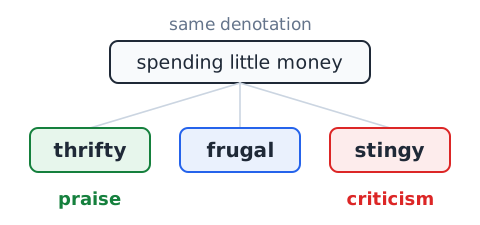
On WK items, match the denotation first. If two choices share it, prefer the one whose tone fits the test word or the sentence around it.
Strength and Degree Matter
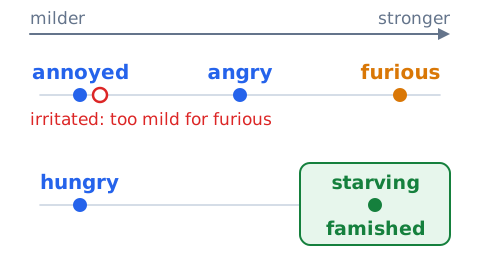
Many words sit on a scale. Annoyed, angry, and furious all name displeasure, but each step is stronger than the last. If the test word is furious, a mild choice like irritated falls short. Match the intensity as well as the general idea: famished is closer to starving than to hungry.
Scope and Specificity Matter
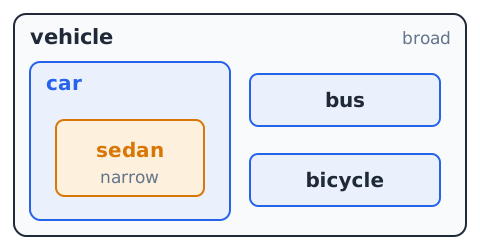
A broad word and a narrow word may not be synonyms. 'VEHICLE' includes cars, buses and bicycles in many contexts, but 'sedan' names a specific kind of car. Similarly, 'scarce' means in short supply; 'extinct' means no longer existing. Avoid options that overstate the target or add a condition not present in the word.
Near-Synonyms That Differ in Outcome
Some verbs share a topic but differ in result. Try and succeed both involve effort, but only succeed says the goal was reached. In the same way, search means to look for something, while find means the looking paid off. When a test word implies completion, such as accomplish, reject choices that describe only the attempt, like strive or pursue.
Antonym and Polarity Traps
An antonym is an opposite meaning. 'TRANSPARENT' versus 'opaque,' 'reluctant' versus 'eager,' and 'augment' versus 'reduce' form clear contrasts. A test choice may be a strong antonym and thus feel connected. When a choice is the opposite of your prediction, explicitly cross it out rather than being impressed by its closeness in topic.
Sound-Alike and Shape-Alike Traps
A familiar-looking word can be misleading. 'Credible' means believable, not 'creditable' (deserving praise). 'Disinterested' properly means impartial, not simply 'uninterested.' Do not choose based on similar spelling alone. Use remembered definitions, grammatical role and the sentence's meaning.
Context Determines the Intended Sense
Many common words carry several meanings, and the sentence decides which one is being tested. Fair can mean just ("a fair judge"), pleasant ("fair weather") or a public event ("the county fair"). In "The referee made a fair call," only "just" or "impartial" works. Read the sentence first, settle on the sense it uses, and then look for that sense among the choices.
Test the Replacement in a Sentence
Original: 'The inspection was CURSORY.' Candidate: 'superficial' → 'The inspection was superficial': meaning preserved. Candidate: 'thorough' → opposite. Candidate: 'scheduled' → a different fact. Candidate: 'expensive' → irrelevant. This swap test is most valuable when two options seem close. When the stem is a standalone word, make up a neutral sentence using the word's main sense.
Synonym Chains: Useful but Not Proof
A synonym chain links words one step at a time: brisk to quick, quick to hasty, hasty to careless. Each link looks reasonable, yet brisk and careless mean very different things, because small shifts add up.
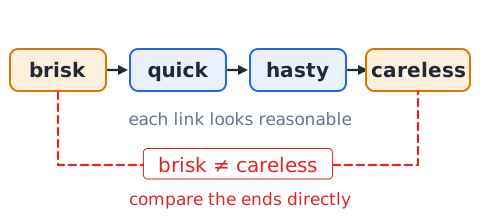
Use a chain only to produce a guess. Then compare the final choice directly with the original word. If the two do not match on their own, drop that choice.
Word Parts as Backup, Not a Guarantee
Prefixes, roots and suffixes can narrow your options when you are stuck. Bene suggests good, mal suggests bad, and the ending -less means without. But word parts can mislead: inflammable means easily set on fire, not fireproof. Use word parts to cut unlikely choices or support a hunch, then confirm with the sentence or your sense of the whole word.
What to Do When Two Answers Look Close
Compare the candidates against THREE tests: core action or state, emotional tone, and specificity. Suppose a report is PRELIMINARY. 'Initial' captures an early, not-final stage; 'uncertain' may describe someone's belief; 'incomplete' concerns missing content; 'binding' is unrelated. PRELIMINARY and initial overlap most closely when describing an early report.
No Context? Use the Most Conventional Sense
Some items give the word alone, as in "SOUND most nearly means." With no sentence to guide you, start with the most common everyday meaning, here "noise." If that sense is not among the choices, check other senses, such as "healthy" (a sound body). Choose the one option that matches any real meaning of the word.
Fast Elimination Categories
Classify each of four choices in two quick passes. Pass A: eliminate clear opposites and unrelated options. Pass B: compare surviving choices for intensity, grammatical role and precise sense. If only one remains, commit. If two remain, use a short substituted sentence and ask which requires fewer added assumptions.
Confidence and Time Under a Timed Test
When confident, answer directly instead of re-reading the same alternatives. When unsure, eliminate wrong choices and make the best-supported selection. In CAT-ASVAB, an answer cannot be revisited after submission; apply a short deliberate check before moving ahead. No practice percentage reliably predicts an official AFQT percentile. Accuracy plus controlled pacing is the objective.
A Practical Vocabulary Review Method
Review each missed term with four entries: target word; plain-English definition; one authentic example sentence; nearest synonym and a contrasting non-synonym. Example: WARY — cautious about possible problems — 'The inspector was wary of an unexplained reading' — cautious / NOT carefree. The contrast helps preserve meaning under test pressure.
Worked Example 1 — Related Topic Distractor
Target: FEASIBLE. Options: (A) profitable (B) workable (C) familiar (D) mandatory. Predict: possible to carry out. 'Workable' matches the central idea. 'Profitable' concerns money; a feasible plan may lose money. 'Familiar' concerns prior knowledge, and 'mandatory' is about obligation. Answer: B, workable.
Worked Example 2 — Correct Intensity
Word: drenched. Choices: damp, soaked, splashed, rinsed.
Drenched means wet all the way through. Damp is too mild. Splashed and rinsed describe actions, not how wet something ended up. Answer: soaked, which matches complete wetness.
Worked Example 3 — Sentence and Word Sense
Sentence: The sergeant will brief the squad before the patrol. Choices: shorten, inform, summarize, delay.
Brief is often an adjective meaning short, which tempts you toward shorten or summarize. Here it follows will, so it is a verb meaning to give someone instructions or key information. Only inform fits that use. Answer: inform.
Worked Example 4 — Precision Versus Association
Sentence: 'The claim needs CORROBORATION.' Options: (A) confirmation (B) translation (C) criticism (D) prediction. 'Corroboration' is supporting evidence or confirmation. 'Confirmation' best captures the meaning; criticism can be part of an evaluation but is not corroboration. Answer: A, confirmation.
Worked Example 5 — Connotation and Base Meaning
Word: inquisitive. Choices: nosy, curious, rude, clever.
Inquisitive means eager to ask questions and learn things. Nosy shares the wish to know, but it adds a negative sense of prying into other people's business. Rude and clever miss the core meaning entirely. Curious matches the base meaning and keeps a neutral to positive tone. Answer: curious.
Worked Example 6 — Closely Related Verbs
Target: VERIFY. Options: (A) observe (B) confirm (C) estimate (D) announce. 'Confirm' means establish that something is true. An observation may be a step toward verification, and an estimate can be unverified. 'Announce' is communication, not proof. Answer: B, confirm.
Worked Example 7 — Temporary Versus Final
Sentence: 'A PROVISIONAL schedule was released.' Options: (A) final (B) temporary (C) detailed (D) demanding. 'Provisional' means arranged for the present but subject to change, so 'temporary' is nearest of the choices. A provisional schedule could be detailed; that property is not its definition. Answer: B, temporary.
Worked Example 8 — Nuanced Advanced Word
Word: ephemeral. Choices: fragile, short-lived, invisible, ancient.
Ephemeral describes something that lasts only a brief time, such as a soap bubble or a passing fad. Fragile is associated with it but means easily broken, not brief. Invisible is unrelated, and ancient points the opposite way. Answer: short-lived.
Common Errors to Avoid
1. Selecting a related topic rather than a same-meaning term. 2. Choosing a clear opposite because it resembles the target. 3. Ignoring grammar (verb vs adjective). 4. Choosing a much stronger or narrower meaning. 5. Changing the intended sense when a sentence is supplied. 6. Giving too much weight to similar spelling. 7. Rejecting a good synonym because it is not identical in every use. 8. Re-reading all choices indefinitely instead of using two-pass elimination. 9. Memorizing a loose synonym chain without retaining the central definition. 10. Treating a practice item as an official or leaked test question.
Exam-Day Quick Review
For WK, ask: What does the TARGET mean here? Predict a plain paraphrase. Classify options: synonym, opposite, related, unrelated. Compare nuance: intensity, scope, tone and part of speech. Substitute the best option into the sentence. Choose the BEST meaning and move on. The same method works for short standalone prompts and contextual stems. The following 24-question quiz is original ASVAB-style practice with explanations; it is not an official exam form.
 English ▾