 ASVAB Camp
Lesson mission: select materials from observable properties
By the end of this lesson you should be able to look at a job and pick a sensible material by asking what the part must actually do. You will sort materials into families, tell physical, mechanical, thermal and chemical properties apart, and match words such as hardness, toughness, ductility, malleability, elasticity, creep and fatigue to real shop situations.
You will also calculate density, stress, strain, Young's modulus, thermal expansion and simple heat energy, and you will learn the dust, chip and corrosion hazards that come with common shop materials.
Material families and what a label can—and cannot—tell you
Most shop materials fall into a few families: metals (ferrous and nonferrous), polymers such as plastics and rubber, ceramics and glass, wood, and composites that combine two materials. Knowing the family gives you a first guess. Metals usually conduct heat and electricity; ceramics are usually hard and brittle; plastics are light and insulating.
A family name is only a starting point, though. "Aluminum" or "steel" covers hundreds of grades with very different strength, hardness and corrosion behavior, so the exact grade and condition must be checked before you trust a part.
Physical versus mechanical versus chemical properties
Physical properties can be observed without forcing or changing the material: color, density, melting point, electrical and thermal conductivity, and thermal expansion. Mechanical properties describe the response to applied force: strength, hardness, toughness, stiffness, ductility and elasticity. Chemical properties describe how the material reacts with its surroundings, such as rusting, corrosion in salt water, or attack by solvents and acids.
Example: a copper pipe's color and density are physical, its ability to be bent is mechanical, and its green surface patina is a chemical result.
Density: mass divided by volume
Density tells how much mass is packed into each unit of volume.
Here (rho) is density, m is mass and V is volume. Shop units are usually grams per cubic centimeter (g/cm³) or kilograms per cubic meter (kg/m³); 1 g/cm³ equals 1,000 kg/m³.
Quick use: a metal block has a mass of 1,580 g and a volume of 200 cm³. Its density is
a value typical of steel.
Equal-volume mass comparison
When two parts have the same shape and size, their volumes are equal, so the denser material is always the heavier part. Mass is density times volume:
Suppose two brackets each occupy 250 cm³. An aluminum version at about 2.7 g/cm³ has a mass of 675 g. A steel version at about 7.85 g/cm³ has a mass of about 1,963 g, nearly three times as much. That is why aluminum is chosen for covers and housings that must be carried or moved, as long as it is strong enough for the load.
Specific gravity is a ratio, not a new mass unit
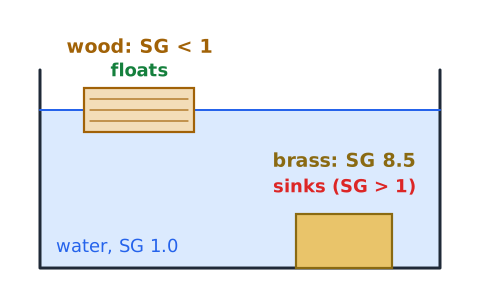
Specific gravity (SG) compares a material's density with the density of water.
Because the units cancel, SG has no units. Water is about 1.0 g/cm³, so a brass part at 8.5 g/cm³ has an SG of 8.5. A number above 1 means the solid sinks in water; below 1 means it floats, which is why many woods and some plastics float. Never write SG with units such as grams; it is a comparison, not a mass.
Hardness is not the same as strength
Hardness is resistance to scratching, denting or local indentation at the surface. Strength is the stress a material can carry before it yields or breaks. The two often rise together in steel, but they are not the same property.
A file is very hard and resists scratches, yet if you drop it on concrete it may snap. A mild steel bar is much softer and easy to file, yet it bends instead of breaking. Testing labs measure hardness by pressing a small hard tip into the surface and checking the size or depth of the dent, not by pulling the part apart.
Mohs hardness: relative scratch ranking
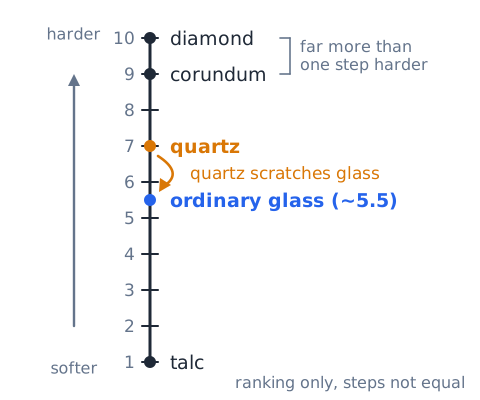
The Mohs scale ranks minerals from 1 (talc) to 10 (diamond) by which one can scratch another. A mineral scratches anything with a lower number and is scratched by anything higher. Quartz at 7 scratches ordinary glass, which sits near 5.5.
The scale is a ranking, not a measurement with equal steps. Diamond at 10 is far harder than corundum at 9, much more than one step's worth. A Mohs number also says nothing about tensile strength or impact behavior; it only tells you the scratch order.
Toughness: absorbing energy before fracture
Toughness is the ability to absorb energy, by bending and deforming, before a crack runs through the material. A tough part survives sudden blows and shock loads.
A sledgehammer head and a cold chisel shank need toughness: they are struck again and again and must not shatter. Rubber and many medium-carbon steels are tough; glass and hardened tool steel are not. Toughness depends on both strength and the ability to deform, so a strong but brittle material can still have low toughness.
Brittleness: fracture with limited plastic deformation
A brittle material breaks with little or no plastic deformation first. It may be strong, but once it reaches its limit it cracks suddenly instead of bending or stretching. The broken pieces often fit back together cleanly because almost nothing was permanently stretched.
Glass, ceramic tile, cast iron and fully hardened tool steel behave this way. In a shop, a brittle part gives little warning before failure. Brittleness also depends on conditions: some steels become more brittle when very cold or when struck sharply.
Ductility: permanent stretching before rupture
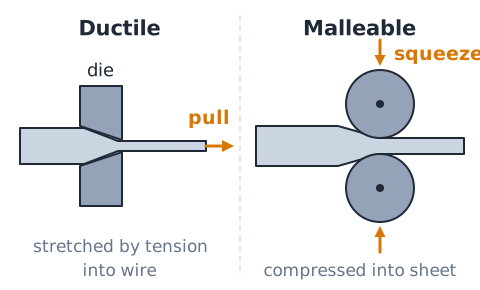
Ductility is the ability to be stretched or drawn out permanently, under pulling (tensile) force, without breaking. Wire drawing is the classic proof: copper rod is pulled through smaller and smaller dies until it becomes thin wire.
Copper, gold, aluminum and low-carbon steel are ductile. A ductile part usually stretches, necks down and bends visibly before failure, giving a warning. In a tensile test, ductility is reported as the percent elongation or the reduction in cross-sectional area at fracture.
Malleability: shaping under compression
Malleability is the ability to be flattened or shaped permanently by squeezing forces, such as hammering, pressing or rolling, without cracking. Rolling a metal into thin sheet or foil depends on malleability.
Gold can be beaten into leaf thin enough to see light through, and aluminum is rolled into kitchen foil. A blacksmith shaping hot steel with a hammer is using malleability too. Ductility deals with pulling, while malleability deals with compression, and many metals have both.
Elasticity: recovering shape when load is removed
Elastic deformation is temporary. When the load comes off, the material springs back to its original size and shape. Inside a metal, the atoms are pulled slightly apart but do not slip past one another.
A steel spring in a door closer, a tape measure blade that flexes and straightens, and a diving board are all working in their elastic range. As long as the stress stays below the elastic limit, the part can be loaded and unloaded many times without a permanent change in shape.
Plastic deformation and permanent set
If the load is large enough to pass the elastic limit, layers of atoms slip past each other and the change becomes permanent. This is plastic deformation, and the leftover change in shape is called permanent set.
A paper clip bent too far stays bent, and an overtightened bolt can stretch so it no longer holds tension. Plastic deformation is useful when forming metal on purpose, but in a finished part it usually means the part was overloaded and should be inspected or replaced.
Stress: load divided by area
Stress is the internal force carried by each unit of cross-sectional area.
Here (sigma) is stress, F is the force in newtons and A is the area resisting it. One newton per square millimeter equals one megapascal (MPa).
Quick use: a rod with a 60 mm² section carries a 9,000 N pull. The stress is
MPa. Double the area and the same force gives half the stress.
Strain: change in length relative to initial length
Strain measures how much a part stretches or shortens compared with its starting length.
is strain, is the change in length and is the original length. The units cancel, so strain is a pure number, often written as a percent.
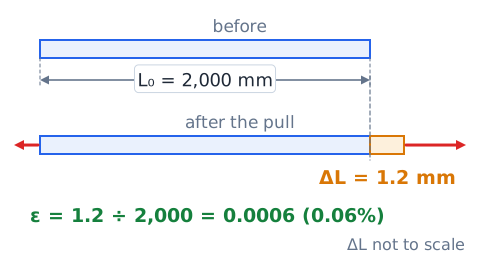
Quick use: a 2,000 mm rod stretches 1.2 mm. Strain is
or 0.06 percent. Always use the same length unit on top and bottom.
Young’s modulus is stiffness, not breaking strength
In the elastic range, stress and strain are proportional. The constant that links them is Young's modulus, E.
A high E means a material is stiff: it stretches very little for a given stress. Steel is about 200 GPa, aluminum about 70 GPa, and wood much lower along the grain. Quick use: 150 MPa of stress with a strain of 0.00075 gives E = 200,000 MPa, or 200 GPa.
E tells you about stiffness, not about how much load causes breaking.
Stiffness of a part combines shape and material
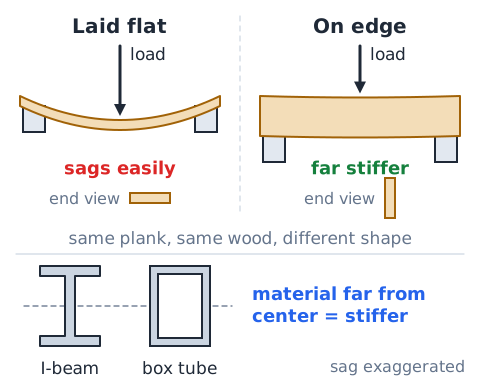
How much a real part bends depends on two things: the material's modulus and the part's shape and supports. Geometry often matters more than the material.
A wooden plank laid flat across two blocks sags easily, but the same plank turned on edge is far stiffer, even though nothing about the wood changed. I-beams and box tubes put material far from the center, which greatly raises stiffness for little added weight. A longer span also bends much more. Changing to a stiffer material helps, but changing shape is often the cheaper fix.
Yield strength versus ultimate tensile strength
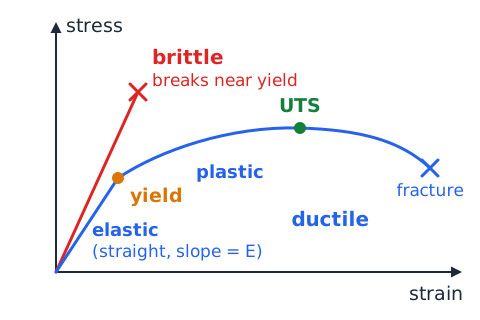
On a tensile test, yield strength is the stress where a material starts to deform permanently. Ultimate tensile strength (UTS) is the highest stress the sample reaches before it begins to neck down and break.
For a ductile steel, UTS is higher than yield, so the part can bend a lot before it parts. Designers usually keep working stress well below yield, because once a shaft or bracket yields it no longer has the correct shape, even if it has not broken. For a brittle material, yield and fracture happen at almost the same point.
Strength in tension, compression and shear
Loads act in different ways. Tension pulls a part apart, as in a hoist cable. Compression pushes it together, as in a column or table leg. Shear makes one layer slide past the next, as in a bolt holding two plates that are pulled in opposite directions, or in scissors cutting paper.
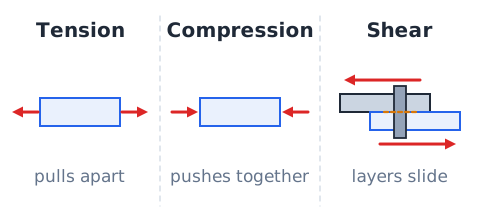
A material's strength can differ greatly between these. Concrete and cast iron are strong in compression but weak in tension. Steel is strong in all three. Always ask which kind of load the part sees before comparing strengths.
Fatigue: repeated loading can matter more than one load
Fatigue is cracking caused by loads that repeat thousands or millions of times, even when each single load is well below the yield strength. A tiny crack starts at a scratch, sharp corner or hole, grows a little with every cycle, and finally the part breaks suddenly.
Bending a paper clip back and forth until it snaps is a quick fatigue demonstration. Axles, crankshafts, springs and vibrating brackets are designed with fatigue in mind. Passing one static load test does not prove a part will last under vibration.
Creep: time-dependent deformation under sustained load
Creep is slow, continuing deformation under a load that stays constant for a long time. Nothing changes in the load, yet the part keeps stretching or sagging month after month.
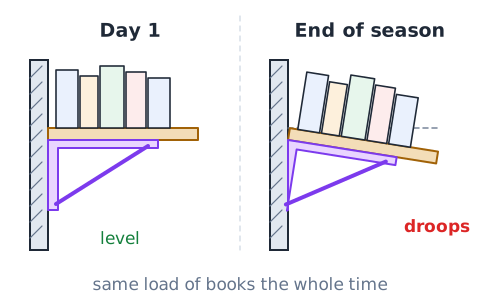
Plastics and lead creep noticeably at room temperature: a plastic shelf bracket holding heavy books may droop over a season. Metals usually need high temperatures for serious creep, which is why turbine blades and boiler tubes use special alloys. If a part must hold a steady load for years, check creep data, not just short-term strength.
Wear resistance and abrasion
Wear is the gradual loss of material from surfaces that rub, slide or meet grit. Abrasion is wear from hard particles or rough surfaces cutting tiny grooves.
Hardness is the main defense. Plow blades, bulldozer edges, drill bits and grinding wheels use hard steels, carbide or ceramic grains. A surface-hardened gear tooth wears much more slowly than a soft one. Keeping dirt out with seals and filters also slows abrasion, because one hard grain of sand trapped between parts can score both surfaces.
Friction, lubrication and material pairings
Friction is the force that resists one surface sliding on another. It depends on the pair of materials and on whether a lubricant is present. Oil or grease puts a thin film between the surfaces so they do not touch directly, cutting friction, heat and wear.
Some pairings work well together, such as a steel shaft running in a bronze bushing. Others can stick or gall, such as stainless steel bolts in stainless nuts tightened dry. Brake pads are a case where high, steady friction is the goal, so lubricant on them is dangerous.
Ferrous metals: iron-rich alloys
Ferrous metals are metals whose main ingredient is iron. The family includes wrought iron, cast iron, carbon steels, alloy steels, tool steels and stainless steels.
Most ferrous metals are strong, relatively cheap and easy to weld or machine, which is why they dominate structures, tools and machinery. Most are attracted by a magnet, and plain ferrous metals rust when moisture and oxygen reach them. Nonferrous metals such as aluminum, copper, brass, zinc and titanium contain little or no iron.
Steel composition and heat treatment
Steel is mainly iron with a small amount of carbon, usually under about 2 percent. More carbon generally makes steel harder and stronger but less ductile. Low-carbon (mild) steel bends and welds easily; high-carbon steel holds an edge in knives and springs.
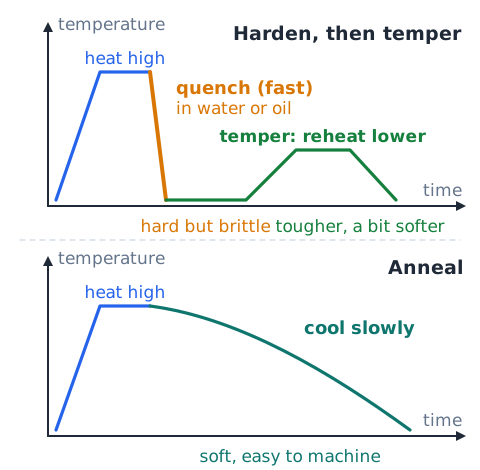
Heat treatment changes steel's internal structure. Hardening heats it and quenches it quickly in water or oil, making it hard but brittle. Tempering reheats it to a lower temperature to trade some hardness for toughness. Annealing heats and cools slowly to soften it for machining.
Cast iron compared with ordinary steel
Cast iron contains more carbon than steel, usually about 2 to 4 percent, often with silicon. It melts at a lower temperature and flows well into molds, so it is used for engine blocks, machine bases, vises and pipe fittings.
Cast iron is strong in compression and damps vibration well, but common gray cast iron is brittle in tension and can crack if dropped or struck. Ordinary steel is tougher and more ductile, so it is preferred where parts must bend without breaking, such as hooks and structural beams.
Stainless steel and corrosion resistance
Stainless steels contain at least about 10.5 percent chromium. The chromium forms a very thin, tough oxide film on the surface that blocks further rusting and repairs itself when scratched, as long as oxygen is present.
Stainless is used for sinks, food equipment, surgical tools and marine fittings. It is not rust-proof in every case. Chlorides from salt water or pool chemicals can cause pitting, and some grades resist corrosion much better than others. Match the grade to the environment instead of trusting the word stainless alone.
Aluminum alloys: lightweight and useful, not universal
Aluminum is roughly one-third the density of steel, conducts heat and electricity well, and forms a protective oxide layer in air. Alloys with copper, magnesium, silicon or zinc can be heat-treated to good strength, which is why aluminum appears in aircraft, ladders, boat hulls and engine parts.
It is not the answer to every job. Its stiffness is about one-third that of steel, so an aluminum part must be thicker to bend as little. It also has a lower melting point, can fatigue, and corrodes when paired with copper or steel in salt water.
Copper and its alloys
Copper is an excellent conductor of electricity and heat, is very ductile and malleable, and resists corrosion in fresh water. That makes it the standard choice for building wire, motor windings, plumbing tubing and heat exchangers.
Copper's alloys add other benefits. Brass, copper plus zinc, machines easily and is used for fittings, valves and decorative hardware. Bronze, traditionally copper plus tin, is hard-wearing and low-friction, so it is used for bushings, bearings and marine propellers. Both are nonferrous and generally not attracted by a magnet.
Electrical conductors versus electrical insulators
A conductor lets electric current flow easily because it has many free electrons. Silver, copper, gold and aluminum are the best common conductors, and copper gives the best balance of cost and performance for wiring.
An insulator strongly resists current. Rubber, most plastics, glass, porcelain, and dry wood are insulators, which is why wires are coated in plastic and tool handles may carry rubber grips. Moisture and dirt can make an insulator's surface conduct, so wet wood or a damp ladder is not safe near live wiring.
Thermal conductivity versus heat resistance
Thermal conductivity is how quickly heat flows through a material. Copper and aluminum move heat fast, which suits heat sinks and cookware bottoms. Foam, wood and fiberglass move heat slowly, which suits insulation and tool handles.
Heat resistance is a different question: can the material survive the operating temperature without melting, softening, burning or losing strength? Aluminum conducts heat well yet melts near 660 °C, while firebrick conducts heat poorly but survives furnace temperatures. Check both properties separately.
Thermal expansion basics
Most materials grow when heated and shrink when cooled. The change in length is
where is the coefficient of linear expansion (per °C), is the starting length and is the temperature change. The answer comes out in the same unit as .
Quick use: an aluminum rail 2,000 mm long has
per °C. A 40 °C rise gives
of growth. Bridges, pipelines and sidewalks have expansion joints for this reason.
Corrosion, galvanic couples and moisture
Corrosion is the chemical breakdown of a metal by its environment. Rust on steel is the familiar example; it needs both oxygen and moisture, and salt speeds it up greatly.
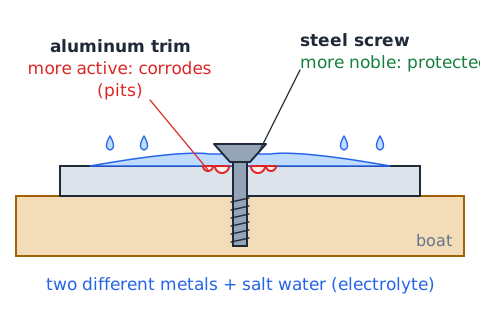
Galvanic corrosion happens when two different metals touch, or are electrically connected, while wet with an electrolyte such as salt water. The more active metal, such as zinc or aluminum, corrodes faster while the more noble metal, such as copper or stainless steel, is protected. Steel screws in aluminum boat trim, or copper pipe joined directly to galvanized steel pipe, are classic problem pairs.
Protective coatings and surface preparation
Coatings protect a metal by blocking moisture and oxygen. Paint, powder coat, oil, plating and galvanizing (a zinc coating on steel) are common choices. Zinc also sacrifices itself, corroding first so a small scratch does not immediately rust the steel underneath.
A coating is only as good as the surface beneath it. Rust, mill scale, oil and dust must be removed by wire brushing, sanding, blasting or solvent cleaning before priming. Paint over loose rust lets corrosion continue under the film, so it bubbles and peels.
Polymers: chains and processing categories
Polymers are materials made of very long chain molecules built from many small repeating units. Plastics, rubbers, many adhesives and nylon fibers are polymers.
They are usually light, electrically insulating and resistant to water and many chemicals. They are also less stiff than metals, soften at fairly low temperatures and may creep. Polymers are grouped by how they behave when heated: thermoplastics soften and can be reshaped, thermosets cure into a permanent shape, and elastomers stretch like rubber.
Thermoplastics and thermosets
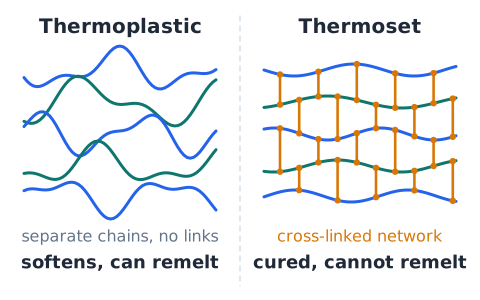
A thermoplastic softens when heated and hardens when cooled, and that cycle can be repeated. Polyethylene, PVC, nylon, acrylic and ABS are thermoplastics; they can be molded, extruded, heat-bent and often recycled.
A thermoset goes through a chemical cure that cross-links its chains into a rigid network. Once cured it cannot be remelted; too much heat only chars or degrades it. Epoxy, polyester resin in fiberglass, phenolic and many electrical-box plastics are thermosets, chosen for heat resistance and dimensional stability.
Rubber and elastomers
Elastomers are polymers that can stretch to several times their length and snap back. Their long chains are loosely cross-linked, so they uncoil under load and recoil when released.
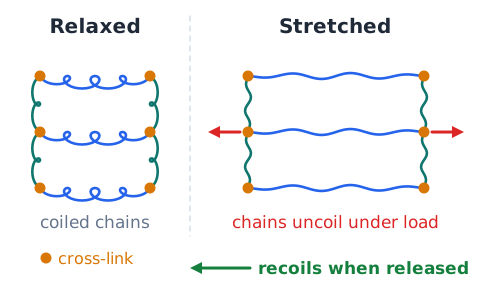
Natural rubber, neoprene, nitrile, silicone and EPDM are common examples, used in tires, hoses, O-rings, gaskets and vibration mounts. Each resists different things: nitrile handles oil and fuel, silicone handles heat, and EPDM handles weather and ozone. Using the wrong elastomer can cause swelling, cracking or a leaking seal, and rubber stiffens badly in extreme cold.
Ceramics and glass
Ceramics are hard, inorganic, nonmetallic materials, usually formed and then fired at high temperature. Brick, porcelain, tile, alumina and silicon carbide are examples. Glass is a related material that cools without forming crystals.
Ceramics are very hard, resist heat and wear, and are good electrical insulators, so they appear in grinding wheels, spark-plug insulators, cutting inserts and kiln linings. Their weakness is low toughness: they are strong in compression but crack under tension, impact or sudden temperature change.
Composite materials and reinforcement
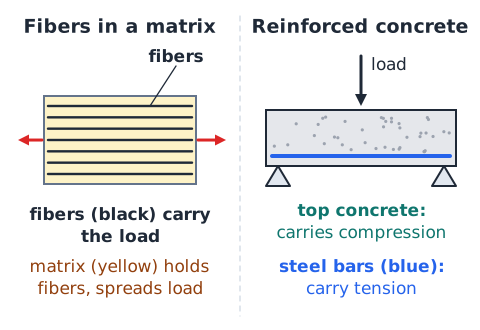
A composite combines two or more materials so the result has properties neither has alone. Usually strong fibers carry the load while a binder, called the matrix, holds them in place and spreads the load among them.
Fiberglass uses glass fibers in polyester or epoxy resin; carbon-fiber parts use carbon fibers in epoxy. Reinforced concrete pairs steel bars, which carry tension, with concrete, which carries compression. Plywood can also be viewed as a layered composite. Composites can be light and strong, but only in the directions their fibers run.
Anisotropy: properties change with direction
A material is isotropic if its properties are the same in every direction, as in a typical piece of cast metal. It is anisotropic if properties depend on the direction of loading.
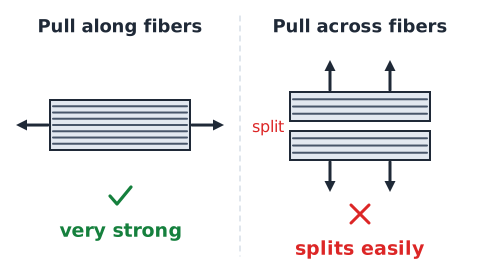
Wood, rolled sheet metal and fiber composites are anisotropic. A carbon-fiber strip with all fibers running lengthwise is very strong along its length but can split easily when pulled across the fibers. Engineers lay fibers in several directions when loads come from several directions, and they check strength in the direction the real load acts.
Wood grain and loading direction
Wood grain is the direction the wood fibers run, roughly along the length of the tree trunk. Wood is far stronger and stiffer along the grain than across it.
A ladder rail or shelf board is cut so the grain runs along its length, carrying load in the strong direction. Short grain, where fibers run across a thin part such as a chair leg, makes a weak point that can snap. Splitting a log with a wedge works because wood separates easily between fibers along the grain.
Hardwood and softwood are botanical terms
Hardwood comes from broadleaf trees that usually lose their leaves, such as oak, maple, walnut and balsa. Softwood comes from conifers, mostly needle-bearing trees with cones, such as pine, fir, spruce and cedar.
The names describe the botanical group, not how hard the wood actually is. Balsa is a hardwood yet is one of the softest, lightest woods there is, while some softwoods such as southern yellow pine are dense and strong. Most framing lumber in US houses is softwood, so softwood is certainly structural.
Moisture content, swelling and shrinkage of wood
Wood absorbs and releases moisture until it balances with the humidity around it. As its moisture content goes up it swells, and as it dries it shrinks.
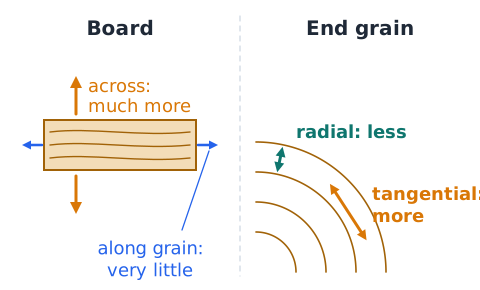
The movement is uneven. Wood changes very little along the grain but much more across it, and tangential shrinkage (along the growth rings) is greater than radial shrinkage. That uneven movement is why boards cup, twist and bow when humidity changes. Letting lumber acclimate in the room where it will be used, and sealing all faces, reduces warping.
Plywood, MDF and solid lumber
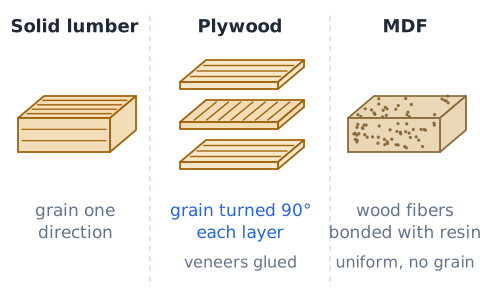
Solid lumber is cut straight from a log. It shows natural grain, can be planed and shaped, but moves with humidity and can warp or split.
Plywood is made of thin veneers glued with the grain of each layer turned 90 degrees to the next. The cross layers restrain each other's swelling, so plywood stays flat and resists splitting, and it is sold in rated grades for sheathing and subfloors. MDF (medium-density fiberboard) is wood fibers bonded with resin; it is smooth and uniform for cabinets and paint, but it is weak in screw holding at edges and swells badly if wet.
Natural defects, knots, checks and splits
Natural defects lower the strength of wood. A knot is the base of a branch embedded in the trunk; the grain bends around it, creating a weak spot, and loose knots can fall out. Checks are cracks along the grain from uneven drying. Splits pass completely through a board, often at its end.
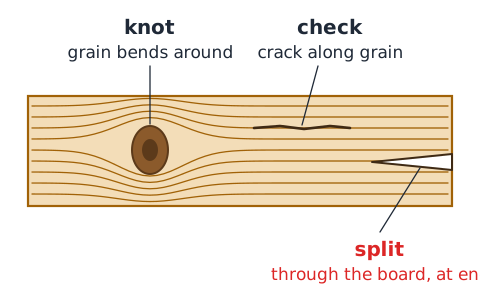
Lumber grade stamps account for these defects. A structural member with a large knot on its tension edge, or a long end split, should be rejected or placed where it carries little load.
Engineered selection: requirements before material
Good material choice starts with the job, not with a favorite material. First list the requirements: load type and size, needed stiffness, temperature range, moisture or chemicals, wear, weight limits, electrical needs, cost and how the part will be made.
Then find which requirement is decisive and choose materials that satisfy all of the rest. A boat cleat needs corrosion resistance first; an electrical handle needs insulation first; a hammer face needs hardness with toughness. Picking "the strongest metal" without that list often fails in another way.
Machinability versus finished-part performance
Machinability is how easily a material can be cut, drilled or turned to size with good finish and reasonable tool life. Brass, aluminum and free-machining steels cut easily; hardened steel, titanium and some stainless grades are difficult.
Easy machining does not mean the finished part will perform well. A free-cutting steel may be less tough or weldable than another grade. Often parts are machined while soft, then heat-treated to full hardness afterward, giving both easy production and good service performance.
Formability and work hardening
Formability is how well a material can be bent, stretched or pressed into shape without cracking. Soft annealed metals form easily.
As a metal is bent or hammered cold, it becomes harder, stronger and less ductile. This is work hardening (or strain hardening). Bend a copper tube several times and it stiffens; keep going and it cracks. Annealing, heating and slowly cooling the metal, restores softness so forming can continue. Sheet-metal workers plan bend order so a section is not worked more than necessary.
Heat treatment versus surface coating
Heat treatment changes the properties of the material itself by heating and cooling it under control. Hardening, tempering, annealing and case hardening all alter the internal structure, sometimes through the whole part and sometimes only near the surface.
A surface coating, such as paint, chrome plating or zinc, is a separate layer added on top. It may improve corrosion resistance, appearance or wear, but it does not change the strength of the steel underneath. A plated bolt and an unplated bolt of the same grade carry the same load.
Grain size, microstructure and property variations
Metals are made of many tiny crystals called grains. The size and arrangement of these grains, the microstructure, strongly affects properties. In general, finer grains give higher strength and toughness, while coarse grains are often weaker and more brittle.
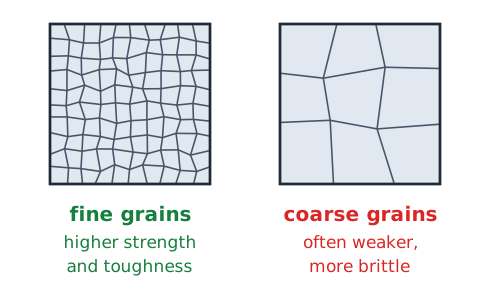
Processing controls the grains. Forging, rolling and heat treatment can refine them; welding and overheating can coarsen them near the hot zone. That is why two parts of the same alloy may behave differently, and why a weld's heat-affected zone can be the weak point in a structure.
Fracture appearance is a clue, not proof
The look of a broken surface gives hints about how a part failed. A ductile break often shows necking, stretched edges and a dull, fibrous surface. A brittle break tends to be flat and grainy or shiny with little deformation. Fatigue breaks often show smooth bands, called beach marks, spreading from a starting point, and then a rough final zone.
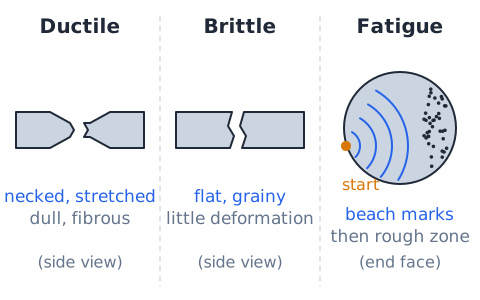
These are clues only. Coatings, corrosion, temperature and later damage can change the appearance, so a serious failure needs lab analysis before blaming the material.
Corrosion-resistant does not mean chemical-proof
A corrosion-resistant material resists attack in certain environments, not in all of them. Stainless steel handles fresh water and kitchen use well but can pit in chlorides. Aluminum is fine in air but is attacked by strong alkalis such as lye. Many plastics shrug off acids but are dissolved or swelled by certain solvents or fuels.
Before using any material near chemicals, check a compatibility chart or the manufacturer's data for that specific chemical, concentration and temperature. The safety data sheet for the chemical also lists incompatible materials.
Heat capacity and thermal expansion are distinct
Specific heat tells how much energy it takes to warm a material. Thermal expansion tells how much the material's size changes when its temperature changes. They answer different questions.
In the first equation, c is specific heat in J/(kg·°C). In the second, is the expansion coefficient per °C. Water has a very high specific heat, but that value says nothing about how much it expands; aluminum has a fairly high specific heat and also a large expansion coefficient. Knowing one value tells you nothing about the other.
Simple thermal energy example
Heat needed to warm a solid, ignoring losses, is
Q is energy in joules, m is mass in kilograms, c is specific heat in J/(kg·°C) and is the temperature rise in °C.
Example: a 3 kg aluminum plate, with c about 900 J/(kg·°C), is heated by 20 °C.
or 54 kJ. The same mass of steel, with c about 450 J/(kg·°C), needs only half as much energy for the same rise.
Material identification by appearance: limits
Color and shine give only a rough hint about a metal. Brass is yellow and copper reddish, but plated steel can look like brass or chrome, and aluminum, stainless steel, zinc and nickel plating can all look similarly silvery.
Weight, a magnet test, a file test for hardness, a spark test and the sound when tapped all add clues. For anything critical, such as lifting gear or pressure parts, rely on markings, mill certificates or proper testing rather than appearance alone.
Magnetic response is not the same as ferrous
Iron, nickel and cobalt can be strongly attracted by a magnet, and so can most carbon steels and some stainless grades. A magnet test is quick and useful, but it does not identify a material by itself.
Common 300-series stainless steels are ferrous yet usually only weakly magnetic, or not magnetic, when annealed, and cold working can make them slightly magnetic. Nickel attracts a magnet but is not ferrous. Plated steel looks like another metal yet sticks. Treat the result as one clue among several.
Bending, torsion and compression in everyday parts
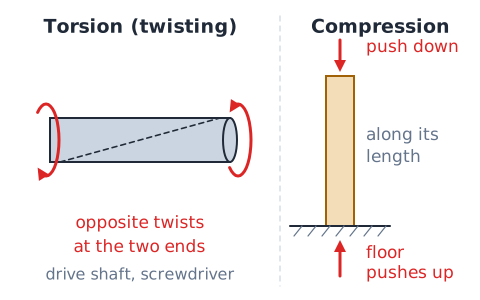
Everyday parts carry loads in different ways. A shelf bracket or diving board is in bending: one face stretches in tension while the opposite face is squeezed in compression. A screwdriver shank or vehicle drive shaft carries torsion, a twisting load. A table leg, jack stand or column carries compression along its length.
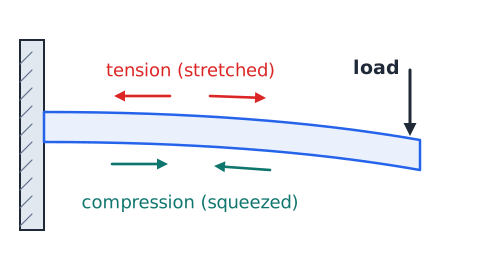
Each load type stresses the material differently, and the shape that works best changes too. Hollow tubes handle torsion efficiently; deep sections handle bending; short thick shapes handle compression.
Buckling is not necessarily crushing
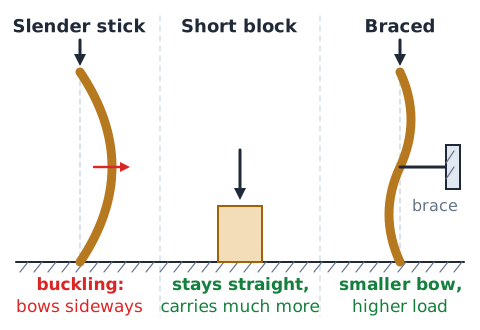
A long, slender column under compression can suddenly bow sideways and collapse even though the material itself is far from being crushed. This instability is buckling.
Press down on a yardstick standing upright and it bends out to the side long before the wood breaks. A short block of the same wood would carry much more load. Buckling depends on length, cross-section shape, the material's stiffness and how the ends are held. Bracing a column at midpoint or using a wider tube greatly raises the buckling load.
Safety: material chips and dust are hazards
Cutting, grinding and sanding throw off chips and dust that can injure eyes, skin and lungs. Wear safety glasses or a face shield, and handle sharp metal chips with a brush or pliers, never bare hands.
Fine dust from wood, many plastics and metals such as aluminum or magnesium can burn, and in a cloud it can even explode. Keep dust collection systems clean, avoid letting dust pile up on ledges, and follow the shop's procedures for combustible dust. Some dusts, such as certain hardwoods, silica or lead, also harm health and need ventilation or respirators.
Cutting sparks do not establish chemical identity
A spark test holds a metal against a grinding wheel and watches the sparks. Low-carbon steel gives long, plain yellow streaks; higher-carbon steel produces bright bursts; cast iron gives short reddish streaks. Many nonferrous metals produce little or no spark.
These patterns help an experienced worker sort scrap, but they cannot give an exact grade or chemical composition. Lighting, wheel speed and pressure change the look. When exact identity matters, use markings, certificates or a laboratory analysis.
Recycling marks do not specify engineering strength
The triangle symbols with numbers 1 to 7 on plastic items are resin identification codes. They tell recyclers what type of plastic the item is made of, such as 1 for PET or 2 for high-density polyethylene.
They say nothing about strength, temperature rating, food safety for a particular use, or chemical resistance. Two items stamped with the same code can differ widely in grade, thickness and additives. For an engineering part, use the manufacturer's material data and ratings, not the recycling mark.
Trade-off example: light outdoor housing
A small electronics box will be mounted outside on a pole. It must be light enough to install by hand, survive rain and sun for years, and protect the circuit inside.
Painted steel is strong but heavy and will rust where the paint chips. A UV-stabilized polycarbonate or glass-filled nylon housing is light, cannot rust and insulates electrically, but plain plastics may yellow and crack in sunlight. Powder-coated aluminum is light, corrosion resistant and conducts heat away from electronics. The choice depends on which requirement is most important.
Trade-off example: cutting tool versus impact tool
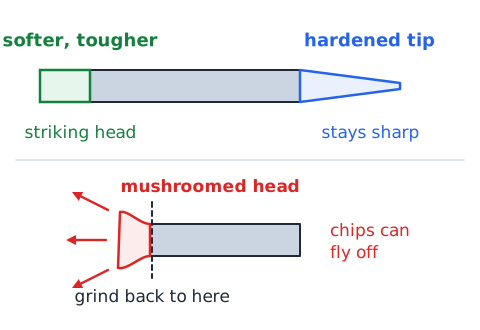
A chisel's cutting edge and its striking head need different balances. A cutting edge must be very hard so it stays sharp while slicing; a little brittleness is acceptable because the edge is supported and loaded smoothly.
The striking head of a chisel or punch must be tough. If it were as hard as the cutting edge, a hammer blow could chip off a fragment and send it flying. Tool makers therefore harden the tip and leave the head softer. A head that has mushroomed should be ground back for the same safety reason.
Trade-off example: saltwater fastener
A dock builder needs bolts to hold aluminum fittings to a wooden pier in seawater. Plain carbon steel bolts would rust quickly. Copper or brass bolts against aluminum would set up a strong galvanic couple and eat away the aluminum.
A better choice is a corrosion-resistant grade such as 316 stainless steel, isolated from the aluminum with plastic washers or sleeves, or aluminum-compatible fasteners. The decisive property is corrosion behavior in salt water with the specific metals involved, not raw strength.
Worked example: density and equal dimensions
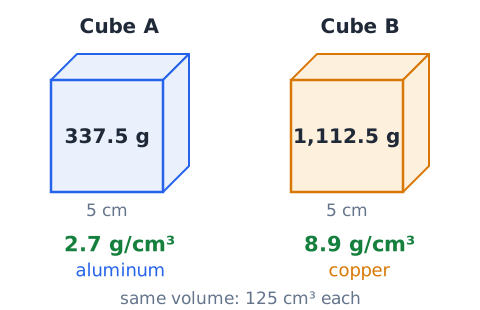
Problem: two cubes each measure 5 cm on every edge. Cube A has a mass of 337.5 g and Cube B has a mass of 1,112.5 g. Find each density and suggest a likely metal.
Volume is the same for both:
Cube A:
which matches aluminum.
Cube B:
close to copper.
Answer: equal size, so the heavier cube is the denser one, by a factor of about 3.3.
Worked example: engineering stress and safe interpretation
Problem: a round steel rod 10 mm in diameter carries a 12,000 N pull. Its yield strength is 250 MPa. Is it safe?
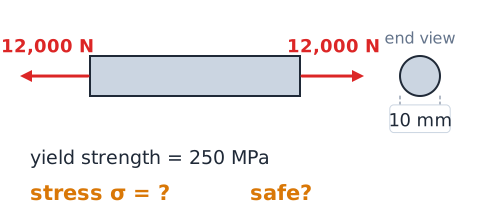
The stress is below yield, so the rod should not deform permanently. The margin is 250 ÷ 153, about 1.6. That is a small margin if the load could jump suddenly or vibrate, so a designer would likely want a larger rod.
Worked example: elastic strain and modulus
Problem: an aluminum bar 800 mm long has E = 70 GPa. It carries a stress of 105 MPa. Find the strain and the stretch.
Convert E to MPa: 70 GPa = 70,000 MPa.
Answer: strain of 0.15 percent and a 1.2 mm elongation, which disappears when the load is removed.
Worked example: thermal expansion in millimeters
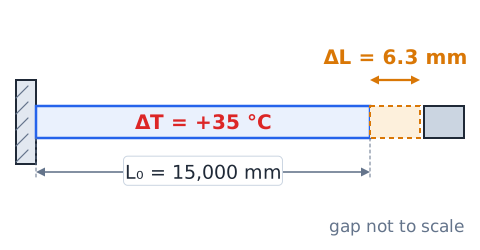
Problem: a steel rail 15 m long has
per °C. On a hot day it warms by 35 °C. How much gap does it need?
Convert length first: 15 m = 15,000 mm.
Answer: about 6.3 mm of growth. Without that gap, the rail would build up large compressive stress and could buckle sideways.
Worked example: area and material comparison
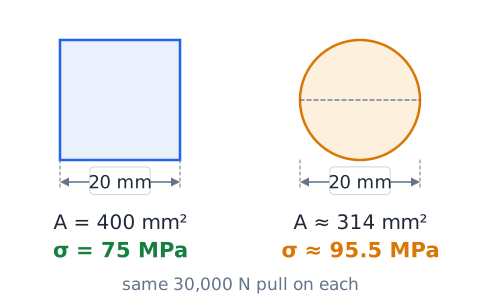
Problem: a 30,000 N pull acts on either a square bar 20 mm on each side or a round bar 20 mm in diameter. Which has more stress?
Square:
mm², so stress =
MPa.
Round:
mm², so stress ≈ 30,000 ÷ 314 ≈ 95.5 MPa.
Answer: the round bar has about 27 percent more stress because it has less area. If both are the same steel, the square bar has the larger margin.
Worked example: units and conversion traps
Problem: a 6,000 N load rests on a pad of area 0.0003 m². Find the stress in MPa.
In SI base units:
Since 1 MPa = 1,000,000 Pa, that is 20 MPa. Check another way: 0.0003 m² is 300 mm², and
N/mm² = 20 MPa.
Watch for traps: 1 m² = 1,000,000 mm², not 1,000; 1 GPa = 1,000 MPa; and 1 g/cm³ = 1,000 kg/m³.
Common trap: hardness versus toughness
The trap: assuming that a hard material is also tough. Many students see "hard" and picture something that cannot break.
Why it is wrong: hardness is about resisting scratches and dents; toughness is about absorbing energy without cracking. Glass and a file are hard yet shatter when struck. Rubber is soft yet very tough.
The fix: when a question mentions scratching, wear or indentation, think hardness. When it mentions impact, shock or sudden blows, think toughness. Some tools, like saw blades, need both.
Common trap: ductile versus malleable
The trap: mixing up ductile and malleable because both describe metals that change shape without breaking.
Why it is wrong: the difference is the type of force. Ductility is permanent stretching under tension, the key to drawing wire. Malleability is permanent flattening under compression, the key to rolling sheet or hammering.
The fix: link "ductile" with "drawn into wire" and "malleable" with "hammered or rolled flat." If the question says wire, choose ductile; if it says sheet or foil, choose malleable.
Common trap: conductivity versus corrosion
The trap: assuming a good electrical conductor must also resist corrosion, or that a shiny metal must be rust-free.
Why it is wrong: conductivity is a physical property, while corrosion is a chemical reaction with the environment. Copper conducts superbly yet turns green outdoors, and steel conducts reasonably but rusts quickly. Pairing two good conductors in salt water can even cause galvanic corrosion.
The fix: answer conductivity questions with conductivity data, and corrosion questions with the environment and grade.
Common trap: wood family and grain
The trap: believing every hardwood is hard and every softwood is weak, or that wood is equally strong in all directions.
Why it is wrong: hardwood and softwood are botanical groups. Balsa is a hardwood yet very soft, and Douglas fir is a softwood used for heavy framing. Wood is also much stronger along the grain than across it.
The fix: for strength questions, think grain direction, species data and grade, not the hardwood or softwood label.
Test strategy: use the decisive property
Shop and mechanical questions usually hinge on one key word. Find the property that the scenario truly tests, then choose the answer that names it.
Words like scratch or dent point to hardness. Blows or shock point to toughness. Wire points to ductility; sheet points to malleability. Springing back points to elasticity, staying bent to plastic deformation. Repeated cycles point to fatigue, and slow sag under steady load points to creep. Eliminate choices that are true facts but answer a different question.
Guided drill: build a selection matrix
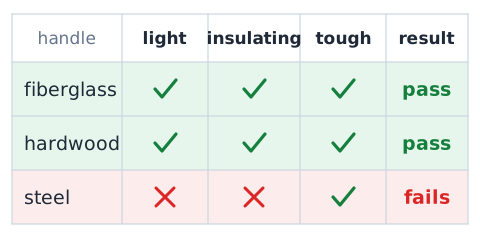
Practice making a quick selection matrix. Write the requirements across the top and candidate materials down the side, then mark which pass.
Prompt: a garden tool handle must be light, insulating and tough. Answer: fiberglass or hardwood pass; steel fails on weight and insulation.
Prompt: an engine cylinder head must conduct heat and be light. Answer: aluminum alloy passes; plain plastic fails on heat resistance.
Prompt: a chemical tank lid must resist acid and not corrode. Answer: a suitable polymer such as polyethylene passes; plain carbon steel fails.
Guided drill: reason through a changing environment
Ask how each choice changes when the environment changes.
Prompt: a steel bracket indoors works well. It is moved to a beach house. What new concern appears? Answer: corrosion from salt air, so a coating or stainless grade is needed.
Prompt: a plastic clip is moved next to an engine. Answer: heat softening and creep.
Prompt: a wooden door is installed in a damp basement. Answer: swelling, sticking and possible rot from higher moisture content.
Prompt: an aluminum frame is used outdoors in winter. Answer: shrinkage from thermal contraction at joints.
End-of-lesson recall checklist
Before moving on, check that you can do the following without notes.
Name the major material families and give an example of each. Separate physical, mechanical and chemical properties. Define hardness, toughness, brittleness, ductility, malleability, elasticity, plasticity, fatigue and creep, each with a shop example. Calculate density, stress, strain, Young's modulus, thermal expansion and heat energy with correct units. Explain thermoplastic versus thermoset, hardwood versus softwood, and why grain matters. State why galvanic corrosion and combustible dust are hazards.
 English ▾