 ASVAB Camp
Test-Day Mission and Learning Objectives
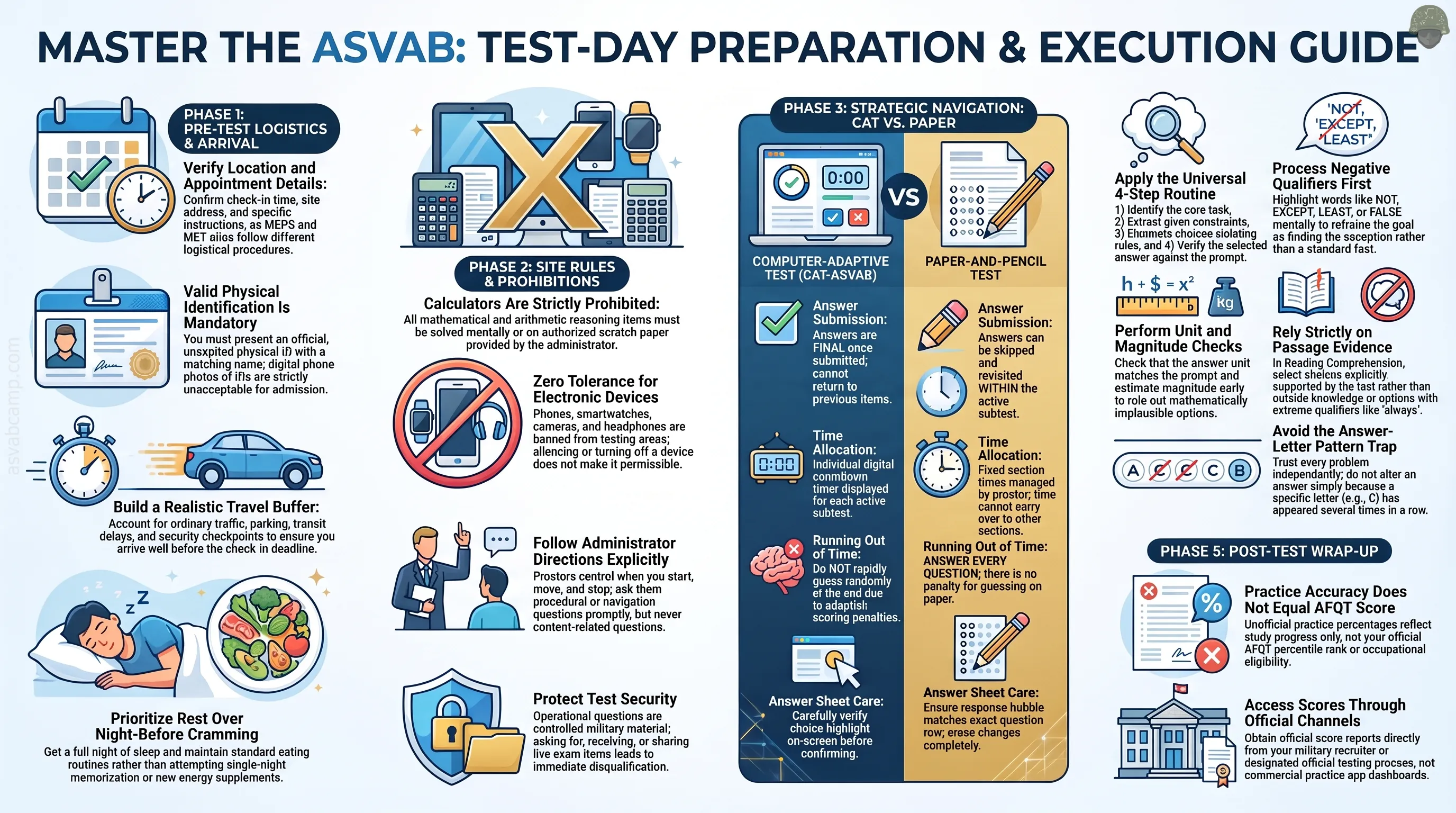
The purpose of test-day preparation is to make it possible to demonstrate what you know without avoidable administrative or procedural errors. By the end of this lesson, you should be able to distinguish official requirements from helpful personal routines; verify your appointment, location, and identity documents; follow rules about devices and assistance; and choose an appropriate strategy for a computer-adaptive or paper test. The objective is execution, not predicting secret questions or promising a particular score. This course is independent educational preparation, not an official testing authority.
Verify the Appointment Before You Travel
Confirm the exact date, arrival or check-in time, site address, and any instructions supplied by your recruiter or authorized testing representative. A Military Entrance Processing Station and a Military Entrance Test site may have different check-in logistics. Do not assume that a location used for an earlier meeting is your current testing location. Save essential directions in an accessible form that will not require taking a prohibited device into the testing room. If information conflicts, resolve the discrepancy with the authorized contact before leaving home.
Identification Is an Admission Requirement
The official ASVAB applicant guidance states that valid identification is needed for admission to MEPS or MET testing. Verify the specific form of ID your appointment instructions require, including whether the name matches your registration and whether the document is current. A photograph of an ID on a telephone should not be assumed equivalent to the required document. Keep identification reachable during authorized check-in, but follow the administrator's directions once seated. An excellent academic preparation plan cannot replace an admissible identity document.
Build a Realistic Arrival Buffer
Being late can result in being turned away and having to reschedule. Work backward from the official check-in time, accounting for ordinary traffic, public transportation, parking, security, and the route from the entrance to the designated desk. A personal travel buffer is a planning aid, not a new universal examination rule; no single number of minutes fits every location. If a transportation problem occurs, contact the official appointment contact rather than inventing alternative entrance procedures. Arrival planning reduces uncertainty before the first question appears.
Sleep, Meals, and the Evening Before
Official ASVAB preparation advice recommends getting plenty of rest the night before testing. Organize travel information and necessary identification early enough that last-minute packing does not replace sleep. Choose a familiar eating and hydration routine suitable for your situation, rather than experimenting with new energy products. These are general study-performance practices, not medical advice or guarantees of a higher score. A brief review of familiar strategies is usually more sensible than trying to memorize an unfamiliar subject in a single night.
A Checklist Must Separate Rules and Preferences
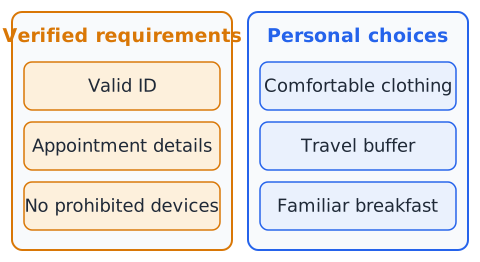
Write two categories: verified requirements and optional personal preparation. Valid ID, appointment details, and prohibited testing devices belong in the requirements category because official directions control admission and conduct. Comfortable clothing, travel buffers, and a familiar breakfast are personal decisions unless your specific site gives additional directions. Do not create a rule such as 'everyone must arrive exactly forty-five minutes early' without a corresponding official instruction. Treat your appointment notice and test administrator as authoritative when circumstances differ from generic advice in this lesson.
Secure Phones and Other Electronics
Current Department of Defense MEPS testing rules prohibit cameras, cellular telephones, and other personal electronic devices within testing areas. Arrange beforehand where your possessions can be lawfully left or stored, according to the specific location's instructions. A silent phone is still a personal electronic device; disabling notifications does not make it permissible at a testing station. Avoid carrying headphones, smartwatches, tablets, or similar devices into a restricted area without explicit authorization. This applies to the testing area, not necessarily to every building or reception area.
No Calculator During the ASVAB
The official ASVAB applicant guidance states that a calculator cannot be used on the ASVAB. That prohibition includes treating a phone's calculator function as a workaround. Prepare to solve arithmetic reasoning and mathematics problems through authorized mental work and permitted scratch procedures, if supplied or allowed by the administrator. Do not presume that a commercial practice application's calculator feature reflects examination policy. If a math question looks difficult, check units, estimate magnitude, and work methodically rather than seeking an unauthorized device.
Respect Test Security and Controlled Questions
Operational ASVAB questions are controlled testing materials. Applicants should neither distribute nor request specific live questions, and unauthorized assistance may lead to disqualification or other penalties. Practice with publicly available official sample questions or original educational problems, not alleged leaked answer keys. In the testing room, keep your attention on your own materials and obey instructions about conversation and movement. Claims that an unofficial vendor possesses current hidden test items are a warning sign, not a legitimate shortcut for preparation.
The Administrator Controls Room Procedures
Listen fully to the proctor or test administrator before beginning each section. Their procedures determine when you may start, which materials you may use, and when you may leave the room. Ask an authorized procedural question if a direction is unclear; do not silently improvise a rule borrowed from another institution's exam. A person giving the test cannot normally provide the answer to a live question, but may clarify permitted testing procedures. Follow site-specific instructions even when they are more detailed than an online summary.
Recognize MEPS, MET, and PiCAT Differences
For applicants, the ASVAB can be administered at MEPS or MET sites, while the unproctored PiCAT is a separate online administration arranged through a recruiter. The format, time limits, score access, and verification process are not identical. Do not apply an at-home PiCAT workflow to a scheduled proctored examination room. This lesson primarily addresses MEPS/MET test-day execution. If your appointment is actually for PiCAT or its verification test, obtain the correct instructions for that particular administration rather than relying on the wrong checklist.
Know Which Format You Will Take
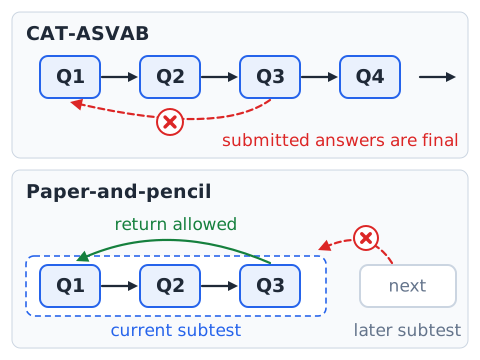
Computer-adaptive CAT-ASVAB and paper-and-pencil ASVAB measure related subject content but use different navigation procedures. Confirm your assigned format through your recruiter or testing instructions. CAT-ASVAB chooses later items adaptively and does not permit returning to a question once answered and submitted. The paper version permits reviewing answers within the active subtest, subject to the administrator's timing directions. Practicing the wrong navigation strategy could cost time or leave questions unanswered. The format should be known before deciding when to skip, guess, or check work.
Computer-Adaptive Test: Commit Deliberately
On a proctored CAT-ASVAB, a submitted answer is final; the examinee cannot return to that question. Read the full stem, identify qualifiers such as NOT or EXCEPT, compare the plausible answers, and then commit. Avoid making the confirmation keystroke before you have checked that the intended option is selected. This does not mean spending unlimited time on each problem. Instead, use enough focused reasoning to avoid preventable errors while still respecting that the subtest has its own time limit.
Paper Test: Review Within the Active Subtest
The official paper-and-pencil strategy allows an examinee to answer known questions and return later to difficult items within that subtest when time permits. It does not authorize revisiting an earlier completed subtest or moving ahead before instructed. Paper answer sheets also require careful alignment: a correct solution recorded on the wrong row may be counted incorrectly. If you change a marked answer, follow directions for a complete erasure. The advantage of review exists only inside the permitted time and section boundaries.
The Timer Belongs to Each Subtest
Proctored CAT-ASVAB imposes time limits by subtest and displays the remaining time and question count for the current subtest. Do not assume that time left in one subtest can be carried over to another. The existence of experimental tryout items can affect the number of questions and allotted time, so memorizing one table of minute counts is not a substitute for reading the actual screen. Use the displayed timer as a guide, check progress periodically, and avoid frequent compulsive clock-checking that interrupts reasoning.
Paper Administration Also Has Strict Boundaries
Paper-and-pencil testing uses fixed question counts and time limits for each subtest. Even if you finish early, you should not advance to another booklet or section until the administrator directs you to do so. If you have time remaining in the current active subtest, check omitted answers, negative qualifiers, and answer-sheet alignment. When time is called, stop immediately and follow collection instructions. The entire appointment can include administrative processing outside the scored question periods, so arrival and departure planning should not rely only on summed subtest minutes.
CAT Guessing Is Not Identical to Paper Guessing
Official ASVAB guidance distinguishes the two formats when time is short. Paper-and-pencil examinees are advised to answer every question; there is no penalty for guessing on that format. The CAT-ASVAB guidance cautions against rapidly selecting random responses at the end of a subtest because of its scoring procedures. Instead, try to read and legitimately answer each CAT question. Elimination and educated guesses remain legitimate, but an end-of-section burst of arbitrary clicks is not the recommended substitute for reasoning.
Reading Directions Saves More Than It Costs
Every subtest defines what counts as an acceptable answer and how to navigate its interface or paper answer sheet. Spending a short, authorized interval understanding directions prevents repeated confusion later. Clarify whether multiple options are ever permitted before assuming a different format; standard practice questions here have one correct choice, but live instructions always prevail. Watch for unit requirements, definitions, and the question's actual target. Directions are not filler; they establish the conditions under which your knowledge can be measured.
A Universal Four-Step Question Routine
Use a compact routine that fits most original practice questions: identify the task, extract the given information, reject choices that violate a clear constraint, and verify the selected response. For reading questions, locate evidence instead of relying on a familiar-sounding sentence. For mathematical questions, check the relationship and units before calculating. For spatial tasks, track orientation and connection points rather than shape color. The same routine can be adapted to different content areas without assuming that every test item uses the same method.
Process Negations Before Looking for Familiar Words
Qualifiers such as NOT, EXCEPT, LEAST, or FALSE can reverse what a stem requests. Mark the qualifying word mentally, then restate the task as 'find the one that does not satisfy the usual rule' when appropriate. A choice that describes a generally correct fact may be wrong if the question asks for an exception. Do not select an option just because its terminology resembles a textbook heading. Read each choice as a claim that must be tested against the exact wording of the question.
Arithmetic Without Electronic Aids
When a calculator is unavailable, arithmetic structure matters. Simplify fractions before multiplying, factor numbers for manageable products, and estimate a reasonable range for the answer. For a rate problem, track numerator and denominator labels so distance per hour is not confused with hours per distance. If a problem asks for a percentage change, divide the change by the original value rather than the final value. Scratch procedures depend on testing instructions; use only the materials or methods allowed at the site.
Check Units to Catch Implausible Answers
A reliable final check asks whether the selected answer has the requested unit. A distance problem should not produce hours unless it asks for travel time. A percentage must be interpreted relative to the correct base. If the stem gives feet and seconds, converting too early or combining unlike quantities can create distractors. Estimate first: if forty units are split among five equal groups, a proposed answer of two thousand is implausible. Unit checks are particularly useful when four answer options look numerically close.
Reading Comprehension: Prefer Passage Evidence
In a paragraph-comprehension item, choose the claim supported by the passage rather than an appealing real-world assumption. Identify whether the question asks for the main idea, a stated detail, or a reasonable inference. An inference should follow from the text without adding a new fact. When choices differ by words such as always and sometimes, check whether the passage supports that strength of claim. A correct-sounding option can still be wrong when it imports information that the paragraph does not establish.
Word Knowledge: Meaning in Context
Word Knowledge requires determining a word's meaning, frequently by identifying the closest synonym. A word may have multiple dictionary senses, so attend to its use in the provided question. Eliminate options that contradict the core sense or differ substantially in strength. Familiar roots and prefixes can help but do not override context. When uncertain, evaluate the remaining words rather than picking the longest or most formal-sounding choice. This method is useful in both timed practice and official testing without relying on answer-letter patterns.
Science and Technical Reasoning Under Time Pressure
Science, electronics, mechanical, automobile, and shop questions reward principles more than last-minute name recognition. Draw on basic causal relationships: what a force does, how a circuit behaves when opened, why friction changes motion, or how a tool is used safely. Reject choices that conflict with the physical setup before arguing about small details. Do not over-generalize a rule: a lever's advantage depends on arm lengths, and electrical measurements require correct circuit conditions. Reasoning from constraints is usually stronger than recalling an isolated slogan.
Spatial Assembly: Preserve Marks and Orientation
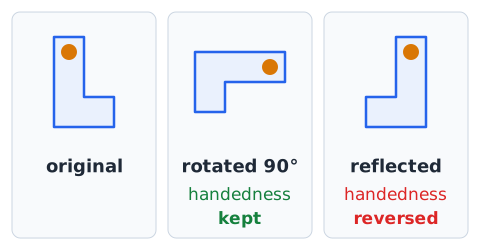
On Assembling Objects items, identify mating features, distinct endpoints, and any marks that must stay connected to their parts. Rotation is not the same transformation as reflection: rotating a piece does not reverse its handedness. If a proposed combined shape changes the order of distinctive notches, reject it even if the silhouette appears similar. Track which edges become internal boundaries and which remain visible on the outside. Use a deliberate feature checklist rather than mentally spinning every possible option without a plan.
When Two Answers Seem Possible
If two choices survive the first pass, find the smallest constraint that differentiates them. In mathematics, substitute each candidate into the original relationship. In reading, locate the precise sentence that supports or rules out a claim. In mechanical problems, compare directions, contact points, and force balance. In spatial questions, track one asymmetric feature or marked corner. Choose on evidence, not on how often you have selected a particular answer letter. A short targeted comparison is often better than restarting the entire question from scratch.
Avoid the Answer-Letter Pattern Trap
The official test is not reliably solvable by guessing that correct answers follow a cycle such as A, B, C, D. A practice quiz may balance its answer key, but that is not a prediction of operational exam keys. Treat every question independently. Likewise, answer length and vocabulary complexity do not prove correctness. Selecting the first plausible option without checking the others invites avoidable error. Your evidence should come from the stem and relevant content, not from the apparent randomness of choices.
If You Experience a Technical Problem
If the computer freezes, the screen behaves unexpectedly, or you cannot understand an interface instruction, follow the official help or proctor procedure instead of restarting hardware yourself. Ask for authorized assistance promptly; a testing administrator can address an operational issue without giving you a substantive test answer. Do not use a personal phone to troubleshoot from the testing area. Keep attention on preserving proper testing conditions rather than trying to exploit or conceal a malfunction. Exact restart arrangements depend on the official system and staff.
If You Feel Rushed or Distracted
First distinguish a real subtest time limit from a momentary sense of urgency. Look at the official display when appropriate, return attention to the current question, and use the shortest reliable solution method you know. Noise or uncertainty about instructions should be handled through the permitted proctor procedure, not whispered discussion with another examinee. A personal calming routine can support focus, but it should not interfere with timing or site rules. The priority remains careful, legitimate responses to the questions presented.
Do Not Share Testing Materials
A live question remembered after the exam is still part of a controlled assessment. Do not photograph, reproduce, post, or trade operational items or answer keys. The ASVAB program explicitly warns against receiving or disclosing specific test-question information. If another person claims to sell protected questions, do not assume the material is authentic or authorized. You can discuss general subject areas and preparation methods without distributing confidential content. Original practice questions like those in this course are designed for learning, not for duplicating current secure test forms.
Separate Procedural Questions from Content Help
It can be appropriate to ask a proctor how to navigate a screen, where to enter a response, or what the posted directions mean. It is not appropriate to request the correct answer to an exam item. Consider the difference between 'Which key submits a completed response?' and 'Which fraction is the correct one?' The first concerns authorized administration; the second seeks prohibited assistance on the substance of the test. Ask procedural questions through the approved channel, and avoid talking with other test takers during the assessment.
Protect the Answer Sheet on Paper
On a paper-and-pencil administration, the answer sheet is a separate scoring object. Before marking a response, verify the question number and correct row. Mark only one answer when required, and make a full erasure when changing your selection. A repeated row shift can spoil multiple answers even when your calculations were right. Use a practical check at natural breakpoints rather than repeatedly counting every bubble. Never work in a previous or future subtest against instructions just to correct a suspected marking error.
Reasonable Time Budget for One Practice Set
Suppose an unofficial practice set has twenty questions and a thirty-minute target. Dividing thirty by twenty gives an average of one and a half minutes per question, but it does not require exactly ninety seconds on every item. Some calculations need more reasoning, and some facts take less time. This practice arithmetic is not a claim about official ASVAB subtest timings. On the actual exam, use its displayed limits and question count, and remember that tryout items can alter CAT-ASVAB allocations.
Work Example: Travel-Time Buffer
A candidate expects a fifty-minute trip and schedules an additional twenty minutes for ordinary variability. Their planned travel allocation is seventy minutes, not fifty plus another full examination hour. This calculation is a personal scheduling example, never a universal arrival requirement. If the testing notice gives an earlier mandatory check-in deadline, follow that official deadline. When comparing route choices, consider reliability and lawful check-in requirements rather than treating the shortest map prediction as a guarantee of arrival.
Work Example: Percent Correct Is Not AFQT
A candidate answers twenty-four of thirty original practice questions correctly. The practice accuracy is eighty percent. It does not establish that the candidate has an official AFQT percentile of eighty, a standard score of eighty, or eligibility for a particular occupation. Official ASVAB scores result from the standardized military testing and scoring process, including designated subtests and norm-based reporting. Use practice results to find conceptual gaps, not to advertise a predicted score or enlistment qualification.
Work Example: Paper Skip-and-Return
In a paper subtest, an examinee reaches an unfamiliar item with adequate time remaining and several easier questions still ahead. Following official preparation guidance, the examinee may leave the item temporarily and return within that same active subtest before time ends. The examinee cannot decide to revisit that section once a later section begins. Apply this method only when the test format and the administrator's instructions permit it. The identical strategy fails in CAT-ASVAB because submitted computer-adaptive items cannot be revisited.
Work Example: CAT Confirmation Check
A CAT-ASVAB candidate solves a problem and believes the correct option is C, but the interface currently highlights B. The candidate should correct the selection before submitting. After confirmation and advancement, the response is final. This is a question about careful interface execution, not about which letter is usually right. When a screen is unfamiliar, read the displayed instructions and ask authorized procedural help if needed. Never assume a highlighted choice automatically matches the answer you intended to give.
Work Example: Handling an Unauthorized Device
A candidate realizes that a smartwatch remains on their wrist while approaching a restricted testing area. Turning off sound alone is not adequate compliance with prohibitions on personal electronics. The correct action is to follow the site's approved storage or handling procedure before entering, asking staff when necessary. The candidate should not hide the watch or claim it is a regular wristwatch if it remains an electronic device. Proactive compliance protects the integrity of the test and avoids an unnecessary disciplinary problem.
Work Example: Read the Exception Correctly
Consider a checklist question asking which action is NOT consistent with official ASVAB rules. Three options may describe arriving with identification, following administrator directions, and refraining from calculator use. A fourth proposes consulting a phone during a math item. Because the stem asks for the exception, the fourth choice is the target even though it is a bad practice. Recognizing the negative qualifier is the reasoning task; trying to choose the most generally approved behavior would reverse the requested answer.
Work Example: Dividing an Error-Review Session
A learner budgets forty-eight minutes to examine twelve original practice errors. If every review takes equal time, the average is four minutes. The learner may instead spend extra time on a recurring ratio misconception and less on a simple transcription slip. The arithmetic gives a planning reference, not a strict clock to impose during the actual ASVAB. Diagnostic review happens during preparation; during an official CAT item you cannot stop the exam to conduct a long retrospective analysis of a previous answer.
Final Check: Before Leaving Home
Confirm identity documents, the verified testing destination, current appointment details, a transportation route, and any written instructions from your recruiter. Check the site's rules about personal belongings and prohibited electronic devices. Bring only items you are directed or permitted to bring; do not assume textbooks, scratch paper, or calculators will be allowed. A final checklist should be short enough to execute reliably. The aim is to prevent an administrative surprise, not to create a new source of stress through elaborate rituals.
Final Check: At the Testing Site
Arrive according to your confirmed check-in requirement, present identification as directed, and cooperate with security or administrative screening. Ask permitted procedural questions before the section begins if a direction is unclear. Put away personal electronics in the authorized manner, and do not access notes or prohibited materials during testing. Remain alert to where the administrator instructs you to sit and when you may begin. Test-day compliance is part of competent execution, independent of your knowledge of math, words, or technical subjects.
Final Check: Before Submitting a Response
Identify what the stem actually asks; review the selected choice against that task; and confirm that a negative qualifier, sign, unit, or marked feature has not been overlooked. On CAT-ASVAB, this is the last opportunity to correct an answer before submission. On paper, check that the bubble aligns with the intended item. Keep the check brief and targeted because each section is timed. Do not change a selection only because one answer letter has appeared several times in a row.
Final Check: When Time Is Running Out
On the paper-and-pencil test, official guidance encourages answering every question and revisiting skipped items within the current subtest when allowed, because random guessing is not separately penalized. On CAT-ASVAB, do not blindly rush through arbitrary responses at the end; instead read and legitimately answer as many remaining items as possible. These differences matter because CAT scoring uses adaptive procedures. Always obey the actual section timer and the administrator's instructions instead of substituting a generic app countdown strategy.
When the Session Ends
Follow the authorized procedures for finishing the test, returning materials, and departing. Do not photograph screens, discuss controlled live questions, or retain testing materials unless explicitly permitted. For score information, use the recruiter or official process described for your test format; computer, paper, and PiCAT administrations may differ in when results become available. A practice-app dashboard is not an official score report. If something seems unusual in the official process, ask the authorized contact rather than relying on social-media rumors.
Scope and Limits of This Checklist
This lesson describes common official ASVAB rules but does not replace your individualized testing instructions. Rules can change, and your location may have additional operational procedures. The Department of Defense controls actual examination administration and score processing. This paid educational app neither administers an official ASVAB nor has access to protected live questions. The checklist cannot guarantee admission, a score, or a military assignment. Confirm changing details from current official sources and your authorized testing representative.
Mini Scenario: Identify the Only Valid Sequence
Imagine a candidate who confirms the site, brings the prescribed identification, stores electronics according to the administrator, listens to directions, and answers questions deliberately. This sequence is compatible with published guidance. Replacing any one step with 'arrive late', 'use a smartwatch calculator', or 'trade live answers' creates a clear conflict with test rules. Practice recognizing the binding requirements that make the sequence valid. This skill helps distinguish a genuine prerequisite from a merely helpful personal preference.
Mini Scenario: Choose a Format-Specific Strategy
Two candidates face difficult items. The first is taking the computer-adaptive ASVAB and should reason before submitting because earlier answers cannot be revisited. The second is using paper under instructions that allow checking within the current subtest; that candidate may return to a skipped item if time remains. Neither is authorized to work ahead into future subtests without permission. Their different choices do not suggest different intelligence levels; they follow different administration rules. Know the distinction before applying any timing tactic.
Lesson Summary and Actionable Takeaways
Success on test day means demonstrating real skills through an authorized process. Verify the appointment, location, required ID, arrival instructions, belongings policy, and test format; rest beforehand; and listen to official directions. During questions, identify the task, evaluate evidence, check key qualifiers, and follow the correct CAT or paper navigation rule. Never use prohibited electronic aids or share operational questions. Afterward, rely on official score channels. Practice examples in this lesson teach execution and do not imply privileged access to ASVAB content or guaranteed outcomes.
 English ▾