 ASVAB Camp
What You Will Learn
This final lesson explains how to plan a lawful ASVAB retest and select trustworthy preparation resources. You will distinguish an initial administration, first retest, second retest, and later retests; interpret the official waiting periods; recognize circumstances involving confirmation tests or invalidated sessions; and build a study plan without promising a particular outcome. You will also practice verifying web addresses, challenging advertisements that claim to sell real exam answers, and protecting personal information. This is an educational explanation, not scheduling permission or legal advice. Confirm the individual appointment with your recruiter or authorized testing staff.
A Retest Is a New Official Administration
A retest is an authorized additional administration of the ASVAB after an earlier valid attempt. It is not another chance to submit answers for an already completed computer-adaptive session and is not the same as repeating an app practice set. The authorized test operator schedules official testing under eligibility, timing, and security requirements. This distinction matters because a student can repeat original educational questions whenever useful, but an official candidate cannot simply reserve a new ASVAB date without considering the retest policy. Track the dates of actual administrations, not the dates you opened a commercial practice app.
Locate the Official Retest Rule
The ASVAB Enlistment Testing Program publishes an explicit Retest Policy under its recruiter resources. The policy states that the wait between an initial test and first retest is one calendar month. A second retest requires another one-calendar-month wait. Further retests have a six-calendar-month waiting requirement. These conditions are program rules, not estimates of how long someone needs to study. An unofficial website may describe them inaccurately as thirty days or provide a simplified slogan. Always consult the official policy before setting a date, especially when a specific calendar month has fewer than thirty-one days.
First Retest: One Calendar Month
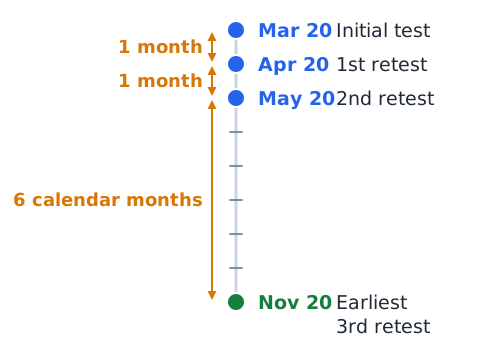
Imagine a valid initial ASVAB on March 20. Under the standard one-calendar-month rule, a first retest can be given on or after April 20. March 21 or April 19 would not satisfy this example, even if a candidate felt prepared. The waiting period follows the official test date, not the date the candidate first reviewed the scores or spoke to a recruiter. Since there may be site availability and appointment requirements, April 20 is an earliest-policy example rather than a guaranteed appointment. Verify whether a proposed testing date is permitted before purchasing travel or making related commitments.
Second Retest: Another Calendar Month
A candidate who completed a first retest on April 20 may ordinarily take a second retest on or after May 20. The key is that the second one-month interval begins at the first retest, not at the original March test. Counting a month only from the very first sitting can produce an invalid plan. Also distinguish a second retest from a second total attempt: the initial administration is attempt one, the first retest is attempt two, and the second retest is attempt three. Correct labels prevent mistakes when reading policy examples and discussing a record with authorized staff.
Third and Later Retests: Six Months
After two retests have been administered, the standard waiting period for another retest is six calendar months from the second retest. The same six-month spacing applies to later retests. For example, if the second retest took place on May 20, November 20 is the relevant six-month date under the ordinary rule. Do not confuse six calendar months with six weeks or an arbitrary one-hundred-eighty-day promise. Exceptional cases, testing validity, and changes to official policy warrant confirmation with the current program administrator. A retest date can be policy-eligible without being available at a particular testing location.
Student Tests and Enlistment Tests
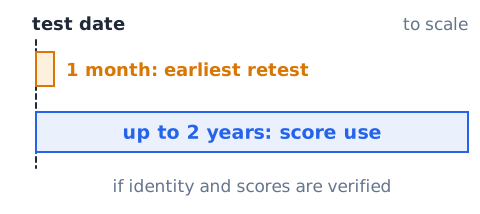
A common misconception is that an ASVAB taken at school is a completely separate history that resets the waiting clock for enlistment testing. The published official retest policy says the policy is the same regardless of whether the initial examination was a student test or an enlistment test. Applicants therefore need to disclose and verify relevant prior administrations when scheduling. A school score may also be usable for enlistment for up to two years when the result can be verified as belonging to the candidate. This does not guarantee qualification or override separate enlistment requirements. Ask authorized staff how the record applies in a particular case.
What a Calendar Month Means
Official examples measure calendar months by dates, such as March 20 to April 20, rather than describing a fixed thirty-day period. This distinction becomes especially important for test dates near the end of a short month. The official examples do not necessarily resolve every possible month-end situation. Instead of inventing a date, identify the actual administration date, locate the relevant official rule, and ask the authorized scheduler to confirm eligibility where the calendar is ambiguous. A commercial course should not issue a definitive appointment authorization. Treat waiting intervals as minimum conditions, not as proof that an appointment has been booked.
Wait Period Versus Study Period
The official minimum wait is a scheduling rule, while the study period is a personal preparation decision. An individual can need more than one month to close gaps in fractions, reading comprehension, or technical concepts. Conversely, preparation readiness does not erase the mandatory waiting period. A sensible plan treats eligibility and readiness as two independent checkboxes: first, establish when another official administration is permitted; second, decide whether available evidence shows a meaningful change in skills. If the candidate cannot explain previously missed concept types, an immediate eligible retest may be less useful than targeted review.
Score Validity Is a Different Clock
ASVAB scores can generally be used for enlistment for up to two years after the examination date when identity and score verification conditions are met. This two-year use period is distinct from the one-month and six-month retest intervals. A candidate should not assume that a score becomes invalid at the earliest available retest date or that a valid score guarantees placement in a chosen service job. The official applicant FAQ explains both score use and the percentile meaning of AFQT. Confirm what record, score, and remaining period apply with authorized recruiting staff rather than relying on a cached commercial article.
AFQT Is Not an App Quiz Percentage
An app test showing thirty-two correct answers out of forty provides eighty percent raw practice accuracy. That eighty percent is not automatically an official AFQT percentile of eighty. The official AFQT derives from ASVAB performance in Arithmetic Reasoning, Mathematics Knowledge, Word Knowledge, and Paragraph Comprehension, using standardized methods. The distinction matters when deciding whether a retest may be worthwhile. Use practice correctness to diagnose subjects and recurring misconceptions, not to claim an exact official future score or promise military entry. Never present a self-scored quiz result as a verified ASVAB report.
Large AFQT Gains and Confirmation Tests
The published official policy identifies a critical AFQT gain, illustrated by an increase of twenty or more points within a six-month period, as a circumstance that may require a confirmation test, also called a C-Test. That confirmation procedure is not simply another ordinary paid practice examination. The official policy has its own scheduling treatment, including a possible immediate confirmation administration rather than the usual one-month retest wait. Do not conclude that a large improvement is prohibited, fraudulent, or automatically accepted. Follow the precise confirmation instructions provided by the authorized program staff and avoid guessing about validity before the formal review.
Confirmation Tests Are Not Normal Retests
A C-Test checks a qualifying score gain under the program's confirmation policy. It should not be counted as a standard retest for casual planning without consulting the detailed policy, because the timing rules differ. After a confirmation test, the official policy can require six months before a further standard retest. The conditions also distinguish a confirmation no-show from completing the confirmation. For a realistic timeline, record the type of event beside each date rather than writing every event as simply 'another ASVAB.' When an applicant receives a notice about confirmation, the notice and authorized personnel govern the next action.
Administrative Invalidation and Testing History
A test invalidated for an administrative reason, such as a site disruption, may be treated differently from a completed valid test. The official policy indicates that an invalid initial session for administrative reasons does not count as the initial test. An invalid retest also has special treatment, including use of another form and reference to the applicable original administration. Do not assume a disrupted test always resets the record in the same way. Ask staff to distinguish administrative invalidation, a voluntarily missed appointment, and a scored official session. The precise classification matters more than a commercial website's simplified retest calculator.
Cheating Invalidation Has Serious Consequences
The official retest policy treats a test invalidated for cheating differently from an administration invalidated for administrative problems. The published policy includes a six-month wait after an initial or first/second retest invalidated for cheating. That is not a loophole for starting over, and other consequences may also apply under testing rules. Legitimate practice focuses on original examples and independent understanding, never acquiring or distributing controlled operational questions. If a seller invites a candidate to photograph the test screen or share remembered questions, decline and consult the test operator. Protecting test integrity matters more than a proposed shortcut.
Read the Entire Policy, Not Just a Chart
A compact retest table is helpful but may omit critical-gain confirmations, no-shows, invalidation categories, student-versus-enlistment distinctions, and verification requirements. The official retest page contains detailed scenarios for a reason. When planning an actual retest, identify which scenario applies to the applicant's test history and compare all relevant facts. The safest educational response to an unclear case is to ask an authorized recruiter or testing office to resolve the status. This lesson can teach a decision process but cannot adjudicate an individual record, override test-center scheduling, or promise that a particular proposed date will be accepted.
Who Can Confirm a Retest Appointment
An authorized recruiter or testing administrator can help determine whether and when a candidate may be scheduled. An app, content publisher, anonymous chat account, or seller of 'priority test slots' cannot confer official eligibility. For planning, prepare the previous administration date, test type, and any documented invalidation or confirmation notices. Keep relevant records secure. Ask what documentation the local site requires and whether the test is a computer-adaptive ASVAB, paper administration, or another authorized program. Distinguish a statement that a candidate is eligible from the separate confirmation that a time and location are reserved.
Use the Official ASVAB Domain
The public official Enlistment Testing Program website is officialasvab.com. Verify the complete hostname before treating a page as an authoritative source, especially if an advertisement uses a lookalike spelling. The domain's official retest, applicant FAQ, and preparation disclaimer pages are particularly important for this lesson. A secure HTTPS connection protects transport but does not by itself prove a website is the federal program's official site. A paid educational platform can be useful, but it should identify itself as independent rather than implying military sponsorship. Use a known official address entered directly or a trusted official link.
Know What 'Official' Means
An official policy page comes from an authorized government or ASVAB Enlistment Testing Program source. A blog that quotes or paraphrases policy is a secondary explanation even if the article looks professional. A practice website calling its questions 'official style' has not demonstrated access to genuine operational test questions. Look for the publisher, original source, date, and whether the claim aligns with the actual official guidance. If the seller claims endorsement, check whether the official program itself states that endorsement. The program explicitly says it does not recommend specific commercial courses or authorize the sale of live correct answers.
Official Preparation Disclaimer
The ASVAB Enlistment Testing Program warns that third parties claiming actual ASVAB test questions or guaranteed passing scores through paid services are misleading. It states that it does not provide live questions to external preparation businesses, endorse paid score-guarantee programs, or authorize anyone to sell the test's correct answers. A candidate need not reject every commercial textbook to heed that warning. The key is truthful representation: independent practice can teach skills, but access to secured operational items and guaranteed results are unsupported claims. An ethical application clearly identifies original practice items and acknowledges the absence of official endorsement.
Free and Legitimate Preparation Sources
Official ASVAB resources direct applicants to sample questions, foundational courses in mathematics, English, and science, the ASVAB Career Exploration Program's free materials, and the Army's free March2Success learning program. These resources can be used to orient preparation and check broad topic coverage. A free resource does not guarantee a specific military job any more than a paid resource does. Choose activities that address observed mistakes: arithmetic reasoning when word problems cause errors, paragraph comprehension when conclusions are missed, and technical review when terminology is unfamiliar. Follow the official site's current links rather than an unfamiliar download mirror.
Commercial Materials Have Limited Claims
A legitimate commercial ASVAB preparation product may offer explanations, original practice questions, diagrams, and a structured schedule. It should not promise admission, falsely claim government certification, or represent an app quiz as an official score report. Its value must be judged by factual accuracy, realistic examples, clear feedback, and transparent limitations. When evaluating subscriptions, read renewal, refund, and data collection terms before paying. Do not purchase any bundle advertised as the 'current answer key' to secure test questions. Commercial learning resources can supplement official material, but they cannot issue a retest date or replace the administered examination.
The 'Guaranteed Pass' Warning Sign
An advertisement might claim 'Pay today and we guarantee your AFQT will be above a certain threshold.' The official program explicitly rejects paid guarantees that imply privileged access or endorsement. Real performance depends on the individual, standardized testing, and rules outside a vendor's control. A score-guarantee slogan is especially suspicious if accompanied by secrecy, pressure, or threats that a limited offer will disappear. Evaluate the evidence instead: Are the questions original? Are explanations sound? Does the product disclose that it is unofficial? A responsible tutor can set study goals but cannot certify a future score or service eligibility.
'Real Questions' and 'Leaked Keys' Are Not Prep
Operational ASVAB questions are controlled material. An offer to provide photographed screens, memorized current items, a live test database, or an insider answer key should be rejected. Even when the seller demonstrates plausible-looking examples, the claims do not prove authenticity. Attempting to use unauthorized material jeopardizes test fairness and can trigger serious consequences. Study legitimate released samples and newly authored practice questions instead. If someone offers private copies from a recent sitting, do not buy, forward, or reproduce them. A candidate's goal is to improve competence, not acquire confidential material that the official testing program protects.
Protect Identity and Financial Information
A suspicious site may ask for a Social Security number, government identification image, bank-card details, or test account credentials to 'unlock' results or a priority retest. Unofficial preparatory courses normally do not need such sensitive records to teach basic math and reading. The official ASVAB disclaimer warns that even its public contact form is not a secure way to submit personally identifiable information. Use authorized channels for official paperwork and verify the recipient before sharing anything sensitive. Treat links in unsolicited direct messages with caution, and do not infer authenticity merely from military-themed logos or a reassuring padlock icon.
Lookalike Links and Fake Endorsements
Fraudsters can make a web address appear similar to officialasvab.com by altering letters, adding misleading subdomains, or displaying a fake federal seal. Before entering information, inspect the domain itself and navigate through the known official website rather than relying on an advertisement's destination. A social-media page can post genuine military images without becoming an authorized testing office. Likewise, an independent app can provide useful practice while remaining unaffiliated with the government. Test the claim of endorsement against an actual official statement. When no official evidence exists, describe the product accurately as third-party educational material and avoid sharing sensitive records.
Pressure, Secrecy, and False Urgency
A message saying that 'only three guaranteed score packages remain' combines false certainty with pressure to purchase immediately. Other warning signs include requests to keep the service secret, pay through irreversible transfers, or send an identification document outside an authorized portal. Such tactics replace educational evidence with fear of missing out. A reasonable candidate can pause, cross-check the policy, compare available free preparation resources, and consult the official testing office. A real retest eligibility decision does not depend on paying a private account for a shortcut. Record suspicious claims for reporting rather than engaging with alleged answer-key sellers.
Use a Three-Question Credibility Check
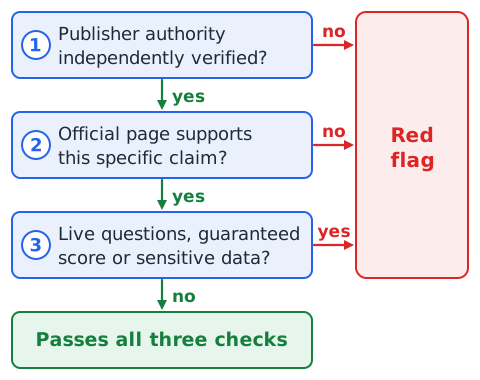
When evaluating a preparation claim, ask three questions. First, who made the claim and can the publisher's authority be independently verified? Second, does an authentic official page support the specific statement, not merely the broad topic? Third, does the offer involve live questions, an allegedly guaranteed score, or sensitive information that an educational provider does not need? This decision process is more reliable than trusting a high search ranking or star rating alone. Apply it equally to advertisements, videos, downloadable PDFs, recruiter impersonations, and products promoted through messaging apps. Cite the original official page when explaining any rule to others.
Build a Retest Decision Record
A simple paper worksheet can record the dates and status of previous official ASVAB administrations, the reason a retest is being considered, and the skills needing improvement. Include columns for test number, administration type, valid or invalid status, policy scenario, authorized confirmation, and next study action. Candidates can maintain sensitive official records in channels they control. The record exists to avoid confusing practice attempts with official tests. A plan is not completed until the candidate independently verifies proposed scheduling with an authorized testing administrator.
Classify Weakness Before Choosing a Resource
An incorrect practice answer may come from a missing fact, calculation error, misunderstood vocabulary, hurried reading, or weak spatial visualization. Different errors need different repairs. For example, failing to convert two-thirds into sixths is a fractions problem, not an argument for buying 'secret' ASVAB questions. Misreading 'except' in a passage is a comprehension and attention issue. Use a few original practice problems to determine whether the difficulty persists. Then choose a targeted lesson, worked example, or legitimate free resource. The goal is a specific improvement in reasoning, not simply completing as many random quizzes as possible.
Focus on the AFQT Subtests When Relevant
The official AFQT is computed from Arithmetic Reasoning, Mathematics Knowledge, Word Knowledge, and Paragraph Comprehension. If the immediate concern is an AFQT threshold, reviewing these tested skills may be particularly relevant. However, the ASVAB includes other subtests that contribute to service job qualification decisions; a desired occupational specialty may demand broader preparation. An independent app should not imply that every applicant should ignore non-AFQT areas. Clarify the purpose of the retest with authorized staff, then allocate study time to the skills implicated by the actual goal. Remember that an app's raw quiz percentage is not the standardized AFQT percentile.
Read an Error Explanation Actively
After choosing a wrong option, identify why the selected reasoning failed and why the correct option follows from the evidence. Do not merely memorize the letter A, B, C, or D. For a rate problem, write the relevant units and check that the result's magnitude is sensible. For vocabulary, connect the correct meaning to the sentence. For spatial assembly, compare rotations with mirror images rather than guessing from appearance. Then solve a new, independently authored item that tests the same rule. A short written explanation of the correction is more informative than repeating the identical question until its answer becomes familiar.
Schedule Against the Actual Wait
A study plan should fit the allowed official interval without implying it can change that interval. If the next retest is not permitted for one calendar month, use the time to practice under realistic conditions and address persistent errors. For a later six-month interval, distribute lessons and periodic review rather than cramming the entire schedule at the end. Eligibility dates remain subject to authorized confirmation. The candidate may choose to study longer than the minimum. Do not schedule a real appointment merely because a practice app counts down to a date; local administration, availability, verification and exceptional policy cases require separate official handling.
Example: A Four-Week Study Allocation
Suppose a candidate has four weeks for legitimate skill building, with five study days each week and forty-five minutes each day. The planned total is twenty sessions, or fifteen hours. One possible allocation is six sessions of arithmetic reasoning, five of mathematics knowledge, five of language skills, and four of mixed review. These are personal scheduling choices, not a mandated ASVAB curriculum. Adapt the allocation to actual gaps and job-related subtests. Monitor whether error types disappear in fresh practice questions. Do not treat the completion of twenty app sessions as a right to an appointment or as evidence of an official score.
Example: Review Time Versus Test Time
A candidate has sixty minutes available and plans thirty-five minutes of independent practice followed by twenty-five minutes of reviewing mistakes. The sum is sixty minutes, so the plan fits the available block. The purpose of the review segment is to identify the specific rule behind each error. If the candidate only circles incorrect answers without understanding them, the extra time may add little value. When time is constrained, shorter sets with clear feedback can be more productive than repeatedly using the same long set. This is a study-planning example and is not an official ASVAB subtest time allowance.
Choose Evidence, Not an Imagined Passing Probability
An improvement from eighteen of thirty correct practice answers to twenty-four of thirty is a six-answer increase, or twenty percentage points in raw accuracy. That does not establish a twenty-point AFQT gain, predict a required C-Test, or guarantee that an official retest result will improve. Different original practice sets may vary in difficulty, and standardized ASVAB scores are computed differently. Treat the change as a reason to inspect which skills have improved and which remain uncertain. Confirmation-test rules refer to actual official AFQT changes under the published conditions, not informal quiz accuracy differences.
Review Two-Year Score Use Carefully
A verified school ASVAB score may be usable for enlistment for up to two years from its test date. This does not mean every applicant will enter service automatically, that all jobs remain open, or that the same score is valid without verification. A candidate should ask the authorized recruiter which scores are on record and which current entry or job rules apply. The two-year score-use statement also does not nullify official waiting rules for a new test. Keeping these different timelines separate prevents costly misunderstandings. An educational course must never promise to extend score validity or alter a government record.
Know When to Ask About Exceptions
Unusual circumstances can include an invalidated administration, a critical AFQT gain, a required confirmation, a confirmation no-show, or a prior school examination. These are reasons to read the full official retest policy and contact the testing staff, not reasons to improvise a favorable rule. Prepare the facts and ask for the specific policy classification that applies. Do not assume that an administrator's correction of a disrupted test is the same as a candidate requesting a voluntary additional attempt. The correct answer in an ambiguous educational scenario may be 'verify with the official test authority' rather than a made-up calendar date.
Worked Case: Initial, First, and Second
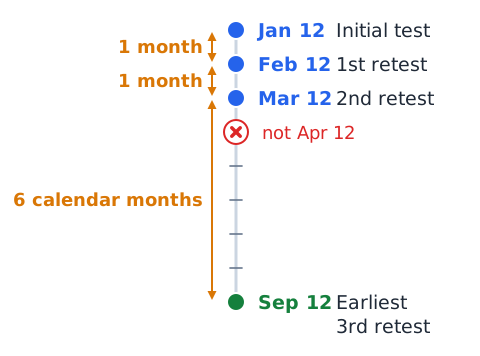
Consider a candidate who took a valid initial ASVAB on January 12, a first retest on February 12, and a second retest on March 12. These three events meet the ordinary one-calendar-month spacing examples. Under the standard policy, the next ordinary retest after the second is subject to a six-month interval, pointing to September 12, not April 12. This worked case assumes all administrations were valid and no special confirmation rules apply. A real appointment must still be confirmed through an authorized scheduler. The example illustrates the correct sequence, not the existence of a reserved testing place.
Worked Case: Two Attempts Versus Two Retests
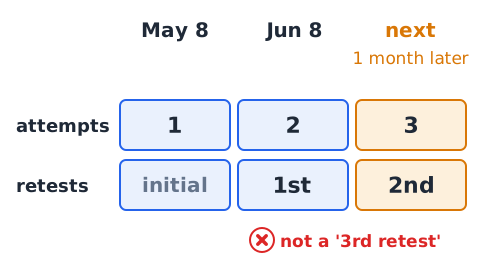
Suppose Maya initially tests on May 8 and retests on June 8. She has taken the ASVAB twice in total but has completed only one retest. Under the ordinary policy, her next attempt is the second retest, which has another one-calendar-month interval after June 8. Calling this event a 'third retest' would incorrectly introduce the six-month rule. Always count actual retests separately from the initial administration. This simple naming distinction is especially important when a commercial summary says 'the third time' without explaining whether that means three tests overall or three retests.
Worked Case: Suspicious Score Guarantee
A vendor offers a 'government-certified answer key' with a guaranteed qualifying AFQT score if the customer pays immediately and submits identity documents. Three independent red flags appear: a false or unverified endorsement, a guarantee of standardized score outcomes, and a claim to provide secured answers. Official guidance rejects actual-question sellers and paid score guarantees. The correct decision is not to buy or share personal information; instead, review official free preparation sources and report misleading activity through an appropriate official channel. A professional-looking checkout page cannot turn an unauthorized claim into a legitimate test preparation product.
Worked Case: The School Examination
An applicant completed the ASVAB through a school program on October 14 and hopes to take an enlistment ASVAB on October 25. The official retest policy states that student and enlistment initial administrations follow the same waiting framework, so the applicant cannot assume an eleven-day gap is automatically permitted. First establish the official status of the earlier school test and verify the earliest permissible retest with authorized personnel. If the prior score is appropriate and verifiable, ask whether it may be used for the relevant application. Avoid treating a change in testing location or purpose as an automatic reset of the clock.
Worked Case: Claimed Practice Score Jump
A student scores fifty percent on one original practice set and seventy-five percent on another. The gain is twenty-five percentage points of raw accuracy on those two sets. It is not necessarily a twenty-five-point official AFQT gain, and it cannot itself trigger or waive an ASVAB confirmation policy. Investigate whether the second set was easier or whether the student solved new problems more consistently. An official C-Test policy concerns qualifying changes in actual reported AFQT under defined time circumstances. Do not buy an expedited confirmation appointment based on an unofficial practice score graph.
Worked Case: Administrative Disruption
A testing session is stopped because of a building emergency, and the candidate receives a notice that the administration was invalidated for administrative reasons. The appropriate next step is to preserve the authorized notice and ask the testing office which scenario in the official retest policy applies. An invalidated initial exam may not count as an initial administration, while a retest invalidated administratively has its own detailed treatment. The candidate should not self-report the event as a cheating invalidation or a valid scored sitting. A clear event classification avoids applying the wrong one-month or six-month timeline.
Worked Case: Minimum Date Is Not Booking
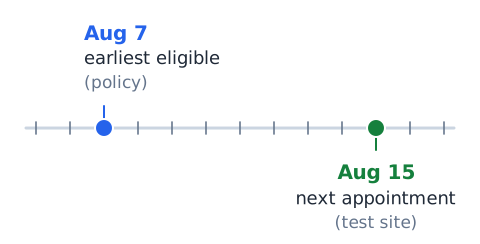
A candidate's standard first retest would become policy-eligible on August 7. The local test site, however, offers the next available appointment on August 15. Those are two different facts: August 7 is the earliest timing example, while August 15 may be the actual scheduled date after verification. An independent learning application cannot promise a seat for August 7. Practical preparation involves confirming the testing location, admission requirements, and official scheduling confirmation. The same principle applies to subsequent retests: satisfying a waiting interval does not automatically create an appointment or bypass normal applicant checks.
Build a Safe Source List
Maintain a short reference list with the official ASVAB retest policy, applicant FAQs, the official test-preparation disclaimer, and official sample questions. For relevant career decisions, use verified government or authorized service recruiting sources. Record the date a rule was checked because policies and occupational qualification criteria can change. Link to source pages directly instead of re-hosting an unofficial PDF that may be outdated or altered. When you study retest policy, check the authority behind each rule and keep original practice separate from protected official items. This makes future updates and independent fact checking easier.
Report Rather Than Amplify Suspicious Claims
If a seller appears to offer current ASVAB answers or an endorsed guaranteed-score scheme, avoid reposting the alleged question content. Use the official ASVAB preparation disclaimer's reporting information or an appropriate recognized reporting channel. Preserve only what is necessary to describe the misleading claim, and do not submit sensitive personal data to an insecure form. Reporting helps protect other candidates but does not itself validate a future retest or obtain a refund. A legitimate educational response stays focused on safe sources and original practice. Do not negotiate access to purported leaked items merely to 'verify' whether they are authentic.
Final Ethical Preparation Checklist
Before an authorized retest, confirm the actual test history and policy category, obtain scheduling guidance, and choose targeted original study material. Check whether the preparation vendor clearly discloses its independent status, avoids score guarantees, respects protected testing content, and publishes sources for important rules. Practice interpreting evidence rather than memorizing answer letters. Do not treat raw practice accuracy as an AFQT percentile. Recheck the official testing site's current instructions for identification, devices, and arrival time. These steps reduce preventable mistakes but cannot promise admission, an occupational assignment, or a particular official score.
Exam-Style Reasoning: Apply the Policy Precisely
A strong answer identifies the exact stage of the testing sequence, distinguishes normal and exceptional administration types, and applies the official calendar-month interval. For fraud questions, test the actual claims: government endorsement, access to operational questions, guaranteed AFQT results, and requests for sensitive information. Eliminate statements that convert unofficial practice into official scores or turn an earliest retest date into a confirmed booking. When a question lacks necessary facts about validity or a special confirmation event, a definitive invented date is not justified. The correct reasoning is transparent, cautious, and grounded in the published program policy.
Lesson Summary and Next Action
The standard ASVAB retest progression is one calendar month after the initial test, another calendar month after the first retest, and six calendar months for subsequent retests. Special cases include confirmation tests for certain critical AFQT gains and different treatment of invalidated administrations. Student and enlistment tests share the retest policy. Scores may be usable for up to two years when verified, but a score-use period is not a retest interval. Consult officialasvab.com, reject live-question sellers and guaranteed-score offers, protect personal information, and build targeted study using legitimate free and original resources. Confirm individual dates and requirements with authorized personnel.
 English ▾