 ASVAB Camp
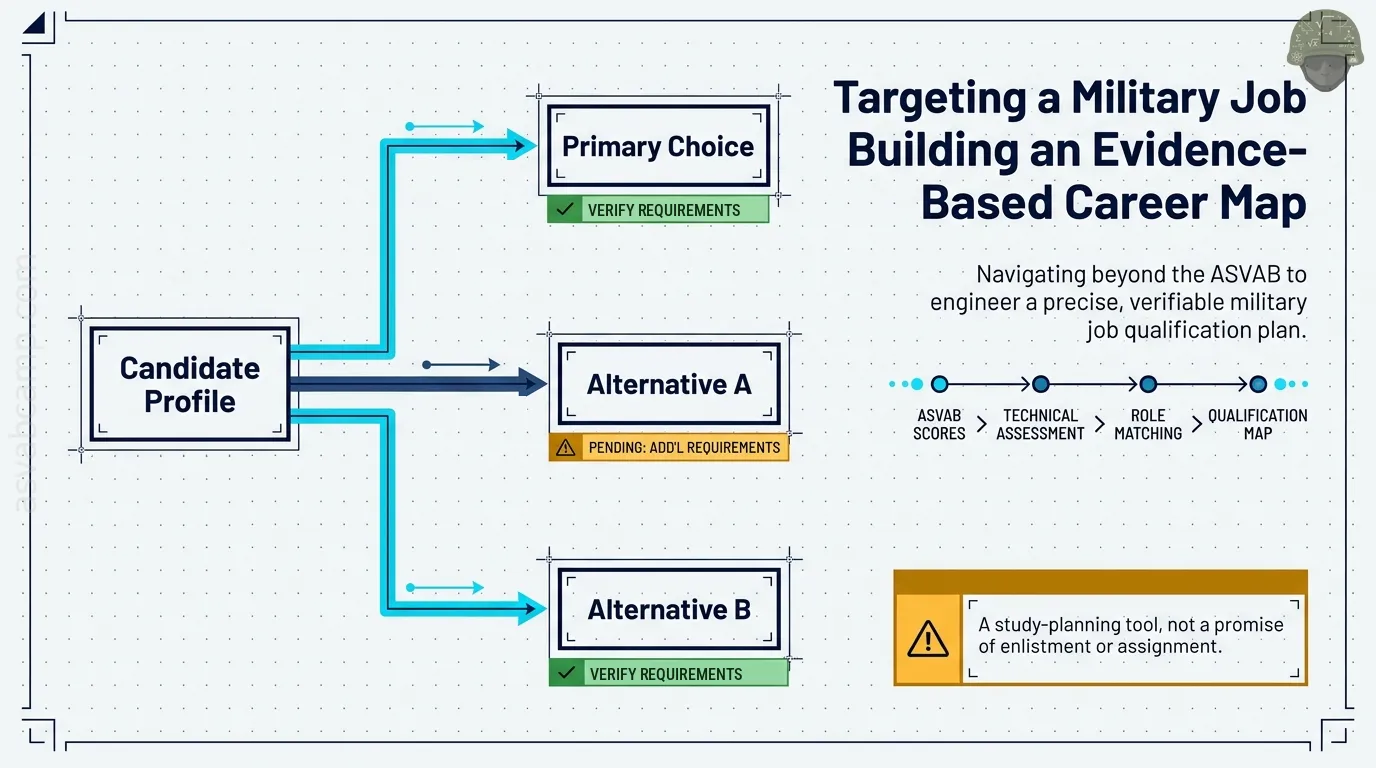
Lesson Mission: Build a Career Evidence Map
This lesson teaches a systematic way to connect a desired enlisted military occupation with the abilities tested by the ASVAB. Begin with the exact Service and current occupation description, identify the official occupational score or composite, trace its contributing subtests where documented, and choose learning priorities from that evidence. The procedure is a study-planning tool, not a promise of enlistment or assignment. At the end, you should explain both what test preparation can influence and which decisions require a recruiter, current policy, and individual screening.
Define the Actual Decision
A question such as “Can I join?” is different from “Could I qualify for this particular job?” and different again from “Is a seat available?” A general entry screen considers AFQT and other requirements. A job-qualification decision can depend on a Service composite, additional qualifications, and current rules. A final job offer adds availability and administrative approval. Before interpreting any score, write the decision in a complete sentence. This avoids solving the wrong problem with a number that looks relevant but answers another question.
Choose the Service First
The military Services do not all calculate occupational composite scores using one shared formula. Official ASVAB documentation explains that each Service validates its own composites for classifications of work. Therefore, two occupations with similar civilian descriptions may call for different aptitude evidence when offered by different Services. Record the Service before selecting any score chart. If a webpage lists a score for a job but does not identify the Service and effective requirements, treat the result as unverified rather than immediately changing your study plan.
Separate Enlisted Careers from Officer Routes
Most occupational planning examples in this lesson concern enlisted careers using ASVAB results. Officer accession programs often follow separate education, selection, and testing rules; for example, the Air Force describes the AFOQT for officer applications. Do not transfer an enlisted line-score requirement onto an officer position simply because the job names sound alike. The safe first question is whether the advertised opportunity is enlisted or officer. Once that is clear, use the corresponding official route and confirm which tests actually apply.
Start with an Occupation Description, Not a Rumor
A vague desire to work “with computers” or “in aviation” is too broad to identify a qualifying score. Find a current official position description, read its duties, and write the occupational code or specialty identifier if one is given. Distinguish hands-on maintenance, communications, analysis, flight operations support, and administrative work. They may emphasize different skills even though they share a familiar label. A rumor, social-media clip, or out-of-date score chart can suggest a search term, but should not be treated as the final eligibility source.
Create a Three-Choice Career Shortlist
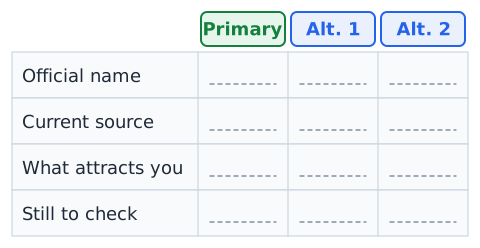
Maintain a primary choice and at least two realistic alternatives within the Services you are considering. For each choice, record its official name, current source, what attracts you to the work, and what requirements still need checking. A backup occupation should be genuinely acceptable, not simply easier on paper. Having alternatives reduces the temptation to assume that one threshold or one available opening must control the entire plan. Recheck every alternative independently: an apparently related occupation can still have a different composite or screening condition.
Understand the AFQT Gate
The Armed Forces Qualification Test score is used to help determine eligibility for enlistment. It is computed from Word Knowledge, Paragraph Comprehension, Arithmetic Reasoning, and Mathematics Knowledge; it is reported as a percentile, not a percentage of questions answered correctly. A satisfactory AFQT does not certify qualification for every job. Conversely, strong technical subtest preparation does not make general entry requirements disappear. Plan for both general eligibility and occupational evidence, and verify current Service policies rather than treating a single historic cutoff as permanent.
Treat Percentiles and Composites as Different Scales
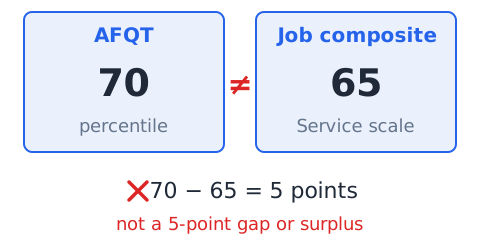
A percentile describes relative performance against a reference group. An occupational composite combines specified subtest standard scores under the relevant Service's system. Their numbers cannot safely be compared by subtraction, division, or simple ranking. A displayed 70 AFQT and 65 on a job-related measure do not imply a five-point deficiency or surplus. First identify the score's name, scale, owner, and official meaning. Only then decide whether a relevant criterion has been met. A calculation without compatible units may look mathematical while remaining invalid.
Trace the Composite to Subtests
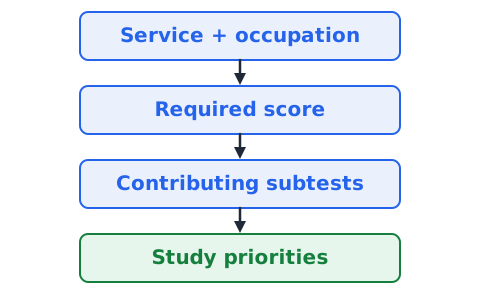
An occupational composite is useful for studying only after you know which subtests contribute to it. Official ASVAB materials publish general Service classification concepts; exact current occupation criteria should be checked through the Service and recruiter. Make a traceable map from occupation to required score to contributing knowledge areas. A mechanical emphasis may point toward mechanical principles, while a technical specialty may involve arithmetic, mathematics, electronics, or other subtests. Never infer the exact formula from the occupation title alone.
Read Official Score Reports Carefully
A score report can contain an AFQT percentile, individual subtest results, and additional composites. Read each label exactly as printed; do not rename a standard score a percentile. If a recruiter provides a job requirement, ask whether the stated value is a line score, composite, or some other program measure. If the report and a website use different labels, verify that they refer to compatible scales before comparing values. A photograph of a score table stripped of its column headings is not adequate evidence.
Army Line-Score Examples
The U.S. Army explains that different occupational families use different ASVAB category or line-score information. Its examples distinguish clerical work from combat-oriented aptitude patterns. This does not mean every clerical occupation has the same conditions or that every combat role shares an identical minimum. The study implication is to look up the intended Army occupation and identify its relevant published categories. A high unrelated practice score should not overshadow a weakness in a subtest actually used for the desired composite.
Air Force MAGE Categories
The U.S. Air Force organizes ASVAB-related aptitude information into Mechanical, Administrative, General, and Electronics categories, often called MAGE. Current Air Force pages also explain that job counseling may consider medical and citizenship information. Do not interpret MAGE as a single universal pass/fail total. If a prospective career is described in a specific aptitude area, use the current Air Force description to see which scores matter; then check other listed requirements. Prepare for the relevant content, but do not assume a published example is an individual offer.
Navy Ratings and Line Scores
The Navy says ASVAB and individual line scores are used to determine eligibility for specific enlisted careers. A rating is a Navy occupational classification; a similarly named civilian activity is not itself a Navy rating. Begin with the official rating page, identify the required score information, and confirm that it applies to the testing and recruiting route under consideration. Some specialized Navy programs have additional screening. When a recruiting page says that scores influence career qualification, it does not establish that passing one line-score threshold completes every other step.
Marine Corps and Other Service-Specific Programs
Service-owned classification methods matter for Marine Corps occupational fields and for other uniformed-service programs. Do not transfer a cutoff from an Army example to a Marine Corps specialty, or infer one Service's policy from a different Service's recruiting article. The general ASVAB principle remains: occupational composites combine relevant standard-score information, but the decision framework belongs to the Service. When exact criteria are not clearly published for the intended program, mark them for official confirmation instead of inventing a formula.
A Score Is Evidence, Not a Job Contract
Test evidence contributes to a classification decision; it is not the same as an enlistment contract, a training reservation, or a signed occupational assignment. Even when an applicant meets a score criterion, other screening and opening conditions may remain. This distinction matters when comparing career options: write “appears to meet the published aptitude condition” rather than “guaranteed to receive the job.” The latter statement claims authority over decisions that the test cannot make. A good study plan maintains this uncertainty explicitly.
Check the Official Date and Scope
Occupational requirements can be revised. A useful source record includes the Service, occupation identifier, webpage title, access date, and the exact requirement wording. If the site is undated, note that limitation. Distinguish an official page describing a testing program from an occupation-specific rule that may have been updated elsewhere. When sources conflict, do not average their thresholds or guess which is binding. Ask the authorized recruiting contact to resolve the conflict and preserve the answer's scope and date in your planning notes.
Educational and Credential Requirements
An occupation may require a diploma, particular training pathway, credential, or other education-related qualification beyond the ASVAB. Not every job does, and the details vary. A candidate can study mathematics effectively and still need a separate educational document checked. Conversely, eligibility for the entry path does not erase occupation-specific prerequisites. Read the official job description and ask which requirements can be satisfied before the application, which are checked later, and which are genuinely mandatory. Avoid interpreting a missing public detail as a waiver.
Medical, Vision, and Physical Screening
Some occupational paths have medical, vision, hearing, or physical requirements separate from aptitude scores. The exact screening and possible exceptions are governed by current Service policy, not by a general ASVAB practice lesson. This lesson does not diagnose fitness or predict whether a person will receive an exception. Keep a distinct “medical and other screening” column in the career evidence map. Label it verified, pending, or not applicable only with an appropriate official basis. A strong composite never substitutes for required medical review.
Security, Background, and Citizenship Conditions
Certain occupations may involve citizenship conditions, background checks, or suitability reviews. Other jobs have different rules. Do not infer clearance eligibility from a test score or from the applicant's enthusiasm for a field. If an occupation page specifies such a condition, record the exact language and ask the recruiter how the process is administered. Avoid submitting sensitive personal information into an educational app to obtain a speculative eligibility verdict. The role of this lesson is to teach how to recognize separate conditions, not to adjudicate them.
Openings and Training Seats Are Time-Dependent
Meeting academic and screening conditions does not imply that an opening is available on a preferred date or location. Availability can depend on staffing and training schedules that change independently of a learner's ASVAB performance. This is why a shortlist is useful. When planning preparation, keep “appears score-qualified” and “opening confirmed” as distinct statuses. If a desired role has no current opening, improving a composite is not proof that a seat will appear. Ask the authorized Service representative about the current options.
Build a Qualification Matrix
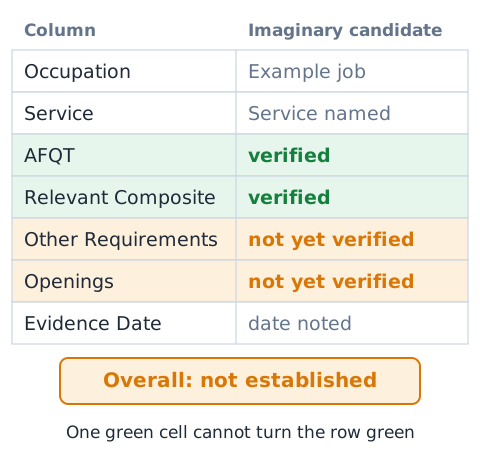
Use columns headed Occupation, Service, AFQT, Relevant Composite, Other Requirements, Openings, and Evidence Date. For an imaginary candidate, place “verified,” “not yet verified,” or “does not meet the stated requirement” in each independent column. A single green cell cannot turn the entire row green. Write the needed next action beside each unknown. The matrix prevents a common logic error: assuming that because one necessary condition is satisfied, the conjunction of all conditions is satisfied. The record is a planning worksheet, not an official determination.
The Logic of Multiple Conditions
A simplified educational model is: the desired occupational option requires general eligibility AND occupational aptitude AND other applicable qualifications AND an available route. The word AND matters. If three conditions are known true and one is unknown, the overall outcome is not proved true. Do not use the model to fabricate official requirements; it only illustrates the structure of a conditional decision. On a multiple-choice test, a defensible response preserves the unknown rather than converting it to an automatic approval or rejection.
Identify Subtest Skill, Not Just a Score Number
A low diagnostic result becomes useful when translated into an observable skill weakness. For example, losing points on word problems may reflect interpreting the problem, choosing an equation, or performing arithmetic. A category name alone does not tell you which step failed. Sample several original questions and mark the error type. Then work on the underlying skill rather than memorizing an imagined occupational cutoff. Practice tests are educational indicators; they do not produce official ASVAB standard scores or guaranteed composite estimates.
Arithmetic Reasoning Preparation
Arithmetic Reasoning problems require interpreting quantities in word-based situations. For career-targeted practice, work with ratios, proportions, unit rates, percentages, and multistep calculations. Read the requested unit before choosing operations. If an occupation's official classification uses AR, this is a rational subject to emphasize; however, do not claim that every extra correct practice item yields a predictable composite increase. Evaluate progress through better reasoning and fewer repeated error types, not a made-up conversion from practice accuracy to official score.
Mathematics Knowledge Preparation
Mathematics Knowledge typically emphasizes algebra, geometry, and other school mathematics. Establish fraction fluency, solve linear equations, simplify expressions, and practice area and volume reasoning. Keep formulas meaningful: understanding when a formula applies helps more than memorizing an isolated symbol. If the occupation's relevant score grouping includes MK, connect this work to that verified requirement. If the grouping does not, continue maintaining the general AFQT skills needed for eligibility. A study priority is a weighting decision, not permission to abandon other core content.
Word Knowledge Preparation
Word Knowledge rewards understanding English vocabulary in context. Build associations with roots, prefixes, suffixes, and common semantic distinctions; check meaning through example sentences rather than rote lists alone. In a multiple-choice item, eliminate choices that do not match the grammatical or conceptual context. WK contributes to AFQT and can be relevant in other composites depending on Service rules. Improving language skills can support both general testing and later technical reading, but the value of a particular study session should be judged by demonstrated skill growth.
Paragraph Comprehension Preparation
Paragraph Comprehension tests accurate reading of short passages: main idea, supported detail, inference, and author purpose. Practice answering from the passage instead of importing a plausible outside assumption. Technical occupations often require careful reading, but do not substitute a personal belief about job relevance for an official composite formula. For preparation, identify what the passage actually says, underline the controlling sentence mentally, and reject overly strong conclusions. This is also useful when reading recruitment requirements containing exceptions, definitions, or eligibility qualifiers.
Mechanical Comprehension Preparation
Mechanical Comprehension covers physical relationships such as force, motion, levers, gears, pulleys, and fluid behavior. For technical-career planning, use diagrams and explain cause and effect aloud. Ask whether a system trades distance for force, whether friction changes motion, and which direction a component moves. These are the kinds of skills an MC-focused study block develops. Do not assume a job with machinery necessarily uses a particular MC cutoff; verify the score grouping for the target occupation first and use original practice problems.
Electronics Information Preparation
Electronics Information includes concepts such as circuits, voltage, current, resistance, and components. Learn the physical role of each quantity before relying on formulas. A circuit drawing with a branch and a series connection should lead to different reasoning. If a Service's official occupational category emphasizes electronics, EI practice may be especially useful. But do not assume that studying electronics can replace required math or reading components of a composite. Separate subject content mastery from formal job-qualification decisions and from any safety or technical certification required after enlistment.
Auto and Shop Information Preparation
Auto and Shop Information examines tools, materials, maintenance ideas, and basic mechanical contexts. Study why a tool is suited to a fastener, what common systems do, and the difference between a safe procedure and an unsafe shortcut. For an occupation that officially uses this subtest, target weak terminology and functional relationships. Do not treat tool familiarity from a hobby as proof of occupational eligibility; only the official testing and screening process can establish a qualifying result. Practice questions should stay instructional and use accurate, broadly applicable examples.
General Science and Spatial Skills
General Science, Assembling Objects, and other ASVAB subtests may matter in occupational classifications even when they are not all part of the four-subtest AFQT calculation. General Science spans basic life, physical, and earth science, while Assembling Objects examines visual-spatial part relationships. Check the chosen Service's current composite documentation to determine their actual role. Prepare through original diagram problems, explanations, and comprehension rather than assuming every spatial skill contributes to every job. This is another reason to research the exact occupation instead of studying only a broad career stereotype.
Study Priorities Should Be Evidence Based
After checking the actual score grouping, rank study subjects using two considerations: how relevant the skill is to your current testing goal and how large the observed skill gap seems. A personally weak subject that is relevant to both AFQT and a desired composite may deserve more practice time. But no single metric can produce a guaranteed score outcome. A simple priority label—high, moderate, or maintain—may be more honest than a numerical optimization pretending to know scoring weights that were never supplied.
Worked Example: A Two-Goal Study Week
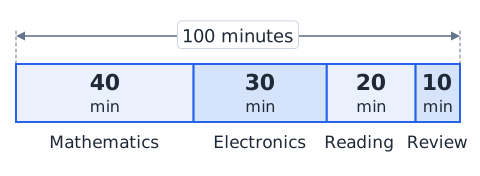
Suppose a fictional learner wants to maintain verbal ability while strengthening algebra and circuit concepts. The learner has 100 minutes available for one session and chooses 40 minutes of mathematics, 30 of electronics, 20 of reading, and 10 of review. The allocation totals 100 minutes; it does not estimate a composite score. Next session, the learner should reevaluate based on which explanations were understood and which mistakes persisted. The point is to allocate scarce study time transparently, not to present these weights as official requirements.
Worked Example: Reading an Ambiguous Table
Imagine a screenshot labeled “technical 105” without Service name, occupation code, effective date, or column definition. The number alone does not tell you whether it is an official line-score minimum for your intended job. A responsible learner finds the original Service publication and asks an authorized contact to verify how the requirement is applied. Selecting “105 guarantees entry” from a quiz would be wrong because it skips almost every necessary condition. The best interpretation of incomplete information is “unverified,” not “confirmed.”
Worked Example: An Apparently Strong AFQT
A fictional candidate reports an AFQT percentile of 80 and wants an electronics-related occupation. The percentile is evidence of strong performance relative to the AFQT reference group, but it is not the occupation's electronics composite. The next step is to inspect the relevant official classification score and other requirements. The candidate should not convert 80 to an electronics line score or assume every technical occupation is open. Strong general eligibility and specific occupational qualification are distinct questions, even when the same subtests contribute to more than one calculation.
Worked Example: Two Related Jobs
An applicant likes both aircraft maintenance and communications systems. Their interests overlap but the two specialties could use different score groupings and screening. Build separate rows for each occupation, identify the exact Service, and compare the sources, not merely the job titles. If the score conditions are different, the preparation plan may include one common core and two smaller targeted modules. A person can sensibly pursue alternatives without claiming that the same official threshold applies to each or that both openings must exist simultaneously.
Worked Example: Unknown Non-Test Criteria
A candidate appears to meet the published composite requirement for an occupation, but the page also mentions additional suitability screening. The screening result is unknown. Write “score condition may be met; final eligibility undetermined” and obtain the official screening guidance. Never change “unknown” into “failed,” either: the evidence supports neither approval nor denial. You can learn this logic without sharing personal background, medical, or identity information. This protects against misleading eligibility advice and unnecessary data collection.
Worked Example: A Changed Requirement
A two-year-old training forum lists an occupational score condition different from the currently maintained Service career page. Treat the current official source as stronger evidence for planning, while recognizing that the individual's recruiting path may require confirmation. Do not average the two numbers or choose the easier figure. Save the current source title and access date in a worksheet. If the conflict affects a consequential decision, ask the recruiting authority to reconcile it. The goal is traceability, not the appearance of certainty.
Ask a Recruiter a Precise Question
Instead of “Can I get a technology job?” ask: “For the exact enlisted specialty I identified, which current ASVAB composite and other requirements apply to my recruiting path?” Follow with “Which documents confirm this?” and “Are training openings currently available?” A precise question makes it easier to receive a useful, scoped answer. Do not assume the recruiter can promise future vacancies or override all independent screening processes. The lesson also encourages learners to compare information from the branch's official public materials.
Use Official Career Pages as Primary Evidence
Prefer the official ASVAB program for scoring principles and the relevant Service's official career pages for occupation descriptions and eligibility steps. The Army, Air Force, and Navy websites provide public explanations of how test scores influence career qualification, but not every page provides a complete rulebook. Secondary study resources can be useful for practice; they should not override current official requirements. Keep URLs and page titles when studying. An app that claims “guaranteed qualification” without authority is not a reliable source.
Reading Drill: Necessary Versus Sufficient
An invented job listing says that applicants need the stated aptitude score AND must complete additional screening. Which statement follows from an adequate aptitude score? It establishes only the aptitude condition, not final eligibility. Which statement follows from a missing screening result? Final status remains unknown. Read the word “and” carefully. This reasoning transfers directly to test distractors containing “automatically,” “always,” or “guaranteed.” Such absolutes require stronger evidence than a single listed score provides.
Reading Drill: Identify the Owner of the Score
A practice prompt gives an Army-style line-score label alongside an Air Force job description. Before doing any numerical comparison, recognize the Service mismatch. The correct next step is to find the Air Force's own aptitude requirement for that job, not to reuse an Army grouping. This drill trains an essential verification habit: each claimed criterion must belong to the correct decision-making authority. The appearance of both numbers in an ASVAB discussion does not make them interchangeable.
Reading Drill: Which Subject to Study?
A fictional official description places emphasis on a mechanical aptitude grouping. A practice diagnostic shows consistent difficulty on levers and pulley systems but stronger results in vocabulary. A defensible short-term priority is targeted mechanical reasoning alongside maintenance of core AFQT preparation. The answer is not to stop reading and math entirely or to announce a guaranteed score gain. The exam-style skill here is to choose a study adjustment directly supported by two facts: an identified relevant component and a demonstrated weakness.
Reading Drill: Composite Versus Practice Accuracy
A learner answers 18 of 24 locally written circuit questions correctly, which is 75 percent accuracy. That result can identify a skill area to review; it is not an official electronics composite or AFQT percentile. The denominator, test conditions, norms, and scoring system are different. A misleading answer choice might rename the practice percentage “75 Electronics.” Reject it. Use practice performance to inspect specific error types, and rely on official scoring processes for formal numerical qualification.
Reading Drill: Compare Alternatives Fairly
Two occupations are appealing. One has a verified score requirement but unknown availability; the other has an open-looking recruiting page but unclear eligibility rules. Neither can yet be declared a guaranteed choice. Build a source-based comparison, note which facts are confirmed, and ask the appropriate Service about both uncertain fields. A learner who carefully documents unknowns has made more progress than one who invents confidence. The exercise trains decision literacy as well as knowledge of the ASVAB system.
Common Trap: One Score Opens Every Door
A strong AFQT can support general entry screening, but job classification uses Service-specific composites and potentially additional conditions. The wrong-choice language “qualifies for every job” erases distinctions among occupations and screening processes. Another trap is the reverse assumption that a single weak unrelated practice area makes all jobs impossible. A careful answer identifies the exact score condition and the missing evidence. Think in terms of relevant criteria rather than a single magical number.
Common Trap: Career Title Predicts the Formula
An occupation involving machinery may sound mechanical, but that word alone does not reveal the exact current composite formula or cutoff. Likewise, “information technology” does not automatically map to one universal electronics score across Services. The tempting shortcut saves research by inventing a rule. Replace it with an evidence question: “Which current Service source defines the actual required composite for this specialty?” A valid study plan can use broad skill interests provisionally while waiting for authoritative qualification details.
Common Trap: Turn Unknown into Rejection
When an official page omits a requirement, it does not necessarily mean the requirement is absent. When a candidate's screening status is unknown, it does not mean that screening has failed. A high-quality multiple-choice answer avoids both unjustified reassurance and unwarranted rejection. State the limited conclusion and the next evidence source. This habit matters because employment, eligibility, and military accession decisions can be consequential for real people; educational material should not claim decision authority it does not possess.
A Five-Step Career-Targeting Checklist
First, name the Service and exact enlisted occupation. Second, record the current official score or composite and the contributing ASVAB skills where documented. Third, check general AFQT and separate requirements without converting scores across scales. Fourth, use original diagnostic problems to identify which relevant skills need attention; retain a balanced foundation. Fifth, verify any unknowns, availability, and changes with the appropriate official recruiting channel. A checklist is valuable because it creates a repeatable process without promising a job, storing sensitive personal data, or claiming access to secure test questions.
Final Review: What a Sound Plan Can Claim
A good plan makes a modest, useful promise: it can tell a learner what to research, which topics to practice, and what evidence is missing. It cannot certify medical status, clearance, vacancies, contractual assignment, or future policy. The AFQT addresses general eligibility; the Service-specific composites support occupational classification; other rules operate separately. If a statement uses one score to guarantee all outcomes, reject it. The goal is to target effort responsibly while maintaining the flexibility to consider verified alternative careers and updated official requirements.
 English ▾