 ASVAB Camp
Lesson Objective and Limits
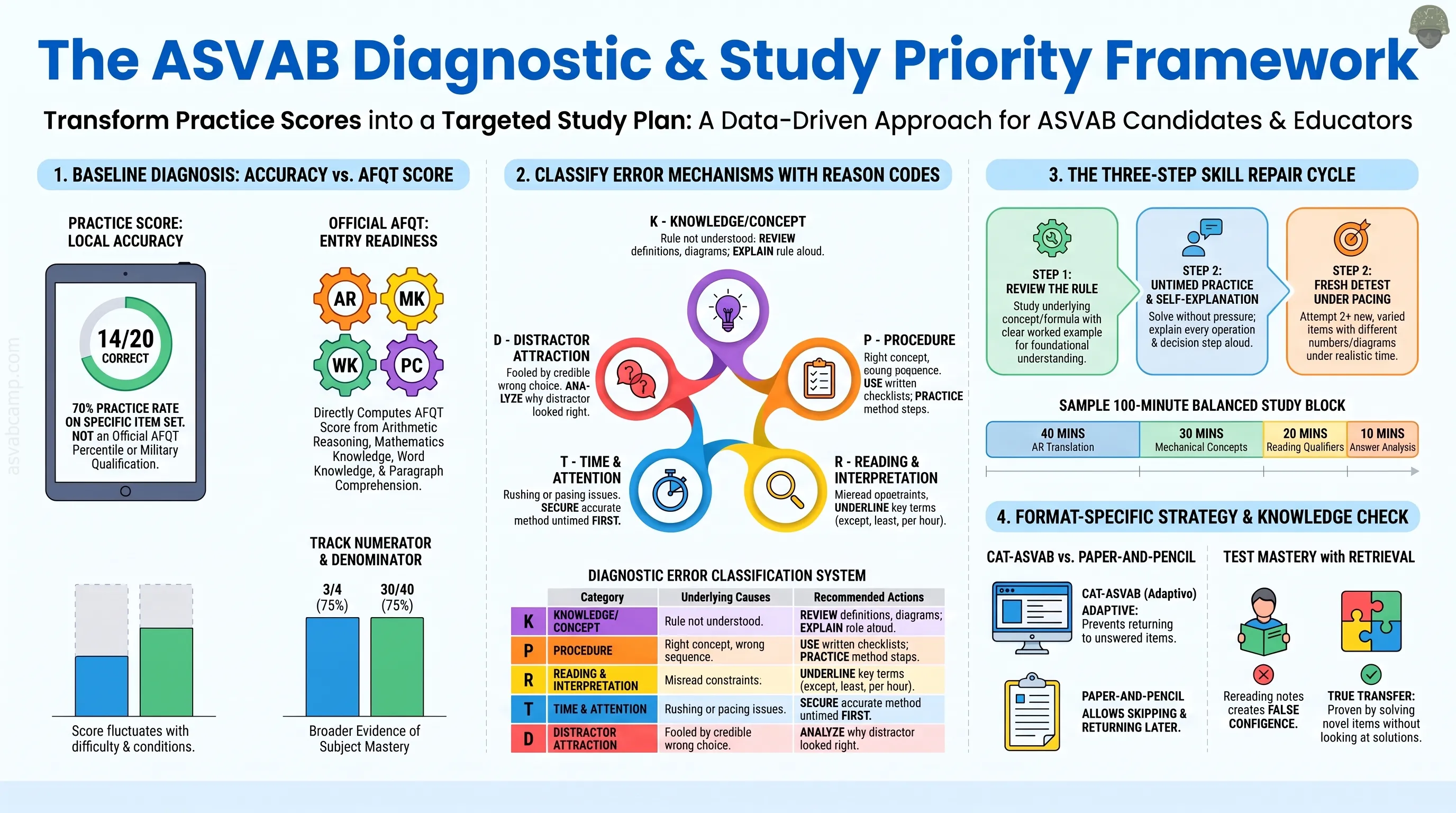
A diagnostic is a structured way to find what to review next. In this lesson, you will interpret practice results by ASVAB subtest, distinguish knowledge errors from process errors, decide which topics deserve study time, and retest with fresh practice. A diagnosis is a learning tool, not a military qualification decision. An app's percentage correct is not an official AFQT percentile or an occupational composite score. You will finish with a reusable, privacy-conscious worksheet.
Begin With the Actual Test Map
The ASVAB includes distinct subtests that measure different abilities. Arithmetic Reasoning examines quantitative word problems; Mathematics Knowledge examines mathematical principles; Word Knowledge and Paragraph Comprehension address verbal abilities. General Science, Electronics Information, Auto Information, Shop Information, Mechanical Comprehension, and Assembling Objects cover additional science, technical, and spatial skills. A study plan should therefore name the subtest, not merely the vague label "ASVAB." Always check the administration format because CAT and paper versions are organized differently, including the treatment of some technical subtests.
Distinguish Practice from Scored Testing
Practice performance is useful because errors show where an explanation or skill may need work. It cannot reproduce official scores by a simple conversion. Official CAT-ASVAB scoring uses an item-response model, while a classroom quiz or original practice set may have a different mix of question difficulties. For example, 14 correct answers out of 20 practice items means 70 percent practice accuracy, nothing more. Do not call that an AFQT score of 70 or infer military eligibility. Keep the original question set and its difficulty mix in mind.
Baseline Before Intensive Review
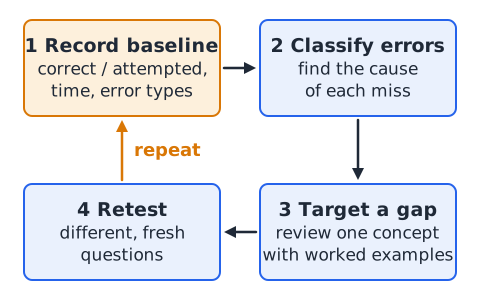
An initial baseline asks: what can I solve under reasonable conditions before I study this topic further? Use original questions covering the planned domains and record the subtest, topic, number attempted, number correct, approximate time, and types of errors. Treat this snapshot as a starting point, not a label for the learner. A single poor session can be affected by distraction, unfamiliar wording, or rushing. Repeat with different items before treating a pattern as stable.
Read a Diagnostic Table Correctly
Suppose a fictional practice report shows Arithmetic Reasoning 12/20, Mathematics Knowledge 16/20, Word Knowledge 17/20, and Paragraph Comprehension 14/20. These ratios describe only the listed practice sets. The arithmetic result invites inspection, but it does not prove mathematics is permanently the weakest ability. Review which word problems were missed and whether arithmetic calculations, interpreting conditions, or managing time caused the errors. A percentage is the start of an investigation; it is not a complete diagnosis or official test score.
Track the Denominator
An accuracy claim is ambiguous without the number of questions. Six correct out of eight is 75 percent, and thirty correct out of forty is also 75 percent, but the samples have different sizes and might sample different skills. Three correct out of four does not establish the same breadth of evidence as fifteen correct out of twenty. Read both the numerator and the denominator before comparing topic results. When sets have different difficulty distributions, even equal sample sizes do not make them perfectly comparable.
Identify the Smallest Actionable Gap
"Weak at math" is too broad to prescribe a productive session. "I confused the amount remaining with the total amount in three percentage word problems" identifies something teachable and testable. Drill down from subtest to concept, then to step: translating words into an equation, selecting an operation, solving it accurately, or checking reasonableness. This level of detail prevents wasting an entire hour relearning familiar material. Use the wrong answer and the explanation as evidence, not as a reason to assign yourself a permanent weakness label.
Error Type: Conceptual Knowledge
A concept error occurs when the underlying rule is not understood. Examples include thinking that a parallel circuit has only one current path or treating a fraction's numerator as its denominator. Revisiting definitions, diagrams, and worked examples is often more useful than immediately timing another test. After review, explain the rule aloud and solve a fresh question without copying the demonstration. If you cannot state why a rule works, extra guesses are unlikely to produce a reliable improvement. Mark the concept for targeted teaching.
Error Type: Procedure
A procedure error occurs when the learner knows the concept but applies the wrong sequence or operation. Someone may understand ratios yet invert the proportion, or understand unit conversion yet multiply when division is needed. For this type, use a written step-by-step checklist, inspect the first incorrect step, and redo the item with a correct method. Practice two or three varied examples, then remove the checklist. More background reading may not resolve a procedural problem unless it is paired with method practice.
Error Type: Reading and Interpretation
Sometimes the calculation is correct for a question that was misunderstood. Look for qualifiers such as except, least, per hour, remaining, total, or most likely. For paragraph questions, distinguish a claim directly supported by a passage from an assumption that sounds plausible. A reading-related mistake can affect mathematics, science, and mechanical problems as well as the verbal subtests. The intervention is to identify exactly what the prompt asks, restate it simply, and test every candidate answer against the supplied facts.
Error Type: Time and Attention
A student may be able to solve a question during untimed review but miss it while hurrying. Time-related errors include losing track of units, re-reading without progress, spending too long on one diagram, and selecting the first familiar term. First establish an accurate method; then practice maintaining that method under a realistic time budget. Do not teach careless guessing as a speed technique, especially for computerized adaptive testing. Separate the evidence "I ran out of time" from the unsupported conclusion "I did not know the topic."
Error Type: Distractor Attraction
A distractor is an incorrect choice designed to look credible. In a mechanical problem, it may use the wrong direction of force; in a verbal question, it may be a related but non-equivalent word; in mathematics, it may reflect an intermediate result. Reviewing only the correct letter hides the mechanism of the mistake. For each wrong answer, explain why it almost looked right and what rule rules it out. Such a note can be more valuable than memorizing which letter was correct in a previous practice item.
Establish a Reason Code
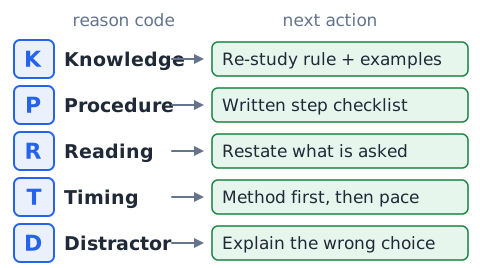
Use a short reason code on a temporary worksheet: K for knowledge, P for procedure, R for reading, T for timing, and D for distractor. Some errors have more than one plausible cause; choose the cause you can support and add a note if uncertain. The point is not a medical or psychological diagnosis. Codes simply route a learner to a useful next action. When the learner is unsure, review the full solution before assigning a code; unsupported labeling gives false confidence.
Use a Two-Pass Review
On the first pass, examine all mistakes and identify the skill and probable error mechanism. On the second pass, look for repeats: did three different questions fail at converting words to ratios, or did one unusual diagram create a one-off error? A repeat pattern gives stronger direction than a single anecdote. Review correct answers too when they were lucky guesses; an accidental correct response may conceal the same weakness. Do not treat a guessed correct answer as firm mastery.
Confidence Is Not Accuracy
Feeling sure is different from answering correctly. A learner who confidently applies an incorrect rule needs a conceptual correction; a learner who solves correctly but feels uncertain may need explanation and additional varied examples. A simple optional self-check such as "sure," "partly sure," or "guess" can be written on paper during personal study. Look for mismatches between confidence and evidence, then select a learning intervention rather than a personal ranking.
High Priority Means Useful, Not Urgent Panic
A practical priority considers the topic's relevance, observed gap, and readiness to improve. A weak topic used in a required score composite may matter, but a practice course cannot determine an applicant's actual eligibility or job assignment. Work with official score information and an authorized recruiter for such questions. In study planning, give more attention to recurring foundational errors than to isolated unfamiliar trivia. Never interpret a low baseline as an irreversible result. Priorities should be revisited as learning evidence changes.
Do Not Ignore Foundations
Advanced errors often originate in basic skills. Difficulty with speed-distance questions may be caused by fraction arithmetic or unit conversion. Difficulty with electronics may begin with multiplication, Ohm's law relationships, or reading a circuit diagram. Before assigning more advanced tasks, verify prerequisites with short original examples. A strong foundation supports several subtests. However, do not automatically make every learner start at the simplest lesson; use actual evidence to choose which prerequisite is missing.
AFQT-Related Study Focus
Arithmetic Reasoning, Mathematics Knowledge, Word Knowledge, and Paragraph Comprehension contribute to the AFQT computation. That makes them important for understanding entry-related academic readiness. The exact scoring process is not the arithmetic average of their practice percentages. Studying these subjects also builds general reading and quantitative skills that support other learning. A student targeting a technical occupation may additionally need relevant science or technical domains. Preserve a balanced plan rather than assuming one category alone controls all decisions.
Career-Specific Focus Requires Verification
For military career planning, Service occupational composite scores use specified ASVAB subtests; their labels, formulas, and occupational rules depend on the Service. Therefore the learner should verify the current requirement for the actual occupation before assuming which technical subtest deserves extra time. A generic web summary may be stale. Practice diagnostics should never be presented as a guarantee that a particular military specialty is open, available, or approved. Use this lesson to plan learning, not to issue an eligibility verdict.
Study-Time Allocation as an Example
Suppose a fictional learner has 100 minutes to study and recurring errors in arithmetic translation, mechanical diagrams, and reading qualifiers. One possible allocation is 40 minutes for arithmetic, 30 for mechanical concepts, 20 for reading, and 10 for reviewing explanations. This totals 100 minutes. It is a sample schedule, not an official ASVAB formula, and a different diagnostic would justify a different allocation. The exact distribution matters less than whether each block has a clear objective and a way to check it.
Verify Simple Practice Arithmetic
Practice accuracy is calculated as correct divided by attempted, multiplied by 100 percent. For 18 correct out of 24, the practice rate is 75 percent. For 9 correct out of 15, the rate is 60 percent. These values help organize error review within the chosen questions. They do not express formal test percentiles or predict a precise official score. If some questions were skipped, decide consistently whether the denominator is all assigned questions or only attempted questions and label the metric accurately.
The Difference Between Count and Rate
Suppose one set has 4 errors in 10 items, while another has 6 errors in 30 items. The first misses 40 percent; the second misses 20 percent. Comparing error counts alone would misleadingly rank the second as worse. Conversely, percentage alone still hides question difficulty and sample size. A good diagnostic records both misses and opportunities. If errors cluster in one concept, prioritize that concept even when the broader topic percentage looks respectable. Make every comparison explicit about what was measured.
Separate Topic Review From Answer Memorization
Repeating the same four questions until their answers are familiar can create the illusion of improvement. After studying a solution, select new items that require the same underlying principle but use different numbers, wording, or diagrams. Explain the method before checking the result. If performance transfers to fresh items, that provides stronger learning evidence than remembering the location of a correct option. Original practice questions should not be confused with confidential live ASVAB questions or sold as access to secure exam content.
Design a Three-Step Repair Cycle
Step one: review the rule with a worked example. Step two: practice the rule without a countdown and explain each step. Step three: try two or more varied fresh items under reasonable time pressure. If errors persist, identify the step that fails and repeat targeted instruction. This cycle is more diagnostic than repeatedly taking whole mock exams without analysis. A lesson test should close with feedback that names the rule, not simply a red or green result. Keep remediation proportional to actual evidence.
Use Retrieval Rather Than Rereading Alone
Retrieval practice asks learners to produce an answer from memory before looking at a solution. For vocabulary, explain a word's meaning or select a synonym from context. For math, recall the formula, choose units, and solve a new problem. For science, sketch the relation between components. Then check the explanation and correct mistakes promptly. Rereading has a role when a concept is unfamiliar, but solving a fresh item reveals whether the idea is usable without the text open. Avoid turning the entire review into passive scrolling.
Use Spacing Across Sessions
Spread exposure to a recurring topic across multiple independent sessions instead of doing all examples back to back. A personal printed checklist or a one-time session sheet can remind the learner to revisit ratio calculations or mechanical leverage. The amount of spacing should suit the learner's available time rather than a supposedly universal algorithm.
Check the Whole Solution
A complete review explains why the selected answer is correct and why competing choices are wrong. In arithmetic, inspect equation setup, operations, units, and estimated size. In reading, cite a relevant part of the passage. In electronics or mechanics, trace the given diagram. A numerical answer may be correct for an invalid reason, and an arithmetic slip may hide sound conceptual understanding. This distinction matters because the best follow-up exercise depends on the cause rather than the final letter alone.
Reading Errors Across Subtests
Verbal knowledge is not confined to two verbal tests. Science definitions, mechanical conditions, and algebra word problems also require accurate reading. When reviewing, ask which word controlled the meaning. Did the question say increase or decrease? Did the passage state a fact or only suggest a possibility? Was the learner asked for the exception? Practice underlining constraints on a personal worksheet. Then revisit the original subject concept to make sure the reading correction is transferable rather than tied to one exact question.
Diagnose Mathematics by Operation
For Arithmetic Reasoning, distinguish extracting facts from a story, choosing a model, performing the arithmetic, and interpreting the result. For Mathematics Knowledge, distinguish algebraic properties, geometry principles, proportional relationships, and accurate manipulation. Do not write "math weak" if all mistakes come from a misplaced decimal during unit conversion. Prioritize the incorrect operation with a small set of fresh examples. Check mental estimation before calculating; a plausible magnitude is an effective independent guard against many errors.
Diagnose Science by Explanatory Model
A General Science mistake may come from confusing a definition, misunderstanding a system, or interpreting a diagram incorrectly. Ask the learner to describe the mechanism in ordinary language: what causes the change, what is measured, and what stays constant? Use a short schematic when relationships matter. When an explanation relies on specific assumptions, make them visible. Reviewing a single memorized fact is sometimes enough, but conceptual models provide better transfer across unfamiliar examples. Record the topic of the misconception, not a permanent score for the student.
Diagnose Technical and Mechanical Problems
Mechanical Comprehension, Electronics Information, and automotive/shop knowledge often require applying a relationship to a pictured setup. Separate three error sources: recognizing the component, tracing the physical relation, and calculating or predicting the result. A learner who confuses series and parallel wiring needs a different drill from one who knows the circuits but performs Ohm's law arithmetic incorrectly. Inspect the labels, directions, and assumptions. Use new drawings with changed orientation so a familiar sketch is not mistaken for genuine understanding.
Diagnose Spatial Assembly Carefully
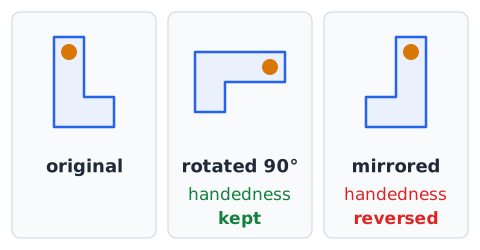
For Assembling Objects, examine whether the error involved mental rotation, mirroring, matching connection points, or hidden edges. A shape rotated 90 degrees preserves its handedness; a mirrored shape reverses handedness. When two pieces are joined, the contact features must align without impossible overlaps. Review by tracing a distinctive mark from source to answer. A learner may be accurate but slow in one spatial operation and inaccurate in another. Target the specific transformation rather than marking all spatial reasoning as one undifferentiated weakness.
Avoid Unsupported Score Predictions
A practice-set gain from 60 to 80 percent is useful local feedback if the sets are comparable. It does not imply an official AFQT percentile gain of 20 points. ASVAB scores come from formal scoring models and particular test administrations. Statements such as "answer these 40 items and guarantee a qualifying score" are misleading. Describe outcomes precisely: more correct practice responses, fewer unit errors, or shorter review time at maintained accuracy. These observations can direct study without pretending to predict the next official score or specialty decision.
CAT-ASVAB Is Not a Reviewable Practice Quiz
On the CAT-ASVAB, examinees cannot return to an item once it has been answered. The system selects questions adaptively and applies its own scoring and timing procedures. Training should therefore emphasize reading the item, selecting a reasoned answer, and checking it before submitting. This does not justify filling the end of a CAT test with random guesses when time is short; official guidance warns against such behavior. In an offline practice quiz you may review all answers afterward, but do not confuse that review feature with live CAT navigation.
Paper-and-Pencil Strategy Is Different
On the paper-and-pencil ASVAB, official guidance permits answering easier items first and returning to skipped ones later. Examinees are advised to answer every item because guessing carries no penalty in that version. CAT-ASVAB navigation and end-of-test behavior differ. A diagnostic lesson can teach both formats without claiming that an unsubmitted practice question follows official CAT rules. Before test day, verify which format will actually be administered and consult current official instructions. Strategy should follow the format, not the other way around.
Treat Speed as a Conditional Skill
Speed is valuable only when a solution remains accurate. If a learner solves 16 of 20 problems correctly in a relaxed session but only 10 of 20 during a rushed one, the diagnostic suggests a timing or attention issue worth exploring. It does not prove lack of underlying knowledge. Practice with moderate limits after the method is secure. Record both accuracy and how long a set took. Never target an arbitrary seconds-per-question value without regard to the official subtest's time limit and actual item demands.
Handle a One-Question Outlier
An isolated difficult item can distort a tiny diagnostic. Suppose a learner gets four of five short geometry questions right but misses one unusual spatial visualization. That single miss is not enough to claim the entire geometry topic needs comprehensive relearning. Review the error, then sample several distinct problems. If all new items are solved correctly, add a brief reminder instead of dedicating the next session to that issue alone. If a pattern emerges, elevate it. A diagnostic decision should be open to revision.
Build a Transparent Priority Matrix
An optional planning worksheet can have columns for subtest, observed mistake, evidence count, chosen concept, next practice action, and when to check again. For example: AR; three ratio-setup errors; study variable definitions; solve five fresh ratio situations. Another row might say AO; two mirror-image confusions; review handedness; solve three rotated and mirrored examples. These are self-managed study notes, not official scores. A clear matrix makes priorities explainable and prevents relying on vague impressions.
Choose Workable Sessions
Match a task to the time available. In a 20-minute session, review one concept, solve a few varied questions, then analyze mistakes. In a 60-minute session, cover two related concepts plus an untimed and a timed check. The goal is deliberate repair, not merely reaching a minute quota. An example schedule should never be presented as a scientifically guaranteed prescription. When fatigue causes repeated careless errors, a shorter accurate session may be more productive than forcing an additional full-length set.
Worked Case: Ratios and Reading
A fictional student answers 9 of 15 ratio problems correctly. Review shows three errors in translating "per" into a proportion, two arithmetic slips, and one missed condition. The largest identified pattern is model translation, not calculation. A reasonable next block teaches ratio language with two worked examples and three fresh word problems, followed by brief calculation checking. This is more precise than assigning all study time to Mathematics Knowledge. The 9/15 is a practice rate of 60 percent, not an official AFQT score.
Worked Case: Same Percent, Different Evidence
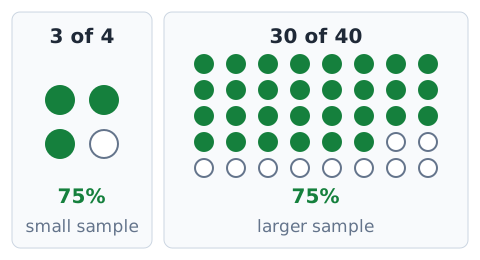
Two fictional subtests each show 75 percent on a practice sheet. One was 3/4; the other 30/40. The percentages match, but the sample sizes differ substantially. The smaller set may have sampled fewer concepts, so treat it as provisional. Rather than ranking the topics strictly, review the actual mistakes and give the small set a broader follow-up sample. Do not claim a larger sample is automatically harder or standardized. Evidence quality includes topic coverage and question comparability as well as the number of attempts.
Worked Case: Technical Career Interest
A learner is interested in an electronics-related military occupation and notices repeated circuit-identification errors in original practice questions. They should review fundamental circuit paths, symbols, and relationships, but they must also verify the real Service and current occupational score rules before assuming electronics is the only relevant subtest. A practice course cannot grant an occupational qualification. A reasonable session pairs core electronics understanding with maintenance of general mathematics and reading skills. The result is a content plan, not an enlistment prediction.
Worked Case: Timed Versus Untimed
Suppose a student gets 18/20 correct untimed and 12/20 correct under a new time restriction on a comparable original practice set. The first is 90 percent practice accuracy and the second is 60 percent. The gap suggests investigating timing, but the sets could differ. Compare error types and use another balanced set before concluding. First preserve the correct method, then gradually practice reasonable pacing. A timer is a training aid, not a substitute for conceptual understanding or official scoring procedures.
Worked Case: Spatial Distractors
A learner chooses a reflected shape instead of a rotated shape twice. Review the difference between mirror reversal and quarter-turn rotation with a distinctive arrow or marked corner. Ask the learner to predict the location of the mark before viewing the choices, then test several new shapes. If the error persists, use a clear diagram and slow explanation rather than randomly repeating four-option items. The diagnostic should say "mirror versus rotation" rather than merely "bad at AO." A specific problem invites a specific repair.
Worked Case: Build a 90-Minute Plan
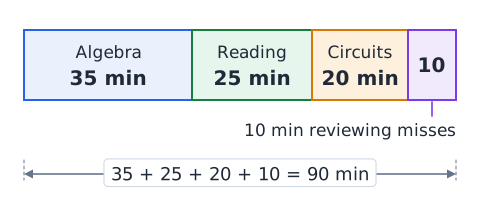
Assume a learner identifies three repeating gaps: algebra setup, reading qualifiers, and circuit tracing. An illustrative 90-minute plan is 35 minutes on algebra, 25 on reading, 20 on circuits, and 10 on reviewing misses. The total is 90 minutes. The split is a practice planning example, not an official optimization rule. Afterward the learner tests each gap using fresh questions; any persistent error determines the next session. Reassign time based on observations, not the need to preserve the same percentage split every day.
The Final Five-Minute Review
At the end of a study block, the learner should explain one corrected misconception, name a question type that still causes trouble, and identify the next fresh exercise. A practical note might be "I can now set up unit-rate equations, but I still reverse the ratio when the question says per worker." This is better than writing "score improved" without details. Such notes are optional and can remain under the learner's control on paper or their own device.
Avoid False Precision
It is tempting to combine practice percentages into a weighted readiness number such as 83.6 and treat that as a predicted military qualification. Unless a weighting is official and based on valid scored data, such precision is artificial. Comparing unrelated sets also risks confusing topic coverage with ability. Prefer descriptive evidence: repeated equation-setup mistakes, an isolated vocabulary miss, and accurate untimed solutions needing pacing. If you compute a simple fraction for practice analysis, label it clearly as local practice accuracy and state its denominator.
Respect Test Security and Honest Claims
A third-party preparation app must not claim possession of confidential live ASVAB items or guarantee a result. The ASVAB Testing Program explicitly cautions against such commercial claims. Our diagnostic questions are original educational practice. A credible study plan uses official subtest descriptions and publicly available sample questions for orientation while creating its own explanations and examples. If a marketing page promises access to exact current answers, that is a warning sign rather than trustworthy learning evidence. Real preparation builds transferable skills.
Independent Knowledge Check
Before finishing, answer five questions without reading the lesson: Which four subtests contribute to AFQT? Why is 16/20 not an AFQT percentile of 80? What is the difference between a concept error and a time-pressure error? Which format allows returning to skipped questions? What evidence would persuade you to change the next study priority? Then check each answer against the explanatory material. The objective is to make decisions from evidence, not memorize a catchphrase. Review any uncertain answer before attempting the final lesson test.
Summary and Next Action
A useful ASVAB diagnostic begins with a clear baseline, records subtest and concept details, classifies errors cautiously, and directs attention to fresh, varied practice. Compare both numerator and denominator, avoid score-conversion claims, and verify the real test format. Use official sources to understand the assessment rather than treating app percentages as official results. Choose the next study task using recurring errors and relevant objectives, then check with new questions.
 English ▾