 ASVAB Camp
What Job Qualification Actually Means
A military job is not awarded by choosing the most attractive occupational title on a score report. The Service first evaluates general enlistment eligibility, then considers scores that predict aptitude for a field, and then applies additional requirements and current personnel needs. These are different decision stages. This lesson teaches you how to read the evidence at each stage without pretending that one number guarantees an assignment or that requirements remain fixed forever. The examples are hypothetical and are not official job qualification decisions.
Outcomes You Should Be Able to Explain
By the end, you should distinguish AFQT screening from Service job classification; identify the issuing Service before interpreting a composite; recognize that a composite draws on selected ASVAB subtests; describe additional non-test requirements; and choose a safe next action when information is incomplete. You should also be able to spot a misleading recruiter rumor, an outdated requirement table, or a fictional calculation that uses incompatible score scales. Accuracy requires both subject knowledge and restraint about claims the evidence cannot support.
One Battery, Several Decisions
ASVAB produces subtest results that support more than one kind of decision. Four designated subtests contribute to the AFQT percentile used for general entry screening. Other combinations, developed and validated by individual military Services, help match applicants to occupational groups. The same applicant may show a different strength profile in language-heavy, mechanical, or electronics-related composites. An apparent conflict is not a scoring error: the two decisions ask different questions, use different inputs, and may report results on different scales.
Begin With the AFQT Screen
The Armed Forces Qualification Test uses Arithmetic Reasoning, Mathematics Knowledge, Word Knowledge, and Paragraph Comprehension. Its reported value is a percentile compared with an established norming sample, not simply the percentage of practice questions answered correctly. A Service's current entrance policies determine whether a score meets a general enlistment condition. Passing that screen is meaningful, but it does not imply a person meets the composite standard or other restrictions for any particular specialty. Avoid using AFQT percentile as a universal job-eligibility calculator.
Occupational Classification Comes Next
Service classification composites are built from ASVAB subtest standard scores using combinations validated for classes of military occupations. The official ASVAB Military Jobs resource explains that Services develop their own composites because different kinds of work place different demands on recruits. The result supports aptitude-related classification rather than promising placement. A student should not assume that all technical occupations use the same formula, that similar job titles refer to identical duties, or that a composite score from one Service has the same meaning in another.
Learn What a Standard Score Means
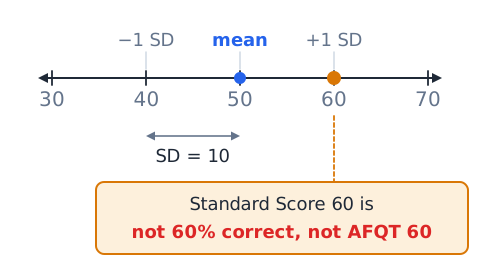
An individual ASVAB subtest Standard Score is norm-referenced. Official ASVAB information describes a scale centered at 50 with a standard deviation of 10. That does not convert a 60 to 60 percent correct, nor does it turn a 60 into an AFQT percentile of 60. Standard scores are input measures; AFQT and Service composites are calculated outputs. When reading a table of scores, identify the label and units of every column before comparing values or inferring occupational aptitude.
The Job Name Is Not a Formula
A career title may sound related to electronics, machinery, medical care, administration, or language, but the relevant qualification method is set by the military Service. A superficially similar civilian career name is not enough to identify the correct composite. First confirm the Service, the official occupational code or rating, the applicable application pathway, and the current qualification publication. Only then ask which composites and other prerequisites apply. Reverse-engineering a formula from the job name can send preparation in the wrong direction.
Army Occupational Classification Example
The Army uses named classification composites such as General Technical, Clerical, Mechanical Maintenance, and Electronics Repair. Official ASVAB materials show Army General Technical as using Arithmetic Reasoning together with a Verbal Expression composite. This is a concrete example of selected inputs, not a universal rule for all Army specialties or an official score calculator for homemade quizzes. The exact occupation and entry program determine which qualifications matter, so a student should avoid attaching a single Army GT target to every Army job.
Air Force MAGE Framework
The U.S. Air Force describes four occupational aptitude areas with the letters MAGE: Mechanical, Administrative, General, and Electronics. Its public ASVAB page identifies the kinds of subtests contributing to each area and directs applicants to job-specific information. General and Electronics need not move in parallel because their input mixes differ. MAGE is a classification framework, not a replacement for the AFQT eligibility screening requirement. Read current Air Force career requirements, rather than applying an Army job score to an Air Force specialty.
Navy Ratings and Line Scores
Navy recruiting materials explain that both an overall score and individual line scores may be relevant to specific enlisted ratings. Different ratings can emphasize different skills, and their score combinations are not interchangeable with the Air Force MAGE headings. An applicant should locate the currently published requirements for the precise Navy rating instead of relying on a social-media list labeled simply 'Navy technical score.' Do not assume that the largest number on a score report represents the most job options without considering its scale and purpose.
Marine Corps Composite Concepts
The Marine Corps also uses its own composite approach. Official ASVAB job classification tables describe categories such as Mechanical, Clerical, General Technical and Electrical, with subtest ingredients distinct from other Services. These broad descriptions illustrate why a standardized test can support several occupational classifications. They do not certify any specific applicant for an occupational specialty. Confirm the current specialty code, available recruiting program, composite requirements, and all non-score standards through current official sources and the relevant representative.
Coast Guard and Other Service Questions
Do not assume the same published list covers every branch or every enlistment program. Information pages may emphasize certain Services or present formulas for a particular testing and classification context. If the desired path concerns the Coast Guard, Space Force, reserve component, or a special accession program, verify that specific organization's current published rules. The sound method does not change: identify the authority, identify the exact score being discussed, separate eligibility from classification, and verify any extra requirements. Missing a branch from a general reference table is not proof that no rules exist.
Composite Inputs Are Chosen for Predictive Value
The official ASVAB military-jobs explanation says the Services develop and validate composites using subtests most closely associated with training or job performance for clusters of occupations. That is why two composites may use different combinations of mathematics, electronics, verbal, mechanical, or general science results. A student should study a desired field's official qualification description, but still build broad basic skills. No one preparation lesson can promise the same occupational result for every applicant because classification includes multiple considerations beyond practice accuracy.
AFQT Percentile Versus Composite Score
A hypothetical report displaying AFQT 71 and an occupational composite 105 does not say that the composite is thirty-four points better. The values answer different questions and can be reported on different metrics. Likewise a fictional AR Standard Score of 55 should not be subtracted from an AFQT percentile of 71 to describe an improvement need. In a practice question, eliminate any option that treats unlike score types as directly ranked, averaged, or converted without an authoritative conversion method. Useful symbolic summary:
An Aptitude Threshold Is One Necessary Condition
Suppose a published occupation description includes a minimum composite score. Meeting that condition may permit further consideration, but other eligibility rules still apply. These can include education, medical standards, background-related screening, citizenship or other legal conditions, physical capabilities, training prerequisites, and Service staffing needs, depending on the occupation. The precise list and standards vary. It is therefore unsafe to turn a qualifying score into an unconditional acceptance letter. Clear language says 'may meet the aptitude criterion' rather than 'has been assigned the job.'
Screening, Classification, and Assignment
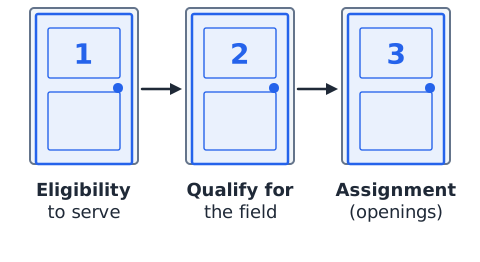
Think of three separate doors. Door one concerns eligibility to serve. Door two concerns whether an applicant may qualify for a particular occupational field. Door three concerns actual classification or assignment subject to available openings and administrative decisions. Passing one door does not erase the other doors. This three-door model is a teaching aid, not a fixed official workflow for every Service or program. Its value is conceptual: it prevents incorrect certainty and encourages the student to ask the right question at each stage.
Educational Qualifications Beyond Test Scores
Many military roles require education or documented training standards that are not encoded in ASVAB subtest results. A candidate may perform well on a technical composite yet still need to meet an education criterion. Similarly, earning a diploma or completing coursework does not substitute for any required aptitude results. The appropriate conclusion from incomplete information is conditional. In a score-interpretation item, do not invent the applicant's education record or claim all jobs have the same minimum education profile.
Medical and Physical Requirements
Some occupational opportunities involve medical, sensory, mobility, or other physical standards. These are separate from cognitive aptitude testing and vary by role and policy. The ASVAB cannot determine medical fitness or occupational physical eligibility. A high mechanical or electronics composite therefore cannot logically override a medical screening condition. When presented with a scenario involving both a score and a non-test requirement, identify which requirement is satisfied and which remains unknown. Individual medical qualification determinations come only from official military medical authorities.
Security and Background Considerations
Some positions require a particular level of vetting or access approval, and the standards for those determinations are administered separately from the ASVAB. A person could show adequate academic aptitude while a background-based requirement is still under review. The responsible interpretation is that the occupational screening process has multiple independent components. Avoid promises such as 'a score above X guarantees clearance' or 'all intelligence-related positions share the same process.' Job and security requirements must be checked with authoritative current sources.
Citizenship and Legal Criteria
Certain occupational programs have citizenship, immigration, age, or other legal rules that are distinct from ASVAB scores. These rules can vary by branch, status, and specific field, and they can be revised. A score-report worksheet does not contain enough information to make a personal eligibility decision. The correct educational habit is to flag the additional requirement, identify the governing Service, and seek its current official rule. Never infer that a high percentile automatically satisfies a separate legal condition.
Job Availability Is Not a Score
A candidate may meet a score-based criterion while the desired opening is unavailable in a particular recruitment period. Conversely, an available training slot cannot waive required eligibility conditions by itself. Personnel needs, timing, and programs create a separate decision dimension. When reading an attractive advertised occupation, separate 'listed career,' 'aptitude eligible,' 'otherwise eligible,' and 'currently available.' These statements describe distinct facts. Careful communication avoids making promises about contracts or assignments based only on an aptitude worksheet.
The Meaning of 'May Qualify'
In official-adjacent educational writing, 'may qualify' is intentionally conditional. It means the stated evidence supports only part of an eligibility assessment. 'Qualified for the job' would require confirmation of every applicable criterion, whereas 'guaranteed placement' introduces additional assumptions about actual selection. Exam questions often make wrong answers look appealing by replacing a conditional conclusion with an absolute claim. Train yourself to notice words such as automatically, always, must, cannot, and guarantees, then compare each claim against the facts provided.
Avoid Outdated Occupational Cutoffs
Exact job cutoff numbers can change, and recruitment pages may be updated at different times. A screenshot from an earlier year, even if it once came from an official domain, does not prove a current requirement. A reliable workflow checks the date, relevant Service, occupation code, accession route, and most recently available official standard. When a number appears in a teaching example, clearly label it hypothetical unless you have verified that it is current and properly scoped. This lesson intentionally does not freeze real job thresholds into its question bank.
Distinguish Published Formulas From Personal Calculators
An official document can display which subtests contribute to a composite, but calculating an actual qualifying score may involve scaled values, weighting, norming, and program-specific reporting procedures. Adding raw practice questions or turning a study-app percentage into a line score is not a valid substitute. Formulas in this lesson are schematic unless explicitly sourced; they teach how to identify inputs, not how to certify an applicant. Use an official score report for decisions, and rely on the applicable Service to interpret a particular occupational score.
Verbal Expression Is Not Raw Vocabulary Accuracy
Some published formulas contain the abbreviation VE for Verbal Expression. Official ASVAB descriptions explain that it is a calculated verbal composite involving Word Knowledge and Paragraph Comprehension, rather than a raw number correct on a vocabulary quiz. When a formula uses VE, do not simply substitute a student's practice percentage in its place. The distinction illustrates a general principle: a formula label identifies a specific scaled variable, not an informal synonym that can be replaced with any score that sounds similar.
Understanding Subtest Abbreviations
Several common abbreviations help you read official tables. AR is Arithmetic Reasoning, MK is Mathematics Knowledge, WK is Word Knowledge, PC is Paragraph Comprehension, GS is General Science, EI is Electronics Information, MC is Mechanical Comprehension, and AO is Assembling Objects. Auto and Shop content may appear as AS in occupational formulas. The names signal what knowledge is sampled; they are not independently a list of passing grades. A particular occupational composite may rely on only a subset of these reported skills.
Study Planning From a Desired Occupational Field
Start with a general review of all scored areas, then look at current official job descriptions for the occupational fields of interest. Mark which subtests are associated with the relevant score or aptitude area. If a field uses electronics and mathematics, additional targeted practice in those topics may be reasonable; it does not justify neglecting AFQT-critical verbal or math preparation. Prioritize learning concepts and interpreting questions accurately over trying to guess a cut score from unofficial practice results.
A Two-Track Preparation Plan
Track one prepares foundational Arithmetic Reasoning, Mathematics Knowledge, Word Knowledge, and Paragraph Comprehension because those contribute to AFQT. Track two targets the other tested domains relevant to potential job families based on current Service publications. Progress on either track does not replace official score reporting. The plan is intentionally generic: a learner may review any content without an automated job prediction. This keeps your preparation focused on study rather than unverified eligibility judgments.
Example: Strong Math, Modest Technical Knowledge
Imagine an applicant who performs strongly on arithmetic and mathematics but finds electronics terminology unfamiliar. It would be reasonable to expect possible differences between composites that emphasize arithmetic and composites containing Electronics Information, but no exact outcome can be computed from that summary. Other inputs and the official transformations matter. A good response recommends reviewing the specific subtests involved and checking current career criteria. A bad response promises that a strong AFQT automatically compensates for any technical composite weakness.
Example: Strong Technical Skills, Uncertain AFQT
Now imagine an applicant who understands tools and mechanical systems but has not yet established an official AFQT result. Strong technical preparation can help with some occupational composites, but it does not itself establish general enlistment eligibility. The appropriate next step is to use the official ASVAB testing process and interpret the reported AFQT alongside relevant technical composites. Do not declare the candidate eligible or ineligible solely from a practice mechanical score. The question is about separating evidence, not guessing a real applicant's future.
Example: Same AFQT, Different Career Options
Two fictional applicants both have AFQT 68 but different subtest profiles in General Science, Electronics Information, Mechanical Comprehension, and Auto and Shop Information. Their possible occupational composite outcomes can differ even with the same AFQT percentile. It is therefore incorrect to conclude that they qualify for identical military jobs. The right response recognizes that AFQT reflects the designated core contributors while classification composites may include other skills. The exact occupational outcome still needs official data and other eligibility conditions.
Example: Same Composite, Different Outcomes
Two applicants could share a score on the same named composite yet differ in education, occupational screening, application timing, and available positions. Their eventual offers or assignments need not match. This scenario proves why classification is more than comparing a number against a cutoff. The composite gives evidence about tested aptitude; it is not a complete personnel file. In multiple-choice reasoning, choose the statement that allows different outcomes until the remaining variables are known and assessed under current policy.
Example: Confusing Job Names Across Services
Suppose a student sees a maintenance-related role in both the Navy and Air Force and assumes its score formula must be identical. The shared word maintenance is not evidence of a shared qualifying composite. Each Service defines its own occupational structure, rating or specialty labels, and aptitude method. The student must consult the official requirement for each exact role. Comparing job families can guide career research, but copying a threshold from one Service's web page to another is an invalid shortcut.
Example: A Screenshot Without a Date
An image shared online claims a specific military specialty requires a composite of 104. The student cannot tell when the image was published, which branch issued it, or whether the specialty designation has changed. The strongest conclusion is not '104 is definitely correct' or '104 must be false'; it is 'this is insufficient evidence for the current requirement.' Check current official occupational information and confirm through the appropriate recruiting channel. A cautious verification step is more valuable than premature certainty.
Read a Fictional Qualification Matrix
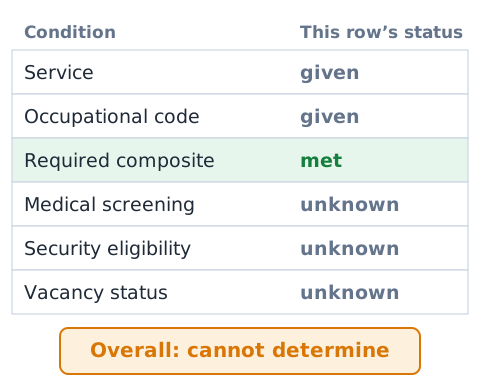
Imagine a practice table with columns for Service, occupational code, required composite, medical screening, security eligibility, and vacancy status. The table is useful precisely because it prevents a single score from swallowing all the other conditions. To answer a scenario, read one row completely; do not import criteria from another Service or another row. If a field is missing, label it unknown rather than assuming passed. A matrix illustrates logical conditions but does not constitute a current military occupation database.
The AND Logic of Multiple Conditions
A simplified teaching model might write 'eligible for further consideration' only when the relevant listed conditions are satisfied together. In logic, A AND B requires both A and B to be true. Satisfying A does not prove B. If a score standard is met but a necessary non-score condition is unknown, the overall occupational decision remains unresolved. The model is a reasoning tool, not a promise that every conceivable factor can be represented in one formula or that all Services follow one identical workflow. Useful symbolic summary:
Unknown Is Not the Same as Failed
When a scenario does not mention a person's medical status, security eligibility, education, or program availability, those items are unknown. You cannot silently treat unknown as passed, but you also cannot infer they are failed. This distinction matters for answering applied questions fairly. The supported response may be 'cannot determine from the provided information.' Learn to reserve this answer for genuine missing conditions, not as an escape from a question with enough explicit evidence to classify a score or identify a named composite.
A Job-Qualification Decision Tree
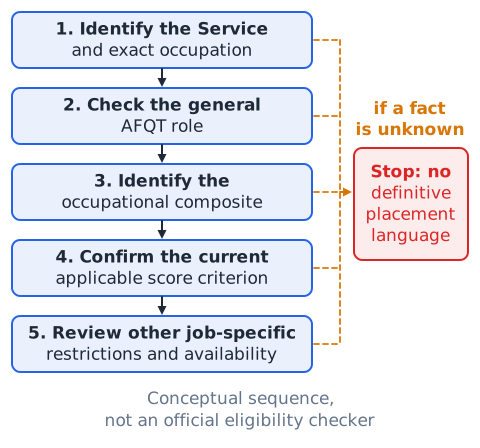
A reliable decision sequence is to identify the Service and exact occupation, check the general AFQT role, identify the occupational composite, confirm any current applicable score criterion, then review other job-specific restrictions and availability. Each step should be supported by an official source or supplied scenario fact. If an essential fact is unknown, stop short of definitive placement language. This sequence is conceptual; it is not a recruitment application or a real-time official eligibility checker. The goal is disciplined interpretation.
Four Types of Misleading Answer
Watch for four common distractor patterns. A scale-confusion option equates AFQT percentile with an occupational composite. A branch-swap option applies an Army formula to a Navy rating. A condition-omission option ignores necessary screening outside scores. An absolute-language option turns a potential qualification into a guaranteed slot. Each fails for a different reason. Training to name the defect makes it easier to eliminate plausible-sounding options rather than relying on a vague feeling that the answer is wrong.
Why the Highest Score Is Not Always the Relevant Score
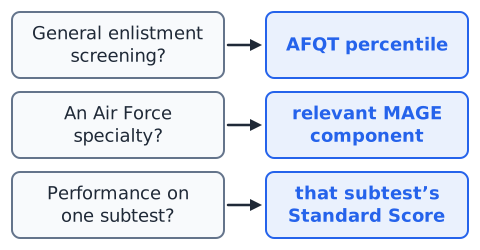
The visually largest number on a report is not necessarily the most useful for the question being asked. If a question asks about general enlistment screening, an AFQT percentile is relevant. If it asks about aptitude for a particular Air Force specialty, a relevant MAGE component may be needed. If it asks about performance in a subtest, the Standard Score for that subtest is appropriate. Choose by function, label, and Service, not by magnitude. Different scales can make numerical comparisons meaningless.
Verify the Source Before the Threshold
A trustworthy requirement source should clearly identify its issuing military authority, the exact occupational program, the date or publication version when available, and the score terminology. A generic tutoring chart may be useful for practice, but it does not replace official policy. Even an official page might be superseded by more recent instructions. For a real applicant, a recruiter or authorized program representative can clarify how the currently applicable rules are interpreted. This course does not represent the Department of Defense or any Service.
Know the Difference Between Test and Contract
ASVAB results support eligibility and classification assessments; they do not, by themselves, make a binding job contract. A candidate may discuss job interests and available pathways with an authorized representative, but the existence of a score report is not proof that an agreement has been offered or signed. In a multiple-choice case, reject a statement claiming that receiving any score automatically signs someone into a specialty. Distinguish tested aptitude, qualification review, offer, and formal assignment as separate processes.
Officer Routes Are a Different Question
This lesson concerns common enlisted ASVAB score interpretation and occupational classification. Many officer pathways have separate testing, educational, commissioning, and selection requirements. For example, the U.S. Air Force's public ASVAB information describes the Air Force Officer Qualifying Test as distinct from enlisted AFQT use. Never generalize an enlisted occupational composite chart into universal officer qualification rules. A question mentioning an officer program needs pathway-specific research rather than an assumption that an enlisted line score controls all accession routes.
Apprenticeships and Specialized Training
A job title that involves training does not imply an applicant skips other eligibility checks merely because their composite is high. Some programs include prerequisites, staged screening, or additional assessments. The correct educational statement is that aptitude scores may contribute to determining suitability for training; they cannot guarantee a particular training seat or completion. Students should ask what the Service currently publishes for the specific program instead of relying on a broad occupation label such as technician or specialist alone.
Official Versus Practice Results
A preparation app can display practice accuracy and explanations, but those are not official AFQT or Service composite scores. Official score reporting involves standardized administration and scoring procedures. A learner who answers 32 of 40 questions correctly has a practice percentage of 80 percent; that does not establish an AFQT percentile of 80, a MAGE score of 80, or eligibility for a named position. This distinction protects students from misleading score calculators.
Common Vocabulary for Careful Conclusions
Prefer phrases such as 'supports initial screening,' 'is one aptitude input,' 'may meet a score criterion,' 'requires current verification,' and 'cannot be determined from the facts given.' Avoid the stronger expressions 'guarantees acceptance,' 'automatically qualifies for every role,' and 'replaces all other screening.' The correct phrase depends on what the scenario proves. Practicing conditional language is not indecision; it is the skill of separating a claim supported by evidence from an imagined conclusion.
Practice With Competing Requirements
Consider a fictional role requiring condition A (an applicable aptitude score) and condition B (a separately specified background screening). If A is known true and B is unreported, only A can be confirmed. If both are known true, the scenario supports that both listed conditions have been met, but the real-world process could contain other requirements. If A is false, the role's stated score criterion is not met. Answer from the scenario's explicit logic and do not invent hidden exceptions or unreported waivers.
Your Research Checklist
Before drawing a conclusion about a real military career, collect the current Service, precise specialty identifier, application or accession pathway, official score report, current composite definition and any required score criterion, separate non-score requirements, and clarification about available options. Write down which facts are known and which need authoritative confirmation. This checklist is a learning aid; it does not collect personal details or determine eligibility. It makes conversations with authorized representatives more focused and reduces misunderstanding based on outdated screenshots.
Quick Review of the Major Contrasts
AFQT is a percentile used for general enlistment screening. Service composites use selected ASVAB subtest scores to support occupational classification. Their definitions and the applicable requirements vary by Service and field. Subtest Standard Scores are yet another reported score type. A high score can be valuable evidence but does not override separate standards or guarantee a vacancy. The correct next action with missing or dated occupational requirements is to verify the current Service-specific rule rather than guess.
Final Worked Scenario
A hypothetical applicant reports AFQT 75, a strong electronics-related study profile, and an interest in an Air Force technical specialty. The facts suggest reviewing the current Air Force MAGE criteria and relevant occupational requirements. They do not establish an Electronics composite result, any official technical qualification, medical eligibility, or an available contract. A good exam response identifies those gaps clearly. Study toward applicable subtests, request official score interpretation when available, and avoid translating a practice result into a guaranteed career outcome.
 English ▾