 ASVAB Camp
Your Two Score Questions
Your ASVAB report serves two different decisions. First, do your verbal and mathematics results support basic eligibility to enlist? That is the purpose of the Armed Forces Qualification Test (AFQT) score. Second, which occupational fields might fit your tested strengths? A military Service uses its own classification composites, often called line scores, for that question. These scores come from the same ASVAB assessment, but they answer different questions. By the end of this lesson, you should be able to read a score report without treating the AFQT percentile as a universal job score or treating a composite as a promise of placement.
One Assessment, Multiple Reported Scores
There is not a separate AFQT entrance exam that must be taken after the ASVAB. The ASVAB is a battery of subtests; several different reports can be calculated from its results. An applicant can have subtest standard scores, an AFQT percentile, and one or more Service composites. These values are not interchangeable just because they all appear as numbers. Before interpreting any reported value, identify the score label, the score scale, its intended decision, and which population or formula it uses.
AFQT: The Basic Enlistment Screening Question
The AFQT is used primarily to help establish an applicant's eligibility for enlistment. It is calculated using Arithmetic Reasoning (AR), Mathematics Knowledge (MK), Word Knowledge (WK), and Paragraph Comprehension (PC). It is then reported as a percentile between 1 and 99, not simply the percentage of questions answered correctly. A strong AFQT result does not automatically qualify an applicant for a chosen military occupation; classification requires additional information, including the relevant Service composite and other requirements.
Service Composites: The Occupational Question
Each military Service develops composite scores by combining ASVAB subtest scores that help predict training or job performance for particular occupational clusters. These may include science, electronics, mechanical, spatial, verbal, and mathematics subtests, depending on the Service and composite. The composites are not one universal set shared by every branch. A person can satisfy an enlistment threshold while missing a classification criterion for a desired job. The reverse does not mean that a strong technical score overrides basic eligibility requirements.
Subtest Standard Scores Are a Third Kind of Number
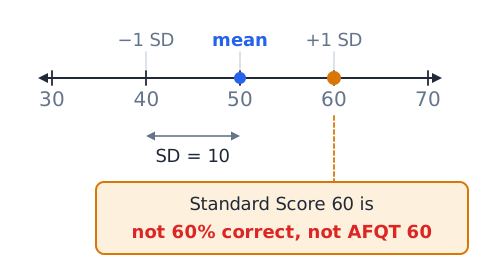
An ASVAB subtest Standard Score describes performance on that subtest relative to a reference group. Official materials describe a mean of 50 and a standard deviation of 10. A Standard Score of 60 is not a claim of 60 percent correct, and it is not an AFQT percentile of 60. Subtest standard scores contribute to calculated scores, but the reporting conventions and transformations for those calculated scores may differ. Always preserve this distinction when comparing report columns.
A Percentile Is Not a Test Accuracy Rate
An AFQT result of 67 means the examinee performed as well as or better than approximately 67 percent of the relevant nationally representative reference sample under the official norming scheme. It does not mean 67 of every 100 exam questions were correct. It also does not mean 67 percent of military jobs are available. The percentile is a rank-based comparison, not a direct measure of the number of skills mastered. Raw practice-test percentages cannot be converted into official AFQT scores by simple substitution.
The Four AFQT Contributors
The AFQT takes information from AR, MK, WK, and PC. AR tests reasoning through arithmetic word problems. MK concerns mathematics principles. WK concerns vocabulary and meaning in context. PC concerns extracting information from written passages. Official scoring uses these test results through prescribed scoring and norming procedures. Understanding which subtests count is useful for allocating study time, but do not invent an AFQT percentile by adding raw practice answers. Remember the symbolic relationship: . This is a component relationship, not a direct percentile conversion.
Why Science and Mechanical Skills Still Matter
General Science, Electronics Information, Mechanical Comprehension, Auto and Shop content, and Assembling Objects may be relevant to particular occupational composites even though they do not make up the four AFQT contributors. It would be a mistake to ignore those subjects because they do not appear directly in the AFQT formula. The correct study plan is balanced: work on verbal and mathematics foundations for enlistment eligibility, then prepare the occupationally relevant subtests for the jobs you hope to pursue.
A Process Map for Reading Scores
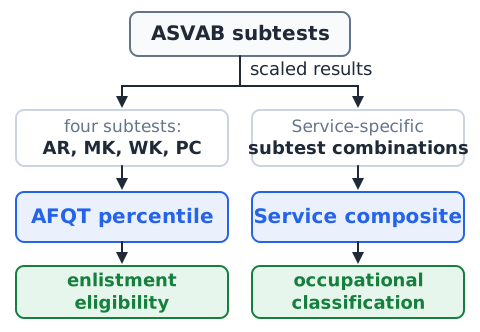
Read the scoring sequence from top to bottom. ASVAB subtests produce scaled results; four designated subtests contribute to the AFQT eligibility percentile; Service-specific combinations of subtests support occupational classification. These paths start from the same exam but use different subsets of information. Mapping the paths this way helps you avoid mistaking one final score for the whole score report. The map is conceptual and is not a score-conversion calculator.
AFQT Eligibility Is Necessary but Not Sufficient
If an applicant meets the current applicable AFQT threshold, that is one important step, not a signed enlistment contract or a guaranteed specialty. Recruiting decisions also consider rules and factors outside this educational module, such as eligibility standards and the needs of the Service. The exact requirements can change. In a practice question, a conclusion containing words like always, automatically, or guarantees should be treated with special caution unless the governing evidence explicitly supports it.
Why a Service Composite Does Not Guarantee a Job
A classification composite helps determine whether an applicant may meet aptitude requirements for a field. Actual placement can depend on additional eligibility criteria, training seats, timing, screening, and current Service policies. A score by itself is not an offer of a particular occupation. When two applicants report the same composite, do not assume they will receive identical assignments. When evaluating a scenario, distinguish score-based qualification from all the later personnel and administrative decisions.
Different Services, Different Formulas
A Navy composite and an Army composite may have different names, include different subtests, or use different scoring transformations. The official ASVAB Military Jobs page publishes a table of Service classification composites and their formulas, but job standards and reporting practices can change. Never apply a formula shown for one Service to another Service merely because both jobs sound mechanical or technical. The meaning of a label depends on the Service that issued it.
Army Example: General Technical
The official ASVAB Military Jobs reference lists Army General Technical (GT) as the sum of AR and VE in its displayed composite table. VE is a derived verbal composite from the verbal subtests, not simply a raw Word Knowledge question count. This example illustrates a mathematical grouping, not an invitation to calculate your own official line score from practice percentages. It should also not be generalized into a Navy, Marine Corps, or Air Force requirement. Remember the symbolic relationship:
This is a component relationship, not a direct percentile conversion.
Air Force Example: Four Aptitude Areas
The official reference lists Air Force composites labeled Mechanical, Administrative, General, and Electronic. The displayed component combinations differ. For example, its General formula includes VE and AR, while Electronic includes AR, MK, EI, and GS. These names help you see why a person could be relatively strong in one area but not another. The displayed scoring expressions are not universal job thresholds and should not be mistaken for AFQT percentiles.
Navy Example: Multiple Specialized Composites
The Navy portion of the official table identifies many occupational groupings, including administration, mechanical, operations, and technical combinations. Some involve AS, MC, AO, MK, or EI; others emphasize verbal or mathematics results. That is why “my AFQT is high, so my Navy technical score must also be high” is not justified. Compare the actual labeled composite reported for the specific occupational classification rather than assuming there is only one Navy score.
Marine Corps Example: Technical Groupings
The official Marine Corps composites include Mechanical, Clerical, General Technical, and Electrical in the published ASVAB overview. Their formulas draw on different subtest combinations. A mechanical cluster can call for knowledge that differs from a clerical cluster even though both candidates take the ASVAB. This example reinforces the underlying rule: the score label and Service are essential context. A composite name alone is not a universal percentile and cannot be copied between branches.
Reading a Hypothetical Two-Column Report
Imagine a made-up report labeled “AFQT percentile: 58” and “Technical composite: 104.” First identify that the AFQT value is a national percentile; 58 does not say how many questions were correct. Next identify that 104 is a Service-specific composite on a different scale, and no specific eligibility conclusion follows without the Service, occupation, and current requirement. The number 104 cannot be ranked directly against 58. This example is purely illustrative, not a real official score conversion.
Example: Same AFQT, Different Job Composites
Two hypothetical applicants each have an AFQT percentile of 65. One is stronger on electronics-related subtests and the other on reading-related subtests outside the information captured by that single percentile. Depending on the Service and formula, their occupational composites may differ. You cannot infer identical job eligibility from identical AFQT results. The practice takeaway is to ask which additional subtests a composite uses, not to invent a promised job assignment.
Example: Strong Mechanical, Weaker Verbal
A hypothetical learner excels in mechanical principles and shop knowledge but struggles with word meanings and reading passages. Mechanical strengths might support certain composite profiles, yet AFQT uses verbal and mathematics subtests. The learner should not assume that technical success compensates automatically for all enlistment eligibility criteria. A sensible study plan strengthens verbal and mathematics skills while maintaining mechanical expertise. This is a learning illustration, not a prediction of a score or military position.
Example: Strong AFQT, Limited Occupational Match
A learner reports a very strong AFQT percentile but a lower score in a composite relevant to a preferred occupation. Those outcomes are compatible because the AFQT and occupational composite are calculated for different uses. The correct conclusion is to review the current aptitude rules for that specific branch and specialty rather than to assume the AFQT overrides all other job-screening results. A recruiter or official Service source is needed to confirm current requirements.
Example: School Versus Enlistment Program Report
An ASVAB Career Exploration Program report may emphasize Verbal Skills, Math Skills, and Science and Technical Skills composites, while the Enlistment Testing Program reports Service-specific classification composites. The words “composite score” apply to both settings, but the formulas and intended decisions are different. When somebody sends a screenshot from a school report, first check the program before interpreting any composite as a direct qualification for a military occupation.
Example: Sorting Numbers Without Comparing Magnitudes
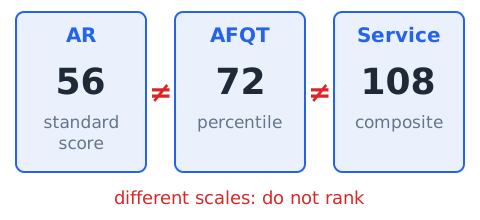
Consider three labels in a fictional score report: AR Standard Score 56, AFQT percentile 72, and a Service composite 108. Although 108 is the largest numeral, that alone does not make it the strongest result. Each value has its own scale. The correct order of interpretation is to identify the label, interpret that label according to its scale, and apply the relevant decision rule. Do not rank unrelated numbers merely by their printed magnitudes. Remember the symbolic relationship: . These values sit on different scales and cannot be ranked against one another.
Mistake 1: Calling the AFQT a Standalone Exam
The Armed Forces Qualification Test is not a separate test that follows the ASVAB. It is a computed score based on designated ASVAB subtests. If a distractor says a learner must register for a second AFQT exam, check the official FAQ: it describes one ASVAB testing process producing different scores. Because many educational websites use “AFQT practice test” informally, always distinguish a practice product name from the actual assessment and its score.
Mistake 2: Treating a Percentile as Raw Accuracy
A student with AFQT 74 did not necessarily answer 74 percent of all ASVAB questions correctly. A percentile references relative standing in a norm group; raw accuracy references correct responses divided by total responses. These are fundamentally different statistics. To avoid the trap, look for wording such as “relative to others,” which suggests percentile, versus “number correct,” which suggests raw performance. Be cautious when a choice replaces one with the other.
Mistake 3: Assuming One Composite Works Everywhere
No single line score is automatically portable from the Army to the Navy or Air Force. Different Services develop and validate different composites. A distractor that asserts the same formula is used by every branch conflicts with that official principle. Even similar-sounding composite labels need their own source and purpose. A good reader always identifies the Service, the specific composite, and the occupational context before drawing a conclusion.
Mistake 4: Confusing a Score with a Guarantee
A score report is one evidence source in a recruiting process. Meeting a classification cutoff does not guarantee the occupation will be assigned, and meeting an AFQT threshold does not guarantee enlistment. Reframe categorical claims as conditional ones. For example, “may support qualification subject to current policy and other criteria” is defensible; “automatically obtains the job” is not. This distinction matters whenever the question asks for the most careful interpretation.
Mistake 5: Applying Old Thresholds Indefinitely
Specific minimums, program qualifications, and job availability can change over time. An older screenshot of a recruitment forum is not enough to establish a currently valid rule. The enduring concept is the difference between AFQT eligibility screening and Service classification. For a real-world decision, review the current official Service material or a recruiter. For this lesson, no numerical branch minimum is treated as a permanent law.
Mistake 6: Confusing Score Inputs and Outputs
An AFQT category is not a contributing subtest. Likewise, a Service composite is an output built from selected test results, not an additional ASVAB question section. Confusion occurs when learners mix WK, PC, AR, and MK with broad labels such as GT or Electronic. Keep a two-level model: input subtests, then calculated reported results. The same input can contribute to more than one reported result without making the outputs equivalent.
A Four-Step Interpretation Method
Use the same checklist every time: identify the score label; determine whether it is a standard score, a percentile, or a Service-specific composite; identify the decision it informs; and check whether the evidence actually supports the proposed conclusion. If the question mentions occupational placement, ask about the branch-specific composite and any other criteria. If it asks basic enlistment screening, begin with the AFQT. This systematic approach is faster and more accurate than interpreting an unlabeled number.
Study Time: AFQT Fundamentals First
The AFQT contributors are verbal and mathematics tests, so improving AR, MK, WK, and PC should be part of any broad enlistment-focused plan. Work steadily on weak areas with original reasoning exercises; do not memorize a fictional formula-to-percentile shortcut. Add occupationally relevant technical preparation if a desired military field uses those subtests. A balanced plan recognizes the two purposes without promising any particular official test score.
Study Time: Target Specific Occupational Skills
Once you know the occupational fields you want to explore, look at the Service's current official composite criteria and note their contributing subtests. For example, an electronics-oriented combination may depend on EI and GS in addition to math skills. This is a strategy for identifying study priorities, not a guarantee that boosting a practice quiz by a given percentage will raise an official composite by a known number of points.
Use Precise Language on Practice Tests
When asked what a score tells you, choose the narrowest warranted claim. “AFQT mainly informs enlistment eligibility” is different from “AFQT guarantees a job.” “Service composites assist occupational classification” is different from “Service composites always select the final assignment.” Correct answers tend to respect the limits of score interpretation. If an option mixes a true score input with an unjustified outcome, the whole option should be rejected.
Timing Without Guessing Score Calculations
A quick score interpretation question can usually be solved by labeling the variables: AFQT equals percentile-related eligibility; a composite equals Service-specific classification. Do not waste time trying to estimate raw scores from a hypothetical percentile. On a CAT administration, check navigation rules before assuming you can return to earlier questions. This lesson does not claim that a test taker may change a submitted response; accurate decisions matter more than rushing through invented shortcuts.
When the Correct Answer Is “Not Enough Information”
A scenario may provide an AFQT percentile and request the exact Army specialty the applicant qualifies for. That information is insufficient: occupational classification depends on more than an AFQT percentile. It may instead supply a line score but omit the Service, occupational cutoff, or other requirements. Practice identifying the missing variable rather than guessing a job code or minimum. Uncertainty is a legitimate and often essential part of accurate score interpretation.
Guided Drill: Identify the Scale
For each label, state the type without calculating a new score: AFQT 63 is a percentile; WK 53 is a subtest standard score; an Army GT figure is a Service composite. Explain why “63 is stronger than 53” is meaningless without considering the differing scales. Then write one sentence for what each value can and cannot tell you. The aim is precise interpretation, not comparison of unrelated numerical magnitudes.
Guided Drill: Classify the Decision
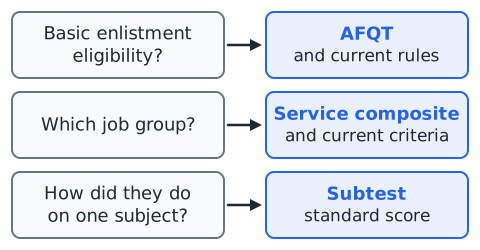
Read three statements and choose the right score family. “Is this applicant likely to meet basic enlistment testing eligibility?” points first to AFQT. “Does the applicant meet this branch's current aptitude criterion for a technical field?” points to the relevant composite. “How did the applicant perform on Mechanical Comprehension relative to the norm group?” points to an MC standard score. In each case, additional rules may still apply.
Guided Drill: Find the Missing Information
A learner reports AFQT 81 and asks whether that guarantees a Navy electronics job. Identify at least three missing facts: the relevant Navy score combination, the latest specialty requirement, and non-score qualifications or availability. Repeat for a learner reporting “GT 110” without identifying Service or assignment. Being able to name missing facts is more useful than memorizing a promotional claim.
Guided Drill: Identify Correct AFQT Inputs
From this mixed list—AR, MK, WK, PC, EI, AO, GS, MC—select the four AFQT contributors. They are AR, MK, WK, and PC. Next explain why selecting only the technical tests would be incorrect even though those tests can affect some Service composites. Finally write the four full names from memory. This connects abbreviations to the functional scoring map instead of encouraging rote recognition alone.
Guided Drill: Compare Two Applicants Carefully
Imagine that applicant A and applicant B have the same AFQT percentile but different EI and MC results. Explain why their technical occupational classifications could differ. Then imagine two applicants who have the same EI but different verbal or mathematics performance: explain why their AFQT and other composites could differ. You do not need numeric formulas to make these valid deductions. The crucial principle is that the score outputs draw on different combinations of inputs.
Guided Drill: Repair Overstated Claims
Rewrite each overconfident sentence. “An AFQT 85 guarantees an engineering job” becomes “An AFQT 85 reports a percentile; a specific job may require relevant composites and other criteria.” “A Mechanical score of 105 is 105% accuracy” becomes “The score belongs to a separate classification scale and is not a percentage-correct claim.” Try two more examples yourself. The goal is to replace slogans with defensible statements.
AFQT Versus Composites: Side-by-Side
Think of two columns: AFQT is an enlistment eligibility screening score derived from AR, MK, WK, and PC and reported as a percentile. Service composites combine selected subtest results to help classify applicants for occupations and have branch-specific names, inputs, and reporting. The shared source is the ASVAB assessment, not a shared score scale. The distinction remains useful even if a Service revises a formula or its job-entry thresholds.
Why Multiple Score Families Are Useful
People can show different profiles of strengths across verbal, mathematical, technical, and spatial abilities. A single percentile cannot capture every possible military occupational aptitude. Separate classification composites help organize more specific information while the AFQT supports a broad eligibility decision. You should not use either family as an assessment of someone's personal worth or potential. The score family is a tool for a particular institutional decision, with limits and context.
Current Policy Is a Separate Question
The conceptual difference between AFQT and Service composites is stable; current acceptance criteria are not guaranteed to be stable. This lesson intentionally does not assert one permanent minimum for every Service or specialty. For real applications, consult current official recruiting guidance and confirm with the applicable Service. When reading third-party charts, note their publication date and whether they identify the population, score type, and branch.
Five Facts to Recall
Remember these facts without mixing their scales: one ASVAB assessment can produce several score families; AFQT uses AR, MK, WK, and PC; AFQT is reported as a percentile; Service composites help evaluate occupational aptitude using Service-specific combinations; and neither score alone guarantees a particular enlistment outcome or assignment. If you can explain every fact using your own example, you have learned the heart of the lesson.
Rapid Self-Check Before the Test
Ask yourself: Can I state the four AFQT contributors? Can I explain what the AFQT percentile does not mean? Can I name two reasons a technical composite is not an AFQT score? Do I know why different Services might use different combinations? Can I distinguish qualification from guaranteed assignment? If any answer is uncertain, revisit the score map and worked examples. Answering these questions correctly prepares you for the 40 original review items.
Application: Explaining a Report to Someone Else
Imagine explaining a fictional score report to a classmate. Say what each column is called, what it was designed to measure, and one conclusion you cannot make from it. Do not calculate an official AFQT percentile from unscaled classroom quiz results. Avoid presenting a Service composite without naming its Service. Teaching the difference out loud is a useful test of comprehension because a correct explanation must use the intended decision, not just recognize an abbreviation.
Glossary: AFQT, Standard Score, Composite
AFQT: an Armed Forces Qualification Test score computed from four ASVAB subtests and reported as a percentile. Standard Score: a norm-referenced scaled result on an individual ASVAB subtest, with a mean of 50 in official reporting materials. Service composite: a Service-selected combination of ASVAB subtest results used to help classify applicants for occupational fields. These definitions describe three distinct levels of score reporting.
Glossary: VE, AR, MK and Technical Labels
VE means a derived verbal composite based on WK and PC standard scores; AR is Arithmetic Reasoning; MK is Mathematics Knowledge. EI means Electronics Information; GS means General Science; MC means Mechanical Comprehension; AO means Assembling Objects; AS is the combined Auto and Shop score in relevant reporting contexts. The same abbreviations may appear in official Service formula tables, but seeing letters in a formula is not itself a job qualification.
Score-Report Interpretation Case Study
A fictional candidate presents AFQT 62, AR Standard Score 58, and an unnamed “Mechanical 110.” First, explain that 62 is a percentile and 58 is a subtest standard score. Next, refuse to interpret Mechanical 110 as a percentile or as an admission to a specific specialty until you know which Service calculated it and which policy applies. The strongest answer is a careful conditional statement, not an invented conversion between 62, 58, and 110.
Final Decision Flow
When a question asks whether a score supports basic enlistment testing eligibility, locate the AFQT and check current rules. When it asks what job group the applicant may qualify for, locate the applicable Service composite and identify the specific occupation and current criteria. When it asks what someone did on a particular subject, locate the corresponding subtest standard score. These are complementary views of ASVAB performance. Never convert one into the other by comparing their raw printed numbers.
 English ▾