 ASVAB Camp
Understand the AFQT report
The Armed Forces Qualification Test, or AFQT, is an eligibility score reported with your ASVAB results. After this lesson you should be able to interpret a percentile correctly, assign any valid whole-number AFQT percentile to its reporting category, distinguish the AFQT from military job composites, and explain why a percentile cannot by itself guarantee enlistment, a particular occupation, or a bonus. Practice reading the official category table accurately before trying to memorize branch policies that can change.
What the AFQT actually measures
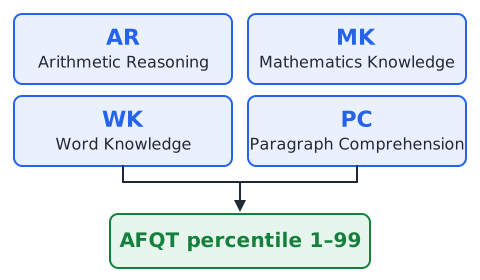
The AFQT combines selected verbal and mathematics performance from the ASVAB. It is not a second examination that you take separately after the ASVAB. It is a score derived from four ASVAB subtests and used by military services in judging basic enlistment eligibility. An applicant can have a high result in one technical subtest and still need adequate performance in the four AFQT contributors. Treat the AFQT as a broad qualification indicator, not a description of every skill or every military career.
The four contributing subtests
Arithmetic Reasoning (AR), Mathematics Knowledge (MK), Word Knowledge (WK), and Paragraph Comprehension (PC) contribute to the AFQT. AR tests solving mathematical word problems, while MK covers mathematical principles. WK concerns word meanings and vocabulary; PC concerns interpreting written passages. The official score combines standardized results rather than simply counting four quiz scores. Remember the four names and their roles. General Science, Electronics Information, Auto and Shop, Mechanical Comprehension, and Assembling Objects can matter for other scores, but they are not among these four AFQT contributors.
Why AFQT is not a percent-correct score
A reported AFQT of 72 does not mean the examinee answered 72 percent of the ASVAB questions correctly. Seventy-two is a percentile rank: it compares performance with a defined norm group. Raw numbers correct, individual subtest standard scores, and percentile ranks are different types of measurement. A practice app can report a percentage correct on its own questions, but that classroom percentage is not a valid official AFQT estimate without official scoring and norm conversion. Avoid treating unofficial online percentage calculators as definitive enlistment results.
Percentile meaning in plain language
If your official AFQT percentile is 72, your performance is at least as high as approximately 72 percent of the relevant national reference sample. The remaining percent does not tell you how many actual test questions you missed. A percentile rank compares your performance with other people in a standardized reference group, not with a possible maximum of 100 points. This interpretation is important because a result of 49 and a result of 50 fall into adjacent reporting categories even though their relative standings differ only slightly.
Who is the comparison group?
The official ASVAB describes the current AFQT percentile norm group as a nationally representative sample of 18- to 23-year-old people who participated in a 1997 norming study. It is not a ranking of everyone who enlisted this year, of one graduating class, or of other users of this learning app. Historical reference groups make reported percentiles comparable within the defined scoring system. The date of the norming study is not the date of an applicant’s test and does not mean the current exam was written in 1997.
Official AFQT range
Official AFQT percentile scores are reported as whole numbers from 1 through 99. A practice percentage of zero or one hundred might be possible on a homemade ten-question quiz, but zero and one hundred are not official reported AFQT percentile values in the category table. When categorizing a score, first check that it is in the official reporting range, and then locate the inclusive endpoints of the correct band. Do not round an imagined practice result into an official percentile yourself.
Overview: six primary category labels
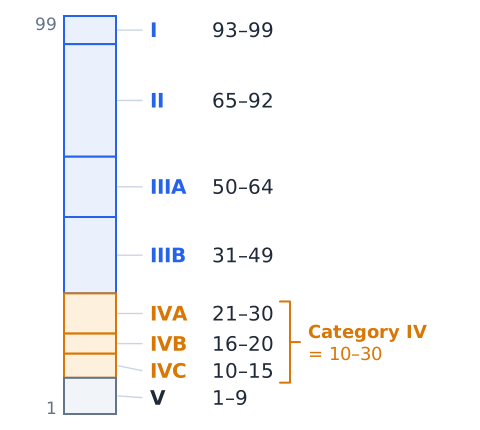
The official enlistment eligibility page groups AFQT scores into Category I, II, IIIA, IIIB, IV, and V. The official detailed scores page splits Category IV into IVA, IVB, and IVC. These are compatible levels of detail: category IV remains the parent group covering 10 through 30. The high-level bands are I 93–99, II 65–92, IIIA 50–64, IIIB 31–49, IV 10–30, and V 1–9. Understanding both displays prevents apparent contradictions.
Category I: percentile 93 through 99
Category I contains percentile scores 93 through 99, inclusive, and is the highest AFQT reporting category. A score of 93 belongs to I, while 92 belongs to II. A very high percentile does not automatically satisfy medical, age, citizenship, security, occupational, or other requirements. Nor does it guarantee a particular incentive or assignment. It tells you how the AFQT performance compares with the national reference group. Use Category I to interpret the reporting band—not as a contract about future military selection.
Category II: percentile 65 through 92
Category II covers all whole-number percentiles from 65 to 92. Both 65 and 92 are included. A person with 64 falls in IIIA instead. This wide reporting band does not say every person in it has the same subtest strengths. Two applicants can share an AFQT category and still have very different technical, verbal, and occupational composite profiles. In a category identification question, pay attention to the inclusive limits. In a career-planning question, remember that a category alone is not a job-qualification checklist.
Category IIIA: percentile 50 through 64
Category IIIA begins at the 50th percentile and ends at the 64th percentile. The official enlistment eligibility site notes that applicants in IIIA or higher may qualify for certain enlistment incentives. The word may matters: incentives depend on current service programs, contract terms, and eligibility rules, not just the category. A score of 50 is IIIA; a score of 49 is IIIB. Practice distinguishing an objective category classification from an uncertain administrative decision made by a recruiting service.
Category IIIB: percentile 31 through 49
Category IIIB covers the 31st through the 49th percentile. It is the lower reporting division of Category III. A score of 31 is IIIB; a score of 30 is within IV instead. Being in IIIB does not establish that a specific military branch will accept a candidate or that a particular job is available. The official ASVAB says minimum AFQT requirements vary by service. Other eligibility factors and current recruiting policies can also matter. Consult current official guidance instead of using a fixed universal cut score.
Category IV: percentile 10 through 30
Category IV is the parent category for scores from 10 to 30 inclusive. Some official tables list it as one band. Other official tables divide it for more detailed reporting. A score of 10 is part of IV, not V, and a score of 30 is part of IV, not IIIB. Enlistment rules for low-score categories are constrained, and current eligibility cannot be inferred from the table alone. This lesson focuses on identifying what the score says, without making a branch-specific eligibility promise.
Category IVA: percentile 21 through 30
Within Category IV, the official detailed table identifies IVA as percentiles 21 through 30. A reported 21 belongs to IVA and a 20 belongs to IVB. If a question only offers the broad category IV, IVA is one of its subdivisions. Do not claim that IVA means a person automatically qualifies under a particular program: it labels an AFQT percentile interval. The broad and detailed labels are not competing score systems. They are a parent category and its more precise subrange.
Category IVB: percentile 16 through 20
The detailed scores table assigns percentile 16 through 20 to Category IVB. A score of 16 is IVB, while 15 is IVC. Category IVB remains within broad Category IV. When you encounter wording such as “What is the broad AFQT category for 18?” the answer is IV. When a question asks for the detailed subcategory, the answer is IVB. Reading the requested level of detail is as important as knowing the endpoints.
Category IVC: percentile 10 through 15
Category IVC covers the 10th through the 15th percentile in the detailed official AFQT table. The lower endpoint of 10 is included. A reported 9 is Category V, not IVC. This is a frequent boundary-reading trap because the gap between 9 and 10 is only one percentile point but crosses two reporting categories. Describing IVC as a subcategory of IV is accurate; describing it as an additional group outside I through V is not. Always verify whether a source uses broad or detailed reporting.
Category V: percentile 1 through 9
Category V is the lowest AFQT reporting category and covers scores 1 through 9, inclusive. A 9 belongs to V; a 10 belongs to IVC within IV. Category V has a distinct enlistment eligibility significance under federal policy. For the legal and administrative implications, rely on currently published Defense Department and service rules; do not interpret Category V as a permanent judgment about a person’s potential or learning capacity. Test scores describe performance in a specific assessment context, not human worth.
Worked example: classify 92 and 93
Consider two people whose official percentiles are 92 and 93. First find the upper endpoint of Category II: 92 is included. Then find the lower endpoint of Category I: 93 is included. The first result is II and the second is I. Neither should be rounded, because both are already reported whole-number percentiles. This simple comparison illustrates why category classification is a lookup task with exact inclusive boundaries rather than a vague description such as “high” or “very high.”
Worked example: 49 versus 50
At percentile 49, the reported band is IIIB (31–49). At percentile 50, the reported band is IIIA (50–64). Suppose a training worksheet asks whether a 49 could become IIIA merely by rounding it to a convenient tens place. No: an official score of 49 is already an exact reported percentile. One different point would change its category, but a learner must never alter the report. Eligibility and incentives still depend on service policy, so category identification and actual recruiting decisions remain separate.
Worked example: 10, 15, 16, 20, 21 and 30
Every one of these six scores falls in the broad Category IV. For precise labels, 10 and 15 are IVC, 16 and 20 are IVB, and 21 and 30 are IVA. Notice that the three detailed bands are contiguous: 10–15, 16–20, and 21–30, with no missing integer. A chart that places a score of 15 in Category V, or a 20 in IVA, is inconsistent with the official detailed table. The correct answer is determined by the inclusive boundaries.
Why the official pages show different detail
The official enlistment eligibility page groups all of 10–30 as IV, while the official scores page spells out three IV subdivisions. Both presentations can be used correctly depending on the question. If a recruiter discusses broad categories, the word IV may be sufficient; if a score report or detailed educational table specifies subdivisions, IVA, IVB, and IVC are more precise. Always ask what level of reporting the task requires. Do not combine unrelated internet charts that use inconsistent ranges.
Reading an AFQT category table quickly
A practical lookup method is to read the score first, find the interval containing that number, and verify both endpoints. For broad categories, remember the threshold sequence 10, 31, 50, 65, 93. For the detailed IV bands, remember 10, 16, and 21. Instead of memorizing the category letters without their values, build a consistent mental number line. This makes it easier to reject answers with nearby but invalid ranges, such as 64 belonging to II or 30 belonging to IIIB.
Difference between percentile and standard score
Each individual ASVAB subtest is reported with a standard score scale, whereas AFQT is reported as a percentile. The official ASVAB explains that subtest standard scores are norm-based with a reference average around 50 and standard deviation around 10. A mathematics subtest standard score of 60 is not the same as an AFQT percentile of 60. They use different units and describe different quantities. Avoid lining up raw, standard, and percentile numbers as if a number of 60 always had the same meaning.
The AFQT composite is not a simple sum of quiz percentages
Because AFQT scoring combines standardized verbal and mathematics information and then reports a percentile, you cannot safely add the percentage of correct answers from AR, MK, WK, and PC and call that an official AFQT. The verbal composite has specific weighting in formal calculations, and norm conversion is required. For this educational app, use arithmetic only to learn score definitions and boundaries. Do not promise that any four practice scores can be converted to a precise official AFQT without the actual scoring system.
Why AR is relevant
Arithmetic Reasoning asks you to work through quantitative word problems. A student can understand an equation yet lose points through misreading units or the situation described. To develop AFQT-related preparation, practice extracting relevant quantities, deciding on an operation, and checking whether the final number makes sense. Remember that AR is one of the four AFQT contributing subtests; it is not a standalone enlistment eligibility category. A strong AR performance cannot alone reveal the final AFQT percentile or a branch-specific job composite.
Why MK is relevant
Mathematics Knowledge tests principles and operations such as algebra, geometry, fractions, and other foundational mathematical ideas at the exam’s required level. MK is an AFQT component but must not be confused with the overall AFQT. Studying MK means understanding mathematical relationships, not memorizing percentile thresholds alone. When planning improvement, divide errors into concepts: equation setup, number properties, geometry, and computation. The official AFQT result still depends on the full combination of relevant subtests and standardized score processing.
Why WK and PC are relevant
Word Knowledge and Paragraph Comprehension supply the verbal dimensions of AFQT scoring. Vocabulary knowledge helps in WK, and careful reading of passage meaning helps in PC. A learner who reads fluent everyday English may still need practice distinguishing precise meanings and evidence-supported conclusions. The two subtests contribute jointly to verbal information in AFQT scoring. Their names are easy to confuse with unrelated technical subtests, so check whether the task asks about basic eligibility, occupational composites, or a specific subject test.
What the AFQT tells a recruiter
Military services use AFQT information as part of the initial enlistment eligibility process. Recruiters also consider factors outside a test score and follow service-specific rules and current administrative procedures. The category gives a compact way to describe where a percentile falls, but does not replace the individual numeric percentile or official verification. When asking for practical next steps, provide your official score report to an authorized recruiter and verify your circumstances through the current service recruiting office.
AFQT does not choose your military job
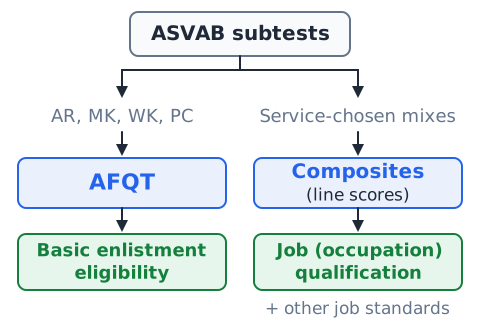
A candidate might meet a service’s overall AFQT minimum while still lacking a composite score needed for a desired specialty. Services use various subtest composites, commonly called line scores or aptitude areas, for different occupation qualification decisions. Occupational standards can also include medical, vision, citizenship, security, physical, or training-related conditions. Therefore, “Category II” is not enough information to decide whether someone qualifies for a named career. Subsequent lessons examine these service-specific composite systems in greater detail.
Two candidates, one category, different strengths
Imagine two hypothetical applicants both assigned to Category IIIA. One may have relatively strong verbal performance, while the other may perform better in quantitative tasks. Even if their reported AFQT percentile and category were identical, other standardized ASVAB subtest scores could differ. A job qualification decision often considers those differences through relevant composites. This example illustrates why categories do not rank applicants in every knowledge area. Avoid using a broad percentile as an unofficial diagnosis of someone’s mechanical, electronic, or technical aptitude.
Branch minimums are not one permanent number
The official ASVAB eligibility guidance states that minimum AFQT scores for enlistment vary by branch. Some policies also depend on education credentials, recruiting needs, available programs, and dates. This lesson intentionally avoids presenting a universal minimum for the Army, Navy, Air Force, Marine Corps, Space Force, or Coast Guard. A number found in an old blog post might not apply to the person or date you are considering. Check official service recruiting sites or a recruiter for the current minimum and any exceptions.
What “may qualify” means for incentives
The official ASVAB states that IIIA or higher may qualify for enlistment incentives. This sentence does not mean every person with percentile 50 or above automatically receives money, a preferred occupation, an enlistment contract, or a training guarantee. A valid decision requires up-to-date program conditions and contract documentation. The useful instructional takeaway is a language distinction: “may qualify” signals potential eligibility for consideration, whereas “automatically receives” would be an unjustified promise. Watch for these absolute claims in practice questions.
Percentiles cannot be averaged to predict an AFQT
If two unrelated practice tests yield the 60th and 80th percentile, their arithmetic average is 70. That number does not become an official AFQT of 70. Percentiles are ranks relative to reference distributions and need not behave like raw points when combined. AFQT calculation follows its own standardized scoring design, not an average of arbitrary website percentile ranks. A sound preparation tool can show concept strengths and question explanations, but it should label any estimated result clearly and avoid presenting it as an authoritative official score.
Percentile 50 is not guaranteed average accuracy
An AFQT of 50 means a position at or above about half of the designated norm group, not exactly half the items answered correctly. It also does not prove a person answered exactly half of the arithmetic or vocabulary items correctly. The relationship between item answers and a reported score is affected by standardized scaling and the exam administration. This distinction helps learners focus on skill improvement rather than attempting to force a specific percent-correct target from the official category boundaries.
Moving one category can be close to a boundary
Because category bands have sharp percentile boundaries, relatively small changes in a reported percentile near a cutoff can change the label. For example, 64 is IIIA while 65 is II, and 30 is IV while 31 is IIIB. A category jump is meaningful for reporting but does not imply a sudden change in a person’s underlying skill at that exact threshold. Avoid interpreting the label as a complete explanation of performance. The numeric percentile provides a more precise location within a band.
Why you should use official score reports
An official score report identifies actual scored results, whereas an unverified screenshot or website estimator may mislabel values. Before planning eligibility steps, identify whether the number is an AFQT percentile, an individual subtest standard score, or a service composite. The category table applies only to official AFQT percentiles. An unofficial test result that says 83% correct cannot safely be categorized as Category II without additional valid scoring. Handle official personal score reports privately.
Scenario: a score displayed as 83% correct
A learner practices forty original questions and answers thirty-three correctly, which is 82.5 percent correct. Can we call that an official AFQT percentile of 83 and say Category II? No. A classroom accuracy rate is not a nationally normed AFQT score. The right conclusion is that the practice set accuracy is thirty-three out of forty, while the official AFQT category is unknown. If the learner later receives an actual official AFQT percentile of 83, that particular reported value is within Category II.
Scenario: identify an error in an online chart
Suppose a chart claims that Category V extends from 1 to 15, and it describes Category IVC as 10 to 15. Those statements overlap, which contradicts the current official detailed ASVAB table. Under the official ranges, V ends at 9 and IVC begins at 10. A reliable educational chart must preserve nonoverlapping, inclusive bands. When several websites disagree, prioritize official ASVAB score guidance instead of copying an attractive infographic or a statement in user-generated comments.
Eligibility versus admission to a specialized program
An AFQT band can be relevant to the starting eligibility conversation, but it does not guarantee acceptance to a technical school, officer pathway, clearance-sensitive role, or advanced training program. Such programs typically apply their own conditions. The official score table describes broad performance, not specialty admission. You should read any program-specific claim as conditional unless accompanied by current service documents. A practice question that promises a specific job solely because of Category I should be rejected even if the category number itself is classified correctly.
What an AFQT result cannot reveal
An AFQT score alone does not disclose exact numbers of correct answers, individual raw scores, your correct-answer pattern, guaranteed occupational placement, medical eligibility, or the probability of receiving a bonus. A percentile also does not give a student’s age, education level, citizenship, or training record. If a question asks what can be inferred from “AFQT 72,” a safe answer is that 72 is a percentile rank in Category II. Statements about the applicant’s other attributes would go beyond the reported evidence.
Read the wording of a classification question
Classification questions may ask for the broad category, the detailed Category IV subdivision, or the meaning of a reported percentile. These are different tasks. For a score of 18, “broad category” means IV; “detailed subdivision” means IVB; “meaning of score” means relative rank against the official reference group. Always answer the question asked. Do not insert an unverifiable conclusion about branch eligibility when the prompt only requests a numerical band.
How to verify a boundary efficiently
Write down the relevant neighboring intervals, such as IIIA 50–64 and II 65–92. Compare the reported number with both ranges, including endpoints. For an AFQT of 64, it satisfies the IIIA interval; 65 does not. A consistent number-line method eliminates most errors in a few seconds. For detailed Category IV, separate IVC 10–15, IVB 16–20, and IVA 21–30. If an answer reverses a boundary by one point, reject it.
The role of category labels in preparation
Category labels help interpret an eventual official AFQT, but memorizing the ranges does not itself raise a score. Preparation requires learning arithmetic, mathematics, vocabulary, and reading comprehension. Use score interpretation to set realistic questions for a recruiter, and use practice exercises to build the underlying skills. Focus study time on topics you can actually improve. Use structured lessons and original exercises for self-directed review.
A note on currentness and policy changes
Official ASVAB score interpretation pages describe category boundaries, and current branch websites address recruiting requirements. A category range is a reporting definition; an enlistment minimum is a separate policy. Do not confuse a stable table with a permanent promise of acceptance. Government agencies and military services can revise implementation requirements. Before making a consequential decision, check sources again, record the access date, and ask an authorized recruiter to verify requirements for the intended service and applicant circumstances.
Quick practice: five boundary checks
Without looking at a table, classify official percentiles 9, 10, 31, 50, and 93. The detailed answers are V, IVC, IIIB, IIIA, and I, respectively. Now try the broad reporting system: V, IV, IIIB, IIIA, and I. Explain why 10 can be called both IV and IVC without contradiction. This short drill targets boundaries rather than vague impressions and helps you remember that Category IV has three subdivisions in the detailed score display.
Quick practice: evidence versus assumption
Decide whether each statement is supported by an official AFQT of 68: (1) the score is Category II; (2) the applicant answered 68 percent of questions correctly; (3) the applicant qualifies for every military job; (4) the percentile is at or above about 68 percent of the designated norm group. Only statements (1) and (4) are justified by that score. The other statements claim details that cannot be recovered from a percentile rank.
Quick practice: count the official inputs
Write the four AFQT contributing subtests in a fixed order: AR, MK, WK, PC. Then identify General Science, Mechanical Comprehension, Electronics Information, and Assembling Objects as subtests that do not directly contribute to the AFQT. This is not a statement that those other subtests are unimportant; they may be relevant to composites used for job qualification. Different decisions use different combinations of scores, which is why a learner must not treat AFQT as the only measurement on an ASVAB report.
Quick practice: an incentive claim
A promotional sentence says: “Everybody whose AFQT is 50 or higher is guaranteed an enlistment bonus.” Evaluate it. Category IIIA does start at percentile 50, and the official ASVAB says IIIA or higher may qualify for some incentives. But the sentence replaces conditional eligibility with a guarantee. It is therefore false. A responsible answer mentions current service programs and contract conditions rather than inventing a universal bonus schedule.
Master category reference
Detailed official AFQT percentile intervals: I 93–99; II 65–92; IIIA 50–64; IIIB 31–49; IVA 21–30; IVB 16–20; IVC 10–15; V 1–9. The broader Category IV covers 10–30. Every official reported integer from 1 through 99 fits exactly one detailed band. Check inclusive endpoints. The AFQT uses AR, MK, WK, and PC and is reported as a norm-based percentile, not a quiz percentage. Service minimums, jobs, and incentives require additional current information.
Takeaways and next lesson
Read an AFQT as a percentile rank, use the correct inclusive category boundaries, and keep basic enlistment eligibility separate from occupational classification. A score alone never guarantees acceptance, a specific job, or an incentive. Practice the four contributing subtests to improve the skills the exam assesses rather than memorizing labels in isolation. The next lesson, AFQT Versus Service Composite Scores, examines the additional score combinations military branches use in screening applicants for specific occupations. All examples here are original educational material, not official secure ASVAB questions.
 English ▾