 ASVAB Camp
Lesson outcomes
Use evidence inside an original short passage to determine what a word, phrase or figurative expression means there. Distinguish contextual meaning from familiar dictionary senses, track reference words, preserve the author’s level of certainty, and defend an answer with a nearby textual clue.
Official PC scope and the distinction from WK
The official ASVAB defines Paragraph Comprehension (PC) as the ability to obtain information from written passages. Words-and-phrases-in-context questions are practice for that broad reading skill, not a promised official item category. Word Knowledge can also ask about word meanings; here the surrounding passage must determine the specific sense. Every example is newly written.
What the passage actually licenses
A Paragraph Comprehension answer must be permitted by the passage itself. Your outside knowledge can suggest possibilities, but only the words on the screen decide which meaning is supported. If a choice is true in real life yet the paragraph never backs it, treat it as unlicensed. Ask: which sentence lets me say this?
A five-step passage-based meaning method
First, find the target word or phrase. Second, reread its full sentence plus the one before and after. Third, note clue types such as contrast, cause or examples. Fourth, predict a plain meaning in your own words. Fifth, pick the choice that matches your prediction and fits the sentence without changing its claim.
Replace-and-reread test
After choosing a meaning, put it into the sentence in place of the original wording and read the whole sentence again. If it still sounds natural and the claim, tone and qualifiers stay the same, the choice works. If the sentence turns odd or says something new, reject that option.
Context can override the most common sense
The meaning you know best is not always the one the writer intends. In "The coach will field questions after practice," field does not mean a grassy area; it means to handle or answer. Let the surrounding words choose the sense, not your memory.
Nearby definitions and renaming
Writers often define a term right beside it. Watch for commas, dashes, parentheses and phrases like "that is" or "known as." In "The crew used a winch, a crank-driven pulling machine, to free the truck," the words after the comma rename and explain winch.
Paraphrase and restatement clues
A later sentence may say the same idea in simpler words. If a writer calls a plan "untenable" and then adds, "It simply could not be kept going," the second sentence restates the first and gives you the meaning.
Contrast is a boundary on meaning
Words such as but, however, although and unlike signal an opposite. In "Unlike his chatty brother, Omar was reticent," reticent must mean roughly the opposite of chatty: quiet or reserved. Contrast tells you which direction the meaning cannot go.
Concession can narrow an interpretation
A concession admits a point before limiting it. "Granted, the route is scenic, yet it adds an hour" concedes a benefit but keeps the main claim negative. A choice that reads the sentence as full praise ignores the limit the writer set.
Cause and consequence as clues
Words like because, so, therefore and as a result link a term to its cause or effect. In "The bridge was deemed precarious, so engineers closed it at once," the closure suggests precarious means unsafe or likely to fail. The effect points to the meaning.
Examples identify a category
A list of examples shows what group a word names. In "The pantry held staples such as rice, flour, salt and beans," the items are basic foods kept on hand, so staples here means common everyday supplies, not metal fasteners.
A sentence may carry several clue types
One sentence can hold more than one clue. In "Although the old pump was obsolete, replaced years ago by electric models such as the ones in the shop, nobody threw it away," contrast, cause and examples all work together: obsolete means out of date and no longer in use. Use every clue to confirm your prediction.
Literal versus figurative meaning
Literal language means exactly what the words say. Figurative language uses words to create an image or comparison. "The new hire drowned in paperwork" does not mean water was involved; it means the person was overwhelmed by too many forms.
Idioms cannot always be decoded word by word
An idiom is a fixed phrase whose meaning differs from its parts. "Hit the books" means to study hard, not to strike anything. Decide an idiom's meaning from how the passage uses it, since adding up the single words often leads you astray.
Metaphor as an evidence-backed comparison
A metaphor says one thing is another to show a shared feature. If a writer calls a busy dispatcher "the heartbeat of the station," look for evidence: she keeps everything moving on a steady rhythm. Choose the feature the passage supports, not any trait of a heart.
The strength of an expression
Words differ in force. Disliked is weaker than despised; helpful is weaker than essential. When the writer says a tool was "somewhat useful," a choice saying it was "vital" overstates the claim. Match the strength of the original wording.
Modal verbs preserve uncertainty
Modal verbs such as may, might, could, should and must show how certain or required something is. "The storm may delay the convoy" reports a possibility, not a fact. An answer saying the storm will delay the convoy turns a maybe into a certainty and should be rejected.
Quantifiers and scope
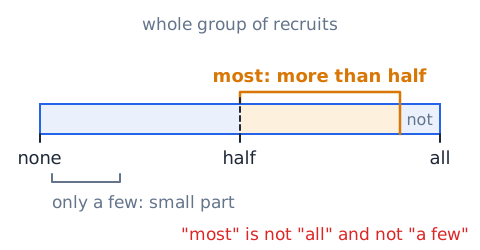
Quantifiers like all, most, many, some, few and none tell how much of a group a claim covers. "Most recruits passed the swim test" does not mean all passed, and it does not mean only a few did. A correct paraphrase keeps the same range, so most stays as a majority, not everyone.
Time qualifiers change meaning
Words such as once, now, still, no longer, recently and eventually place a claim in time. "The road was once unpaved" means it is probably paved today. Dropping the time word turns a past fact into a present one and changes what the sentence claims.
Condition words control the conclusion
If, unless, only if and provided that set conditions. "The drill proceeds unless it rains" means rain cancels it; without rain, it goes ahead. A choice saying the drill always proceeds, or proceeds only in rain, ignores the condition.
Prepositions and directional relationships
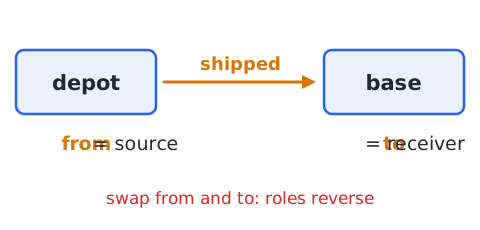
Small words like to, from, toward, against and by set direction and roles. "Supplies were shipped from the depot to the base" names the depot as the source. Reversing from and to swaps who sent and who received, so read these words closely.
Word class helps eliminate mismatches
Check whether the target word acts as a noun, verb, adjective or adverb. In "Please record the readings," record is a verb meaning to write down. A choice that gives a noun meaning, such as "a music disc," cannot fit the slot and can be crossed out quickly.
Pronouns often point back to a specific noun
Pronouns such as it, they, she and them usually refer to a noun named earlier. In "The medics treated the hikers after they reached camp," decide whether they means medics or hikers by checking which reading the passage supports.
Demonstratives can refer to entire ideas
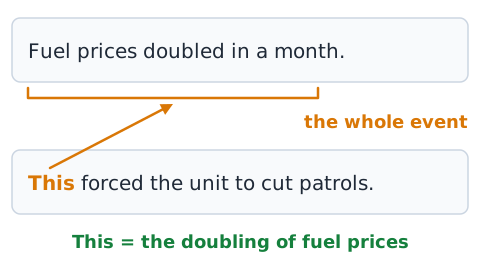
This, that, these and those can point to a whole statement rather than one noun. "Fuel prices doubled in a month. This forced the unit to cut patrols." Here this means the doubling of fuel prices, the whole event, not just the word prices.
The word one may replace a noun phrase
One can stand in for a noun phrase already mentioned. In "The blue jacket was too small, so she bought a larger one," one means jacket, possibly the blue jacket. Find the phrase it replaces before choosing an answer.
Negation can reverse a familiar sentence
Words like not, never, hardly and neither flip a statement. "The report did not find the engine faulty" is the opposite of saying the engine was faulty. Read negatives slowly, especially double negatives such as "not unlikely," which means fairly likely.
Negative prefixes need contextual confirmation
Prefixes like un-, in-, dis- and non- often mean not, but check the context. Invaluable means extremely valuable, not worthless, and inflammable means able to burn. Use the sentence to confirm the prefix really reverses the root.
Synonym choices may differ in precision
Several choices can be near synonyms, yet one fits best. If a passage says a sergeant "scrutinized" the gear, both looked at and examined closely relate, but examined closely captures the careful inspection the word implies. Pick the most precise match.
Associated idea is not equivalent meaning
A choice may name something connected to a word without meaning the same thing. If a passage says a runner showed "stamina," a choice like "sports drink" is linked to running but is not a meaning. "Endurance" is. Look for equivalent meaning, not a topic link.
Scope shifts create convincing distractors
Wrong choices often widen or shrink the scope. If the passage says one clinic extended its hours, a choice claiming all clinics did so widens it. A choice about one doctor shrinks it. Keep the same who, what and how much.
Tone words can aid phrase interpretation
The writer's attitude helps explain a phrase. If a review says the film "dragged on" and calls the plot "tiresome," the tone is negative, so "dragged on" means felt slow and too long. A positive reading clashes with that tone. Note adjectives and verbs that reveal approval, doubt or criticism before you choose.
Quotation marks can signal specialized usage
Writers put quotation marks around a word to show special, ironic or borrowed use. "The 'shortcut' added forty minutes" means the route was not short at all. Ask whether the marks signal irony, jargon or a quoted term.
Technical-sounding words remain evidence questions
A word may look technical, but the passage usually explains enough. If a text says "the hull was coated to resist corrosion, the slow rusting caused by salt water," the definition is right there. Read for the clue instead of panicking at the term.
Keep the setting but do not invent facts
Your interpretation should stay within the passage's setting: a farm, a ship, a clinic. Still, do not add details the writer never gave. If a passage says a mechanic was "swamped," you may say she was very busy, but not that she worked overtime unless the text says so.
Separate speaker interpretation from narrator fact
When a character speaks, the words show that person's view, not necessarily the truth. If the narrator says the bridge held, but a worried driver calls it "a death trap," the phrase shows fear, not proof of danger. Note who is talking before deciding what a phrase means.
Cause is not the same as purpose
A cause explains why something happened; a purpose explains what someone hoped to achieve. "The pipe burst because of frost" gives a cause. "Crews wrapped the pipe to prevent bursting" gives a purpose. Do not swap one for the other.
Comparison language implies a standard
Words such as faster, safer, more costly or less reliable compare against something. "The new radio is lighter" implies lighter than an earlier radio. Identify what is being compared so you do not treat a relative claim as an absolute one.
An unusual word may have a nearby action clue
What a person does near a strange word can reveal its meaning. "Feeling lethargic, Dana skipped her run and napped until noon" shows tired, sluggish behavior, so lethargic means lacking energy. Let the actions guide your prediction.
Multiple-sentence evidence is often necessary
The clue for a word may sit two or three sentences away. A passage might call a policy "contentious," then later describe heated meetings and angry letters. Those later details confirm the word means causing argument. Read past the target sentence when it alone is not enough.
Choose the minimum sufficient paraphrase
The best answer says just enough to match the passage, no more and no less. If a text says a medic was "cautiously optimistic," "hopeful but careful" fits. "Certain of success" adds too much, and "hopeful" alone drops the caution.
How to handle two nearly correct options
When two choices both seem right, compare them word by word. Find the one detail where they differ, such as strength, scope or time, then check that detail against the passage. The option whose differing detail is supported is the answer.
Context clues can be misleading when isolated
A single clue read alone can mislead. "The sergeant's remarks were brief but cutting" might suggest cutting means short if you notice only brief. But the word but signals contrast, so cutting means sharp or hurtful. Read the whole sentence.
Fast scan without skimming away evidence
Read the question first so you know which word or phrase matters. Then scan the passage to find it and read that area carefully, including qualifiers and signal words. Speed comes from knowing where to look, not from skipping words near the target. Small words like not or only can change the right answer.
First predict, then compare choices
Before looking at the options, cover them and state the meaning in your own words based on the clues. Then compare each choice to your prediction. This keeps attractive distractors, especially common dictionary senses, from steering you away from what the passage says.
Eliminate by the wrong kind of meaning
Cross out choices that are the wrong type: a noun meaning for a verb slot, a literal meaning for a figurative phrase, a positive word for a negative tone, or a related topic instead of a definition. Removing mismatches first leaves fewer choices to weigh.
For CAT-ASVAB, answer with the available evidence
On the computer-adaptive ASVAB you must answer each question before moving on, and you cannot go back to change it. So do not plan to return later. Use the evidence in front of you, make your best supported choice, and move forward. Spending too long on one item can hurt you later in the subtest.
No unsupported minute-per-item guarantee
Do not rely on a fixed rule such as "one minute per question." Passage length and question difficulty vary, and timing rules can differ by test version. Check the official instructions for your test, keep a steady pace, and avoid getting stuck on any single item.
Evidence sentence as a final defense
Before confirming an answer, point to the sentence that supports it. If you cannot name the line that backs your choice, reconsider. This quick check catches answers based on memory or assumption instead of the passage.
Trap: dictionary sense over passage sense
The trap is choosing the first meaning you learned. In "The pilot will bank left," bank does not mean a place for money; it means to tilt. Fix: test the familiar meaning in the sentence and drop it if it does not fit.
Trap: exaggerated certainty
The trap is choosing an answer stronger than the text. If a writer says a method "seems to reduce" errors, a choice saying it "eliminates" errors is too sure. Fix: keep hedges such as seems, may and likely in your paraphrase.
Trap: mistaking a consequence for a definition
A result is not a meaning. "The trail was treacherous, and two hikers fell" shows a consequence. Treacherous means dangerous, not "causing falls." Fix: ask what the word describes, then use the result only as a clue.
Trap: confusing the referent
The trap is linking a pronoun or this to the closest noun without checking. In "Lena thanked Rosa because she had fixed the radio," she means Rosa, since people thank the person who helped them, even though Lena comes first. Fix: test each possible referent and choose the one the passage logic supports.
Trap: emotional overreading
The trap is reading more feeling into a phrase than the text gives. If a manager "raised concerns" about a schedule, she was not furious or panicked. Fix: match the level of emotion the words actually show, and avoid dramatic choices without support.
Trap: replacing only half the phrase
Some answers explain one word of a phrase and ignore the rest. For "fell short of the goal," a choice about falling ignores the whole expression, which means did not reach it. Fix: interpret the full phrase as a unit.
Worked example 1 — multiple senses of draft
Passage: "The mechanic sealed the gap under the shop door because a cold draft kept chilling the workbench."
Question: As used here, draft most nearly means a first version, a current of air, a selection of recruits, or a beverage from a tap?
Step one: the sentence mentions a gap under a door and cold chilling the bench. Step two: predict "moving air." Step three: test it: "a cold current of air kept chilling the workbench" reads naturally. Answer: a current of air.
Worked example 2 — figurative bottleneck
Passage: "Orders arrived quickly, but the single packing station became a bottleneck, and boxes piled up waiting to be sealed."
Question: What does bottleneck mean here?
The station is not a bottle. The clue is that boxes piled up waiting, while orders arrived fast. Predict: a point where work slows because it cannot pass through quickly. Answer: a place that slows the whole process down.
Worked example 3 — careful quantifier reading
Passage: "Several of the generators failed the load test, though most ran without trouble."
Question: Which statement is supported? Most generators failed; all generators passed; a minority of generators failed; no generators were tested.
Several and most work together: most ran fine, so the failures were fewer than half. Answer: a minority of generators failed.
Worked example 4 — contrast narrows the word
Passage: "The first instructor was lenient about late homework, whereas the second marked down every late paper."
Question: Lenient most nearly means strict, forgiving, confused or absent?
Whereas sets up a contrast with marking down every late paper, which is strict. So lenient is the opposite. Answer: forgiving.
Worked example 5 — phrase means more than components
Passage: "After weeks of debate, the council finally threw in the towel and dropped the stadium plan."
Question: What does threw in the towel mean?
No towel is involved. The clue "dropped the stadium plan" shows the council stopped trying. Answer: gave up. A choice about cleaning or sports gear decodes the words, not the phrase.
Worked example 6 — pronoun refers to an event
Passage: "The supply truck arrived two days late. That meant the cooks had to stretch their rations."
Question: What does that refer to?
That cannot be just the truck; a truck does not mean anything by itself. It points to the whole event: the truck arriving two days late. Answer: the late arrival of the supply truck.
Worked example 7 — cautious approval
Passage: "The inspector said the repaired ramp was acceptable for now but should be rebuilt within a year."
Question: How does the inspector view the ramp?
Acceptable for now shows limited approval; should be rebuilt adds a reservation. Avoid "fully satisfied" and "unsafe." Answer: approved it only as a temporary fix.
Worked example 8 — professional tone as meaning evidence
Passage: "In her memo, the supervisor noted that the team's response time was 'not yet at the expected level' and listed training dates."
Question: What does the quoted phrase suggest?
The tone is calm and formal, and training dates point to improvement. Answer: performance needs to improve. Choices like "the team is failing badly" exaggerate the polite wording.
Worked example 9 — find the exact referent
Passage: "Marco lent his toolkit to the new apprentice, who returned it the next morning."
Question: What does it refer to?
The apprentice returned something Marco lent: the toolkit, not Marco or the morning. Answer: the toolkit.
Worked example 10 — scope of an idiom
Passage: "On the electrical work, the new tech was still learning the ropes, but she already handled the paperwork on her own."
Question: What does learning the ropes mean, and how far does it apply?
The idiom means getting familiar with how a job is done. Its scope is the electrical work only; she already handled paperwork alone. Answer: she was still becoming familiar with the electrical tasks.
Guided drill A — choose the contextual replacement
Prompt: "The medic will dress the wound before transport." Dress means put clothes on, bandage or decorate? Answer: bandage.
Prompt: "Prices remained stable all winter." Stable means unchanging, a horse barn or strong? Answer: unchanging.
Prompt: "The captain will address the crew at noon." Address means a location or speak to? Answer: speak to.
Guided drill B — decide the antecedent
Prompt: "The nurse called the patient's daughter because she was listed as the emergency contact." Who was listed? Answer: the daughter.
Prompt: "Rain flooded the lot overnight. This delayed the shift change." What does this mean? Answer: the overnight flooding.
Prompt: "The old drill broke, so Kai borrowed a new one." One means? Answer: drill.
Guided drill C — preserve qualifiers
Prompt: "Some volunteers may stay late." Best paraphrase: all volunteers will stay late, or some volunteers might stay late? Answer: some might.
Prompt: "The bridge is no longer used by trucks." Does this mean trucks use it now? Answer: no; trucks used it in the past.
Prompt: "The plan rarely works in winter." Answer: it seldom works then, not never.
Guided drill D — infer idiom only from context
Prompt: "After the long march, the squad called it a day and set up tents." Answer: stopped working for the day.
Prompt: "The new rule was a drop in the bucket compared with the backlog." Answer: too small to make much difference.
Prompt: "She kept her cool while alarms blared." Answer: stayed calm.
Quick review — evidence-based contextual meaning
Meaning in context comes from the passage, not from memory alone. Find the target, read the nearby sentences, spot clues such as definitions, contrast, cause and examples, then predict a plain meaning. Keep qualifiers, tone, scope and referents intact. Test your choice by substituting it into the sentence and confirming that the claim stays the same.
Final self-check before leaving this lesson
Can you name at least four kinds of context clues? Can you explain an idiom without decoding it word by word? Can you keep words like may, most and no longer in a paraphrase? Can you find what this or it refers to? Can you point to the sentence that proves your answer? If yes, you are ready for practice.
 English ▾