 ASVAB Camp
What you will master
By the end of this lesson you should be able to name the main job a passage is doing, state the author's position using only what the text supports, describe tone from specific word choices, spot the intended audience, and keep the author's views separate from the views of people the author quotes.
Official PC construct and this lesson's scope
The ASVAB Paragraph Comprehension test measures how well you take meaning from short written passages. Some items ask for stated facts or main ideas; others ask what the writer is trying to accomplish or how the writer feels about the topic. This lesson focuses on that second group: purpose, point of view, tone, audience and attribution.
Four questions that sound alike but differ
Purpose asks what the writer is trying to do. Point of view asks what position the writer takes. Tone asks how the writer sounds, judged by word choice. Audience asks who the text is written for. A single passage answers all four, but each question needs its own evidence, so read the question stem carefully before choosing.
Purpose is an action the text performs
State purpose with an action verb: to explain, to instruct, to persuade, to compare, to warn, to describe. A topic alone, such as "solar panels," is not a purpose. "To explain how solar panels turn sunlight into electricity" is, because it names what the passage does with the topic.
Inform versus persuade
An informative passage presents facts and lets readers draw their own conclusions. A persuasive passage pushes toward a belief or action, often with words like should, must or ought, or with a clear judgment. Compare "The library now opens at 8 a.m." with "The library should open earlier so commuters can use it." The first informs; the second persuades.
Explain a process versus tell a story
A process passage walks through steps or causes in order, often with words like first, then, after and finally, and it usually applies to any case. A story, or narrative, follows particular people through events in time. "To change a tire, loosen the lug nuts, then jack up the car" explains. "Maria pulled over in the rain and found her tire flat" narrates.
Describe versus evaluate
Describing tells what something is like: its size, parts, colors or features. Evaluating judges whether it is good, bad, useful or worth the cost. "The tent has two doors and weighs four pounds" describes. "The tent is the best choice for long hikes" evaluates. Watch for judgment words that turn a description into an evaluation.
Compare versus advocate
A comparison sets two or more things side by side and notes how they differ. If the passage stops there, its purpose is to compare. If it then says one option is better or should be chosen, the comparison becomes evidence for advocacy. Check the closing sentences to see whether the writer picks a side.
Warn, reassure, question and celebrate
Some purposes carry a clear emotional direction. A warning points to a risk and often advises caution. Reassurance tells readers a worry is smaller than they feared. A questioning passage raises doubts about a claim. A celebration praises an achievement. Identify which direction the details push, then match the answer choice that names that same direction.
Primary versus secondary purpose
Many passages do more than one thing. A notice may describe a road closure and also suggest a detour. The primary purpose is the one the whole passage serves; secondary purposes support it. Ask which goal the other sentences help accomplish. If the description exists to make the detour advice useful, the main purpose is to guide travelers.
Purpose is not the effect on every reader
A passage about a delayed bridge might make some readers angry, but that does not mean the author's purpose was to anger anyone. Purpose is what the text is built to do, shown by its structure and wording. Do not choose an answer because of how a reader might react; choose it because the text itself supports it.
Audience clues without guessing identity
Audience shows up in what the writer assumes readers know and what the writer asks them to do. A passage that says "bring your badge to your first shift" addresses new workers. Technical terms left unexplained suggest experts. Choose the audience the text directly addresses, and avoid answers that name a narrow group the passage never mentions.
An explicit recommendation is strong evidence
When a writer states a recommendation outright, such as "The school should replace the old bleachers before fall," that sentence is strong evidence of a persuasive purpose. The earlier facts usually serve as support for it. Do not overlook a clear should or must statement just because most of the passage sounds factual.
Point of view: expressed position, not all beliefs
An author's point of view is the position the text actually expresses about its topic. If a writer argues for longer library hours, you know that view. You do not know the writer's politics, hobbies or opinions on unrelated topics. Answer only with what the passage states or clearly implies.
Point of view versus narrator identity
Point of view can also mean the narrator's position: first person (I, we), second person (you) or third person (he, she, they). This grammatical sense differs from the author's opinion. A first-person story can still be neutral, and a third-person article can still argue a strong position. Check which meaning the question uses.
Author's view versus a source's view
Writers often report what other people think. "The mayor says the plan will save money" tells you the mayor's view, not necessarily the author's. Look for the author's own voice, usually in unattributed judgments or conclusions such as "That claim needs more support." Credit each opinion to the person who holds it.
Third-party quotations can be neutral evidence
Quoting someone does not mean the author agrees. A neutral report may quote supporters and critics alike to show the range of opinion. Only when the author adds an evaluation, such as calling a quote convincing or misleading, does the quote reveal the author's stance.
What an author doubts
Doubt often appears in quiet ways: words like claims, alleged or supposedly, phrases such as "has not been shown," or a note that evidence is missing. A writer who says a company "claims the paint lasts twenty years, but no long-term test exists" doubts the claim without calling it false. Match answers to that level of doubt.
Concession and contrast guide stance
Words like although, however, but, yet and still signal a turn. Writers often grant a point to the other side and then state their own view after the turn. In "Although the new schedule saves fuel, it leaves night workers without a bus," the main stance comes after the turn: the schedule has a serious drawback.
Balanced or mixed evaluation
Some authors find both strengths and weaknesses. A review might praise a phone's camera and criticize its battery. The correct description of such an attitude is mixed or qualified, not wholly positive or wholly negative. Answers using extreme words like completely, entirely or never usually miss a balanced view.
Tone is conveyed by diction and framing
Tone is the attitude the writing expresses, and you detect it through diction, which means word choice, and framing, which means what the writer emphasizes. "The council finally acted" sounds impatient; "The council voted on Tuesday" sounds neutral. Point to the exact words that create the tone before choosing an answer.
Neutral reporting versus disapproval
Neutral writing reports facts with plain words and no judgment, like "The store will close at 6 p.m. on Friday." Disapproval uses negative words or framing, such as "The store will once again shut early, leaving shoppers stranded." The facts may be the same; the word choices reveal the difference.
Qualified approval versus excitement
Qualified approval praises something while keeping limits in view: "The new system is a solid step forward, though it still needs testing." Excitement is stronger and less restrained: "The new system is a stunning breakthrough!" If a passage includes cautions or conditions, choose a measured description over an enthusiastic one.
Skeptical versus dismissive
A skeptical writer questions a claim and wants better evidence but stays open to it. A dismissive writer rejects the claim as not worth considering, often with scornful words like absurd or nonsense. "The claim deserves a closer test" is skeptical. "The claim is ridiculous" is dismissive. Most test passages are skeptical, not dismissive.
Urgency versus panic
An urgent tone stresses that action is needed soon, usually with specific, calm steps: "Residents should move vehicles before the storm arrives tonight." Panic is frantic and exaggerated, with words like disaster and doom. A warning passage that gives clear instructions is urgent, not panicked.
Objective fact, interpretation and opinion
A fact can be checked: "The river rose three feet overnight." An interpretation explains what facts may mean: "The rise suggests heavy rain upstream." An opinion states a judgment or preference: "The town should have built higher levees." Strong passages mix all three, and test items often ask you to tell them apart.
Bias is not the same as having a conclusion
Reaching a conclusion from evidence is not bias. A writer who reviews data and concludes that a crosswalk needs a signal is reasoning, not being unfair. Bias means presenting evidence in a one-sided or distorted way, such as leaving out facts that point the other way. Do not label every opinion as biased.
Loaded wording and emotionally tilted framing
Loaded words carry strong positive or negative feeling beyond their literal meaning. Calling a tax a "money grab" or a park plan a "paradise" tilts the reader before any evidence is given. When you notice loaded words, they reveal the author's attitude, even if the facts around them are accurate.
Evidence versus rhetorical confidence
A confident tone is not the same as strong evidence. "Everyone knows this method works" sounds certain but offers no support. "In two trials, the method cut waste by half" gives evidence. When a question asks what the passage supports, rely on the evidence given, not on how forcefully the author speaks.
Data selection and uncertainty
Writers choose which numbers to present. A passage that reports only one good month, or leaves out the size of a sample, may overstate a result. Careful writers note uncertainty with phrases like "early results" or "a small study." When an author points out such limits, the author is showing caution, not rejecting the data.
How rhetorical questions function
A rhetorical question is asked for effect, not for an answer. "How long must commuters wait for a safe crosswalk?" really means "They have waited too long." Such questions usually push a point and signal a persuasive purpose. A genuine question, by contrast, expects information, as in "Which route is faster?" Decide which kind you are reading.
Claims about others do not reveal hidden motives
If a passage reports that a manager supports a new policy, you cannot conclude the manager wants a promotion or is hiding something. Test answers that assign secret motives, dishonesty or personal hostility usually go beyond the text. Stick to the reasons the passage actually provides.
Evidence can support different purposes
The same fact can serve different goals. "The bridge is seventy years old" can inform readers in a history piece, warn them in a safety notice, or support an argument for funding repairs. To find the purpose, look at what the passage does with the fact, especially in the sentences that follow it.
Compare recommendation and prediction
A recommendation says what should happen: "The city should add a bike lane." A prediction says what will or may happen: "Traffic will likely increase next year." A passage can predict without recommending and recommend without predicting. Watch the verbs: should and ought recommend, while will and may predict.
Distinguish proposal from final decision
A proposal is an idea still under consideration; a decision is final. "The board is considering a later start time" describes a proposal. "The board approved a later start time" reports a decision. Answers that treat a proposed plan as already approved misread the passage.
Authorial certainty is graded
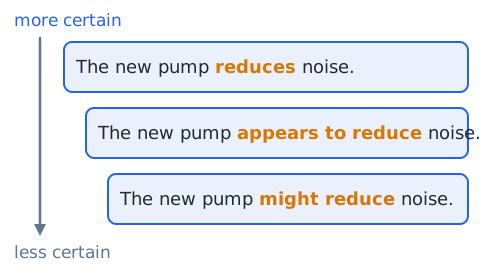
Authors express different levels of certainty. Compare "The new pump reduces noise," "The new pump appears to reduce noise," and "The new pump might reduce noise." Each step down is less certain. The correct answer must match the author's level, neither stronger nor weaker.
First person does not automatically mean persuasion
A writer may use I or we and still simply inform: "We tested three backpacks over two weeks and recorded their weights." The first person shows who did something, not necessarily that the writer is arguing. Look for judgments or recommendations before calling a passage persuasive.
Headlines and final lines are clues, not shortcuts
A title or last sentence often hints at the purpose, but it can mislead if read alone. A closing line may be a minor aside, and a catchy title may not match the body. Use them as clues, then confirm with the rest of the passage before choosing an answer.
Recognize an implied viewpoint
Writers do not always state their views directly. Suppose a passage lists a park's broken swings, overflowing trash bins and a cracked path, then ends, "Meanwhile, the city has approved a new parking garage." No opinion is stated, but the contrast implies the author thinks the park is being neglected. Implied views still need textual support.
Use textual evidence to choose between close purposes
When two answer choices seem close, such as "to explain" and "to persuade," look for evidence that tips the balance. Does the passage contain should, a judgment word, or a clear call to action? If yes, persuade. If it lays out facts or steps without taking a side, explain. Name the specific sentence that decides it.
A passage can explain a view it does not endorse
A writer can describe why some people hold a belief without sharing it. "Some drivers prefer the old highway because it has fewer traffic lights" explains a view. Unless the writer adds approval, such as "and they are right," you cannot treat that view as the author's own.
Read modal verbs with care
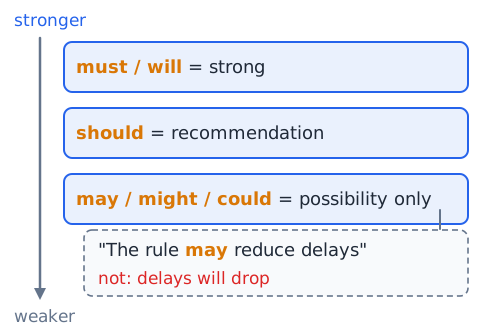
Modal verbs signal strength. Must and will are strong. Should signals a recommendation. May, might and could signal possibility only. "The rule may reduce delays" does not claim that delays will drop. Choose answers that keep the same strength as the passage's modal verbs.
The purpose-statement test
Before reading the choices, try to finish this sentence: "The author wrote this passage to (blank one) about (blank two)." Fill the first blank with an action verb and the second with the topic. Then pick the choice closest to your sentence. This keeps you from being pulled toward a choice that names the topic but the wrong action.
The author-versus-source test
For each opinion in a passage, ask, "Who says this?" Mark views that belong to named people, groups or documents, then find any judgment left without attribution; that is usually the author's. When a question asks about the author's view, eliminate choices that repeat a source's claim the author does not adopt.
The tone-evidence test
For a tone question, find two or three words in the passage that carry feeling. If you cannot point to such words, the tone is probably neutral. If you find words like promising, but and needs, the tone is likely measured or cautious. Choose the answer whose tone word you can defend with those exact words.
The primary-purpose hierarchy
When several purposes appear, rank them. An explicit recommendation usually outranks supporting facts. A warning with instructions outranks the background details. A comparison that ends with a choice becomes advocacy. Pick the goal the other parts serve, not a detail that appears in only one sentence.
Eliminate scope and intensity errors
Wrong answers often go too far in scope or intensity. Scope errors use words like all, every or always when the passage discusses one case. Intensity errors turn mild criticism into fury or cautious hope into certainty. Cross out choices that are broader or stronger than the passage, then compare what remains.
Timer-friendly two-pass reading
On the first pass, read the passage quickly for its overall action and any turn words like however. Then read the question. On the second pass, go straight to the lines that answer it, such as the final recommendation for a purpose question. This keeps you accurate without rereading every word.
CAT-safe final selection
The computer-adaptive ASVAB does not let you go back and change an answer once you move on. Before you confirm, check your choice against the passage one last time: does a specific sentence support it, and is its strength right? If yes, select it and move on without second-guessing, so you do not lose time on later items.
A four-way distractor audit
Test each answer choice with four checks. Does it name the right action? Does it attribute the view to the right person? Does it match the passage's strength? Does it stay within the passage's scope? A choice that fails any check is wrong. The correct choice passes all four.
Trap: confusing subject with purpose
The trap is picking a choice just because it mentions the passage's topic. A passage about recycling bins might aim to explain a new pickup schedule, not to persuade people to recycle more. The fix is to ask what the author does with the topic and choose the action that the passage's sentences actually perform.
Trap: mistaking quoted praise for author praise
The trap is assuming that glowing quotes reflect the author's opinion. If a passage quotes a coach calling a new field "the best in the state" and then adds that drainage has not been tested, the author is cautious, not enthusiastic. The fix is to separate quoted voices from the author's own statements.
Trap: emotion supplied by the reader
The trap is reading your own feelings into a neutral passage. A plain notice about a rate increase is not angry just because readers might be upset. The fix is to judge tone only by the writer's words; if no emotional words appear, choose neutral or informative.
Trap: confusing intent and successful effect
The trap is treating what a passage tries to do as proof that it worked. A letter urging the council to fund a crosswalk shows the author's purpose to persuade; it does not show that the council agreed. The fix is to describe the intent and avoid answers that claim a result the passage never reports.
Trap: assuming disagreement proves personal hostility
The trap is thinking that an author who disagrees with someone must dislike or distrust them. A writer can reject a manager's plan respectfully, citing costs. The fix is to describe the disagreement as being about ideas, and to avoid answers that claim anger, insult or bad faith without evidence.
Trap: inferring universal belief from one case
The trap is stretching a single example into a general rule. If an author praises one school's tutoring program, that does not mean the author thinks every school needs that program. The fix is to keep the author's view tied to the specific case discussed and reject choices that generalize it.
Guided drill: purpose or topic?
Passage: "Volunteers will plant trees along Elm Street on Saturday. Bring gloves; shovels will be provided. Meet at the library at 9 a.m."
Prompt: Is "trees on Elm Street" the purpose? Answer: No, that is the topic.
Prompt: What is the purpose? Answer: To inform volunteers about the event and tell them how to take part.
Guided drill: attributed judgment
Passage: "The bakery owner calls the new oven 'a game changer.' Sales records for the first month have not yet been released."
Prompt: Whose view is "a game changer"? Answer: The owner's.
Prompt: What is the author's stance? Answer: Reserved; the author points out that no sales evidence is available yet, without either praising or rejecting the oven.
Guided drill: qualified favorable tone
Passage: "The new crosswalk signal has made mornings safer near the school, though its timer still feels short for slower walkers."
Prompt: Is the tone enthusiastic? Answer: No; the word though adds a limit.
Prompt: Best tone description? Answer: Generally favorable but qualified, since the writer approves of the change while noting a problem to fix.
Guided drill: comparison serving persuasion
Passage: "Option A costs less to buy, while Option B uses half the fuel. Over five years, Option B saves more money, so the fleet should choose it."
Prompt: Does the passage only compare? Answer: No.
Prompt: Main purpose? Answer: To recommend Option B, using the comparison as evidence.
Guided drill: genuine question versus rhetoric
Passage A: "Which bus line reaches the airport fastest? The schedule below lists each route."
Passage B: "How many more missed flights must riders endure before the airport bus runs on time?"
Prompt: Which question is rhetorical? Answer: Passage B, because it pushes a complaint rather than seeking information. Passage A asks a genuine question and then answers it.
One-minute author-purpose checklist
Name the action the passage performs. Look for should, must or other calls to action. Separate the author's voice from quoted sources. Point to the words that create tone. Notice qualifiers like may, though and early results. Reject choices that are too broad, too strong or that guess at hidden motives.
Readiness threshold for the lesson quiz
You are ready for the quiz when you can do three things quickly: state a passage's purpose as an action verb plus topic, identify which views belong to the author rather than to sources, and describe tone using words from the text. If any of these still feels slow, review the worked examples before testing yourself.
Worked example 01 — Purpose behind a recommendation
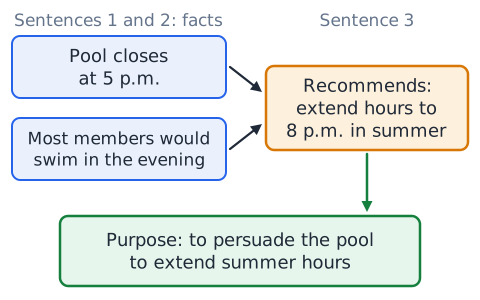
Passage: "The community pool closes at 5 p.m., before many parents finish work. A survey found that most members would swim in the evening. Extending hours to 8 p.m. during summer would serve more families."
Step one: the first two sentences give facts. Step two: the last sentence recommends a change. Step three: the facts support that recommendation. Answer: the purpose is to persuade the pool to extend summer hours.
Worked example 02 — Topic versus purpose
Passage: "A compost bin turns food scraps into soil. Layer green scraps with dry leaves, keep the pile damp, and turn it every week."
Topic: compost bins. Action: giving steps in order. Answer: the purpose is to instruct readers how to make compost, not simply to discuss composting.
Worked example 03 — Mixed evaluation
Passage: "The town's new website makes paying bills faster, and its layout is clean. However, the search tool often fails to find meeting minutes, and the site loads slowly on older phones."
Step one: list the praise, which is speed and layout. Step two: list the criticism, which is search and loading. Answer: the author's evaluation is mixed, approving some features while pointing out real problems.
Worked example 04 — Source versus author
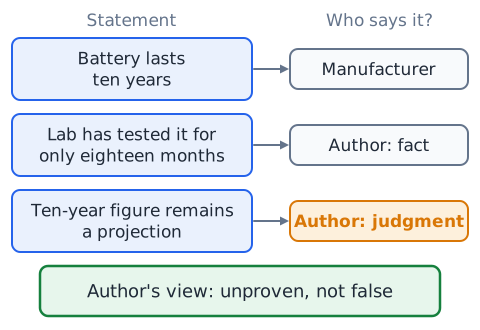
Passage: "The manufacturer says its battery lasts ten years. An independent lab has tested it for only eighteen months. Until longer results arrive, the ten-year figure remains a projection."
Step one: the ten-year claim belongs to the manufacturer. Step two: the final sentence is unattributed, so it is the author's. Answer: the author treats the claim as unproven, not false.
Worked example 05 — Warning without panic
Passage: "High winds are expected after 6 p.m. Secure loose outdoor items, and avoid parking under large trees. Check the county website for updates."
Step one: the passage names a risk. Step two: it gives calm, specific actions. Step three: there are no exaggerated words. Answer: the tone is urgent but controlled, and the purpose is to warn and advise.
Worked example 06 — Skeptical not dismissive
Passage: "A new study reports that a phone app improves sleep. The study followed just twenty people for one week, so its findings need confirmation in a larger trial."
Step one: the author does not call the study worthless. Step two: the author points to its small size and short length. Answer: the author is skeptical, wanting more evidence, not dismissive.
Worked example 07 — Compare or persuade?
Passage: "Route 9 is shorter but has more stoplights. Route 12 is longer but usually moves steadily. Travel times on both vary with the hour."
Step one: two options are described side by side. Step two: no option is called better, and no should appears. Answer: the purpose is to compare the routes, not to recommend one.
Worked example 08 — Attributed excitement
Passage: "Fans called the stadium's new scoreboard 'amazing' on opening night. The display is twice as wide as the old one and shows replays."
Step one: the excited word amazing belongs to fans, in quotation marks. Step two: the author's own sentence gives plain facts. Answer: the author's tone is neutral and informative; the excitement is attributed to fans.
Worked example 09 — Instructions versus argument
Passage: "To reset the router, unplug it for thirty seconds, plug it back in, and wait for the green light."
Step one: the sentence gives ordered steps. Step two: it makes no judgment or claim to defend. Answer: the purpose is to instruct, not to argue.
Worked example 10 — Tone and certainty
Passage: "Early readings suggest the repaired roof is keeping water out, but only one storm has passed since the work was finished. Another inspection is planned after the spring rains."
Step one: suggest and early show limited certainty. Step two: the planned inspection shows care. Answer: the tone is cautiously optimistic, not confident.
 English ▾