 ASVAB Camp
What you will be able to do
Read two or more ideas in an original passage, identify what they share and where they differ, track which characteristic belongs to which side, and select the best comparison supported by the entire text rather than by a single familiar word.
Official ASVAB PC scope and this lesson
The official ASVAB describes Paragraph Comprehension as obtaining information from written passages. Comparing ideas is a useful reading skill within that broad construct, not an official promise of a separate comparison question type or fixed number of items. All practice passages and answer options here are original.
Comparison starts with two clear subjects
Before you compare anything, name the two subjects. In a passage about a diesel generator and a solar panel array, every detail belongs to one side, the other side, or both. If you cannot say which subject a detail describes, you are not yet ready to judge a comparison answer.
Similarity and difference are separate claims
A similarity says the subjects share a feature. A difference says one subject has a feature the other lacks, or has it to a different degree. These are separate claims, and each needs its own evidence. If a passage says two trucks both carry 2 tons, that proves a shared payload, not matching fuel use.
The two-column evidence grid
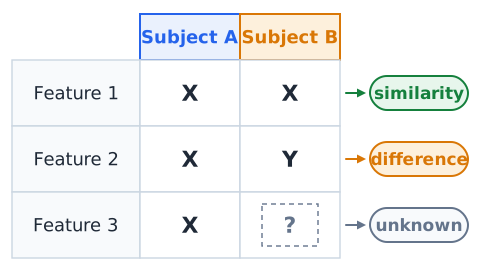
Picture two columns, one for each subject, and a row for each feature the passage mentions. Fill a cell only with what the text actually states. Rows with matching entries are similarities, rows with different entries are differences, and empty cells are unknowns.
Compare the same dimension
A fair comparison lines up the same feature on both sides. Saying one radio weighs 3 pounds while the other has a 12-hour battery compares nothing. Match weight with weight and battery life with battery life before deciding how the two differ.
Similarity can coexist with an important difference
Two things can be alike in one way and very different in another. Two bridges may cross the same river, yet one carries trains and the other carries only foot traffic. An answer that names only the shared feature can be true but miss the main contrast.
Different methods can serve the same purpose
Two subjects may reach the same goal by different means. One clinic reminds patients of visits by text message; another mails postcards. Both aim to reduce missed appointments. The shared purpose is a similarity, while the method is a difference.
Same method does not imply same outcome
Using the same method does not guarantee the same result. Two farms may plant the same seed on the same date, yet one harvest is larger because it got more rain. Do not assume matching outcomes unless the passage reports them.
Signal words that introduce contrast
Contrast signals include however, but, whereas, while, unlike, in contrast, on the other hand, and instead. When you see one, expect the next idea to differ from the one before it. Example: Unlike the older pump, the new model runs without oil.
Signal words that introduce similarity
Similarity signals include likewise, similarly, both, also, in the same way, as well as, and just as. Example: Just as the first crew checked the brakes, the second crew also inspected them before departure.
Concession adds nuance
A concession admits a point before making a stronger one. Words such as although, even though, granted, and admittedly often mark it. In "Although the steel frame is heavier, it lasts longer than the aluminum one," the writer accepts a drawback but stresses durability as the main point.
Comparatives need a reference point
Words like faster, cheaper, and more reliable need something to be measured against. "The new route is shorter" means shorter than some other route the passage names. Find that reference point; an answer that swaps in a different one misreads the comparison.
Superlatives are stronger than comparatives
A comparative ranks one item against another; a superlative ranks one item above all others in a group. "Faster than the bus" is weaker than "the fastest option." Do not accept a superlative unless the passage supports it.
Absolute and qualified comparisons
Absolute comparisons use words like always, never, and every. Qualified ones use often, usually, most, or in some cases. If a passage says one valve usually seals better, an answer claiming it always does goes too far.
Not stated is not the same as not true
If a passage describes a feature for one subject but says nothing about the other, the other subject's status is unknown. Silence is not evidence that the feature is missing; it is simply a gap in the information.
Different wording can express equivalence
Passages often express one idea in different words. "Costs the same as" and "is equally priced" mean the same thing. A correct answer may paraphrase the passage, so compare meanings, not exact wording.
Negation reverses comparison
A single not can change a comparison. "The new tire is not more durable than the old one" does not mean it is less durable; the two may be equal. Read negations carefully and do not stretch them into the opposite claim.
“Only” marks an exclusive feature
Only marks a feature that belongs to one subject and none of the others. "Only the second shelter has a backup generator" tells you the other shelters lack one. Without only, the sentence would not rule out generators elsewhere.
Time can change the comparison
A comparison may be true at one time and false at another. If the east clinic had longer waits last year but the west clinic has longer waits now, the answer must match the time period the question asks about.
Location and setting are boundaries
A comparison stated for one place or setting may not hold elsewhere. If a coating protects better in dry climates, do not assume it protects better near salt water unless the passage says so.
Numbers offer precise contrast
Numbers make a contrast exact. If Crew A finished 48 inspections and Crew B finished 36, Crew A did 12 more, which is one third more than Crew B. Check whether a question wants the difference or the ratio, and which subject serves as the base.
Percent and percentage points are not interchangeable
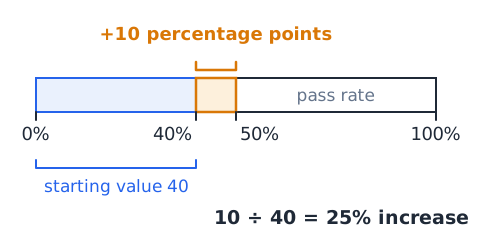
If a pass rate rises from 40 percent to 50 percent, it rose 10 percentage points, but that is a 25 percent increase relative to the starting value. Answer choices that mix up the two terms are wrong.
Comparison of claims versus comparison of facts
Sometimes a passage compares what people claim rather than what is proven. "The supplier says its filter lasts longer" reports a claim. An answer stating that the filter does last longer treats the claim as fact and goes beyond the text.
Direct observation versus expectation
A passage may compare what was seen with what was expected. "Engineers predicted the dam would hold; inspectors found small leaks" contrasts a forecast with an observation. Keep the two kinds of statement apart.
Author and quoted speakers can disagree
When a passage quotes people, their views may differ from the author's. If a mayor praises a new road but the author notes rising traffic, the praise belongs to the mayor. Check who holds each view before choosing an answer.
A shared limitation may be the main point
Sometimes the key point is what two subjects lack together. If a passage says both budgeting apps track spending but neither warns users before they overspend, that shared weakness may be the main idea, not the small differences.
Trade-offs: no single winner
A trade-off means each option gains something and gives something up. A heavier jacket is warmer but harder to pack. When a passage presents trade-offs, avoid answers that name one option as better overall.
Criteria change a “better” judgment
Which option is better depends on the criterion. A small car is better for fuel economy; a van is better for carrying a whole team. If a question asks which is better, find the standard the passage uses and judge only by that.
Compare problems with solutions
Some passages pair a problem with a proposed solution. If the problem is late deliveries and the fix is adding trucks, check whether the passage says a shortage of trucks caused the delays. A mismatch between the two is worth noticing.
Compare two explanations without deciding causation
A passage may offer two explanations for one event without choosing between them. If one expert blames a fish die-off on heat and another blames farm runoff, a correct answer reports both views, not that either cause is proven.
Compare several cases using a consistent rule
When a passage compares three or more cases, apply one rule to all of them. If the rule is that a ladder must hold 250 pounds, test every ladder against 250, not against a different number for each one.
Mixed similarity and difference questions
Some questions ask for a statement that gives both a similarity and a difference. Check each half separately. A choice with a true similarity but a false difference is still wrong, because both parts must be supported.
Separate category membership from identity
Two items can belong to the same group without being the same thing. A canoe and a kayak are both paddled boats, but they differ in seating and paddle design. Sharing a category is a similarity, not proof of identity.
Parallel structures can hide opposite meanings
Sentences built the same way can still say opposite things. "The first crew finished early; the second crew finished late" looks balanced, but the meanings differ. Read the key word in each half, not just the matching pattern.
Exception statements matter
Words like except, unless, and but not limit a comparison. "All the trucks passed inspection except Truck 4" means one truck failed. Answers that ignore the exception overstate the result.
Cause, purpose and result are different dimensions
Why something happened, what it was meant to do, and what actually happened are three separate questions. A new rule may be caused by a budget gap, aim to cut costs, and result in longer lines. Match each detail to its kind.
Chronological comparisons need aligned dates
To compare events over time, make sure the dates line up. Comparing one store's March sales with another store's December sales mixes seasons. A fair comparison uses the same period for each subject.
Comparison is not always evaluation
Describing how two things differ is not the same as saying one is better. A passage may note that one map is larger and the other is more detailed without favoring either one.
Strongest supported statement wins
When several answers seem true, choose the one the passage supports most fully and most exactly. A narrow, well-supported statement beats a broad one that adds claims the text never makes.
Read the comparison question before hunting details
Read the question first to learn what kind of comparison it wants: a similarity, a difference, a trade-off, or which side holds a feature. Then scan the passage for that target instead of trying to memorize every detail before you know what matters.
Underline one clue per side
For each subject, note one key phrase tied to the question, using scratch paper if needed. Having one clue per side keeps you from attaching a detail to the wrong subject when you check the answer choices.
A fast verbal grid for short passages
For a short passage, say a quick sentence to yourself: A has X, B has Y, both have Z, and W is unknown. This mental grid takes seconds and gives you a checklist for testing each answer choice.
Eliminate by scope and attribution
Cross out any choice that gives a feature to the wrong subject, widens a claim beyond its stated scope, or turns a quoted opinion into the author's view. What remains is usually the supported answer.
Use evidence, not general knowledge
Answer only from the passage, even if you know more about the topic. If the passage says two batteries charge at similar speeds, do not pick an answer based on what you have read elsewhere about one brand. The test rewards careful reading, not outside knowledge.
CAT-ASVAB answer selection
On the computer-based ASVAB, you cannot return to a question once you submit an answer, and leaving items unfinished can lower your score. Read every choice, eliminate the unsupported ones, pick the best remaining option, and move on without second-guessing.
When two options appear correct
If two choices both look right, compare them with each other. Look for an extra word in one that goes beyond the passage, such as all, always, or best. The choice that stays closest to what is stated is usually correct.
Trap: attribute swapping
The trap: a choice gives subject A's feature to subject B. If the passage says the north well is deeper and the south well is cleaner, a choice saying the south well is deeper swaps them. The fix: check each choice against your grid.
Trap: invented superiority
The trap: a choice calls one option better overall when the passage only lists differences. Why it is wrong: no ranking was given. The fix: accept better only when the text states a criterion and a winner.
Trap: omission treated as difference
The trap: assuming a feature mentioned for one subject is missing from the other. Why it is wrong: the passage may simply be silent. The fix: label silent cells unknown, not different.
Trap: shared outcome mistaken for shared method
The trap: two methods reach the same result, so a choice claims they used the same method. Why it is wrong: a shared outcome says nothing about process. The fix: compare methods and results in separate rows.
Trap: changing the comparison dimension
The trap: a choice compares cost for one subject with speed for the other. Why it is wrong: the dimensions do not match. The fix: confirm both sides of the choice measure the same feature.
Trap: exaggerating a qualified claim
The trap: the passage says a method often works, and the choice says it always works. Why it is wrong: the qualifier was dropped. The fix: keep words like often, some, and usually in your reading.
Trap: forecast represented as result
The trap: a planned or predicted result is treated as something that already happened. Why it is wrong: forecasts are not outcomes. The fix: notice words such as expects, plans, aims, and will.
Trap: false equivalence from a shared word
The trap: two subjects share a word, so a choice treats them as alike. A light truck and a light snack are not similar in any useful way. The fix: check what the word means in each context.
Worked example 1 — two inspection approaches
Passage: Plant A inspects every welded joint by eye each week. Plant B checks a random tenth of its joints with an ultrasonic tester each month.
Question: Which statement is supported?
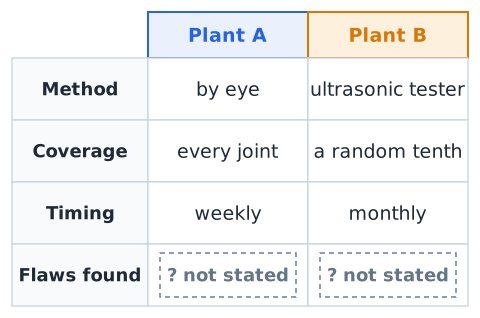
Step one: name the subjects, Plant A and Plant B. Step two: line up method (eye versus tester), coverage (all joints versus a tenth), and timing (weekly versus monthly).
Answer: Plant A checks more often and covers more joints. Nothing says which plant finds more flaws.
Worked example 2 — common goal, different equipment
Passage: To keep a field hospital warm, one unit uses propane heaters, while another runs electric heaters from a generator.
Question: What do the two units share?
Reasoning: the equipment differs, propane versus electric, but the goal, keeping patients warm, is the same.
Answer: a common purpose reached with different equipment.
Worked example 3 — explicit trade-off
Passage: Tent X sets up in 5 minutes but weighs 9 pounds. Tent Y weighs 5 pounds but takes 15 minutes to pitch.
Question: How do the tents compare?
Reasoning: X wins on setup time, Y wins on weight, and the passage names no overall winner.
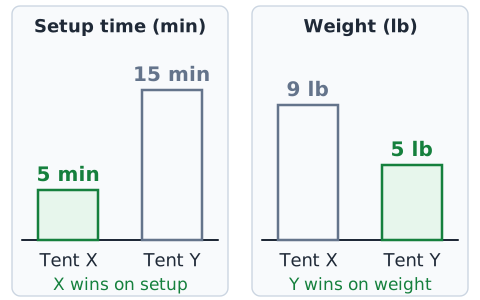
Answer: each tent trades one advantage for another, and neither is called better.
Worked example 4 — distinguish intention from result
Passage: The town painted bike lanes to reduce crashes. In the first year, crashes on those streets stayed about the same.
Question: Which statement is accurate?
Reasoning: separate the purpose, fewer crashes, from the result, no clear change.
Answer: the lanes were meant to cut crashes, but the first-year result did not show a drop.
Worked example 5 — missing evidence
Passage: Battery brand P lasted 30 hours in cold-weather tests. Brand Q was tested only at room temperature.
Question: Which brand performs better in the cold?
Reasoning: Q has no cold-weather data, so its cell in the grid is unknown.
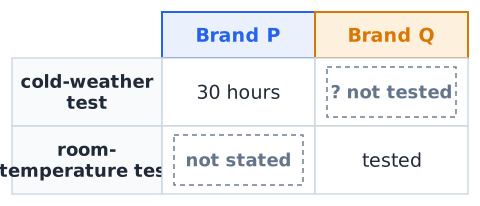
Answer: the passage cannot tell us; only P was tested in the cold.
Worked example 6 — comparison words and scope
Passage: Most volunteers in the morning group finished the course faster than those in the evening group.
Question: Which claim is supported?
Reasoning: a choice saying every morning volunteer was faster drops the word most.
Answer: the morning group generally finished faster, though some evening volunteers may have been quicker.
Worked example 7 — more than two designs
Passage: Three pump designs were rated for noise. Design 1 was the quietest; Designs 2 and 3 were equally loud.
Question: Which is true?
Reasoning: apply the same noise rule to all three.
Answer: Design 1 is quieter than both others, and Designs 2 and 3 tie.
Worked example 8 — quoted viewpoints
Passage: The fire chief said the new alarm system "will save lives." A city auditor called it "too costly for the benefit." The article reports that the system is now in two stations.
Question: Who views the system as too costly?
Reasoning: track attribution; the author reports both views and takes no side.
Answer: the auditor, not the author or the chief.
Worked example 9 — change versus current state
Passage: Reservoir 1 rose 4 feet this month and is now 60 percent full. Reservoir 2 dropped 2 feet and is now 75 percent full.
Question: Which reservoir is fuller relative to its capacity?
Reasoning: the question asks about the current state, not the change.
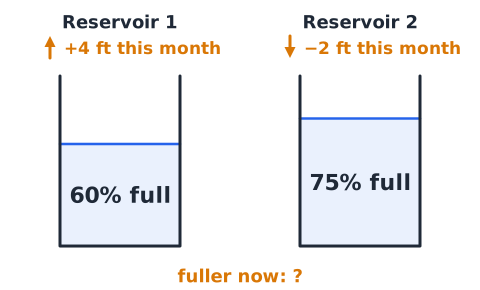
Answer: Reservoir 2, even though Reservoir 1 gained water.
Worked example 10 — the strongest two-part answer
Passage: Both shuttle routes serve the airport. The red route runs every 10 minutes but stops at six hotels; the blue route runs every 20 minutes and goes directly.
Question: Which statement best captures the comparison?
Reasoning: "Both routes serve the airport" is true but incomplete. A stronger choice adds that red runs more often while blue is direct.
Answer: the two-part statement, because it covers the similarity and the trade-off.
Guided drill A — state the pair
Name the two subjects in each sentence.
Prompt: The night shift logged fewer errors than the day shift. Answer: the night shift and the day shift.
Prompt: Unlike copper wire, fiber cable carries light. Answer: copper wire and fiber cable.
Prompt: The older map shows trails the new one omits. Answer: the older map and the new map.
Guided drill B — detect the invented inference
Find the unsupported inference.
Prompt: The passage says Team A trained longer. Choice: Team A won. Answer: invented, since winning is never mentioned.
Prompt: The passage says both stoves burn gas. Choice: they cost the same. Answer: invented, since cost is not stated.
Guided drill C — compare predictions to predictions
Compare like with like.
Prompt: One forecaster expects rain Monday; another predicts dry skies. Answer: two predictions that disagree; neither is a result.
Prompt: A survey predicted higher turnout; the count showed lower turnout. Answer: a prediction versus a result.
Guided drill D — preserve time and condition
Keep the time and condition.
Prompt: In winter, Road 9 is slower than Road 3. Is Road 9 slower in summer? Answer: unknown.
Prompt: When loaded, Truck B uses more fuel than Truck C. Does it always? Answer: only the loaded case is stated.
Summary — five checks for comparison questions
Use five checks on every comparison question. First, name the two subjects. Second, match each feature to the correct side. Third, compare the same dimension on both sides. Fourth, keep qualifiers, times, places, and speakers attached. Fifth, mark silent details as unknown, not as differences.
Final evidence checklist
Before you lock in an answer, ask: Does the passage state this, or am I adding it? Is each feature on the right side? Did I keep words like most, only, and except? Is a forecast or quoted opinion being treated as fact? Choose the option that passes every check.
 English ▾