 ASVAB Camp
Learning outcomes
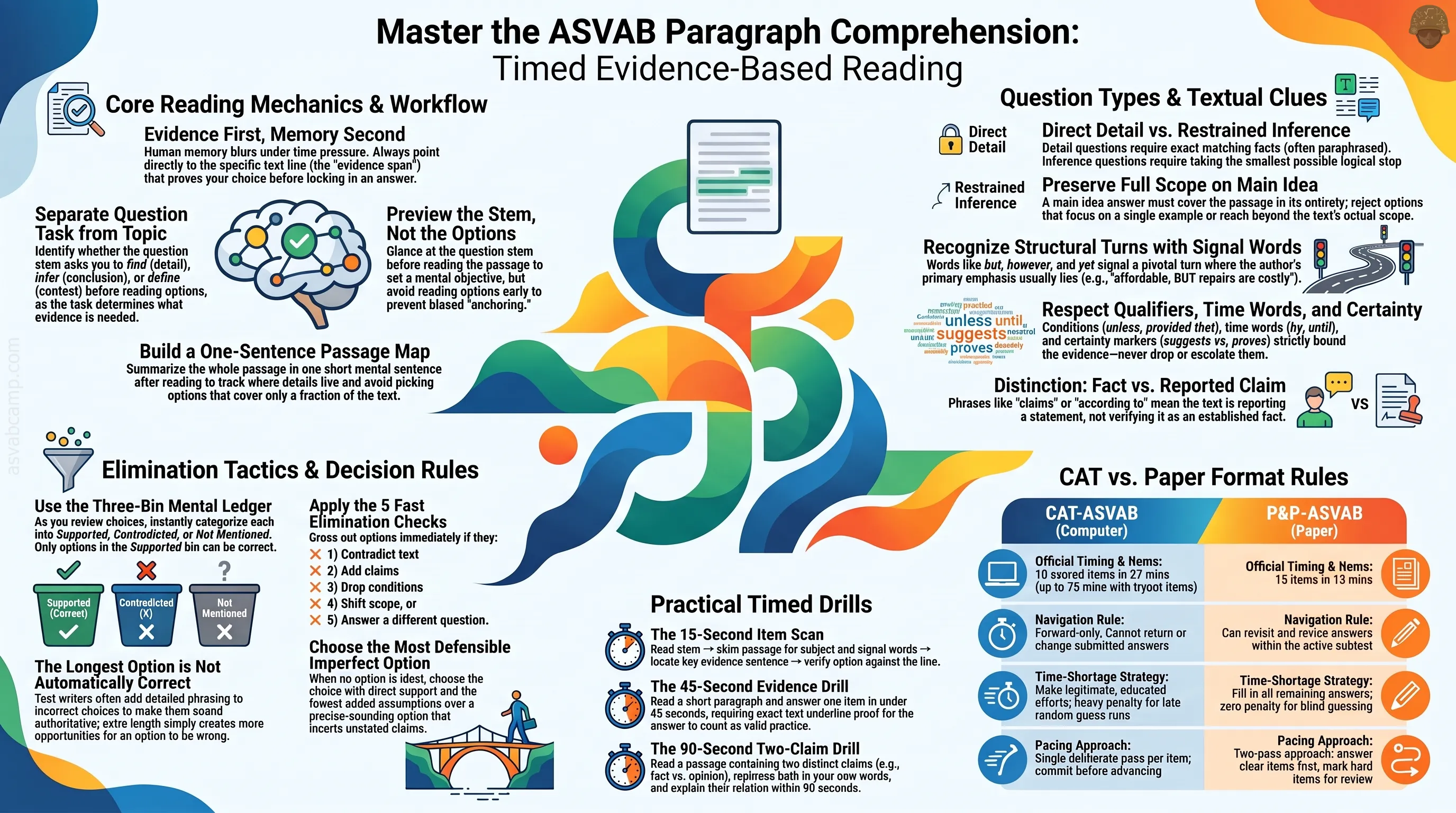
By the end of this lesson you will be able to find the exact words that support an answer, draw only small inferences the text allows, keep conditions and qualifiers intact, rule out distractors quickly, and adjust your navigation habits to the computer or paper version of the test.
What the official Paragraph Comprehension subtest measures
The official ASVAB describes Paragraph Comprehension (PC) as obtaining information from written passages. Its sample questions include direct information, implication, and interpreting a phrase in context. Evidence-based reading is a practical preparation method, not a distinct officially scored subtest or a promise of particular operational question types.
Evidence first, memory second
Your memory of a passage is a rough sketch, and under time pressure it blurs. Before you commit to an answer, look back and point to the line that supports it. If you cannot find that line, treat the choice as unproven, no matter how familiar it feels.
Separate a question task from its topic
Every question has a topic (what it is about) and a task (what it asks you to do). Two questions about the same bridge may ask for a detail, a main idea, or an inference. Name the task first, such as find, infer, or define, because the task decides what kind of evidence you need.
Preview the question without anchoring on an option
Glance at the question stem before reading so you know what to look for, but avoid studying the options first. If you read the choices too early, one of them can stick in your mind and bend how you read the passage. Read with the question in mind, then judge the options.
Two-pass reading when useful
On a longer passage, a quick first pass gives you the layout: what each sentence does. A second, focused pass goes straight to the part the question targets. On a two-sentence passage, one careful read is usually faster than two.
Build a one-sentence passage map
After reading, sum up the passage in one short sentence of your own, such as "The town replaced its streetlights to cut costs, but residents dislike the color." This map tells you where details live and keeps you from picking an answer that covers only one part of the passage.
The evidence span
The evidence span is the smallest stretch of text, often one sentence or clause, that answers the question. Find it, reread it slowly, and compare it to each choice. Text outside the span may be true but rarely decides the answer.
Exact detail: answer with the matching fact
A detail question asks what the passage states. The correct choice restates a specific fact, often in different words. If the passage says the ferry runs every 40 minutes on weekdays, the answer must keep both the number and the weekday limit.
Inference: add as little as possible
An inference is a conclusion the passage strongly suggests but does not say outright. Take the smallest step possible. If a store posts that it is closed for inventory on Monday, you can infer it will not sell goods that day, not that business is failing.
Main idea: preserve the full scope
A main idea answer must cover the whole passage, not just one example, and must not reach past it. If a paragraph describes three ways bees help farms, "Bees benefit agriculture in several ways" fits; "Bees pollinate apples" is too narrow.
Purpose and tone: look at the writer’s action
To find purpose, ask what the writer is doing: explaining, warning, comparing, persuading, or describing. To find tone, look at word choice. "The plan was a reckless gamble" signals disapproval, while "the plan carried some risk" is more neutral.
Word meaning must fit the sentence
When asked what a word means in context, replace it with each option and reread the sentence. In "The coach tried to temper the team's excitement," temper means moderate or calm, not anger. The right meaning is the one that keeps the sentence logical.
Signal words: contrast
Words such as but, however, although, yet, and on the other hand signal a turn. What follows the turn usually carries the writer's stronger point. In "The car is affordable, but repairs are costly," the key concern is repair cost.
Signal words: conditions and exceptions
Words such as if, unless, only when, except, and provided that limit a statement. "Visitors may park here unless a game is scheduled" does not mean parking is always allowed. An answer that drops the condition is wrong.
Signal words: evidence strength
Words like proves, shows, suggests, may, and might tell you how sure the writer is. "The study suggests coffee may aid focus" is weaker than "coffee improves focus." Choose an answer that matches the writer's level of certainty.
Time words: before, after, by, until
Time words set limits. "Submit forms by Friday" means Friday is the last allowed day. "Stay until noon" means leave at noon. "Before the meeting" and "after the meeting" point in opposite directions. Read them as carefully as numbers.
Causation versus sequence
Sequence means one event came after another. Causation means one event made the other happen. "After the new manager arrived, sales rose" gives order only. Unless the passage says the manager caused the rise, an answer claiming cause adds something unstated.
Numerical comparisons in reading
When a passage compares numbers, check what is being compared and in which direction. "Town A has twice as many parks as Town B" means B has half as many, not that A has two more. Keep units and words like more, fewer, at least, and at most exactly as written.
Pronouns and reference words
Pronouns such as it, they, this, and which point back to an earlier noun. In "The pilot radioed the tower, and it confirmed the runway," it refers to the tower. When a question hinges on a pronoun, find the noun it replaces before you choose.
Fact versus reported claim
"The company says the product is safe" reports a claim; it does not confirm the product is safe. Notice phrases such as according to, claims, believes, and reports. An answer stating the claim as settled fact goes beyond the passage.
Observation versus recommendation
An observation describes what is; a recommendation says what should be done. "Many hikers get lost on this trail" is an observation. "Hikers should carry a map" is a recommendation. Match the answer to the kind of statement the question asks about.
Necessary versus sufficient
A necessary condition must be met but may not be enough. A sufficient condition is enough on its own. "A license is required to drive a truck" makes a license necessary, but having one does not guarantee you will be hired to drive.
Scope: sample, place and time
Notice who, where, and when a passage covers. A survey of night-shift nurses in one city in 2020 does not describe all nurses everywhere today. Answers that widen the group, place, or time overstate the evidence.
Compare and contrast under pressure
When a passage compares two things, sort each feature to the right side. Make a quick mental split: X is cheaper, Y lasts longer. Wrong answers often swap features between the two or claim one is better overall when the text compares only one trait.
Eliminate contradiction first
The fastest elimination is an option that says the opposite of the passage. If the text says the bridge closed for repairs and a choice says it stayed open, cross it out at once. Contradictions are easy to spot and save time for harder choices.
Eliminate unsupported additions
Some options repeat the passage and then add a new claim, such as a cause, a result, or a number not mentioned. If any part of an option goes beyond the text, the whole option is unsupported. Check every part of the option, not just the start.
Eliminate a true but irrelevant detail
An option can match the passage word for word and still be wrong because it does not answer the question. If the question asks why the dam was built and an option states when it was built, it is accurate but off target. Tie each option to the task.
Choose the best supported among imperfect alternatives
Sometimes no option is perfect. Then pick the one with the fewest problems and the most direct support. An answer that is slightly vague but fully supported beats one that is precise but adds a claim the passage never makes.
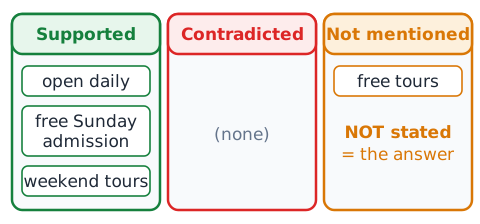
Use an evidence ledger in your head
As you test each option, sort it into one of three bins: supported, contradicted, or not mentioned. Only the supported bin can hold the answer. This quick mental ledger keeps you from rereading the same option again and again.
A 15-second scan for a short item
For a brief passage, spend about 15 seconds on a quick scan: read the stem, skim the passage for its subject and any signal words, and note where the key sentence sits. Then read that sentence carefully and check the options against it. The scan is a starting point, not a substitute for reading.
A 45-second evidence drill
Practice this drill: set a 45-second limit, read a short paragraph, answer one question, and underline or name the exact sentence that proves your choice. If you got it right without evidence, count it as a lucky guess. The goal is speed with proof, not speed alone.
A 90-second two-claim drill
In this drill, read a passage that makes two separate claims, such as a fact and an opinion. Within 90 seconds, state each claim in your own words and explain how they relate. This trains you to keep multiple ideas apart under time pressure.
Personal pacing without a rigid timer
Track repeated practice runs by accuracy first and seconds second. Some questions require a quick fact lookup; others need two or three sentences of reasoning. A rigid equal-time rule can waste time on easy items or rush nuanced inference questions; learn to recognize when a second reading changes the evidence.
CAT-ASVAB: navigation rule
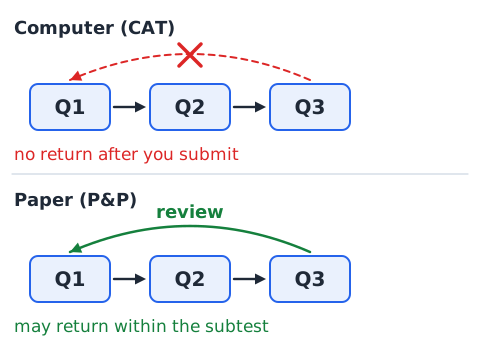
Official CAT-ASVAB guidance states that once you submit an answer and move on, you cannot return to that question to change it. Verify that your chosen option matches the evidence before submitting; do not assume you can bookmark an unanswered item and revisit it as on a paper test.
CAT-ASVAB: what to do when time is short
Official ASVAB preparation guidance advises making a legitimate effort on remaining CAT items rather than rapid random responses. CAT-ASVAB uses a penalty procedure for unfinished items and relatively large penalties for a run of random guesses near the end. Educated elimination remains preferable to blind speed-clicking.
P&P-ASVAB: use review differently
Within the current paper-and-pencil subtest, you may return to questions if time remains, but you cannot revisit earlier subtests. If running out of time on the paper test, official guidance says to fill remaining answers because there is no penalty for guessing. These instructions must not be imported into CAT-ASVAB.
Official PC timing is format-specific
According to the official current test-format tables, CAT-PC lists 10 scored items with 27 minutes without tryout items, or up to 75 minutes when tryout items are administered; P&P-PC lists 15 items in 13 minutes. These numbers describe actual test administrations, not the longer practice sets in this course; verify current official instructions before the test.
Why this 30-question lesson quiz differs
This lesson quiz has more questions than a single official Paragraph Comprehension subtest, and it is not timed the same way. Its purpose is practice across many skills, not a copy of real test conditions. Use the official site for current item counts and time limits, and treat your quiz score as feedback, not a prediction.
Multi-pass approach on paper only
In paper-format practice, answer clear items on the first pass and mark genuinely uncertain ones for review, staying within the active subtest. On CAT items, use a single deliberate pass followed by the final choice because the format does not permit returning to previously submitted questions.
The final evidence check
Before you lock in an answer, take two seconds to check: Does the evidence span support every word of my choice? Have I kept the conditions and certainty level? Does it answer the actual question? If yes to all three, move on.
When to move on from a difficult item
If you have read an item twice and still cannot narrow it down, make your best supported choice and move on. Spending too long on one question takes time from others you can answer. Eliminate what you can, choose, and keep your pace.
Why the longest option is not automatically correct
Test writers sometimes add detail to wrong options, making them long and impressive. Length is not evidence. A long option has more parts that can be wrong. Judge each choice on support from the passage, not on how complete it sounds.
Beware emotionally loaded phrasing
Words like always, never, disaster, or perfect can make an option feel strong. Unless the passage uses that level of intensity, such phrasing usually overstates. Prefer options whose tone matches the writer's.
What “except” and “NOT supported” require
An "except" or "NOT supported" question reverses the usual task. Three options are supported, and you must find the one that is not. Check each option against the passage and look for the one that is contradicted or missing from the text. Reread the stem before choosing.
Evidence for implied conclusions
An implied conclusion still needs a basis. Identify the sentence or sentences that lead to it. If a passage says the truck started the day with its full 10-gallon tank and used 9 gallons by noon, you can infer it was nearly empty, but not that the driver forgot to refuel.
Reading a paragraph containing a quotation
When a passage quotes someone, separate that speaker's view from the writer's. "The mayor called the plan 'a big win'" tells you the mayor's opinion. The writer may agree, disagree, or stay neutral; check other sentences.
Read comparisons with baselines
"Accidents dropped by 30 percent" needs a baseline. Compared to what period or place? An answer that changes the baseline, such as from last year to the national average, misreads the comparison.
Extract a rule from a schedule
When a passage gives a schedule, look for the pattern. "The shuttle leaves at 7:00, 7:20, and 7:40" means a 20-minute interval. A question about the next departure after 7:40 can be answered as 8:00 only if the passage implies the pattern continues.
Avoid turning possibility into certainty
"The storm could delay flights" means delays are possible, not certain. An option that says "flights will be delayed" changes possibility into certainty. Keep words like may, could, and might when you match an answer.
Do not confuse a proposed solution with an outcome
"The council proposed a new bus route" does not mean the route exists or has helped riders. A proposal, plan, or goal is not a result. Pick answers that keep the passage at the stage it describes.
Evidence over thematic resemblance
An option may use the same topic or keywords as the passage but say something the passage does not. Shared vocabulary is not proof. Choose the answer that the evidence supports, even if it uses different words.
Paraphrase carefully
Correct answers often paraphrase the passage, using synonyms and new sentence structure. A good paraphrase keeps the meaning: same subject, same claim, same limits. If the passage says "most" and the option says "all," the paraphrase has changed the meaning and is wrong.
Five fast checks for wrong options
Run these checks on each suspicious option: Does it contradict the text? Does it add a claim? Does it drop a condition or qualifier? Does it shift the scope? Does it answer a different question? A yes to any one is enough to eliminate it.
The answer-choice reread trap
Rereading answer choices again and again without checking the passage wastes time and builds false confidence. Each reread makes options feel more familiar. Instead, go back to the evidence span and compare it to the options once.
The first-sentence shortcut
Assuming the first sentence is always the main idea is risky. Many passages open with background or a view the writer then challenges. Read to the end and check whether a later sentence states the real point.
The all-or-nothing shortcut
Students sometimes reject an option because one word looks off, or accept it because most of it fits. Both shortcuts fail. An option must be fully supported to be right, and a small wording change is fine if the meaning holds.
Guessing from an answer pattern
Four consecutive C answers in a practice session are not evidence the next correct answer must be A. Real questions are judged by their passages, not by the local distribution of labels. Use the support test for every item even when an answer-letter pattern looks improbable.
Guided drill A: detail in 30 seconds
Passage: "The library extends its hours to 9 p.m. during finals week. Otherwise it closes at 6 p.m."
Question: When does the library close during a normal week? Answer: 6 p.m. The evidence span is the second sentence, and "otherwise" marks the non-finals schedule.
Guided drill B: scope in 45 seconds
Passage: "A 2023 survey of 200 riders on the city's east-side buses found most wanted later service."
Question: Which conclusion fits? Answer: Most surveyed east-side riders wanted later service. A choice about all city riders widens the scope beyond the sample.
Guided drill C: inference in 60 seconds
Passage: "The bakery's oven broke Tuesday morning. The repair technician cannot come until Thursday."
Question: What is the most reasonable inference? Answer: The bakery probably cannot bake with that oven on Wednesday. Claiming it will close permanently adds too much.
Guided drill D: negative stem in 60 seconds
Passage: "The ranger station offers maps, water refills, and first-aid kits. It does not rent gear."
Question: All of the following are offered EXCEPT. Options: maps, water refills, tent rentals, first-aid kits. Answer: tent rentals, because the station does not rent gear.
Guided drill E: format-aware practice
Practice one set as if on computer: answer each item before moving on, because you cannot go back. Practice another set as if on paper: mark hard items, finish the easy ones, then return. Notice how your choices change in each setting.
Guided drill F: error classification
After a practice set, label each miss by its cause: missed condition, overstated certainty, scope shift, unsupported addition, wrong task, or misread word. Over several sets, your most common label shows you which habit to fix first. Keep a running tally to track your progress.
Exam-day evidence checklist
On test day: read the stem first, name the task, find the evidence span, keep conditions and certainty level, eliminate contradictions and additions, check that your choice answers the question, then move on. On the computer version, commit before advancing. On paper, you may mark and return.
Accuracy first, speed second
Speed comes from good habits, not from rushing. A correct answer found with evidence beats a fast guess. Practice accuracy first; as you get faster at locating evidence, your pace will improve on its own. Build both skills together through regular timed practice.
Worked example 1 — Explicit detail with an exception
Passage: "All staff must wear safety glasses in the shop, except during the lunch break when machines are off."
Question: When are safety glasses not required? Step 1: Find the exception word, except. Step 2: Read what follows it. Answer: During the lunch break, when machines are off.
Worked example 2 — The most defensible inference
Passage: "The pond froze early this year. Ice-fishing permits sold out by mid-December."
Question: Which inference is best supported? Step 1: Link the two facts. Step 2: Pick the smallest step. Answer: Demand for ice fishing was high this season. Saying the pond will stay frozen until spring is unsupported.
Worked example 3 — Author conclusion after a concession
Passage: "Electric scooters are popular with commuters. Admittedly, they are cheap to run. However, the city has seen a rise in sidewalk crashes involving them."
Question: What is the writer's main concern? Step 1: Find the concession, admittedly. Step 2: Find the turn, however. Answer: Safety on sidewalks.
Worked example 4 — Different facts for different groups
Passage: "Students under 18 need a parent's signature to join. Adult students need only a photo ID."
Question: What does a 20-year-old need to join? Step 1: Identify the group. Step 2: Match the rule. Answer: A photo ID only.
Worked example 5 — A phrase in its local context
Passage: "After the long march, the recruits were running on fumes, but they still finished the drill."
Question: What does "running on fumes" mean here? Step 1: Read the surrounding words. Step 2: Test each option. Answer: Nearly out of energy. The march explains the tiredness.
Worked example 6 — Necessary condition is not a guarantee
Passage: "Applicants must pass a hearing test to qualify for the job."
Question: If Maria passed the hearing test, what follows? Step 1: Note that the test is necessary. Step 2: Ask whether it is enough. Answer: She has met one requirement; the passage does not say she will be hired.
Worked example 7 — Negative question stem
Passage: "The museum is open daily. Admission is free on Sundays. Guided tours run on weekends."
Question: Which is NOT stated? Options: open daily, free Sunday admission, weekend tours, free tours. Step 1: Check each. Answer: free tours, which is never mentioned.
Worked example 8 — Comparison with different criteria
Passage: "Brand A batteries last longer. Brand B batteries charge faster."
Question: Which is supported? Step 1: Note the two different criteria. Step 2: Avoid an overall ranking. Answer: Each brand has a different strength. "Brand A is better" is unsupported.
Worked example 9 — Reported claim versus verification
Passage: "The manufacturer states the jacket is fully waterproof. Independent tests have not yet been published."
Question: What can be concluded? Step 1: Notice states. Step 2: Notice no tests yet. Answer: The claim of waterproofing is unverified.
Worked example 10 — A speed-and-evidence decision
You have a minute left and two items to go. Item one is a short detail question; item two is a long inference passage. On paper, answer the short item first, then make a quick supported choice on the second. On the computer, you must answer in the order given, so give the current item a fast, evidence-based answer and keep going.
 English ▾