 ASVAB Camp
Learning outcomes
After this lesson you should be able to name the order a short passage follows, such as time order, steps, cause and effect, problem and response, examples, definition, comparison or qualification. You should also explain what job a given sentence performs and reject answer choices that claim more than the text supports.
How this lesson fits Paragraph Comprehension
The official ASVAB describes PC as the ability to obtain information from written passages. Passage structure is a practical way to locate information and follow an explanation; the official ASVAB does not identify “passage organization” as a separately scored subtest or guarantee that a named structure appears on any particular form.
Organization means the relationship among ideas
A passage's organization is not its subject. It is the way the ideas connect to one another. One sentence may set up a problem while the next offers a fix; one may state a rule while the next gives an instance of it. Seeing those links tells you why each sentence is there and how the writer moves the reader from start to finish.
The central question: What job does each sentence do?
For each sentence, ask what it adds. Does it introduce the topic, state a claim, give a reason, offer an example, describe a step, show a result or limit an earlier point? Naming that job is the core skill behind most organization questions.
Topic versus organizational pattern
The topic is what a passage is about; the pattern is how it is arranged. Two passages about wildfires can differ completely: one traces a single fire hour by hour, while another lists the causes of fires in general. Same topic, different structures.
Purpose versus organization
Purpose is why the author wrote (to inform, persuade, warn or instruct). Organization is how the content is laid out. A passage meant to persuade readers to wear seat belts might be built as a problem and solution, or as a series of examples. Keep the two questions separate when you read the answer choices.
First-sentence role
The opening sentence often names the topic, states the main claim or sets the scene. Do not assume it is always the main idea, though. Sometimes it presents a common belief that the rest of the passage goes on to challenge, so read ahead before labeling it.
Middle-sentence role
Middle sentences usually do the support work. They give reasons, details, data, steps or examples that back up or develop the opening point. A middle sentence can also turn the passage, for instance by raising an objection that the writer later answers.
Final-sentence role
The last sentence may sum up, draw a conclusion, state a result, recommend an action or add a limit. Check whether it simply restates the opening or moves beyond it. A closing that begins with "therefore" often signals a conclusion drawn from what came before.
Chronological order: what happened when
Chronological order tells events in the sequence they occurred. Look for dates, times and words such as then, later, by evening and the next year. Example: a storm formed on Monday, reached the coast on Wednesday and weakened over land by Friday. Questions may ask what happened before or after a given event.
Process order: how a task is completed
Process order explains how to do something or how something works, step by step. Unlike a story, the steps can be repeated by anyone. Changing a tire, for example, means loosening the lug nuts, raising the car with a jack, removing the wheel and mounting the spare. Order matters because a later step depends on an earlier one.
Sequence reversal and flashback
Writers do not always tell events in order. A passage may open with an outcome and then go back to explain how it came about. The order of sentences is not the order of events, so track time clues to rebuild the real sequence before answering.
Cause-effect: what produced what
A cause-effect passage explains why something happened or what followed from it. Clue words include because, as a result, led to, so and therefore. Example: heavy rain soaked the hillside, so the soil loosened and slid onto the road. The rain is the cause; the slide is the effect.
Multiple causes and multiple effects
One effect can have several causes, and one cause can trigger several effects. A crop failure might come from drought and pests together. A factory closing might lead to job losses, empty stores and lower tax revenue. Read for every link the passage names.
Correlation is not an established mechanism
Two things happening together does not prove one caused the other. If a passage says towns with more parks report fewer illnesses, it shows a link, not a proven cause. Choose an answer that says the passage claims causation only if the text actually says so.
Problem-solution: obstacle, response, result
This pattern names a difficulty, describes what someone did or proposed about it and sometimes reports how well it worked. Example: a base had long lines at the dining hall, so it added a second serving line, and wait times dropped. Note which parts are stated.
Problem-solution versus cause-effect
Both patterns involve a chain of events, but problem-solution centers on a response to a difficulty. Cause-effect simply explains why something happened. If a passage explains why a bridge rusted, that is cause-effect. If it describes the repaint crew hired to stop the rust, it has become problem-solution.
Definition and classification
A definition passage explains what a term means, often adding traits or an example. Classification sorts things into groups by a shared basis. A passage might define "renewable energy" as power from sources that refill naturally, then classify it into solar, wind, water and geothermal types.
Generalization followed by examples
A common pattern opens with a broad statement and then backs it up with specific cases. "Many animals change behavior before winter. Squirrels store nuts, bears build up fat, and some birds fly south." The first sentence is the general claim; the rest are examples. Look for phrases like for instance and such as.
Examples before a general conclusion
Sometimes the cases come first and the broad point comes last. A writer might describe three late deliveries, a lost package and a damaged box, then conclude that the shipping service is unreliable. The final sentence draws the general idea from the details.
Compare-contrast as passage structure
A compare-contrast passage shows how two or more things are alike, different or both. Clue words include similarly, likewise, however, whereas and unlike. A passage might note that both bicycles and scooters need regular maintenance, but that their parts and ranges differ.
Block organization versus point-by-point
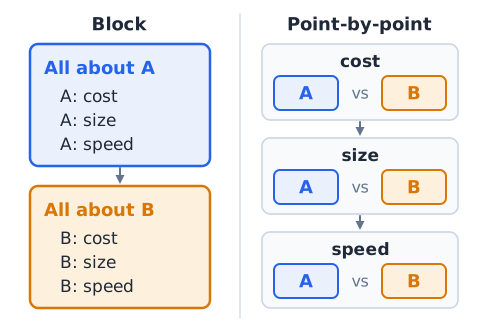
In block order, the writer covers everything about item A, then everything about item B. In point-by-point order, the writer goes feature by feature, comparing A and B on cost, then on size, then on speed. Knowing which form is used helps you find details quickly.
Claim, evidence and reasoning
Argument passages often follow a three-part path. The claim states what the writer believes. The evidence supplies facts, data or observations. The reasoning explains why the evidence supports the claim. When asked about a sentence's role, decide which of the three it is. A sentence with a number is usually evidence; a sentence with "this shows" is usually reasoning.
Concession followed by qualification
A writer may admit a point on the other side, then limit or answer it. "It is true that night shifts pay more. Still, they can harm sleep and health." The first sentence concedes; the second qualifies and returns to the writer's main view.
Condition and exception structure
Some passages state when a rule applies and when it does not. Look for if, unless, only when and except. "Visitors must show ID at the gate unless they arrive with an escort." The rule is the ID check; the exception is the escort. Answers that ignore the exception usually overclaim.
Location or spatial arrangement
Spatial order describes where things are, moving in a planned direction such as top to bottom, left to right or inside to outside. A description of a ship might move from the bridge down to the engine room. Words like above, beside, behind and across signal this pattern, which helps you picture the layout.
Whole-to-part and part-to-whole
Whole-to-part order presents the full system first and then breaks it into components, such as describing a car engine and then its pistons, valves and spark plugs. Part-to-whole works the other way, building up from pieces to the complete thing. Both help readers see how parts fit together.
Mixed structure is normal
Real passages often combine patterns. A paragraph might define a term, give an example and then contrast it with a similar idea. When asked for the overall structure, choose the pattern that organizes the whole passage, not one that fits only a single sentence.
Transition words help but do not prove structure
Signal words point toward a pattern, but they are not proof. "Then" can mark time or a logical result. "Since" can mean because or after. Confirm the pattern by checking what the sentences actually do, not by spotting a single clue word and stopping there.
Pronouns and reference chains
Words like it, this, they and such link sentences together. "This change" points back to a change already named. Following these reference chains shows which idea a sentence builds on. If you are unsure what a pronoun refers to, look at the closest earlier noun that makes sense.
Repeated key terms and synonyms
Writers keep a passage unified by repeating key words or using synonyms. A passage might call something a "vehicle," then the "truck," then "it." Recognizing that these all name the same thing helps you follow the line of thought.
A shift marker announces a new role
Words such as however, but, yet, on the other hand and in contrast warn that the passage is about to turn. What follows may challenge, limit or contrast with what came before. Pay extra attention after a shift marker.
A counterexample tests a broad rule
A counterexample is a single case that does not fit a general rule. If a passage says all metals are solid at room temperature, mercury shows that the rule is too broad. When a passage offers a counterexample, its job is to limit or disprove a claim, not to support it.
Evidence and examples are not identical
An example shows what an idea looks like in a single case. Evidence is information offered to prove a claim is true, such as survey results or test data. A single story about one sailor who stayed fit illustrates a point; a study of five hundred sailors is evidence. Questions may ask which a sentence provides.
Distinguish consequence from recommendation
A consequence is what happens as a result. A recommendation is what someone says should be done. "Ice formed on the wings" is a consequence of cold weather. "Crews should de-ice before takeoff" is a recommendation. Watch for should, must and ought.
Distinguish objective from outcome
An objective is what someone set out to do. An outcome is what actually happened. A unit may aim to cut fuel use by 10 percent, but the passage may say it only reached 6 percent. Do not treat a stated goal as proof that the goal was met.
Main structure versus minor embedded details
A passage may mention a date, name or small fact that is not part of its main pattern. A process paragraph could note in passing that the tool was invented decades ago. That date does not make the passage chronological. Focus on the overall framework.
Answer the exact organizational question
Read the question carefully. "What is the role of the second sentence?" is not the same as "How is the passage organized?" One asks about a single part; the other asks about the whole. Match your answer to the scope of the question.
Common answer labels translated
Answer choices use formal labels. "Provides an illustration" means gives an example. "Introduces a qualification" means adds a limit. "Presents a contrasting view" means offers the other side. "Offers a solution" means proposes a fix. "Describes a sequence" means lists events or steps in order. Translate each label into plain words before deciding.
When structure is implied without labels
Some passages use no signal words at all. "The pump failed. The basement flooded." Nothing says "because," yet the order implies a cause and effect. Use the logic of the content to infer the link, but do not stretch beyond what the sentences reasonably suggest.
Short-paragraph map: three slots
Many short paragraphs fit a simple map with three slots: an opening that sets the point, a middle that develops it and a close that concludes or limits it. Sketching these three slots in your head gives you a quick picture of where each sentence belongs and what it is doing.
Do not overread a statistic
A number supports only what it measures. If a passage says that complaints fell from 40 to 30, that is a drop of
It does not show that customers are happier, only that fewer complained. Before choosing an answer, ask exactly what the figure counted, over what period and for which group.
Organization across two paragraphs
In a two-paragraph passage, the paragraphs often have different roles. The first may present a problem and the second a solution, or the first may describe one view and the second a different one. Ask how the second paragraph relates to the first.
Sentence placement and continuity
Some questions ask where a sentence fits best. Look for links: a pronoun that needs an earlier noun, a "for example" that needs a general claim before it, or a "then" that needs a previous step. The sentence belongs where those connections are satisfied. A sentence that starts with "As a result" must follow the cause it refers to, so place it directly after the sentence that names that cause.
Sequence of claims versus sequence of events
A list of claims in a certain order is not the same as events happening in time. "First, the plan saves money. Second, it reduces waste" lists reasons, not stages. Do not call this chronological just because it is numbered.
Structure under uncertainty
Some passages report findings that are still tentative, using words such as may, might, suggests or appears. The structure might be claim and evidence, but the claim is hedged. Keep that hedge in mind when picking an answer.
A four-pass reading routine
On the first pass, read the whole passage for its general topic. On the second pass, label each sentence's job in a word or two. On the third pass, read the question and identify whether it asks about one sentence or the whole. On the fourth pass, check every answer choice against the text and cross out any that add claims the passage does not make.
The arrow-map method
Picture each sentence as a box and draw arrows to show how they connect, such as cause leading to effect or claim leading to support. If you can describe the arrows, you understand the structure. This mental map also makes it easier to spot answers that reverse the direction.
When two answer options look plausible
If two choices both seem right, compare them word by word against the text. Usually one is more precise or better covers the whole passage, while the other fits only part of it or adds an extra claim. Pick the one with the strongest support in the actual sentences.
Reading speed without mechanical skimming
Rushing by skimming every passage can cause you to miss shift words or qualifiers that change the meaning. Instead, read at a steady pace and slow down on key words like but, unless and only. Steady, purposeful reading is faster overall than reading twice.
CAT-ASVAB decision discipline
On the computer-based ASVAB, you cannot skip a question and return to it later. Each answer is final once you move on, and harder questions follow correct answers. Read the passage fully, eliminate answers that overreach, and choose the best-supported choice. Pace yourself so you finish every item, since unanswered items can hurt your score.
When structure words are unfamiliar
If an answer choice uses a term you do not know, such as "juxtaposes" or "enumerates," focus on the parts you do understand. Eliminate options that are clearly wrong, then compare the rest to what the passage actually does. Context in the choice itself often hints at the meaning.
Trap: assuming “first” always means time
The word "first" does not always mean the earliest event. It can mean the first reason, first example or most important point. Check what the list contains. If the items are reasons or features, the passage is not chronological.
Trap: reversing cause and effect
Answer choices may flip the direction of a cause-effect relationship. If a passage says heat made the metal expand, an answer saying the expansion created the heat is wrong. Trace which event came first and which one resulted.
Trap: treating a proposal as a completed fix
A passage may describe a planned solution without saying it worked. "The city plans to add bike lanes to ease traffic" does not mean traffic has eased. Do not pick an answer that treats a proposal as an achieved result.
Trap: changing the target of an example
An example supports a specific point. If a passage uses a story about a mechanic to show that training reduces errors, the example is not about mechanics in general. Make sure an answer matches the idea the example actually illustrates.
Trap: mistaking a concession for agreement
When a writer admits a point on the other side, that does not mean the writer accepts the opposing view. "Some say uniforms limit expression, and that may be partly true, but they also reduce distractions." The writer still favors uniforms.
Trap: mixing up quoted and author positions
A passage may report what others believe before giving the author's view. "Critics claim the new rule is costly" states the critics' opinion, not the author's. Read on to find the author's own stance.
Guided drill: identify sentence functions
Passage: "Grease fires spread fast. Water makes them worse by splattering burning oil. Covering the pan with a lid cuts off the air."
Sentence 1? Answer: states the problem. Sentence 2? Answer: explains a cause of danger. Sentence 3? Answer: offers a solution.
Guided drill: check chronology
Passage: "The recruit passed the physical. Before that, she had taken the ASVAB. Weeks later, she shipped to basic training."
What happened first? Answer: she took the ASVAB. What happened last? Answer: she shipped to basic training.
Guided drill: resolve an exception
Passage: "All gear must be returned by Friday unless a supervisor approves an extension in writing."
Must a sailor with written approval return gear by Friday? Answer: no. Does a sailor with only spoken approval get an extension? Answer: no; it must be in writing.
Guided drill: identify what a comparison supports
Passage: "LED bulbs cost more to buy than older bulbs, but they last years longer and use far less power."
What does the contrast support? Answer: that LED bulbs can be the better long-term value.
The six structures to recognize
The main patterns are chronological order, process, cause-effect, problem-solution, comparison and contrast, and definition or classification. Most passages fit one of these or blend several. Spotting the pattern helps you predict where details belong and why each sentence matters. Example-based and qualifying moves often appear within these patterns.
Evidence-first review checklist
Before choosing an answer, ask: Did I find the words in the passage that support it? Does my answer match the scope of the question? Have I respected any limits, exceptions or hedges? Have I kept cause and effect in the right order? Did I avoid adding claims the passage does not make?
Worked example 1 — A problem followed by an evaluated fix
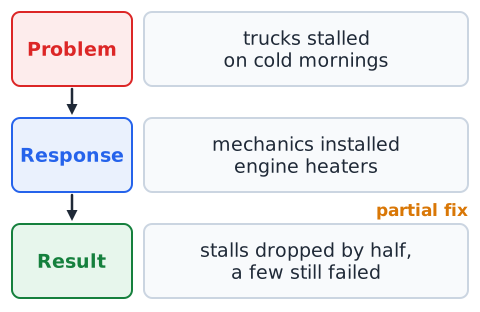
Passage: "Trucks at a depot kept stalling in cold mornings. Mechanics installed engine heaters. Over the next month, stalls dropped by half, though a few vehicles still failed."
Step 1: Sentence 1 states the problem. Step 2: Sentence 2 gives the response. Step 3: Sentence 3 reports a partial result. Answer: the passage is problem-solution with an evaluation showing the fix helped but did not fully solve the issue.
Worked example 2 — A general claim supported by concrete cases
Passage: "Small habits can strengthen fitness. Taking stairs adds leg work. Walking during calls burns calories. Stretching before bed improves flexibility."
Step 1: The first sentence states the general claim. Step 2: Each of the next three gives a specific case. Answer: the structure is a general statement followed by supporting examples.
Worked example 3 — Time order with a retrospective opening
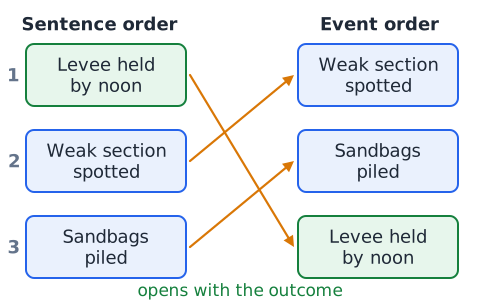
Passage: "By noon the levee held. Early that morning, crews spotted a weak section. They piled sandbags along it for hours."
Step 1: The opening states the final outcome. Step 2: "Early that morning" moves back in time. Step 3: The sandbagging fills the gap. Answer: the events happened in this order: weak section spotted, sandbags placed, levee held. The passage begins with the outcome and then tells the events.
Worked example 4 — Comparing subjects feature by feature
Passage: "Ship A is faster than Ship B. Ship B, however, carries more cargo. Both require the same size crew."
Step 1: Each sentence compares the two ships on one feature: speed, cargo, crew. Answer: this is point-by-point comparison, covering similarities and differences.
Worked example 5 — Cause followed by linked consequences
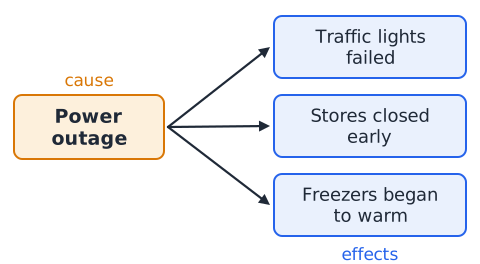
Passage: "A power outage hit the town. Traffic lights failed, causing delays. Stores closed early, and freezers began to warm."
Step 1: The outage is the cause. Step 2: Failed lights, closed stores and warming freezers are effects. Answer: one cause leads to several effects.
Worked example 6 — Claim, data, then qualified conclusion
Passage: "A new training method seems to improve marksmanship. In a trial, scores rose by 12 percent. However, the trial included only 20 soldiers, so more testing is needed."
Step 1: Sentence 1 states a claim. Step 2: Sentence 2 gives data. Step 3: Sentence 3 limits the claim. Answer: the structure is claim, evidence and a qualified conclusion.
Worked example 7 — Definition followed by classification
Passage: "A lever is a rigid bar that turns on a fixed point. Levers are grouped into three classes by where the load, effort and fixed point sit."
Step 1: Sentence 1 defines the term. Step 2: Sentence 2 sorts levers into groups by position. Answer: the structure is definition followed by classification.
Worked example 8 — An objection and a counterpoint
Passage: "Some argue that four-day workweeks cut productivity. Yet a test at one firm showed output held steady while sick days fell."
Step 1: Sentence 1 presents an objection. Step 2: "Yet" signals a reply. Step 3: The data answers the objection. Answer: the passage raises an objection and then counters it with evidence.
Worked example 9 — A process with a dependency
Passage: "To jump-start a car, connect the red clamp to the dead battery's positive terminal, then to the good battery's positive terminal. Next attach the black clamp to the good battery and then to bare metal on the dead car."
Step 1: Each step depends on the one before. Answer: this is process order, and the steps must follow the stated sequence.
Worked example 10 — A general rule limited by an exception
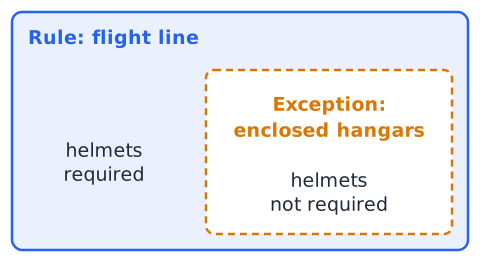
Passage: "Personnel must wear helmets on the flight line. The rule does not apply inside enclosed hangars."
Step 1: Sentence 1 states the general rule. Step 2: Sentence 2 names an exception. Answer: the structure is a rule followed by a limiting exception, so helmets are not required in enclosed hangars.
 English ▾