 ASVAB Camp
Outcome: track order and explain relationships
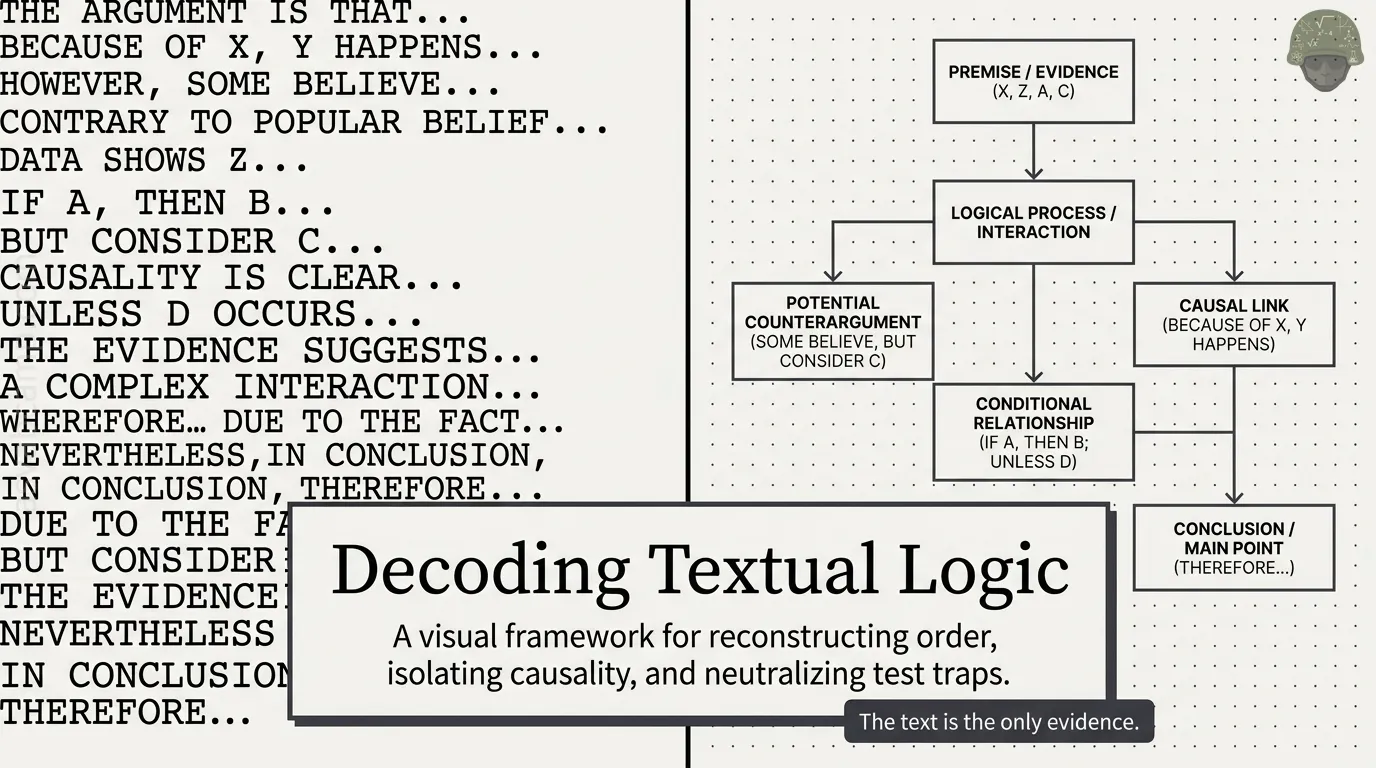
After this lesson, accurately reconstruct events, detect required prerequisites, distinguish cause from purpose and outcome, and explain what a passage does or does not establish about causality. Support every answer with the words of the supplied passage rather than a familiar real-world scenario.
ASVAB Paragraph Comprehension scope
Official ASVAB materials describe Paragraph Comprehension as obtaining information from written passages. Sequence and cause–effect reasoning are practical reading skills within that construct, not separate advertised subtests or a guarantee about operational question counts. All teaching passages and questions in this lesson are original.
Four relationships to separate
Sequence questions ask what happened first, next or last. Cause questions ask why something happened. Purpose questions ask what someone intended to achieve. Condition questions ask what must be true for something to happen. A single passage can contain all four, so decide which relationship the question targets before you look for evidence.
Chronological order versus presentation order
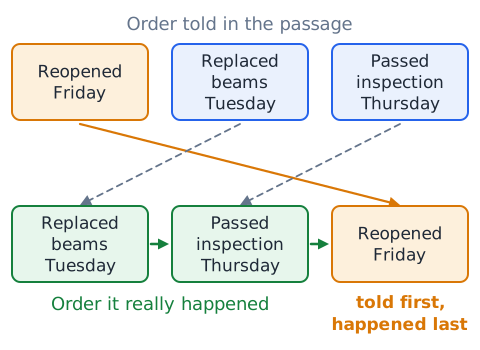
Writers do not always tell events in the order they occurred. A passage may open with a result and then explain what led to it. For example: "The bridge reopened Friday. Crews had replaced the cracked beams on Tuesday and passed inspection Thursday." The bridge reopening is mentioned first, yet it happened last. Rebuild the real timeline from time words and verb tenses, not from sentence position.
Temporal markers: before, after, then and finally
Time words show order. Before and earlier point back; after, then, next and later point forward; finally and at last mark the end. In "After the paint dried, Lena hung the shelves," drying comes first even though hanging is the main action. Read each marker carefully, because it often reverses the order in which the clauses appear.
Immediately before means the adjacent earlier step
When a question asks what happened immediately before an event, the answer is the step right next to it on the timeline, not any earlier step. If a cook chops onions, heats oil and then adds the onions, the step immediately before adding onions is heating the oil. Chopping happened earlier but is not adjacent.
Distinguish order from elapsed time
Order tells which event came first; elapsed time tells how far apart events were. "The seeds sprouted, and the first leaves appeared" gives order but not timing. Do not choose an answer that says "within a day" or "weeks later" unless the passage gives that interval. Sequence evidence alone never proves how long a gap lasted.
Simultaneous events and overlapping windows
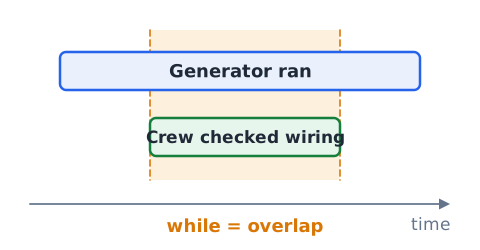
Words such as while, as, during and meanwhile signal that events overlap. In "While the generator ran, the crew checked the wiring," neither action comes before the other; they share a time window. An answer that places one strictly before the other misreads the passage. Note when an overlap starts and ends, since one event may begin earlier and continue alongside another.
Time clauses with had already and by the time
The past perfect (had plus a past participle) marks an action completed before another past moment. "By the time the bus arrived, Omar had already left" means leaving came first and the bus came second. By the time sets a reference point, and had already places the other action earlier than that point.
Reverse narratives and flashbacks
Some passages begin at the end and work backward, or jump into the past with phrases like years earlier or it all started when. Treat each flashback as a separate earlier block on your timeline. For instance, a story that opens with a ribbon cutting and then recalls a fundraiser three years before should place the fundraiser first, the ribbon cutting last.
Cause: the factor a passage connects to a result
A cause is the factor the passage links to a result with words like because, since, due to, led to or as a result. In "The game was postponed because the field flooded," flooding is the cause and postponement is the effect. Your answer should name the cause the passage states, not one you think is more likely.
Immediate and underlying causes
An immediate cause is the final event that directly produced a result; an underlying cause is a deeper condition that made the result likely. If a shelf collapsed when a heavy box was added, the box is the immediate cause, while screws loosened by months of vibration are the underlying cause. Questions may ask for either, so check the wording.
Cause versus effect: arrow direction
Picture each cause-effect pair as an arrow pointing from cause to effect. "Sales fell, so the store cut its hours" means falling sales point to shorter hours. A choice saying the shorter hours caused falling sales has the arrow reversed. Keep the direction exactly as the passage states it.
Purpose is an intention, not a measured result
Purpose words such as to, in order to, so that and aimed at describe what someone hoped would happen. "The town planted trees along Main Street to reduce summer heat" tells you the goal, not whether temperatures actually dropped. Unless the passage reports a result, an answer claiming the trees cooled the street goes beyond the evidence. Keep intention and outcome separate.
Trigger versus enabling condition
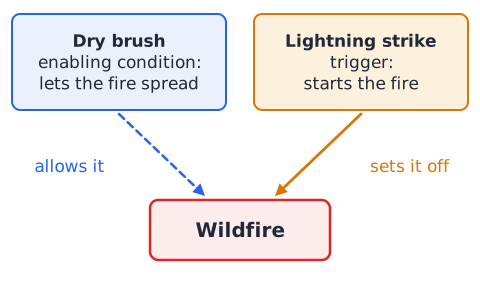
A trigger sets off an event; an enabling condition only makes the event possible. Dry brush in a canyon allows a wildfire to spread, but a lightning strike may be what starts it. If a question asks what started the fire, choose the trigger. If it asks what allowed the fire to grow so large, choose the enabling condition.
Conditional rules: if P then Q is one-way
"If P, then Q" means P guarantees Q, but it does not mean Q guarantees P. "If a member pays dues, she receives the newsletter" does not say that everyone who receives the newsletter paid dues; a library copy might arrive too. Do not reverse the rule, and do not assume Q fails just because P is absent.
Only if describes a necessary condition
"Q only if P" means Q cannot happen without P, so P is required. "The van will start only if the battery is charged" tells you a dead battery means no start. It does not promise that a charged battery makes the van start; fuel or another part could still be missing. Only if names a requirement, not a guarantee.
Unless, except and as long as
Unless means if not. "The pool stays open unless lightning is seen" means the pool closes when lightning appears. Except marks a stated exception to a general rule. As long as sets a condition that keeps something going: "You may park here as long as you display a permit" means permission ends when the permit is missing.
Necessary versus sufficient in ordinary reading
A necessary condition must be present but may not be enough; a sufficient condition is enough by itself. A ticket is necessary to board a train, yet you also need to arrive on time. Winning the final game may be sufficient to take the title, even if other paths exist. Ask whether the passage presents a factor as required, as enough, or both.
AND conditions versus OR alternatives
An AND condition requires every listed item; an OR condition accepts any one of them. "Applicants need a diploma and a clean driving record" means both are required, so having one is not enough. "Applicants may submit a transcript or a test score" means either item works. Do not turn an AND into an OR, or an OR into an AND, when choosing an answer.
Correlation is not proven causation
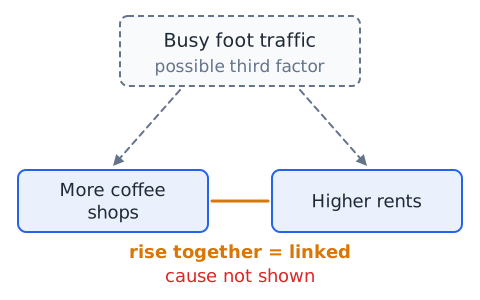
Two things rising or falling together is a correlation, not proof that one causes the other. If a passage says neighborhoods with more coffee shops have higher rents, it has not shown that coffee shops raise rent. A third factor, such as busy foot traffic, could drive both. Pick a causal answer only if the passage itself makes the causal claim.
Explicit causal claim versus independent proof
Sometimes a passage states a cause outright, such as "The clinic reports that the new schedule caused shorter waits." On the test, that statement is your evidence, and you can say the passage claims the schedule caused shorter waits. Do not add that the claim is definitely proven or disproven by outside facts. Report what the passage asserts and who asserts it, nothing more.
Multi-cause outcomes and contributing factors
Many results have several causes. If a passage says a harvest was poor because of a late frost and a shortage of workers, both are contributing factors. An answer naming only the frost as the sole cause overstates the evidence. Look for words like also, along with, in addition and partly, which signal more than one cause.
Intervening steps in a causal chain
Causes often link in a chain: A leads to B, and B leads to C. "Heavy rain raised the river, the river flooded the road, and the road closure delayed deliveries" connects rain to delays only through two middle steps. A question about the direct cause of the delays wants the road closure, while rain is the starting point of the chain.
Feedback loops and repeated sequences
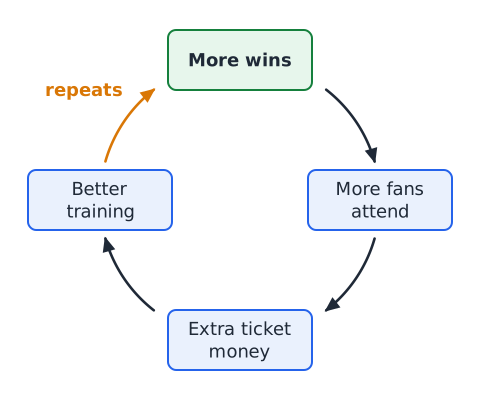
In a feedback loop, an effect circles back to strengthen or weaken its own cause. A passage might say that as a team won more games, more fans attended, and the extra ticket money paid for better training, leading to more wins. Track each link in order and notice where the cycle repeats rather than treating it as a single straight line.
Cause versus contrast
Words such as but, however, although and despite signal contrast, not cause. In "Although the forecast called for sun, the picnic was canceled," the forecast did not cause the cancellation; the sentence says the outcome happened in spite of it. Look for because or so when you need a cause, and treat contrast words as signs of surprise.
Sequence versus causation: after does not mean because
An event that comes after another is not automatically caused by it. "After the new manager arrived, two employees quit" sets up an order, not a reason. They may have left for unrelated jobs. Choose a causal answer only if the passage adds words like because of or as a result; otherwise keep it as sequence.
Distinguish outcome from prediction
An outcome is something the passage says happened; a prediction is something someone expects. Words like will, is expected to, may and could mark predictions. "Officials expect the new lane to ease traffic" does not report that traffic eased. When a question asks what happened, choose only reported events, not forecasts or hopes.
Interpreting prevention and negative outcomes
Prevention describes something that did not happen because of an action. "Sandbags kept the water out of the library" means flooding was avoided, so the outcome is no damage. Read negatives carefully: prevented, stopped, avoided and failed to each flip the meaning. A choice claiming the library flooded contradicts the passage even though flooding is mentioned.
Multiple actors: assign each action correctly
When several people or groups appear, match each action to the right actor. In "The council approved the budget, and the mayor then signed it," the council approved and the mayor signed. A choice saying the mayor approved the budget mixes up the actors. Before answering, list who did what so you do not swap roles.
Pronouns can hide what caused what
Pronouns like it, this, they and that can refer to an earlier noun or an entire idea. In "The pump failed and the tank overflowed. This forced a shutdown," this most likely refers to the overflow and the failure together. Trace each pronoun back to its referent before deciding which event caused the next one.
Numbers and dates as timeline anchors
Dates, times and counts give firm anchors. If a passage says a store opened in 2015, expanded in 2019 and moved in 2022, those years set the order even if the sentences mention the move first. Arrange dated events from earliest to latest, then fit undated events around them using words like before, after and during.
First determine the question type
Before reading the choices, label the question: order, cause, purpose, condition or outcome. Phrases like first, next or immediately before mean order; why or led to means cause; in order to means purpose; only if means condition. The label tells you what kind of evidence to search for.
Make a compact arrow sketch
For longer passages, jot a quick sketch using short labels and arrows, such as storm, then outage, then generator, then repairs. Mark causes with a solid arrow and plain order with a dash or comma, so you do not confuse the two. The sketch takes seconds and shows at a glance which event is adjacent, which came first and which led to what.
Quote the smallest decisive evidence
Find the shortest phrase that settles the question, such as "because the valve stuck" or "only after the inspection." If you cannot point to a phrase that supports a choice, that choice probably goes beyond the passage. Small, exact evidence protects you from answers that sound reasonable but rest on assumptions you added yourself.
Evaluate alternatives one relationship at a time
Wrong choices often mix a true detail with a false relationship. Check each choice in pieces: are the events real, is the order correct, is the cause stated, does the arrow point the right way? If any piece fails, eliminate the choice. One wrong link makes the whole answer wrong.
Use signal words as clues, not absolute rules
Signal words help, but context decides. Since can mean because or from a time onward. So can show a result or mean very. Then can mark order or a conclusion. Read the whole sentence to confirm the meaning, and do not choose an answer just because it repeats a signal word.
Read across sentence boundaries
Causes and effects are often split between sentences. "The shipment arrived late. As a result, the clinic rescheduled several visits" links the late shipment to the rescheduling across a period. Words such as therefore, consequently and for this reason connect back to the earlier sentence, so read the sentence before the signal word to find the cause.
Handling long multi-step passages
In a long process passage, number the steps in your head or on scratch paper as you read. Note where a step repeats, splits into two paths, or depends on a condition. When a question names one step, locate it on your list and check its neighbors. This prevents losing track of order when many steps sound alike.
Timed decision habits without invented limits
Work steadily: find the evidence, test each choice, then commit. If two choices remain, ask which one the passage directly supports, and pick it. Do not linger on a single item; mark your best answer and move on. Use the time limit printed in your official test instructions rather than any number someone guessed for you.
Trap: true event in the wrong position
A common trap offers an event that really is in the passage but sits in the wrong place on the timeline. If asked what happened right after the alarm sounded, a choice naming the final cleanup is true yet not adjacent. Why it fails: being in the passage is not enough. Fix: confirm both that the event occurred and that it holds the exact position the question asks about.
Trap: reversing explanation and outcome
This trap swaps cause and effect. If the passage says the road was closed because a tree fell, a choice saying the tree fell because the road was closed reverses the arrow. Fix: restate the passage's relationship as "X led to Y" and check that the choice keeps the same direction.
Trap: claiming sole causation from partial evidence
A passage may name one factor among several, yet a choice says it was the only cause. Words like only, solely and entirely are warning signs. Why it fails: the passage did not rule out other causes. Fix: pick the choice that matches the passage's level of certainty, such as contributed to or was one reason.
Trap: equating required with sufficient
If a passage says a permit is required to hold a street fair, a choice saying any group with a permit may hold one treats a requirement as a guarantee. Why it fails: other rules, such as dates or insurance, may also apply. Fix: a required item must be present, but having it alone does not ensure the result.
Trap: mixing goals with demonstrated results
A passage states that a school added a tutoring hour to raise test scores. A choice saying test scores rose treats the goal as an achieved result. Why it fails: the passage gave intent, not outcome. Fix: look for a reported result, such as scores rose, before accepting any claim of success.
Trap: using outside scientific or historical knowledge
You may know more about a topic than the passage says, but the test asks only about the passage. If it says a town grew after a railroad arrived, do not add reasons from your own reading of history. Why it fails: outside facts may not match the passage. Fix: support every answer with text on the page.
Guided drill: reconstruct a four-stage process
Passage: "Before the clay can be fired, it must dry fully. The potter shapes it first. After firing, she applies glaze." Order the four stages. Answer: shape, dry, fire, glaze. What happened immediately before firing? Answer: drying. Which stage came last? Answer: glazing, signaled by after firing.
Guided drill: separate cause from purpose
Passage: "Because the old bridge was rusting, the county built a new one to carry heavier trucks." What caused the county to build? Answer: the rusting bridge, marked by because. What was the purpose? Answer: to carry heavier trucks, marked by to. Does the passage say trucks now use it? Answer: no, it states only the goal, not the result.
Guided drill: preserve an AND condition
Passage: "Volunteers may drive the shuttle only if they are over 21 and have completed safety training." Can a 25-year-old without training drive? Answer: no, both conditions are required. Can a trained 19-year-old drive? Answer: no, the age requirement is missing. Does meeting both guarantee a shift? Answer: no, only eligibility.
Guided drill: reject a correlation trap
Passage: "Students who ate breakfast at school tended to have better attendance." Does the passage show breakfast caused better attendance? Answer: no, it reports an association. What could explain both? Answer: students who arrive early may be more likely to eat and to attend. Best summary: the two were linked, cause not shown.
Guided drill: read a reverse chronology
Passage: "The museum opened its new wing in May. Months earlier, workers had finished the roof. Before that, the board had approved the design." Order the events. Answer: approval, roof, opening. What came immediately before the opening? Answer: finishing the roof. Which event is told first but happened last? Answer: the opening.
Worked example 1 — Immediately before
Passage: "Dana unlocked the shed, pulled out the mower, filled the gas tank and started the engine." Question: what did Dana do immediately before starting the engine? Step 1: list the actions in order. Step 2: find starting the engine at the end. Step 3: take the adjacent earlier action. Answer: she filled the gas tank. Unlocking came earlier but is not adjacent.
Worked example 2 — Backward narration
Passage: "The team celebrated its title Sunday. On Saturday it won the final; on Friday it had beaten the top seed." Question: which event happened first? Step 1: anchor each event to its day. Step 2: order the days. Answer: beating the top seed on Friday, though it is mentioned last.
Worked example 3 — Explicit cause
Passage: "The library extended its hours because student visits had doubled." Question: why did the library extend its hours? Step 1: find the signal word because. Step 2: read what follows it. Answer: student visits had doubled. Reject choices that name budget or staffing, which the passage never mentions.
Worked example 4 — Stated purpose, unknown success
Passage: "The city installed speed bumps on Elm Street to slow traffic near the school." Question: what can you conclude? Step 1: note the purpose marker to. Step 2: check for a reported result; none appears. Answer: the city intended to slow traffic. Whether cars actually slowed is not stated.
Worked example 5 — Causal chain
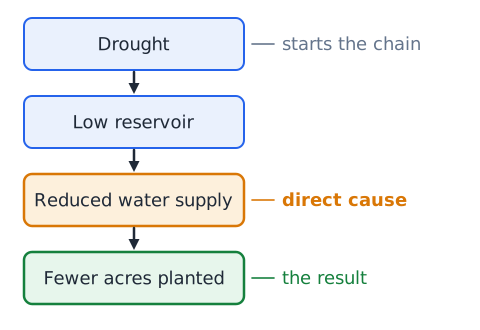
Passage: "A drought dried the reservoir, which cut water supply, which led farmers to plant fewer acres." Question: what directly caused fewer acres? Step 1: map drought, then low reservoir, then reduced supply, then fewer acres. Answer: the reduced water supply. The drought began the chain.
Worked example 6 — Conditional necessity
Passage: "Members can reserve the court only if they book a day ahead." Question: Jo booked a day ahead; must she get the court? Step 1: only if names a requirement. Step 2: meeting it does not guarantee the result. Answer: no, booking ahead is necessary, not sufficient; the court may be full.
Worked example 7 — Two requirements
Passage: "To join the climbing trip, hikers need a signed waiver and their own helmet." Question: Sam has a helmet but no waiver; can he join? Step 1: and means both are needed. Step 2: check each one; the waiver is missing. Answer: no, Sam does not meet the requirements because one of the two is absent.
Worked example 8 — Association is not proof
Passage: "Towns with more bike lanes reported fewer traffic injuries." Question: does the passage prove bike lanes reduce injuries? Step 1: identify the claim type; it reports a link. Step 2: look for because or caused; neither appears. Answer: no, it shows an association, and other factors could explain it.
Worked example 9 — Permission differs from occurrence
Passage: "Residents may water lawns on weekends." Question: did residents water their lawns last weekend? Step 1: may grants permission. Step 2: no event is reported. Answer: unknown; the rule allows it but does not say it happened.
Worked example 10 — Cause, purpose and reported outcome
Passage: "Because complaints about noise grew, the park closed at 9 p.m. to give neighbors quiet evenings. Complaints then fell by half." Cause: growing complaints. Purpose: quiet evenings for neighbors. Reported outcome: complaints fell by half. The passage pairs the outcome with the closing time but does not prove the earlier closing alone caused the drop.
One-minute sequence and cause–effect checklist
Name the question type. Rebuild the true timeline from time words and dates, not sentence order. For immediately before or after, take only the adjacent step. Keep cause arrows pointing the stated way. Separate purpose from result and prediction from outcome. Respect only if, unless, and and or. Never treat after or correlation as proof of cause.
Completion standard and next skill
You have met this lesson's goal when you can order events from mixed-up passages, pick out immediate and underlying causes, tell purpose from outcome, and apply conditions without adding causes the text does not state. These skills also support drawing inferences and conclusions that a passage supports but does not say outright.
 English ▾