 ASVAB Camp
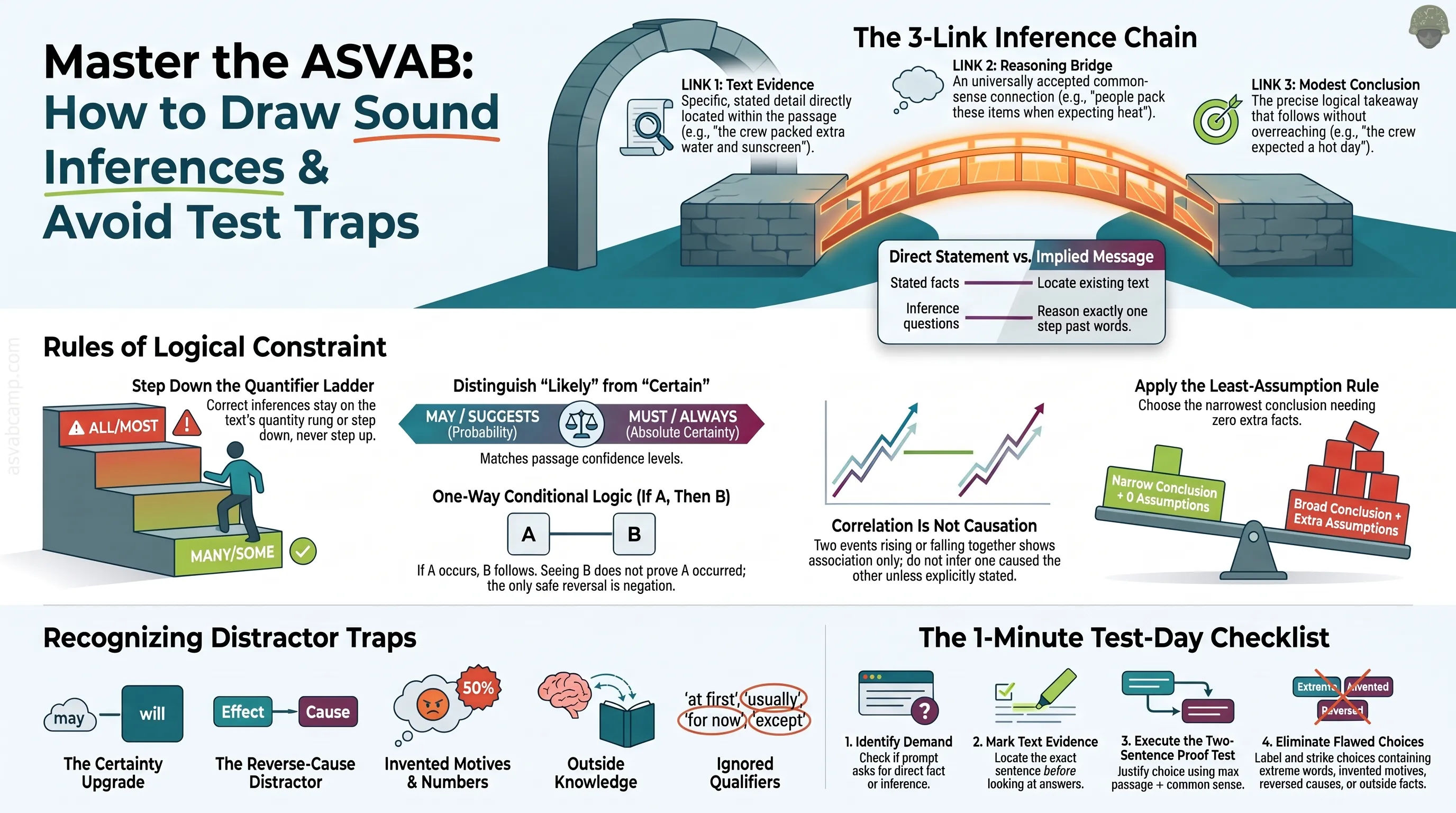
Goal: make the smallest defensible inference
Infer what a passage makes likely or logically necessary without treating a possibility as a certainty. Identify precise textual evidence, supply a short reasoning bridge, preserve conditions and uncertainty, and reject alternatives that add unsupported people, motives, predictions, or causes.
Official PC scope and original practice
The official ASVAB describes Paragraph Comprehension as obtaining information from written passages; an official example asks what an author implies. Inferring cautiously is thus a relevant reading skill, not a promise that any fixed number of operational questions use this topic. All examples and test passages here are newly written, not secure ASVAB items.
An inference is a supported conclusion, not a guess
An inference is a conclusion the passage supports even though it never states it outright. It is not a hunch, a wish, or a fact you happen to know from somewhere else.
Suppose a passage says the parking lot was full by 7 a.m. and late arrivals had to park on the street. You can infer that some people arrived after the lot filled. You cannot infer that the lot is too small for the building.
The evidence → bridge → conclusion chain
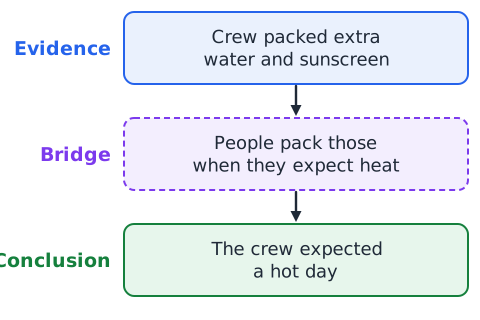
Every sound inference has three links. The evidence is a specific detail in the passage. The bridge is a common-sense connection nearly anyone would accept. The conclusion is what follows.
Evidence: the crew packed extra water and sunscreen. Bridge: people pack those items when they expect heat. Conclusion: the crew expected a hot day. If you cannot name the evidence, your conclusion is only a guess.
Direct statement versus implied message
A direct statement appears in the words themselves. An implied message has to be worked out. "The library closes at 6 p.m." is direct. "Maria checked her watch, grabbed her books, and ran to the library at 5:50" implies she was worried about closing time, though the passage never says so.
A stated-fact question asks you to locate. An inference question asks you to reason one step past the text.
First identify what the question demands
Before you read the choices, label the question. Phrases such as "according to the passage," "the author states," or "the passage mentions" call for a fact you can point to. Words such as "suggests," "implies," "most likely," or "it can be inferred" call for a conclusion one step beyond the text. "Best predicts" asks for a next step. Knowing the demand tells you how far from the text the right answer may travel.
Mark the evidence before reading options
After reading the question, go back and find the sentence or phrase that bears on it before you look at the answers. Sum it up in a short mental note, such as "deliveries were late twice this week." Then read the options and keep only those that grow directly from that note. Reading the options first lets a polished distractor shape what you remember the passage saying.
What makes an inference stronger?
An inference is stronger when several details point the same way, when the bridge is something almost everyone accepts, and when the conclusion is modest.
"The roads were icy, two buses ran late, and the school opened two hours late" strongly supports "the delay was weather related." It only weakly supports "the district always delays when it snows," because a single event cannot establish a rule.
Necessary conclusion versus plausible explanation
A necessary conclusion must be true if the passage is true. A plausible explanation could be true but competes with other explanations.
Passage: "The office printer had no paper on Monday morning." Necessary: no one could print there without first adding paper. Plausible: someone used the last sheets on Friday. Perhaps, but the tray may have been emptied for a repair. Test answers usually reward the best-supported option.
Likely is weaker than certain
Words such as likely, probably, may, and suggests express a degree of confidence. Words such as must, always, proves, and certainly claim there is no doubt.
If a passage reports that most trainees who finished a practice course passed the exam, an answer saying a trainee who finished "probably passed" fits. An answer saying she "definitely passed" goes too far, because "most" leaves room for exceptions.
Do not turn correlation into proven causation
Two things that rise or fall together are correlated, but that alone does not prove one caused the other. If a passage says neighborhoods with more trees reported cooler summer temperatures, you can infer an association. You cannot infer that the trees by themselves caused the cooling unless the passage says so, since other factors, such as less pavement, might also matter.
Purpose and motive: read signals cautiously
Questions about why a person acted or why an author wrote something call for care. Look for signal words such as "to," "in order to," "because," or "so that." If a manager "posted the schedule early so that staff could arrange childcare," the purpose is stated. If she simply posted it early, you may infer she wanted people to see it in advance, but not that she was seeking a promotion or trying to please her boss.
Predicting the next step within stated limits
A prediction question asks what will most likely happen next. The best answer continues the pattern or plan the passage describes and stays within its limits. If a town has added one bike lane each spring for three years and has budgeted for one more, the safest prediction is another lane next spring. Predicting that every street will soon have a lane ignores the budget limit.
Conditional statements are one-way
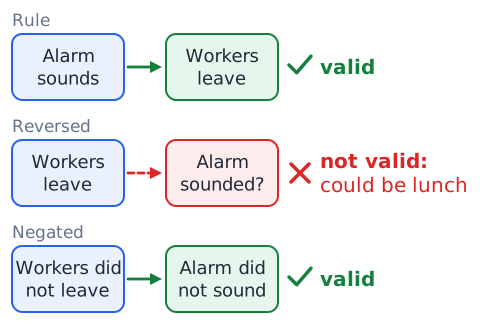
An "if A, then B" statement works in one direction. Rule: "If the alarm sounds, all workers leave the building." When the alarm sounds, you know workers leave. But if you see workers leaving, you cannot conclude the alarm sounded; they might be going to lunch. The only safe reversal uses negation: if the workers did not leave, the alarm did not sound, assuming the rule was followed.
Unless, only, and except narrow conclusions
Small words change how far a sentence reaches. "Only members may use the pool" means nonmembers may not; it does not mean every member uses it. "The gym is open daily except holidays" tells you it is closed on holidays. "The trip goes ahead unless it rains" means rain cancels it; without rain it proceeds. Read these words twice, because distractors often ignore them.
Quantifier ladder: one, some, many, most, all
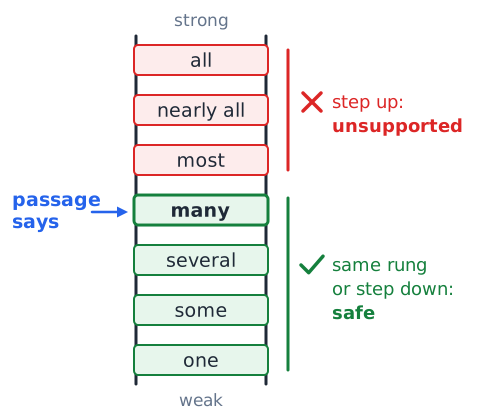
Quantity words form a ladder from weak to strong: one, some, several, many, most, nearly all, all. A correct inference stays on the passage's rung or steps down, never up.
If a passage says many volunteers returned the next year, "some volunteers returned" is safe. "Most volunteers returned" climbs a rung and is unsupported. "Every volunteer returned" jumps to the top. A similar ladder runs downward through few, hardly any, and none.
Possibility, ability, and requirement differ
Can, may, and must mean different things. "Recruits can request a later start date" describes an option, not a rule. "Recruits must bring photo ID" states a requirement. "The test may be rescheduled" names a possibility. An answer that turns "can" into "must," or "may" into "will," changes the meaning and should be eliminated.
Negative evidence and absence of mention
When a passage does not mention something, you usually cannot infer anything about it. If a recipe lists flour, eggs, and milk, you cannot conclude it contains no sugar; the list may be partial. Silence becomes evidence only when the passage claims to be complete, for example, "The only ingredients are flour, eggs, and milk."
Compare options without upgrading the evidence
When two answers look close, compare what each one needs. The better one requires no new facts. Passage: a clinic added weekend hours after many patients asked for them. "Patient requests influenced the change" uses only the passage. "The clinic wants to win patients from a rival" adds a competitor who never appears. Choose the answer that stays at the passage's level of evidence.
Contrast usually carries an implied reason
Words such as but, however, although, and yet signal that something turned out differently than expected, and the contrast often hints at a reason. "The trail is short, but most hikers need three hours to finish it" implies the trail is steep, rough, or slow going. The contrast does not tell you which, so the best inference is the general one: something other than distance slows hikers down.
Changes over time: establish a baseline
To infer a change, you need a starting point. "The shop now sells 40 sandwiches a day" says nothing about growth unless the passage also gives an earlier figure or uses words such as "increased" or "more than before." Without a baseline, avoid answers about improvement or decline. With one, compare only the times the passage actually names.
Follow the actor and action in multi-person passages
When a passage involves several people, track who did what. "Lee asked Dana to call the supplier after she finished the inventory." Who finishes the inventory? The sentence alone does not settle it: "she" could be Lee or Dana, so look to the surrounding sentences before deciding. Distractors often attach the right action to the wrong person, so link each verb to its subject before answering.
Distinguish observation, interpretation, recommendation
Passages mix three kinds of statements. An observation reports what was seen: "Water pooled near the north door." An interpretation explains it: "The gutter may be clogged." A recommendation urges action: "Maintenance should clear the gutter." Questions often ask which kind the writer offers, and an answer that treats a guess as an observation is wrong.
Author's attitude: implied versus exaggerated
Tone shows through word choice. A writer who calls a policy "a sensible first step that still leaves gaps" is mildly approving, with reservations. That is neither enthusiastic nor hostile. Match the strength of your attitude word to the strength of the language. Labels such as outraged, thrilled, or scornful need strong evidence; mild wording calls for mild labels such as cautious, concerned, or supportive.
The least-assumption rule in close choices
When two choices both seem supported, count the assumptions each needs. Passage: a warehouse switched to LED lighting, and its electric bill fell the next quarter. Choice one: the new lights may have helped lower the bill. Choice two: the lights saved enough money to hire more staff. The first needs no extra facts; the second assumes the size of the savings and a hiring plan. Pick the first.
Why a correct answer is not necessarily repeated
Correct inference answers rarely copy the passage. They state a consequence in fresh words. If a passage says "the bridge is closed to trucks over ten tons," a correct inference might be "some heavy vehicles must take another route." Do not reject an answer because its wording looks unfamiliar; check whether the passage supports its meaning.
When a direct paraphrase is a distracting answer
On an inference question, a choice that simply restates a sentence from the passage may be true and still be wrong, because it does not answer what was asked. If the question asks what the passage implies about the town's budget, a choice repeating "the town repaved Main Street" is accurate but says nothing about the budget. Match the answer to the question, not just to the text.
Detect the reverse-cause distractor
This distractor flips cause and effect. Passage: "Because the river flooded, the road was closed." Distractor: "Closing the road caused the flooding." Both events appear, so the choice feels familiar. Check the direction: which happened first, and which linking word, such as because or so, connects them?
Detect the all-or-nothing distractor
This distractor takes a partial claim and makes it total. "Several residents opposed the new parking rules" becomes "Residents rejected the rules" or "No one supported the rules." Watch for all, none, every, always, never, and only in the choices, and confirm that the passage uses the same extreme.
Detect the invented-numbers distractor
Some wrong answers add figures the passage never provides. If a report says sales "rose sharply," a choice claiming they "doubled" or "rose 50 percent" invents precision. Unless the number, or a way to calculate it, appears in the passage, eliminate any choice that supplies one.
Detect the invented-motive distractor
This distractor assigns a hidden reason to an action. If a passage says a coach moved practice to the morning, a choice claiming she wanted to avoid a certain player or impress parents invents a motive. Accept a motive only when the passage states it or clearly signals it.
Detect the outside-knowledge distractor
Some choices are true in the real world but are not supported by the passage. If a passage about a camping trip mentions that the group carried a first-aid kit, a choice saying such kits should include bandages may be sensible, yet the passage never said it. Answer from the text, even when you know more.
Detect answer choices that contradict a qualifier
Qualifiers such as usually, in some cases, at first, and for now limit a claim. If a passage says the new software "at first slowed the team down," a choice saying the software makes the team slower is wrong, because it drops "at first." Before choosing, find each qualifier and confirm the answer keeps it.
Two-sentence inference: combine linked facts
Some inferences require joining two sentences. "All forklift drivers must hold a current license." "Jordan drives a forklift on the night shift." Together they show Jordan is required to hold a current license. Neither sentence says that alone. Look for a general rule and a specific case that fits it.
Compare two credible alternatives
Sometimes two answers are both reasonable. Test each against every detail, not just one. Passage: attendance at a community class fell after its start time moved from 7 p.m. to 5 p.m. Explanation A: the earlier time conflicted with work hours. Explanation B: people lost interest in the topic. Only A connects to the detail the passage highlights, the time change.
Use the two-sentence proof test
To test an answer, try to justify it using no more than two sentences from the passage plus ordinary common sense. If you can, the answer is probably supported. If you need an outside fact, a hidden motive, or a number you made up, the answer is probably a distractor.
Eliminate certainty upgrades immediately
Strike any answer that makes the passage sound more certain than it is. Warning signs include changing "may" to "will," "suggests" to "proves," "some" to "all," or "often" to "always." These upgrades are common because they sound confident. A correct inference keeps the passage's level of confidence or lowers it.
Keep inference and supporting-detail skills distinct
Supporting-detail questions ask what the passage says; inference questions ask what follows from it. Using the wrong skill costs points. On a detail question, the answer should be findable almost word for word. On an inference question, a choice found word for word may miss the target, so ask whether it really answers the question.
Timed reading: evidence before speculation
Under time pressure, readers tend to fill gaps with their own ideas. Resist that. Read the question, find the line that matters, form a modest conclusion, then choose. If you are stuck, first eliminate choices with extreme words or outside facts; that is faster than debating which story sounds most interesting.
Computer-adaptive caution
On the computer-adaptive version of the ASVAB, questions appear one at a time. You cannot skip an item and come back to it, and you cannot change an answer after you move on. Read each passage and question fully before you confirm. Base your choice on the evidence rather than on a quick impression, because a hasty pick cannot be reviewed later.
Prove the distractors wrong by type
When you eliminate a choice, name its flaw: too certain, reversed cause, invented number, invented motive, outside knowledge, or ignored qualifier. Labeling the error makes elimination faster and more reliable. The choice left with no flaw to label is usually the correct one.
What to do when every answer feels possible
If every choice seems possible, rank them by how much each assumes. Return to the exact sentence the question targets. Remove any choice that needs a fact the passage lacks. Among the rest, choose the narrowest conclusion. Possible is not enough; the correct answer is the one the passage most directly supports.
Worked example 01 — Extra evening hours
Passage: "Starting this month, the Riverside branch library will stay open until 9 p.m. on weekdays instead of 6 p.m. Staff said the change followed a survey in which many working adults reported they could not visit before closing."
Question: Which conclusion is best supported? (A) The library will hire more staff. (B) Some working adults found the old hours inconvenient. (C) All patrons prefer evening visits. (D) Weekend hours will also be extended.
Step one: the question asks for an inference. Step two: the evidence is the survey of working adults who could not come before closing. Step three: test the choices. A adds hiring, which is never mentioned. C upgrades "many" to "all." D predicts a change the passage never discusses. B restates the survey finding modestly.
Answer: B.
Worked example 02 — Inspection before reopening
Passage: "The pool will reopen only after the county inspector approves the new filter system. The inspection is scheduled for Thursday."
Question: What can be inferred? (A) The pool will reopen Thursday. (B) If the inspector does not approve the filter, the pool will stay closed. (C) The old filter was dangerous. (D) The inspector will approve the system.
Reasoning: "only after" makes approval a requirement for reopening. A assumes both approval and a same-day reopening. C invents a reason for the new filter. D predicts the inspection result with no basis. B follows directly from "only after."
Answer: B.
Worked example 03 — Comparing two packaging methods
Passage: "A bakery tested two ways of shipping cookies. Boxes lined with paper arrived with about one cookie in ten broken. Boxes with molded trays arrived with almost none broken, though the trays cost more."
Question: Which statement is best supported? (A) The bakery will switch to trays. (B) Trays protected the cookies better in this test. (C) Paper liners are useless. (D) The trays are too expensive to justify.
Reasoning: the passage reports results, not a decision, so A predicts too much and D offers an opinion the passage never states. C exaggerates, since paper still protected most cookies. B matches the comparison and limits it to this test.
Answer: B.
Worked example 04 — Weather and attendance
Passage: "The outdoor concert series drew about 300 people on each of its first three Saturdays. On the fourth Saturday, heavy rain fell all afternoon, and about 80 people came."
Question: What is the most reasonable inference? (A) Rain kept every missing person at home. (B) The rain likely contributed to the lower turnout. (C) The fourth band was less popular. (D) Future concerts will draw fewer people.
Reasoning: the baseline is about 300, and the drop coincides with rain. B links them cautiously with "likely." A claims certainty about every person. C brings in a factor never mentioned. D predicts a trend from one event.
Answer: B.
Worked example 05 — Conditional equipment approval
Passage: "A ladder may be issued to a crew member only if it has a current inspection tag. Ladder 7's tag expired last week."
Question: What follows? (A) Ladder 7 cannot be issued until it gets a current tag. (B) Ladder 7 is broken. (C) Every tagged ladder will be issued. (D) Ladder 7 was used unsafely last week.
Reasoning: "only if" makes a current tag necessary. Ladder 7 lacks one, so it may not be issued now. B confuses an expired tag with damage. C reverses the condition; a tag is required but does not guarantee issue. D invents an event.
Answer: A.
Worked example 06 — A cautious conservation claim
Passage: "Since the town asked households to water lawns only in the early morning, summer water use has dropped by roughly a tenth. Officials say cooler-than-usual weather may also have played a part."
Question: Which conclusion fits best? (A) The watering rule alone cut use by a tenth. (B) The watering rule may have helped reduce water use. (C) Cool weather is the only reason use fell. (D) Residents ignored the rule.
Reasoning: officials name two possible factors, so A and C, which each claim a single cause, are unsupported. D conflicts with the drop. B keeps the caution.
Answer: B.
Worked example 07 — Missing report information
Passage: "The safety report lists three minor injuries at the plant in March: a cut finger, a sprained wrist, and a bruised knee."
Question: Which can be inferred? (A) There were no serious injuries in April. (B) At least three injuries occurred at the plant in March. (C) The plant is safer than last year. (D) Workers wore gloves in March.
Reasoning: the report covers only March and only the injuries it lists. A, C, and D each need information the passage does not give. B stays with what the list shows.
Answer: B.
Worked example 08 — A public-space comparison
Passage: "Two city parks are about the same size. Oak Park has lighted paths and benches near its playground; Elm Park has neither. A city count found that evening visits to Oak Park were about twice those to Elm Park."
Question: Which statement is best supported? (A) Lighting is the reason Oak Park gets more evening visits. (B) Oak Park's features may help explain its higher evening use. (C) Elm Park is unsafe. (D) Adding lights to Elm Park will double its visits.
Reasoning: the passage pairs a difference in features with a difference in use but never tests the cause. A claims proof. C assumes danger. D predicts an exact result. B notes a possible link without overstating it.
Answer: B.
Worked example 09 — A constrained purchase decision
Passage: "The repair shop needs a new air compressor. The owner set a limit of 900 dollars and requires a tank of at least 20 gallons. Model X costs 850 dollars with a 15-gallon tank. Model Y costs 880 dollars with a 20-gallon tank. Model Z costs 1,050 dollars with a 30-gallon tank."
Question: Which model meets both requirements?
Reasoning: apply the price rule first. X and Y are under 900 dollars; Z is over. Then apply the tank rule. X's 15 gallons is too small, while Y's 20 gallons meets "at least 20." Only Y passes both tests.
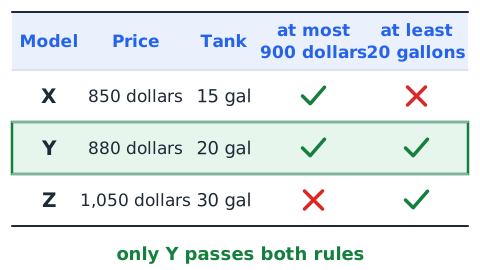
Notice the limit of the inference: the passage does not say the owner will buy Y, only that Y is the one model fitting the stated rules. A choice saying "the owner prefers the cheapest model" adds a preference never mentioned.
Answer: Model Y.
Worked example 10 — Storage-space forecasting
Passage: "The supply room holds 120 boxes. It currently holds 90. Each week about 10 new boxes arrive, and none are removed."
Question: If the pattern continues, about when will the room be full?
Reasoning: space left is 120 minus 90, or 30 boxes. At about 10 boxes per week, 30 divided by 10 gives 3 weeks. Prediction: in roughly three weeks.
Limits matter. The words "about" and "if the pattern continues" mean a delayed shipment or a cleanout would change the result. A choice saying the room "will be full in two weeks" miscalculates, and one saying "the company must build a new storeroom" goes beyond the passage.
Answer: in about three weeks, if nothing changes.
Trap: too certain
The mistake: choosing an answer that says must, proves, or always when the passage supports only likely or may. It is wrong because the passage leaves room for other outcomes. The fix: compare the confidence words in the choice with those in the passage, and pick the choice that matches them or is weaker.
Trap: emotionally appealing but unsupported
The mistake: picking the answer that sounds kind, fair, or inspiring, such as "the volunteers were heroes," when the passage only reports what they did. The fix: ignore how pleasant an answer sounds and ask which line of the text supports it. If no line does, cross it out.
Trap: shared topic, wrong conclusion
The mistake: choosing an option because it shares the passage's subject, such as fuel costs, without checking its claim. A choice can mention fuel and still say something the passage never supports. The fix: read past the topic words to the actual claim, then test that claim against the evidence.
Trap: a reason invented after the fact
The mistake: explaining an outcome with a cause you supplied because it seems logical. If a team lost, it is tempting to say the players were tired. The fix: accept a cause only if the passage states it or gives evidence pointing to it; otherwise treat the cause as unknown.
Trap: confusing absence with contradiction
The mistake: treating an unmentioned idea as false. If a passage praises a car's fuel economy and says nothing about safety, it does not show the car is unsafe. The fix: label such choices "not addressed." A choice is contradicted only when the passage states something that cannot be true alongside it.
Guided exercise: direct, inferred, or unknown
Passage: "Kim set two alarms and laid out her uniform the night before her first day at the new job." Decide whether each statement is direct, inferred, or unknown.
Kim laid out her uniform. Answer: direct; the sentence says so.
Kim wanted to be on time. Answer: inferred; two alarms and early preparation point to it.
Kim's new job is at a hospital. Answer: unknown; nothing mentions the workplace.
Guided exercise: choose the narrower conclusion
For each passage, pick the narrower supported conclusion.
Prompt one: "Several drivers reported that the new route saved them time." Option A: the route saves time for everyone. Option B: some drivers found the route faster. Answer: B, because "several" does not reach "everyone."
Prompt two: "The cafe ran out of soup by noon on both test days." Option A: soup sold out early on those days. Option B: soup is the cafe's best seller. Answer: A.
Guided exercise: conditional chain
Rules: If the generator fails, the backup lights turn on. If the backup lights turn on, the guard calls maintenance.
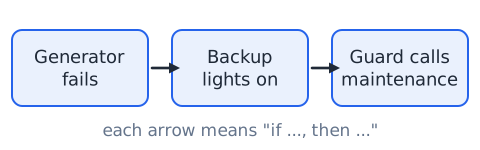
Prompt one: The generator failed. What follows? Answer: the backup lights came on, and the guard called maintenance.
Prompt two: The guard called maintenance. Did the generator fail? Answer: not necessarily; the call may have another cause.
Prompt three: The guard did not call maintenance. Answer: the backup lights did not come on, so the generator did not fail.
One-minute inference checklist
Before choosing, check each point. What does the question ask for, a stated fact or an inference? Which line is the evidence? Does the answer keep every qualifier? Does it stay on the same level of certainty and quantity? Does it avoid invented numbers, motives, causes, and outside facts? If it passes every check, select it.
End-of-lesson mastery standard
You have mastered this lesson when you can point to the evidence behind any inference, explain the bridge in one sentence, and reject choices that overstate certainty, reverse cause and effect, ignore qualifiers, or rely on outside knowledge. Aim to explain why each wrong answer fails, not just to recognize the right one.
 English ▾