 ASVAB Camp
Learning outcomes and exam focus
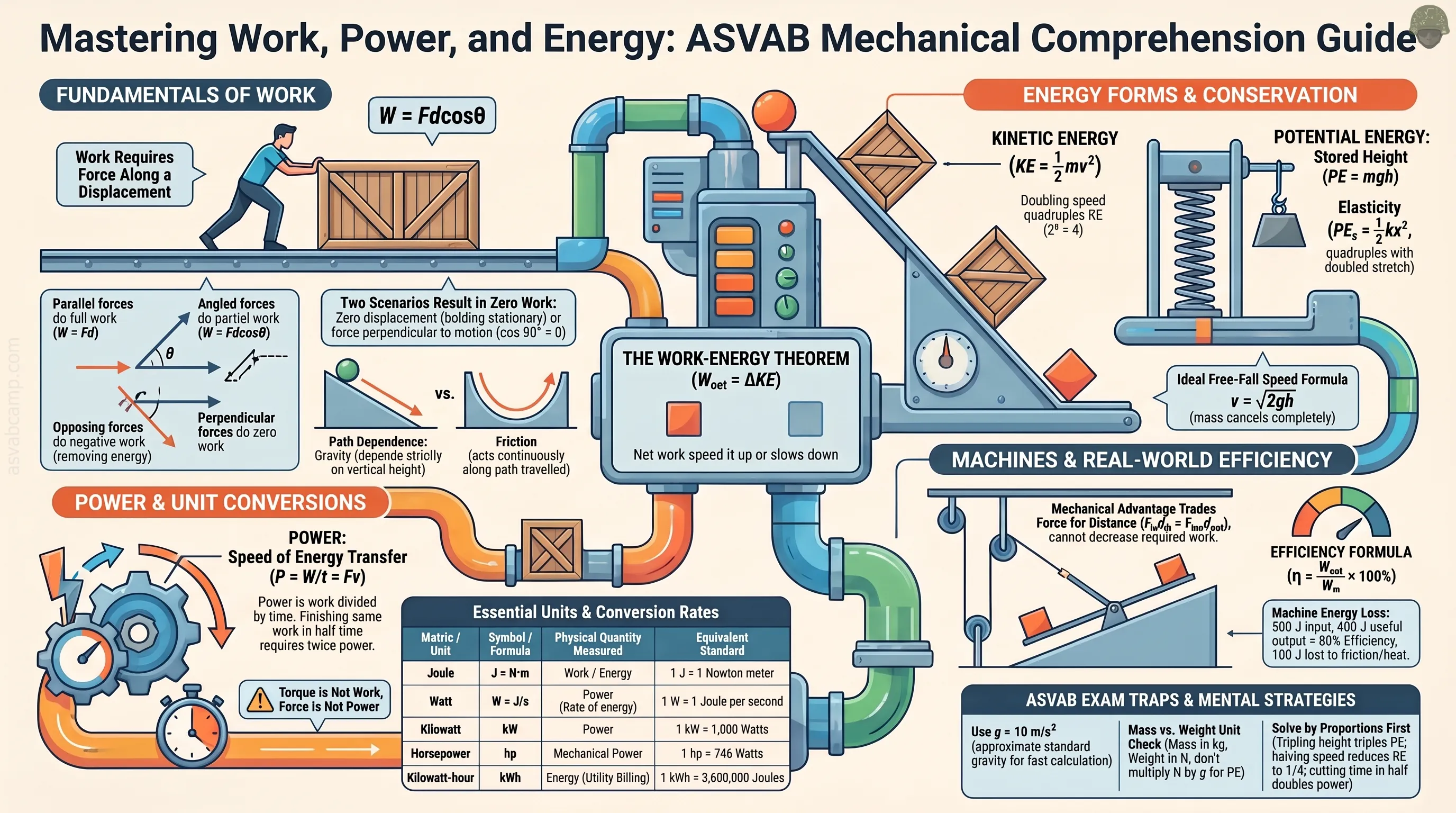
This lesson covers how forces transfer energy. You will calculate work from force and displacement, including forces at an angle and forces that oppose motion, and add individual works to get net work. You will compute kinetic, gravitational, and spring energy.
You will also find power, convert among watts, kilowatts, horsepower, and kilowatt-hours, and judge machine efficiency. Problems follow ASVAB style, with g taken as 10 m/s² unless stated otherwise.
Work is an energy transfer
In physics, work is done when a force moves an object through a displacement. Work measures how much energy that force transfers into or out of the object. For a constant force pointing along the motion,
where F is the force in newtons and d is the displacement in meters. Effort alone is not work: holding a heavy bag still is tiring, yet it transfers no energy to the bag.
SI units for work
Work and energy share one SI unit, the joule (J). One joule is the work done by a one-newton force acting through one meter:
Lifting an apple weighing about 1 N up by 1 m takes about 1 J.
Larger amounts use kilojoules (1 kJ = 1,000 J). Do not confuse the joule with the watt, which is a joule per second, or with the newton, which measures force.
Parallel-force calculation
When the force and the displacement point the same way, just multiply them. A shopper pushes a cart with a steady 25 N forward while it rolls 12 m forward:
The answer is in joules, not newtons or watts, and it is the work done by that one push only.
Force at an angle
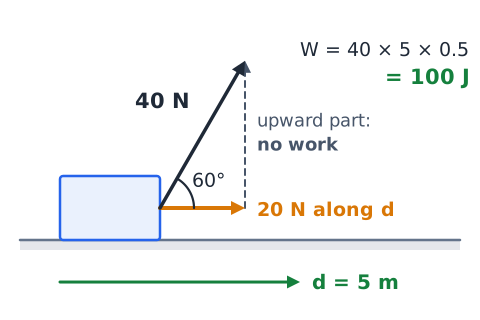
If a force is angled to the motion, only its component along the displacement does work:
Here is the angle between the force and the displacement. Useful values: cos 0° = 1, cos 60° = 0.5, cos 90° = 0. A 40 N pull held 60 degrees above a level path over 5 m does
Positive work
Work is positive when the force has a component in the same direction as the motion. Positive work adds energy to the object.
A tow truck pulling a car forward, a person lifting a box upward, and gravity pulling a falling stone downward all do positive work. In each case the force helps the motion along, and unless other forces interfere, the object speeds up or gains stored energy.
Negative work
When a force points against the motion, its work is negative: it removes energy from the object. With the force directly opposite the motion,
Example: kinetic friction of 15 N acts on a box sliding 6 m. Its work is
Air drag on a falling leaf and gravity on a ball thrown upward also do negative work.
Zero work with no displacement
If the object does not move, d = 0, so the work is zero however large the force is:
A lifter holding a 200 N barbell overhead for a minute does no work on it, even though the muscles tire. The body burns chemical energy internally to keep the muscles tense, but none of that energy is transferred to the barbell.
Zero work at right angles
A force perpendicular to the motion does no work, because
A server carrying a tray across a level room pushes up on it while it moves sideways, so that upward force does zero work on the tray.
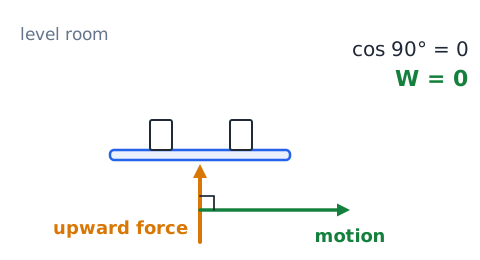
The same is true of the floor's normal force on a cart rolling across it, and of the string tension on a ball whirled in a horizontal circle at steady speed.
Work depends on displacement, not a route description
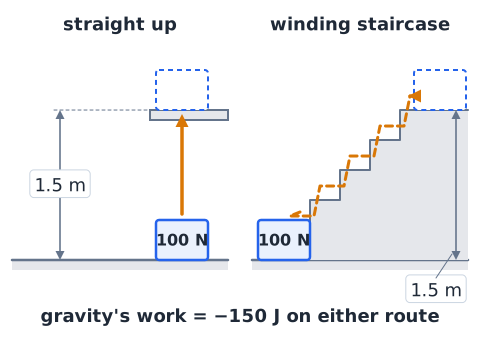
For gravity, work depends only on the vertical displacement. Raising a 100 N box onto a 1.5 m shelf means gravity does J of work on it, whether you lift it straight up or carry it along a winding staircase.
Friction is different. It acts along the actual path at every step, so a longer route means more energy lost to friction. Read whether a question involves gravity alone or a path-dependent force such as friction.
Net work versus work by one force
Several forces can act on one object at once, and each does its own work. The net work is the sum of all of them, signs included:
If a winch does +500 J on a sled and snow friction does −320 J, the net work is +180 J. Net work, not the work of any single force, decides the change in speed.
Worked example with opposing friction
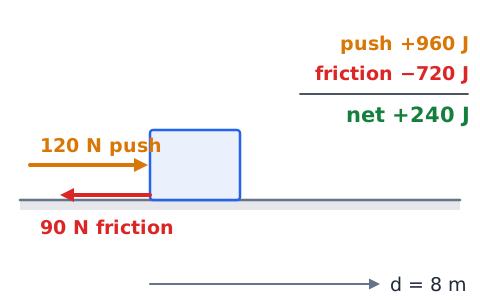
A worker pushes a crate 8 m across a floor with a 120 N horizontal force while friction resists with 90 N.
Push:
Friction:
The crate's kinetic energy rises by 240 J.
Reading a force-distance graph
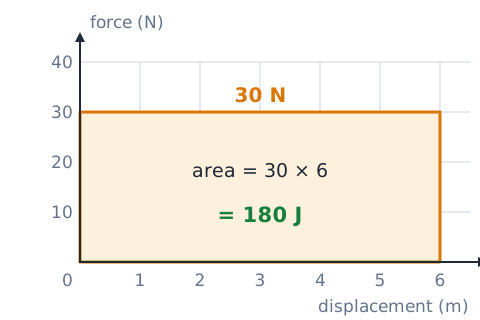
On a graph of force (vertical axis) against displacement (horizontal axis), the work done equals the area between the line and the horizontal axis. For a constant force the shape is a rectangle, so the work is height times width.
A flat line at 30 N stretching from 0 to 6 m encloses 180 J. If part of the line falls below the axis, that part counts as negative work. Read the axis units before computing the area.
Variable force on a triangular graph
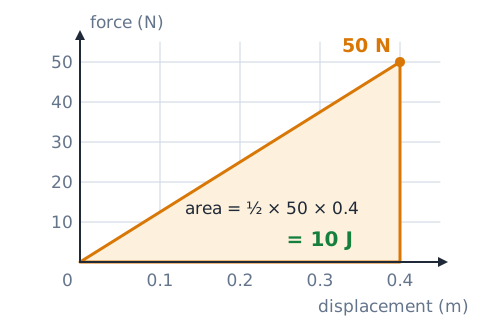
When force rises steadily from zero, the graph is a triangle and the work is half of base times height:
Stretching a spring until its pull reaches 50 N over 0.4 m takes
Using the full 50 N for the whole distance would double the answer by mistake.
Energy measures capacity for physical change
Energy is the ability to make something happen physically: to move an object, raise it, heat it, or bend it. It appears as motion (kinetic energy), as stored position or shape (potential energy), as heat, as chemical energy in fuel, and as electrical energy.
Work is the way mechanical energy passes from one object to another. Energy is never created or destroyed; it only changes form or moves between objects, and the joule measures it in every form.
Kinetic energy definition
A moving object carries kinetic energy:
Here m is mass in kilograms and v is speed in meters per second, giving joules. Kinetic energy is never negative and does not depend on direction. Because speed is squared, it climbs quickly: a fast object carries far more energy than a slow one of the same mass.
Worked example with kinetic energy
Problem: a 1,200 kg car travels at 15 m/s. How much kinetic energy does it have?
That is 135 kJ. Square the speed first, then multiply.
Why doubling speed is not doubling energy
Since kinetic energy depends on , multiplying the speed by a factor k multiplies the energy by . Doubling the speed gives four times the energy, and tripling it gives nine times.
A bicycle at 10 m/s carries four times the kinetic energy it had at 5 m/s. This is why stopping distance grows so sharply with speed: the brakes must remove four times as much energy.
Work-energy theorem
The work-energy theorem links forces to changes in speed: the net work on an object equals the change in its kinetic energy.
Positive net work speeds the object up, negative net work slows it down, and zero net work leaves its speed unchanged, even if individual forces are doing work.
Worked example from rest
Problem: a 50 kg go-kart starts from rest and receives 1,600 J of net work. What is its final speed?
Starting from rest, all the net work becomes kinetic energy:
So
Braking by negative work
Brakes stop a vehicle by doing negative work, turning kinetic energy into heat. The stopping force times the stopping distance equals the kinetic energy removed:
A 150 kg motorbike at 12 m/s carries
Brakes supplying 2,700 N stop it in
Gravitational potential energy
Lifting an object stores energy in its position, called gravitational potential energy:
Here m is mass in kilograms, g is about 9.8 m/s² (10 on most tests), and h is the height in meters above a chosen reference level. The product mg is simply the weight, so PE is also weight times height. Raising a 300 N sack 2 m stores 600 J.
Worked lift with specified gravity
Problem: a 12 kg tool bag is hoisted 3.5 m onto a scaffold. Use
With g = 10 the answer would be 420 J. Use the g value the problem specifies.
Mass and weight distinction
Energy problems sometimes give mass in kilograms and sometimes weight in newtons. Mass is the amount of matter; weight is the gravitational force on it. A 20 kg crate weighs about 200 N with g = 10.
If a problem gives the weight directly, do not multiply by g again: lifting a 200 N crate 3 m takes 600 J, not 6,000 J. Look at the unit to know which one you have.
Elevator work and net work
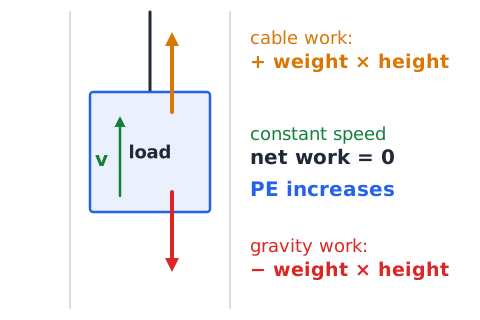
An elevator raising a load at constant speed shows the difference between one force's work and net work. The cable does positive work equal to the load's weight times the height. Gravity does an equal amount of negative work.
The net work is zero, so the speed does not change, yet the load gains potential energy. The cable's work went into stored height energy rather than into motion.
Mechanical energy forms
Mechanical energy is the total of kinetic and potential energy:
Potential energy can be gravitational (height) or elastic (a stretched or compressed spring). A swinging pendulum, a roller coaster, and a bouncing trampoline all trade energy back and forth among these forms. Heat, sound, and chemical energy are not counted as mechanical energy.
Conservation of ideal mechanical energy
If only gravity and ideal springs do work, with no friction or drag, mechanical energy stays constant:
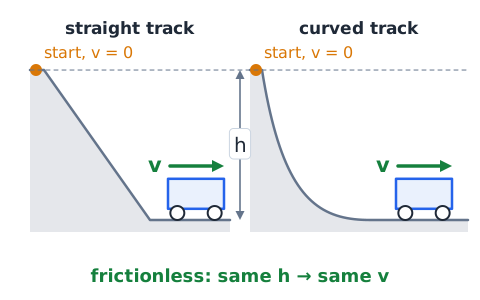
Whatever potential energy an object loses, it gains as kinetic energy, and the reverse. A frictionless coaster car dropping through a given height reaches the same speed whatever the shape of the track.
Ideal falling object calculation
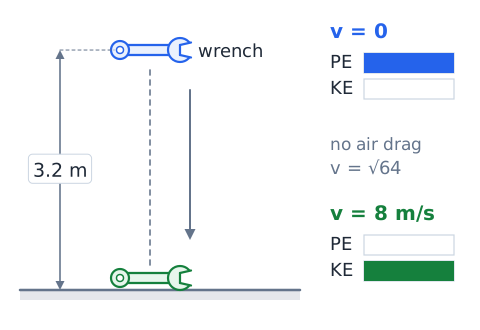
For an object dropped from rest with no air resistance, setting
gives
Mass cancels. A wrench falling 3.2 m with g = 10 lands at
as would a feather in a vacuum.
Choosing an energy reference height
Potential energy depends on where you set h = 0, so its value alone is somewhat arbitrary. A 2 kg book on a 1 m desk has 20 J of potential energy measured from the floor, but none measured from the desktop.
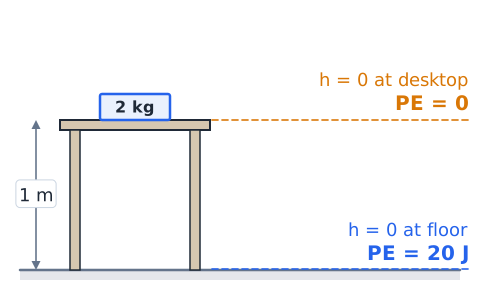
What matters physically is the change in potential energy between two positions, and that change comes out the same for any reference. Choosing the lowest point in the problem as zero avoids negative numbers.
Spring force and compression
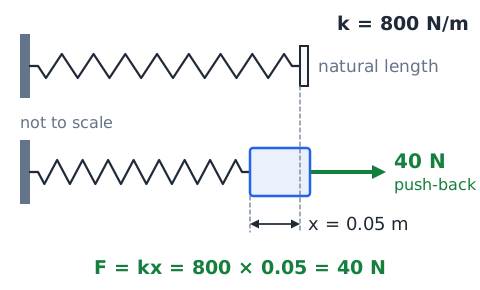
An ideal spring pushes or pulls back with a force proportional to how far it is stretched or compressed from its natural length (Hooke's law):
Here k is the spring constant in N/m, a measure of stiffness, and x is the stretch or compression in meters. A spring with k = 800 N/m compressed 0.05 m pushes back with 40 N.
Elastic potential energy in a spring
The work done to compress or stretch a spring is stored as elastic potential energy:
The one-half comes from the triangle under the force-distance graph. A spring with k = 500 N/m stretched 0.3 m stores
Doubling the stretch quadruples the stored energy.
Energy transformations in an ideal spring
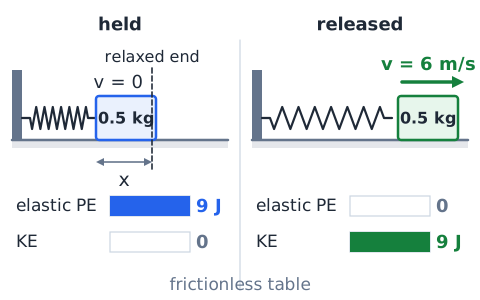
Picture a block on a frictionless table, held against a compressed spring. While it is held, all the energy is elastic. On release, the spring pushes the block, turning into .
A 0.5 kg block launched by a spring storing 9 J leaves with
so
Nonconservative forces and friction losses
Friction, air drag, and similar forces are called nonconservative because the energy they remove does not come back as mechanical energy. They convert it into heat, sound, and wear.
A sled sliding down a real hill reaches the bottom more slowly than the ideal formula predicts, and the missing energy shows up as slightly warmer snow and runners. In these problems, start with the mechanical energy, subtract the energy lost to friction, and what remains is the final mechanical energy.
Work and energy through an ideal ramp
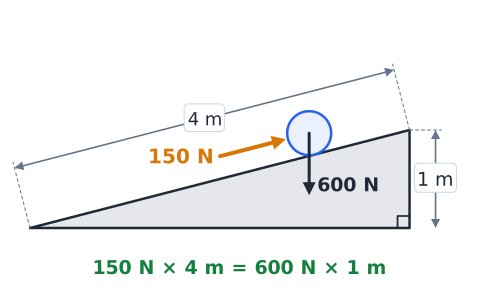
Pushing a load up a frictionless ramp gives it the same potential energy as lifting it straight up to the same height. The ramp lets you use a smaller force over a longer distance: force times ramp length equals weight times height.
Raising a 600 N barrel 1 m along a 4 m ramp takes only 150 N, but you push four times as far. A ramp twice as long to the same height needs half the force.
Mechanical advantage does not create energy
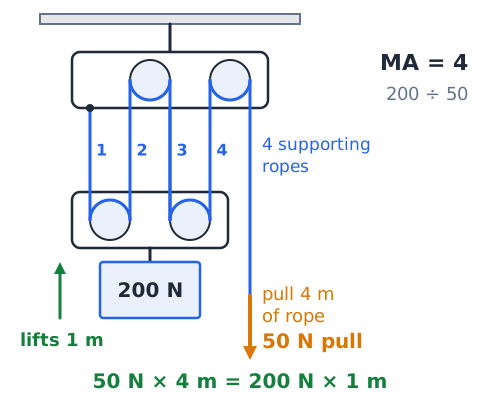
Mechanical advantage is output force divided by input force:
A lever or pulley lets a small force move a heavy load, but never with less work. In an ideal machine,
A pulley system with MA of 4 lets 50 N lift 200 N, but you pull 4 m of rope for each 1 m of lift.
Input versus useful output work
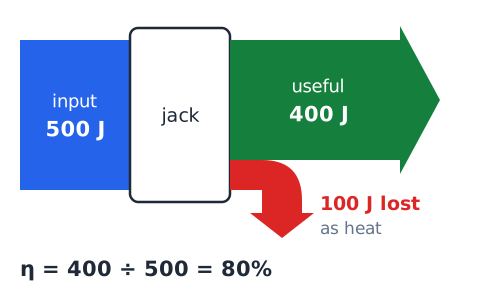
Every machine involves two kinds of work: the input work you put in and the useful output work it delivers to the load. In a real machine some input always goes into friction, heat, and noise, so the output is less than the input.
A car jack might take 500 J of cranking to deliver 400 J of lifting. The 100 J difference is not destroyed; it warms the jack's moving parts and threads.
Efficiency definition
Efficiency is the fraction of input work that becomes useful output:
Efficiency (eta) has no units, and real machines always fall below 100%. The car jack above:
To find the input from a known output and efficiency, divide: input equals output divided by the efficiency as a decimal.
Worked machine-efficiency example
A chain hoist lifts a 900 N engine 1.2 m. To do this, the mechanic pulls 18 m of chain with a 75 N force. What is the efficiency?
Useful output:
Input:
Efficiency:
or 80%. The other 270 J went into friction in the gears and chain.
Efficiency from force and displacement
Efficiency can be worked out directly from forces and distances. Output work is load force times load distance; input work is effort force times effort distance.
A worker pushes a 450 N cart up a ramp with a 100 N force along 5 m of ramp, raising the cart 0.8 m. Output:
Input:
Efficiency:
Power measures speed of energy transfer
Power tells how fast work is done or energy is transferred:
W is work in joules, t is time in seconds, and P comes out in watts. Two people can do identical work, but the one who finishes sooner has more power. Moving 900 J worth of boxes in 30 s is 30 W; doing it in 10 s is 90 W.
Watt and kilowatt conversions
One watt equals one joule per second:
Larger powers use kilowatts (1 kW = 1,000 W) and megawatts (1 MW = 1,000,000 W).
A 1.5 kW space heater converts 1,500 J every second. To go from watts to kilowatts, divide by 1,000; a 750 W drill is 0.75 kW.
Worked example: average power
Problem: a 70 kg climber ascends a 15 m rock wall in 60 s. Using g = 10, what average power does the climb require?
Time from power and work
Rearranging the power equation gives the time needed:
A 400 W pump must deliver 24,000 J to raise water into a tank. It needs
A pump with twice the power would finish in half the time, 30 s.
Power at steady speed
When a force keeps an object moving at constant speed, power equals force times speed:
F is the force in newtons along the motion and v is the speed in m/s. This follows from P = Fd/t, because d/t is the speed. A conveyor belt pulling with 500 N at 0.6 m/s delivers 300 W. More speed at the same force means more power.
Worked pushing-power example
Problem: a worker pushes a loaded wheelbarrow with a steady 90 N horizontal force across a 30 m yard at constant speed, taking 20 s. What power does the push deliver?
Work:
Power:
Check with the speed method: speed =
so
Both methods agree.
Horsepower as a power unit
Engines and motors in the United States are often rated in horsepower. The mechanical horsepower used for such ratings is about 746 watts:
A 5 hp lawn mower engine delivers about
roughly 3.7 kW. To go from watts to horsepower, divide by 746: a 150 kW car engine is about 201 hp.
Rotating shaft power
For a turning shaft, power equals torque times angular speed:
Here (tau) is the torque in newton-meters and (omega) is the angular speed in radians per second. A shaft delivering 50 N·m at 40 rad/s carries 2,000 W. More torque at the same speed, or more speed at the same torque, means more power.
Rotational speed units
Shaft speeds are usually given in revolutions per minute (rpm), but
needs radians per second. One revolution is radians and one minute is 60 s, so
For 300 rpm,
rad/s. A handy shortcut: divide rpm by about 9.55 to get rad/s.
Torque versus work
Torque and work both come out in newton-meters, but they are different quantities. Torque is a twisting effect, force times lever arm, written N·m. Work is energy, and its N·m is called a joule.
Torque can exist with no motion, as with a wrench straining on a stuck bolt. Work requires rotation: turning through an angle in radians against torque gives
Energy, power and time on a rating plate
A motor's nameplate lists power, which is a rate, not an amount of energy. The energy used depends on how long it runs:
A 1.2 kW pump running for 5 minutes (300 s) uses
Running twice as long, it uses twice the energy at the same power. Do not answer an energy question in watts.
Kilowatt-hours measure energy
Utilities bill energy in kilowatt-hours. One kilowatt-hour is the energy used by 1 kW running for one hour:
A 500 W freezer running for 6 hours uses
kWh. Despite the word watt in its name, the kilowatt-hour is an energy unit, not a power unit.
Worked input-output motor power
Problem: an electric winch draws 1,500 W of input power and is 70% efficient. How much useful power does it deliver, and how high can it lift a 3,000 N load in 20 s?
In 20 s it delivers
enough to raise the load
The other 450 W becomes heat.
Energy conservation versus useful efficiency
Energy conservation and efficiency do not conflict. Conservation says the total energy going in equals the total energy coming out, when everything is counted. Efficiency asks how much of that output is useful.
A motor with 85% efficiency still conserves energy; the other 15% leaves as heat and sound. No machine can exceed 100% efficiency, so any answer above 100% signals an error in the setup or the arithmetic.
Ramps, pulley systems and time
Simple machines trade force for distance, but they do not change the useful work, and they change power only if the time changes. Using a long ramp instead of lifting straight up lowers the force needed, but at the same walking pace it takes longer, so the power needed drops.
If two methods raise the same load to the same height in the same time, they need the same useful power. Friction in a real ramp or pulley adds input work and lowers the efficiency.
Comparing power of two workers
Suppose two stockers each lift forty 100 N boxes onto a 1.5 m shelf. Each does
J of useful work.
One finishes in 2 minutes and the other in 3 minutes. Their average powers are
W and 6,000 ÷ 180 ≈ 33 W. The faster worker delivers 1.5 times the power even though the work is identical: equal work in less time means more power.
Force-distance-energy consistency check
Before picking an answer, check that its units fit. Force times distance must give joules; joules divided by seconds give watts; watts times seconds give joules again. If a problem asks for work from a force and a distance and a choice is labeled in watts, that choice is wrong.
Also check the scale. Pushing a cart a few meters with tens of newtons gives hundreds of joules, not millions.
Balanced numerical rounding
Test problems use friendly numbers, but some steps still produce decimals, such as converting rpm to rad/s or using cos 37° ≈ 0.8. Keep full precision through the middle steps and round only at the end, to match the precision of the answer choices.
Swapping g = 10 for a stated g = 9.8 shifts an answer about two percent, which can land on a distractor when choices are close. When choices are far apart, a quick estimate is enough.
Unpowered object moving steadily
A puck gliding at constant velocity on frictionless ice needs no force to keep moving, so no work is done on it and its kinetic energy stays the same.
On a real floor, a sled moving at steady speed must be pulled with a force equal to the friction. The pull does positive work, friction does an equal amount of negative work, and the net work is zero, which matches the unchanged speed.
Work of gravity on descent
When an object moves downward, gravity acts along the motion and does positive work equal to weight times vertical drop. A 50 N bucket lowered 6 m at constant speed has +300 J of work done on it by gravity.
The rope holding it back does −300 J, so the net work is zero and the speed stays steady. The bucket loses 300 J of potential energy, which passes to whatever is lowering it instead of turning into motion.
Worked example with a resisting ramp
Problem: a 40 kg crate is pushed 5 m up a ramp, rising 2 m, at steady speed against 60 N of friction. Using g = 10, what push force is needed?
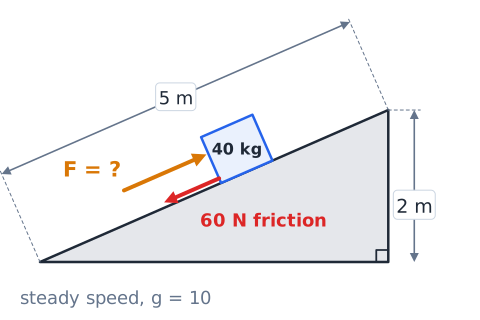
Potential energy gained:
Energy lost to friction:
Push force:
Worked example: mixed kinetic and potential gain
Problem: a 6 kg package starts at rest, is lifted 1.5 m, and ends up moving at 3 m/s. With g = 10 and no losses, how much energy must be supplied?
Total: 117 J.
Worked example: slowing uphill
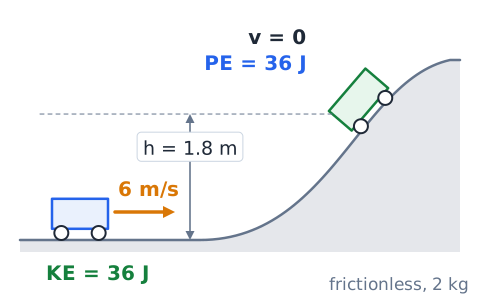
Problem: a 2 kg cart rolls at 6 m/s toward a frictionless hill. How high up the hill does it get before stopping? Use g = 10.
Its kinetic energy is
All of it becomes potential energy at the top:
So h = 1.8 m. The mass actually cancels:
Worked example: brake force from energy
Problem: a 900 kg car moving at 20 m/s brakes to a stop over 40 m on level road. What average braking force acts?
The brakes must do −180,000 J of work over 40 m:
Worked example: efficiency from watt ratings
Problem: a pump motor draws 1,250 W of electrical input, and the water it lifts gains energy at 900 W. What is the efficiency?
The remaining 350 W becomes heat in the motor windings, bearings, and water turbulence.
Common trap: force is not power
A large force does not by itself mean large power. Power depends on how fast the force moves its point of application.
A tugboat straining with 50,000 N against a ship tied firmly to a dock delivers no power to the ship, because the ship does not move. A small motor pushing gently but quickly can deliver more. Newtons measure force and watts measure power, and answer choices often mix them on purpose.
Common trap: energy is not automatically kinetic
Work done on an object does not always become speed. Work by a lifting cable at steady speed becomes potential energy. Work against friction becomes heat. Work compressing a spring becomes elastic energy. Only the net work changes kinetic energy.
When a question asks how fast, use net work and kinetic energy. When it asks how much energy was stored, or how high something rises, track potential energy instead.
Common trap: ideal systems and real losses
Problems described as ideal, frictionless, or without losses let you set input work equal to output work, and mechanical energy at the start equal to that at the finish. Real machines always lose some energy.
If a question states an efficiency or a friction force, include that loss: the input must be larger than the useful output. Answer choices often include the ideal value as a distractor in a problem with losses, so read the wording carefully.
Common trap: a longer path for gravity
Taking a longer path to the same height does not change gravity's work, which depends only on vertical change: weight times height.
A 700 N hiker who climbs 300 m gains
J of potential energy, whether on a long switchback trail or a short, steep one. The long trail only lowers the effort per step and spreads the work over more time.
Common trap: time and speed ratios
Watch how time and speed affect power. For the same work, power is inversely proportional to time: half the time means twice the power. For the same force, power is proportional to speed: twice the speed means twice the power.
Kinetic energy, however, goes with the square of speed. Mixing up these patterns is a common source of wrong answers, so name the relationship before computing.
ASVAB strategy: identify the target system
Before calculating, decide which object you are analyzing and which forces act on it. Work done by the motor is not the same as net work on the load, and energy stored in a spring is not the same as the block's kinetic energy.
Make a quick sketch, list the forces, and note which ones act along the motion. Once the target is clear, the question usually points to a single formula.
ASVAB strategy: use proportion before arithmetic
Many items can be answered by scaling. If the height triples, potential energy triples. If speed is halved, kinetic energy drops to one fourth. If power doubles, the time for the same job is cut in half. If efficiency falls from 80% to 40%, the input needed for the same output doubles.
Spotting these ratios saves time and guards against arithmetic slips. Confirm with numbers only when two choices are close.
Final review and mastery check
Key relationships: work is
in joules. Kinetic energy is , gravitational potential energy is mgh, and spring energy is . Power is
in watts. Efficiency is useful output over input.
Net work equals the change in kinetic energy. Perpendicular forces and stationary objects get zero work. One horsepower is about 746 W, and one kWh is 3.6 million joules. Check units before choosing.
 English ▾