 ASVAB Camp
Lesson objective and exam scope
After this lesson you should be able to describe where an object is relative to a chosen origin, tell distance from displacement and speed from velocity, and work with constant acceleration using signed values. You will read position, velocity and acceleration graphs, handle free fall and upward throws, and chain two-stage trips. Expect short ASVAB-style calculations where units and signs matter.
Position needs a reference point
A position only means something once you say where it is measured from. That starting mark is the origin. Saying a forklift is "15 m" tells you nothing until you add "15 m east of the loading dock door." Pick the origin once, then measure every later position from that same point so your numbers stay comparable.
Choosing the positive direction
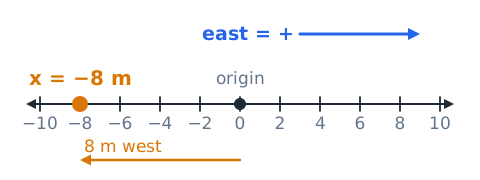
On a straight line you also choose which way counts as positive. If east is positive, a point 8 m west of the origin sits at negative 8 m. The choice is arbitrary, but it must stay fixed for the whole problem. A minus sign on position, velocity or acceleration then simply means "pointing the negative way," not "less than nothing."
Distance versus displacement
Distance is the total length of path covered, so it is never negative and it keeps growing as long as you move. Displacement is the straight-line change in position, final minus initial, and it carries a sign or direction.
Walk to a mailbox and back and your distance is the whole route, but your displacement is zero.
Worked example: a return trip
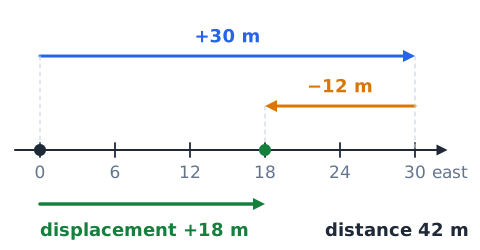
A pallet jack is pushed 30 m east along an aisle, then pulled 12 m back west. Take east as positive.
Distance adds the path lengths: 30 m plus 12 m gives 42 m.
Displacement adds signed moves:
The jack ends 18 m east of where it started after covering 42 m of floor.
Speed as a rate of distance
Average speed tells how fast path length is covered on average. Divide the total distance by the total elapsed time.
A drone that flies a 600 m route in 120 s has an average speed of 5 m/s. Speed has no direction and is never negative.
Average velocity uses displacement
Average velocity divides displacement, not distance, by elapsed time, so it keeps a sign.
Because displacement can be smaller than distance, average velocity can be much smaller than average speed. Any trip that ends where it began has zero average velocity no matter how far or fast the object went.
Worked example: average speed and velocity
A runner goes 300 m east in 60 s, then 100 m west in 40 s. East is positive.
Total distance is 400 m in 100 s, so average speed is 4 m/s.
Displacement is
so average velocity is
which means 2 m/s east.
Instantaneous speed and velocity
Instantaneous values describe one moment rather than a whole trip. A car speedometer shows instantaneous speed: how fast you are going right now. Instantaneous velocity is that same size plus a direction, such as 20 m/s north. Over a very short time interval, the average velocity becomes the instantaneous velocity, which is why the two often agree for steady motion.
Units for speed
Any length unit divided by any time unit is a valid speed unit: m/s, km/h, ft/s and mi/h all work. The science standard is meters per second. Two handy conversions are
and 1 mi/h is about 0.447 m/s. Divide km/h by 3.6 to get m/s; multiply m/s by 3.6 to go back.
Worked conversion: road speed
Convert 72 km/h to meters per second.
Change kilometers to meters and hours to seconds in one line:
That gives
The shortcut gives the same answer: 72 divided by 3.6 is 20 m/s.
Time and distance at constant speed
When speed does not change, distance grows in direct proportion to time.
Rearrange as needed:
Keep units matched. If speed is in m/s, time must be in seconds and distance comes out in meters.
Worked example: travel time
A delivery truck holds a steady 60 km/h on a 150 km highway route. How long does the trip take?
Solve
for time:
That is 2 hours 30 minutes. Notice the kilometers cancel, leaving hours.
Average acceleration defined
Acceleration is the rate at which velocity changes. Average acceleration divides the change in velocity by the time the change took.
Units are meters per second per second, written m/s². A cart that gains 6 m/s in 2 s accelerates at 3 m/s².
Acceleration versus speed
Speed says how fast you are going; acceleration says how fast that velocity is changing. They are independent. A jet cruising at 250 m/s in a straight line has zero acceleration. A sprinter leaving the blocks has a low speed but a large acceleration. A large speed does not imply a large acceleration, and a small speed does not imply a small one.
Positive and negative acceleration
The sign of acceleration tells which way the velocity change points along your chosen axis. With right as positive, a positive acceleration means velocity is becoming more rightward; a negative one means it is becoming more leftward. The sign alone does not say whether the object speeds up or slows down. You must compare it with the sign of the velocity.
When an object slows down
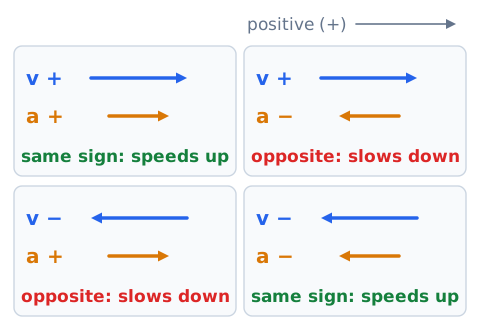
An object slows down when its acceleration points opposite its velocity. A car moving in the positive direction with negative acceleration slows. A car moving in the negative direction with positive acceleration also slows. When velocity and acceleration share a sign, the object speeds up. "Deceleration" is just everyday language for this opposite-sign case.
Worked example: signed acceleration
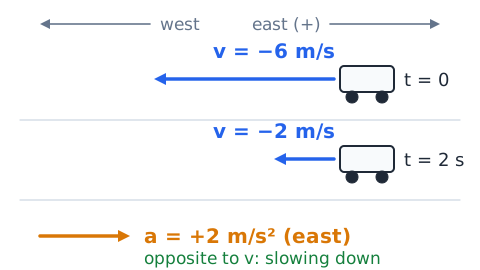
Take east as positive. A cart rolls west at 6 m/s and, 2 s later, is rolling west at 2 m/s. Find its acceleration.
The acceleration is positive (east) while the cart moves west, so the cart is slowing down.
Constant acceleration as a model
Many test problems assume acceleration stays constant: a car pulling away steadily, a brake applied with even pressure, or an object falling with air resistance ignored. Real motion is rarely perfectly uniform, but this model is simple and close enough for short intervals. The kinematic equations in this lesson are only valid when acceleration is constant.
Velocity after a known time
With constant acceleration, velocity changes by the same amount each second. Start with the initial velocity and add the acceleration times the elapsed time.
Here is the starting velocity in m/s, is acceleration in m/s², and is time in s. Signs must follow your chosen positive direction.
Worked example: start from rest
A forklift starts from rest and accelerates evenly at 2.5 m/s² for 8 s. What is its speed at the end?
From rest means
Each second adds 2.5 m/s, and eight seconds of that adds 20 m/s.
Displacement during constant acceleration
When velocity changes steadily, displacement depends on both the starting velocity and the extra distance gained from acceleration.
The first term is how far you would go with no acceleration. The second term grows with the square of time, so doubling the time quadruples that part.
Worked example: acceleration from rest
A go-kart leaves the line from rest at 2 m/s² for 5 s. How far does it travel?
With
only the second term remains.
As a check, its final speed is 10 m/s, its average speed is 5 m/s, and 5 m/s times 5 s is 25 m.
Average velocity for constant acceleration
Under constant acceleration velocity changes in a straight line with time, so the average velocity is exactly halfway between the start and end values.
Multiply that average by the time to get displacement. This shortcut fails if acceleration is not constant.
Worked example: changing velocity evenly
A tram speeds up evenly from 4 m/s to 16 m/s over 6 s without reversing. Find its displacement.
Average velocity is
You did not need the acceleration (2 m/s²) at all; the endpoints and the time were enough.
Distance without elapsed time
Sometimes a problem gives speeds and acceleration but no time. Use the relation that skips time entirely.
For a stop, set
and use a negative when the motion is positive. Solving gives the braking distance
Units: (m/s)² divided by m/s² leaves meters.
Worked example: required stopping distance
A van moving at 25 m/s brakes steadily at 5 m/s² until it stops. How much road does braking need?
So the braking distance is 62.5 m. Ignoring reaction time, the van needs 62.5 m of clear road ahead.
Braking distance versus stopping distance
Braking distance is only the part covered after the brakes take hold. Stopping distance is the total: reaction distance plus braking distance. During the reaction time the driver has not yet pressed the pedal, so the vehicle keeps its full speed. Questions that say "total stopping distance" want both parts added together.
Reaction distance example
During reaction time the vehicle has no braking, so it moves at constant speed and
applies.
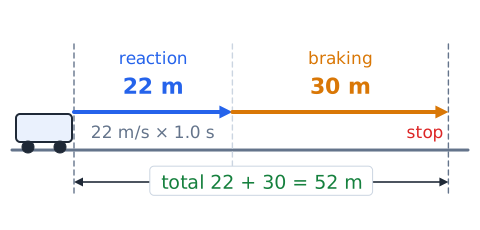
A driver going 22 m/s takes 1.0 s to react before braking. The reaction distance is
If the braking distance on that road is 30 m, the total stopping distance is
Effect of speed on braking distance
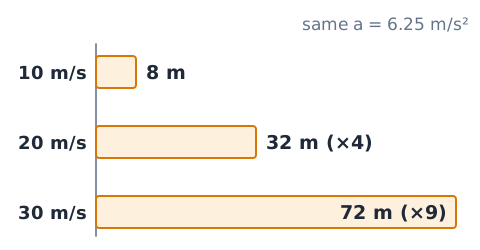
Because braking distance equals , it grows with the square of speed. With the same deceleration of 6.25 m/s²:
and 30 m/s needs 72 m. Doubling speed makes braking distance four times longer; tripling it makes it nine times longer. Reaction distance, by contrast, only doubles.
Motion graphs: position versus time
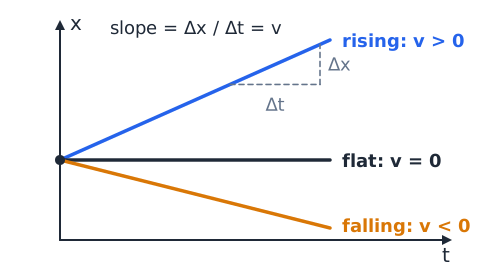
On a position-time graph, the slope equals velocity.
A rising straight line means constant positive velocity, a falling line means constant negative velocity, and a horizontal line means the object is not moving. A curved line means the velocity is changing.
Worked example: position graph slope
A position-time line starts at 10 m at t = 0 and falls in a straight line to 2 m at t = 4 s. Find the velocity.
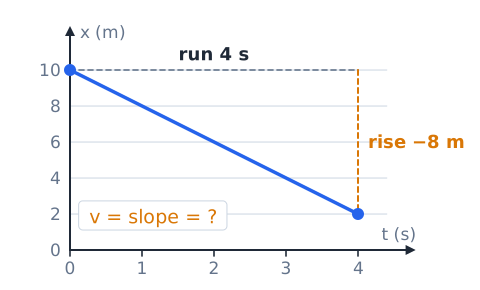
The object moves toward the negative direction at a steady 2 m/s.
Motion graphs: velocity versus time
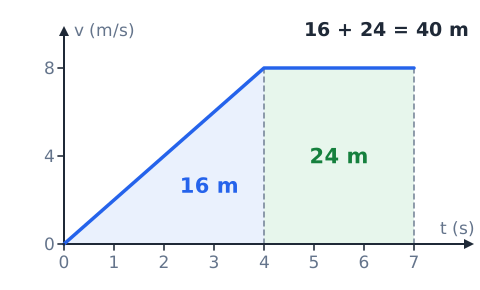
On a velocity-time graph, two features carry meaning. The slope is acceleration: steep means rapid change, flat means constant velocity. The area between the line and the time axis is displacement. A line above the axis means motion in the positive direction; below the axis means motion in the negative direction.
Worked example: area under velocity graph
A scooter's velocity rises in a straight line from 0 to 8 m/s over 4 s, then holds at 8 m/s for 3 s. Find the displacement.
The triangle gives
The rectangle gives
Total displacement is
Signed area and reversing direction
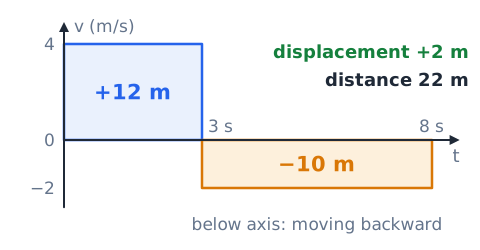
Area above the time axis counts as positive displacement; area below counts as negative. If a velocity line crosses the axis, the object turned around at that instant. To get displacement, add the signed areas. To get total distance, add the sizes of the areas and ignore the signs.
Worked graph: forward then backward
A cart's velocity graph shows +4 m/s for 3 s, then −2 m/s for 5 s.
First area:
Second area:
Displacement is
Distance is
The cart ends just 2 m ahead of its start after traveling 22 m.
Acceleration-time graph interpretation
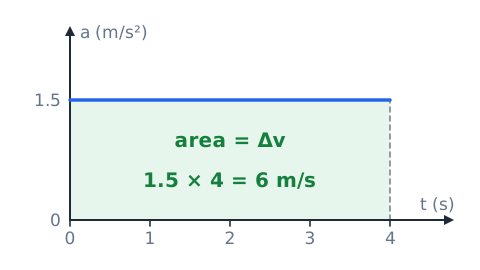
On an acceleration-time graph, the area under the line equals the change in velocity.
A horizontal line at 1.5 m/s² lasting 4 s means velocity rises by 6 m/s. The graph tells you the change only; you still need the starting velocity to know the actual velocity.
Uniform acceleration and graph shape
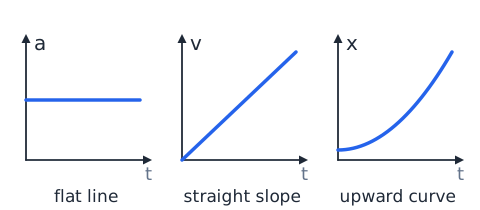
For constant, nonzero acceleration, the three graphs have signature shapes. The acceleration-time graph is a flat horizontal line. The velocity-time graph is a straight sloped line. The position-time graph is a curve (a parabola) that bends upward for positive acceleration and downward for negative. Recognizing these shapes answers many graph questions quickly.
Free fall as accelerated motion
An object in free fall moves under gravity alone, with air resistance ignored. Near Earth its acceleration is about 9.8 m/s² straight down; tests often round to 10 m/s². Dropped from rest, its speed and drop distance after time t are
Each second adds about 9.8 m/s of downward speed.
Worked example: dropped object
A bolt slips from a scaffold and falls freely for 2.0 s. Use
and ignore air resistance.
Speed after 2.0 s:
Drop distance:
With g rounded to 10 m/s², both answers become 20.
Upward throw under gravity
A ball tossed straight up slows by about 9.8 m/s each second while rising, stops for an instant at the top, then speeds up on the way down. Throughout the flight, including at the top, the acceleration is g pointing downward. Only the velocity is zero at the peak. With no air drag, the trip up takes the same time as the trip down.
Worked upward throw
A ball leaves a hand straight upward at 15 m/s. Use
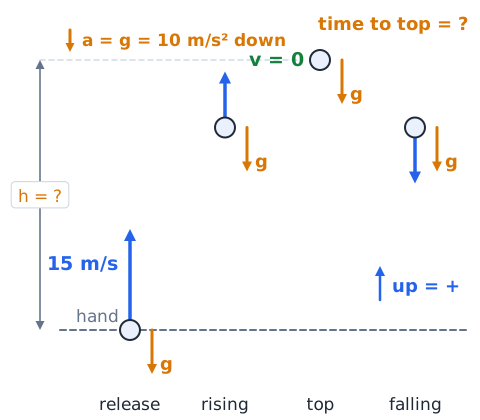
Time to the top, where velocity is zero:
It returns to the hand 3.0 s after release, moving at 15 m/s downward.
Mass independence in ideal free fall
When air resistance is negligible, every object falls with the same acceleration regardless of its mass. A heavier hammer feels a bigger gravitational pull, but it also has more mass to accelerate, and the two effects cancel. Dropped together in a vacuum, a hammer and a feather land at the same time. In air, light or spread-out objects fall slower because of drag.
Circular motion and direction change
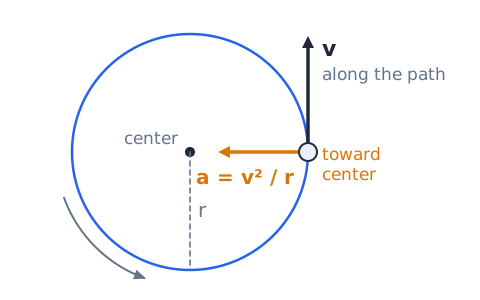
Velocity includes direction, so an object moving in a circle at constant speed is still accelerating. That acceleration points toward the center of the circle and is called centripetal acceleration.
Here v is speed in m/s and r is the radius in m, giving m/s².
Worked turn-radius comparison
A cart takes a curve at 10 m/s. Compare a 50 m radius with a 25 m radius.
Halving the radius doubles the acceleration. Doubling the speed on the same curve would quadruple it, because speed is squared.
Relative motion in one dimension
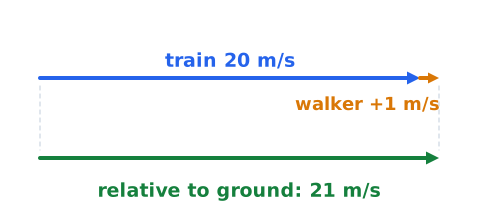
Velocity always depends on who is watching. The velocity of A as seen by B is A's velocity minus B's velocity, both measured from the ground.
A passenger walking forward at 1 m/s on a train moving at 20 m/s moves at 21 m/s relative to the ground.
Head-on closing speed
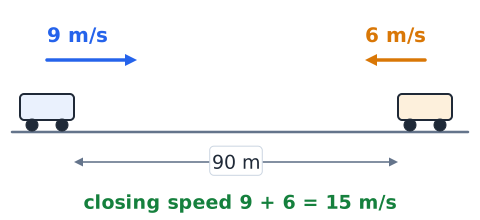
When two objects move toward each other, the gap shrinks at the sum of their speeds.
Two carts 90 m apart roll toward each other at 9 m/s and 6 m/s. They close at 15 m/s and meet after
Same-direction closing speed
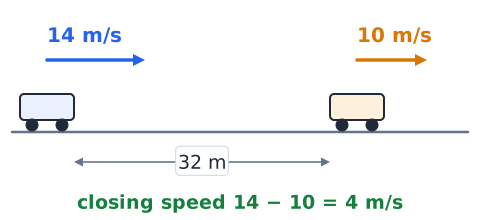
When a faster object chases a slower one in the same direction, the gap shrinks at the difference of their speeds.
A rover at 14 m/s trails a rover at 10 m/s by 32 m. The gap shrinks by 4 m each second, so it catches up after
Two-stage journeys
Many problems split motion into stages, such as speeding up and then cruising. Treat each stage as its own problem. The final velocity of stage one becomes the initial velocity of stage two. Find the displacement of each stage with the formula that fits it, then add them. Never apply one formula across a boundary where the acceleration changes.
Worked example: acceleration then cruise
A shuttle cart starts from rest, accelerates at 2 m/s² for 6 s, then cruises for 10 s.
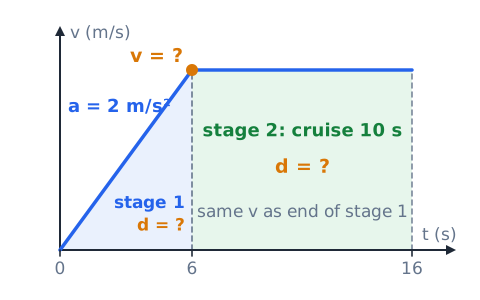
Stage one:
Stage two:
Total distance is
Average speed over unequal periods
Average speed is total distance over total time, not the average of the speeds.
A bike rides 3 m/s for 10 s (30 m) and 9 m/s for 5 s (45 m). Average speed is
not 6 m/s, because more time was spent going slowly.
When average acceleration is zero
Average acceleration is zero whenever the final velocity equals the initial velocity, even if the object sped up and slowed down in between. A bus that leaves a stop, travels, and halts at the next stop has zero average acceleration for that whole leg. A belt moving at one steady velocity also has zero acceleration at every moment.
Rounding and significant units
Keep full precision during a calculation and round only at the end, or small errors can grow. Match the precision of the given data: if values have two significant figures, report about two. Always attach units, because a number like 20 could mean m, m/s or m/s². On multiple-choice items, an answer with the wrong unit is wrong.
Dimensional analysis of motion formulas
Checking units catches many errors. Each term in a valid equation must have the same unit. In the displacement formula,
and also gives meters. If an expression you build gives m/s when you need meters, a time factor is missing.
Choosing the right equation
List the known quantities and the unknown, then pick the equation that contains exactly those. No distance asked: use
No final velocity given: use
No time given: use
No acceleration given: use average velocity times time.
Exam trap: zero speed at one instant
An object can have zero velocity for an instant while still accelerating. At the top of a toss, or when a cart reverses, velocity passes through zero, but gravity or the pushing force is still changing it. Zero velocity does not mean zero acceleration, and zero acceleration does not require zero velocity.
Exam trap: negative means braking
A negative acceleration does not automatically mean an object is slowing down. It only means the acceleration points in the negative direction. If the object is already moving in the negative direction, a negative acceleration speeds it up. Check whether velocity and acceleration have the same sign (speeding up) or opposite signs (slowing down).
Exam trap: mixing distance and graph area
The signed area under a velocity-time graph gives displacement, not distance. If part of the graph lies below the time axis, signed areas cancel and the net result can be small or even zero. When a question asks for total distance traveled, add the area sizes without signs. Read the question carefully to see which one is wanted.
Exam trap: doubling acceleration or speed
Scaling effects are not all linear. For a fixed time, doubling acceleration doubles the distance gained from rest. For a fixed acceleration, doubling time quadruples that distance. For braking with fixed deceleration, doubling initial speed quadruples braking distance but only doubles the stopping time. Know which quantity is squared.
Guided drill: three quick decisions
Is a car circling a track at a constant 15 m/s accelerating? Answer: yes, because its direction keeps changing.
A cart moves at −3 m/s with +1 m/s² acceleration. Speeding up or slowing down? Answer: slowing, because the signs differ.
A v-t graph line is flat at 7 m/s. What is the acceleration? Answer: zero.
Worked example: speed is not velocity
A runner completes one 400 m lap of a track in 80 s and finishes at the starting line.
Because she ends where she began, her displacement is zero, so her average velocity is 0 m/s. Same trip, same time, but the two averages differ because one uses path length and the other uses net change in position.
Reading a motion table
Tables of data can reveal acceleration without a graph. A test cart's velocity is recorded each second: 2, 5, 8 and 11 m/s at t = 0, 1, 2 and 3 s.
The velocity rises by 3 m/s every second, so acceleration is a constant 3 m/s².
Equal gains in equal times signal constant acceleration.
Instantaneous acceleration from a curve
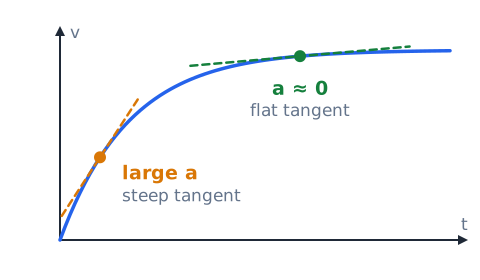
If a velocity-time graph is curved, acceleration changes from moment to moment. To find it at one instant, imagine a straight line that just touches the curve at that point, the tangent line. Its slope is the instantaneous acceleration. Where the curve is steep, acceleration is large; where it flattens out, acceleration approaches zero.
Reverse direction under constant acceleration
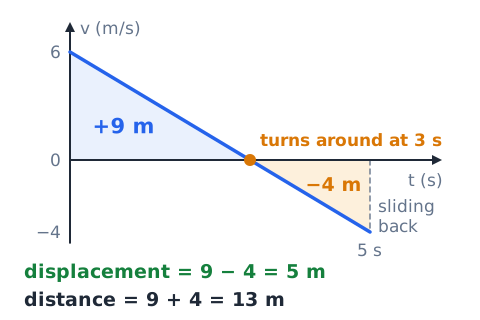
A puck moves at +6 m/s up a ramp and has a constant acceleration of −2 m/s². It stops after
having moved 9 m. It then slides back. At t = 5 s:
Distance covered is 9 m up plus 4 m back, or 13 m.
Displacement is not always distance
Displacement is a straight-line arrow, while distance follows the actual path. A surveyor walks 30 m east, then 40 m north. Distance is 70 m. Displacement is the diagonal from start to finish:
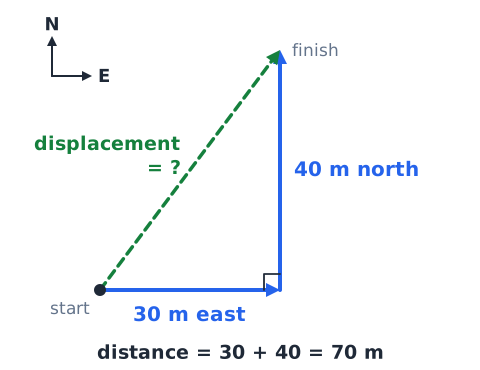
Displacement equals distance only for straight motion in one direction without reversing. Any turn or backtrack makes distance larger.
Deriving the stopping-time relation
Start from
At a stop the final velocity is zero, and the acceleration has size opposing the motion, so
A train at 30 m/s braking at 6 m/s² stops in
Deriving distance using average speed
During a steady stop, speed falls evenly from to zero, so the average speed is . Multiply by the stopping time:
Example: a train moving at m/s brakes at m/s² and stops in s, so
The time-free formula agrees:
Two routes, one answer.
Why curved-path acceleration matters
Turning requires a force toward the center of the curve. For a car, that inward push comes from friction between tires and road. Since the needed acceleration is , a faster turn or a tighter curve demands much more grip. On ice or loose gravel the available friction may be too small, and the vehicle slides outward along a straighter path. That is why curves carry lower posted speeds.
Acceleration and mechanical causes
Acceleration does not happen on its own; a net force causes it. Newton's second law links the two:
A 1200 kg car with 3000 N of net forward force accelerates at
The same force on a heavier vehicle produces less acceleration.
Ideal assumptions and real workshop machines
Textbook kinematics assumes point-like objects, constant acceleration, no air drag, and instant changes between stages. Real machines differ: motors ramp up gradually, belts stretch, brakes fade as they heat, and air resistance grows with speed. Ideal answers are best treated as estimates. When safety depends on a stopping or clearance distance, engineers add margin beyond the ideal figure.
Graph intersection and pursuit
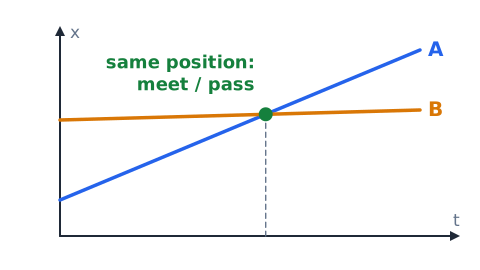
When two objects are plotted on the same position-time graph, the point where their lines cross is the moment they are at the same place, so it marks a meeting or a pass. On a velocity-time graph, a crossing means only that they share the same velocity at that instant, not that they are side by side. Check which graph you are reading before you answer a pursuit question.
Acceleration on different coordinate axes
You may choose any axis direction, as long as signs follow it. For vertical motion with up positive, gravity is
with down positive it is +9.8 m/s². For a cart on a ramp, pick an axis along the slope, so motion and acceleration lie on one line. The physics does not change; only the signs on the numbers change.
Speed after distance with no stopwatch
If you know the acceleration and the distance but not the time, use the time-free relation to find speed.
A cart starts from rest and accelerates at 3 m/s² over 24 m. Then
No time measurement was needed.
Final integrated self-check
A cart at 6 m/s brakes at 2 m/s². How long to stop? Answer: 3 s.
How far does it go while stopping? Answer:
A ball is tossed up at 20 m/s with
What is its acceleration at the top? Answer: 10 m/s² downward.
Convert 36 km/h to m/s. Answer: 10 m/s.
A runner laps a track and ends at the start. Average velocity? Answer: zero.
Review checklist and next connection
Before moving on, confirm you can: set an origin and a positive direction; separate distance from displacement and speed from velocity; apply the constant-acceleration equations with signs; read slope and area on motion graphs; solve free-fall, braking and two-stage problems; and check units. The next lessons connect these motion ideas to forces, friction and Newton's laws.
 English ▾