 ASVAB Camp
Learning goals and examination boundaries
By the end of this lesson you should be able to compute density from mass and volume, find pressure as a perpendicular force spread over an area, and predict how pressure grows with depth in a still liquid. You will also apply Archimedes' principle to find buoyant force, apparent weight on a scale, and the fraction of a floating object that sits below the surface, and you will tell gauge pressure apart from absolute pressure.
The lesson stays at the level of the ASVAB Mechanical Comprehension test: fluids at rest, friendly numbers, and g usually rounded to 10 m/s².
Fluids and static equilibrium
A fluid is any substance that flows and takes the shape of its container. Liquids and gases both qualify. A liquid keeps a nearly fixed volume, while a gas spreads out to fill whatever space it is given.
In this lesson the fluid is at rest, a condition called static equilibrium. Every small parcel of still fluid has balanced forces on it: the push from the surrounding fluid exactly cancels the parcel's own weight. Think of a glass of water on a table. Nothing swirls, so each layer must be holding up the layers above it, and that support is what we measure as pressure.
Mass versus weight
Mass is the amount of matter in an object, measured in kilograms. It does not change if you carry the object to the Moon or lower it into a lake. Weight is the gravitational force on that mass, measured in newtons:
Here m is mass in kilograms and g is gravitational acceleration, about 9.8 m/s² near Earth and often rounded to 10 on tests. A 50 kg sandbag weighs about
Buoyancy compares forces, so convert mass to weight before comparing.
Density as mass per volume
Density describes how tightly matter is packed. It is the mass of a sample divided by the volume the sample fills:
The Greek letter rho stands for density, m is mass in kilograms, and V is volume in cubic meters, so the SI unit is kg/m³. A clay brick of 4.5 kg that fills 0.0025 m³ has density
/m³. Density belongs to the material, not to the size of the sample.
Rearranging the density equation
The density equation can be solved for either of the other two quantities. To find mass, multiply:
To find volume, divide:
Example: a tank holds 0.25 m³ of diesel fuel with density 850 kg/m³. Its mass is
Going the other way, 17 kg of the same fuel fills
Check the units each time: kilograms divided by kg/m³ leaves cubic meters.
Unit conversions for volume
Volumes appear in liters, cubic centimeters, and cubic meters, and mixing them is the fastest way to wreck a density problem. The key links are 1 L = 1,000 cm³ and 1 m³ = 1,000 L, so 1 L = 0.001 m³.
Water's density of 1,000 kg/m³ is the same as 1 kg per liter or 1 g/cm³. A 25 L fuel can therefore holds 0.025 m³. Remember that every side of a cube counts: a box 0.5 m on each edge has volume
not 1.5 m³.
Typical reference densities
A few benchmark values make it easy to sanity-check answers. Fresh water is about 1,000 kg/m³ and seawater about 1,025 kg/m³. Ice is near 917 kg/m³, which is why it floats with most of its bulk hidden. Many woods fall between roughly 400 and 800 kg/m³.
Aluminum is about 2,700 kg/m³, steel about 7,850, and lead about 11,300. Gasoline is roughly 700 to 750 kg/m³, so it floats on water. Air at sea level is only about 1.2 kg/m³. If a calculation says a rock is less dense than air, recheck the units.
Relative density and specific gravity
Specific gravity, also called relative density, compares a material's density with that of water:
Because the two densities share units, specific gravity has no units. A motor oil with density 880 kg/m³ has SG =
A solid with SG below 1 floats in fresh water, and one above 1 sinks. For a floating solid, its SG also equals the fraction of its volume that rides underwater in fresh water.
Average density of composite objects
Many real objects combine materials or enclose air. What decides floating is the average density: total mass divided by total outside volume, including any sealed air space.
Example: a sealed, empty steel drum has mass 20 kg and an outside volume of 0.2 m³. Its average density is
/m³, even though steel itself is near 7,850. That drum floats high. Load 150 kg of sand inside and the average becomes
/m³. It still floats, but much deeper.
Pressure defined as normal force per area
Pressure is the perpendicular, or normal, force on a surface divided by the area of that surface:
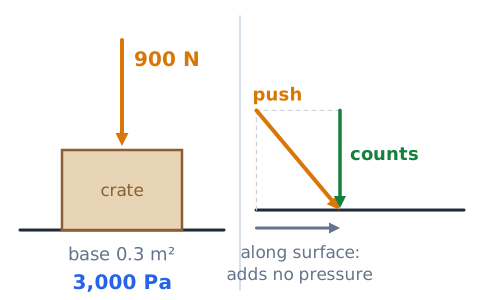
F is the force in newtons measured at right angles to the surface, and A is the area in square meters. A crate weighing 900 N resting on a 0.3 m² base presses on the floor with
Only the part of a force that is perpendicular to the surface counts; a push sliding along the surface does not add to the pressure.
The pascal and unit checking
The SI unit of pressure is the pascal:
One pascal is tiny, roughly the pressure of a sheet of paper lying flat, so practical values are usually given in kilopascals (1 kPa = 1,000 Pa).
Unit check: 6,000 N spread over 2 m² gives 3,000 Pa, or 3 kPa. If an area is given in square centimeters, convert it first, because 1 m² = 10,000 cm².
Pressure from unequal contact areas
The same weight can produce very different pressures. A 600 N hiker standing in boots with a total sole area of 0.06 m² presses on snow with
Strap on snowshoes covering 0.3 m² and the pressure drops to 2,000 Pa, one fifth as much, so the hiker sinks far less.
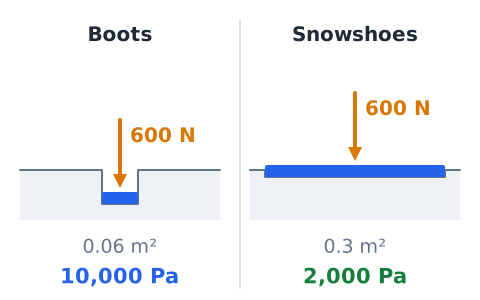
The force has not changed; only the area has. The same reasoning explains why heavy machines ride on wide tracks and why a brick laid flat sinks less into mud than one stood on end.
Gauge pressure versus absolute pressure
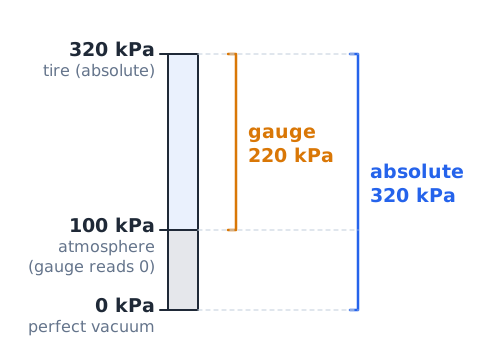
Most pressure gauges, such as a tire gauge, read zero when open to the air. They show gauge pressure, which is how far the pressure is above the surrounding atmosphere. Absolute pressure is measured from a perfect vacuum, so it includes the atmosphere:
Sea-level atmospheric pressure is about 101 kPa, often rounded to 100 kPa. A tire reading 220 kPa on its gauge holds about 320 kPa absolute. A gauge reading of zero does not mean a vacuum; it means the pressure equals the atmosphere's.
Fluid pressure acts in all directions
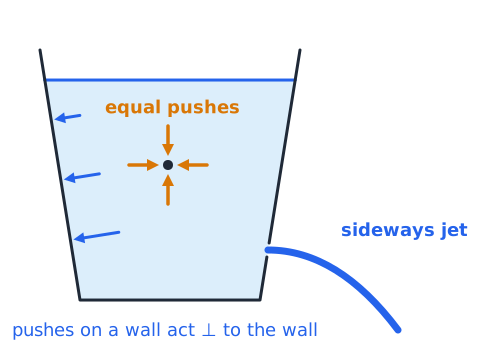
In a still fluid, pressure at a given point pushes equally in every direction: down, up, and sideways. That is why water spurts sideways from a hole in the wall of a bucket, and why a swimmer's ears feel the same squeeze at a given depth whether the head faces up or down.
The force that fluid pressure exerts on any surface always acts perpendicular to that surface. A small pressure sensor held at one depth gives the same reading no matter which way it faces.
Gravity and depth create pressure
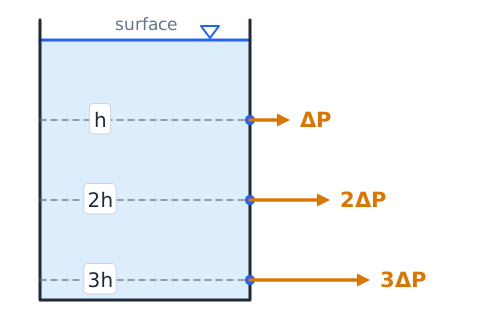
Pressure in a liquid grows with depth because each layer must hold up the weight of all the liquid above it. For a liquid of density rho, the extra pressure at depth h below the surface is
with rho in kg/m³, g in m/s², and h in meters, giving pascals. This term is the gauge pressure due to the liquid. It grows in direct proportion to depth: twice as deep means twice the liquid pressure, and three times as deep means three times.
Depth rather than container shape
Picture a tall, thin pipe and a wide swimming pool, both filled with fresh water to a depth of 3 m. The pool holds vastly more water, yet the pressure at the bottom is the same in both.
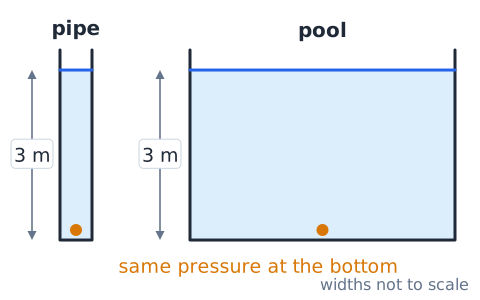
The expression contains no width and no total volume. The extra water in the pool is spread over a much larger floor, so each square meter still supports a 3 m column. Only the liquid's density, gravity, the vertical depth, and the pressure at the surface matter. Slanted or flared walls do not change this.
Comparing depths and fluids
Because liquid pressure is proportional to both density and depth, comparisons can be made with simple ratios. A point 6 m deep has twice the liquid pressure of a point 3 m deep in the same liquid. At equal depths, a liquid 1.5 times as dense produces 1.5 times the pressure.
Mercury is about 13.6 times as dense as water, so 10 cm of mercury gives about the same pressure as 1.36 m of water. Ask first: did the depth change, the liquid change, or both?
Numerical hydrostatic example
Find the gauge pressure at the bottom of an open oil tank 2.5 m deep, holding oil of density 900 kg/m³, with
With the top open to a 100 kPa atmosphere, the absolute pressure at the bottom is
Water pressure and dam walls
Dams are built much thicker at the base than at the top for a good reason. Water pressure increases steadily with depth, so the lowest part of the wall takes the hardest push. At 40 m down, fresh water adds about
roughly four times atmospheric pressure, while near the surface the added pressure is small.
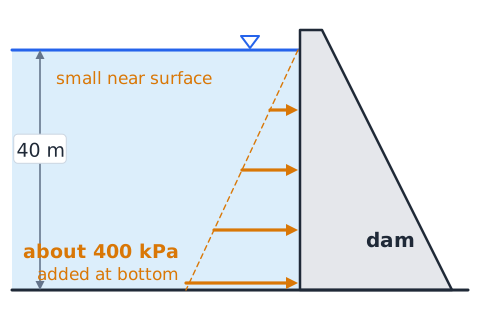
The total force on a dam depends on the water depth and the width of the wall. It does not depend on how far the lake stretches back behind the dam.
Pressure differences across an object
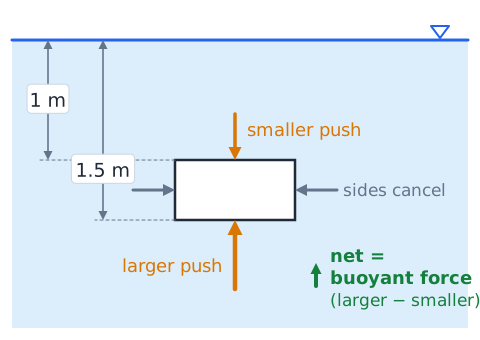
Fluid pressure explains where buoyancy comes from. Picture a closed box held underwater with its top face 1 m deep and its bottom face 1.5 m deep. The bottom face is deeper, so the water pushes up on it harder than it pushes down on the top.
The pushes on the sides cancel because they act at matching depths from opposite directions. The leftover upward push is the buoyant force. It depends on the height difference between the faces, which is set by the object's size, not on how deep the box happens to be.
Archimedes' principle
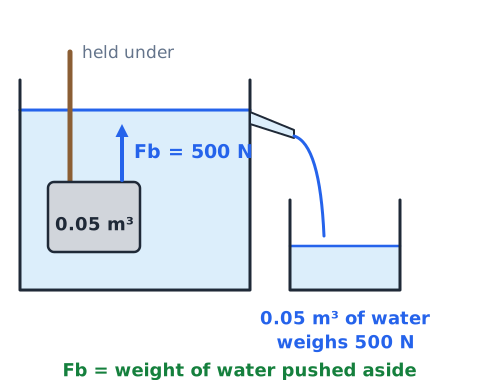
Archimedes' principle states that an object wholly or partly in a fluid feels an upward buoyant force equal to the weight of the fluid it displaces:
The density in this formula is the fluid's, not the object's. A sealed 0.05 m³ canister held fully under fresh water displaces 0.05 m³ of water, so
A steel canister and a plastic one of the same outside size get the same 500 N.
Displaced volume is the submerged volume
The displaced volume is simply the part of the object that sits below the fluid surface. For an object that is completely submerged, it equals the object's full outside volume. For a floating object, it is only the portion below the waterline.
A rowboat with 0.4 m³ of hull below the water displaces 0.4 m³, no matter how much empty space sits above the waterline. Dropping a stone into a measuring cup shows the idea directly: the water level rises by exactly the stone's volume.
Floating, sinking, or neutral behavior
To predict what a released object does, compare its weight with the buoyant force it would get if fully submerged. That is the same as comparing densities.
A less dense object rises and floats with only part of it under. A denser object sinks because its weight beats the largest buoyant force it can get. Equal densities give neutral buoyancy: the object stays wherever it is placed. The net vertical force is ; a positive result means upward, a negative result means downward.
Fraction submerged for floating objects
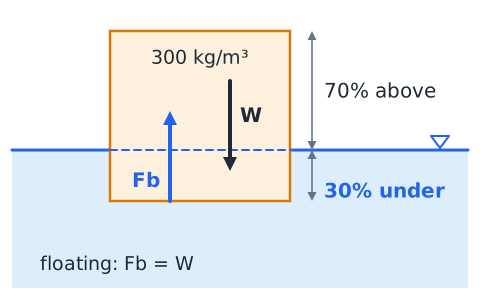
When an object floats, the buoyant force equals its weight. Writing both in terms of densities gives
The fraction underwater equals the density ratio. A foam float of density 300 kg/m³ in fresh water rides 30% submerged, with 70% above. The rule also works backward: if 25% of a uniform block shows above fresh water, 75% is under, so its density is 750 kg/m³.
Worked float fraction: timber block
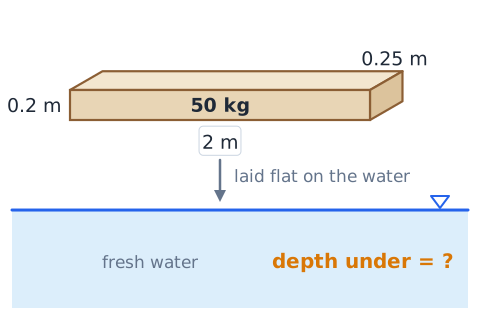
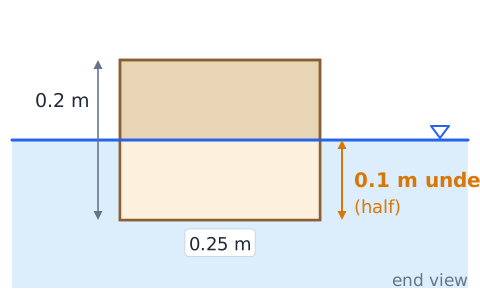
Problem: a pine timber 2 m long, 0.25 m wide, and 0.2 m thick has a mass of 50 kg. Lying flat in fresh water, how much of it is submerged?
Volume:
Density:
/m³.
Half the timber, 0.05 m³, is underwater. Lying flat, it sinks 0.1 m into its 0.2 m thickness.
Apparent weight when immersed
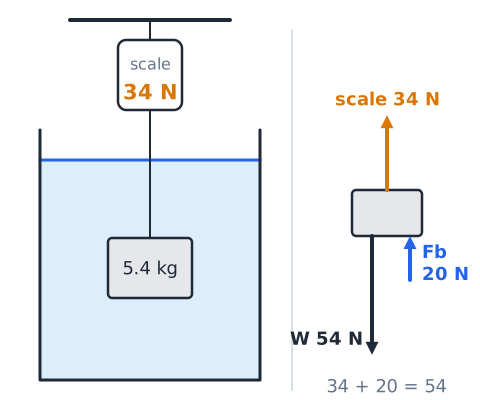
When an object hangs from a scale underwater, the scale carries only part of the weight because the water also pushes up on the object. The scale reading is called the apparent weight:
The object's mass and true weight do not change; gravity pulls exactly as before. A 60 N stone with a 22 N buoyant force reads 38 N on the scale. This is why a heavy rock feels easy to lift off a lake bottom until it breaks the surface.
Worked apparent-weight example
Problem: a 5.4 kg aluminum casting with volume 0.002 m³ hangs from a spring scale, fully under fresh water. Use
True weight:
The scale reads 34 N. As a check, the casting's density is
/m³, the usual value for aluminum, so it should sink, and it does.
Why a ship made of steel floats
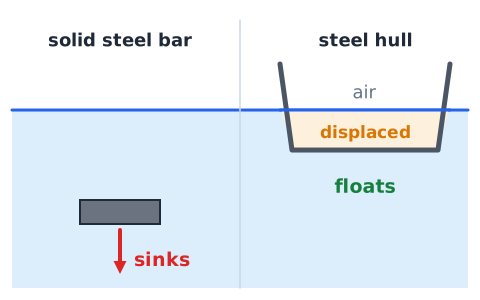
A solid steel bar sinks because steel is nearly eight times as dense as water. A ship's hull uses that steel as a thin shell around a huge volume of air. The hull pushes aside a great deal of water, and the ship settles until the weight of displaced water equals its total weight.
The ship's average density, steel plus air plus cargo divided by the hull's outside volume, is below that of water. If a breach lets water fill the hull, the average density climbs, and that is how ships sink.
Why a submarine changes depth
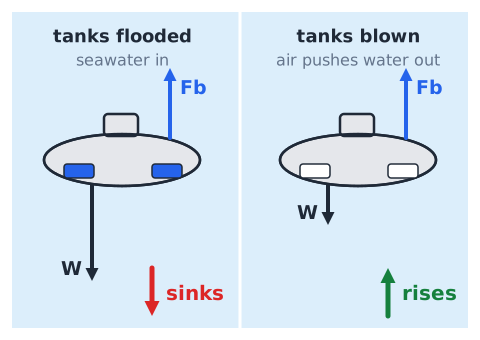
A submarine has a fixed outside shape, so when it is fully submerged its buoyant force stays nearly constant. To change depth it changes its weight instead.
Flooding ballast tanks with seawater makes the boat heavier than the water it displaces, so it sinks. To rise, compressed air blows the water out, the boat becomes lighter, and buoyancy wins. By trimming the tanks carefully, the crew reaches neutral buoyancy and can hover at a chosen depth. Many fish do something similar by adjusting the gas in their swim bladders.
Freshwater versus saltwater buoyancy
Seawater is roughly 2 to 3 percent denser than fresh water because of its dissolved salts. A floating object must displace its own weight of liquid, and in denser water a smaller volume does that job. So a ship rides slightly higher after sailing from a river into the ocean, and swimmers float more easily in the sea.
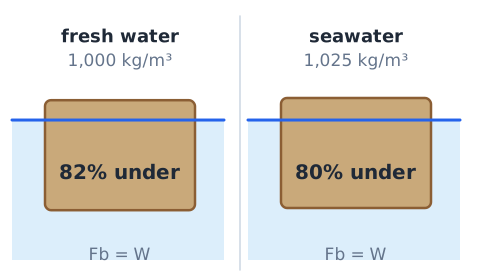
A log of density 820 kg/m³ is 82% submerged in fresh water but only 80% submerged in seawater of 1,025 kg/m³. The buoyant force equals the log's weight in both cases.
Ice floating and liquid rise
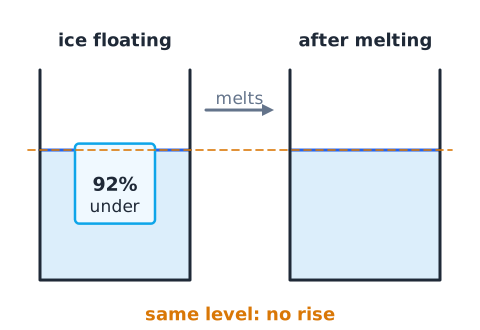
Ice has a density of about 917 kg/m³, roughly 92% that of fresh water, so floating ice keeps about 92% of its volume below the surface. In seawater the fraction is a little less, near 89%.
When an ice cube floating in a glass of fresh water melts, the water level does not change. The cube was already displacing exactly its own weight of water, and the meltwater fills that same volume. Ice that rests on land or on the bottom is different: when it melts, the level does rise.
Floating loaded rafts
A raft floats deeper as it is loaded because it must displace extra water to match each added weight. A raft weighing 800 N displaces 0.08 m³ of fresh water, using g = 10. Add two people totaling 1,400 N and it must displace 0.22 m³ in all.
The raft stays afloat only while its full volume can supply enough buoyancy. If the total weight exceeds the weight of water the entire raft could displace, the deck goes under.
Gas buoyancy and hot-air balloons
Archimedes' principle applies in air, too. A hot-air balloon displaces a large volume of cool outside air. Heating the air inside lowers its density, so the balloon's total weight, including envelope, basket, passengers, and warm air, becomes less than the weight of the cool air pushed aside. The difference is a net upward force.
Helium balloons work the same way because helium is far less dense than air. Since air is so light, a balloon must be very large to lift anything heavy.
Pressure under a piston
A piston pressing on a trapped fluid creates a pressure equal to the piston force divided by the piston's face area:
Example: a 50 N push on a syringe plunger with a face area of 0.0005 m² produces
or 100 kPa, of gauge pressure in the liquid. A narrower plunger pushed with the same force would create a higher pressure, which is why thin syringes can deliver fluid through fine needles.
Pressure versus energy
Pressure and energy are different quantities, even though their units are related. Pressure is force per area, measured in pascals. Energy is the capacity to do work, measured in joules. A pascal equals a joule per cubic meter, which is why pressure is sometimes described as energy stored per unit volume of fluid.
Still, a tall column of motionless water at high pressure is not doing any work. Work happens only when the pressure pushes something through a distance, as when water spins a turbine or drives a piston.
Connected vessels and horizontal levels
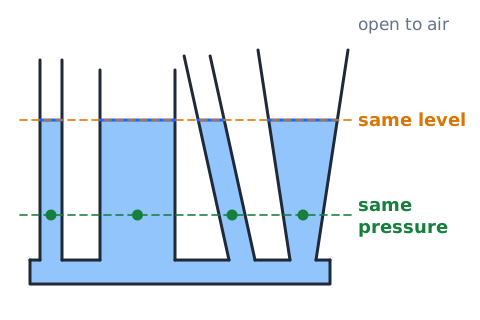
When containers are joined at the bottom, filled with one still liquid, and open to the same air, the liquid settles at the same height in all of them, whatever their shapes. If one level stood higher, the pressure at the bottom of that side would be greater, and liquid would flow until the levels matched.
That is why water in a hose held up at both ends lines up at equal heights, and why builders use a clear water-filled tube to mark level points across a room. Points at the same depth in one connected liquid share the same pressure.
A simple U-tube manometer
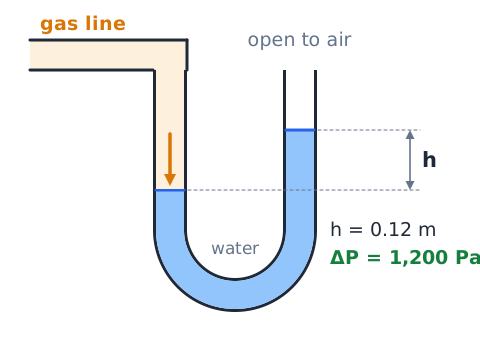
A manometer is a U-shaped tube partly filled with liquid. One end connects to a gas line and the other is open to the air. If the gas pressure is above atmospheric, it pushes the liquid down on its side and up on the open side. The height difference h between the two surfaces gives the gauge pressure:
With water and a 0.12 m difference,
A denser liquid such as mercury shows a smaller height for the same pressure.
Pascal's principle connection
Pascal's principle says that pressure added to a confined fluid is passed undiminished to every part of the fluid and to the container walls. Hydraulic lifts use this.
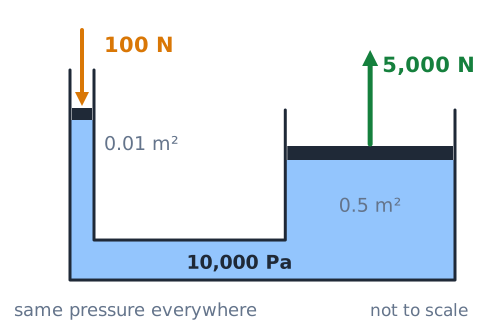
A 100 N push on a small piston of 0.01 m² creates 10,000 Pa. A large piston of 0.5 m² receives that same pressure and pushes up with
The force is multiplied by the area ratio, but the large piston moves a much shorter distance, so no energy is created. The same idea explains why added surface pressure raises the pressure at every depth equally.
The atmospheric pressure baseline
We live at the bottom of an ocean of air. At sea level the weight of the air above presses with about 101,325 Pa, usually rounded to 101 kPa or 100 kPa, which is about 14.7 pounds per square inch. Absolute pressure underwater combines both layers:
At 10 m in fresh water the water term is about 100 kPa, so the absolute pressure is about double the surface value. Divers use the rule that every 10 m of water adds roughly one atmosphere.
Pressure increases but buoyancy may not
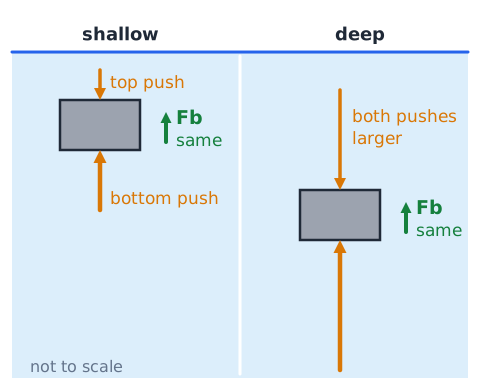
A common error is to think a submerged object gets more buoyancy the deeper it goes because the pressure is larger. For a rigid object, the pressures on its top and bottom both rise by the same amount as it goes deeper, so their difference stays the same.
The buoyant force depends on that difference, not on the absolute pressure. It equals the weight of displaced water, which does not change while the object's volume and the liquid's density stay fixed. A steel toolbox reads the same on a scale at 5 m as at 50 m. Only squeezable objects behave differently.
Effects of compression on balloons
Objects that can be squeezed, such as a balloon, a foam wetsuit, or a diver's lungs, behave differently from rigid ones. As they go deeper, the higher pressure compresses them, their volume shrinks, and they displace less water. Less displaced water means less buoyant force.
A balloon tied to a small weight may float near the surface but sink once pushed deep enough, then sink ever faster. Divers add air to a buoyancy vest as they descend to make up for this lost volume, and vent air as they rise because expanding gas would otherwise speed them upward.
Pressure at two different depths
To compare two depths in the same liquid, subtract the depths first:
Example: sensors sit at 3 m and 8 m in a freshwater tank, with g = 10. The difference is
or 50 kPa. Atmospheric pressure cancels because both readings include it.
Density comparison at equal volume
If two objects have the same volume, the heavier one is the denser one, because each mass is divided by the same volume. One liter of honey has a mass of about 1.4 kg, while one liter of cooking oil is about 0.92 kg, so honey is about one and a half times as dense.
When two equal-volume objects are both fully underwater, however, they receive the same buoyant force because they displace the same volume. Density decides whether each one sinks; displaced volume decides the buoyant force.
Volume comparison at equal material density
Two objects made of the same uniform material have the same density no matter their sizes; the larger one simply has proportionally more mass. Doubling both the mass and the volume leaves density unchanged.
So a small oak chip and a whole oak beam float with the same fraction underwater. When both are held fully submerged, the larger piece gets more buoyant force in proportion to its volume, but it also has more weight in the same proportion, so the balance of forces works out identically for both.
Pressure from a sharp edge
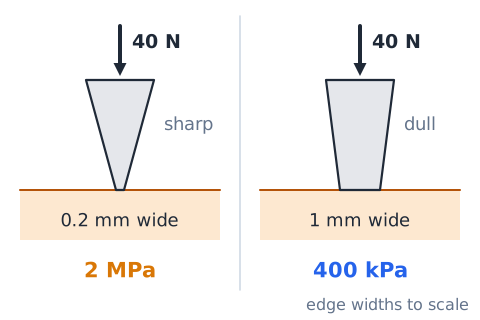
A knife cuts because its edge concentrates force on a tiny area. Suppose you press with 40 N on a blade whose edge touches the food along a strip 10 cm long and 0.2 mm wide, an area of 0.00002 m².
That is 2 MPa. A dull edge 1 mm wide spreads the same force over five times the area and gives only 400 kPa. Nails, needles, and chisels all rely on the same idea.
Buoyancy with g approximated as ten
ASVAB items often round g to 10 m/s² to keep the arithmetic simple. Then each cubic meter of fresh water weighs 10,000 N and each liter weighs 10 N.
That gives a quick shortcut: the buoyant force in newtons on a fully submerged object in fresh water is ten times its volume in liters. A 7 L rock gets 70 N of lift. With g = 9.8 the answer would be 68.6 N, close enough that answer choices usually still separate clearly. Use whichever value the question gives.
Volume needed to support a load
To float, an object must displace liquid whose weight equals the object's total weight. Solving Archimedes' principle for volume gives
Example: a dock float must carry a total weight of 2,500 N in fresh water, with g = 10. The displaced volume needed is
Designers make the float's total volume larger than this so that it rides above the water instead of sitting on the edge of sinking.
Floating object with added payload
When cargo is added to something that keeps floating, the extra displaced volume equals the added weight divided by the liquid's weight per unit volume:
A canoe on a lake takes on a 900 N passenger. With fresh water and g = 10, it settles until it displaces
more water. If the canoe's waterline area is about 1.5 m², it rides about 0.06 m, or 6 cm, lower.
Pressure on equal-area patches
Two patches of equal area on a vertical tank wall feel different forces when they sit at different depths. Take patches of 0.02 m² each, centered at 1 m and 4 m deep in fresh water, with g = 10.
The pressures are 10,000 Pa and 40,000 Pa, so the forces are
Same area, four times the depth, four times the force. That is why the seams near the bottom of a tank need the strongest welds.
Difference between floating and immersed
A floating object and a fully immersed object follow different rules. When an object floats freely, the buoyant force exactly equals its weight, and the submerged volume adjusts itself to make that true.
When an object is held completely under, the buoyant force equals the weight of a full object-volume of water, which can be larger or smaller than the object's weight. A floating beach ball gets lift equal to its few newtons of weight. Pushed under, it gets far more lift, which is why it shoots upward when released.
Displacement of a nonuniform object
For an object built from parts of different densities, such as a fishing bobber with a lead weight at its base, buoyancy still depends only on the total submerged volume. How the material is arranged inside does not change the buoyant force.
The arrangement does affect how the object sits. The heavy part settles lowest, which keeps the bobber upright. To decide whether the object floats at all, use its average density: total mass divided by total outside volume.
Density with temperature changes
Most materials expand when heated, so the same mass fills more volume and the density drops. That is why warm water sits on top of cold water in a lake during summer.
Water has an unusual twist: it is densest near 4 degrees Celsius. Cooled below that, it expands slightly, and it expands much more as it freezes. As a result, lakes freeze from the top down and keep liquid water underneath. Gases change density with temperature far more than liquids do, which is what makes hot-air balloons possible.
Density of air and height
Air is compressible, so the air near the ground is squeezed by all the air above it and is denser than the air higher up. Both air pressure and air density fall as altitude increases. At about 5,500 m, roughly half the atmosphere lies below you and the pressure is about half its sea-level value.
Unlike a liquid, air does not follow a simple straight-line rule with height, because its density keeps changing. A balloon rises until the thinner air around it no longer provides enough lift to exceed its weight.
Floating equilibrium with two liquids
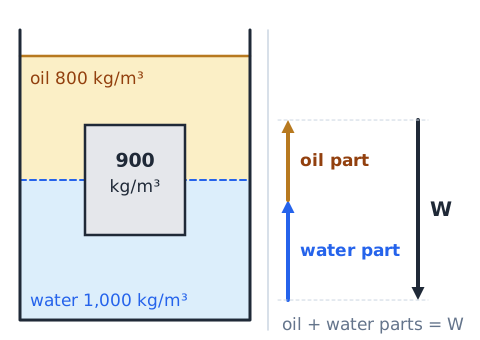
When two liquids that do not mix are layered, such as oil over water, the less dense one stays on top. A block whose density lies between the two settles at the boundary, partly in each layer.
The total buoyant force is the weight of oil displaced plus the weight of water displaced, and together they still equal the block's weight. For example, a block of density 900 kg/m³ placed in a deep layer of oil (800 kg/m³) over water (1,000 kg/m³) floats with half its volume in each liquid.
When pressure and force are confused
Force and pressure are easy to mix up. Force is a push in newtons; pressure is that push per square meter, in pascals. Two tanks of water 2 m deep have the same bottom pressure, 20 kPa with g = 10. Yet a tank with a 3 m² floor feels a total water force of 60,000 N, while a tank with a 1 m² floor feels 20,000 N.
To get force from pressure, multiply:
Always check whether a question asks for pressure or for total force.
Quick strategy: numerical density items
For density questions, write down the three quantities and mark the unknown. Use
Convert liters or cubic centimeters to cubic meters before dividing.
Then compare with benchmarks: values near 1,000 kg/m³ behave like water, and metals land in the thousands. Example: 1.2 kg in 0.0016 m³ gives 750 kg/m³, a wood-like value that floats in water.
Quick strategy: fluid pressure items
For pressure in liquids, look for three clues: the depth, the liquid's density, and whether the question wants gauge or absolute pressure. Ignore the container's width and shape.
With g = 10, each meter of fresh water adds about 10 kPa. If a question mentions a gauge reading or the water's pressure increase, leave out the atmosphere; if it says absolute or total pressure, add about 100 kPa. For a ratio question, such as depth tripled, skip the arithmetic and scale the answer directly.
Quick strategy: buoyancy items
For buoyancy items, first ask whether the object is floating or held fully under. If floating, the buoyant force equals the weight, and the submerged fraction equals the density ratio. If fully submerged, the buoyant force equals liquid density times g times the object's whole volume, regardless of the object's material.
Then compare forces: buoyant force minus weight gives the net force, and weight minus buoyant force gives a scale reading. Wrong choices often swap the object's density for the fluid's.
Worked synthesis: density, buoyancy and apparent weight
A bronze fitting has volume 0.004 m³ and mass 35.2 kg. Find its density, its buoyant force fully under fresh water, and its scale reading there, with g = 10.
Density:
/m³, so it sinks. Weight: 352 N.
Worked synthesis: a floating hollow block
A sealed hollow plastic cube 0.4 m on each edge has mass 16 kg. How deep does it sit in fresh water?
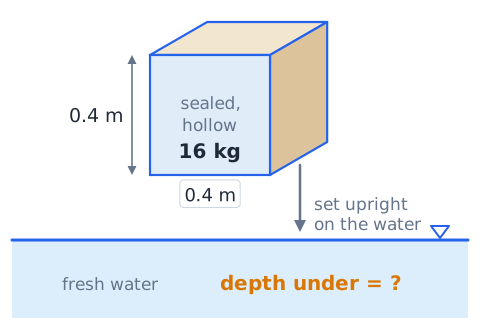
Volume:
Average density:
/m³.
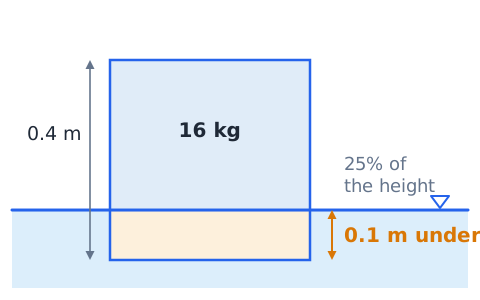
So 0.016 m³ is underwater. Since the cube floats upright, 25% of its 0.4 m height, or 0.1 m, is below the surface.
Worked synthesis: two submerged depths
A sensor on a dock piling in a freshwater lake reads 12 kPa gauge. A second sensor lower on the same piling reads 47 kPa gauge. Using g = 10, how deep is each, and how far apart are they?
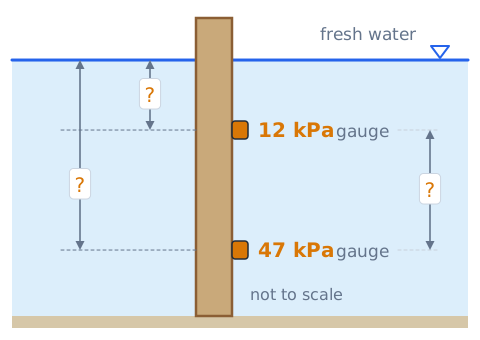
Each meter of fresh water adds 10 kPa, so the sensors sit at 1.2 m and 4.7 m, which puts them 3.5 m apart. If the readings were absolute with a 100 kPa atmosphere, they would be 112 kPa and 147 kPa, but the 35 kPa difference and the 3.5 m spacing would not change, because the atmosphere adds equally to both.
Boundary cases: density equals liquid density
When an object's average density exactly matches the liquid's, it is neutrally buoyant. Its weight equals the buoyant force it receives when fully submerged, so the net force is zero. Placed anywhere below the surface, it neither rises nor sinks; if already moving, it drifts until drag stops it.
This balance is delicate. If the liquid becomes denser, for example when salt is dissolved in it, the buoyant force grows and the object starts to rise. If the object takes on a little water, or the liquid warms and becomes less dense, the object sinks.
Boundary cases: external forces and floor contact
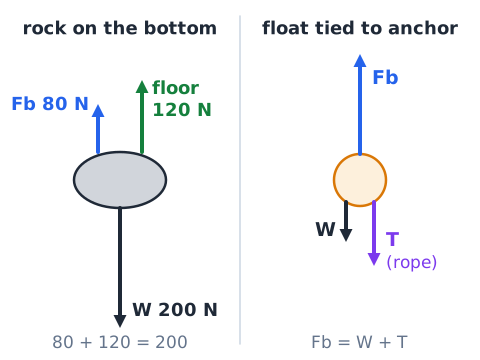
The simple floating and sinking rules assume nothing else touches the object. Extra forces change the balance. A 200 N rock resting on a pond bottom still gets buoyancy, say 80 N, and the bottom supplies the remaining 120 N of support.
A float tied to an anchor below has rope tension pulling down, so buoyancy equals weight plus tension. A hand pushing a ball under adds a downward force. In every case, list all the vertical forces and set their total to zero for equilibrium before solving.
Mechanical intuition review
Pull the lesson together with a few mental checks. Density,
is a property of the material. Pressure,
rises as area shrinks. Liquid pressure, , depends only on density and depth, not container shape.
Buoyant force, , depends on the fluid and the displaced volume, not on the object's material. The floating fraction equals object density over fluid density. An answer that breaks one of these patterns is probably a distractor.
Final practice checklist
Before test day, make sure you can do each of these without notes. Convert liters and cubic centimeters to cubic meters. Find density, mass, or volume from the other two. Compute pressure from force and area, and explain why a sharp edge cuts.
Find the gauge pressure at a depth and add the atmosphere for absolute pressure. Explain why container shape does not matter. Find the buoyant force from displaced volume, a scale reading underwater, the fraction of a floating object below the surface, and the extra volume displaced when cargo is added.
 English ▾