 ASVAB Camp
Lesson mission and measurable outcomes
This lesson gives you a reliable way to handle any spring question on the Mechanical Comprehension test. When you finish, you should be able to predict which way a spring pushes or pulls, use
with correct units, combine springs in series and in parallel, judge how mass and stiffness change an oscillation, and explain where the ideal spring model stops matching real hardware.
What counts as an elastic system
An elastic system is anything that deforms under a load and then returns to its original shape when the load is removed. A coil spring is the classic case, but a diving board, a rubber band, a car leaf spring, a guitar string and even a steel beam that sags slightly under a truck all behave elastically within limits. The common feature is stored energy: the deformed part pushes or pulls back as it tries to recover its shape.
Equilibrium versus natural length
A spring's natural length is the length it has with no load at all. Its equilibrium position is wherever all forces on the attached object balance. For a horizontal spring with nothing else pushing, those two places are the same. Hang a weight on a vertical spring, though, and the new resting point sits lower, where the spring force equals the weight,
Always measure stretch from natural length, not from wherever the object happens to rest.
Extension and compression
Pulling the ends of a spring apart makes it longer than its natural length; that change is called extension, and the spring is in tension. Pushing the ends together makes it shorter; that change is compression. A screen-door closer works in tension, while a valve spring in an engine works in compression. For an ideal spring the rule is the same either way: the farther you move it from natural length, the harder it resists.
The restoring-force direction
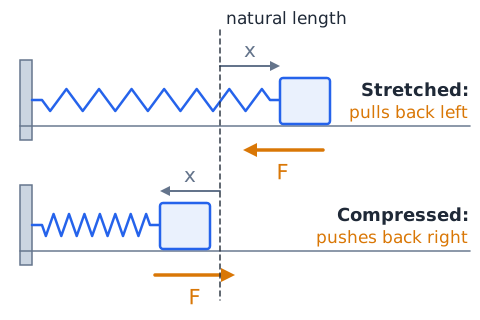
A spring always pushes or pulls back toward its natural length. Stretch it, and it pulls the attached object back toward the anchor. Squeeze it, and it pushes the object away. In sign form this is written
The minus sign simply says the force points opposite to the displacement. If a block pulls a wall-mounted spring to the right, the spring pulls the block to the left, toward the wall.
Hooke law and its limits
Hooke's law says the spring force is proportional to how far the spring is stretched or compressed:
Double the deflection and the force doubles. This straight-line rule holds only in the elastic range. Stretch a spring too far and the coils take a permanent set, the force no longer follows the line, and the spring will not return to its original length. Test questions assume the linear range unless they say otherwise.
Meaning of the spring constant
The spring constant tells you how stiff a spring is: it is the force needed for each unit of deflection. A spring with
N/m needs 50 N for every meter of stretch, while one with
N/m needs a hundred times more. Under the same load, the spring with the larger moves the least. A soft mattress spring has a small ; a truck suspension spring has a large one.
Units and dimensions
Because
its SI unit is newtons per meter (N/m). You may also see N/mm or pounds per inch in shop catalogs. Force is in newtons, deflection in meters, and stored energy in joules, where 1 J equals 1 N·m. If you plug centimeters or millimeters into a formula that expects meters, your answer will be off by a factor of 100 or 1000, so convert first.
Recognizing force and extension graphs
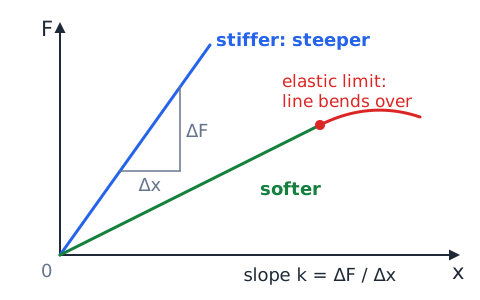
Plot force on the vertical axis and extension on the horizontal axis. An ideal spring gives a straight line through the origin, and its slope is
A steeper line means a stiffer spring. If the line starts bending over at the top, the spring has passed its elastic limit. The area under the line, a triangle, equals the energy stored.
Fast mental comparison
Many spring questions can be answered by proportion instead of full calculation. Force scales directly with deflection, so tripling triples . Energy scales with the square of deflection, so tripling makes nine times larger. For a fixed load, deflection scales as : a spring twice as stiff stretches half as far. Spotting these ratios saves time and catches unreasonable choices.
Finding force from displacement
When you know the stiffness and the deflection, multiply them. Suppose a gate spring has
N/m and is stretched 0.08 m.
The spring pulls back with 20 N. Check that the deflection is in meters before multiplying; 8 cm must be written as 0.08 m.
Finding extension from force
Rearrange Hooke's law when the load is known and the stretch is wanted:
A 45 N pull on a spring with
N/m gives
That is 5 cm. A bigger force or a softer spring both mean more stretch.
Finding stiffness from a test
To measure , apply a known load and record the deflection. In a shop test, an 18 N weight stretches a spring by 0.06 m.
Repeating the test with a second load and getting the same ratio confirms the spring is behaving linearly.
Direction signs in one dimension
Pick one direction as positive, often to the right or upward, and stick with it for the whole problem. Displacement in that direction is positive, and the spring force then comes out negative, pointing back. On the test you usually only need magnitudes, but deciding a sign convention first keeps you from mixing up which way forces act when several springs or weights are involved.
Force diagrams for spring problems
Draw the object alone and add every force acting on it: weight downward, the spring force along the spring, any applied push or pull, and support or friction forces. Then apply the balance condition for an object at rest,
For a block hanging on a spring, the diagram has just two arrows, the spring pulling up with and gravity pulling down with .
Horizontal spring with no friction
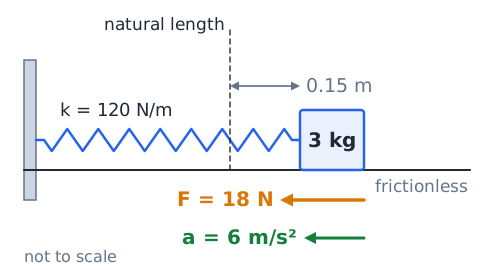
On a frictionless table, the spring is the only horizontal force on a block, so gravity does not change the stretch. If a 3 kg block is pulled 0.15 m from natural length on a spring with
N/m and released, the spring force is
By Newton's second law,
directed back toward the natural-length position.
Vertical spring and a hanging mass
A mass hung from a vertical spring stretches it until the upward spring force equals the downward weight:
So the static stretch is
A heavier mass or a softer spring gives a bigger stretch. The resting position is the new equilibrium, not the natural length.
Worked example: hanging weight
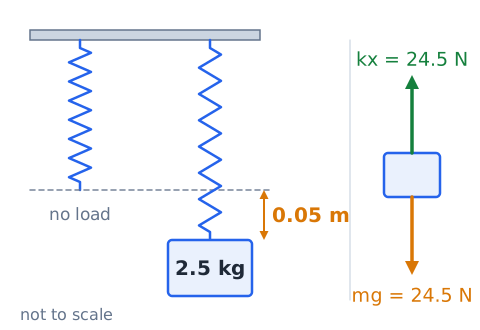
A 2.5 kg toolbox hangs from a spring with
N/m. Take
How far does the spring stretch?
Weight:
The spring stretches 5 cm.
Weight units and test conventions
A mass in kilograms is not a force. Convert it to weight with
using whatever value of the question gives, often 9.8 or 10 m/s². In US customary problems, pounds are already a force, so a 20 lb load on a 40 lb/in spring stretches it half an inch with no conversion. Read the units in each answer choice to see which system the question expects.
Preload in installed springs
Many springs are installed already compressed or stretched. This built-in deflection is preload, and it means the spring pushes even before the mechanism moves. A valve spring, for example, holds the valve shut with preload force. The total force at any moment uses the total deflection from natural length:
Here is the preload deflection and is the extra movement.
Worked example: preload change
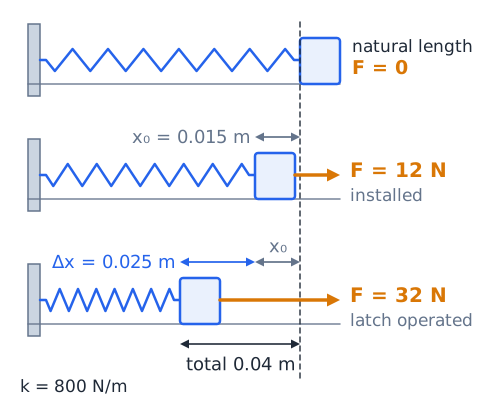
A latch spring with
N/m is installed compressed 0.015 m. Operating the latch compresses it another 0.025 m. Find the initial and final forces.
Initial:
Total compression is 0.04 m, so the final force is
The increase is 20 N, which equals times the extra 0.025 m.
Spring work is not final force times travel
The force of a spring grows from zero as it is stretched, so the work you do is not the final force multiplied by the distance. Use the average force, which is half the final force:
For a 600 N/m spring stretched 0.1 m, the final force is 60 N, but the work is 3 J, not 6 J.
Elastic potential energy
The work done deforming an ideal spring is stored as elastic potential energy:
is in joules, in N/m and in meters. The energy is the same whether the spring is stretched or compressed by the same amount, and it is recovered when the spring returns to natural length. This is how a wind-up toy or a trap mechanism stores energy for later.
Worked example: stored energy
A door-stop spring with
N/m is compressed 0.04 m. How much energy does it store?
The spring holds 2 J, ready to push the door back.
Energy ratio without arithmetic
Because energy depends on , you can compare two deflections of the same spring by squaring their ratio. Doubling the deflection gives four times the energy; tripling it gives nine times; halving it leaves one quarter. If a question asks how energy changes when compression goes from 3 cm to 6 cm, the answer is four times as much, with no need to know .
Energy change between two positions
If a spring is already deflected and you move it farther, the extra work is the difference between the two stored energies:
Do not compute ; that treats the spring as if it started relaxed and gives too small an answer. Square each deflection first, then subtract.
Worked example: adding extension
A 500 N/m spring is already stretched 0.06 m. How much more work is needed to stretch it to 0.10 m?
Force versus energy on a graph
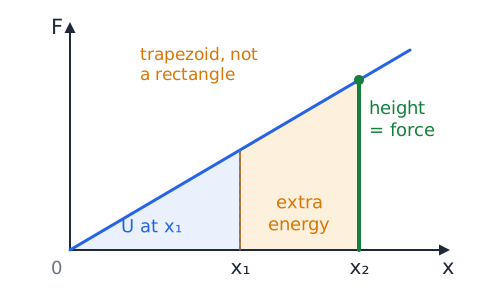
On a force-extension graph, the height of the line at any point is the force, and the area under the line up to that point is the stored energy. Between two extensions the extra energy is a trapezoid-shaped strip, not a rectangle. Questions that show a graph may ask for either quantity, so decide first whether you need a height reading or an area.
Converting stored energy into motion
When a compressed spring pushes a cart on a frictionless track, its stored energy becomes kinetic energy:
Solving gives the launch speed:
A stiffer spring or more compression gives more speed; a heavier cart gives less.
Worked example: ideal launch
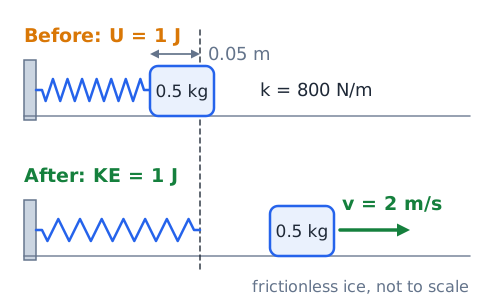
A toy launcher spring has
N/m and is compressed 0.05 m behind a 0.5 kg puck on frictionless ice. Find the launch speed.
Stored energy:
So
Series connection principle
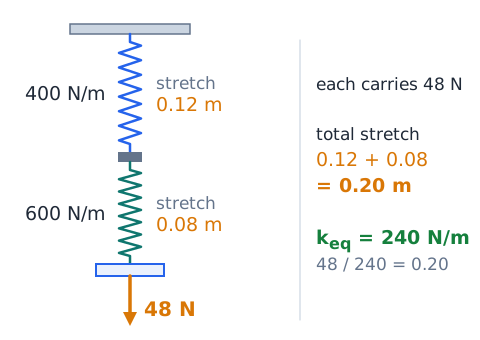
Springs in series are joined end to end, so the load passes through one and then the next. Each spring carries the full force, and the total stretch is the sum of the individual stretches. That makes the combination softer than either spring alone:
Think of it like a chain where every link feels the same pull but each link adds its own give.
Two unequal springs in series
For exactly two springs in series, the product over sum form is quickest:
The result is always smaller than the softer spring. The softer spring also does most of the stretching, since it has the same force but a smaller . If one spring is far stiffer than the other, the combination behaves almost like the soft spring alone.
Worked example: series pair
A 400 N/m spring is hooked in series with a 600 N/m spring and a 48 N load hangs from the bottom.
Each spring carries 48 N, so they stretch 0.12 m and 0.08 m. The total, 0.20 m, matches .
Identical series springs
When identical springs of stiffness are connected end to end, each one stretches the same amount, so the chain stretches times as much as one spring would:
Two identical 300 N/m springs in series act like one 150 N/m spring. Three in series act like 100 N/m.
Parallel connection principle
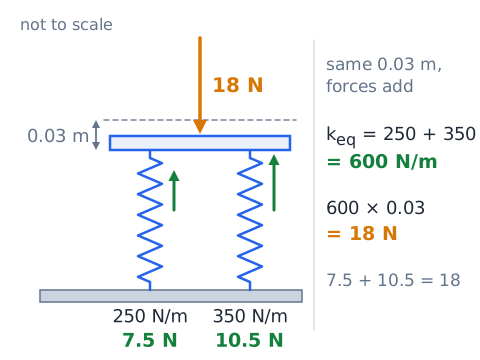
Springs in parallel sit side by side and connect to the same rigid plates, so they all deflect the same distance. Each spring supplies its own force, and the forces add. The combination is stiffer than any single spring:
The coil springs at the four corners of a bed frame or under a washing machine work this way, sharing the load.
Worked example: parallel pair
A 250 N/m spring and a 350 N/m spring support a platform together and both compress 0.03 m.
The forces are
N and
Their sum, 18 N, matches . The stiffer spring carries the larger share of the load.
Identical parallel springs
When identical springs share the load side by side, each carries of it, and the combined stiffness is
Four identical 200 N/m springs under a machine base act like one 800 N/m spring. Adding more springs in parallel always makes the support stiffer and reduces the sag.
Series versus parallel visual test
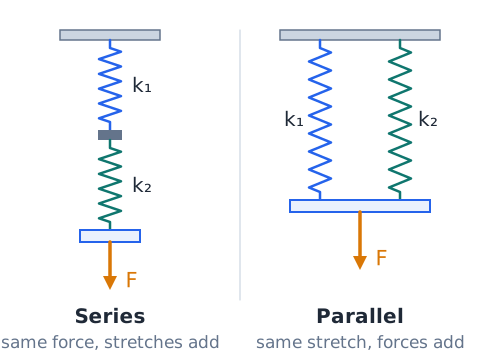
Trace the path of the load. If the force must pass through one spring to reach the next, the springs are in series, so the forces are equal and the stretches add. If the springs share the same two end plates and the load splits among them, they are in parallel, so the stretches are equal and the forces add. The way springs look on the page does not matter; the load path does.
Mixed spring assemblies
Real assemblies often mix both arrangements. Break the network into simple groups. Find any set of springs that clearly share the same two plates and replace them with one parallel equivalent. Find any chain that carries one force and replace it with one series equivalent. Keep simplifying, redrawing as you go, until only a single spring remains. Work from the innermost group outward.
Worked example: mixed network
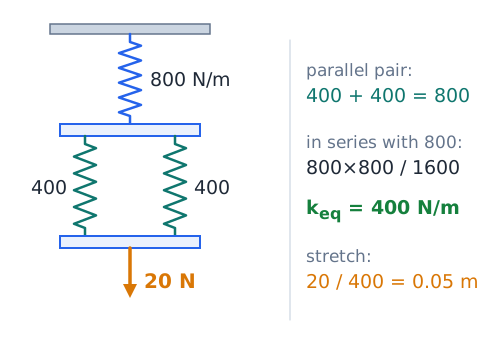
Two 400 N/m springs share a plate in parallel, and that plate hangs from an 800 N/m spring above it. Find the overall stiffness.
Parallel pair:
N/m.
That 800 N/m group is in series with the 800 N/m spring:
A 20 N load would stretch the assembly 0.05 m.
Compliance as flexibility
Compliance is the opposite of stiffness:
the deflection per newton of force. A flexible spring has high compliance. This view makes series springs easy, because compliances add just like stretches do:
For parallel springs, stiffnesses add instead. Use whichever quantity adds directly for the arrangement in front of you.
Energy in more than one spring
The total energy in a group of springs is the sum of the energy in each:
You can also find the equivalent stiffness first and use with the total deflection; both routes give the same answer. Energy does not divide evenly, though. How it splits depends on whether the springs share force or share displacement.
Series energy under fixed force
In series, every spring carries the same force . Writing energy in terms of force gives
With equal force, the spring with the smaller stores more energy, because it stretches farther. A 100 N/m spring and a 400 N/m spring in series store energy in the ratio 4 to 1, the softer one holding the larger share.
Parallel energy under fixed displacement
In parallel, every spring moves the same distance . Then
shows that the stiffer spring stores more energy, in direct proportion to . A 600 N/m spring beside a 200 N/m spring stores three times as much energy. Notice this is the reverse of the series case.
Spring position in real mechanisms
Look at where a spring sits in a machine and ask what it does. A spring that holds a part against a cam keeps contact; one that returns a pedal resets a control; one between a wheel and a frame absorbs bumps; one in a clutch or brake supplies clamping force. Knowing the job tells you whether the spring is meant to be in tension or compression and which way it pushes when the part moves.
Tension spring and compression spring
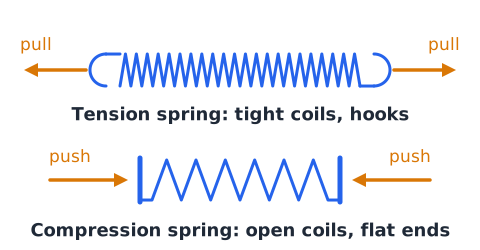
A tension spring, also called an extension spring, usually has tightly wound coils and hooks or loops on each end. It is designed to be pulled and to pull back, like a garage-door spring or a trampoline spring. A compression spring has open coils with gaps between them and flat or squared ends. It is designed to be pushed and to push back, like a pen spring or a car coil spring.
Torsion springs and rotation
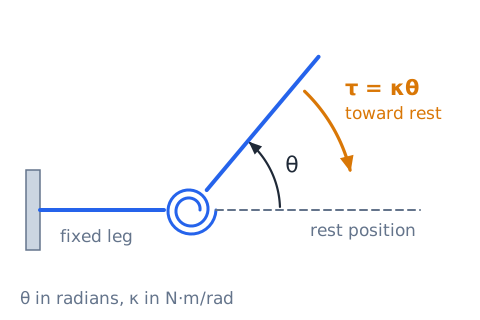
A torsion spring resists twisting instead of stretching. Its torque grows with the angle of twist:
is the angular stiffness in N·m/rad, and is in radians. The stored energy follows the same pattern as a linear spring,
Clothespins, mousetraps and self-closing hinges use torsion springs.
Worked example: rotational stiffness
A hinge spring has
N·m/rad and the door is opened 0.5 rad from its rest position.
Torque:
N·m.
That energy is what swings the door shut.
Oscillation after release
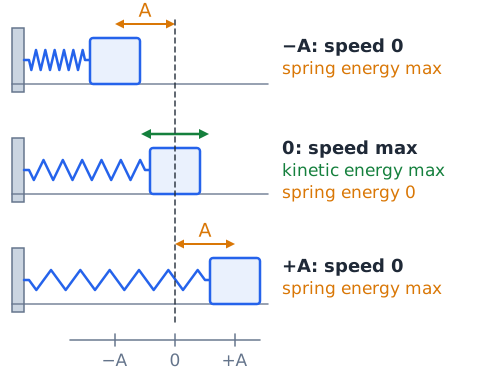
Pull a mass on a spring away from equilibrium and let go. The spring accelerates it back, but the mass overshoots, compresses the spring, and is pushed back again. Energy swaps between spring energy at the ends of the motion and kinetic energy at the center, where speed is greatest. With no friction this back-and-forth, called simple harmonic motion, would continue with a constant amplitude.
Mass and oscillation period
The time for one full back-and-forth cycle is the period:
A heavier mass makes the motion slower and the period longer; a stiffer spring makes it faster. Because of the square root, quadrupling the mass only doubles the period. For an ideal spring, the period does not depend on how far you pulled the mass before release.
Worked example: frequency scaling
A 0.5 kg mass on a spring oscillates at 3 Hz. It is replaced by a 2 kg mass on the same spring. What is the new frequency?
Frequency varies as . The mass grew by a factor of 4, so frequency drops by a factor of
Frequency and period
Frequency is the number of cycles per second, measured in hertz. It is the reciprocal of the period:
A system that takes 0.25 s per cycle vibrates at 4 Hz. When the period gets longer, the frequency gets lower, and the other way around.
Effect of gravity on a vertical oscillator
Hanging a spring vertically shifts its equilibrium downward by , but it does not change the period. The mass simply oscillates about the new, lower equilibrium point with the same
it would have on a horizontal frictionless surface. Gravity changes where the motion is centered, not how fast it repeats.
Damping and energy loss
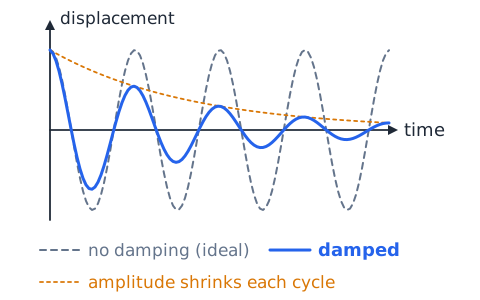
Real oscillations die out because friction, air drag and internal heating in the material remove energy each cycle. This loss is called damping. The amplitude shrinks over time, and the lost mechanical energy ends up as heat. Engineers add damping on purpose with fluid-filled dampers or rubber pads so that a disturbance does not keep vibrating.
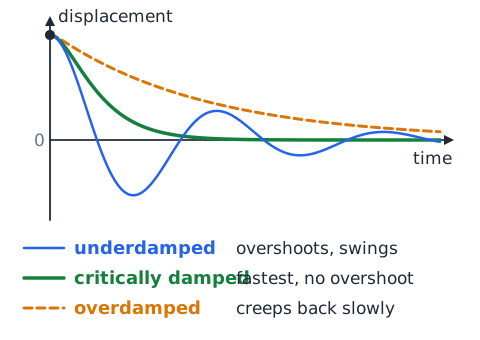
Underdamped, critical and overdamped
With light damping, a system is underdamped: it swings past equilibrium several times with shrinking amplitude, like a plucked ruler. Critically damped means just enough damping that it returns to rest as quickly as possible without overshooting, the target for many door closers and measuring instruments, while vehicle suspensions are usually tuned somewhat underdamped. Overdamped systems have so much damping that they creep back slowly, like a door closer set too tight.
Suspension springs and shock absorbers
In a vehicle, the springs carry the weight and let the wheels move over bumps. The shock absorbers, which are really dampers, turn the bouncing motion into heat in hydraulic fluid. Without working shocks, the car keeps bouncing after each bump and the tires can lose grip. Worn shocks do not change how much the car sits down under load; that is set by the springs.
Spring scales and calibration
A spring scale works because extension is proportional to force. The scale is marked so that each division corresponds to a fixed number of newtons or pounds. Calibration means hanging known weights and checking the readings. If the spring has been overstretched and permanently lengthened, or used beyond its linear range, the readings become wrong and the scale must be adjusted or replaced.
Vibration isolation and tradeoffs
Machines such as pumps and compressors are often set on soft springs or rubber mounts so their vibration does not pass into the floor. A softer mount lowers the natural frequency, and isolation works well when the machine runs much faster than that frequency. The cost is more static sag and larger movement during start-up, so designers balance softness against stability and clearance.
Spring travel and mechanical stops
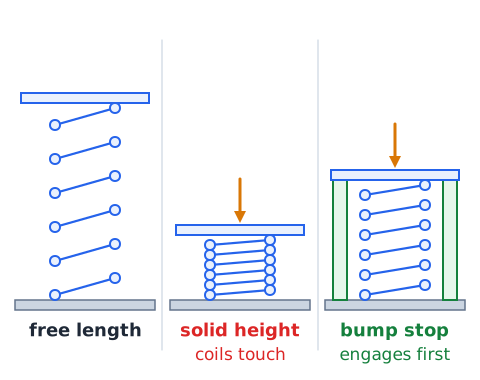
Every spring has a usable travel. A compression spring cannot squeeze past the point where its coils touch, called solid height. Many mechanisms add a bump stop or a limit block so the spring never reaches that point or gets overstretched. Once a stop engages, the system suddenly becomes much stiffer and the simple
rule for the spring alone no longer describes the motion.
Elastic versus plastic deformation
Elastic deformation goes away when the load is removed; the spring returns to its original length. Plastic deformation is permanent: the metal has yielded and the spring stays bent or lengthened. A spring loaded past its elastic limit is weakened and gives lower force at the same position. That is why springs should stay within their rated deflection.
Yield, fatigue and repeated cycles
Yield is the stress level at which a material begins to deform permanently. Even below yield, a spring that is loaded and unloaded thousands or millions of times can develop small cracks that slowly grow. This is fatigue, and it is the most common way valve springs and suspension springs fail. Good design keeps stresses well below yield, uses smooth surfaces, and avoids nicks and corrosion that start cracks.
Buckling and sideways instability
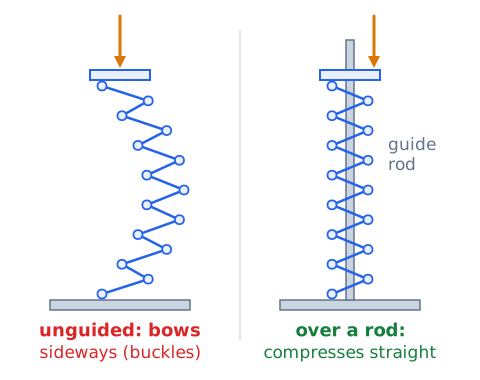
A long, slender compression spring can bow out sideways instead of compressing straight. This is buckling, and it happens when the spring is much longer than its diameter and its ends are not well guided. Placing the spring over a rod or inside a tube, or using a shorter, wider spring, prevents it. Buckling is a reason real springs can fail even when
says the load is fine.
Coil spring dimensions and stiffness
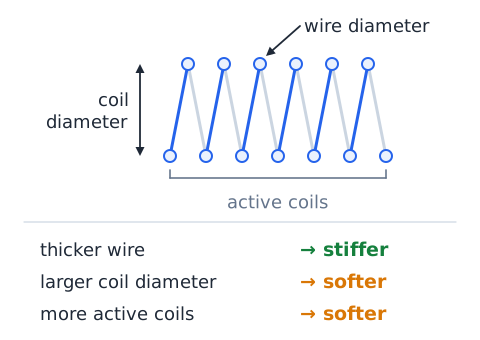
For coil springs made of the same material, a few patterns predict stiffness. Thicker wire makes a stiffer spring. A larger coil diameter makes it softer. More active coils make it softer, because each coil adds its own bit of deflection like springs in series. A stiffer material, such as steel instead of brass, makes it stiffer. You can use these trends to compare springs without any formula.
Cutting a uniform spring
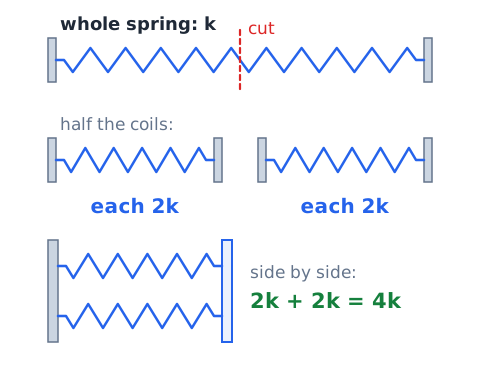
A uniform coil spring behaves like many small springs in series. Cutting it in half leaves half as many coils, so each half is twice as stiff:
Cutting it into thirds makes each piece . Putting the two halves side by side in parallel would give , four times the original stiffness.
Choosing an efficient solution route
Before calculating, decide what the question really asks. If it asks for a force, use Hooke's law. If it asks for energy or launch speed, use the energy formula. If several springs are involved, find the equivalent stiffness first. If it asks how something changes, use ratios instead of full numbers. Then check that your answer has sensible units and size, and eliminate answer choices that are off by factors of 100 or have the wrong unit.
Common trap: centimeters in place of meters
A spring with
N/m is compressed 4 cm. Writing
N is a classic mistake. Convert first: 4 cm is 0.04 m, so
Answer choices often include the unconverted value as a decoy.
Common trap: energy proportional to force
It is tempting to think twice the force means twice the energy. For a single spring, though, twice the force means twice the deflection, and energy goes with deflection squared, so it becomes four times as large. For the same force on two different springs, the softer one stores more energy, not less. Always check whether energy depends on or before choosing.
Common trap: mixing series and parallel
Students often add stiffnesses for springs in series, giving an answer that is too large. Remember: in series the combination is softer than either spring, so the answer must be smaller than the smallest . In parallel it is stiffer, so the answer must be larger than the largest . Use this as a quick sanity check on any result.
Common trap: measuring displacement from the wrong zero
Spring force and energy depend on deflection from natural length. A common error is to measure from the hanging equilibrium point, from the installed preload position, or from the spring's full coiled length. If a spring is 30 cm long relaxed and 34 cm long under load, the extension is 4 cm, not 34 cm. Identify the natural length before doing anything else.
Common trap: assuming all energy reaches the load
Ideal problems let all the spring's energy turn into kinetic energy, but real systems lose some to friction, air drag and heat. If a question says some energy is lost, subtract it before solving for speed:
Ignoring the loss gives a speed that is too high.
Worked synthesis: two parallel launch springs
Two 600 N/m springs side by side push a 0.75 kg sled on a frictionless rail. Both are compressed 0.05 m. Find the launch speed.
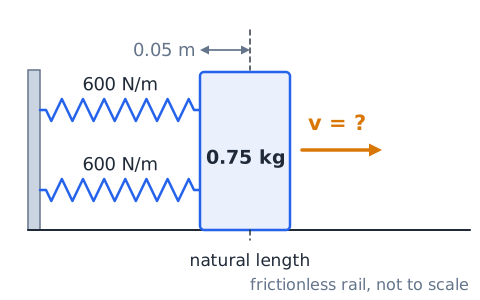
Parallel stiffness: 1200 N/m.
Final self-check and exam strategy
Before answering, ask four quick questions. Is the deflection measured from natural length and in meters? Are the springs sharing force (series) or sharing displacement (parallel)? Does the question ask for force, which is linear in , or energy, which goes with ? Does the answer pass a reasonableness check, such as a series result being smaller than either spring? With these habits, most spring questions can be answered in under a minute.
Compact formula summary
Hooke's law:
with the force pointing back toward natural length. Stored energy:
Extra work between deflections: .
Series:
Parallel:
Period:
frequency
Torsion:
 English ▾