 ASVAB Camp
Lesson mission and success criteria
This lesson connects heat to the way machines and materials behave. By the end you should be able to tell temperature from heat, convert between Celsius, Kelvin and Fahrenheit, predict thermal expansion with
identify conduction, convection and radiation, use
and describe stress, strain, stiffness and common material failures. Success means solving each type of problem quickly, with correct units and a sensible size of answer.
Temperature is not heat
Temperature measures how hot something is, which reflects the average energy of motion of its particles. Heat is energy that moves from one object to another because of a temperature difference. A bathtub of warm water and a cup of boiling water show the difference: the cup is at a higher temperature, but the tub holds far more thermal energy and could melt much more ice. Heat is measured in joules; temperature in degrees or kelvins.
Thermal equilibrium
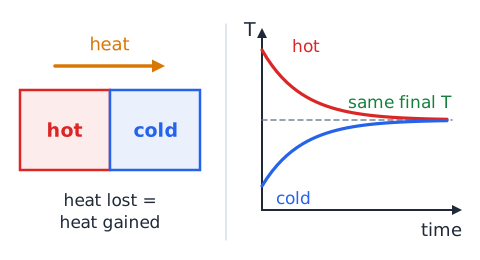
Put a hot object in contact with a cold one and heat flows from hot to cold until both reach the same temperature. That final state is thermal equilibrium, and then no net heat flows. In an insulated system, energy is conserved, so the heat lost by the hot object equals the heat gained by the cold one:
A thermometer works because it comes to equilibrium with whatever it touches.
The Celsius and Kelvin scales
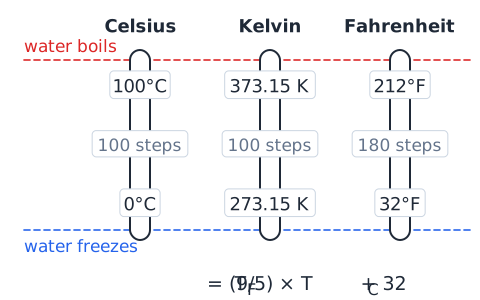
On the Celsius scale, water freezes at 0°C and boils at 100°C at sea-level pressure. The Kelvin scale uses the same size degree but starts at absolute zero, the lowest possible temperature:
So 25°C is 298.15 K. Because the steps are the same size, a change of 1°C equals a change of 1 K. A rise of 30°C is a rise of 30 K, with no 273 added.
Fahrenheit conversion
The Fahrenheit scale puts freezing at 32°F and boiling at 212°F, so 100 Celsius degrees span 180 Fahrenheit degrees. To convert a reading:
For 35°C,
For a temperature change, skip the 32: a change of 10°C equals a change of 18°F.
Why solids expand when heated
The atoms in a solid are always vibrating about their positions. When the solid is heated, they vibrate harder and, on average, push a little farther apart. Every dimension of the object grows slightly: length, width, thickness, and the size of any holes. The effect is small for each degree, but over long lengths or large temperature swings it adds up to movement that designers must allow for.
Linear expansion equation
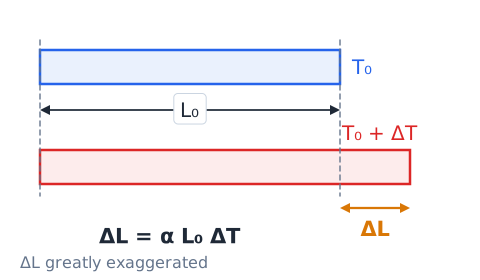
The change in length of a solid with temperature is
is the change in length, is the coefficient of linear expansion in 1/°C (or 1/K), is the original length, and is the temperature change. The growth is proportional to each factor: double the length or double the temperature rise and the expansion doubles. With no temperature change, there is no expansion.
Reading the coefficient of expansion
The coefficient is the fractional change in length per degree. Steel has of roughly per °C, meaning each meter of steel grows about 12 micrometers for every degree of warming. Aluminum is about twice that, near , and glass used for lab ware is much lower. A larger means more expansion for the same length and temperature change.
Worked: expanding steel rail
A 25 m steel rail with
/°C warms by 40°C on a summer afternoon. How much does it lengthen if free?
That is why rail joints and welded track need careful allowance for heat.
Worked: comparing two alloys
A 3 m aluminum bar (
/°C) and a 3 m steel bar (
/°C) are both heated by 60°C.
Aluminum:
or 4.14 mm.
Steel:
or 2.16 mm.
The aluminum bar ends up 1.98 mm longer than the steel bar. With equal length and heating, the larger coefficient wins.
Estimate before calculating
Expansion problems mix very small and ordinary numbers, so an estimate protects you from power-of-ten mistakes. A metal with near grows about one part in a hundred thousand per degree. Over 100 degrees that is one part in a thousand, so a 1 m bar grows about 1 mm. If your calculation says a building beam grew several meters or a bolt grew a nanometer, recheck the exponents.
Thermal contraction on cooling
Cooling reverses expansion. The same equation applies with a negative , giving a negative . A 40 m steel bridge section that cools by 30°C shrinks by
about 14 mm. Power lines sag more in summer and tighten in winter for the same reason.
Expanding holes and rings
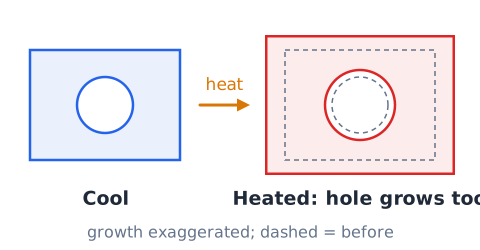
When a plate with a hole is heated evenly, the hole gets bigger, not smaller. Every distance in the metal grows by the same fraction, including the distance across the empty hole, as if the whole object were photographically enlarged. A metal ring grows in both its outer and inner diameters. Mechanics use this to loosen a stuck nut by heating it, or to fit a gear onto a shaft by heating the gear so its bore opens up.
Area expansion
A flat sheet expands in two directions, so its area grows about twice as fast, in fractional terms, as its length:
A steel plate warmed by 50°C grows in length by about 0.06 percent, so its area grows by about 0.12 percent. The same rule applies to the area of a hole in the plate.
Volume expansion
A solid block expands in all three directions, so its volume coefficient is about three times its linear coefficient:
Liquids are usually described directly by , since they have no fixed shape. Most liquids have larger volume coefficients than metals, which matters for anything filled with fluid.
Liquid expansion in a container
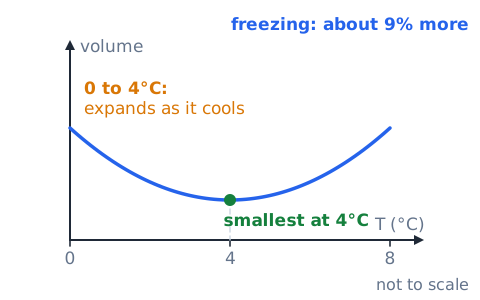
Both a liquid and its container expand when warmed, but liquids usually expand more. A gas can filled to the brim on a cool morning may overflow in the afternoon sun, and a car's cooling system needs an overflow reservoir for the same reason. Water is an exception between 0°C and 4°C, where it actually expands as it cools, and it expands by about 9 percent more when it freezes into ice, which is why freezing water can crack pipes and engine blocks.
Thermal expansion joints
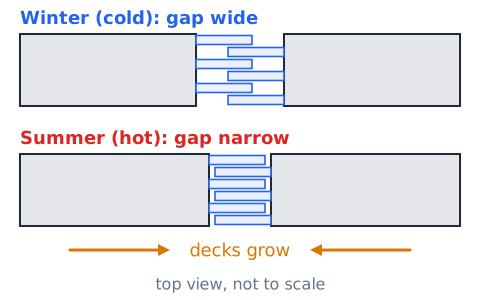
Long structures such as bridges, sidewalks, pipelines and railroad track change length with the seasons. Designers leave deliberate gaps or flexible sections called expansion joints so the parts can grow and shrink without pushing on each other. The finger-like steel plates at the ends of a highway bridge and the cut lines in a concrete sidewalk are examples. Without them, the material would buckle or crack.
Constrained expansion produces stress
If a bar is heated but its ends are held fixed, it cannot grow, so the supports squeeze it. The resulting thermal stress is the stress needed to push the bar back by the length it wanted to gain:
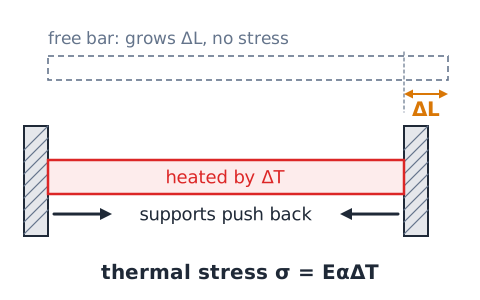
is the material's Young modulus. A free bar has no thermal stress. Notice that stress does not depend on length; a short and a long restrained bar of the same material develop the same stress.
Worked: thermal stress trend
Thermal stress grows with stiffness, with expansion coefficient and with temperature change, all in direct proportion. A fully restrained aluminum bar with
GPa and
/°C, warmed by 20°C, develops about 32 MPa. Double the temperature rise and the stress doubles to about 64 MPa. A material with half the coefficient but twice the stiffness would give the same stress, because only the product matters.
What a bimetal strip does
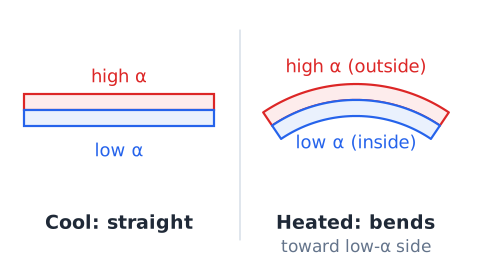
A bimetal strip is two metals with different expansion coefficients bonded together along their length. When heated, the high-expansion side grows more, so the strip curls toward the low-expansion side. When cooled, it bends the other way. Older thermostats, toasters, and circuit breakers use this bending to open or close electrical contacts at a set temperature, with no electronics needed.
Heat transfer: the three mechanisms
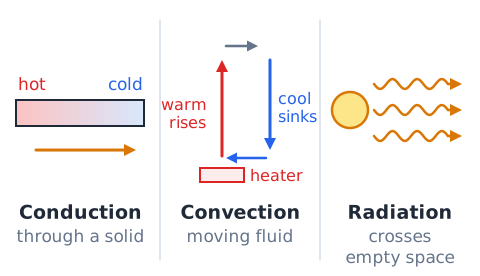
Heat moves in three ways. Conduction passes energy through a material by direct contact between particles, as along a metal rod. Convection carries energy by moving a fluid, such as warm air rising from a heater. Radiation sends energy as electromagnetic waves, mostly infrared, and can cross empty space, which is how sunlight warms Earth. Most real situations involve more than one at once.
Conduction in solids
In conduction, faster-vibrating particles at the hot end bump their neighbors, passing energy along toward the cold end. Heat always flows from higher temperature to lower temperature. A spoon left in hot soup grows warm at the handle by conduction. In metals, free electrons carry energy especially well, which is why metals feel colder to the touch than wood at the same temperature: they pull heat out of your hand faster.
Conductivity and insulation
The rate of heat flow through a flat layer is
is power in watts, is thermal conductivity in W/(m·K), is area, is the temperature difference across the layer, and is its thickness. Copper has a very high ; foam, fiberglass and still air have very low , which makes them good insulators.
Worked: wall conduction
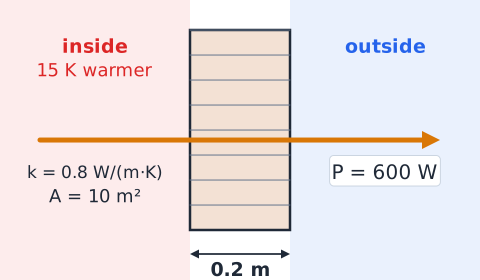
A brick wall is 0.2 m thick with area 10 m² and
W/(m·K). Inside is 15 K warmer than outside. Find the heat loss.
The wall loses 600 joules every second.
Doubling insulation thickness
Thickness sits in the denominator of the conduction equation, so heat flow is inversely proportional to it:
Doubling the insulation thickness cuts the heat flow in half, if everything else stays the same. Doubling the area instead doubles the heat flow. Layers stacked one after another add their resistances, much like springs in series.
Contact resistance and thermal paste
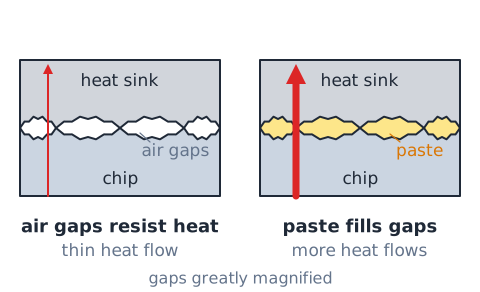
Two flat metal surfaces pressed together look smooth but actually touch only at tiny high spots, with small gaps of air between them. Air conducts heat poorly, so the joint resists heat flow. Thermal paste or a thermal pad fills those gaps with a material that conducts much better than air. That is why a computer processor needs paste between the chip and its heat sink, applied in a thin layer.
Convection in a moving fluid
Convection happens when a fluid carries heat as it moves. In natural convection, warmed fluid becomes less dense and rises while cooler fluid sinks to replace it, setting up a circulating current, as in a pot of heating water or a room with a baseboard heater. In forced convection, a fan or pump drives the flow, which moves heat much faster than natural circulation alone.
Why a fan cools a component
A hot component warms the thin layer of air touching it. If that air sits still, it heats up and slows further heat transfer. A fan sweeps the warm air away and replaces it with cooler air, keeping the temperature difference large and greatly increasing the rate of heat removal. This is forced convection, used in car radiators, computer cases and air-cooled engines.
Radiation needs no material medium
Every object emits electromagnetic radiation, and warmer objects emit more. Unlike conduction and convection, radiation needs no air, water or solid to travel through. Energy from the Sun crosses the vacuum of space to reach Earth and spacecraft. You feel radiation as warmth on your face from a campfire even when the air between you and the fire is cool.
Temperature and radiative power
The power radiated by a surface rises very steeply with absolute temperature:
is emissivity (1 for an ideal blackbody), is a physical constant, is area, and must be in kelvins. Because of the fourth power, doubling the absolute temperature multiplies radiated power by
Reflective and dark surfaces
Dark, dull surfaces absorb most radiation that hits them and are also good emitters. Shiny, light-colored surfaces reflect most radiation and emit poorly. That is why light-colored roofs stay cooler in sunshine, why emergency blankets are coated with shiny metal to keep body heat in, and why radiators and heat sinks are often painted or anodized dark to help them shed heat by radiation.
Which transfer method dominates?
Ask what connects the hot and cold regions. If they are joined by a solid, conduction usually leads. If a liquid or gas is moving between them, convection matters most, especially when a fan or pump is running. If there is a vacuum or a large gap with a very hot surface, radiation takes over. A space heater with a fan relies mainly on convection; a glowing heating element across the room warms you largely by radiation.
Heat capacity of an object
Heat capacity is the energy needed to raise an object's temperature by one degree. It depends on both the material and how much of it there is:
A large cast-iron pan has a bigger heat capacity than a small one of the same metal, so it takes longer to heat up and holds heat longer. Heat capacity is measured in J/K or J/°C.
Specific heat equation
The heat needed to change a material's temperature without a phase change is
is in joules, in kilograms, is the specific heat in J/(kg·K), and is the temperature change. Water has of about 4,200 J/(kg·K); most metals are a few hundred.
Worked: warming a metal block
A 1.5 kg aluminum block (
J/(kg·K)) warms from 20°C to 50°C. How much heat did it absorb?
The temperature change is 30°C, which equals 30 K, so it plugs straight into the formula. Heating the same mass of water through 30 degrees would take more than four times as much energy.
Water and thermal buffering
Water has an unusually high specific heat, about five times that of aluminum and roughly ten times that of iron. It soaks up a lot of energy for each degree it warms, so it changes temperature slowly. That makes water an excellent engine coolant, explains why coastal cities have milder weather than inland ones, and is why a pan of water on a stove takes much longer to heat than the empty pan alone.
Temperature difference matters
Both the heating equation and the conduction equation use a temperature change , not a single temperature. Since Celsius and Kelvin degrees are the same size,
Warming from 20°C to 70°C is a change of 50 K. Only formulas that use an absolute temperature itself, such as radiation, require converting to kelvins first.
Mixing temperatures and energy conservation
When hot and cold substances mix in an insulated container, the heat lost by the hot one equals the heat gained by the cold one:
Solve for the final temperature . It always lies between the two starting temperatures and sits closer to the object with the larger heat capacity.
Worked: mixing identical liquids
In an insulated jug, 3 kg of water at 15°C is mixed with 1 kg of water at 75°C. Since the specific heats are the same, they cancel, and the final temperature is a mass-weighted average:
The result is closer to 15°C because there is more cold water. With equal masses, the result would be the simple average.
Phase changes store and release energy
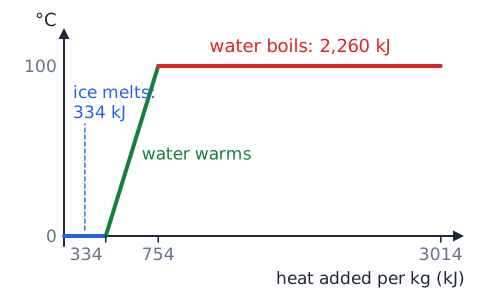
Melting, boiling, freezing and condensing all involve energy even though the temperature does not change while they happen. When ice at 0°C melts, the added heat goes into breaking the bonds that hold it rigid, so the mixture stays at 0°C until all the ice is gone. Condensing steam releases a large amount of energy, which is why a steam burn is worse than a burn from boiling water at the same temperature.
Latent heat equation
The energy for a phase change at constant temperature is
is the mass and is the latent heat in J/kg. For water, the latent heat of fusion (melting) is about 334,000 J/kg, and the latent heat of vaporization (boiling) is about 2,260,000 J/kg.
Worked: melting ice at zero Celsius
How much energy is needed to melt 0.2 kg of ice that is already at 0°C? Use
J/kg.
The meltwater is still at 0°C. Any further warming would need added on.
Boiling points and pressure
A liquid boils when its vapor pressure equals the pressure above it. Raise the pressure and the boiling point goes up; lower it and the boiling point drops. A pressurized engine cooling system keeps coolant liquid well above 100°C, and a pressure cooker cooks faster for the same reason. At high altitude, where air pressure is lower, water boils below 100°C and food takes longer to cook.
Energy versus rate
Energy is an amount, measured in joules. Power is the rate at which energy is transferred, measured in watts, where 1 W is 1 J/s:
A 1,500 W kettle running for 120 s delivers 180,000 J. A higher wattage heater does not provide more total energy; it delivers the same energy in less time.
Efficiency and unavoidable losses
Efficiency compares useful output to total input:
If a motor takes in 2,000 J and delivers 500 J of useful work, its efficiency is 25 percent. The rest ends up mostly as heat. No real machine reaches 100 percent, and an answer above 100 percent signals an error.
Mechanical material properties overview
Engineers choose materials by how they respond to loads. Strength tells how much stress a material can take before it yields or breaks. Stiffness tells how much it deforms under a given stress. Ductility describes how far it can stretch before breaking; brittleness is the opposite. Hardness is resistance to scratching and denting, and toughness is the ability to absorb energy before fracture. Each property matters in different jobs.
Stress is force divided by area
Stress measures how concentrated a load is inside a part:
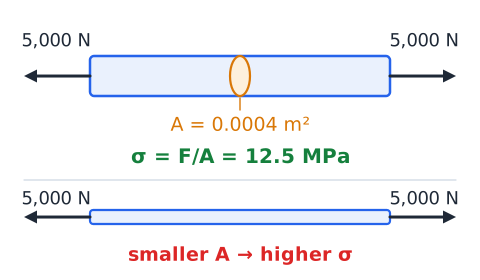
Force is in newtons and area in square meters, so stress is in pascals (Pa), often given in megapascals (MPa). A 5,000 N pull on a rod with cross-section 0.0004 m² gives a stress of 12.5 MPa. The same force on a thinner rod gives a higher stress.
Strain describes relative deformation
Strain is the change in length divided by the original length:
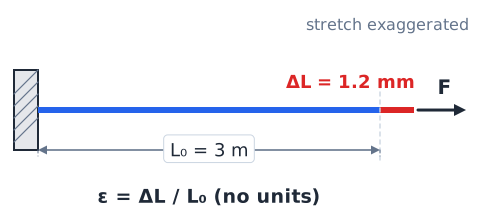
Because both lengths share units, strain has no units. A 3 m cable that stretches 1.2 mm has a strain of
Be sure both lengths are in the same unit before dividing.
Young modulus measures stiffness
In the elastic range, stress is proportional to strain, and the constant of proportionality is Young's modulus:
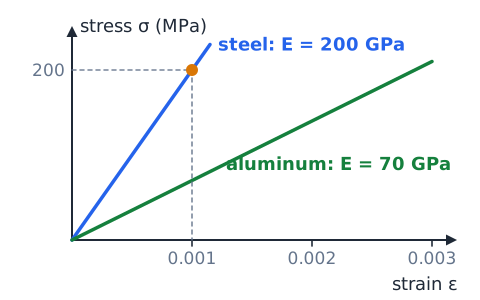
is in pascals, usually gigapascals. Steel is about 200 GPa and aluminum about 70 GPa, so steel stretches roughly a third as much under the same stress. A sample with 200 MPa stress and 0.001 strain has
GPa.
Elastic versus plastic deformation
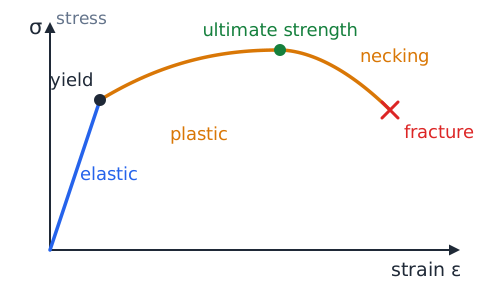
Under light loads, a metal deforms elastically: the atoms shift slightly and return to place when the load is removed. Beyond a certain stress, layers of atoms slip permanently past one another, and the part stays bent or stretched. That is plastic deformation. A paper clip bent slightly springs back; bent sharply, it stays bent. Structures are designed to stay in the elastic range during normal use.
Yield, ultimate strength, fracture
Yield strength is the stress at which permanent deformation starts. As loading continues, many metals harden and carry more stress until they reach the ultimate tensile strength, the highest stress on their stress-strain curve. After that, a ductile bar begins to neck down in one spot, and it finally breaks at fracture. Designers usually base safe loads on yield strength, with a safety factor added.
Ductility and brittleness
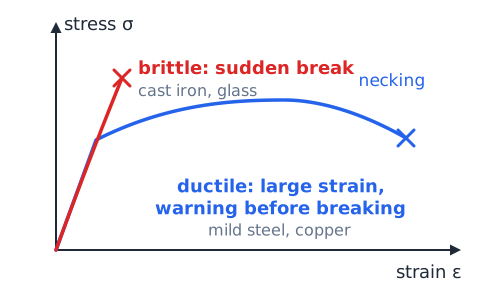
A ductile material, such as mild steel, copper or aluminum, can stretch a great deal before breaking and usually gives visible warning by bending or necking. A brittle material, such as cast iron, glass or ceramic, breaks with little or no deformation, often suddenly. Ductility is valuable in structures because it lets parts deform and redistribute load instead of snapping. Low temperatures can make some steels more brittle.
Toughness versus hardness
Hardness is resistance to surface indentation and wear; a file or a drill bit must be hard. Toughness is the ability to absorb energy and resist cracking under impact; a hammer head or a bulldozer blade must be tough. The two can conflict: very hard steel is often brittle. Heat treatment lets manufacturers choose a balance, such as a hard surface over a tough core.
Fatigue under repeated loading
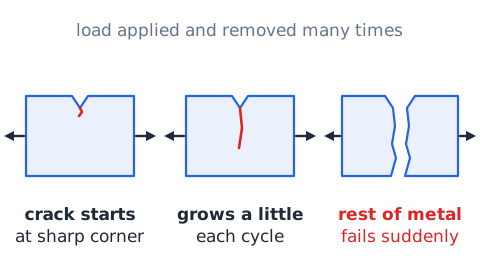
Fatigue is failure caused by loads that are applied and removed many times, even when each load is below the stress that would break the part in a single pull. A tiny crack starts at a scratch, sharp corner or weld flaw and grows a little with each cycle until the remaining metal suddenly fails. Axles, aircraft skins, crankshafts and springs are all designed with fatigue in mind.
Thermal shock and uneven heating
When one part of an object heats or cools much faster than another, the parts try to expand by different amounts, creating internal stress. In brittle materials this can cause cracking, called thermal shock. Pouring cold water on a hot glass dish or a hot cast-iron engine block can crack it. Materials with low expansion, such as borosilicate glass, resist thermal shock better.
Creep at sustained high temperature
Creep is slow, permanent deformation under a steady load that continues over time. At room temperature most metals creep very little, but at high temperatures, such as in jet engine turbine blades, boiler tubes or exhaust manifolds, the effect becomes significant. Over months or years, parts can stretch or sag enough to fail. High-temperature alloys and ceramics are chosen to resist creep.
Corrosion and temperature
Corrosion is the chemical attack of a metal by its environment, such as rust forming on steel exposed to water and oxygen. Higher temperatures usually speed up chemical reactions, so hot exhaust parts, boiler surfaces and engine cooling passages can corrode faster. Corrosion thins the metal, roughens the surface, and creates pits where fatigue cracks start. Coatings, inhibitors in coolant, and corrosion-resistant alloys help prevent it.
Thermal conductivity is not thermal expansion
These two properties are easy to confuse because both involve heat. Thermal conductivity describes how fast heat flows through a material. Thermal expansion describes how much the material changes size when its temperature changes. A material can be high in one and low in the other. Copper conducts heat very well; invar, an iron-nickel alloy, barely expands. Read carefully to see which property a question asks about.
Heat treatment changes materials
Heating and cooling metals in controlled ways changes their internal structure and properties. Quenching hot steel in water or oil makes it hard but brittle. Tempering, a gentle reheat afterward, reduces brittleness and restores some toughness. Annealing, slow cooling from high temperature, softens metal and makes it easier to shape. These processes let one steel serve as a soft wire or a hard cutting tool.
Brakes convert motion into heat
Friction brakes turn a vehicle's kinetic energy into heat in the pads, rotors and drums:
A 1,200 kg car stopping from 20 m/s must dissipate 240,000 J. Because energy depends on speed squared, stopping from twice the speed requires four times as much heat to be absorbed. Overheated brakes can fade, losing stopping power.
Engine cooling systems
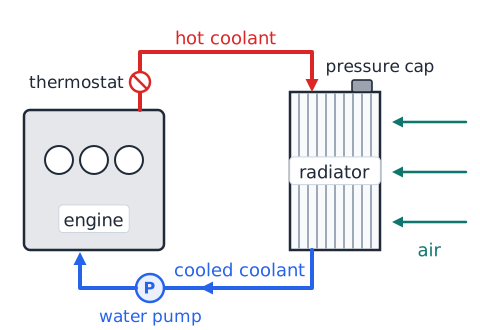
Burning fuel in an engine produces far more heat than useful work. The cooling system pumps a water and antifreeze mixture through passages around the cylinders, where it picks up heat by conduction and convection. The hot coolant flows to the radiator, where air flowing through the fins carries the heat away. A thermostat valve stays closed until the engine warms up, and a pressurized cap raises the coolant's boiling point.
Bearings, fits, and clearances
Moving parts such as shafts and bearings need small clearances. As machinery warms up, parts expand, and if they expand at different rates, clearances can shrink and cause binding, or grow and cause looseness. Engineers allow for this in their designs. For shrink fits, a bearing or gear is heated so its bore expands, slipped over the shaft, and then left to cool, gripping tightly as it contracts.
Electrical components and heat sinks
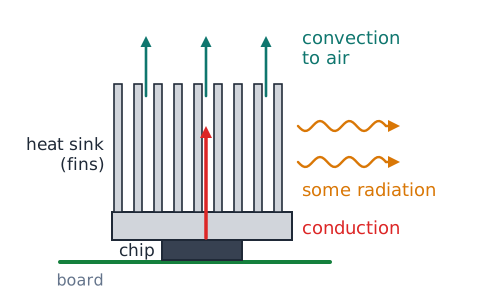
Electrical current in resistors, transistors and processors produces heat. If it is not removed, components overheat and fail. A heat sink is a block of metal, usually aluminum or copper, with many fins. It draws heat away from the component by conduction, spreads it over a large surface, and releases it to the air by convection and some radiation. Fans increase airflow and boost cooling further.
Pipes, exhausts and weldments
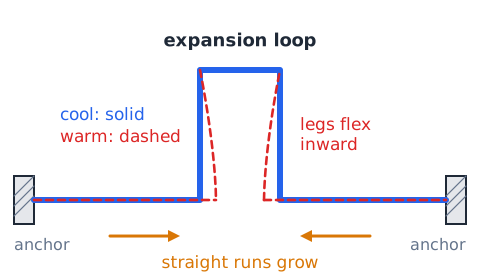
Hot-water and steam pipes change length as they warm, so long runs include expansion loops, bends or flexible joints. Exhaust systems get very hot and use hangers that allow sliding and flex. Welding heats a small area intensely; as the weld cools and shrinks, it can pull parts out of line and leave internal stress. Welders use clamps, preheating and controlled cooling to limit this distortion and cracking.
Units and power-of-ten discipline
Heat and materials problems mix large and small numbers. Modulus is often in gigapascals ( Pa), stress in megapascals ( Pa), and expansion coefficients near per degree. Convert millimeters to meters before using SI formulas, and write answers in a convenient unit afterward. Keep track of each power of ten and check that the final value has a reasonable size.
Worked synthesis: heat and expansion
A 6 m copper water pipe (
/°C, mass 4 kg,
J/(kg·K)) warms from 20°C to 80°C.
Expansion:
about 6.1 mm.
Heat absorbed:
The pipe needs room to grow about 6 mm, and the water supply must deliver over 92 kJ just to warm the copper.
Common trap: temperature versus energy
Questions sometimes ask which object holds more thermal energy, then show a small object at a high temperature beside a large object at a lower one. Temperature alone does not decide it; mass and specific heat matter too. Likewise, during melting or boiling, energy flows in while temperature stays steady. Do not assume that a constant temperature means no heat is entering, or that the hotter object always has more energy.
Common trap: holes shrink when heated
Many people expect a hole in a heated plate to shrink as the metal around it expands inward. It does not. The metal expands uniformly in every direction, so all dimensions, including the hole, grow by the same fraction. Picture the plate drawn on a photo that is being enlarged. The same applies to the inner diameter of a ring or the bore of a gear.
Common trap: using Celsius in T⁴
In radiation problems, the emitted power depends on , and must be absolute temperature in kelvins. Using Celsius gives nonsense; for example, 0°C would wrongly predict no radiation at all. Doubling a temperature from 100°C to 200°C does not multiply radiated power by 16, because in kelvins that is only from 373 K to 473 K. Convert to kelvins first, then compare.
Common trap: confuse strong with stiff
Strength and stiffness are different properties. Stiffness, measured by Young's modulus, tells how much a part stretches under a given load. Strength tells how much load it can carry before yielding or breaking. A rubber band is very flexible but can still be fairly strong for its size; a glass rod is very stiff but breaks easily. When a question asks which part deflects less, it is asking about stiffness, not strength.
Final integrated reasoning
Most problems in this topic come down to three questions. What is changing: temperature, size, phase, or load? Which relationship applies: expansion, heat capacity, latent heat, conduction, or stress and strain? Which quantities scale directly, inversely, or with a power? Solve with consistent SI units, check that your answer has a sensible size, and confirm that the direction of heat flow, from hot to cold, and the direction of size change make physical sense.
Compact reference formulas
Temperature:
Expansion:
Heat:
Conduction:
Radiation:
with in kelvins.
Materials:
restrained thermal stress
 English ▾