 ASVAB Camp
Learning objectives and scope
In this lesson you will learn to tell static friction from kinetic friction, find the normal force on flat floors and on ramps, and use the dry-friction model
with the correct coefficient. You will predict which way friction points, compute net force and acceleration for sliding objects, find the work friction does, and solve ideal braking and slipping problems at ASVAB level.
Why friction matters in machines
Friction is the contact force that resists surfaces sliding across each other. Machines both fight it and rely on it. Bearings, oil and polished slides exist to reduce it, because friction wastes power and wears parts. Brakes, clutches, belts, tires and bolted joints need it, because without grip they cannot transmit force or hold position. Mechanical questions often hinge on which role friction is playing.
Contact surfaces and relative motion
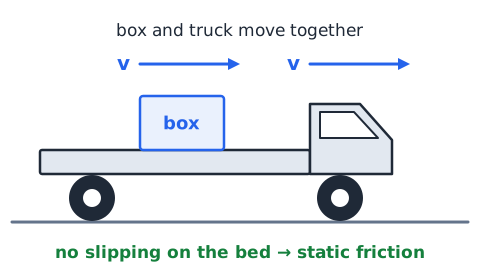
Friction acts only where two surfaces touch, and it always lies along the contact surface, parallel to it. What matters is relative motion between the two surfaces, not motion relative to the room. A box riding on a moving truck bed may be moving down the road while not sliding on the bed at all. If the surfaces are not slipping past each other, any friction present is static friction.
Static friction is adjustable
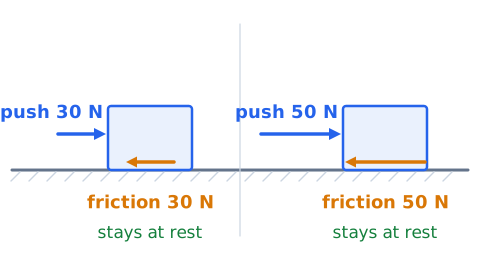
Static friction acts between surfaces that are not slipping. It is not a fixed number. It grows or shrinks to exactly balance whatever tends to cause slipping, up to a limit.
Push a heavy cabinet with 30 N and it stays put: static friction is 30 N backward. Push with 50 N and, if still under the limit, friction rises to 50 N.
The maximum static limit
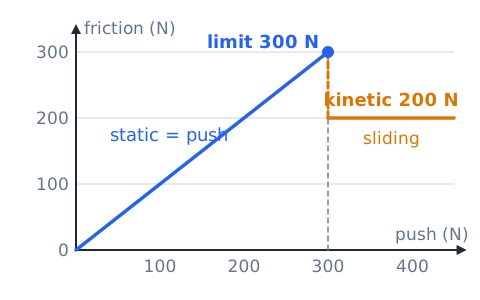
The largest static friction a contact can supply is the static coefficient times the normal force.
With
and a normal force of 500 N, the limit is 300 N. Any push below 300 N is matched exactly. Only a push greater than 300 N can start the object sliding.
Kinetic friction while sliding
Once surfaces slip past each other, kinetic (sliding) friction takes over. In the simple model it has a fixed size, set by the kinetic coefficient and the normal force, and it does not depend on how fast the object slides.
With
and N = 500 N, sliding friction is 200 N. It points opposite the direction of slipping, along the surface.
Static versus kinetic coefficients
For most pairs of materials the static coefficient is larger than the kinetic one. That is why a heavy desk needs a hard shove to get going but then keeps sliding with less effort. Typical values: rubber on dry concrete near 1.0 static and 0.7 kinetic; steel on steel near 0.7 and 0.6; waxed wood on wet snow far lower. Exact values vary with condition.
Coefficient has no physical unit
A friction coefficient is a ratio of two forces, friction divided by normal force, so the newtons cancel and it is dimensionless.
A slide that needs 45 N to keep moving under a 150 N normal force has
The value describes the pair of surfaces in contact, not either surface alone.
Normal force is perpendicular
The normal force is the push a surface exerts on an object, straight out of the surface. "Normal" here means perpendicular. On a level floor it points straight up. On a ramp it tilts, staying at right angles to the ramp face. It is a reaction force: it becomes whatever size is needed to keep the object from moving into the surface.
Mass, gravity, and weight
Mass, measured in kilograms, is how much matter an object has. Weight is the gravitational force on that mass, measured in newtons.
Near Earth g is about 9.8 m/s², often rounded to 10. A 25 kg toolbox weighs
Friction formulas need the normal force in newtons, so convert kilograms to newtons first.
Balanced forces do not imply no friction
Zero net force means zero acceleration, not zero friction. A crate dragged at a steady speed with a 90 N horizontal rope has balanced horizontal forces, so kinetic friction must be exactly 90 N backward.
Likewise, a parked object being pushed but not moving has static friction equal to the push.
Free-body diagram procedure
Draw the object as a simple box. Add every force acting on it, each as an arrow starting at the box: weight straight down, normal force perpendicular to the surface, any applied pushes or pulls, and friction along the surface. Choose axes, usually along and perpendicular to the surface. Then sum forces on each axis separately and apply Newton's second law.
Horizontal crate with modest push
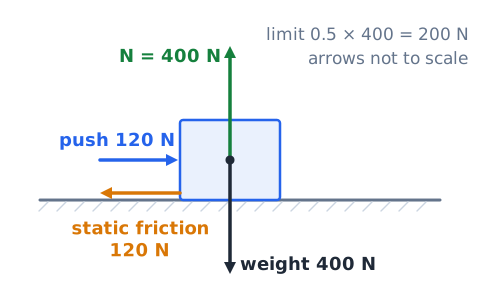
A 400 N crate rests on a level floor with
Its static limit is
A worker pushes horizontally with 120 N. Since 120 N is below the limit, the crate stays at rest and static friction is 120 N opposite the push, not 200 N.
Starting motion versus continuing motion
Getting an object moving requires beating the static limit, . Once it slides, only kinetic friction, , resists. Since the kinetic value is usually smaller, the force needed drops the instant sliding begins. If you keep pushing with the starting force, the object will speed up rather than move at constant speed.
Net force while an object slides
While an object slides, subtract kinetic friction from the applied force along the direction of motion, then use Newton's second law.
A 30 kg cart pushed with 150 N against 90 N of friction has a 60 N net force and accelerates at 2 m/s².
Friction can produce negative acceleration
If nothing pushes a sliding object along the floor, kinetic friction is the only horizontal force, so it slows the object. On a level floor
and the mass cancels.
With
the deceleration is 2.45 m/s². Every object on that surface slows at the same rate, regardless of mass.
Kinetic friction and sliding distance
Combine the friction deceleration with the stopping relation to get how far an object slides before stopping.
A package shoved at 6 m/s across a floor with
slides
Surface materials and finish
The coefficient depends on both materials and on surface condition. Rubber grips concrete well; polished steel on polished steel grips less; Teflon on almost anything is very slippery. Roughening a surface, as with sandpaper, knurled handles or textured flooring, usually raises friction. Polishing, lubricating or adding a layer of water, dust or ice usually lowers it.
Normal force and pressing down
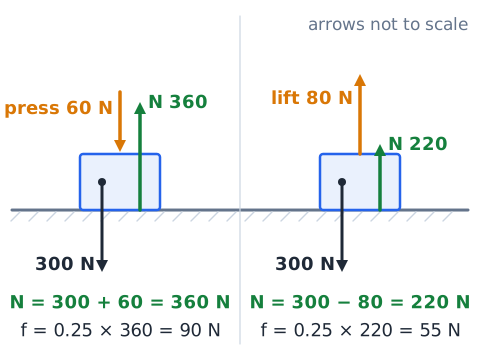
Extra downward force on an object increases the normal force, which raises friction. A 300 N box with someone pressing straight down on it with 60 N has
With
sliding friction becomes
N instead of 75 N. Pressing down makes a box harder to slide.
Normal force and lifting slightly
An upward force that does not lift the object off the floor reduces the normal force. A 300 N box with an 80 N upward lift has
With
friction drops to 55 N. That is why tilting a load up slightly or pulling a sled with an upward-angled rope makes it easier to drag.
Vertical force from downward angled push
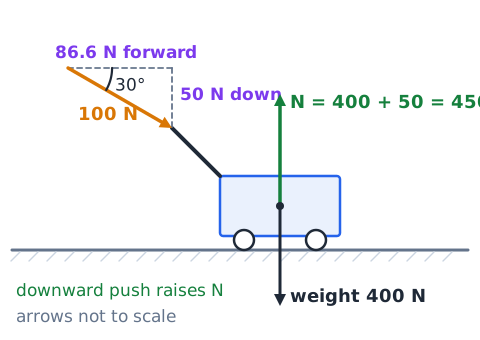
Pushing a cart handle downward at an angle splits the push into two parts. A 100 N push angled 30 degrees below horizontal has
pointing down, and
N forward. On a 400 N cart the normal force becomes 450 N, raising friction.
Horizontal component of angled pull
When a rope pulls at an angle above horizontal, only the horizontal component moves the object along the floor.
A 40 N pull at 30 degrees gives about 34.6 N forward and 20 N upward. The upward part lowers the normal force and therefore lowers friction.
Ramp directions: parallel and perpendicular
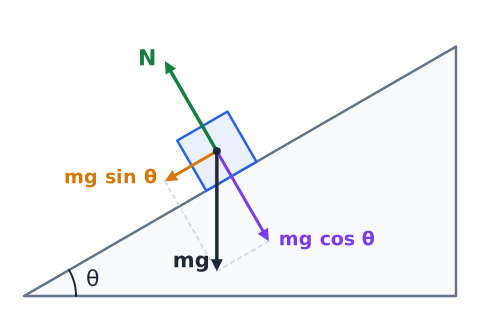
On a ramp tilted at angle , tilt your axes to match: one along the slope, one perpendicular to it. Weight is then split into two components.
The parallel part pulls the object down the slope. The perpendicular part presses it into the ramp and is balanced by the normal force, so
when no other perpendicular forces act.
Gravity down a slope
The steeper the slope, the larger the downhill pull. On a 30 degree ramp,
so a 200 N crate feels a 100 N pull down the slope. At 0 degrees the pull is zero; at 90 degrees (a vertical wall) it equals the full weight.
Threshold for resting on an incline
An object stays at rest on a ramp only if static friction can hold the downhill pull:
Divide both sides by and the weight cancels.
So whether an object slips depends on the angle and the coefficient, not on how heavy it is.
Angle of repose meaning
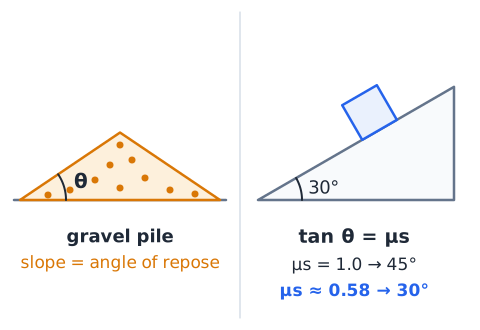
The angle of repose is the steepest angle at which an object, or a pile of loose material like gravel or sand, can rest without sliding. At that angle
If
the critical angle is 45 degrees. If
it is about 30 degrees. Tilt any steeper and sliding starts.
Downhill sliding with kinetic friction
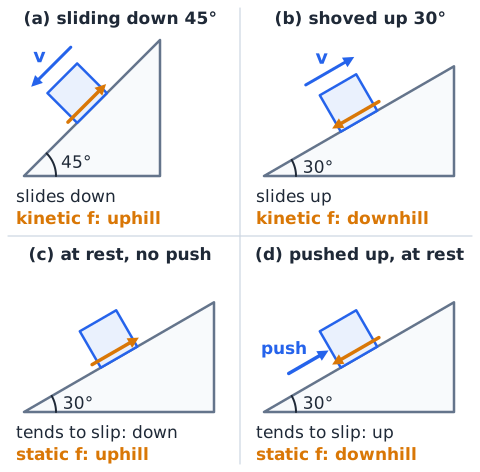
For an object already sliding down a slope, gravity's parallel part pulls it down while kinetic friction acts uphill. Mass cancels:
On a 45 degree chute with
the acceleration is about 4.95 m/s² down the slope. If the bracket were negative, the object would slow down instead.
Sliding uphill and friction direction
A block shoved up a ramp slides uphill, so kinetic friction points downhill, adding to gravity's pull. Both slow it.
On a 30 degree ramp with
the block slows at about 6.73 m/s². After it stops, friction may switch direction.
Static friction can point uphill
When an object rests on a ramp with nothing else pushing along the slope, gravity tends to pull it downhill. Static friction opposes that tendency, so it points up the slope. Its size equals the downhill gravity component, , as long as that stays below the static limit. A parked car on a hill is held this way.
Static friction can point downhill
Static friction opposes the tendency to slip, which is not always downhill. If a worker pushes a crate up a ramp harder than gravity's downhill pull, but not hard enough to start it moving, the crate tends to slip upward. Static friction then points downhill to hold it still. Find the direction from the net tendency, not from the slope alone.
Two contact surfaces in one system
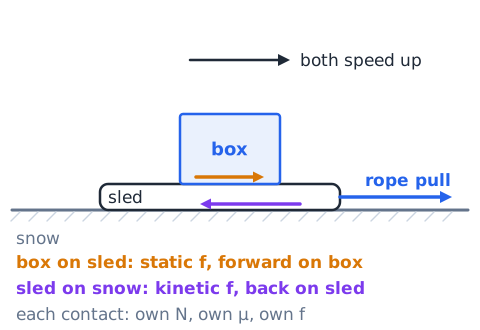
Some setups have more than one friction contact: a box stacked on a sled that is dragged across snow, or a block clamped between two plates. Each contact has its own normal force, its own coefficient and its own friction. Analyze each one separately. The top box may ride along with static friction while the sled slides on the snow with kinetic friction.
Walking needs friction
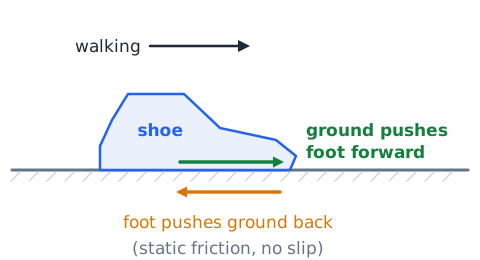
When you walk, your foot pushes backward on the ground. If the shoe does not slip, static friction from the ground pushes your foot forward, and that forward force is what moves you. On ice the static limit is tiny, so a normal step makes the foot slide back. Short steps help on slippery surfaces because they need less horizontal force at each footfall.
Tires: rolling and sliding
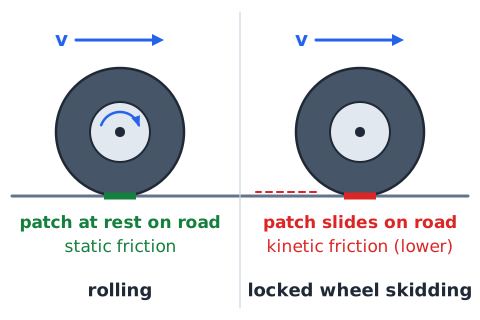
A tire rolling without skidding has a contact patch that is momentarily at rest relative to the road, so static friction transmits driving and braking forces. If the wheel locks and skids, the patch slides, and the lower kinetic friction takes over. That is why a skidding car usually takes longer to stop and cannot steer well. Anti-lock brakes keep tires near the static limit.
Why bearings lower resistance
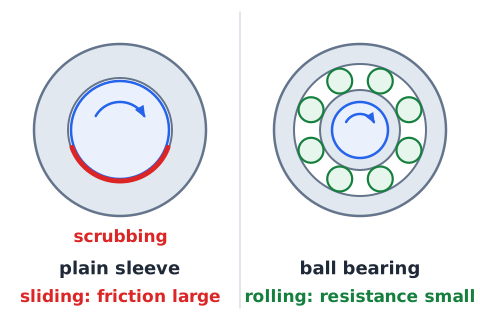
A ball or roller bearing replaces sliding contact with rolling contact. Rolling resistance is usually far smaller than sliding friction, because the surfaces do not scrub past one another. Bearings let wheels, shafts and fans spin with little power lost to heat. They need clean, lubricated races; dirt or a dry bearing raises resistance, causes heating, and speeds wear.
Lubrication and friction changes
A lubricant such as oil or grease places a thin film between surfaces so they slide on the fluid rather than grinding directly against each other. This sharply lowers friction, cuts wear, and carries away heat. The friction that remains depends on the lubricant's thickness and on speed, so the simple dry-friction coefficient no longer fully describes the contact.
Viscous drag is a different model
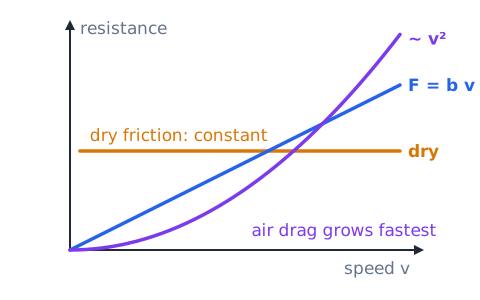
Dry friction is roughly constant regardless of speed. Fluid resistance behaves differently: it grows as speed grows. For slow motion through a thick fluid, a simple model is
where b depends on the fluid and the object's shape. Doubling speed doubles this drag. At higher speeds, air drag grows even faster, roughly with the square of speed.
Why apparent contact area may mislead
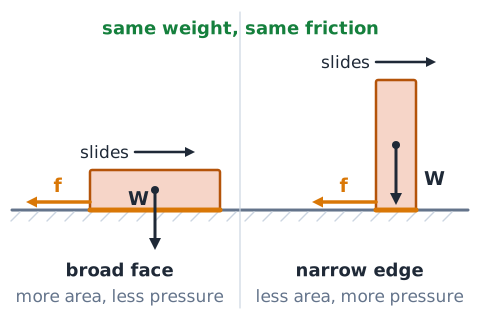
In the simple dry-friction model, friction does not depend on how much area appears to be in contact. A brick slides with the same friction on its broad face as on its narrow edge. A larger face spreads the same weight over more area, so pressure on each spot falls, and the two effects cancel. Real surfaces touch only at tiny high points anyway.
Friction and temperature
Sliding friction turns motion into heat, so surfaces get hotter, as anyone who rubs their hands together knows. Temperature in turn can change friction. Hot brake pads can lose grip, called brake fade. Hot oil becomes thinner, reducing film strength. Rubber gets softer and may grip differently. The constant coefficient in textbook problems assumes these effects are small.
Heat and wear are not identical
Friction always converts some mechanical energy into heat, equal to friction force times sliding distance. A 40 N friction force over 5 m of sliding produces 200 J of heat. Wear is different: it is material actually being removed or deformed. A well-lubricated joint may run warm with little wear, while dry, gritty contact can wear fast at modest temperature.
Braking and available traction
Braking stops a vehicle through friction between tire and road. The greatest deceleration the road can supply, with tires not skidding, is limited by the coefficient.
With
the best possible deceleration is 8 m/s². Wet or icy roads lower , so maximum deceleration drops. Pressing the pedal harder cannot exceed this limit.
Ideal braking distance
Combining
with the stopping relation gives the ideal braking distance on level road.
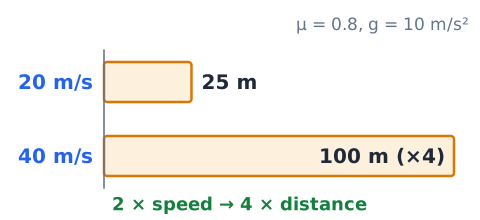
At 20 m/s with
the distance is
Because speed is squared, doubling speed makes braking distance four times longer.
Pushing with changing load
Adding cargo to a cart raises its weight, which raises the normal force and therefore friction. Unloading lowers both. On a flat surface the ratio stays the same: the needed push per newton of weight is the coefficient. A cart that needs 40 N to keep rolling with 400 N of load will need about 80 N with 800 N of load, if the coefficient stays constant.
Worked example: static crate
A 50 kg crate rests on level concrete with
Use
Normal force is
A 150 N push leaves it at rest with 150 N of static friction. A 250 N push exceeds the limit, so it starts to slide.
Worked example: kinetic crate
A 40 kg crate slides across a floor with
while pushed with 200 N. Use
Normal force: 392 N. Friction:
The crate speeds up at about 1.57 m/s².
Worked example: incline components
An 80 N toolbox rests on a ramp tilted 25 degrees. Find its weight components.
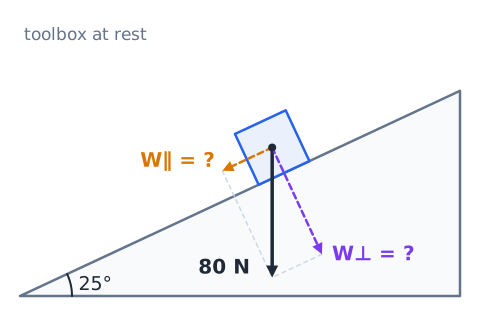
The normal force is about 72.5 N, and about 33.8 N pulls the box down the slope.
Worked example: slipping threshold
A rubber mat on a tilting board has
At what angle will a loaded box on it begin to slip?
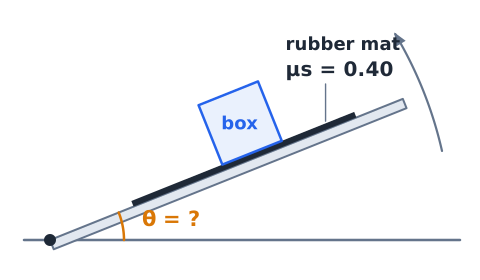
Set
and solve:
Below about 22 degrees the box stays put, whatever its weight; above that it slides.
Worked example: stopping distance
A hockey puck leaves a stick at 5 m/s on ice where
Use
Deceleration:
It glides 25 m and takes
s to stop.
Worked example: angled pull
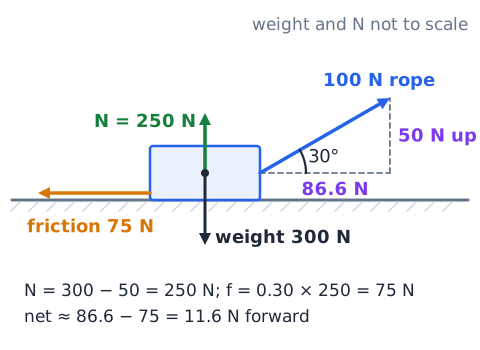
A 300 N sled (mass 30 kg, g = 10) is dragged by a 100 N rope at 30 degrees above horizontal, with
Forward part: about 86.6 N. Upward part: 50 N, so N = 250 N.
Friction:
Net force is about 11.6 N, so
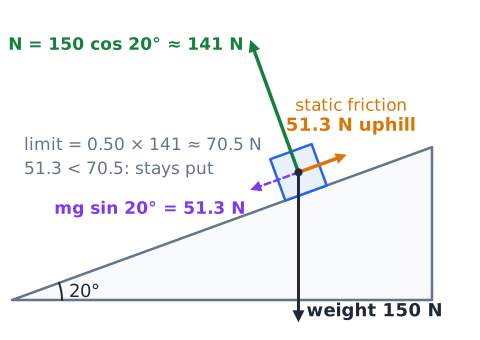
Worked example: ramp at rest
A 150 N box sits on a 20 degree ramp with
Downhill pull:
Static limit:
The pull is less than the limit, so the box stays put, held by 51.3 N of static friction pointing uphill.
Common trap: friction always opposes velocity
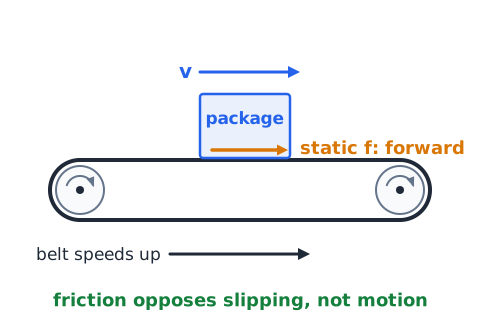
Friction opposes relative slipping between the surfaces, not necessarily the object's velocity relative to the ground. A package on an accelerating conveyor belt moves forward, and static friction on it also points forward, because the belt drags it along. The same is true for a walker's foot and a driven tire. Ask which way the surfaces would slip without friction.
Common trap: mu-s times N at rest
The product is the maximum static friction, not the actual value. At rest, friction equals only what is needed to balance other forces. A box pushed with 20 N whose limit is 90 N has 20 N of friction, not 90 N. Use the full only when the object is on the verge of slipping.
Common trap: the normal force is weight
The normal force equals weight only on a level surface with no other vertical forces and no vertical acceleration. On a ramp it is . A downward push adds to it; an upward pull subtracts from it. In an accelerating elevator it changes too. Always find N from a force balance perpendicular to the surface.
Common trap: heavier means faster slowdown
A heavier sliding object has more friction, but it also has more mass to slow. The two cancel.
A 10 kg box and a 40 kg box on the same floor with
(g = 10) both slow at 2 m/s² and, from the same speed, slide the same distance.
Common trap: friction always wastes energy
When kinetic friction acts opposite the sliding, it does negative work, , and turns mechanical energy into heat. But friction is not always a loss. Static friction does no slipping, so it creates no heat, and it can do useful positive work: it pushes a package forward on a belt, and it supplies the forward force that drives a car. Brakes rely on friction's energy conversion to stop a vehicle.
Surface contamination and wet floors
A thin film of water, oil, grease, dust or ice between a shoe and the floor can slash the friction coefficient. Most slips and falls happen this way. Good safety practice is to clean spills right away, mark wet areas, use mats at entrances, and wear slip-resistant footwear. Clean, dry surfaces keep friction close to the values used in problems.
Friction in clutches and brakes
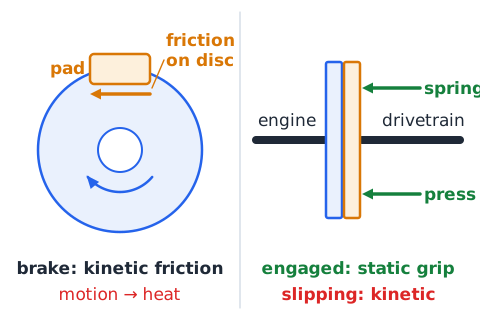
A brake presses a pad or shoe against a rotating disc or drum. Kinetic friction between them slows the rotation and turns motion into heat. A clutch presses two friction plates together so engine torque can pass to the drivetrain; when fully engaged the plates grip without slipping, using static friction. Worn friction material or contamination lowers the coefficient and weakens both.
Belt-drive traction versus slipping
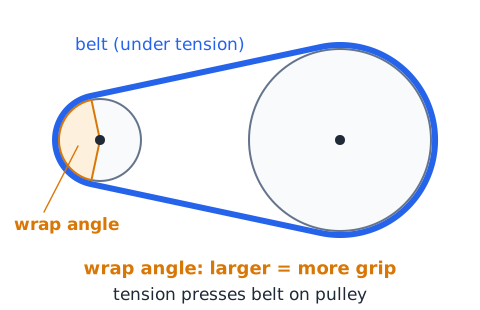
A belt transmits power only through friction where it wraps around the pulleys. Tension presses the belt against the pulley, creating normal force and therefore available grip. If the load demands more force than friction can supply, the belt slips, squeals, heats and wears. Proper tension and a larger wrap angle increase grip. A toothed timing belt avoids slip entirely by meshing.
Fasteners and resistance to loosening
A tightened bolt clamps parts together and stretches slightly, like a stiff spring. Friction in the threads and under the head resists the bolt turning loose. Vibration can momentarily reduce that grip, letting the bolt back off. Lock washers, thread-locking compounds, nylon-insert nuts and correct torque all help keep enough clamp force and friction to hold the joint.
Estimating measurements realistically
Real friction coefficients are not exact constants. They vary with moisture, dust, temperature, wear and even sliding speed. Test values are rounded for convenience, such as 0.2, 0.3 or 0.5, and g is often 10 m/s². Treat calculated forces and distances as estimates. When an answer matters for safety, such as a stopping distance, plan for a lower coefficient than ideal.
How to solve a friction question
Start by deciding whether the surfaces are slipping. If not, friction is static and equals what is needed for balance, up to . If they are slipping, friction is kinetic and equals . Find the normal force from the perpendicular force balance. Point friction against the tendency to slip. Then apply Newton's second law along the surface.
Mixed contact and direction check
Before finalizing an answer, check each contact. Is it static or kinetic? Is friction along the surface? Does it oppose the relative slip at that contact? Does the normal force include all perpendicular pushes and pulls? Is the answer smaller than the static limit if the object is at rest? A quick check like this catches most sign and model errors.
When the textbook model breaks down
The simple model treats friction as proportional to normal force, independent of contact area and sliding speed, with constant coefficients. Real contacts often deviate. Very high pressure, soft materials like rubber, lubricated joints, very high speeds, and surfaces that stick and slip in jerks all behave differently. Engineers then rely on measured data instead of a single coefficient.
End-of-lesson synthesis
Static friction adjusts to match the load, up to . Kinetic friction is and opposes slipping. Find N from the perpendicular balance: mg on level ground, on a ramp, adjusted by any vertical push or pull. Sliding on level ground slows at ; braking distance is . Friction work while sliding is .
 English ▾