 ASVAB Camp
Learning Outcomes, Level, and Honest Exam Context
This lesson covers triangle skills that can appear in ASVAB Mathematics Knowledge: the 180-degree angle sum, exterior angles, isosceles base angles, classification, the triangle inequality, perimeter and area, the Pythagorean theorem and its converse, congruence and similarity, and the 45-45-90 and 30-60-90 special right triangles. The level is high-school geometry. The test samples a broad range of topics, so expect some of these ideas rather than all of them on any one form.
Triangle Anatomy and Labeling
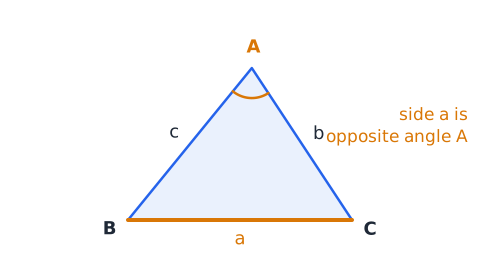
A triangle has three vertices, three sides, and three interior angles. Vertices are named with capital letters, as in triangle ABC. The side opposite a vertex is often labeled with the matching lowercase letter, so side a lies across from angle A. Each side joins two vertices: side BC connects B and C and is the side opposite angle A.
Interior Angle-Sum Theorem
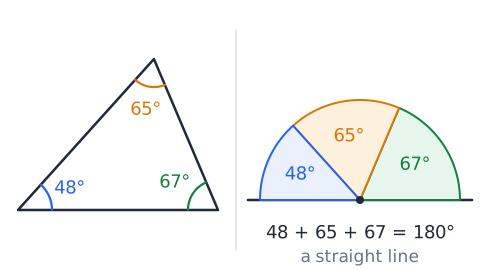
The three interior angles of any triangle add up to 180 degrees. If two angles are 48 and 67 degrees, the third is
One way to see why: tear the three corners off a paper triangle and line them up; together they form a straight line.
Angles Defined by Algebraic Expressions
When angles are written as expressions, add them and set the sum equal to 180. For angles of x, 2x and (x + 20) degrees,
so x = 40. The angles are 40, 80 and 60 degrees. Always substitute back to find each angle and confirm the total is 180.
Side-Based Classification
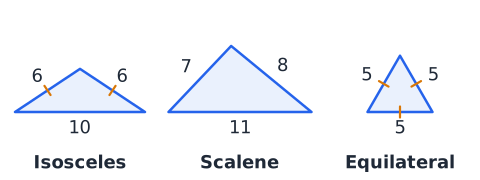
By sides, a triangle is equilateral if all three sides are equal, isosceles if at least two sides are equal, and scalene if no two sides are equal. A triangle with sides 6, 6 and 10 is isosceles; 7, 8 and 11 is scalene; 5, 5 and 5 is equilateral, which also makes each of its angles 60 degrees.
Angle-Based Classification
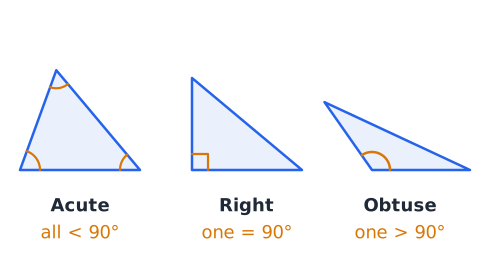
By angles, a triangle is acute if all three angles are less than 90 degrees, right if one angle is exactly 90 degrees, and obtuse if one angle is greater than 90 degrees. A triangle can have at most one right or obtuse angle, because two such angles alone would reach at least 180 degrees.
Isosceles Base Angles
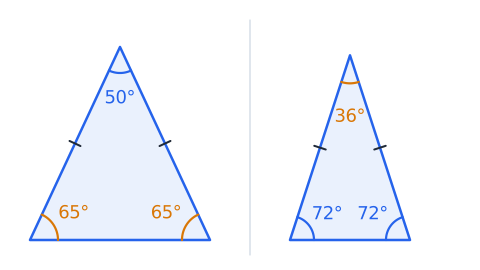
In an isosceles triangle, the angles opposite the two equal sides, called base angles, are equal. The third angle is the vertex angle. If the vertex angle is 50 degrees, each base angle is
If a base angle is 72 degrees, the vertex angle is
Exterior Angle Theorem
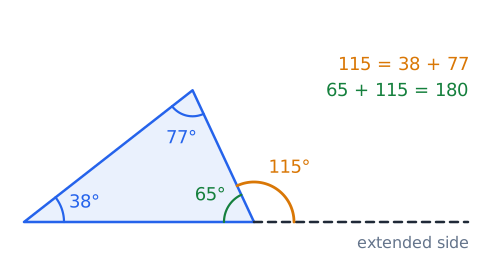
Extend one side of a triangle past a vertex, and the angle formed outside is an exterior angle. It forms a linear pair with the interior angle beside it, so those two add to 180 degrees. It also equals the sum of the two remote interior angles, the ones not touching it. If the remote angles are 38 and 77 degrees, the exterior angle is 115 degrees and the adjacent interior angle is 65 degrees.
Angle Size and Opposite Side Length
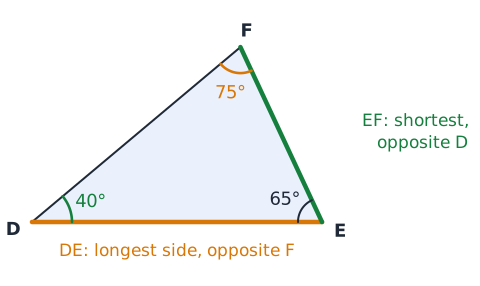
In any triangle, the largest angle lies opposite the longest side and the smallest angle lies opposite the shortest side. If triangle DEF has angles D = 40, E = 65 and F = 75 degrees, the longest side is DE, opposite F, and the shortest is EF, opposite D. In a right triangle, the hypotenuse is always the longest side.
Triangle Inequality: Can These Sides Form a Triangle?
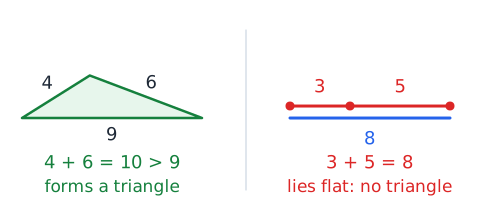
Three lengths form a triangle only if each pair adds to more than the third. A shortcut: check that the two shorter sides sum to more than the longest. Lengths 4, 6 and 9 work because
which beats 9. Lengths 3, 5 and 8 fail because 3 + 5 only equals 8, which lies flat as a segment.
Integer Side Constraints
If two sides are a and b with a smaller than b, the third side must be greater than b - a and less than a + b. With sides 6 and 11, the third side is between 5 and 17, not including either, so whole-number options run from 6 to 16.
Perimeter of a Triangle
The perimeter is the total distance around a triangle: add the three side lengths. A triangular garden bed with sides of 7 ft, 10 ft and 12 ft has a perimeter of 29 ft. Keep units consistent, converting inches and feet to one unit before adding.
Area: Half Base Times Perpendicular Height
The area of a triangle is
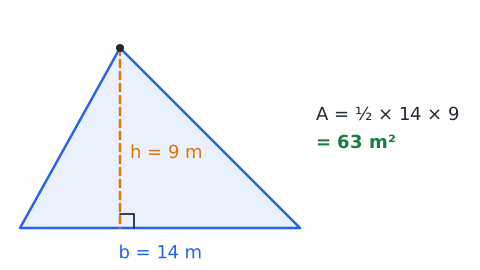
Here b is the length of a chosen base and h is the perpendicular height to that base, the distance from the opposite vertex measured along a line that meets the base at a right angle. Area is in square units. A triangle with base 14 m and height 9 m has area 63 square meters.
Area of Right and Obtuse Triangles
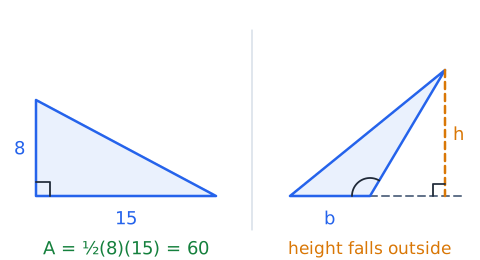
In a right triangle the two legs are perpendicular, so one leg serves as the base and the other as the height: legs of 8 and 15 give
square units. In an obtuse triangle, the height to a short base may fall outside the triangle. Extend the base with a dashed line and measure the perpendicular from the top vertex to that line; the same formula still works.
Why the Area Formula Works
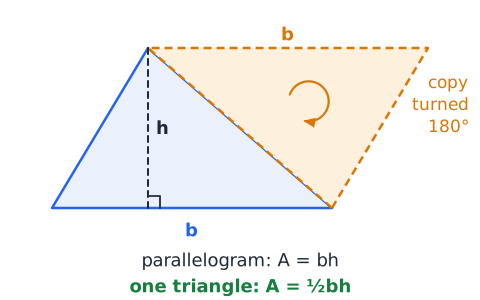
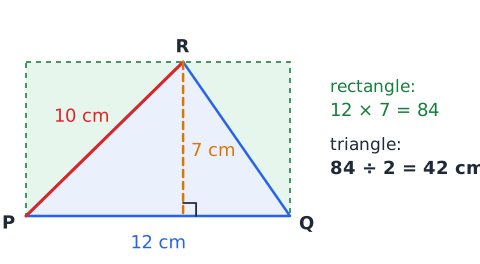
Two identical copies of any triangle can be fitted together to form a parallelogram with the same base and height. A parallelogram's area is base times height, so one triangle is exactly half of it. That explains the factor of one-half, and also why a slanted side cannot stand in for the height.
Right Triangle Vocabulary
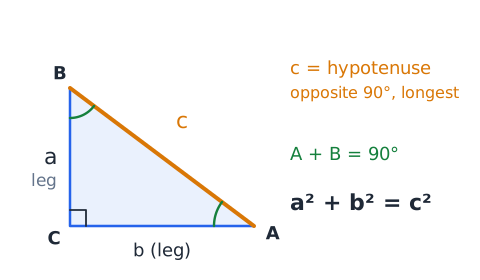
In a right triangle, the side opposite the 90-degree angle is the hypotenuse, usually labeled c, and it is always the longest side. The two sides that form the right angle are the legs, a and b. The two other angles are acute and complementary, adding to 90 degrees. The sides are linked by
Pythagorean Theorem: Find Hypotenuse
To find the hypotenuse, square each leg, add, and take the square root. With legs 9 and 12:
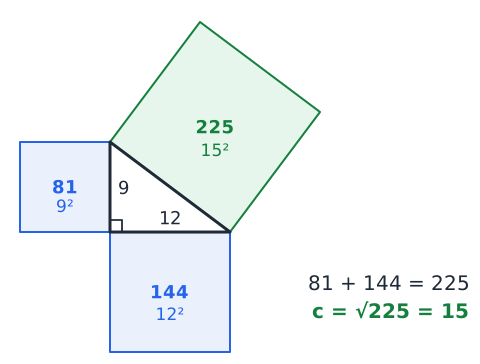
Check that the answer is longer than either leg; a hypotenuse shorter than a leg signals an error.
Pythagorean Theorem: Find a Missing Leg
To find a missing leg, subtract the square of the known leg from the square of the hypotenuse. With hypotenuse 13 and leg 5:
Converse of the Pythagorean Theorem
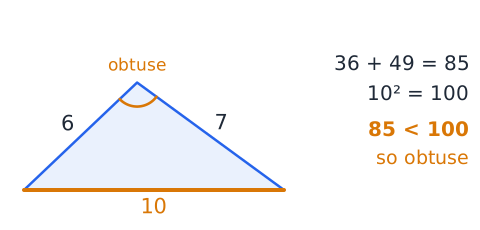
With c the longest side, if
the triangle is right. If
it is acute, and if
it is obtuse. Sides 6, 7 and 10:
less than 100, so obtuse.
Recognize Useful Pythagorean Triples
Some whole-number side sets appear again and again: 3-4-5, 5-12-13, 8-15-17 and 7-24-25. Any whole-number multiple also works, such as 6-8-10, 9-12-15 or 15-20-25. Spotting a scaled triple, like legs of 30 and 40, gives the hypotenuse 50 instantly, with no square roots.
Congruent Triangles
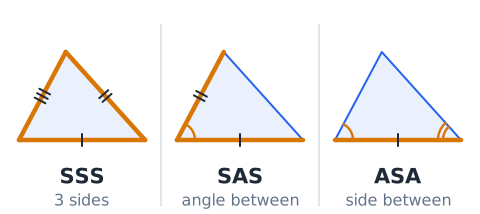
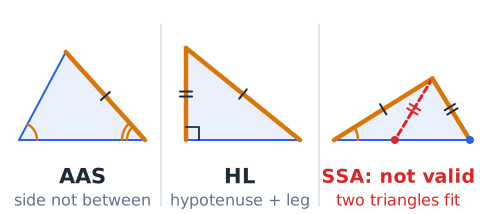
Congruent triangles have exactly the same size and shape, so all matching sides and angles are equal. You do not need all six facts to prove congruence. Valid shortcuts are SSS (three sides), SAS (two sides and the angle between them), ASA (two angles and the side between them), AAS (two angles and a side not between them), and HL for right triangles (hypotenuse and one leg). SSA and AAA are not valid: SSA can fit two different triangles, and AAA fixes only shape, not size.
Similar Triangles
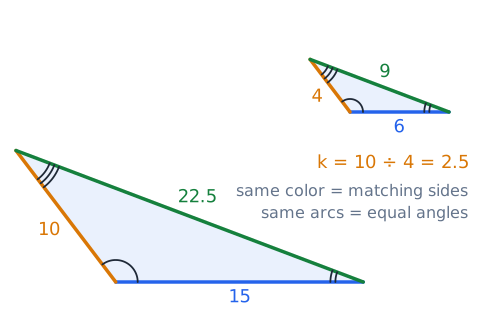
Similar triangles have the same shape but possibly different sizes. Matching angles are equal and matching sides share one ratio, the scale factor k. If a triangle has sides 4, 6 and 9 and a similar triangle has a side of 10 matching the 4, then
and its other sides are 15 and 22.5.
Similarity Criteria
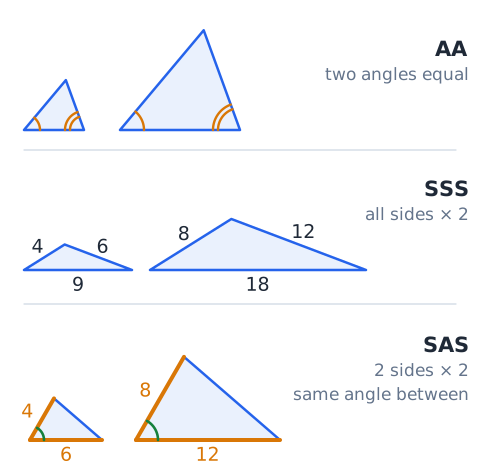
Triangles are similar if two pairs of angles are equal (AA), if all three pairs of sides are in the same ratio (SSS similarity), or if two pairs of sides are in the same ratio and the angles between them are equal (SAS similarity). AA is the most common test, since matching two angles forces the third angles to match as well.
Similarity and Perimeter Ratios
For similar triangles with scale factor k, every length scales by k, including perimeters and heights. A triangle with perimeter 24 enlarged by
has perimeter 36. Working the other way, the ratio of the perimeters gives the scale factor for the sides.
Similarity and Area Ratios
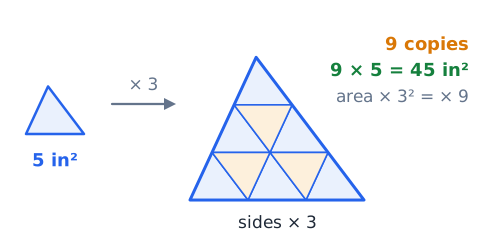
Area depends on two lengths, a base and a height, and each one is multiplied by k. So the areas of similar triangles scale by . If every side triples, the area becomes 9 times as large: a 5-square-inch triangle becomes 45 square inches. If two areas are in the ratio 16 to 25, the sides are in the ratio 4 to 5.
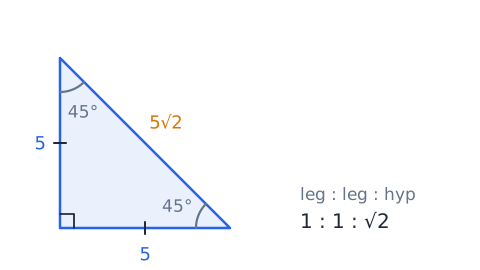
Special Right Triangle: 45°–45°–90°
A 45-45-90 triangle is an isosceles right triangle. Its legs are equal, and the hypotenuse is a leg times , so the sides are in the ratio . Legs of 5 give a hypotenuse of . A hypotenuse of 8 gives legs of
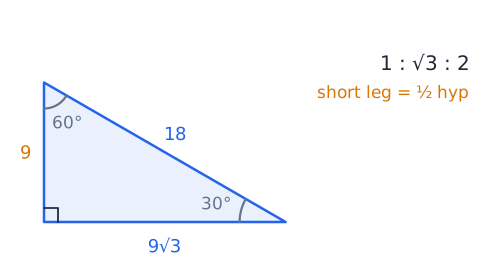
Special Right Triangle: 30°–60°–90°
In a 30-60-90 triangle, the sides are in the ratio . The short leg, opposite 30 degrees, is half the hypotenuse; the long leg is the short leg times . A hypotenuse of 18 gives legs of 9 and .
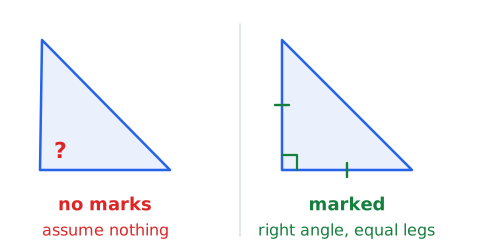
Angles From a Diagram: Facts Versus Appearance
Geometry figures on the test may not be drawn to scale. An angle that looks like 90 degrees is a right angle only if it is marked with a small square or stated in words. Sides that look equal are equal only with tick marks or given lengths. Base every conclusion on the numbers and markings provided, not on how the picture looks.
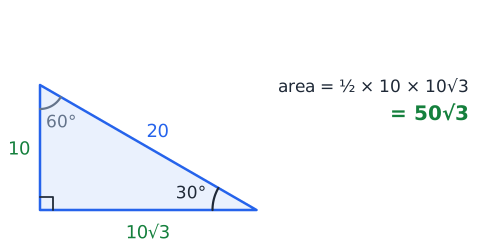
Combined Triangle Angle and Length Problems
Multi-step questions often move between angles and lengths. A right triangle with one acute angle of 30 degrees and a hypotenuse of 20 is a 30-60-90 triangle, so its legs are 10 and . Its area is then half of 10 times , or square units. Identify the triangle type first, then choose the length tool.
No-Calculator Triangle Toolkit
Keep a short toolkit. Angles: the three total 180, and an exterior angle equals the two remote interior angles. Sides: the two shorter sides must add to more than the longest. Right triangles: look for a known triple before squaring, and pull out common factors first; legs of 18 and 24 are 6 times 3 and 4, so the hypotenuse is
Similar figures: lengths scale by k, areas by .
Worked Example 1 — Unknown Algebraic Angles
Problem: A triangle's angles measure (2x + 5)°, (3x − 10)° and (x + 17)°. Find each angle.
Step 1: The three angles of any triangle add to 180°.
Step 2: Combine like terms. The x-terms:
The numbers:
Step 3: Subtract 12 from both sides, then divide by 6.
Step 4: Substitute x = 28 into each expression.
Answer: The angles are 61°, 74° and 45°.
Check:
Worked Example 2 — Exterior Angle and Adjacent Interior
Problem: In triangle ABC, the exterior angle at C measures 128° and angle A is 51°. Find angle B and the interior angle C.
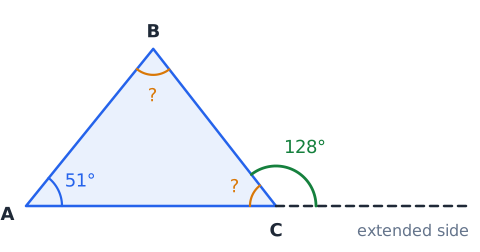
Step 1: An exterior angle of a triangle equals the sum of the two interior angles that are not next to it (the remote angles A and B).
Step 2: Put in A = 51 and subtract to find B.
Step 3: The exterior angle and interior angle C sit side by side on a straight line, so they add to 180°.
Answer: Angle B is 77° and interior angle C is 52°.
Check: The three interior angles must total 180°:
Worked Example 3 — Strict Side-Length Bounds
Problem: Two sides of a triangle are 8 and 13. Which whole numbers can the third side be, and how many are there?
Step 1: Triangle Inequality: the third side must be longer than the difference of the other two sides, or the two short sides could not meet.
Step 2: The third side must also be shorter than the sum of the other two sides.
Step 3: Combine the two limits. The third side s is strictly between 5 and 21.
Step 4: The whole numbers that fit are 6, 7, 8, and so on up to 20. Count them: last minus first, plus 1.
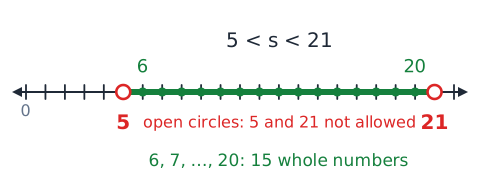
Answer: The third side can be any whole number from 6 to 20, which is 15 possible values.
Check: A side of 5 fails because
only equals 13 and does not exceed it. A side of 21 fails because
does not exceed 21. So 5 and 21 are both excluded.
Worked Example 4 — Isosceles Angles
Problem: An isosceles triangle has two base angles of (3x + 6)° each and a vertex angle of 2x°. Find all the angles.
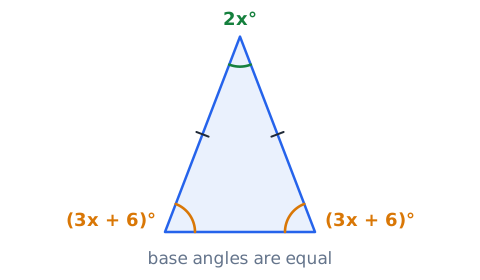
Step 1: The angles of a triangle add to 180°. There are two base angles, so count that expression twice.
Step 2: Distribute the 2: 2 times 3x is 6x, and 2 times 6 is 12.
Step 3: Combine like terms:
Step 4: Subtract 12 from both sides, then divide by 8.
Step 5: Substitute x = 21.
Answer: Each base angle is 69° and the vertex angle is 42°.
Check:
Worked Example 5 — A Right Triangle With Missing Leg
Problem: A 26-foot ladder leans against a wall with its foot 10 feet from the wall. How high up the wall does it reach?
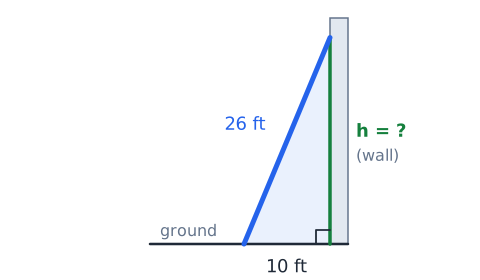
Step 1: The wall, the ground and the ladder form a right triangle. The ladder is the hypotenuse c = 26, the ground distance is one leg a = 10, and the height h is the other leg. Use the Pythagorean theorem.
Step 2: Square the known numbers.
Step 3: Subtract 100 from both sides.
Step 4: Take the square root. Since
the square root is 24.
Answer: The ladder reaches 24 feet up the wall.
Check: 10² + 24² =
². This is the 5-12-13 triangle with every side doubled.
Worked Example 6 — Special Right Triangles
Problem: (a) A square has a diagonal of 7√2 cm. Find its side. (b) A 30-60-90 triangle has a long leg of 6√3. Find its short leg and hypotenuse.
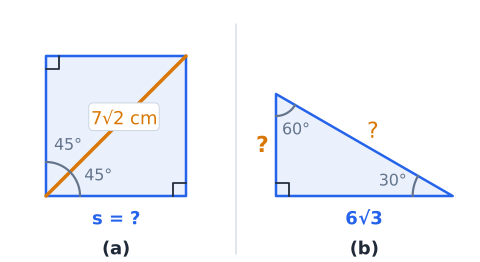
Step 1: The diagonal cuts the square into two 45-45-90 triangles. In a 45-45-90 triangle, the hypotenuse is the leg times √2.
Step 2: The diagonal is the hypotenuse. Match 7√2 with leg × √2, so the leg (the side of the square) is 7.
Step 3: In a 30-60-90 triangle, the sides are short leg, short leg × √3, and 2 × short leg. The long leg is short leg × √3.
So the short leg is 6.
Step 4: The hypotenuse is twice the short leg.
Answer: (a) Each side of the square is 7 cm. (b) The short leg is 6 and the hypotenuse is 12.
Check: For (b), 6² + (6√3)² =
². For (a), 7² + 7² = 98, and (7√2)² =
Worked Example 7 — Similar Triangles
Problem: A 6-foot post casts a 4-foot shadow while a nearby tree casts a 22-foot shadow. How tall is the tree?
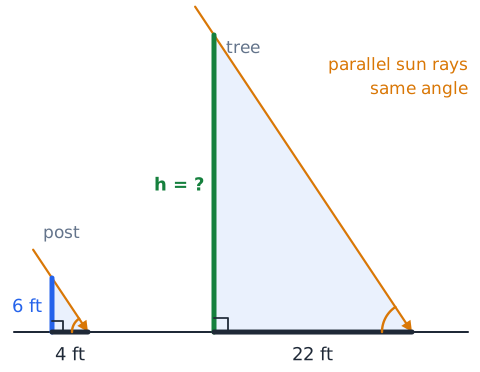
Step 1: The sun hits both objects at the same angle, so the post with its shadow and the tree with its shadow form similar triangles. Their sides are in the same ratio: height over shadow.
Step 2: Simplify 6/4. Dividing 6 by 4 gives 1.5, so each object is 1.5 times as tall as its shadow.
Step 3: Multiply both sides by 22 to get h alone.
Answer: The tree is 33 feet tall.
Check: Another way: the tree's shadow is
times the post's shadow, so the tree is
Same answer.
Worked Example 8 — Area and Perpendicular Height
Problem: Triangle PQR has base PQ = 12 cm. Side PR is 10 cm long, and the perpendicular distance from R to line PQ is 7 cm. Find the area.
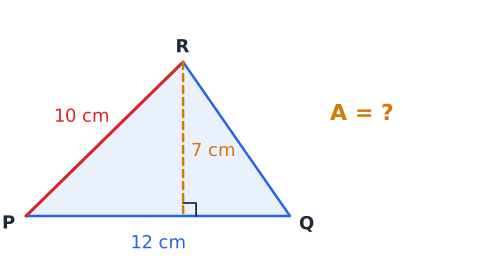
Step 1: Use the triangle area formula. The height must be perpendicular (at a right angle) to the base.
Step 2: Choose the right numbers. The base is 12. The height is the perpendicular distance, 7. Side PR (10 cm) is slanted, so it is not the height and does not go in the formula.
Step 3: Substitute and multiply. Half of 12 is 6, which keeps the arithmetic easy.
Answer: The area is 42 square centimeters.
Check: A rectangle 12 by 7 has area 84, and a triangle with the same base and height is half of that:
Worked Example 9 — Similarity Changes Area
Problem: A triangle with an area of 20 square meters is enlarged so every side is 3 times as long. Find the new area.
Step 1: Area uses two lengths multiplied together (base and height). Both of them get 3 times longer, so the area is multiplied by 3 twice.
Step 2: Multiply the original area by this area scale factor.
Answer: The new area is 180 square meters, not 60.
Check: Suppose the original has base 10 and height 4:
Enlarged, base 30 and height 12:
It matches. Multiplying by 3 alone (to get 60) is the common trap.
High-Value Triangle Traps
Using a slanted side as the height: the height must be perpendicular to the base. Forgetting the one-half in , which doubles the answer. Adding the legs instead of their squares in the Pythagorean theorem, or adding squares when finding a missing leg instead of subtracting. Scaling area by k instead of . Accepting SSA or AAA as a congruence test. Allowing a third side equal to the sum or difference of the other two; the inequality is strict. Mixing up 30-60-90 legs: the short leg is half the hypotenuse, and belongs to the long leg.
Triangle Formula and Reasoning Review
Interior angles total 180 degrees, an exterior angle equals the sum of the two remote interior angles, and isosceles base angles are equal. The longest side faces the largest angle, and any side must be shorter than the sum and longer than the difference of the other two. Perimeter adds the sides; area is with a perpendicular height. For right triangles,
and the triples 3-4-5, 5-12-13, 8-15-17 and 7-24-25 save time. Special ratios are and . Similar triangles scale lengths by k and areas by .
 English ▾