 ASVAB Camp
Learning Goals and ASVAB Application
In this lesson you will find the angle sum of any polygon, the size of one angle in a regular polygon, and the number of diagonals a polygon has. You will sort quadrilaterals into families by their sides, angles and diagonals.
You will also find perimeter and area for rectangles, parallelograms, trapezoids, rhombi and composite shapes, and see how similar figures scale. On the Mathematics Knowledge test these skills come up as short, no-calculator problems.
A Polygon Is a Closed Figure
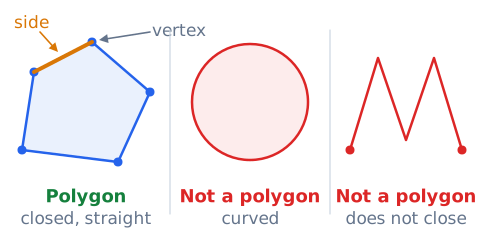
A polygon is a flat shape made only of straight segments joined end to end, so the path closes up with no gaps. Each segment is a side, and each meeting point is a vertex. Sides may not cross each other.
A triangle, a stop-sign octagon and a home plate outline are polygons. A circle is not, because it has no straight sides, and an open zigzag is not, because it does not close.
Regular, Irregular, Convex and Concave
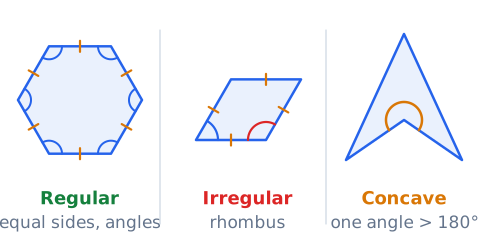
A regular polygon has all sides equal and all angles equal, like a square or the hexagon cells of a honeycomb. If either condition fails, the polygon is irregular. A rhombus has equal sides but usually unequal angles, so it is irregular.
A convex polygon has every interior angle below 180 degrees, so no corner points inward. A concave polygon has at least one angle above 180 degrees, giving it a dent, like an arrowhead.
Quadrilateral Interior Angle Sum
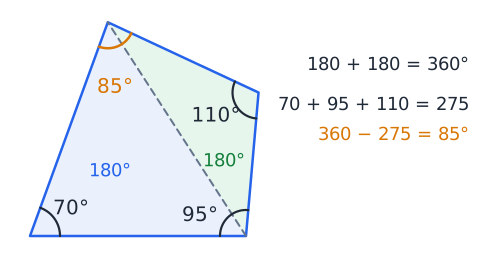
Draw one diagonal in any simple quadrilateral and it splits into two triangles. Each triangle holds 180 degrees, so the four interior angles always total 360 degrees.
Example: three angles are 70, 95 and 110 degrees. They add to 275, so the fourth angle is 360 minus 275, or 85 degrees.
Polygon Interior Angle Sum
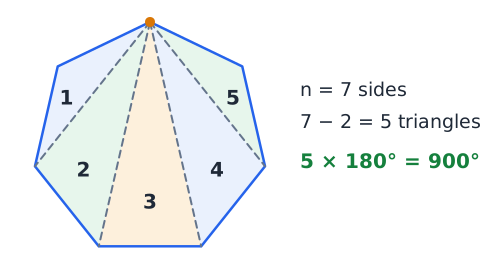
From one vertex of an n-sided polygon you can draw diagonals that cut it into n minus 2 triangles. That gives the interior angle sum:
For a heptagon (7 sides), the sum is 5 times 180, or 900 degrees.
Regular Polygon: One Interior Angle
In a regular polygon all angles are equal, so divide the total angle sum by the number of angles:
Here n is the number of sides. For a regular decagon, the sum is 8 times 180, or 1440 degrees, and one angle is 1440 divided by 10, or 144 degrees.
Exterior Angles of Convex Polygons
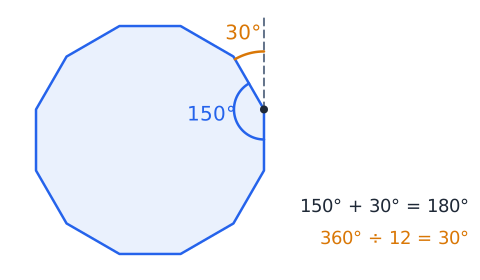
An exterior angle is formed by extending one side past a vertex. At each vertex the interior and exterior angles form a straight line, so they add to 180 degrees. Going once around any convex polygon, the exterior angles always total 360 degrees.
For a regular polygon with n sides, each exterior angle is
A regular 12-sided figure has exterior angles of 30 degrees and interior angles of 150 degrees.
Solving Angle Equations in Polygons
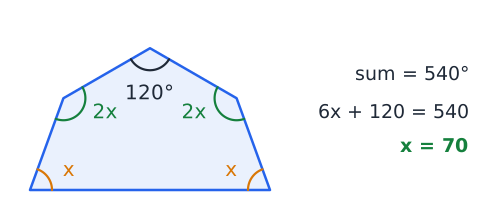
When angles are given as expressions, add them, set the total equal to the angle sum, and solve.
Example: a pentagon has angles x, x, 2x, 2x and 120 degrees. The sum must be 540, so 6x plus 120 equals 540, which gives 6x equal to 420 and x equal to 70. The angles are 70, 70, 140, 140 and 120.
The Parallelogram Family
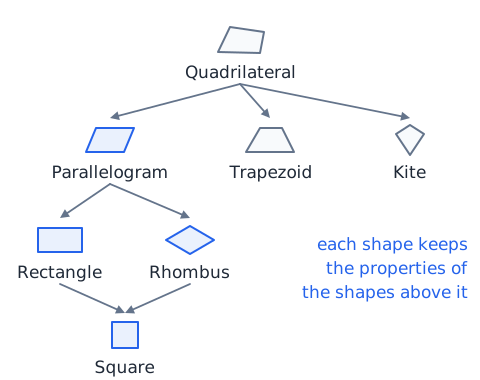
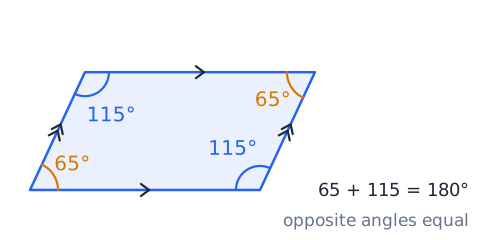
A parallelogram is a quadrilateral with both pairs of opposite sides parallel. That one fact brings several others: opposite sides are equal, opposite angles are equal, neighboring angles add to 180 degrees, and the diagonals cut each other in half.
Rectangles, rhombi and squares are special parallelograms, so they inherit all of these properties. If one angle of a parallelogram is 65 degrees, the others are 115, 65 and 115.
Rectangles
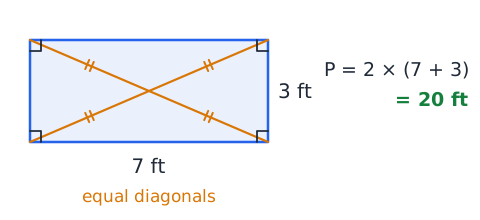
A rectangle is a parallelogram with four right angles. Besides every parallelogram property, its two diagonals are equal in length.
Opposite sides of a rectangle are equal, but neighboring sides need not be. A door panel 7 feet by 3 feet is a rectangle; its perimeter is 2 times (7 plus 3), or 20 feet.
Squares
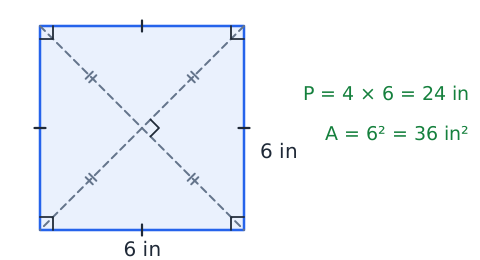
A square has four equal sides and four right angles, so it is both a rectangle and a rhombus. Its diagonals are equal, perpendicular and bisect each other. For side s:
A tile with 6-inch sides has a perimeter of 24 inches and an area of 36 square inches.
Rhombi
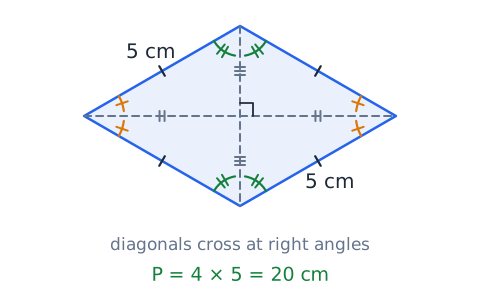
A rhombus is a parallelogram with all four sides equal, like a diamond on a playing card. Its angles do not have to be right angles.
The diagonals of a rhombus cross at right angles, bisect each other, and split each corner angle into two equal parts. If a rhombus has side 5 cm, its perimeter is 20 cm no matter how tilted it is.
Trapezoids and Definition Caution
A trapezoid is a quadrilateral with a pair of parallel sides, called the bases. The other two sides are the legs. If the legs are equal, the figure is an isosceles trapezoid, and its base angles are equal in pairs.
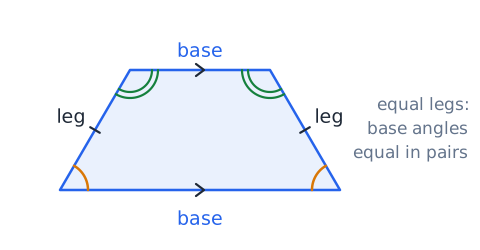
Be careful: some books say a trapezoid has exactly one pair of parallel sides, while others say at least one pair, which would count parallelograms as trapezoids. Test questions normally avoid this conflict, so work from what the problem states.
Kites
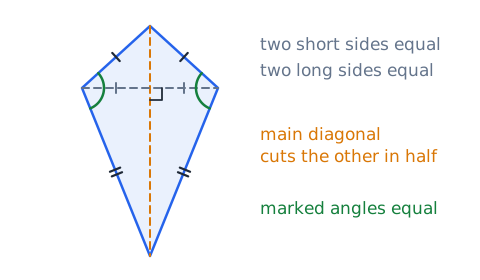
A kite has two pairs of equal sides, with each pair next to each other instead of opposite. Think of a classic toy kite: two short upper edges and two long lower edges.
The diagonals of a kite are perpendicular, and the main diagonal cuts the other one in half. The two angles between the unequal sides are equal. A kite is generally not a parallelogram.
Perimeter as Boundary Length
Perimeter is the total distance around a figure, so you add the lengths of all its sides. It is measured in plain length units such as feet or meters, not square units.
Example: a lot with sides 40, 75, 52 and 90 feet has a perimeter of 257 feet. Fencing, trim and edging problems all ask for perimeter.
Missing Perimeter Sides
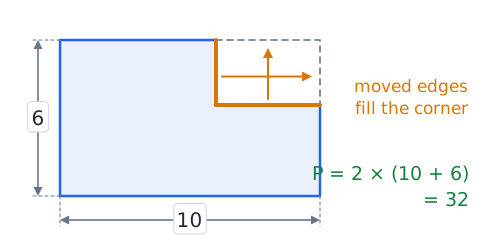
Figures made only of horizontal and vertical edges often hide some side lengths. The right-facing edges together must equal the left-facing edges, and the top edges must equal the bottom edges.
So a 10 by 6 rectangle with a rectangular notch cut from one corner still has a perimeter of 2 times (10 plus 6), or 32 units.
Rectangle and Square Area
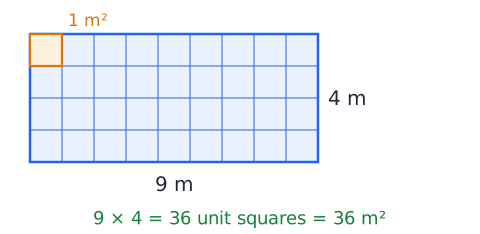
Area counts how many unit squares cover a region. For a rectangle with length l and width w, and a square with side s:
A 9 m by 4 m deck covers 36 square meters, and a 5 m square covers 25 square meters.
Parallelogram Area and True Height
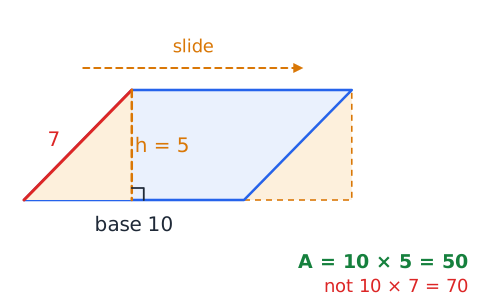
Cut a triangle off one end of a parallelogram and slide it to the other end, and you get a rectangle. So the area is base times height, A = bh.
The height must be the perpendicular distance between the bases, not the slanted side. A parallelogram with base 10, slanted side 7 and height 5 has area 50, not 70.
Trapezoid Area
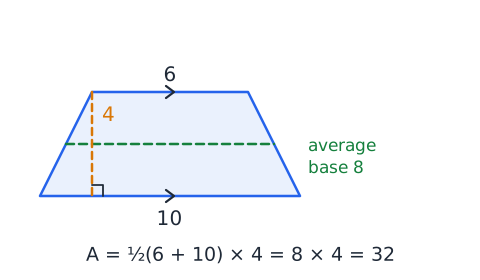
A trapezoid's area is the average of its two parallel bases times the perpendicular height:
With bases 6 and 10 and height 4, the average base is 8, so the area is 32 square units.
Area From Perpendicular Diagonals
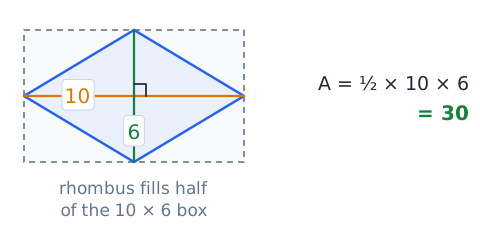
When the diagonals of a quadrilateral cross at right angles, as in a rhombus, kite or square, the area is half the product of the full diagonals:
Diagonals of 10 and 6 give an area of 30 square units.
Regular Polygon: Apothem Formula
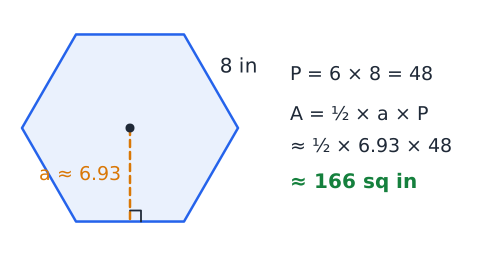
The apothem of a regular polygon is the perpendicular distance from its center to a side. The area is half the apothem times the perimeter:
A regular hexagon with 8-inch sides has perimeter 48 inches and apothem about 6.93 inches, so its area is about 166 square inches.
Polygon Diagonals
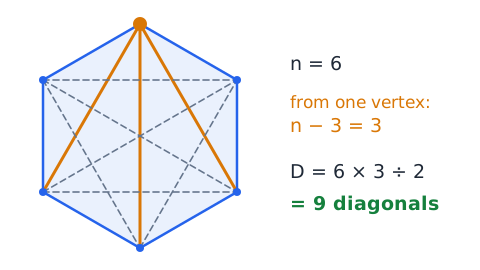
A diagonal joins two vertices that are not neighbors. Each of the n vertices connects to n minus 3 others, and each diagonal is counted twice, so
A hexagon has 6 times 3 over 2, or 9 diagonals; an octagon has 20.
Composite Shapes: Add Areas
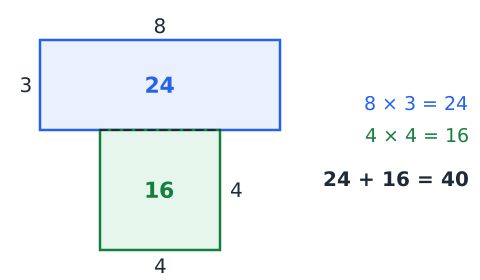
A composite shape is built from simpler pieces. Split it with straight cuts into rectangles, triangles or trapezoids, find each area, and add.
Example: a T-shaped sign is an 8 by 3 rectangle with a 4 by 4 square centered below it. The area is 24 plus 16, or 40 square units. Make sure the pieces do not overlap.
Composite Shapes: Subtract a Cutout
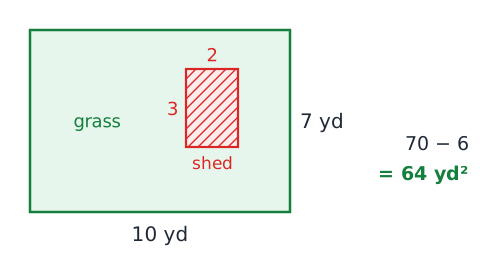
Sometimes it is easier to take the whole outer shape and remove the missing part. Area wanted equals outer area minus cutout area.
Example: a 10 by 7 yard lawn has a 2 by 3 yard shed on it. The grass covers 70 minus 6, or 64 square yards.
Frames and Paths
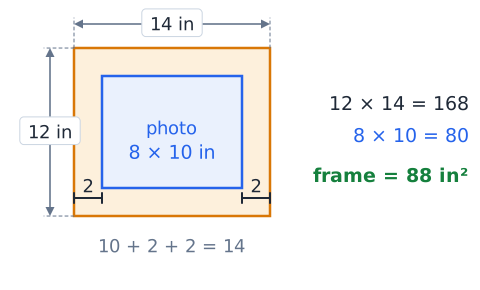
For a border of uniform width around a rectangle, find the outer rectangle, find the inner rectangle, and subtract. A border of width w outside the shape adds 2w to each dimension; a border inside removes 2w.
An 8 by 10 inch photo with a 2-inch frame outside becomes 12 by 14, so the frame area is 168 minus 80, or 88 square inches.
Similar Polygons: Perimeter and Area Scaling
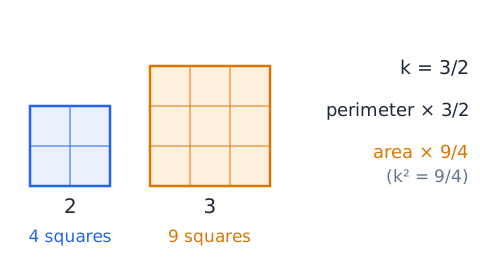
Similar polygons have equal angles and proportional sides. If the side ratio is k, perimeters scale by k and areas scale by k squared:
With a side ratio of 2 to 3, a perimeter of 20 becomes 30, while an area of 20 becomes 20 times 9 over 4, or 45.
Unit Conversion Before Area
Convert lengths to one unit before multiplying. Square units convert by the square of the length factor: since 1 yard is 3 feet,
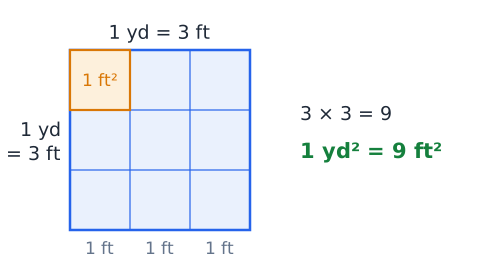
A 15 ft by 12 ft room is 180 square feet, which equals 180 divided by 9, or 20 square yards.
Reading Diagrams Without Unjustified Assumptions
Test diagrams are often not drawn to scale. Do not assume an angle is 90 degrees, sides are parallel, or lengths are equal just because they look that way.
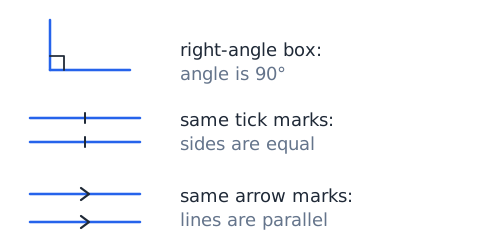
Trust only what is stated or marked: right-angle boxes, tick marks for equal sides, arrow marks for parallel lines, and given numbers. If a needed fact is not given, look for a property of the named shape, such as a parallelogram's equal opposite sides.
No-Calculator Formula and Estimation Routine
First name the shape and decide whether the question wants an angle, a length or an area. Write the matching formula, then plug in.
Keep numbers simple: halve an even factor before multiplying. Before choosing, check units and size; an area answer should be in square units, and an angle in a convex polygon must be under 180 degrees.
Worked Example 1 — Missing Quadrilateral Angle
Problem: A quadrilateral has angles of 115°, 64° and 93°. Find the fourth angle.
Step 1: The four angles of any quadrilateral add to 360°.
Step 2: Add the three known angles, two at a time.
Step 3: Subtract the known total from 360.
Answer: The fourth angle is 88°.
Check:
Worked Example 2 — Regular Polygon Angle
Problem: Each interior angle of a regular polygon is 160°. How many sides does it have?
Step 1: At each corner, the interior angle and the exterior angle sit on a straight line, so they add to 180°.
So each exterior angle is 20°.
Step 2: The exterior angles of any polygon add to 360°. In a regular polygon they are all equal, so divide 360 by one exterior angle.
Answer: The polygon has 18 sides.
Check: The interior angle sum of an 18-gon is
°, which matches.
Worked Example 3 — Parallelogram Height
Problem: A parallelogram has area 72 square meters, base 9 meters and slanted side 10 meters. Find its height.
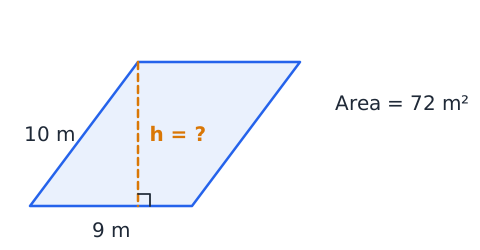
Step 1: The area of a parallelogram is base times the perpendicular height. The slanted side is not the height.
Step 2: Substitute the area and base.
Step 3: Divide both sides by 9 to undo the multiplication.
Answer: The height is 8 meters. The 10-meter slanted side is extra information and is not used.
Check:
the given area. Also the height (8) is shorter than the slanted side (10), as it must be.
Worked Example 4 — Trapezoid
Problem: A trapezoid has parallel bases of 7 cm and 13 cm and a height of 6 cm. Find its area.
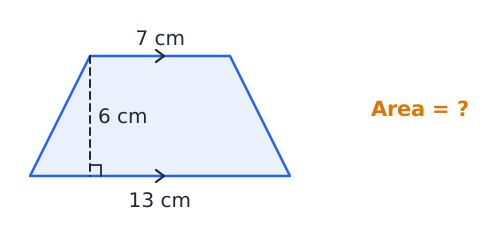
Step 1: The trapezoid area formula averages the two bases and multiplies by the height.
Step 2: Average the bases: add them, then take half.
Step 3: Multiply the average base by the height.
Answer: The area is 60 square centimeters.
Check: The area must be between a 7 × 6 rectangle (42) and a 13 × 6 rectangle (78). 60 is right between them.
Worked Example 5 — Rhombus Diagonals
Problem: A rhombus-shaped tile has diagonals of 14 inches and 10 inches. Find its area.
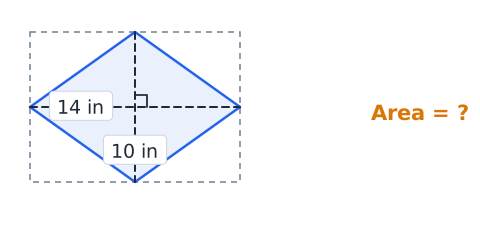
Step 1: The diagonals of a rhombus cross at right angles, so the area is half the product of the diagonals.
Step 2: Multiply the diagonals.
Step 3: Take half.
Answer: The area is 70 square inches.
Check: The rhombus fits inside a 14 by 10 rectangle (area 140) and fills exactly half of it, so 70 makes sense.
Worked Example 6 — Composite L Shape
Problem: A 9 by 7 meter rectangle has a 5 by 3 meter rectangle cut out of its upper right corner. Find the area of the L-shaped region that is left.
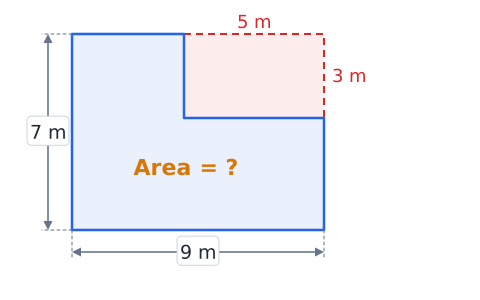
Step 1: Find the area of the full rectangle.
Step 2: Find the area of the piece that was removed.
Step 3: Subtract the removed piece from the full rectangle.
Answer: The L-shaped region has an area of 48 square meters.
Check: Split the L into two rectangles instead. The bottom strip is 9 wide and
tall:
The upper left block is
wide and 3 tall:
again.
Worked Example 7 — Frame
Problem: A 20 by 30 inch mirror gets a frame 3 inches wide around the outside. Find the area of the frame.
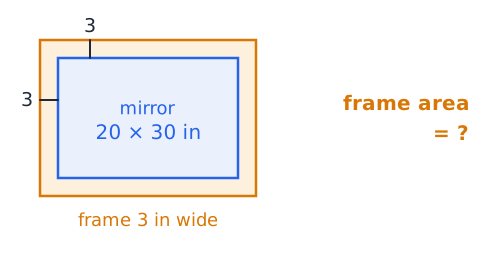
Step 1: Find the outer size. The frame adds 3 inches on both sides, so each dimension grows by
Step 2: Find the outer area (mirror plus frame).
By hand:
Step 3: Find the mirror's area.
Step 4: The frame is what is left after removing the mirror.
Answer: The frame covers 336 square inches.
Check: Cut the frame into strips: two long strips
each (216 total) and two short strips
each (120 total). Then
Worked Example 8 — Similarity and Area
Problem: Two similar pentagons have sides in the ratio 4 to 7. The smaller one has area 48 square feet. Find the larger area.
Step 1: For similar figures, areas scale by the square of the side ratio.
Step 2: Multiply the smaller area by this factor.
Step 3: Divide first to keep the numbers small:
Answer: The larger pentagon has area 147 square feet.
Check: The area ratio should be 16 to 49. Divide both areas by 3:
It matches.
Worked Example 9 — Inverse Trapezoid Formula
Problem: A trapezoid has area 90, height 6 and one base 11. Find the other base b.
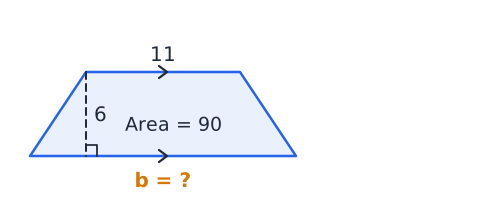
Step 1: Write the trapezoid formula and substitute the known values.
Step 2: Simplify: half of 6 is 3.
Step 3: Divide both sides by 3.
Step 4: Subtract 11 from both sides.
Answer: The other base is 19.
Check:
Common Polygon Traps
Using the slanted side as the height. Area formulas for parallelograms and trapezoids need the perpendicular height. A slanted side is longer than the height, so using it inflates the answer. Look for the right-angle mark.
Mixing up interior and exterior angles. Exterior angles of a convex polygon sum to 360 degrees; interior sums depend on n. Remember each interior and exterior pair adds to 180.
Forgetting the one-half. The trapezoid and diagonal formulas both include a factor of one half.
Doubling the border width only once. A uniform border changes each dimension by twice its width.
Scaling area by k instead of k squared. Similar figures with side ratio k have area ratio k squared.
Mixing units. Convert lengths before multiplying, and report area in square units.
Quick Review and Decision Tree
Angles: interior sum is (n minus 2) times 180, one regular angle is that sum over n, and exterior angles total 360.
Lengths: perimeter adds all sides. Diagonal count:
Areas: rectangle lw, parallelogram bh, trapezoid half the base sum times h, rhombus or kite half of d1 times d2. Composite shapes are added or subtracted. For similar figures, area scales by k squared.
 English ▾