 ASVAB Camp
Lesson Goals and ASVAB Relevance
After this lesson you should be able to solve linear inequalities, including those with negative coefficients, parentheses, fractions, decimals and variables on both sides. You will graph solution sets on a number line, write them in interval notation, and solve compound inequalities joined by and or or. You will also solve absolute-value inequalities and answer word problems where only whole-number answers make sense.
On the Mathematics Knowledge test, inequalities show up directly and inside other topics, such as comparing quantities and reading graphs. A detail that trips up many test-takers is when the inequality sign must reverse.
Inequalities Versus Equations
An equation says two quantities are equal and usually has one solution. An inequality says one quantity is less than (<), greater than (>), at most (
) or at least (
) another. For example,
is true for every number greater than 3, so it has infinitely many solutions.
Solution Sets and the Number Line
The solution set of an inequality is the collection of all values that make it true. Because there are usually infinitely many, we picture them on a number line. Mark the boundary value, then shade the side that works. For
shade from 4 toward the left, since every number smaller than 4 is a solution. For
shade to the right of −1. A quick test point, such as 0, confirms which side to shade.
Open and Closed Endpoints
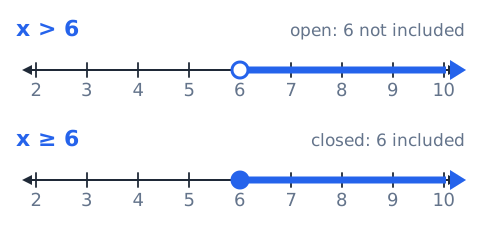
The endpoint shows whether the boundary itself is a solution. An open circle means the boundary is not included; use it for strict signs, < and >. A closed, filled-in circle means the boundary is included; use it for
gets an open circle at 6 with shading right, and
gets a closed circle at 6 with shading right.
Addition and Subtraction Preserve Direction
Adding or subtracting the same number on both sides never changes the direction of the inequality. For
add 6 to get
For
subtract 2 to get
Treat these steps just like equation steps.
Multiplying or Dividing by a Positive Number
Multiplying or dividing both sides by a positive number also keeps the direction. For
divide by 6 to get
For
multiply by 2 to get
Multiplying or Dividing by a Negative Number
Multiplying or dividing both sides by a negative number reverses the inequality sign: less than becomes greater than, and the reverse. For
divide by −4 and flip:
Check with x = 0:
which is at most 20, and 0 is at least −5.
Why Negative Multiplication Reverses Order
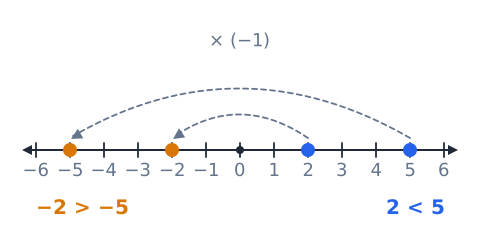
Multiplying by −1 reflects every number across zero on the number line, which reverses left and right. Since 2 is less than 5, you might expect −2 to be less than −5, but −2 is to the right of −5, so
The order flips, and so must the inequality sign.
Distributive Property and Sign Control
Distribute first, then isolate the variable, watching for a negative coefficient. For
Dividing by −3 flips the sign:
Distributing a negative does not flip the sign; only dividing or multiplying both sides does.
Variables on Both Sides
Move the variable terms to one side and constants to the other, just as with equations. For
subtract 2x to get
subtract 1 to get
and divide by 4 to get
Moving the smaller variable term keeps the coefficient positive, so no flip is needed.
Variables With Negative Coefficients on Both Sides
For
add 5x to both sides:
Then
which is
Moving terms to keep a positive coefficient avoids the flip.
Inequalities With Fractions
Clear fractions by multiplying every term by the least common denominator. Since that number is positive, the sign does not change. For
multiply by 6 to get
Subtract 2x:
Check x = 12:
which is less than 6, so it works.
Inequalities With Decimal Coefficients
Multiply every term by 10 or 100 to clear decimals. For
multiply by 10 to get
Equivalent Forms of One Inequality
An inequality can be read from either side.
says the same thing as
swap the sides and turn the symbol around so it still points at the smaller value. Similarly,
is equivalent to
Rewrite answers with x first to match choices.
Compound Inequalities: AND
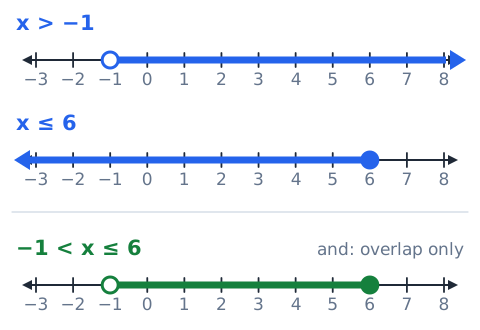
An and statement requires both conditions at once, so the solution is where they overlap. For
the overlap is the segment between them, written
On the number line, shade only between −1 (open circle) and 6 (closed circle).
Compound Inequalities: OR
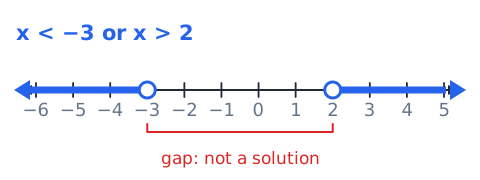
An or statement is true when at least one condition holds, so the solution combines both sets. For
shade to the left of −3 and to the right of 2, with open circles at both. The gap between them is not part of the solution.
Solving a Three-Part Inequality
In a three-part inequality, do each step to all three parts. For
subtract 1:
Divide by 3:
If you divide by a negative, flip both signs.
Interval Notation
Interval notation lists the left endpoint, then the right endpoint. A square bracket means the endpoint is included; a parenthesis means it is not. Infinity always takes a parenthesis. So
is , and
is . The union symbol joins pieces of an or solution.
![Two number lines with interval notation: −2 < x ≤ 3 has an open circle at −2 and closed circle at 3, written (−2, 3]; x ≥ 4 has a closed circle at 4 and an arrow shaded right, written [4, ∞), since ∞ always takes a parenthesis.](../../assets/img/V180_C03S06L01_08.svg)
No Solution and All Real Numbers
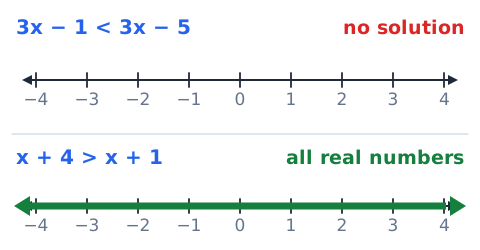
If the variable cancels, judge the leftover statement.
reduces to
which is false, so there is no solution.
reduces to
which is always true, so every real number is a solution.
Checking Boundary Values
Check three values: the boundary, one point inside your answer and one outside. For
with answer
at x = 3 both sides are 19, so 3 is included and the circle is closed. At x = 4, 25 is at least 21, true. At x = 0, 1 is not at least 13, false. All three agree with the answer.
Absolute Value as Distance
means x is less than 3 units from zero, so
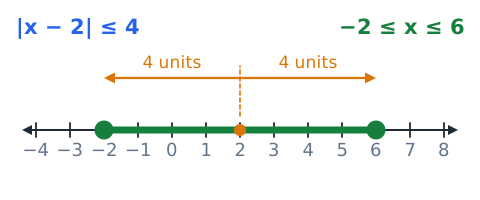
More generally,
means x is within b units of a. So
Absolute Value: Outside a Range
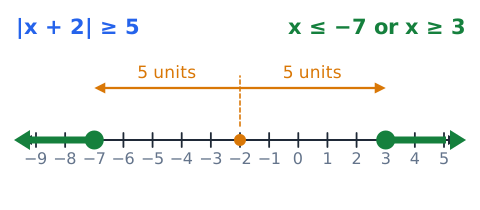
A greater-than absolute value means the distance is large, so the solution splits into two pieces joined by or.
For
solve
Context: Capacity and Minimum Requirements
Phrases such as at most, no more than and cannot exceed mean
Phrases such as at least, no fewer than and a minimum of mean
A freight elevator rated for 2,000 lb carries a 180 lb operator plus 45 lb boxes:
so b is at most about 40.4, meaning 40 boxes.
Context: Integer Quantities
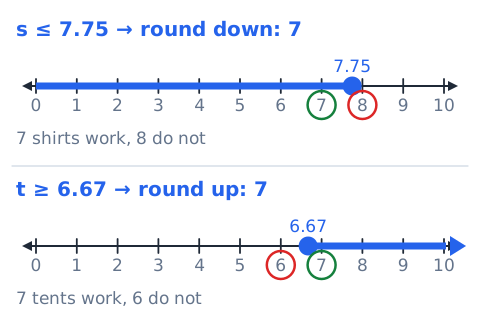
When the answer counts whole objects, the algebra may give a decimal, and you must choose a whole number that still satisfies the condition. For a maximum, round down. With 100 dollars, 7 dollars shipping and 12-dollar shirts,
gives s at most 7.75, so 7 shirts. For a minimum, round up. Housing 40 people in 6-person tents requires
so t is at least 6.67, meaning 7 tents. Rounding the wrong way breaks the condition.
No-Calculator Decision Routine
Work through the same checklist each time. First simplify: distribute and clear any fractions or decimals by multiplying by a positive number. Second, gather variable terms on the side that keeps the coefficient positive if you can. Third, if you do divide or multiply by a negative, flip the sign immediately, before writing anything else. Fourth, decide whether the endpoint is included: strict signs mean open, the others mean closed. Fifth, for word problems, round in the direction that keeps the condition true. Last, test one value inside and one outside your answer.
Worked Example 1 — Negative Coefficient
Problem: Solve
Step 1: Subtract 5 from both sides to get the x term alone:
Step 2: Divide both sides by −6. Important rule: when you multiply or divide an inequality by a negative number, flip the sign. So ≥ becomes ≤.
Step 3: Divide:
Answer:
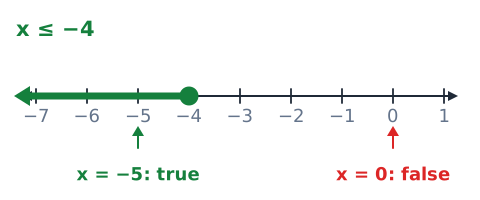
Check: Try
which is less than −4. Then
which is at least 29. True. Try x = 0, which is not allowed:
which is less than 29. False, as expected.
Worked Example 2 — Both Sides and Distribution
Problem: Solve
Step 1: Distribute the 3:
Step 2: Subtract 3x from both sides to collect the x terms on the right, where they stay positive:
Step 3: Subtract 4 from both sides:
Step 4: Divide both sides by 2. Since 2 is positive, the sign does not flip:
Answer:
(the same statement read from the x side).
Check: Try x = 0. Left:
Right:
Is
? Yes. Try
left
right
Is
? No, as expected.
Worked Example 3 — Fraction Coefficients
Problem: Solve
Step 1: Clear the fractions. 12 is the smallest number that both 4 and 6 divide into, so multiply every term by 12. Because 12 is positive, the ≥ sign stays the same.
Step 2: Simplify each term:
Step 3: Combine like terms:
Answer:
Check: Try x = 12:
which is at least 1. Try x = 24:
also at least 1. Try x = 0: 0, which is less than 1, so 0 is correctly left out.
Worked Example 4 — Compound AND
Problem: Solve
Step 1: This compound inequality has three parts. Whatever you do, do it to all three parts. First add 3 to each part to undo the − 3:
Step 2: Divide all three parts by 2. Since 2 is positive, the signs stay the same:
Answer:
written in interval notation as (2, 6]. The round bracket means 2 is not included; the square bracket means 6 is included.
![Number line for 2 < x ≤ 6: open circle at 2, closed circle at 6, shaded between; interval notation (2, 6].](../../assets/img/V180_C03S06L01_10.svg)
Check: x = 6 gives
and 9 ≤ 9 is true. x = 2 gives
and 1 < 1 is false, so 2 is correctly left out.
Worked Example 5 — Empty Solution Set
Problem: Solve
Step 1: Distribute the 5 on the right:
Step 2: Subtract 5x from both sides to collect the x terms. The x terms cancel completely.
Step 3: Read what is left. Is 2 less than −5? No. 2 is to the right of −5 on the number line, so the statement is false.
Because x disappeared and a false statement remains, no value of x can ever make the inequality true.
Answer: There is no solution (the solution set is empty).
Check: Try any number, such as x = 0. Left:
Right:
Is
? No. The left side is always exactly 7 more than the right side, so it can never be smaller.
Worked Example 6 — Absolute-Value Inequality
Problem: Solve
Step 1: Understand the meaning. is the distance between x and 4. The distance must be 3 or less, so x − 4 must be between −3 and 3.
Step 2: Add 4 to all three parts to get x alone:
Answer:
or [1, 7] in interval notation. Both ends are included because the sign is ≤.
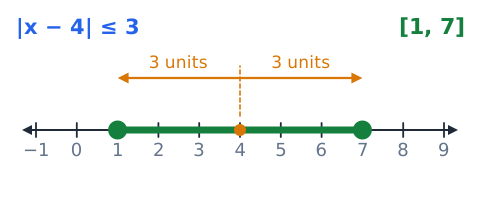
Check: x = 1 gives |1 − 4| = |−3| = 3, and 3 ≤ 3 is true. x = 7 gives |3| = 3, also true. x = 8 gives |4| = 4, which is more than 3, so 8 is correctly left out.
Worked Example 7 — Integer Constraint
Problem: A trailer can safely carry 1,500 kg. It already holds 260 kg of gear, and each crate weighs 75 kg. What is the largest number of crates it can carry?
Step 1: Let c be the number of crates. The gear plus the crates must be at most 1,500 kg.
Step 2: Subtract 260 from both sides:
Step 3: Divide both sides by 75.
leaving
so the result is 16 and 40/75, about 16.5.
Step 4: Crates come whole, so c must be a whole number. Round down (not up) to stay under the limit: c = 16.
Answer: 16 crates.
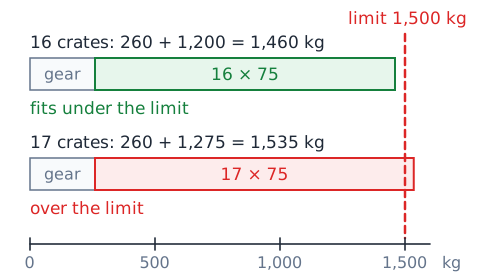
Check: 16 crates weigh
which is allowed. 17 crates weigh 1,275 kg, and
which is too heavy.
Common Traps and Misconceptions
Forgetting to flip the sign after multiplying or dividing by a negative is the most common error; for
the answer is
not
The opposite mistake also happens: flipping when you only subtracted a number, or when a negative appears only on the right side, as in
where the answer is simply
Mixing up open and closed circles changes whether the boundary is a solution. Writing a bracket next to infinity is incorrect; infinity always takes a parenthesis. Treating an or statement like an and statement, or the reverse, gives the wrong region. For
writing
describes nothing; split it into two pieces with or. In word problems, rounding a maximum up or a minimum down produces an answer that breaks the condition.
Final Review
Solve inequalities like equations, with one extra rule: multiplying or dividing both sides by a negative number reverses the sign. Strict signs give open circles and parentheses;
give closed circles and brackets, and infinity always uses a parenthesis. And means overlap; or means combine. In a three-part inequality, apply each step to all parts.
becomes a single between-statement, while
splits into two parts joined by or. If the variable cancels, a false statement means no solution and a true one means all real numbers. Round down for a maximum count and up for a minimum.
 English ▾