ASVAB Camp Get the appGoogle Play
MK · lesson 1 of 14 · 32 min

Number Properties and Divisibility

This foundation lesson builds the number sense that many Mathematics Knowledge questions quietly depend on. You start with factors and multiples, prime and composite numbers, and quick divisibility rules for 2, 3, 4, 5, 6, 8, 9, 10 and 11. From there you move into prime factorization, the greatest common factor, the least common multiple, and a short guide to choosing between GCF and LCM in a word problem.

Video lesson: Number Properties and Divisibility

Video transcript

0:00 So you're gearing up for the ASVAB, and maybe feeling a little, I don't know, anxious about the math part? Take a deep breath because you are in exactly the right place. Today, we are building a completely calculator free toolkit for ASVAB math by mastering foundational number properties. Now, the ASVAB doesn't allow calculators, which means we have to rely entirely on mental math and a solid sense of how numbers work to breeze through these questions. But don't worry, by the end of this explainer, you're going to have the mental shortcuts and the confidence you need to tackle these problems with total ease. Here's our roadmap for today. We'll start with basics and divisibility rules, move into factoring, GCF and LCM, and then cover integers, remainders, and absolute value. After that, we'll look at worked examples in action, point out common number property traps, and finish up with a check yourself section. All right, let's jump right into section one, basics and divisibility rules. First things first, we need to completely clear up the difference between a factor and a multiple. It's absolutely crucial. A factor divides a number perfectly, leaving zero remainder. Think of factors as the limited ingredients that make up a recipe.

1:01 Because of this, a number has a finite set list of factors. For instance, the factors of 12 are just one, two, three, four, six, and 12. That's it. The list stops there. On the flip side, a multiple is what you get when you multiply a number by any whole number. Multiples build a number up endlessly. It's like counting by sevens, seven, fourteen, twenty-one, twenty-eight, and so on forever. So simply put, factors break things down into a limited list and multiples build them up forever. Okay, now, what about prime versus composite numbers? A prime number is any whole number strictly greater than one that has exactly two factors, one and itself. Think of numbers like two, three, five, seven, and eleven. A composite number, however, has more than two factors. Take twenty-seven, for example. It can be broken down into three times nine. And here is a huge detail for the ASVAB that you should lock into your memory right now. The number one is neither prime nor composite.

2:02 And the number two is our one and only even prime number. Now, let's talk about divisibility rules. These are going to literally be your best friends because they completely bypass the need for long division. For two, five and ten, all you do is look at the very last digit. If the number ends in an even digit, it's divisible by two. If it ends in zero or five, it's divisible by five. And if it ends in a zero, it's divisible by ten. Super simple, right? Just check the tail end. Now, for three and nine, we have a different trick. You just add the digits together. If the sum of those digits is divisible by three, the entire massive number is divisible by three. And guess what? The exact same rule applies for nine. Let's build on that with a few slightly trickier rules that are absolute time savers. For four, look at just the last two digits to see if they form a multiple of four. For eight, you check the last three digits. For six, you just combine the tests we already know. The number has to pass the test for two, meaning it's even. And it has to pass the test for three.

3:02 Finally, the test for eleven is really cool. So take your time with this one. Starting from the left, you alternately subtract and add the digits. If your final result is zero or a multiple of eleven, then the whole thing is divisible by eleven. Moving right along, here is section two, factoring, GCF and LCM. Did you know every single whole number above one has a completely unique prime factorization? It's literally like a mathematical fingerprint. Prime factorization just means writing a number as a product of primes only. Take the number 90. If we start breaking it apart, we might say 90 is nine times 10. But neither nine nor 10 are prime, so we can't stop there. We keep splitting. The nine becomes three times three. The 10 becomes two times five. Put it all together, and the true prime factorization of 90 is two times three squared times five. So why do we care about those prime fingerprints? Well, we use them for our next two tools, the greatest common factor or GCF, and the least common multiple or LCM. The ASVAB loves to test if you know which one to pull out of your toolkit for a word problem.

4:07 Here's the secret. Use the GCF when a problem asks you to split things into the largest equal groups. Think about cutting different lengths of wood or ribbon into equal sizes with no waste. On the flip side, use the LCM when a problem involves repeating cycles that need to line up, like two different shuttle buses leaving a station at the exact same time again. Just remember it like this. GCF is for cutting down. LCM is for syncing up. Integers, remainders, and absolute value. Let's run through even and odd numbers really quickly. Keep in mind that an even number plus an even number is always even, and an odd plus an odd is also even. But a product, meaning multiplication, is only odd if every single factor is odd. If there is even one even number hiding in the mix, the whole product becomes even. Now, let me share a brilliant shortcut for consecutive integers. Those are numbers that follow each other exactly in order, like 18, 19, and 20. If you have three consecutive integers, their total sum is always exactly three times the middle number. So if a problem tells you three consecutive integers add up to 57, you just divide 57 by three to get 19.

5:12 That's your middle number. Boom. Your set is effortlessly 18, 19, and 20. All right, absolute value. Absolute value is simply a number's physical distance from zero on the number line. Because it's a distance, it is never ever negative. The huge mistake people make here is thinking you just instantly flip all subtraction signs into addition signs. You definitely don't. Absolute value bars act exactly like parentheses. You absolutely must simplify the math inside the bars first. For example, evaluate the absolute value of four minus 11. First, we do the math inside. Four minus 11 is negative seven. Then we take the absolute value of that result. The absolute value of negative seven is simply seven. All right, it's time to put it all together in section four, worked examples in action. Let's say you've got ribbons measuring 45 inches and 75 inches. You need to cut them into equal pieces as long as possible with no waste. That phrase cut into equal pieces is your secret trigger word.

6:12 It tells us right away we need the GCF. Step one, find the primes. 45 breaks down to nine times five, which is three squared times five. 75 breaks down to three times 25, which is three times five squared. To find the GCF, we take only the primes they share and we use the smaller power of each. They share a single three and a single five. So our GCF is three times five, which equals 15. Each piece will be exactly 15 inches long. One shuttle leaves every 15 minutes and another leaves every 20 minutes. Both leave right now. When do they next leave together? Repeating schedules lining up means we need our other tool, the LCM. Step one, 15 is three times five. 20 is four times five, which is two squared times five. For the LCM, we take every prime that appears across both numbers at its highest power. That means we take two squared times three times five. Multiply that all out and you get 60. No calculator required. The shuttles will leave together again in exactly 60 minutes. Let's tackle an absolute value example.

7:14 We need to evaluate the absolute value of two minus nine minus the absolute value of negative three. Let's do the inside of the first set of bars first. Two minus nine is negative seven. So our first term is the absolute value of negative seven, which simplifies to seven. Our second term is just the absolute value of negative three, which simplifies to three. Now we bring down that middle minus sign that was sitting between the two terms. Step three, seven minus three equals four. See how easy it is when you treat the bars exactly like parentheses? Almost there. Let's hit section five, common number property traps. Test makers absolutely love setting traps, but we're going to see right through them. First trap, calling one a prime number. Don't do it. It only has one factor and a prime number requires exactly two. Second, don't assume every odd number is prime. Look right at 21, 39, and 51. They are definitely composite. Third, as we just practiced, don't mix up GCF and LCM. Cutting into equal groups is GCF. Repeating schedules syncing up is LCM.

8:18 Fourth, don't drop the negative sign early on absolute value. You have to simplify the math inside the bars first. And finally, if a question asks for a remainder, don't give them the quotient. The remainder is just the leftover amount at the very end of your division. And it must always be smaller than the number you divided by. Finally, we've reached section six. Check yourself. You've built the toolkit. Now let's take it for a quick test drive. Which of the following numbers is prime? A 53, B 49, C 57, D 51. Take a second. Feel free to pause the explainer right here if you need a moment to think it through. All right, the correct answer is A 53. Why? Well, you want to test small primes to eliminate the fakes. 51 is actually three times 17. 57 is three times 19. And 49 is seven times seven. Because those have factors other than one and themselves, they are all composite. But no small prime divides evenly into 53, meaning its only factors are one and 53. So it's the real deal.

9:22 Let's try one more. Question two. Using the digit sum test we learned, which number can be divided evenly by nine? A 7521, B 2754, C 4105, D 6312. Again, go ahead and pause if you need to and carefully add up those digits for each option. And the correct answer is B 2754. If we add the digits of that option up, two plus seven plus five plus four, we get exactly 18. And since 18 is perfectly divisible by nine, that entire massive number 2754 is perfectly divisible by nine as well. And guess what? You just solved that without touching a calculator. You now have a powerful calculator free toolkit. When you're walking in to take the ASVAB, remember that the test isn't checking if you're a human calculator. It's just checking if you know the secret rules of the game. And now you definitely do. So what other impossible math barriers are you ready to break down next?

Visual lesson

Lesson slides

15 slides
Number Properties and Divisibility – slide 1 of 15

Lesson Goal

This lesson builds the number sense behind much of Mathematics Knowledge. You will tell factors from multiples, recognize prime and composite numbers, apply quick divisibility tests, write prime factorizations, find the greatest common factor and least common multiple, reason about even and odd numbers and consecutive integers, interpret remainders, and evaluate absolute value.

Factors and Multiples

A factor of a number divides it with no remainder. The factors of 18 are 1, 2, 3, 6, 9 and 18, so a number has a limited list of factors. A multiple is the result of multiplying a number by a whole number. The multiples of 7 are 7, 14, 21, 28 and so on without end. If 6 is a factor of 18, then 18 is a multiple of 6.

Prime and Composite Numbers

A prime number is a whole number greater than 1 with exactly two factors, 1 and itself, such as 2, 3, 5, 7, 11, 13 and 23. A composite number has more than two factors; 27 is composite because

3 × 9 = 27

The number 1 is neither prime nor composite, and 2 is the only even prime.

Divisibility by 2, 5, and 10

Check the last digit. A number is divisible by 2 if it ends in 0, 2, 4, 6 or 8. It is divisible by 5 if it ends in 0 or 5. It is divisible by 10 if it ends in 0. So 3,470 passes all three tests, while 3,475 is divisible by 5 only.

Divisibility by 3 and 9

Add the digits. If the digit sum is divisible by 3, so is the number; if the sum is divisible by 9, so is the number. For 4,671, the digits add to

4 + 6 + 7 + 1 = 18

Since 18 is divisible by both 3 and 9, so is 4,671; in fact

4,671 ÷ 9 = 519

Divisibility by 4, 6, and 8

A number is divisible by 4 if its last two digits form a multiple of 4, and by 8 if its last three digits form a multiple of 8. It is divisible by 6 if it passes the tests for both 2 and 3. Take 5,316: 16 is a multiple of 4, so 4 works; 316 is not a multiple of 8; it is even with digit sum 15, so 6 works.

Divisibility by 11

Starting from the left, alternately subtract and add the digits. If the result is 0 or a multiple of 11, the number is divisible by 11. For 8,294:

8 − 2 + 9 − 4 = 11

so 8,294 is divisible by 11, and

8,294 ÷ 11 = 754

For 5,123:

5 − 1 + 2 − 3 = 3

so it is not.

Prime Factorization

Prime factorization writes a number as a product of primes only. Break the number into any two factors, then keep splitting until every factor is prime. For 90:
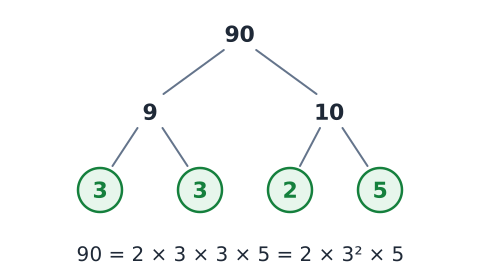
90 = 9 × 10 = 3 × 3 × 2 × 5
Factor tree for 90: 90 splits into 9 × 10, 9 into 3 × 3 and 10 into 2 × 5, with the primes circled; 90 = 2 × 3² × 5.

Every whole number above 1 has exactly one prime factorization.

Greatest Common Factor (GCF)

The GCF is the largest number that divides two numbers exactly. Factor both into primes and multiply the primes they share, using the smaller power of each. For 36 and 60:

GCF:
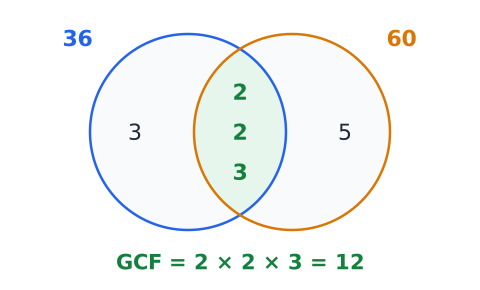
Venn diagram of the prime factors of 36 and 60: 3 only in 36, 5 only in 60, and 2, 2, 3 in the green-shaded overlap; GCF = 2 × 2 × 3 = 12.

Least Common Multiple (LCM)

The LCM is the smallest number that both numbers divide into. Use every prime that appears, each at its highest power. For 10 and 14:

LCM:
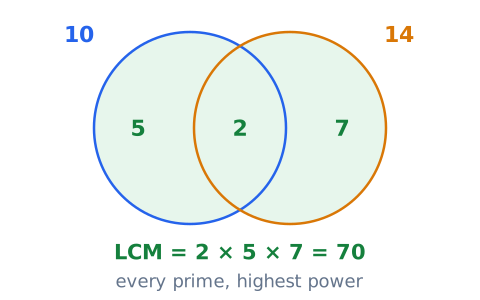
Venn diagram of the prime factors of 10 and 14: 5 only in 10, 7 only in 14, 2 shared; the whole shaded union gives LCM = 2 × 5 × 7 = 70.

GCF vs. LCM: Choosing the Right Tool

Use the GCF when you split things into the largest equal groups or pieces, such as cutting boards into the longest equal lengths or arranging items into identical kits. Use the LCM when events repeat on cycles and you want when they line up again, such as two lights blinking on different schedules. The GCF is never larger than the smaller number; the LCM is never smaller than the larger.

Even and Odd Number Rules

Even plus even and odd plus odd give even; even plus odd gives odd. A product is even if at least one factor is even, and odd only if every factor is odd. So n(n + 1) is always even, because one of two neighboring integers is even.

Consecutive Integers

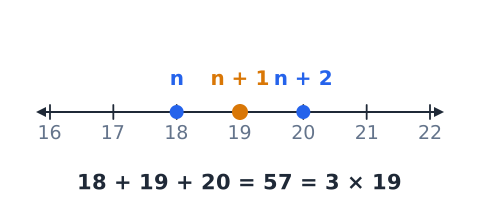
Consecutive integers follow one another, like 18, 19, 20, and can be written n, n + 1, n + 2. The sum of three consecutive integers is three times the middle one. If the sum is 57, the middle is

57 ÷ 3 = 19

giving 18, 19 and 20.

Number line with 18, 19 and 20 marked as n, n + 1 and n + 2, the middle 19 highlighted; 18 + 19 + 20 = 57 = 3 × 19.

Remainders

A remainder is what is left over after dividing as many times as possible. For 47 ÷ 6, the largest multiple of 6 not above 47 is 42 (6 × 7), so the quotient is 7 with remainder 5. Check:

6 × 7 + 5 = 47

A remainder is always smaller than the divisor.
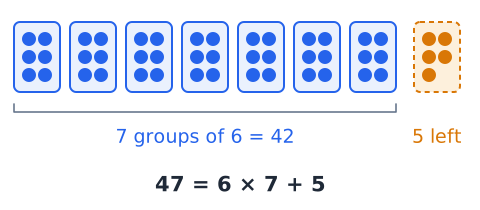
47 dots arranged as 7 groups of 6 (42) with 5 dots left over, showing 47 = 6 × 7 + 5.

Absolute Value

The absolute value of a number is its distance from zero on the number line, so it is never negative. Both |9| and |−9| equal 9. When the bars contain an expression, simplify inside first: |4 − 11| = |−7| = 7. Absolute value bars act like grouping symbols.
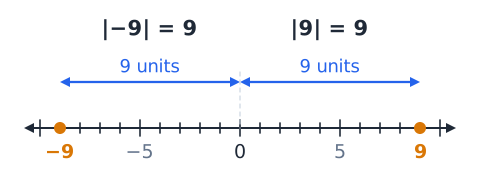
Number line from −10 to 10 with −9 and 9 marked, each 9 units from zero, so |−9| = 9 and |9| = 9.

Factor-Pair Search

To list all factors, test divisors from 1 upward and record each pair. For 84: 1 × 84, 2 × 42, 3 × 28, 4 × 21, 6 × 14, 7 × 12. You can stop once the divisor passes

because any larger factor already appeared in a pair.
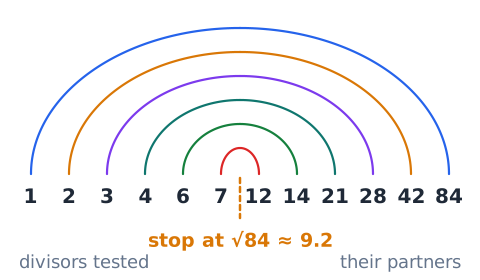
Factors of 84 in a row (1, 2, 3, 4, 6, 7, 12, 14, 21, 28, 42, 84) with arcs joining the pairs 1–84, 2–42, 3–28, 4–21, 6–14 and 7–12; a dashed line between 7 and 12 marks the stop at √84 ≈ 9.2.

Fast Divisibility Screening

On multiple-choice questions, check the cheapest tests first: last digit for 2, 5 and 10, then digit sum for 3 and 9. Combine tests for composite divisors: 6 needs 2 and 3, 15 needs 3 and 5, 12 needs 3 and 4. Eliminate choices that fail one test before doing any long division.

Worked Example 1 — GCF Application

Problem: Ribbons of 45 inches and 75 inches must be cut into equal pieces as long as possible, with no waste. How long is each piece?

Step 1: The piece length must divide both 45 and 75 evenly, and we want the largest such number. That is the greatest common factor (GCF).

Step 2: Break each number into prime factors.

Step 3: Take each prime the two lists share, using the smaller power. Both have one 3 and at least one 5.

Answer: Each piece is 15 inches long.
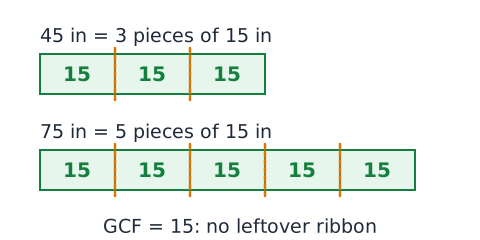
Ribbons drawn to scale: a 45-inch ribbon cut into 3 pieces of 15 inches and a 75-inch ribbon cut into 5 pieces of 15 inches, with nothing left over.

Check:

45 ÷ 15 = 3

pieces and

75 ÷ 15 = 5

pieces, with nothing left over. So there is no waste.

Worked Example 2 — LCM Application

Problem: One shuttle leaves every 15 minutes and another every 20 minutes. Both leave now. When do they next leave together?

Step 1: They leave together at a time that is a multiple of both 15 and 20. The first such time is the least common multiple (LCM).

Step 2: Break each number into prime factors.

Step 3: Use every prime that appears, each with its highest power: , 3 and 5.

Answer: They next leave together in 60 minutes.

Check: List the times. First shuttle: 15, 30, 45, 60. Second shuttle: 20, 40, 60. The first shared time is 60.
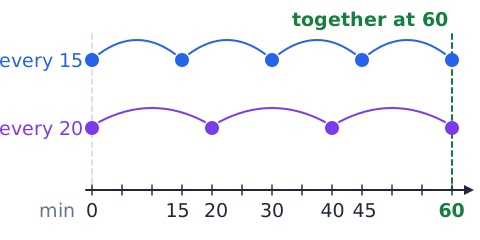
Timeline from 0 to 60 minutes: one shuttle leaves at 0, 15, 30, 45 and 60, the other at 0, 20, 40 and 60; they leave together again at 60 minutes.

Worked Example 3 — Number Properties

Problem: Is 3,402 divisible by 6? By 9?

Step 1: Test for 2. A number is divisible by 2 if its last digit is even. 3,402 ends in 2, so it is even.

Step 2: Add the digits. This sum tests for 3 and for 9.

Step 3: The digit sum 9 is divisible by 9, so 3,402 is divisible by 9. It is also divisible by 3, since 9 is a multiple of 3.

Step 4: A number is divisible by 6 when it is divisible by both 2 and 3. 3,402 passes both tests.

Answer: Yes, 3,402 is divisible by 6 and by 9.

Check: Do the divisions in parts.

Both come out even, with no remainder.

Worked Example 4 — Absolute Value

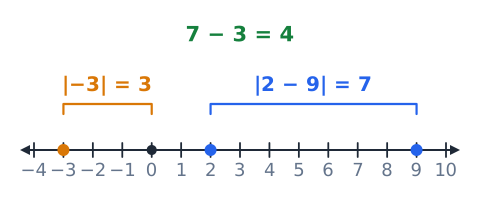
Problem: Evaluate .

Step 1: Work inside the first absolute value bars first, like parentheses.

Step 2: Take the absolute values. Absolute value is the distance from 0, so it is never negative.

Step 3: Subtract.

Answer: 4.

Check: 2 and 9 are 7 apart on the number line, and −3 is 3 away from 0.

7 − 3 = 4

A common mistake is to drop the bars too early and get
−7 − 3 = −10
Number line from −4 to 10: a bracket from 2 to 9 shows |2 − 9| = 7, a bracket from −3 to 0 shows |−3| = 3, and 7 − 3 = 4.

Common Number-Property Traps

Calling 1 prime: a prime needs exactly two different factors, and 1 has only one. It is neither prime nor composite.

Assuming every odd number is prime: 21, 39, 51 and 57 are odd but composite. Test small primes like 3 and 7.

Mixing up GCF and LCM: equal pieces or groups call for the GCF; repeating schedules call for the LCM.

Treating absolute value as "drop the sign" before simplifying: |3 − 8| is 5, not 11.

Reporting the quotient instead of the remainder, or a remainder as large as the divisor.

Quick Review

Factors divide a number; multiples are produced by multiplying it. Primes have exactly two factors, 2 is the only even prime, and 1 is neither prime nor composite. Divisibility tests: last digit for 2, 5 and 10; digit sum for 3 and 9; last two digits for 4 and last three for 8; both 2 and 3 for 6; alternating digit sum for 11. Prime factorization gives the GCF (shared primes, lowest powers) and LCM (all primes, highest powers). An odd times an even is even, three consecutive integers sum to three times the middle, remainders are smaller than the divisor, and absolute value is distance from zero.

Quick review

Factor vs. multiple: what is the difference?
A factor divides a number with no remainder (factors of 12: 1, 2, 3, 4, 6, 12, a finite list). A multiple is the number times a whole number (12, 24, 36, ... without end). Since 4 is a factor of 12, 12 is a multiple of 4.
What makes a number prime, and where do 1 and 2 fit?
A prime is a whole number greater than 1 whose only factors are 1 and itself. A composite has more than two factors. The number 1 counts as neither, and 2 is the one even prime.
Divisibility tests for 3, 9, 4 and 8?
3 or 9: the digit sum is divisible by 3 or 9. 4: the last two digits form a multiple of 4. 8: the last three digits form a multiple of 8. Example: 7,128 has digit sum 18 and ends in 128, so 3, 9, 4 and 8 all divide it.
How do you test divisibility by 6 and by 11?
6: the number must be even and pass the test for 3. 11: from the left, alternately subtract and add the digits; a result of 0 or a multiple of 11 means divisible. Example: 3,729 gives 3 − 7 + 2 − 9 = −11, so 11 divides it.
How do you get the GCF and LCM from prime factorizations?
GCF: multiply only the shared primes, each at its lower power. LCM: multiply every prime that appears, each at its higher power. For and : GCF = 6 and LCM = 72.
Word problem: when do you use the GCF and when the LCM?
GCF: splitting things into the largest equal pieces or identical groups (cutting, packing kits). LCM: repeating cycles that must line up again (buses, blinking lights). The GCF is at most the smaller number; the LCM is at least the larger.
What is the sum of three consecutive integers?
Three times the middle one, since n + (n + 1) + (n + 2) = 3n + 3. If the sum is 84, the middle integer is 84 ÷ 3 = 28, so the integers are 27, 28 and 29.
Is |2 − 10| equal to 12?
No. Simplify inside the bars first: |2 − 10| = |−8| = 8. Absolute value is distance from zero, so it is never negative, and the bars work like grouping symbols.

What next?

About this lesson

Later sections cover even and odd rules, consecutive integers, remainders and absolute value, plus two speed habits: a factor-pair search and fast divisibility screening. Four worked examples apply GCF, LCM, number properties and absolute value step by step, and a section on common traps shows the mistakes that lead to wrong answer choices.

Mathematics Knowledge is one of the four subtests that feed the AFQT, and because the ASVAB does not allow calculators, quick mental checks on factors and divisibility save real time. Plan on about 32 minutes. When you finish the Quick Review, take the lesson test to confirm the rules have stuck.

Take it with you: the free app

The same 124 lessons, 6,516 questions and 82 timed practice tests on your phone, plus flashcards with spaced review and progress tracking. Free to download, and it works offline.

  • Works offline
  • Spaced-review flashcards
  • Progress for every subtest
  • Menus in 59 languages
ASVAB Camp appGoogle Play