ASVAB Camp Get the appGoogle Play
MK · lesson 12 of 14 · 42 min

Circle Geometry

Circle questions appear regularly on the Mathematics Knowledge subtest, one of the four AFQT subtests, and they reward people who know exactly which formula a question wants. This core lesson begins with the center, radius, diameter, chords and tangents, explains what pi means, and then drills circumference versus area, including how to choose length or area based on the wording and when to keep pi exact.

Video lesson: Circles

Video transcript

0:00 Welcome to this explainer, so if you're prepping for the ASVAB right now, and maybe feeling just a little anxious about the math section, especially when it comes to tackling geometry without a calculator, I want you to just take a deep breath. You are in exactly the right place. Today we're cracking ASVAB's circle questions, and we're going to do it purely by hand. No calculator? Honestly, no problem. By the time we wrap up here, you'll see exactly how to master these concepts using really straightforward step-by-step logic. OK, let's just dive right into it. Here's a quick look at our roadmap for conquering these circle questions. We'll start with basics and formulas, move on to portions, angles, and arcs, talk about applications and strategies, run through some step-by-step examples, highlight those pesky common mistakes, and then finish up with a check yourself section. All right, section one, basics and formulas, focusing on core geometry tools. Let's get our foundational tools sorted out first, keeping that strict no calculator constraint in the back of our minds. You're either wrapping around the circle, or you're filling it in. Circumference is the distance around the edge.

1:04 The formula is C equals 2 times pi times the radius, or just pi times the diameter. This is for linear stuff, right, like fencing or a rolling wheel. Area, on the other hand, is the flat space inside, and that formula is A equals pi times the radius squared, and hey, make sure you square that radius first. This is for covering things, like painting a surface, and it's always going to be in square units. And remember, since we don't have a calculator, usually just going to leave your answers in exact pi form. That just means you leave the little pi symbol right there in your answer, like a pi or 25 pi. Oh, and here's a golden rule to remember. The diameter is literally just 2 radii. So if a problem gives you a 14-inch diameter, instantly cut it in half to get a 7-inch radius before you even touch a formula. Section two: portions, angles, and arcs, fractions of a circle. You know, a lot of times, the ASVAB won't even ask about a whole circle. They'll ask about a specific piece of it. And finding a portion of a circle? It basically just means applying a simple fraction to our core formulas. It's like slicing a pie.

2:08 A central angle is just an angle whose point is right smack in the center of the circle. Since a full circle is 360 degrees, you just take the angle they give you, which we call theta, and divide it by 360. So a 90-degree angle is 90 over 360, which is exactly one-fourth of the circle. Want the length of a specific arc? Just multiply that fraction by the total circumference. Want the area of a pie-slice sector? Multiply the fraction by the total area. For a ring, which is called an annulus, it's just the big outer circles area minus the smaller inner circles area. So pi times the big radius squared minus the little radius squared. Okay, section three. This is a real game changer because it lowers your math anxiety by visually organizing the problem before you run a single number. Seriously, just draw the circle.

3:12 Mark the radius. If they give you a diameter, chop it in half immediately and write that down. Write out your formula with the radius plugged in and keep pi as a symbol. And here's a pro tip. Before you even start calculating, glance at the answer choices. If the question is asking for a circumference, you can instantly eliminate any answer choice that uses square units. Step-by-step worked examples. Real-world ASVAB practice. Alright, it is time to gear up. We're going to solve nine rapid-fire questions together. Step-by-step. A round table has a circumference of 34 pi inches. Find its radius. Well, we're just going to reverse engineer this. Step 1, we know C equals 34 pi. Step 2, since the formula for C is 2 pi R, we can say 2 pi R equals 34 pi. Step 3 just divide 34 pi by 2 pi. The pi symbols nicely cancel each other out, and 34 divided by two is 17. So boom, the radius is 17 inches. Pretty easy right? Example two tests area and scaling. So a basin has a radius of 7 feet. The original area is pi times 7 squared, which gives us 49 pi.

4:18 But what if the diameter is doubled? Well, doubling the diameter means we also double the radius, bringing it to 14. Step 3, the new area is pi times 14 squared, which is 196 pi. Now notice this really important detail. Doubling the radius doesn't just double the area. It actually multiplies it by 4. Area always scales by the square of whatever your multiplier is. Okay, example 3. A semi-circular stage has a straight front edge of 20 meters. Find the trim needed for the whole outline. First things first. That straight edge is the diameter, meaning the radius is 10. Step 2, the curved part is exactly half of a full circumference. So 1 half of 2 pi times 10, which gives us 10 pi. Step 3, and listen, here is the classic trap. Do not forget to add that straight edge back in. The total perimeter is exactly 10 pi plus 20 meters. Example 4 is an arc length problem. We have a radius of 15 and a central angle of 72 degrees. Step 1, identify those variables. Step 2, let's find our fraction.

5:22 72 over 360 actually simplifies beautifully to exactly 1 fifth. Step 3, find the full circumference, which is 2 times 15 times pi, or 30 pi. Step 4, just take 1 fifth of 30 pi, which gives us 6 pi centimeters. You see how keeping pi as a symbol just makes the math a breeze? Example 5 applies that exact same logic, but to area. 150 degrees sector of a circle with a radius of 6. The full area is pi times 6 squared, so 36 pi. Our fraction is 150 over 360, which simplifies to 15 over 36. Now multiply 15 over 36 by 36 pi. The 36 is just cancel right out, leaving us with exactly 15 pi square meters. So clean. Example 6 is an annulus, or a ring. We've got a round pond with a radius of 10 meters, and it has a 2 meter walkway built around it. So the inner radius is 10, and the outer radius is 10 plus 2, which is 12. The area of the walkway is just the big circle minus the small circle, but watch out here.

6:24 We have to square the radii first. 12 squared is 144, 10 squared is 100, 144 minus 100 is 44, so the walkway is 44 pi square meters. Whatever you do, never just subtract the radii first. 12 minus 10 is 2, and 2 squared is only 4 pi, which is completely wrong. Let's look at example 7. A cartwheel with a 2 foot diameter rolls 400 pi feet. How many full turns does it make? Well, there's an iron clad rule for wheels. One full rotation equals exactly one circumference of distance traveled. If the diameter is 2, the circumference is 2 pi. To find the total turns, divide the total distance, which is 400 pi, by the circumference, 2 pi. The pi symbols cancel out. 400 divided by 2 is 200. It makes 200 turns. Example 8 covers inscribed angles. Points A, B, and C are on a circle. Angle ABC has its vertex sitting directly on the edge of the circle, and it cuts off an arc measuring 96 degrees.

7:28 The rule here is incredibly simple. An inscribed angle is exactly half of its intercepted arc. Half of 96 is 48, so Angle ABC is just 48 degrees. And our last example, number 9. A metal plate is a 20 by 15 centimeter rectangle, with two round holes punched in it. Each with a radius of 2. What's the area of the metal left? Honestly, it's like cutting out cookies. Just take the total outer area and subtract the inner holes. The rectangle is 20 times 15, which is 300. One hole is pi times 2 squared, or 4 pi. Since there are two holes, that's 8 pi total. So the area left over is simply 300 minus 8 pi square centimeters. And you just leave it exactly like that. Common mistakes. Let's make sure you avoid the classic ASVAB traps. Circle questions can definitely be tricky, but if you want to bypass these traps, you just need to know what they look like. The absolute biggest pitfall of all is the diameter trap.

8:31 If a problem gives you the diameter, and you plug it straight into the area formula without having it first, your answer is going to be exactly four times too large. And I guarantee you, that wrong answer will be sitting right there waiting for you as option A or B. Have the diameter immediately. Also, don't mix up your formulas. Remember, squaring the radius is for square units, which is area. And just like we saw in our examples, don't forget the straight edges on semi-circles. And never square the difference of radii when you're finding a rings area. Square them first, then subtract. All right, section six, check yourself. Test your skills. It is time to put your newly sharpened calculator free skills to the test. Let's do this. Question one. A round manhole cover has a diameter of 18 inches. What is its radius? Is it A, 36, B, 18, C, 9, or D, 4.5? Try to spot the trap. I'll give you a second to think. Okay, let's look at the answer. It's C, 9 inches. This reinforces our golden rule, right?

9:33 A diameter is just two radii laid end to end. You simply divide the diameter of 18 by 2 to get 9. If you got that, you successfully avoided the trap. Here is the final question. Note carefully that it's asking for area, not circumference. What is the area of a circle with a radius of 3 meters? Is it A, 6 pi, B, 3 pi, C, 9 pi, or D, 36 pi? Take a quick moment to calculate that. And the answer is C, 9 pi square meters. For area, we use A equals pi R squared. You square the radius first. 3 squared is 9, leaving us with 9 pi. See? By drawing diagrams, keeping pi as a symbol and remembering to have your diameters, you have literally just conquered what most test takers fear the most. So, if you can master a calculator free geometry today, what other impossible ASVAB math topic are you actually ready to crush tomorrow?

Visual lesson

Lesson slides

14 slides
Circles – slide 1 of 14

Lesson Goal and MK Context

This lesson builds the circle skills tested on Mathematics Knowledge. You will move between radius and diameter, find circumference and area in exact pi form, and work backward from a given circumference or area.

You will also handle semicircles, quarter circles, rings, arcs and sectors, see how scaling a radius changes length and area, and use two angle facts: tangent lines meet radii at right angles, and inscribed angles are half their arcs. Everything is designed for work without a calculator.

Circle, Center, and Radius

A circle is the set of all points in a plane that sit the same distance from one fixed point, the center. That fixed distance is the radius, and any segment from the center to the circle is also called a radius.

Every radius of the same circle has the same length. If a sprinkler throws water exactly 15 feet in every direction, the wet edge forms a circle with the sprinkler at the center and a radius of 15 feet. The radius is the key input for nearly every circle formula.
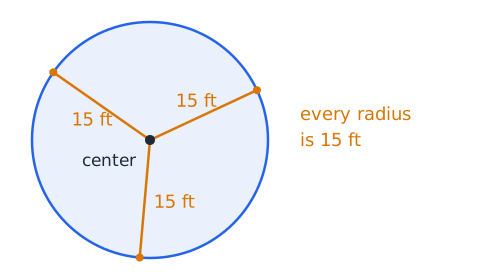
Circle with its center marked and three radii drawn to the edge, each labeled 15 ft.

Diameter and Radius Conversion

A diameter is a segment that passes through the center with both ends on the circle. It is made of two radii laid end to end:

A pipe with a 14-inch diameter has a 7-inch radius. Many problems give the diameter, so halve it before using any formula written with r. Forgetting this step is a classic error.
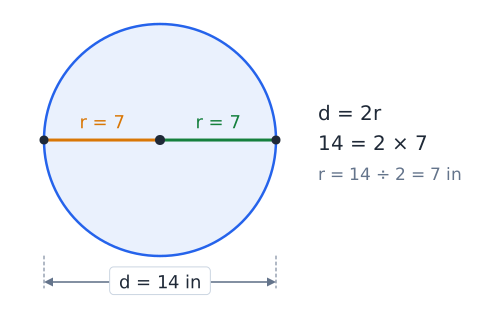
Circle with a diameter of 14 inches made of two radii of 7 inches each; d = 2r, so 14 = 2 × 7.

Chords and the Longest Chord

A chord is any segment whose two endpoints lie on the circle. A diameter is a chord that happens to pass through the center.

The diameter is the longest possible chord. Chords farther from the center get shorter. Also, a line from the center that is perpendicular to a chord cuts that chord into two equal halves, which lets you build right triangles inside a circle.
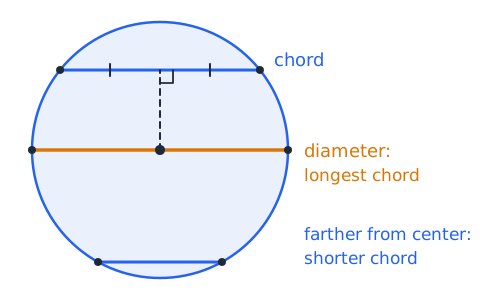
Circle with a diameter as the longest chord, a chord cut into two equal halves by a perpendicular from the center, and a shorter chord farther from the center.

Tangents and Radius Perpendicularity

A tangent line touches a circle at exactly one point. The radius drawn to that point of contact always meets the tangent at a 90 degree angle.

This creates right triangles. If a circle has radius 5 and a point outside it is 13 units from the center, the tangent segment from that point is 12 units long, since 5 squared plus 12 squared equals 13 squared.
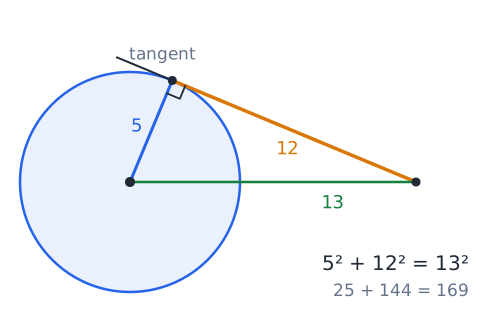
Circle of radius 5 with a tangent segment of 12 from a point 13 units from the center; the radius meets the tangent at a right angle, and 5² + 12² = 13².

The Meaning of Pi

For every circle, the circumference divided by the diameter gives the same number, called pi:

Pi never ends or repeats. Common stand-ins are 3.14 and 22/7. Roughly speaking, the distance around any circle is a little more than three times the distance across it.
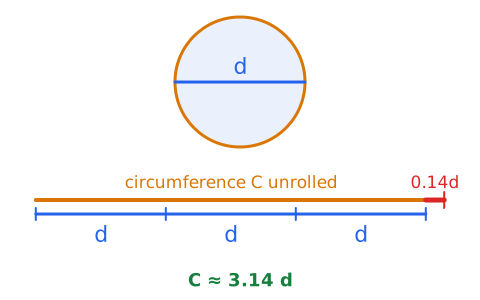
A circle with diameter d and its circumference unrolled into a straight line below it: three diameters plus about 0.14d, so C ≈ 3.14 d.

Circumference of a Circle

Circumference is the distance around a circle, a length:

A clock face with radius 4 inches has circumference 8 pi inches, about 25.1 inches. Answers are often left as a multiple of pi.

Area of a Circle

Area measures the flat space inside the circle, in square units:

Square the radius first, then multiply by pi. A round rug of radius 5 feet covers 25 pi square feet, roughly 78.5 square feet. If given a diameter, halve it first.
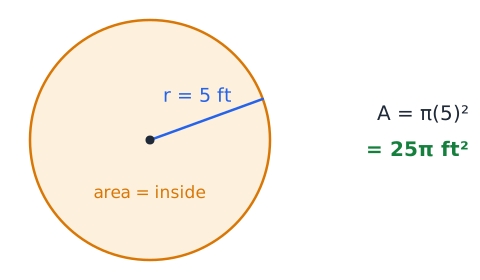
Round rug of radius 5 ft with the whole inside shaded to show area; A = π(5)² = 25π square feet.

Choose Length or Area Based on the Question

Read the situation before picking a formula. Edging, fencing, trim, a rolling wheel or a running lap all follow the boundary, so they need circumference, in linear units.

Paint, sod, a tablecloth or a pizza's surface fill the inside, so they need area, in square units. A good check is the unit: feet means circumference, square feet means area.

Exact Pi and Decimal Approximations

An exact answer keeps pi as a symbol, like 16 pi. A decimal answer replaces pi with an approximation: 16 times 3.14 gives 50.24, while the true value is about 50.27.

Match the form the choices use. If the choices contain pi, do not convert. If the choices are decimals that are close together, notice whether the test says to use 3.14 or 22/7.

Reverse Circumference Problems

Given the circumference, divide by 2 pi to get the radius:

If a hoop has circumference 26 pi cm, then r equals 13 cm and the diameter is 26 cm.

Reverse Area Problems

Given the area, divide by pi and take the square root:

An area of 81 pi square meters means r squared is 81, so r is 9 meters.

Scaling Circles

All circles are similar. If the radius is multiplied by k, the diameter and circumference are also multiplied by k, but the area is multiplied by k squared:

Halving a radius halves the circumference and leaves one fourth of the area. So a 12-inch-wide pizza has four times the area of a 6-inch one, not twice.
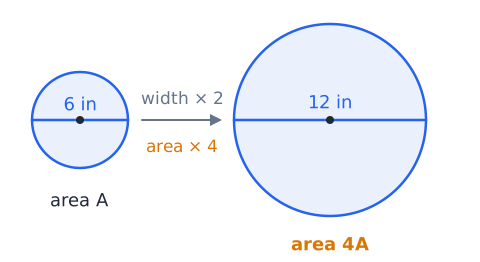
A 6-inch-wide circle and a 12-inch-wide circle drawn to scale: doubling the width multiplies the area by 4.

Semicircles: Curved Portion

A semicircle is half a circle cut along a diameter. Its curved edge is half the circumference, and its area is half the full area:

The full boundary adds the straight diameter: pi r plus 2r. With r of 10, that is 10 pi plus 20.
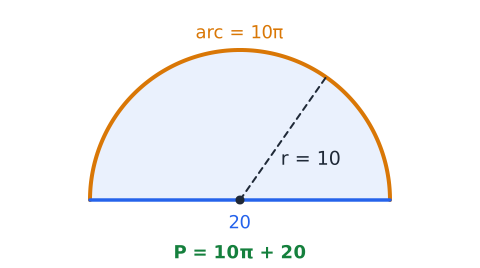
Semicircle of radius 10 with a curved edge of 10π and a straight diameter of 20; perimeter 10π + 20.

Quarter Circles

A quarter circle uses one fourth of everything: a 90 degree slice.

Its full boundary also includes two radii. With r of 4, the arc is 2 pi, the area is 4 pi, and the perimeter is 2 pi plus 8.
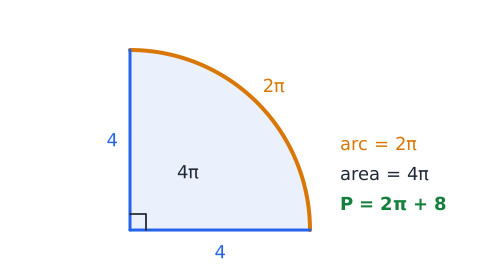
Quarter circle of radius 4 with a right angle at the center: arc 2π, area 4π, perimeter 2π + 8.

Composite Perimeter With Semicircles

For a shape built from straight sides and curved pieces, add only the edges on the outside. Shared edges inside the shape do not count.

Example: a track has two straight sides of 10 m joined by semicircles at each end, each with diameter 6 m. The two semicircles make one full circle, 6 pi. The perimeter is 20 plus 6 pi meters.
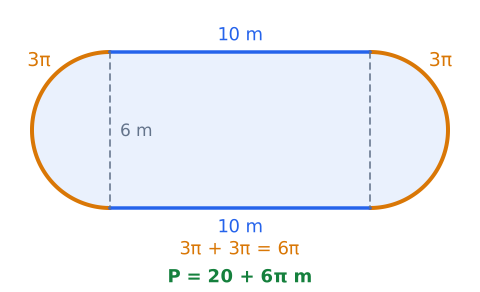
Track shape with two straight 10 m sides and semicircular ends of diameter 6 m; each curved end is 3π, so 3π + 3π = 6π and the perimeter is 20 + 6π m.

Annuli: The Area of a Ring

An annulus is the ring between two circles with the same center. Its area is the big disk minus the small disk:

With outer radius 6 and inner radius 4, the area is pi times (36 minus 16), or 20 pi. Do not subtract the radii first; squaring the difference gives only 4 pi, which is wrong.
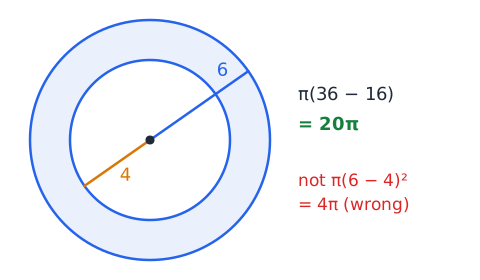
Ring between circles of radius 6 and 4 with the same center; area π(36 − 16) = 20π, not π(6 − 4)² = 4π.

Central Angles and Circular Fractions

A central angle has its vertex at the center of the circle. The full turn is 360 degrees, so a central angle marks off the fraction

of the circle. A 90 degree angle takes one fourth, 120 degrees one third, and 45 degrees one eighth. Arc lengths and sector areas use this fraction.
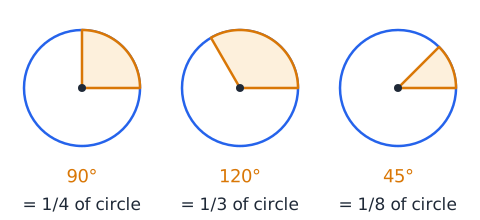
Three circles with shaded central angles: 90° is 1/4, 120° is 1/3 and 45° is 1/8 of the circle.

Arc Length

An arc is a piece of the circumference. Its length is the angle fraction times the full circumference:

On a circle of radius 6, a 60 degree central angle is one sixth of the circle. The full circumference is 12 pi, so the arc is 2 pi units long. Arc length is a length, not an angle.

Area of a Sector

A sector is a pie-slice region bounded by two radii and an arc. Its area is the angle fraction times the full area:

A 60 degree slice of a radius-6 circle is one sixth of 36 pi, or 6 pi square units.
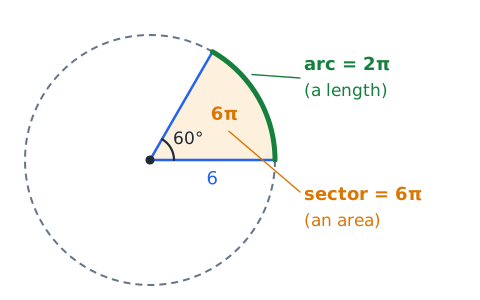
Circle of radius 6 with a 60° central angle: the arc is 2π (a length) and the shaded sector is 6π (an area).

Arc Length and Sector Area Together

The same fraction controls both the arc and the sector. On a circle of radius 12 with a 30 degree angle, the fraction is one twelfth.

The arc is one twelfth of 24 pi, or 2 pi. The sector area is one twelfth of 144 pi, or 12 pi. If asked for the sector's perimeter, add the two radii to the arc: 2 pi plus 24. Keep the length answers and the area answer in their own units.
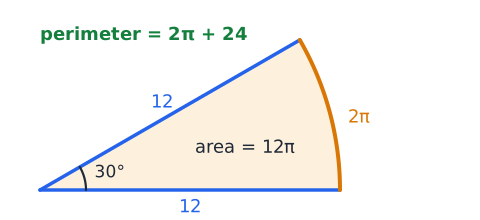
A 30° sector of a circle of radius 12: two radii of 12 and an arc of 2π give perimeter 2π + 24, and the inside area is 12π.

Inscribed Angles

An inscribed angle has its vertex on the circle and its sides along two chords. Its measure is half the arc it cuts off, the intercepted arc:

If the arc is 140 degrees, the inscribed angle is 70 degrees. A central angle on the same arc would be the full 140, so inscribed angles are half of central ones. Inscribed angles that cut off the same arc are equal.
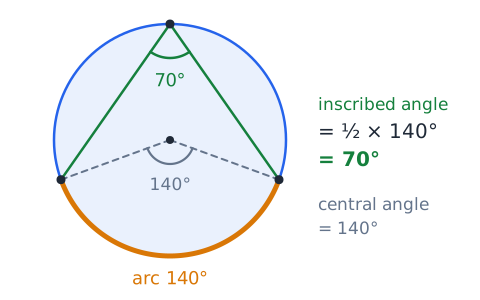
Circle with an inscribed angle of 70° and a central angle of 140° on the same 140° arc.

Angles Subtended by a Diameter

A diameter cuts off a 180 degree arc, so any inscribed angle that stands on a diameter is half of 180, a right angle.

This means a triangle drawn inside a circle with one side as a diameter is always a right triangle. If its legs are 6 and 8, the hypotenuse, which is the diameter, is 10, so the radius is 5.
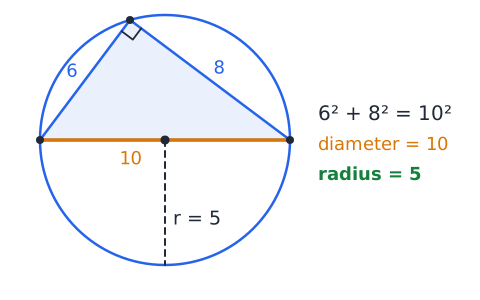
Right triangle inside a circle with legs 6 and 8 and the diameter 10 as its hypotenuse; the radius is 5.

Composite Figures and Subtracted Areas

Shaded-region questions are usually solved as outer area minus inner area. Identify the full shape, identify what was removed, and subtract.

Example: a circle fits exactly inside a square of side 10, so its radius is 5. The four corner regions outside the circle have total area 100 minus 25 pi, about 21.5 square units. Leave the answer in exact form if the choices do.
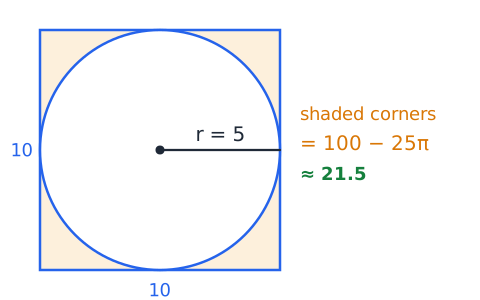
Square of side 10 with a circle of radius 5 inside touching all four sides; the four shaded corners have area 100 − 25π ≈ 21.5.

Unit Conversions Before Squaring

Change the radius to the target unit first, then square. A disk with radius 0.5 m has radius 50 cm, so its area is

Converting after squaring needs the squared factor: 1 square meter is 10,000 square centimeters.

Wheel Rotation Problems

Each full turn of a wheel rolling without slipping moves it forward one circumference. So distance equals the number of turns times the circumference, and turns equal distance divided by circumference.

A bicycle tire with a 26-inch diameter moves 26 pi inches per turn. After 100 turns it has gone 2600 pi inches. Use the diameter or radius correctly when finding the circumference.
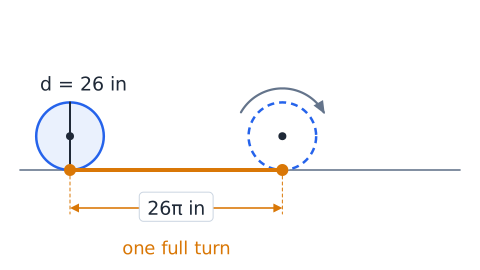
A wheel of diameter 26 in rolls one full turn; the point on its rim that touched the ground moves forward 26π in, drawn to scale along the ground.

Algebraic Circle Problems

Sometimes a dimension is given as an expression. Set up the formula and solve.

Example: a circle has radius x plus 3 and circumference 20 pi. Then

Dividing by 2 pi gives x plus 3 equal to 10, so x is 7.

Diagram-First and No-Calculator Strategy

Start by labeling the diagram: mark the center, the radius, and any angles. Ask whether the question wants a length, an area or an angle.

Write the formula in terms of r, and convert a diameter to a radius at once. Keep pi as a symbol through the whole calculation; most answer choices are in pi form. Simplify fractions such as 60 over 360 before multiplying, so the numbers stay small. Finally, check that the units match the question.

Pi-Based Estimation and Answer Elimination

When choices are decimals, estimate using pi is about 3, then adjust upward slightly. For example,

because the extra 0.14 times 20 adds about 3. Eliminate choices in the wrong units, choices that use the diameter where the radius belongs, and areas that are smaller than a known inner piece.

Worked Example 1 — Radius From Circumference

Problem: A round table has a circumference of 34π inches. Find its radius.

Step 1: Write the circumference formula.

Step 2: Substitute the circumference.

Step 3: Divide both sides by 2π. The π on each side cancels, leaving 34 ÷ 2.

Answer: The radius is 17 inches, so the diameter is

2 × 17 = 34 inches

Check: 2π × 17 = 34π, the given circumference.

Worked Example 2 — Circle Area and Scaling

Problem: A fountain basin has a radius of 7 feet. Find its area, then the area if the diameter is doubled.

Step 1: Use the circle area formula, A = πr².

Step 2: Doubling the diameter also doubles the radius, because the radius is half the diameter.

Step 3: Find the new area.

Answer: The area is 49π square feet (about 154 square feet). With the doubled diameter, it is 196π square feet, four times as large.

Check:

196 ÷ 49 = 4

Doubling every length multiplies area by 2² = 4, so this makes sense.

Worked Example 3 — Entire Perimeter of Semicircle

Problem: A semicircular stage has a straight front edge of 20 m. Find the length of trim needed for its whole outline.
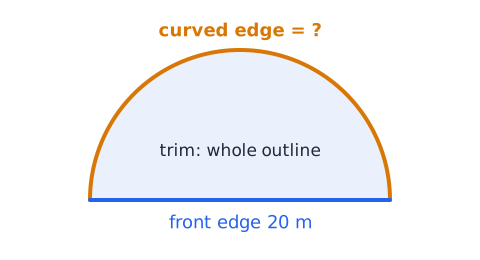
Semicircular stage with a straight front edge of 20 m; the length of the curved edge is marked with a question mark and the whole outline is the trim.

Step 1: The straight front edge is the diameter of the full circle, so the radius is half of it.

Step 2: The curved edge is half of a full circumference.

Step 3: The whole outline is the curved edge plus the straight edge. Do not forget the straight edge.

Step 4: Estimate using π ≈ 3.14:

10 × 3.14 = 31.4

Answer: The trim needed is 10π + 20 meters, about 51.4 m.

Check: A full circle of radius 10 has circumference 20π ≈ 62.8, half is 31.4, and adding the 20 m edge gives 51.4.

Worked Example 4 — Arc Length

Problem: A circle has radius 15 cm. Find the length of the arc cut off by a 72° central angle.
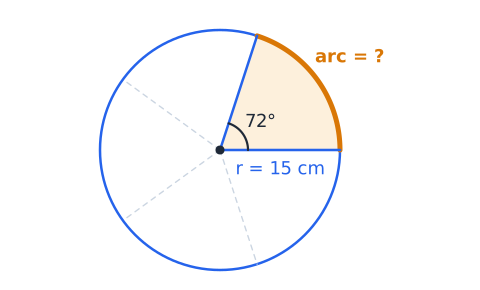
Circle of radius 15 cm with a shaded 72° central angle; the length of its arc is marked with a question mark.

Step 1: Find what fraction of the whole circle the angle covers. A full circle is 360°, so divide the angle by 360.

Divide top and bottom by 72 to simplify (

72 × 5 = 360

).

Step 2: Find the circumference, the distance all the way around. Use C = 2πr with r = 15.

Step 3: The arc is 1/5 of the circumference, so divide 30π by 5.

Answer: The arc is 6π cm long, which is about 18.8 cm.

Check: 5 arcs of 72° make a full circle (

5 × 72 = 360

), and 5 × 6π = 30π, the full circumference.

Worked Example 5 — Sector Area

Problem: Find the area of a 150° sector of a circle with radius 6 m.
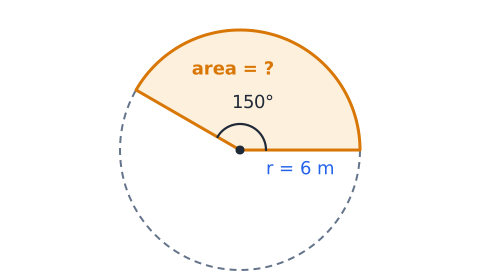
Shaded 150° sector of a circle with radius 6 m; its area is marked with a question mark.

Step 1: Find the area of the whole circle with A = πr². Here r = 6, and 6² =

6 × 6 = 36

Step 2: Find what fraction of the circle the sector covers. Divide the angle by 360°, then simplify by dividing top and bottom by 30.

Step 3: Multiply the fraction by the full area.

36 ÷ 12 = 3
and
3 × 5 = 15

Answer: The sector covers 15π square meters, about 47 m².

Check: 150° is a bit less than half a circle (180°), and 15π is a bit less than half of 36π, which is 18π.

Worked Example 6 — Annular Walkway

Problem: A round pond of radius 10 m has a walkway 2 m wide built around it. Find the walkway's area.
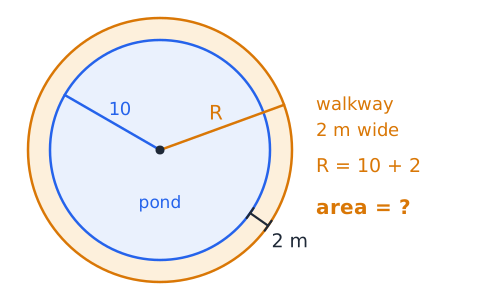
Top view of a round pond of radius 10 m inside a shaded walkway ring marked 2 m wide, outer radius R = 10 + 2; the walkway area is marked with a question mark.

Step 1: Find the outer radius. The walkway adds 2 m to the pond's radius.

Step 2: Find the area of the big circle (pond plus walkway).

12 × 12 = 144

Step 3: Find the area of the pond alone.

10 × 10 = 100

Step 4: The walkway is the big circle minus the pond, so subtract.

Step 5: Estimate with π ≈ 3.14.

44 × 3 = 132
and
44 × 0.14 = 6.16

Answer: The walkway covers 44π square meters, about 138 m².

Check: A common mistake is to use the 2 m width as a radius. The walkway is a ring, so its area must be the difference of two circles.

Worked Example 7 — Wheel Revolutions

Problem: A cart wheel with diameter 2 feet rolls 400π feet. How many full turns does it make?
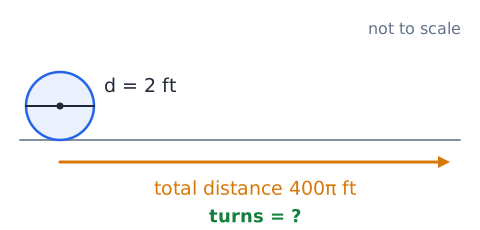
A cart wheel of diameter 2 ft and an arrow along the ground for the total distance 400π ft; the number of turns is marked with a question mark (not to scale).

Step 1: One full turn moves the cart one circumference. Use C = πd with d = 2.

Step 2: Divide the total distance by the distance of one turn.

Step 3: The π on top and bottom cancel, leaving 400 ÷ 2.

Answer: The wheel turns 200 times.

Check: Work backward. 200 turns × 2π feet per turn = 400π feet, the given distance.

Worked Example 8 — Inscribed Angle

Problem: Points A, B and C lie on a circle. Angle ABC cuts off arc AC, which measures 96°. Find angle ABC.
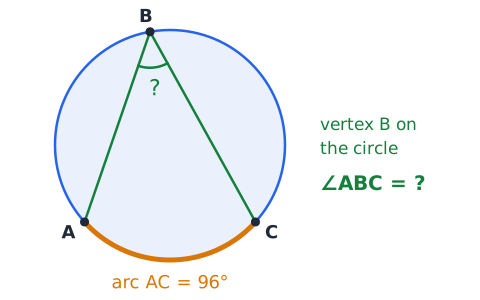
Circle with points A, B and C on it; inscribed angle ABC has its vertex at B and cuts off arc AC of 96°; the angle is marked with a question mark.

Step 1: Notice the vertex B sits on the circle itself, so angle ABC is an inscribed angle. Rule: an inscribed angle is half of the arc it cuts off.

Step 2: Put in the arc and divide by 2.

Answer: Angle ABC is 48°.

Check: Double the answer: 2 × 48° = 96°, the arc. As another example, if AC were a diameter, the arc would be 180° and the angle would be 180° ÷ 2 = 90°.

Worked Example 9 — Composite Area With Hole

Problem: A metal plate is a 20 cm by 15 cm rectangle with two round holes, each of radius 2 cm. Find the area of metal left.
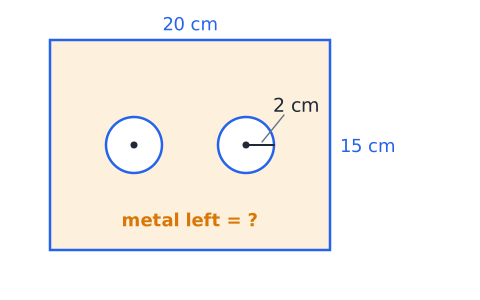
A 20 cm by 15 cm metal plate with two round holes of radius 2 cm; the metal area left is marked with a question mark.

Step 1: Find the rectangle's area, length times width.

Step 2: Find the area of one hole with A = πr². Here r = 2, and

2 × 2 = 4

Step 3: There are two holes, so double it.

Step 4: Subtract the holes from the rectangle.

Step 5: Estimate 8π with π ≈ 3.14:

8 × 3.14 = 25.12
then
300 − 25.12 = 274.88

Answer: About 274.9 cm² of metal is left (exactly 300 − 8π cm²).

Check: The holes are small compared with the plate, so the answer should be a little under 300. It is.

Common Circle Mistakes

Using the diameter as the radius. A diameter given in the problem must be halved before using pi r squared. Using the diameter makes an area four times too big.

Mixing up the two formulas. Area is pi r squared: square r, then multiply by pi. Two pi r is the circumference.

Confusing circumference and area. Boundary questions need length units; covering questions need square units.

Forgetting straight edges. A semicircle's full perimeter is pi r plus 2r, and a sector's is the arc plus two radii.

Finding a ring area with the radius difference. Use

not pi times (R minus r) squared.

Scaling area by k. Area scales by k squared.

Calling an inscribed angle equal to its arc. It is half the arc.

Quick Review

Radius is half the diameter. Circumference is 2 pi r; area is pi r squared.

Use that fraction for arcs and sectors. Ring area is pi times (R squared minus r squared). Scaling by k multiplies area by k squared. A tangent meets a radius at 90 degrees, and an inscribed angle is half its arc.

Quick review

Circumference of a circle?
, where r is the radius and d the diameter; it is a length in linear units. A radius of 9 in gives in, about 56.5 in.
Area of a circle?
: square the radius, then multiply by ; the answer is in square units. A 10 m diameter means r = 5, so m². Using the diameter makes it 4 times too big.
Arc length and sector area?
Use the fraction of the whole: arc , sector . Radius 9, angle 40°: fraction 1/9, arc , sector .
How do circle measures change when the radius is scaled by k?
Diameter and circumference are multiplied by k, but area is multiplied by . Tripling the radius makes the area 9 times as large; halving it leaves one fourth of the area.
Area of a ring (annulus)?
, where R is the outer radius and r the inner radius. R = 5 and r = 3 give . Squaring the difference of the radii (only ) is wrong.
How does a tangent line meet the radius?
A tangent touches the circle at one point and is perpendicular to the radius drawn there, forming a right triangle. Radius 8 and a point 17 from the center give a tangent segment of 15.
Inscribed angle vs. its intercepted arc?
An inscribed angle (vertex on the circle) is half its intercepted arc, while a central angle equals its arc. An arc of 110° gives an inscribed angle of 55°. An inscribed angle standing on a diameter is 90°.
Wheel problems: how far does a wheel roll in one turn?
One circumference per full turn: distance = turns C, and turns = distance ÷ C. A wheel of diameter 3 ft rolling ft makes turns.

What next?

← Previous: Quadrilaterals and Polygons

About this lesson

From there you handle reverse circumference and area problems, scaling circles, semicircles, quarter circles, composite perimeters and annuli. Central angles introduce circular fractions, which lead to arc length, sector area, inscribed angles and angles subtended by a diameter. Later sections cover subtracted areas, unit conversions before squaring, wheel rotation and algebraic circle problems, plus pi-based estimation for eliminating answer choices. Nine worked examples, from finding a radius to an annular walkway, and a list of common circle mistakes round out the material.

The lesson takes roughly 42 minutes. Afterward, sit the Circles lesson test to confirm the formulas before area and volume.

Take it with you: the free app

The same 124 lessons, 6,516 questions and 82 timed practice tests on your phone, plus flashcards with spaced review and progress tracking. Free to download, and it works offline.

  • Works offline
  • Spaced-review flashcards
  • Progress for every subtest
  • Menus in 59 languages
ASVAB Camp appGoogle Play